GENETIC
COUNSELING
• May 2013
• One month later supreme court ruled against gene patents
• Within hours after ruling labs began offering less expensive
testing
• Dramatically changing the testing for BRCA mutations
What is genetic counselling?
 Cancer genetic counseling is a communication process
between a health-care professional and an individual
concerning cancer occurrence and risk in his or her family.
 The process which may include the entire family through a
blend of genetic, medical, and psychosocial assessments and
interventions and has been described as a bridge between the
fields of traditional oncology and genetic counseling
 Involves deciphering whether the cancers in a family are likely to be
caused by a pathogenic variant (mutation) if so, which one
 There are >30 well-described hereditary cancer syndromes, many of
which can be caused by pathogenic variants in multiple genes.
 There are also >100 cancer predisposition genes, mutations in which
cause moderate to high cancer risk, and most of which are not presently
associated with named syndromes.
 The use of tumor (somatic) genetic testing to guide treatment of an
individual tumor is becoming mainstream as a result of the precision
medicine initiative
Who is a candidate for cancer genetic
counselling ?
1. Early age of onset (e.g., younger than 50 y for breast, colon, and uterine
cancer)
2. Multiple family members on the same side of the pedigree with the same
cancer
3. Clustering of cancers/benign findings in the family known to be caused by
pathogenic variants in a single gene (e.g.,
breast/ovarian/pancreatic/prostate or metastatic]; colon/uterine/ovarian;
colon cancer/polyps/desmoid tumors/osteomas)
4. Multiple primary cancers in one individual (e.g., breast/ovarian cancer;
colon/uterine; synchronous/metachronous colon cancers; >15
gastrointestinal polyps; >10 adenomas; >5 hamartomatous or ≥3 juvenile
6. Presence of a tumor that, by itself, indicates a need for genetics
evaluation
(e.g - male breast ca)
7. Pathology
(e.g., triple negative [ER/PR/Her-2] breast cancer 60 y and younger- BRCA
1; medullary thyroid cancer; a colon/endometrial cancer with an abnormal
microsatellite instability or immunohistochemistry result)
8. Tumor profiling results with possible germline implications (e.g.,
pathogenic BRCA1/BRCA2 variant detected by tumor profiling in any tumor
type)
9. Family history of a known pathogenic variant in a cancer predisposition
gene (e.g., BRCA1, MSH2, PTEN, CHEK2)
Components of cancer genetic
counselling
Precouncelling information
 What to expect
 What to collect - Family history & Pathology reports
Family history
 4 generations included
 Exact diagnosis, age at diagnosis, treatment, environmental exposures
 Confirm with pathology reports
 Consanguineous relations
 Both maternal and paternal history equally important
Problems
 First degree relative - 83% correct diagnosis
 Second degree – 67% ; Third degree - 60%
 Change in diagnosis uterine for ovarian , polyp for ca
Problems with genetic screening
 Family history - Geography vs Genetic
 Limited in families that are small or have few female relatives, in families
with several early deaths for other reasons
 In families in which individuals have undergone prophylactic surgeries that
may mask risk (e.g., hysterectomy and ovary removal when a syndrome
that predisposes to gynecologic cancer is being considered)
 Patients have little/no information about their family histories.
 In such families, a single indication may carry more weight, and the
lack of family history of cancer should not discount risk to a family
member.
Risk assessment
 What is the chance that the person will develop the cancer
observed in his or her family (or a genetically related cancer
such as ovarian cancer due to a family history of breast
cancer)?
 What is the chance that the cancers in this family are caused
by a pathogenic variant in a cancer predisposition gene, or
more rarely, pathogenic variants in multiple genes?
 What is the chance that we can identify the pathogenic variant
in this patient with our current knowledge and laboratory
techniques?
Online models
 Gail
 Claus
 BRCA Pro
 BOADICEA
 Tyrer-Cuzick
 PENNII
Genetic testing
 DNA testing
 Affected family member
 At earliest age
 Followed by family members
Results
Interpretation of results
1. Pathogenetic variant - positive
2. True negative
3. Uninformative
4. Variant of uncertain significance (VUS)
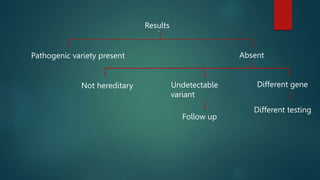
Results
Pathogenic variety present Absent
Not hereditary Undetectable
variant
Different gene
Different testing
Follow up
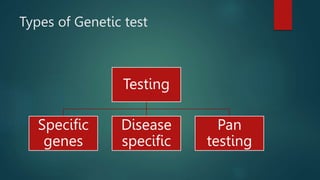
Types of Genetic test
Testing
Specific
genes
Disease
specific
Pan
testing
Whole-Genome Sequencing
Whole-Exome Sequencing
 In the case of WGS/WES, much more genetic information is
analyzed via DNA testing.
 WGS includes analysis of all areas of the human genome, whereas
 WES includes analysis of the <2% of the genomic that codes for
proteins
 secondary findings and could be related to anything from
cardiovascular disease to Alzheimer risk.
Problem with pan testing
 Whole genome analysis - all genes analysed
 This is because carrying a pathogenic BRCA1 or BRCA2 variant is associated
with a 50% to 85% lifetime risk of female breast cancer
 survivors have up to a 40% risk to develop a new primary breast cancer.
 However, pathogenic CHEK2 variants are associated with a 28% to 37%
lifetime risk of breast cancer, and the risk of a second primary breast cancer is
less clear.
 Current NCCN recommendations call for annual breast MRI in addition to
annual mammogram for carriers of single pathogenic CHEK2 variants, but
there is currently insufficient evidence to recommend mastectomy in absence of
a cancer diagnosis or contralateral mastectomy after a breast cancer diagnosis
based on future cancer risk alone
Classification of genes - High risk
genes
 Well studied
 Greater than fourfold risk of developing one or more cancers
 Can cause a moderate risk for other cancers
 National or expert opinion guidelines for screening and prevention are
established
 Examples
 BRCA1/BRCA2 (HBOC: breast, ovary, prostate, pancreatic, etc.)
 MLH1/MSH2/MSH6/PMS2/EPCAM (Lynch: colon, endometrial, ovary, etc.)
 APC/MUTYH (FAP/MAP: colon, gastric, etc.)
 SMAD4/BMPR1A (JPS: colon, gastric, pancreatic, etc.)
Moderate-Risk Genes
 Well studied Approximately
 two- to fourfold risk of developing one or more cancers
 May increase risk for other cancers
 Limited guidelines for screening and prevention
 Examples
 ATM (breast, colon, pancreatic)
 CHEK2 (breast, colon, prostate, etc.)
 BRIP1 (ovary, etc.)
 RAD51C (ovary, etc.)
Newer genes
 Not as well studied, data based on small number of patients within
a specific ethnicity
 Precise lifetime risks and tumor spectrum not yet determined
 Guidelines for screening and prevention are limited or not available
 Examples
 AXIN2 (colon, etc.)
 BARD1 (breast, etc.)
 CDK4 (melanoma, etc.)
 FANCC (breast, pancreatic)
BRCA Management
BRCA screening
 BRCA 1 – 50% Risk of Ca Breast
 BRCA 2 – 85% RISK of Ca Breast
 15-16% - Risk of ovarian Ca
 Ovarian Ca – fallopian tube, primary peritoneal ca
 Male ca breast, pancreatic cancer, melanoma [mainly BRCA 2]
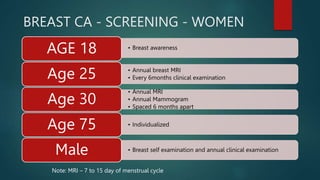
BREAST CA - SCREENING - WOMEN
• Breast awareness
AGE 18
• Annual breast MRI
• Every 6months clinical examination
Age 25
• Annual MRI
• Annual Mammogram
• Spaced 6 months apart
Age 30
• Individualized
Age 75
• Breast self examination and annual clinical examination
Male
Note: MRI – 7 to 15 day of menstrual cycle
RISK REDUCTION
 AGENTS: Limited retrospective data suggest that tamoxifen and
raloxifene reduce the risk of breast cancer in women who are BRCA
carriers.
 Date shows risk reduction in carriers taking tamoxifen in contralateral
breast
 BRCA 2 – mostly ER + - respond well to chemo prevention
 Surgery:
 Reduce risk >90%
 Breast conservation surgery ? To do or not to do
 Profound impact on surgery dissection making
Ovarian cancer
 BRCA 1 /2 – Risk of ovarian, fallopian tube, primary peritoneal cancer
 Ca125/ transvaginal USG – not proven
 In September 2016, the U.S. Food and Drug Administration (FDA) issued the
following warning: “The FDA believes that women at high risk for developing
ovarian cancer should not use any currently offered test that claims to screen for
ovarian cancer.”
 Oral contraceptives reduce the risk of ovarian cancer but risk of increasing the
breast cancer is low so risk benefit analysis favors use of oral contraceptives who
are not yet ready to remove the ovary.
Surgery - Risk-reducing salpingo-
oophorectomy (RRSO)
 RRSO is currently the most effective means to reduce the risk of ovarian cancer and
is typically recommended to BRCA1/BRCA2 carriers by the age of 35 to 40 years or
when childbearing is complete
 Emerging data indicate that most ovarian cancers begin in the fallopian tube and that
salpingectomy may someday be sufficient in reducing ovarian cancer risk in young
women
 On average, ovarian cancers tend to occur slightly later in women with BRCA2
pathogenic variants than in women with BRCA1 pathogenic variants.
 Therefore in some cases it may be reasonable to consider delaying RRSO until
ages 40 to 45 years for women who carry BRCA2 pathogenic variants, especially if a
patient has already undergone prophylactic mastectomies BRCA carriers, an
increase in life expectancy if RRSO is pursued by age 40 years
 A secondary, but important, reason for female BRCA carriers to consider
prophylactic oophorectomy is that It may also reduce the risk of a subsequent breast
Hysterectomy
 Small stumps of the fallopian tubes remain after RRSO alone
 The question of whether BRCA carriers are at increased risk
for uterine serous papillary carcinoma has also been raised
 Removing the uterus may make it possible for a BRCA carrier
to take unopposed estrogen or tamoxifen in the future without
the risk of uterine cancer
Ovarian Cancer guidelines
Screening:
 Ages 30–35 y: Transvaginal Doppler ultrasound and CA 125 blood marker may
be considered.
 However, the effectiveness of this screening has not been established, and this
should be considered a short-term plan until risk-reducing salpingo-
oophorectomy (RRSO).
Risk-reduction agents:
Several studies suggest that oral contraceptives reduce ovarian cancer risk in
carriers of BRCA pathogenic variants.
Prophylactic surgery: RRSO should typically be considered by ages 35–40 y and
upon completion of childbearing.
 Given that BRCA2-associated ovarian cancers occur later, it is reasonable to
consider RRSO by ages 40–45 y in BRCA2 carriers.
Prostate:
 Screening:
 Age 45 y: Yearly digital rectal exam and PSA blood test is recommended
for men with a BRCA2 pathogenic variant and should be considered for
men with a BRCA1 pathogenic variant.
Melanoma:
 Screening: Consider annual dermatologic and eye exams.
Future - General Population
Testing ?
 Ashkenazi Jewish individuals may be justified given that 1 in 40 Ashkenazi Jewish individuals carry a
pathogenic BRCA variant.
 When considering whether population-wide testing for hereditary cancer predisposition should be
undertaken, several questions should be addressed.
 Which genes should be tested?
 How common are pathogenic variants in these genes?
 What is the burden (in terms of cancer risk) of pathogenic variants in these genes, and would it be
difficult to assess risk in absence of a suggestive personal/family history?
 Are there effective surveillance and risk-reducing strategies to employ in those who test positive?
 What would general population testing look like logistically?
 Who would perform the testing, disclose test results, make medical management recommendations, and
discuss implications for relatives?
 How would the cost of testing be covered?
 What would the psychosocial implications of such testing be?
Future technologies - CRISPER
 CRISPER – [clustered regularly interspaced short palindromic repeats]
 CRISPR can “delete” and “replace” genes, which is referred to as
“editing the genome.”
 Researchers are investigating whether this technology could be
used to inactivate genes and to incorporate new genes.
 In theory, these discoveries may lead to fixes for defective
segments of genes, like those containing pathogenic variants, in
diseases such as BRCA-related breast and/or ovarian cancer
syndrome, cystic fibrosis, sickle cell anemia, and Tay-Sachs
disease.
 Some laboratories have already reported successful trials treating
mice with genetic diseases by using this gene editing technology.

genetic screening in cancer presentation

  • 3.
  • 4.
    • May 2013 •One month later supreme court ruled against gene patents • Within hours after ruling labs began offering less expensive testing • Dramatically changing the testing for BRCA mutations
  • 5.
    What is geneticcounselling?  Cancer genetic counseling is a communication process between a health-care professional and an individual concerning cancer occurrence and risk in his or her family.  The process which may include the entire family through a blend of genetic, medical, and psychosocial assessments and interventions and has been described as a bridge between the fields of traditional oncology and genetic counseling
  • 6.
     Involves decipheringwhether the cancers in a family are likely to be caused by a pathogenic variant (mutation) if so, which one  There are >30 well-described hereditary cancer syndromes, many of which can be caused by pathogenic variants in multiple genes.  There are also >100 cancer predisposition genes, mutations in which cause moderate to high cancer risk, and most of which are not presently associated with named syndromes.  The use of tumor (somatic) genetic testing to guide treatment of an individual tumor is becoming mainstream as a result of the precision medicine initiative
  • 7.
    Who is acandidate for cancer genetic counselling ? 1. Early age of onset (e.g., younger than 50 y for breast, colon, and uterine cancer) 2. Multiple family members on the same side of the pedigree with the same cancer 3. Clustering of cancers/benign findings in the family known to be caused by pathogenic variants in a single gene (e.g., breast/ovarian/pancreatic/prostate or metastatic]; colon/uterine/ovarian; colon cancer/polyps/desmoid tumors/osteomas) 4. Multiple primary cancers in one individual (e.g., breast/ovarian cancer; colon/uterine; synchronous/metachronous colon cancers; >15 gastrointestinal polyps; >10 adenomas; >5 hamartomatous or ≥3 juvenile
  • 8.
    6. Presence ofa tumor that, by itself, indicates a need for genetics evaluation (e.g - male breast ca) 7. Pathology (e.g., triple negative [ER/PR/Her-2] breast cancer 60 y and younger- BRCA 1; medullary thyroid cancer; a colon/endometrial cancer with an abnormal microsatellite instability or immunohistochemistry result) 8. Tumor profiling results with possible germline implications (e.g., pathogenic BRCA1/BRCA2 variant detected by tumor profiling in any tumor type) 9. Family history of a known pathogenic variant in a cancer predisposition gene (e.g., BRCA1, MSH2, PTEN, CHEK2)
  • 9.
    Components of cancergenetic counselling Precouncelling information  What to expect  What to collect - Family history & Pathology reports
  • 10.
    Family history  4generations included  Exact diagnosis, age at diagnosis, treatment, environmental exposures  Confirm with pathology reports  Consanguineous relations  Both maternal and paternal history equally important Problems  First degree relative - 83% correct diagnosis  Second degree – 67% ; Third degree - 60%  Change in diagnosis uterine for ovarian , polyp for ca
  • 11.
    Problems with geneticscreening  Family history - Geography vs Genetic  Limited in families that are small or have few female relatives, in families with several early deaths for other reasons  In families in which individuals have undergone prophylactic surgeries that may mask risk (e.g., hysterectomy and ovary removal when a syndrome that predisposes to gynecologic cancer is being considered)  Patients have little/no information about their family histories.  In such families, a single indication may carry more weight, and the lack of family history of cancer should not discount risk to a family member.
  • 12.
    Risk assessment  Whatis the chance that the person will develop the cancer observed in his or her family (or a genetically related cancer such as ovarian cancer due to a family history of breast cancer)?  What is the chance that the cancers in this family are caused by a pathogenic variant in a cancer predisposition gene, or more rarely, pathogenic variants in multiple genes?  What is the chance that we can identify the pathogenic variant in this patient with our current knowledge and laboratory techniques?
  • 13.
    Online models  Gail Claus  BRCA Pro  BOADICEA  Tyrer-Cuzick  PENNII
  • 14.
    Genetic testing  DNAtesting  Affected family member  At earliest age  Followed by family members
  • 15.
    Results Interpretation of results 1.Pathogenetic variant - positive 2. True negative 3. Uninformative 4. Variant of uncertain significance (VUS)
  • 16.
    Results Pathogenic variety presentAbsent Not hereditary Undetectable variant Different gene Different testing Follow up
  • 17.
    Types of Genetictest Testing Specific genes Disease specific Pan testing
  • 18.
    Whole-Genome Sequencing Whole-Exome Sequencing In the case of WGS/WES, much more genetic information is analyzed via DNA testing.  WGS includes analysis of all areas of the human genome, whereas  WES includes analysis of the <2% of the genomic that codes for proteins  secondary findings and could be related to anything from cardiovascular disease to Alzheimer risk.
  • 19.
    Problem with pantesting  Whole genome analysis - all genes analysed  This is because carrying a pathogenic BRCA1 or BRCA2 variant is associated with a 50% to 85% lifetime risk of female breast cancer  survivors have up to a 40% risk to develop a new primary breast cancer.  However, pathogenic CHEK2 variants are associated with a 28% to 37% lifetime risk of breast cancer, and the risk of a second primary breast cancer is less clear.  Current NCCN recommendations call for annual breast MRI in addition to annual mammogram for carriers of single pathogenic CHEK2 variants, but there is currently insufficient evidence to recommend mastectomy in absence of a cancer diagnosis or contralateral mastectomy after a breast cancer diagnosis based on future cancer risk alone
  • 20.
    Classification of genes- High risk genes  Well studied  Greater than fourfold risk of developing one or more cancers  Can cause a moderate risk for other cancers  National or expert opinion guidelines for screening and prevention are established  Examples  BRCA1/BRCA2 (HBOC: breast, ovary, prostate, pancreatic, etc.)  MLH1/MSH2/MSH6/PMS2/EPCAM (Lynch: colon, endometrial, ovary, etc.)  APC/MUTYH (FAP/MAP: colon, gastric, etc.)  SMAD4/BMPR1A (JPS: colon, gastric, pancreatic, etc.)
  • 21.
    Moderate-Risk Genes  Wellstudied Approximately  two- to fourfold risk of developing one or more cancers  May increase risk for other cancers  Limited guidelines for screening and prevention  Examples  ATM (breast, colon, pancreatic)  CHEK2 (breast, colon, prostate, etc.)  BRIP1 (ovary, etc.)  RAD51C (ovary, etc.)
  • 22.
    Newer genes  Notas well studied, data based on small number of patients within a specific ethnicity  Precise lifetime risks and tumor spectrum not yet determined  Guidelines for screening and prevention are limited or not available  Examples  AXIN2 (colon, etc.)  BARD1 (breast, etc.)  CDK4 (melanoma, etc.)  FANCC (breast, pancreatic)
  • 23.
  • 24.
    BRCA screening  BRCA1 – 50% Risk of Ca Breast  BRCA 2 – 85% RISK of Ca Breast  15-16% - Risk of ovarian Ca  Ovarian Ca – fallopian tube, primary peritoneal ca  Male ca breast, pancreatic cancer, melanoma [mainly BRCA 2]
  • 25.
    BREAST CA -SCREENING - WOMEN • Breast awareness AGE 18 • Annual breast MRI • Every 6months clinical examination Age 25 • Annual MRI • Annual Mammogram • Spaced 6 months apart Age 30 • Individualized Age 75 • Breast self examination and annual clinical examination Male Note: MRI – 7 to 15 day of menstrual cycle
  • 26.
    RISK REDUCTION  AGENTS:Limited retrospective data suggest that tamoxifen and raloxifene reduce the risk of breast cancer in women who are BRCA carriers.  Date shows risk reduction in carriers taking tamoxifen in contralateral breast  BRCA 2 – mostly ER + - respond well to chemo prevention  Surgery:  Reduce risk >90%  Breast conservation surgery ? To do or not to do  Profound impact on surgery dissection making
  • 27.
    Ovarian cancer  BRCA1 /2 – Risk of ovarian, fallopian tube, primary peritoneal cancer  Ca125/ transvaginal USG – not proven  In September 2016, the U.S. Food and Drug Administration (FDA) issued the following warning: “The FDA believes that women at high risk for developing ovarian cancer should not use any currently offered test that claims to screen for ovarian cancer.”  Oral contraceptives reduce the risk of ovarian cancer but risk of increasing the breast cancer is low so risk benefit analysis favors use of oral contraceptives who are not yet ready to remove the ovary.
  • 28.
    Surgery - Risk-reducingsalpingo- oophorectomy (RRSO)  RRSO is currently the most effective means to reduce the risk of ovarian cancer and is typically recommended to BRCA1/BRCA2 carriers by the age of 35 to 40 years or when childbearing is complete  Emerging data indicate that most ovarian cancers begin in the fallopian tube and that salpingectomy may someday be sufficient in reducing ovarian cancer risk in young women  On average, ovarian cancers tend to occur slightly later in women with BRCA2 pathogenic variants than in women with BRCA1 pathogenic variants.  Therefore in some cases it may be reasonable to consider delaying RRSO until ages 40 to 45 years for women who carry BRCA2 pathogenic variants, especially if a patient has already undergone prophylactic mastectomies BRCA carriers, an increase in life expectancy if RRSO is pursued by age 40 years  A secondary, but important, reason for female BRCA carriers to consider prophylactic oophorectomy is that It may also reduce the risk of a subsequent breast
  • 29.
    Hysterectomy  Small stumpsof the fallopian tubes remain after RRSO alone  The question of whether BRCA carriers are at increased risk for uterine serous papillary carcinoma has also been raised  Removing the uterus may make it possible for a BRCA carrier to take unopposed estrogen or tamoxifen in the future without the risk of uterine cancer
  • 30.
    Ovarian Cancer guidelines Screening: Ages 30–35 y: Transvaginal Doppler ultrasound and CA 125 blood marker may be considered.  However, the effectiveness of this screening has not been established, and this should be considered a short-term plan until risk-reducing salpingo- oophorectomy (RRSO). Risk-reduction agents: Several studies suggest that oral contraceptives reduce ovarian cancer risk in carriers of BRCA pathogenic variants. Prophylactic surgery: RRSO should typically be considered by ages 35–40 y and upon completion of childbearing.  Given that BRCA2-associated ovarian cancers occur later, it is reasonable to consider RRSO by ages 40–45 y in BRCA2 carriers.
  • 31.
    Prostate:  Screening:  Age45 y: Yearly digital rectal exam and PSA blood test is recommended for men with a BRCA2 pathogenic variant and should be considered for men with a BRCA1 pathogenic variant. Melanoma:  Screening: Consider annual dermatologic and eye exams.
  • 32.
    Future - GeneralPopulation Testing ?  Ashkenazi Jewish individuals may be justified given that 1 in 40 Ashkenazi Jewish individuals carry a pathogenic BRCA variant.  When considering whether population-wide testing for hereditary cancer predisposition should be undertaken, several questions should be addressed.  Which genes should be tested?  How common are pathogenic variants in these genes?  What is the burden (in terms of cancer risk) of pathogenic variants in these genes, and would it be difficult to assess risk in absence of a suggestive personal/family history?  Are there effective surveillance and risk-reducing strategies to employ in those who test positive?  What would general population testing look like logistically?  Who would perform the testing, disclose test results, make medical management recommendations, and discuss implications for relatives?  How would the cost of testing be covered?  What would the psychosocial implications of such testing be?
  • 33.
    Future technologies -CRISPER  CRISPER – [clustered regularly interspaced short palindromic repeats]  CRISPR can “delete” and “replace” genes, which is referred to as “editing the genome.”  Researchers are investigating whether this technology could be used to inactivate genes and to incorporate new genes.  In theory, these discoveries may lead to fixes for defective segments of genes, like those containing pathogenic variants, in diseases such as BRCA-related breast and/or ovarian cancer syndrome, cystic fibrosis, sickle cell anemia, and Tay-Sachs disease.  Some laboratories have already reported successful trials treating mice with genetic diseases by using this gene editing technology.