SCIENT INSTITUTE OF TECHNOLOGY
(AN UGC AUTONOMOUS)
Approved by AICTE, and Affiliated with JNTU Hyderabad
( Ibrahimpatnam, R.R. Dist., Telangana,501506. ESTD: 2001)
2024-2025
Technical Seminar
On
A Software Engineering Framework for Enchancing Cyber
Security In Network System
UNDER THE GUIDANCE OF:
Mr. G. Mahendar
Associate Professor
Dept of CSE
Presented by:
K.Thirumalesh – 21C01A0547
Technical Seminar Incharge:
Ms.B.Ramya Sree
Assistant Professor
Dept of CSE
Introducation
• Addresses the rise in cyberattacks.
• Proposes a proactive framework
combining software engineering with
security.
Literature survey
Mohammed, Mohammed., Abdalla, I., Abdalla, Musa. (2025). 1. Enhancing
Network Security using Possibility Neutrosophic Hypersoft Set for Cyberattack
Detection:
The paper does not present a software engineering framework specifically for enhancing
cybersecurity in network systems. Instead, it focuses on the Possibility Neutrosophic
Hypersoft Set for Cyberattack Detection (pNHSS-CAD) technique to improve network security
through feature selection and classification.
Pushpita, Chatterjee., Danda, B., Rawat. (2024). 2. Security Enhanced Framework for
Network Access Control in Distributed Software-Defined Networks:
The paper proposes a security framework for Software-Defined Networks (SDN) that enhances
cybersecurity through multi-layered authentication, role-based access control, and secure
communication encryption, addressing vulnerabilities and unauthorized access while ensuring
data confidentiality and integrity in network systems.
ccc
The paper presents a novel cyber security framework integrating authentication, intrusion
detection, and deep learning-based risk prediction using a Weighted Recurrent Neural
Network, enhancing security in network systems by effectively predicting and mitigating
cyber threats
Problem statement
• Defines specific challenges in securing network systems.
• Emphasizes the need for integrating software engineering principles.
Objective
• Propose a framework that ensures:
- Adaptability
- Scalability
- Real-time threat detection.
• Provide measurable metrics for effectiveness.
Architecture
• Key components:
- Threat Detection
- Risk Assessment
- Data Protection
- Incident Response.
• Tools, technologies, and communication protocols used.
Design
• Detailed diagrams:
- UML (Class, Sequence, Use Case Diagrams).
- Data/process flow charts.
• Includes AI/ML integration for predictive threat detection.
Implementation
• Steps to implement the framework.
• Tools and programming languages used.
• Case studies demonstrating real-world application.
• Challenges faced and solutions provided.
Importance of Cyber
Security in the Digital Age
1 Data Breaches
Cyberattacks can lead to
data breaches,
compromising sensitive
information and harming
individuals and
organizations.
2 Financial Losses
Organizations can face
significant financial losses
due to downtime, recovery
costs, and reputational
damage.
3 National Security
Cyberattacks pose a serious threat to national security, impacting
critical infrastructure and government operations.
Challenges in Securing Network Systems
Complexity
Modern network systems are highly
complex, making it difficult to secure
every point of vulnerability.
Evolving Threats
Cybercriminals constantly develop new
attack methods, requiring security
measures to be constantly updated.
Resource Constraints
Organizations may face resource
constraints in terms of budget, staff,
and expertise, hindering their ability to
implement comprehensive security
solutions.
Limitations of Traditional
Security Approaches
Reactive
Traditional approaches often
rely on reactive measures,
responding to attacks after they
occur.
Siloed Security
Security measures are often
implemented in silos, failing to
consider the
interconnectedness of network
systems.
Manual Processes
Many security tasks are still performed manually, prone to human
error and inefficient for handling large-scale networks.
Introducing the Software
Engineering Framework
1 Proactive Approach
The framework promotes a proactive approach to cybersecurity,
addressing vulnerabilities before they are exploited.
2 Holistic Security
It emphasizes holistic security, considering the entire network
system and all its components.
3 Automation
Automation is leveraged to streamline security tasks, enhancing
efficiency and reducing human error.
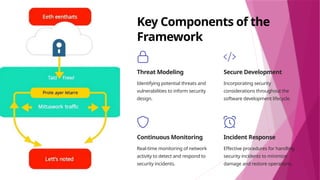
Key Components of the
Framework
Threat Modeling
Identifying potential threats and
vulnerabilities to inform security
design.
Secure Development
Incorporating security
considerations throughout the
software development lifecycle.
Continuous Monitoring
Real-time monitoring of network
activity to detect and respond to
security incidents.
Incident Response
Effective procedures for handling
security incidents to minimize
damage and restore operations.
Threat Modeling and Risk
Assessment
Identify Threats
Categorize potential threats based on their source, motivation,
and capabilities.
Analyze Vulnerabilities
Identify weaknesses in network systems that could be
exploited by threats.
Assess Risks
Evaluate the likelihood and impact of threats exploiting
vulnerabilities.
Secure Software
Development Life Cycle
Security Requirements Define security requirements at
the beginning of development.
Secure Coding Practices Implement secure coding
practices to minimize
vulnerabilities.
Code Review Perform code review to identify
and address security issues.
Security Testing Conduct rigorous security
testing to validate the
effectiveness of security
measures.
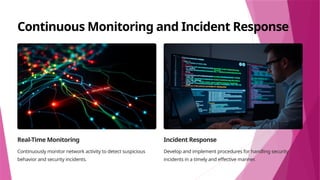
Continuous Monitoring and Incident Response
Real-Time Monitoring
Continuously monitor network activity to detect suspicious
behavior and security incidents.
Incident Response
Develop and implement procedures for handling security
incidents in a timely and effective manner.
Case Studies and Successful Implementations
Numerous organizations have successfully implemented this software engineering framework to enhance their network security,
demonstrating its effectiveness in mitigating risks and protecting critical assets.
References
Mohammed, Mohammed., Abdalla, I., Abdalla, Musa. (2025). 1.
Enhancing Network Security using Possibility Neutrosophic Hypersoft
Set for Cyberattack Detection:
Pushpita, Chatterjee., Danda, B., Rawat. (2024). 2. Security Enhanced
Framework for Network Access Control in Distributed Software-
Defined Networks:
R., Lakshman, Naik., Sourabh, Jain. (2024). 3. A Novel Framework for
Securing Information in Cyber Security System Using Authentication,
Intrusion Detection and Deep Learning-Based Risk Prediction Tasks:
Conclusion
 • Summarizes the framework’s effectiveness.
 • Highlights how objectives were met.
 • Suggests future scope for enhancement.
Thank you
.