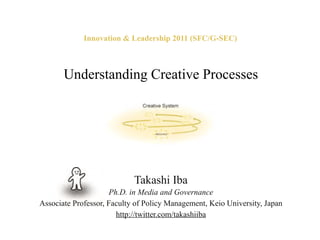
Innovation & Leadership 2011 (SFC/G-SEC)


       Understanding Creative Processes


                            Takashi Iba
                      Ph.D. in Media and Governance
Associate Professor, Faculty of Policy Management, Keio University, Japan
                        http://twitter.com/takashiiba
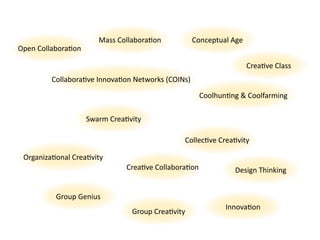
Mass	
  Collabora%on              Conceptual	
  Age
Open	
  Collabora%on

                                                                                 Crea%ve	
  Class
          Collabora%ve	
  Innova%on	
  Networks	
  (COINs)

                                                               Coolhun%ng	
  &	
  Coolfarming

                       Swarm	
  Crea%vity

                                                        Collec%ve	
  Crea%vity

 Organiza%onal	
  Crea%vity
                                    Crea%ve	
  Collabora%on                Design	
  Thinking


            Group	
  Genius
                                                                        Innova%on
                                      Group	
  Crea%vity
Creativity matters!
What is Creativity ?


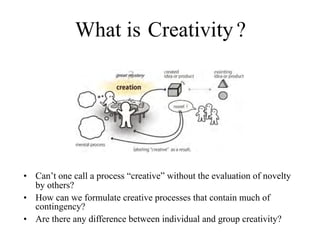
• Can’t one call a process “creative” without the evaluation of novelty
  by others?
• How can we formulate creative processes that contain much of
  contingency?
• Are there any difference between individual and group creativity?
What is Creativity ?
                                                                     Available online at www.sciencedirect.com


                                                                Procedia Social and Behavioral Sciences 2 (2010) 6610–6625
                                                                                                                 6305–6625


                                                                  COINs2009: Collaborative Innovation Networks Conference

                                                        An Autopoietic Systems Theory for Creativity
                                                                                                Takashi Ibaab
                                                                           a   MIT Center for Collective Intelligence, Cambridge MA, USA
                                                                                bFaculty of Policy Management, Keio University, Japan


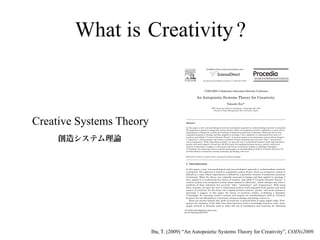
Creative Systems Theory                  A bstract

                                         In this paper, a new, non-psychological and non-sociological approach to understanding creativity is proposed.
                                         The approach is based on autopoietic system theory, where an autopoietic system is defined as a unity whose
                                         organization is defined by a particular network of production processes of elements. While the theory was
                                         originally proposed in biology and then applied to sociology, I have applied it to understand the nature of
                                         creation, and called it "Creative Systems Theory". A creative system is an autopoietic system whose element
                                         is "discovery", which emerges only when a synthesis of three selections has occurred: "idea", "association",
                                         and "consequence". With using these concepts, we open the way to understand creation itself separated from
                                         psychic and social aspects of creativity. On this basis, the coupling between creative, psychic, and social
                                         systems is discussed. I suggest, in this paper, the future of creativity studies, re-defining a discipline
                                         "Creatology" for inquiring creative systems and propose an interdisciplinary field as "Creative Sciences" for
                                         interdisciplinary connections among creatology, psychology, and so on.

                                         Keywords; creativity; systems theory; autopoiesis; pattern language


                                         1 . I ntroduction

                                         In this paper, a new, non-psychological and non-sociological approach to understanding creativity
                                         is proposed. The approach is based on autopoietic system theory, where an autopoietic system is
                                         defined as a unity whose organization is defined by a particular network of production processes
                                         of elements. While the theory was originally proposed in biology and then applied to sociology, I
                                         have applied it to understand the nature of creation, and called it "Creative Systems Theory". A
                                         creative system is an autopoietic system whose element is "discovery", which emerges only when a
                                         synthesis of three selections has occurred: "idea", "association", and "consequence". With using
                                         these concepts, we open the way to understand creation itself separated from psychic and social
                                         aspects of creativity. On this basis, the coupling between creative, psychic, and social systems is
                                         discussed. I suggest, in this paper, the future of creativity studies, re-defining a discipline
                                         "Creatology" for inquiring creative systems and propose an interdisciplinary field as "Creative
                                         Sciences" for interdisciplinary connections among creatology, psychology, and so on.
                                            There are several reasons why study of creativity is pursued from so many angles today. First,
                                         against the backdrop of the shift from labor-intensive work to knowledge-intensive work, many
                                         people involved in business need to make full use of intelligence and creativity for obtaining

                                        1877-0428 © 2010 Published by Elsevier Ltd.
                                        doi:10.1016/j.sbspro.2010.04.071


                          Iba, T. (2009) “An Autopoietic Systems Theory for Creativity”, COINs2009.
Creative Systems Theory
              based on the autopoietic systems theory


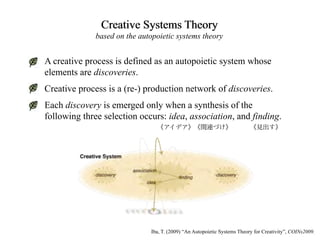
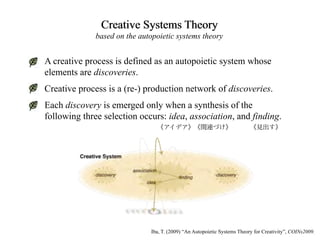
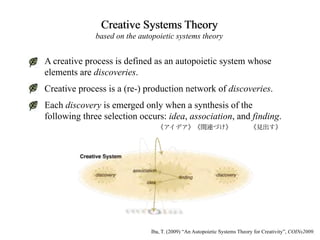
A creative process is defined as an autopoietic system whose
elements are discoveries.
Creative process is a (re-) production network of discoveries.
Each discovery is emerged only when a synthesis of the
following three selection occurs: idea, association, and finding.


                               Iba, T. (2009) “An Autopoietic Systems Theory for Creativity”, COINs2009.
Production Network of Discoveries in Creation

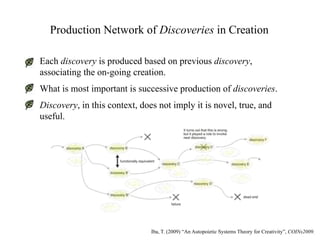
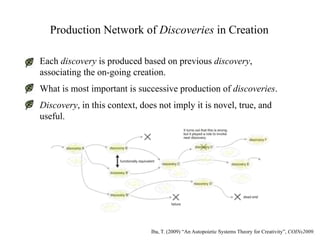
Each discovery is produced based on previous discovery,
associating the on-going creation.
What is most important is successive production of discoveries.
Discovery, in this context, does not imply it is novel, true, and
useful.


                               Iba, T. (2009) “An Autopoietic Systems Theory for Creativity”, COINs2009.
Production Network of Discoveries in Creation

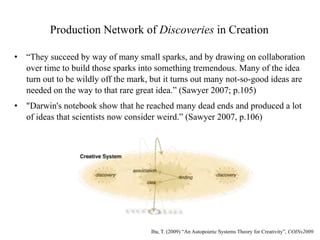
•   “They succeed by way of many small sparks, and by drawing on collaboration
    over time to build those sparks into something tremendous. Many of the idea
    turn out to be wildly off the mark, but it turns out many not-so-good ideas are
    needed on the way to that rare great idea.” (Sawyer 2007; p.105)
•   "Darwin's notebook show that he reached many dead ends and produced a lot
    of ideas that scientists now consider weird.” (Sawyer 2007, p.106)


                                       Iba, T. (2009) “An Autopoietic Systems Theory for Creativity”, COINs2009.
Creative Systems Theory
              based on the autopoietic systems theory


A creative process is defined as an autopoietic system whose
elements are discoveries.
Creative process is a (re-) production network of discoveries.
Each discovery is emerged only when a synthesis of the
following three selection occurs: idea, association, and finding.


                               Iba, T. (2009) “An Autopoietic Systems Theory for Creativity”, COINs2009.
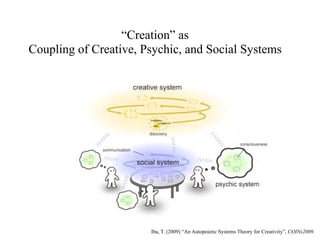
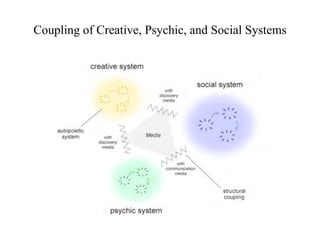
“Creation” as
Coupling of Creative, Psychic, and Social Systems


                      Iba, T. (2009) “An Autopoietic Systems Theory for Creativity”, COINs2009.
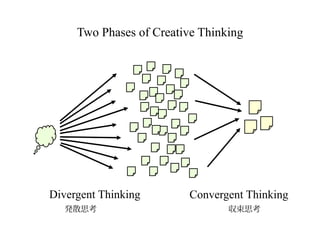
Two Phases of Creative Thinking


Divergent Thinking        Convergent Thinking
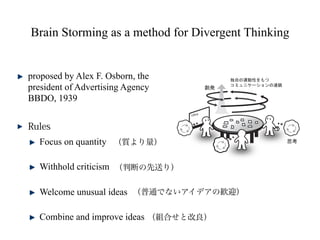
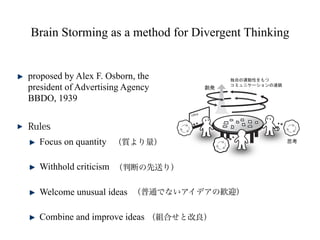
Brain Storming as a method for Divergent Thinking


proposed by Alex F. Osborn, the
president of Advertising Agency
BBDO, 1939


  Focus on quantity

  Withhold criticism

  Welcome unusual ideas

  Combine and improve ideas
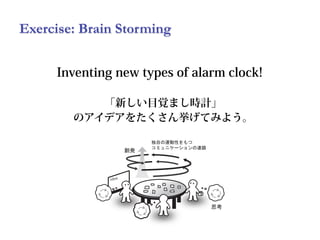
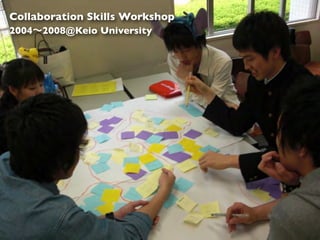
Exercise: Brain Storming
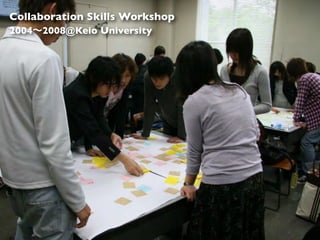
Collaboration Skills Workshop
2004   2008@Keio University
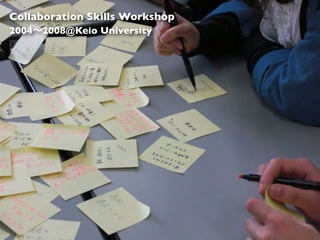
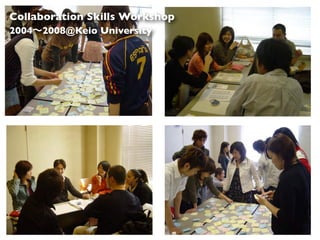
Collaboration Skills Workshop
2004   2008@Keio University
Collaboration Skills Workshop
2004   2008@Keio University
Collaboration Skills Workshop
2004   2008@Keio University
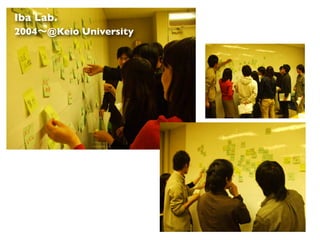
Iba Lab.
2004   @Keio University
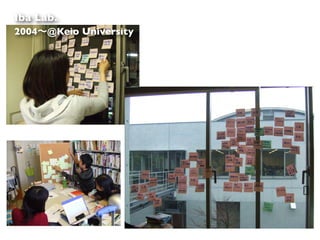
Iba Lab.
2004   @Keio University
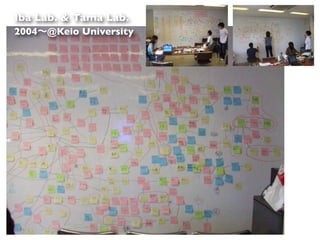
Iba Lab. & Tama Lab.
2004   @Keio University
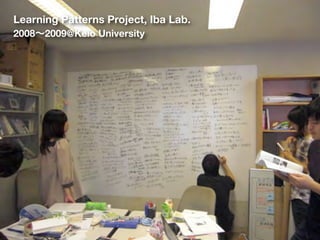
Learning Patterns Project, Iba Lab.
2008   2009@Keio University
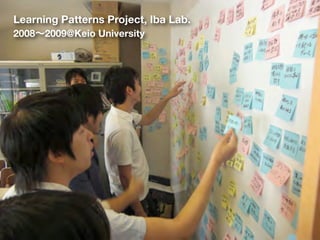
Learning Patterns Project, Iba Lab.
2008   2009@Keio University
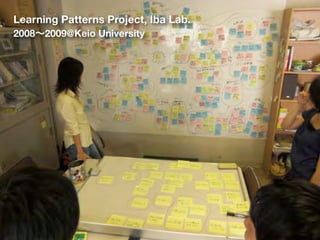
Learning Patterns Project, Iba Lab.
2008   2009@Keio University
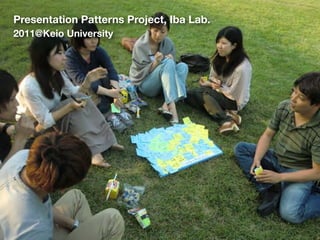
Presentation Patterns Project, Iba Lab.
2011@Keio University
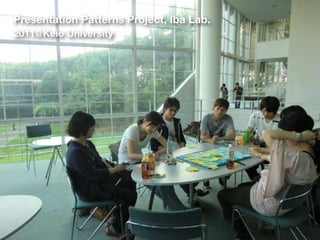
Presentation Patterns Project, Iba Lab.
2011@Keio University
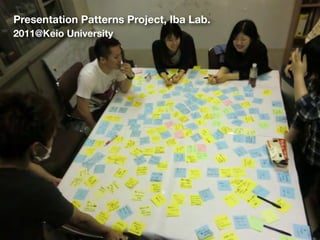
Presentation Patterns Project, Iba Lab.
2011@Keio University
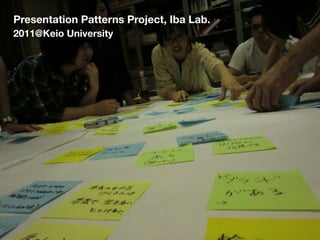
Presentation Patterns Project, Iba Lab.
2011@Keio University
Brain Storming as a method for Divergent Thinking


proposed by Alex F. Osborn, the
president of Advertising Agency
BBDO, 1939


  Focus on quantity

  Withhold criticism

  Welcome unusual ideas

  Combine and improve ideas
Creative Systems Theory
              based on the autopoietic systems theory


A creative process is defined as an autopoietic system whose
elements are discoveries.
Creative process is a (re-) production network of discoveries.
Each discovery is emerged only when a synthesis of the
following three selection occurs: idea, association, and finding.


                               Iba, T. (2009) “An Autopoietic Systems Theory for Creativity”, COINs2009.
Production Network of Discoveries in Creation

Each discovery is produced based on previous discovery,
associating the on-going creation.
What is most important is successive production of discoveries.
Discovery, in this context, does not imply it is novel, true, and
useful.


                               Iba, T. (2009) “An Autopoietic Systems Theory for Creativity”, COINs2009.
“Creation” as
Coupling of Creative, Psychic, and Social Systems


                       Iba, T. (2009) “An Autopoietic Systems Theory for Creativity”, COINs2009.
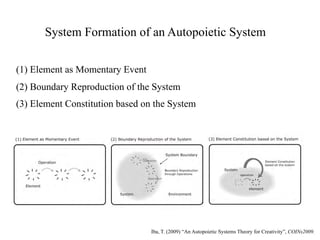
System Formation of an Autopoietic System

(1) Element as Momentary Event
(2) Boundary Reproduction of the System
(3) Element Constitution based on the System


                                 Iba, T. (2009) “An Autopoietic Systems Theory for Creativity”, COINs2009.
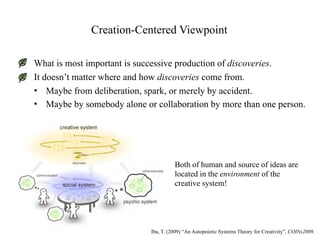
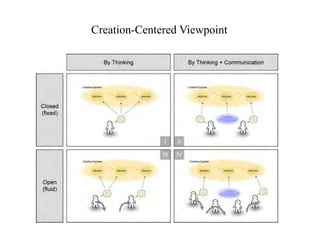
Creation-Centered Viewpoint

What is most important is successive production of discoveries.
It doesn’t matter where and how discoveries come from.
• Maybe from deliberation, spark, or merely by accident.
• Maybe by somebody alone or collaboration by more than one person.


                                      Both of human and source of ideas are
                                      located in the environment of the
                                      creative system!


                            Iba, T. (2009) “An Autopoietic Systems Theory for Creativity”, COINs2009.
Creation-Centered Viewpoint
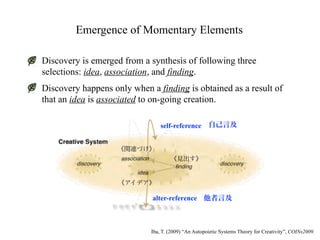
Emergence of Momentary Elements

Discovery is emerged from a synthesis of following three
selections: idea, association, and finding.
Discovery happens only when a finding is obtained as a result of
that an idea is associated to on-going creation.

                                 self-reference


                             alter-reference


                             Iba, T. (2009) “An Autopoietic Systems Theory for Creativity”, COINs2009.
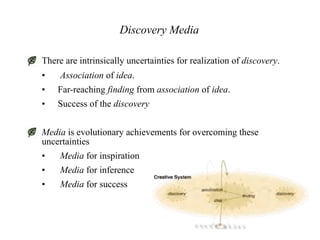
Discovery Media

There are intrinsically uncertainties for realization of discovery.
•    Association of idea.
•   Far-reaching finding from association of idea.
•   Success of the discovery


Media is evolutionary achievements for overcoming these
uncertainties
•    Media for inspiration
•    Media for inference
•    Media for success
Coupling of Creative, Psychic, and Social Systems
Implications


Think and communicate for successive production of
  discoveries!


Remember that ideas are always outside your creation!


Design your media for promoting creative processes!
Innovation & Leadership 2011 (SFC/G-SEC)


       Understanding Creative Processes


                            Takashi Iba
                      Ph.D. in Media and Governance
Associate Professor, Faculty of Policy Management, Keio University, Japan
                        http://twitter.com/takashiiba
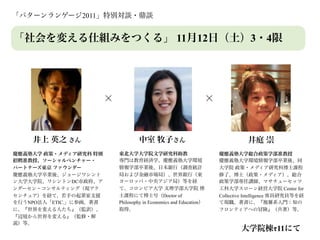
2011


                                                    11        12                   3         4


              DC
                                                                                                   Center for
                                              Doctor of            Collective Intelligence
NPO   ETIC.               Philosophy in Economics and Education


                                                                                                 τ11

Understanding Creative Processes

  • 1.
    Innovation & Leadership2011 (SFC/G-SEC) Understanding Creative Processes Takashi Iba Ph.D. in Media and Governance Associate Professor, Faculty of Policy Management, Keio University, Japan http://twitter.com/takashiiba
  • 2.
    Mass  Collabora%on Conceptual  Age Open  Collabora%on Crea%ve  Class Collabora%ve  Innova%on  Networks  (COINs) Coolhun%ng  &  Coolfarming Swarm  Crea%vity Collec%ve  Crea%vity Organiza%onal  Crea%vity Crea%ve  Collabora%on Design  Thinking Group  Genius Innova%on Group  Crea%vity
  • 3.
  • 4.
  • 5.
    What is Creativity? • Can’t one call a process “creative” without the evaluation of novelty by others? • How can we formulate creative processes that contain much of contingency? • Are there any difference between individual and group creativity?
  • 6.
    What is Creativity? Available online at www.sciencedirect.com Procedia Social and Behavioral Sciences 2 (2010) 6610–6625 6305–6625 COINs2009: Collaborative Innovation Networks Conference An Autopoietic Systems Theory for Creativity Takashi Ibaab a MIT Center for Collective Intelligence, Cambridge MA, USA bFaculty of Policy Management, Keio University, Japan Creative Systems Theory A bstract In this paper, a new, non-psychological and non-sociological approach to understanding creativity is proposed. The approach is based on autopoietic system theory, where an autopoietic system is defined as a unity whose organization is defined by a particular network of production processes of elements. While the theory was originally proposed in biology and then applied to sociology, I have applied it to understand the nature of creation, and called it "Creative Systems Theory". A creative system is an autopoietic system whose element is "discovery", which emerges only when a synthesis of three selections has occurred: "idea", "association", and "consequence". With using these concepts, we open the way to understand creation itself separated from psychic and social aspects of creativity. On this basis, the coupling between creative, psychic, and social systems is discussed. I suggest, in this paper, the future of creativity studies, re-defining a discipline "Creatology" for inquiring creative systems and propose an interdisciplinary field as "Creative Sciences" for interdisciplinary connections among creatology, psychology, and so on. Keywords; creativity; systems theory; autopoiesis; pattern language 1 . I ntroduction In this paper, a new, non-psychological and non-sociological approach to understanding creativity is proposed. The approach is based on autopoietic system theory, where an autopoietic system is defined as a unity whose organization is defined by a particular network of production processes of elements. While the theory was originally proposed in biology and then applied to sociology, I have applied it to understand the nature of creation, and called it "Creative Systems Theory". A creative system is an autopoietic system whose element is "discovery", which emerges only when a synthesis of three selections has occurred: "idea", "association", and "consequence". With using these concepts, we open the way to understand creation itself separated from psychic and social aspects of creativity. On this basis, the coupling between creative, psychic, and social systems is discussed. I suggest, in this paper, the future of creativity studies, re-defining a discipline "Creatology" for inquiring creative systems and propose an interdisciplinary field as "Creative Sciences" for interdisciplinary connections among creatology, psychology, and so on. There are several reasons why study of creativity is pursued from so many angles today. First, against the backdrop of the shift from labor-intensive work to knowledge-intensive work, many people involved in business need to make full use of intelligence and creativity for obtaining 1877-0428 © 2010 Published by Elsevier Ltd. doi:10.1016/j.sbspro.2010.04.071 Iba, T. (2009) “An Autopoietic Systems Theory for Creativity”, COINs2009.
  • 7.
    Creative Systems Theory based on the autopoietic systems theory A creative process is defined as an autopoietic system whose elements are discoveries. Creative process is a (re-) production network of discoveries. Each discovery is emerged only when a synthesis of the following three selection occurs: idea, association, and finding. Iba, T. (2009) “An Autopoietic Systems Theory for Creativity”, COINs2009.
  • 8.
    Production Network ofDiscoveries in Creation Each discovery is produced based on previous discovery, associating the on-going creation. What is most important is successive production of discoveries. Discovery, in this context, does not imply it is novel, true, and useful. Iba, T. (2009) “An Autopoietic Systems Theory for Creativity”, COINs2009.
  • 9.
    Production Network ofDiscoveries in Creation • “They succeed by way of many small sparks, and by drawing on collaboration over time to build those sparks into something tremendous. Many of the idea turn out to be wildly off the mark, but it turns out many not-so-good ideas are needed on the way to that rare great idea.” (Sawyer 2007; p.105) • "Darwin's notebook show that he reached many dead ends and produced a lot of ideas that scientists now consider weird.” (Sawyer 2007, p.106) Iba, T. (2009) “An Autopoietic Systems Theory for Creativity”, COINs2009.
  • 10.
    Creative Systems Theory based on the autopoietic systems theory A creative process is defined as an autopoietic system whose elements are discoveries. Creative process is a (re-) production network of discoveries. Each discovery is emerged only when a synthesis of the following three selection occurs: idea, association, and finding. Iba, T. (2009) “An Autopoietic Systems Theory for Creativity”, COINs2009.
  • 11.
    “Creation” as Coupling ofCreative, Psychic, and Social Systems Iba, T. (2009) “An Autopoietic Systems Theory for Creativity”, COINs2009.
  • 12.
    Two Phases ofCreative Thinking Divergent Thinking Convergent Thinking
  • 13.
    Brain Storming asa method for Divergent Thinking proposed by Alex F. Osborn, the president of Advertising Agency BBDO, 1939 Focus on quantity Withhold criticism Welcome unusual ideas Combine and improve ideas
  • 14.
  • 15.
  • 16.
  • 17.
  • 18.
  • 19.
    Iba Lab. 2004 @Keio University
  • 20.
    Iba Lab. 2004 @Keio University
  • 21.
    Iba Lab. &Tama Lab. 2004 @Keio University
  • 22.
    Learning Patterns Project,Iba Lab. 2008 2009@Keio University
  • 23.
    Learning Patterns Project,Iba Lab. 2008 2009@Keio University
  • 24.
    Learning Patterns Project,Iba Lab. 2008 2009@Keio University
  • 25.
    Presentation Patterns Project,Iba Lab. 2011@Keio University
  • 26.
    Presentation Patterns Project,Iba Lab. 2011@Keio University
  • 27.
    Presentation Patterns Project,Iba Lab. 2011@Keio University
  • 28.
    Presentation Patterns Project,Iba Lab. 2011@Keio University
  • 29.
    Brain Storming asa method for Divergent Thinking proposed by Alex F. Osborn, the president of Advertising Agency BBDO, 1939 Focus on quantity Withhold criticism Welcome unusual ideas Combine and improve ideas
  • 30.
    Creative Systems Theory based on the autopoietic systems theory A creative process is defined as an autopoietic system whose elements are discoveries. Creative process is a (re-) production network of discoveries. Each discovery is emerged only when a synthesis of the following three selection occurs: idea, association, and finding. Iba, T. (2009) “An Autopoietic Systems Theory for Creativity”, COINs2009.
  • 31.
    Production Network ofDiscoveries in Creation Each discovery is produced based on previous discovery, associating the on-going creation. What is most important is successive production of discoveries. Discovery, in this context, does not imply it is novel, true, and useful. Iba, T. (2009) “An Autopoietic Systems Theory for Creativity”, COINs2009.
  • 32.
    “Creation” as Coupling ofCreative, Psychic, and Social Systems Iba, T. (2009) “An Autopoietic Systems Theory for Creativity”, COINs2009.
  • 33.
    System Formation ofan Autopoietic System (1) Element as Momentary Event (2) Boundary Reproduction of the System (3) Element Constitution based on the System Iba, T. (2009) “An Autopoietic Systems Theory for Creativity”, COINs2009.
  • 34.
    Creation-Centered Viewpoint What ismost important is successive production of discoveries. It doesn’t matter where and how discoveries come from. • Maybe from deliberation, spark, or merely by accident. • Maybe by somebody alone or collaboration by more than one person. Both of human and source of ideas are located in the environment of the creative system! Iba, T. (2009) “An Autopoietic Systems Theory for Creativity”, COINs2009.
  • 35.
  • 36.
    Emergence of MomentaryElements Discovery is emerged from a synthesis of following three selections: idea, association, and finding. Discovery happens only when a finding is obtained as a result of that an idea is associated to on-going creation. self-reference alter-reference Iba, T. (2009) “An Autopoietic Systems Theory for Creativity”, COINs2009.
  • 37.
    Discovery Media There areintrinsically uncertainties for realization of discovery. • Association of idea. • Far-reaching finding from association of idea. • Success of the discovery Media is evolutionary achievements for overcoming these uncertainties • Media for inspiration • Media for inference • Media for success
  • 38.
    Coupling of Creative,Psychic, and Social Systems
  • 39.
    Implications Think and communicatefor successive production of discoveries! Remember that ideas are always outside your creation! Design your media for promoting creative processes!
  • 40.
    Innovation & Leadership2011 (SFC/G-SEC) Understanding Creative Processes Takashi Iba Ph.D. in Media and Governance Associate Professor, Faculty of Policy Management, Keio University, Japan http://twitter.com/takashiiba
  • 41.
    2011 11 12 3 4 DC Center for Doctor of Collective Intelligence NPO ETIC. Philosophy in Economics and Education τ11