







Understanding ASL
 Grammatical Features
and Discourse Mapping
   Jeff Pollock and Doug Stringham
      2007 USDB Fall Workshop
Review and identify salient ASL
grammatical structures:
  nominal and pronominal structures
  verbal and adverbial structures
  complex sentences

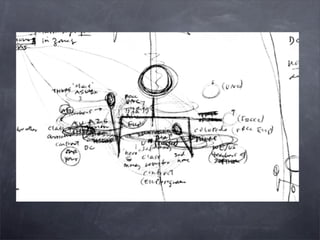
Introduce and demonstrate discourse mapping

Work in small groups to incorporate ASL
grammatical features in our work

Debrief and evaluate
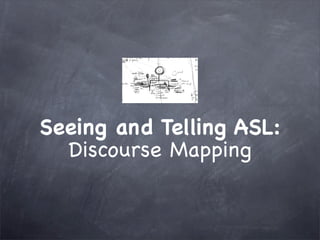
Seeing and Telling ASL:
  Discourse Mapping
What is discourse?
This is discourse.
Patterns, styles, scripts,
 and genres in how and
 what we communicate:
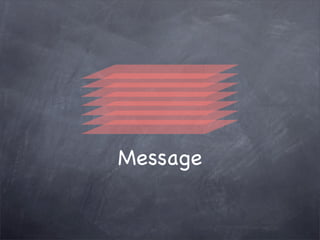
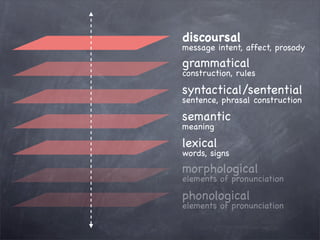
Message
discoursal
message intent, affect, prosody
grammatical
construction, rules

syntactical/sentential
sentence, phrasal construction

semantic
meaning

lexical
words, signs
morphological
elements of pronunciation

phonological
elements of pronunciation
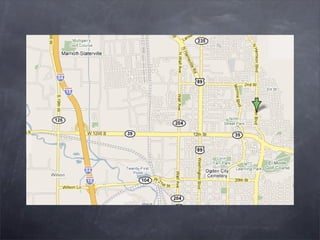
“mapping?”
Not that. This.
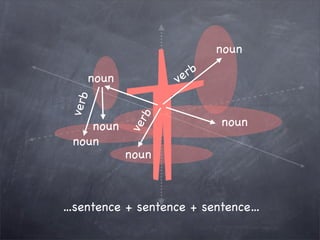
noun
                     rb
verbnoun          ve


            b
                          noun
              r
    noun
           ve
 noun
           noun


…sentence + sentence + sentence…
Why?
Scholarly research data
   and national EIPA
  assessment results:
message cohesion
cognitive mapping
Discourse mapping
helps signers identify
cohesion structures in
    a signed text.
Discourse mapping helps
interpreters cognitively
 map (chunk, peg, link,
and monitor) message in
      a given text.
How?
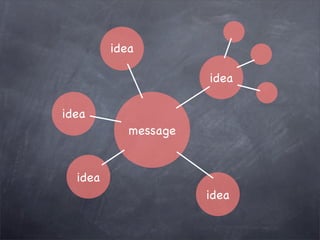
By creating a visual
 representation of how
 native signers organize
and incorporate message
      into language.
idea

                      idea

idea
            message


  idea
                      idea
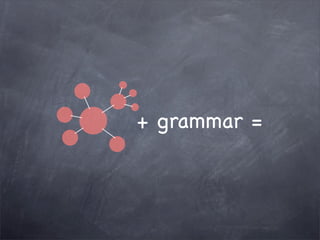
+ grammar =
language
1. Cohesion
What are some ASL
manual and nonmanual
transitional behaviors?
blinks and eyegaze
extended hold of signs
head nod
lexemes
  conjunctionals:
   FINISH, WRONG, FRUSTRATE, HAPPEN
 NEXT
 DOWN-HIERARCHY or SIDE-HIERARCHY
 THEN, AND
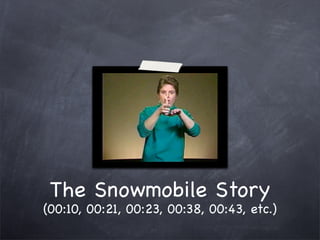
The Snowmobile Story
(00:10, 00:21, 00:23, 00:38, 00:43, etc.)
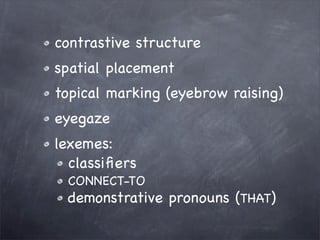
What are some ASL
manual and nonmanual
 relational behaviors?
contrastive structure
spatial placement
topical marking (eyebrow raising)
eyegaze
lexemes:
  classifiers
 CONNECT-TO
 demonstrative pronouns (THAT)
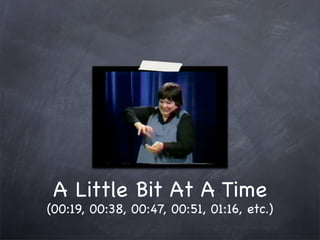
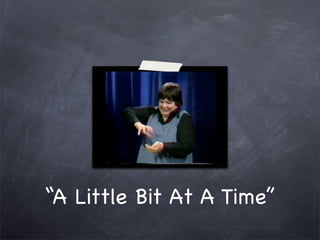
A Little Bit At A Time
(00:19, 00:38, 00:47, 00:51, 01:16, etc.)
2. Cognitive mapping
Chunking, pegging,
 linking, and self-
monitoring message
      in a text.
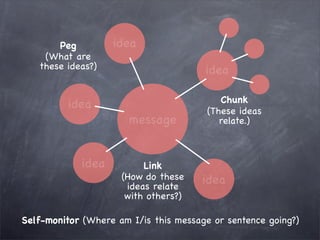
Peg          idea
    (What are
   these ideas?)                       idea

                                           Chunk
          idea                          (These ideas
                       message             relate.)


             idea         Link
                     (How do these     idea
                      ideas relate
                      with others?)

Self-monitor (Where am I/is this message or sentence going?)
How does this happen?
The ability to
restructure information
 in the mind is largely
     dependent on
   language ability.
The goal, then, is to
    replicate logical
 language organization
in interpretative work.
The Discourse
Mapping Process
1. Watch text for
  comprehension.
2. Watch text for
specific linguistic
    features:
nominal and pronominal
     information
verbal and adverbial
    information
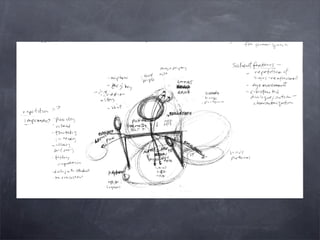
3. Watch text to confirm
observations in #2, make
 visual representation,
    and make notes:
represent spatial zones (clusters
or pegs) where specific linguistic
features occur

peg linguistic features:
  nominals
  pronominals
  unidirectional verbs
  (signer is agent or actor)
  unidirectional verbs
  (signer is recipient or actee)
4. Discuss observations
    in small groups
confirm comprehension (“I saw X..."),
  discuss specific features, identify
       questions for the group)
4a. Repeat for each
 linguistic feature.
5. Watch text again
6. Based on created
visual representations,
   retell the text in
     small groups.
7. Debrief
“A Little Bit At A Time”
Do try this at home.
References

Witter-Merrithew, A. (2006). Discourse
Mapping for Sign Language Interpreters
(workshop notes, n.p.).
Thank you.
jeff.pollock@datc.edu
dstringham@gmail.com

Understanding ASL Grammatical Features and Discourse Mapping