BY
RAHUL SINHA
American sign Language(ASL)
BASICS
What is ASL ?
American sign language is a visual spatial
language that uses hand gestures and hand
shapes to communicate in the deaf
community
 Today we are here to show some techniques used
in ASL.
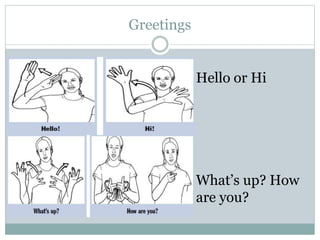
Greetings
Hello or Hi
What’s up? How
are you?
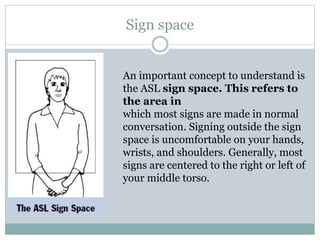
Sign space
An important concept to understand is
the ASL sign space. This refers to
the area in
which most signs are made in normal
conversation. Signing outside the sign
space is uncomfortable on your hands,
wrists, and shoulders. Generally, most
signs are centered to the right or left of
your middle torso.
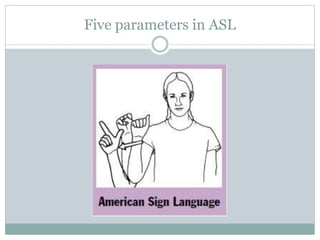
Five parameters in ASL
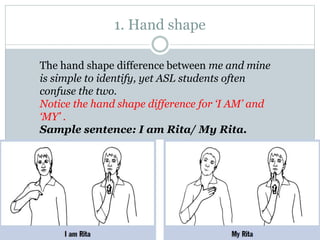
1. Hand shape
The hand shape difference between me and mine
is simple to identify, yet ASL students often
confuse the two.
Notice the hand shape difference for ‘I AM’ and
‘MY’ .
Sample sentence: I am Rita/ My Rita.
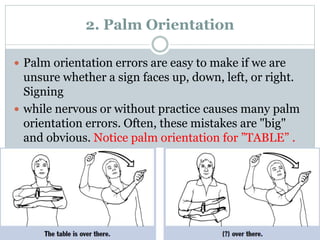
2. Palm Orientation
 Palm orientation errors are easy to make if we are
unsure whether a sign faces up, down, left, or right.
Signing
 while nervous or without practice causes many palm
orientation errors. Often, these mistakes are "big"
and obvious. Notice palm orientation for ”TABLE” .
Sample sentence: The table is over there.
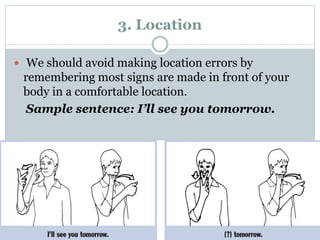
3. Location
 We should avoid making location errors by
remembering most signs are made in front of your
body in a comfortable location.
Sample sentence: I’ll see you tomorrow.
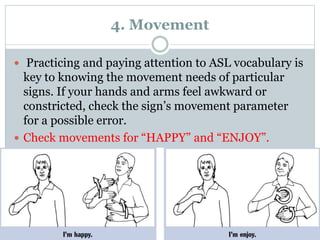
4. Movement
 Practicing and paying attention to ASL vocabulary is
key to knowing the movement needs of particular
signs. If your hands and arms feel awkward or
constricted, check the sign’s movement parameter
for a possible error.
 Check movements for “HAPPY” and “ENJOY”.
Sample sentence: I’m happy/I’m enjoy.
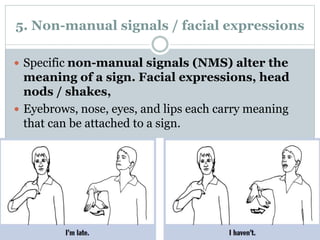
5. Non-manual signals / facial expressions
 Specific non-manual signals (NMS) alter the
meaning of a sign. Facial expressions, head
nods / shakes,
 Eyebrows, nose, eyes, and lips each carry meaning
that can be attached to a sign.
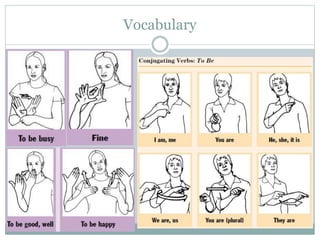
Vocabulary
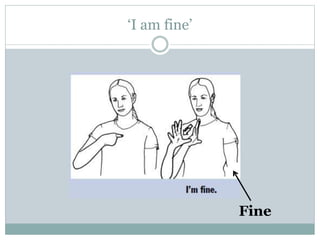
‘I am fine’
Fine
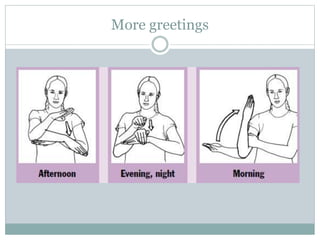
More greetings
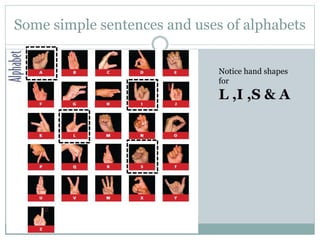
Some simple sentences and uses of alphabets
Notice hand shapes
for
L ,I ,S & A
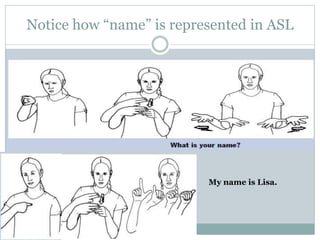
Notice how “name” is represented in ASL
My name is Lisa.
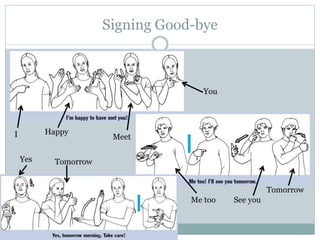
Signing Good-bye
I Happy
Meet
You
Yes Tomorrow
Me too See you
Tomorrow
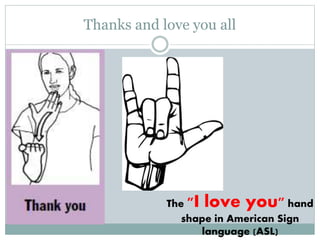
Thanks and love you all
The "I love you" hand
shape in American Sign
language (ASL)

ASL basics

  • 1.
    BY RAHUL SINHA American signLanguage(ASL) BASICS
  • 2.
    What is ASL? American sign language is a visual spatial language that uses hand gestures and hand shapes to communicate in the deaf community  Today we are here to show some techniques used in ASL.
  • 3.
  • 4.
    Sign space An importantconcept to understand is the ASL sign space. This refers to the area in which most signs are made in normal conversation. Signing outside the sign space is uncomfortable on your hands, wrists, and shoulders. Generally, most signs are centered to the right or left of your middle torso.
  • 5.
  • 6.
    1. Hand shape Thehand shape difference between me and mine is simple to identify, yet ASL students often confuse the two. Notice the hand shape difference for ‘I AM’ and ‘MY’ . Sample sentence: I am Rita/ My Rita.
  • 7.
    2. Palm Orientation Palm orientation errors are easy to make if we are unsure whether a sign faces up, down, left, or right. Signing  while nervous or without practice causes many palm orientation errors. Often, these mistakes are "big" and obvious. Notice palm orientation for ”TABLE” . Sample sentence: The table is over there.
  • 8.
    3. Location  Weshould avoid making location errors by remembering most signs are made in front of your body in a comfortable location. Sample sentence: I’ll see you tomorrow.
  • 9.
    4. Movement  Practicingand paying attention to ASL vocabulary is key to knowing the movement needs of particular signs. If your hands and arms feel awkward or constricted, check the sign’s movement parameter for a possible error.  Check movements for “HAPPY” and “ENJOY”. Sample sentence: I’m happy/I’m enjoy.
  • 10.
    5. Non-manual signals/ facial expressions  Specific non-manual signals (NMS) alter the meaning of a sign. Facial expressions, head nods / shakes,  Eyebrows, nose, eyes, and lips each carry meaning that can be attached to a sign.
  • 11.
  • 12.
  • 13.
  • 14.
    Some simple sentencesand uses of alphabets Notice hand shapes for L ,I ,S & A
  • 15.
    Notice how “name”is represented in ASL My name is Lisa.
  • 16.
    Signing Good-bye I Happy Meet You YesTomorrow Me too See you Tomorrow
  • 17.
    Thanks and loveyou all The "I love you" hand shape in American Sign language (ASL)