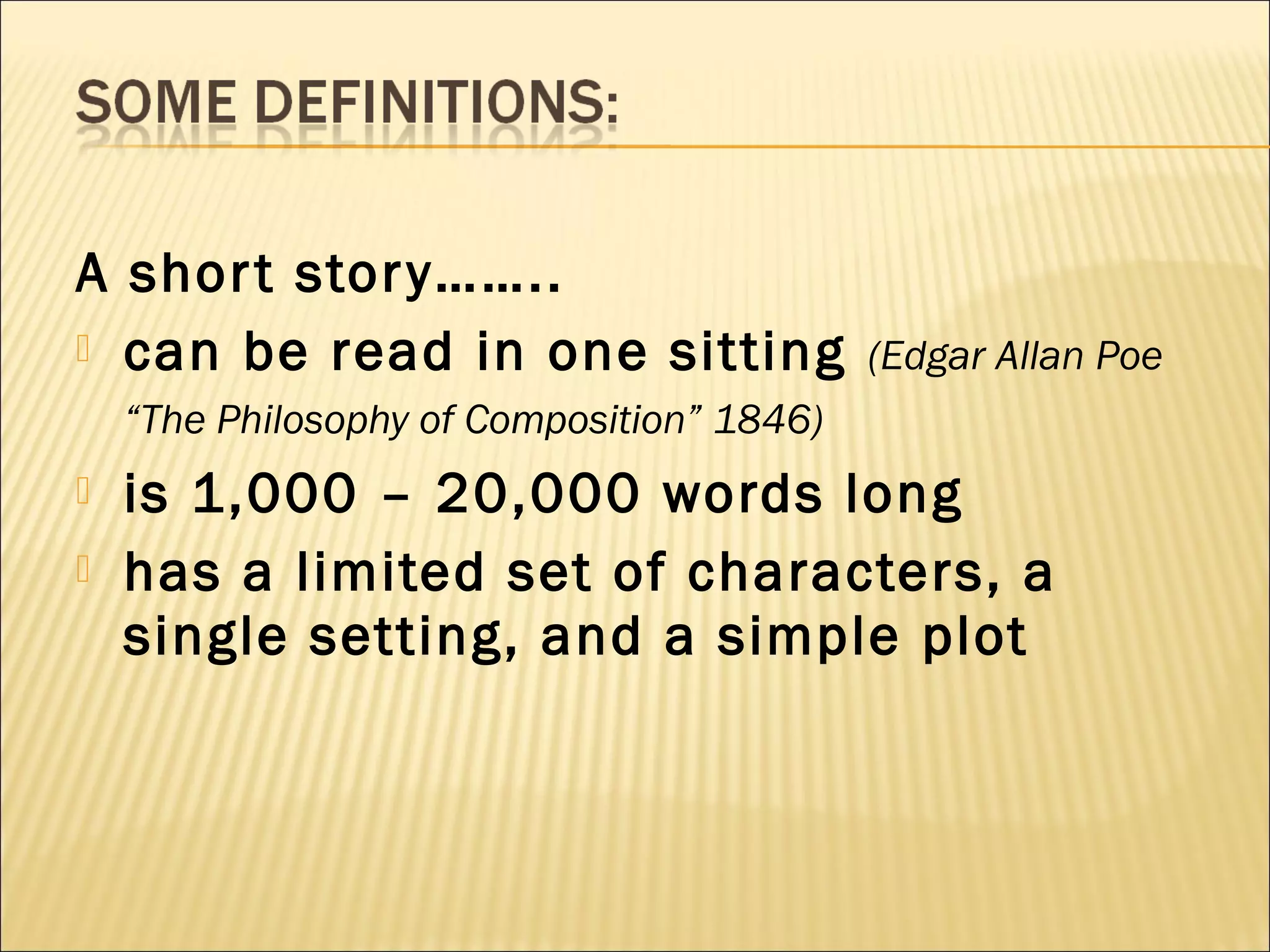
A shor t stor y……..
 can be read in one sitting

(Edgar Allan Poe

“The Philosophy of Composition” 1846)



is 1,000 – 20,000 words long
has a limited set of characters, a
single setting, and a simple plot
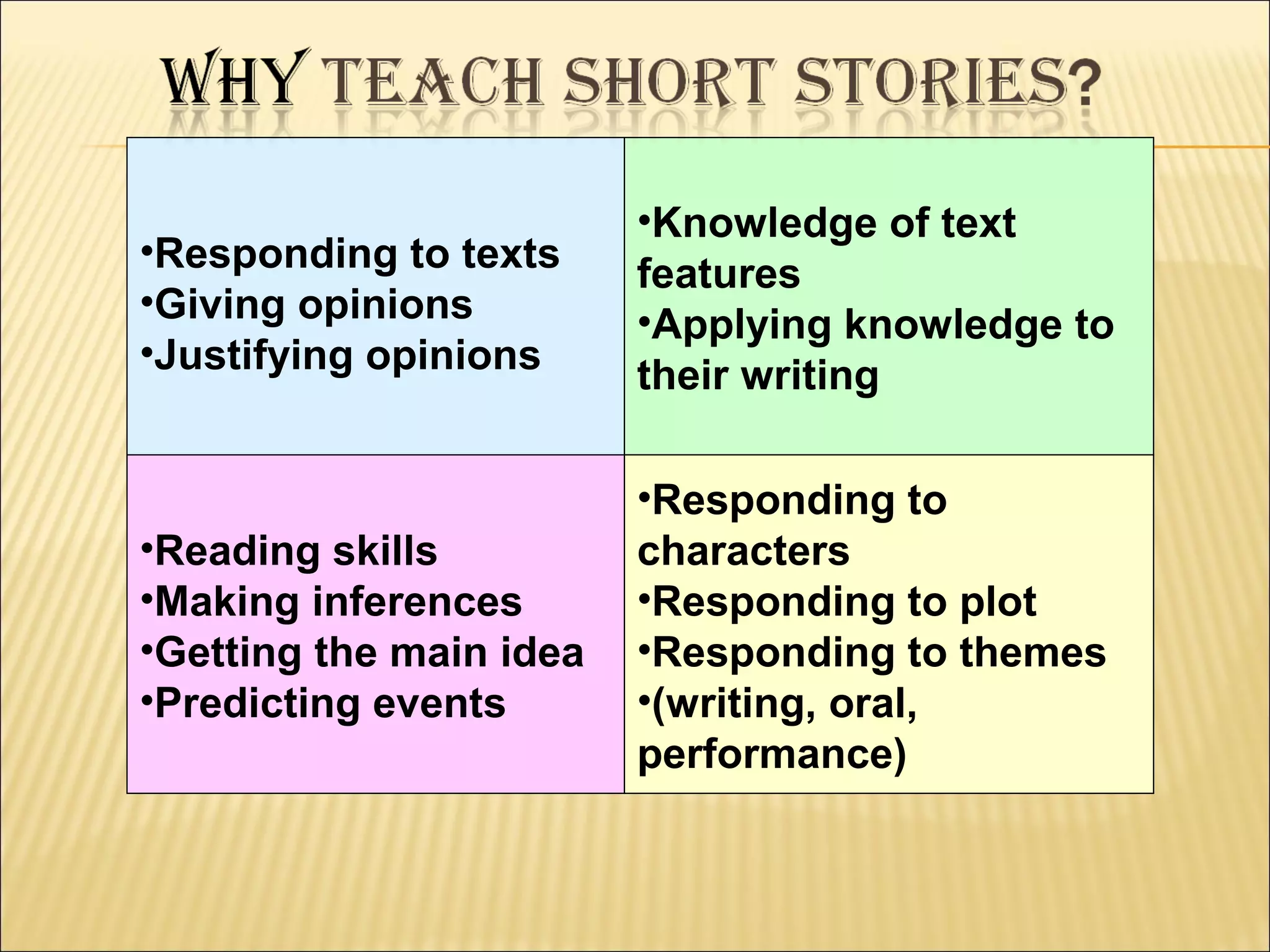
•Responding to texts
•Giving opinions
•Justifying opinions

•Knowledge of text
features
•Applying knowledge to
their writing

•Reading skills
•Making inferences
•Getting the main idea
•Predicting events

•Responding to
characters
•Responding to plot
•Responding to themes
•(writing, oral,
performance)






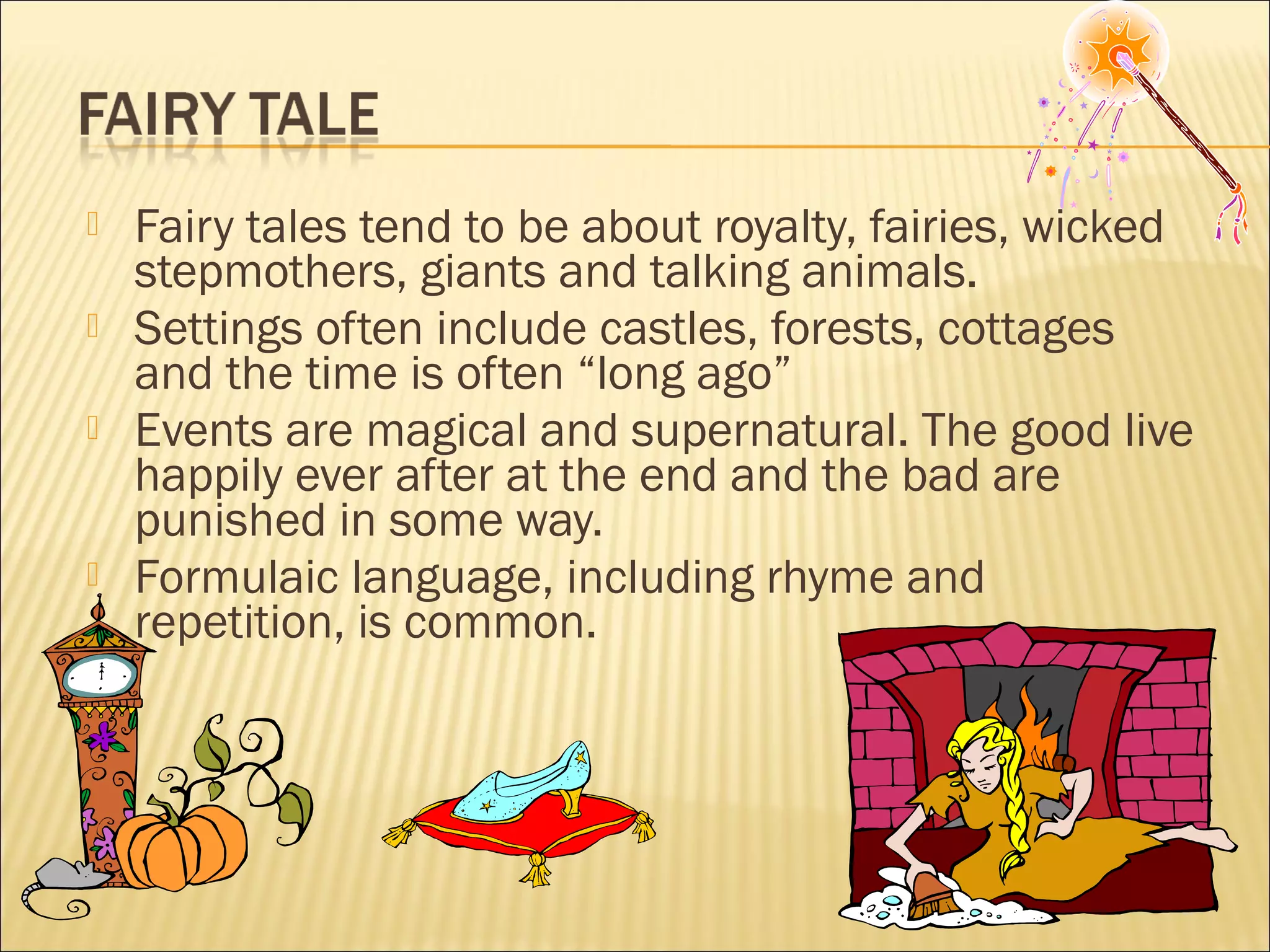
Fairy tales tend to be about royalty, fairies, wicked
stepmothers, giants and talking animals.
Settings often include castles, forests, cottages
and the time is often “long ago”
Events are magical and supernatural. The good live
happily ever after at the end and the bad are
punished in some way.
Formulaic language, including rhyme and
repetition, is common.




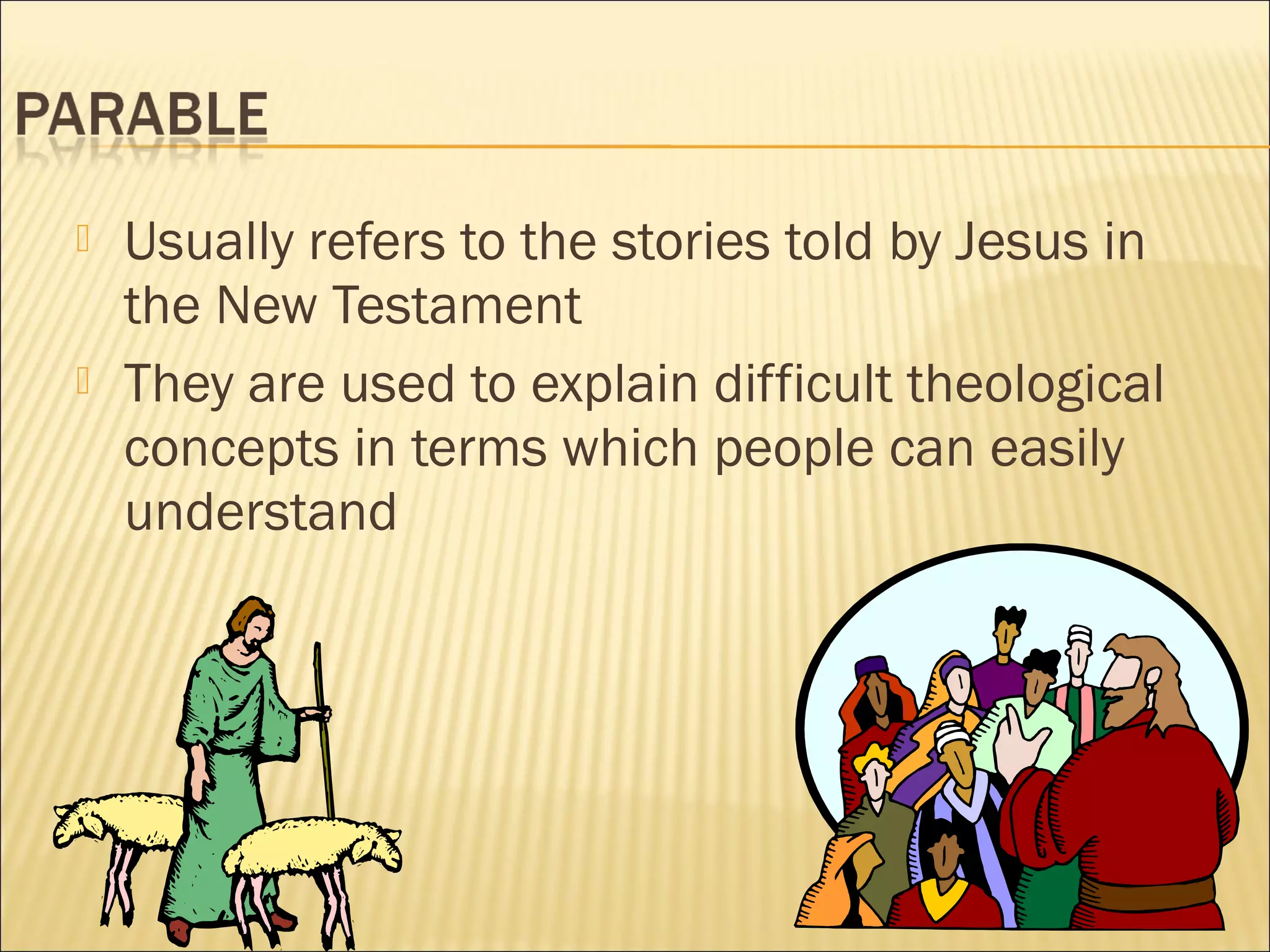
Usually refers to the stories told by Jesus in
the New Testament
They are used to explain difficult theological
concepts in terms which people can easily
understand




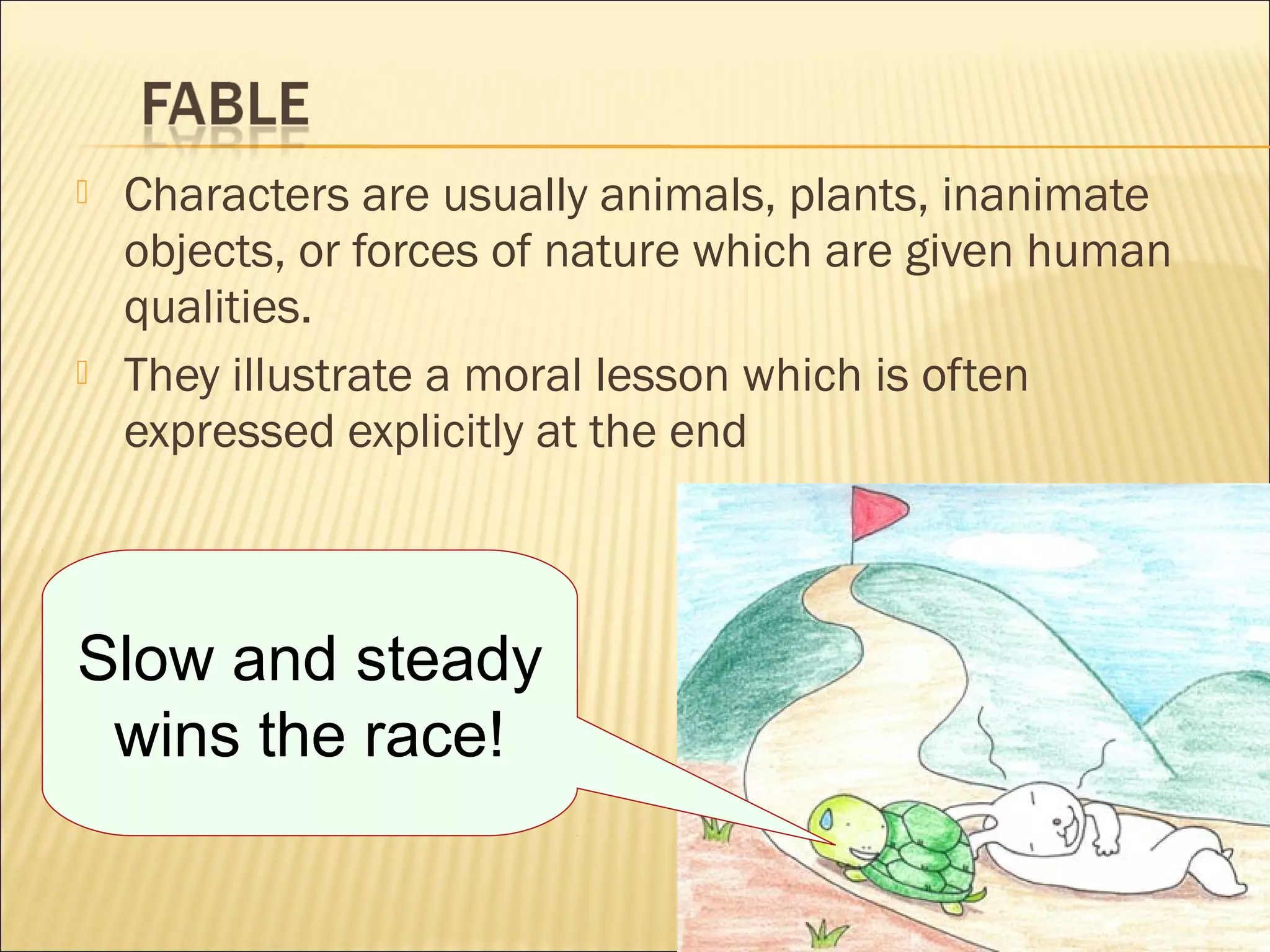
Characters are usually animals, plants, inanimate
objects, or forces of nature which are given human
qualities.
They illustrate a moral lesson which is often
expressed explicitly at the end

Slow and steady
wins the race!







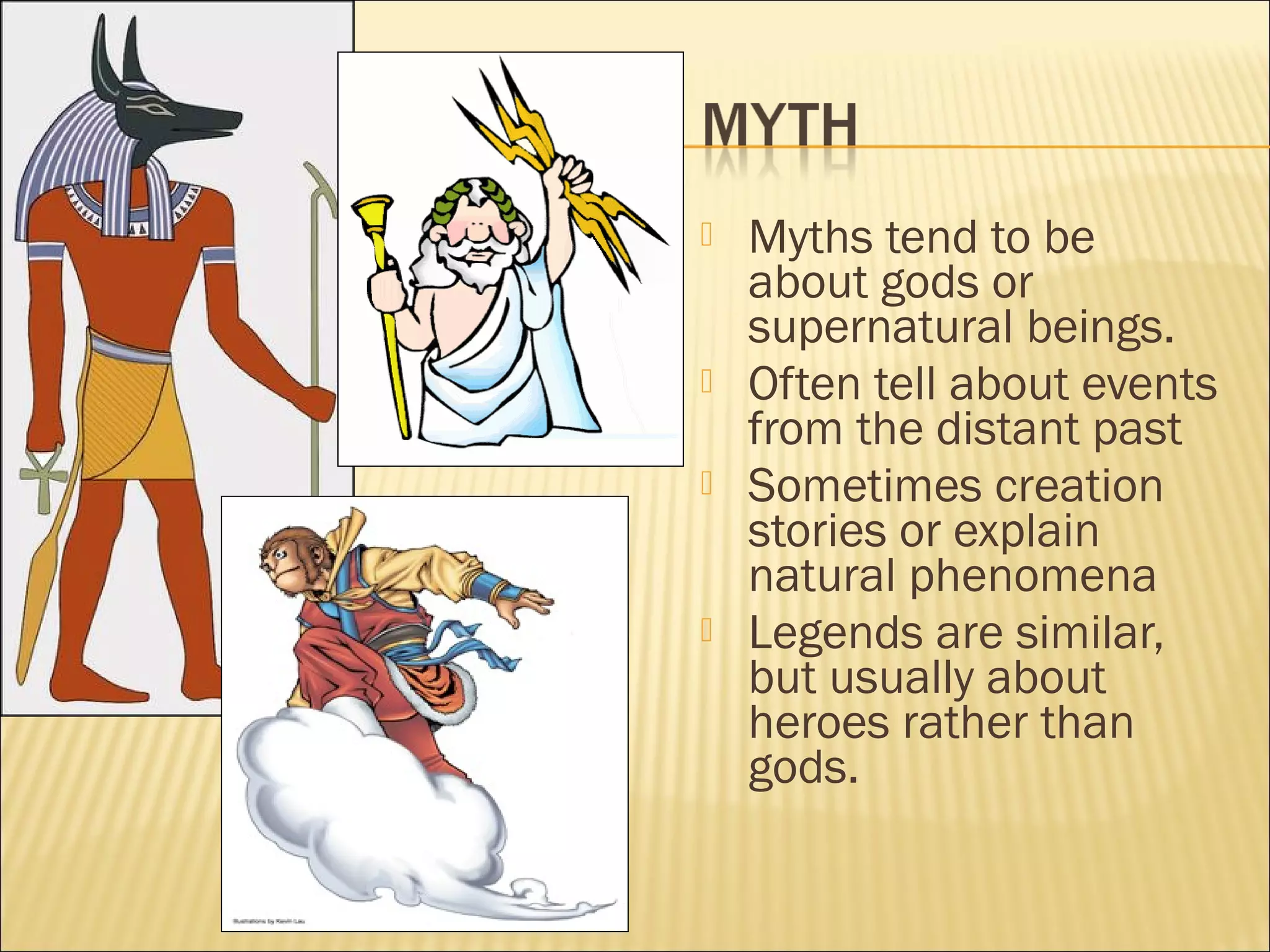
Myths tend to be
about gods or
supernatural beings.
Often tell about events
from the distant past
Sometimes creation
stories or explain
natural phenomena
Legends are similar,
but usually about
heroes rather than
gods.






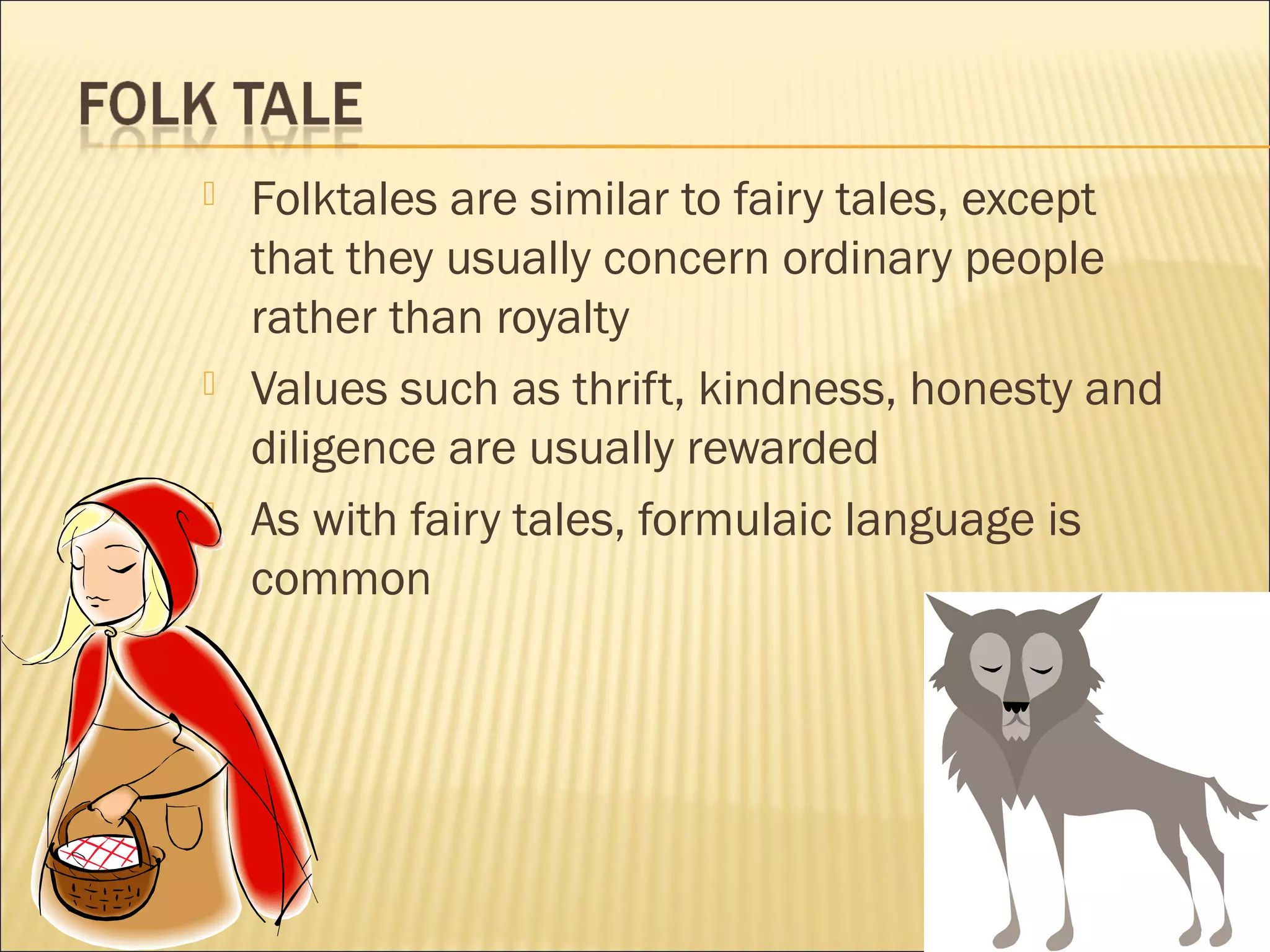
Folktales are similar to fairy tales, except
that they usually concern ordinary people
rather than royalty
Values such as thrift, kindness, honesty and
diligence are usually rewarded
As with fairy tales, formulaic language is
common






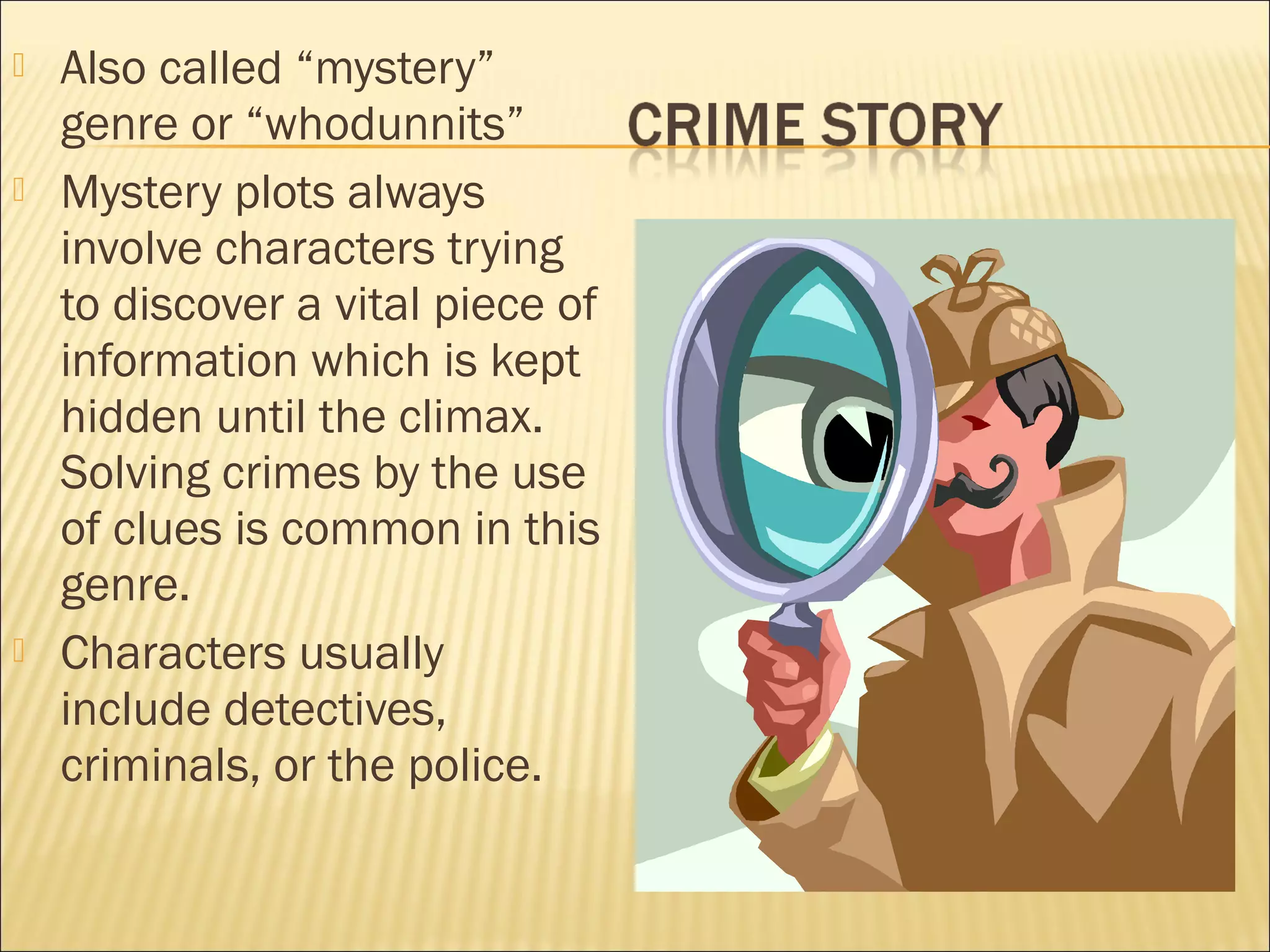
Also called “mystery”
genre or “whodunnits”
Mystery plots always
involve characters trying
to discover a vital piece of
information which is kept
hidden until the climax.
Solving crimes by the use
of clues is common in this
genre.
Characters usually
include detectives,
criminals, or the police.






Science fiction plots commonly explore ideas like
space travel, cloning, time travel, or aliens.
Fantastical things happen but all have a scientific
explanation.  No use of magic.
Settings often include other planets, space ships, or
futuristic cities. These may be described in detail
Characters will often include robots,
aliens, astronauts, or scientists








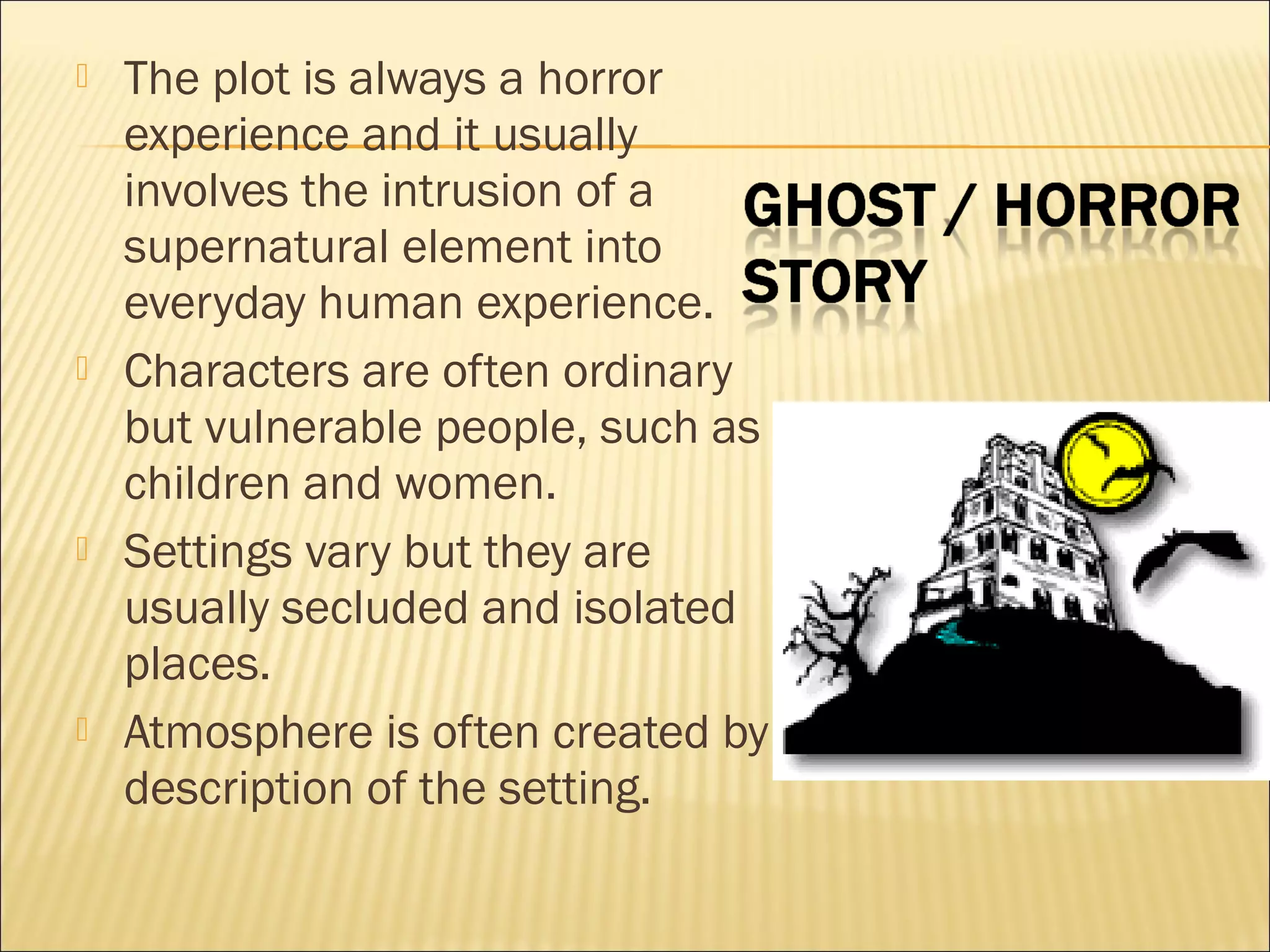
The plot is always a horror
experience and it usually
involves the intrusion of a
supernatural element into
everyday human experience.
Characters are often ordinary
but vulnerable people, such as
children and women.
Settings vary but they are
usually secluded and isolated
places.
Atmosphere is often created by
description of the setting.






Plots of romance revolve around two people as they
develop romantic love for each other and work to
build a relationship together.
Both the conflict and the climax of the story should
be directly related to that core theme of developing
a romantic relationship.
There is often a happy ending.







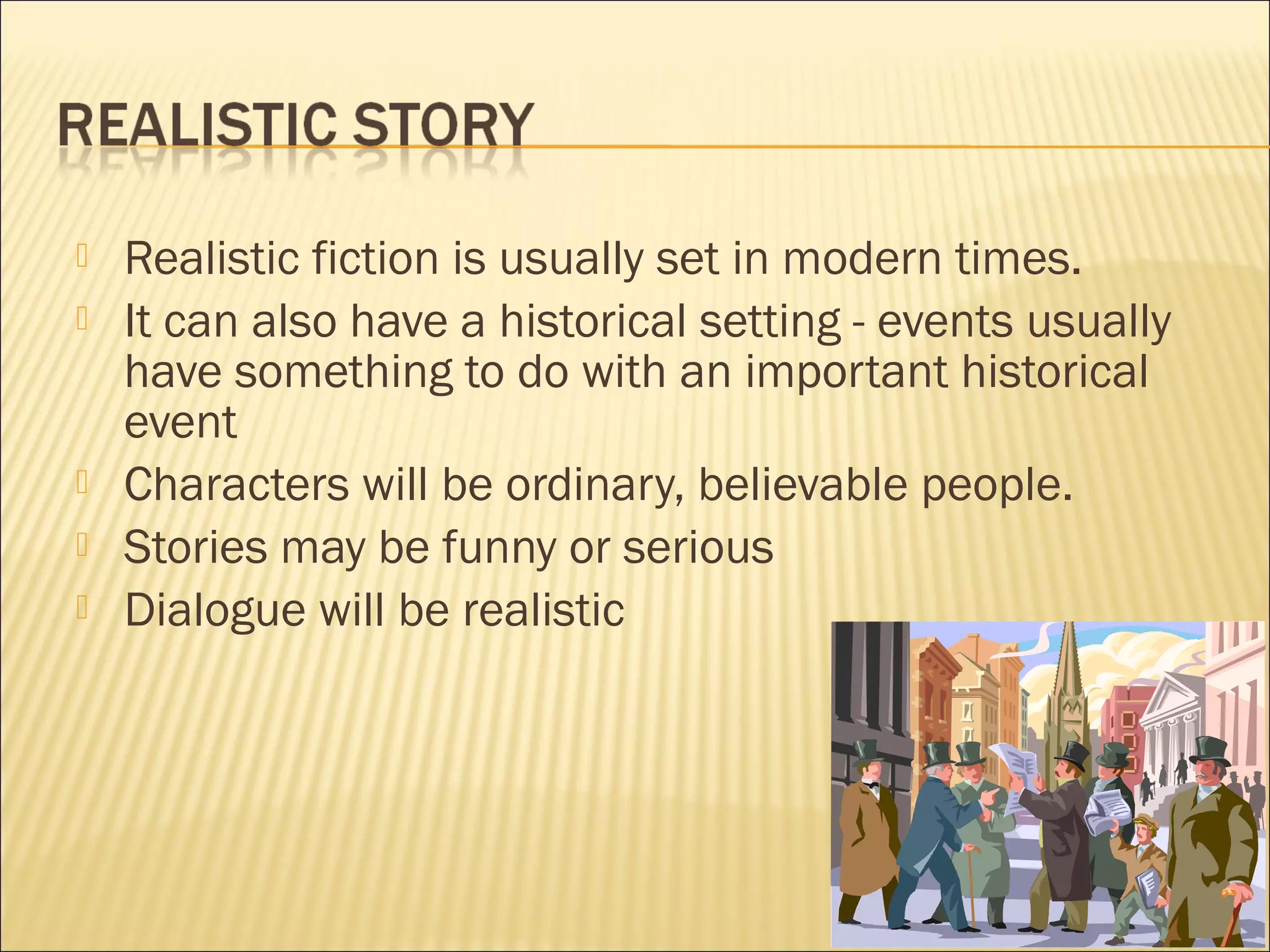
Realistic fiction is usually set in modern times.
It can also have a historical setting - events usually
have something to do with an important historical
event
Characters will be ordinary, believable people.
Stories may be funny or serious
Dialogue will be realistic
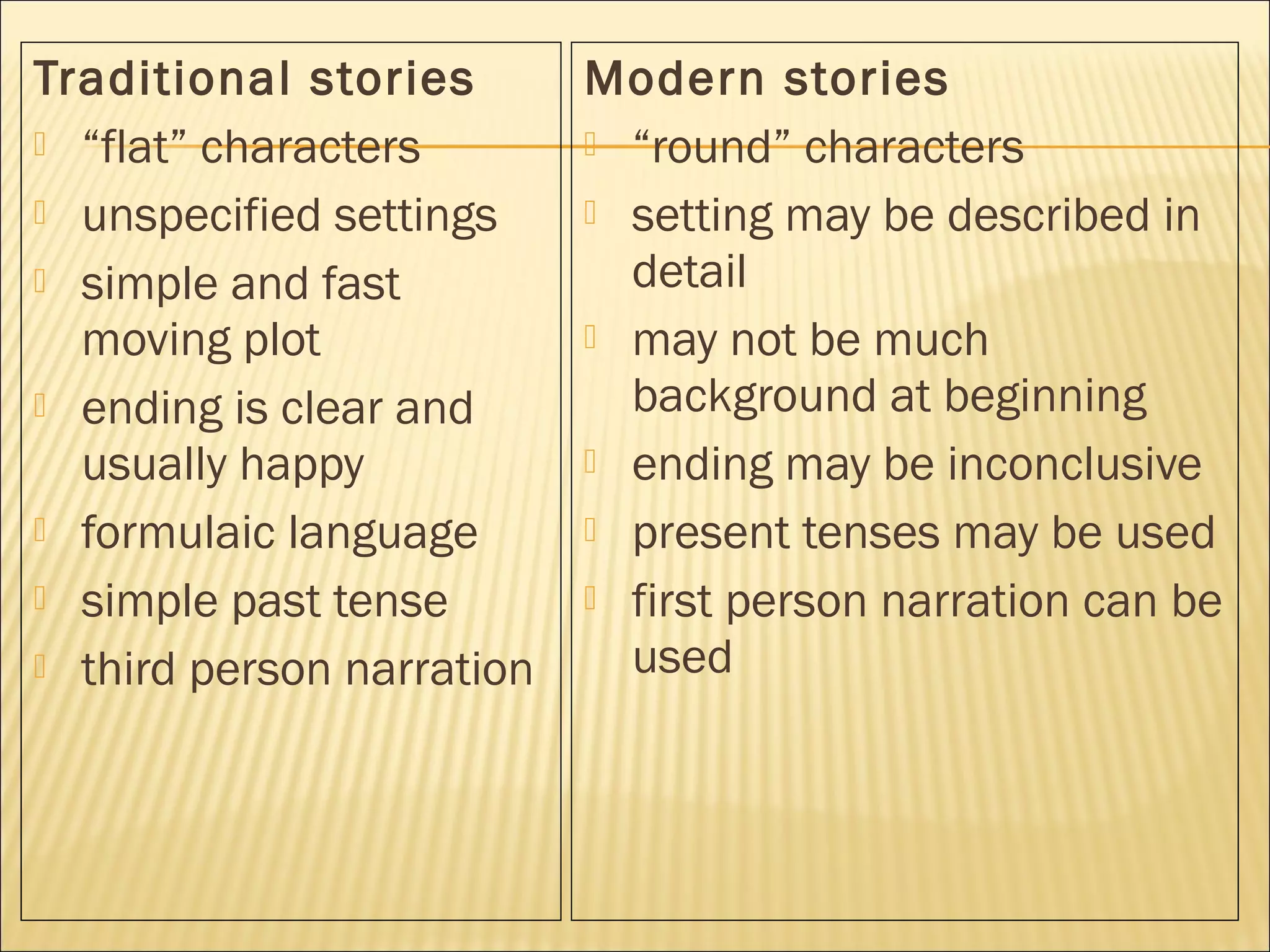
Traditional stories
 “flat” characters
 unspecified settings
 simple and fast
moving plot
 ending is clear and
usually happy
 formulaic language
 simple past tense
 third person narration

Modern stories
 “round” characters
 setting may be described in
detail
 may not be much
background at beginning
 ending may be inconclusive
 present tenses may be used
 first person narration can be
used
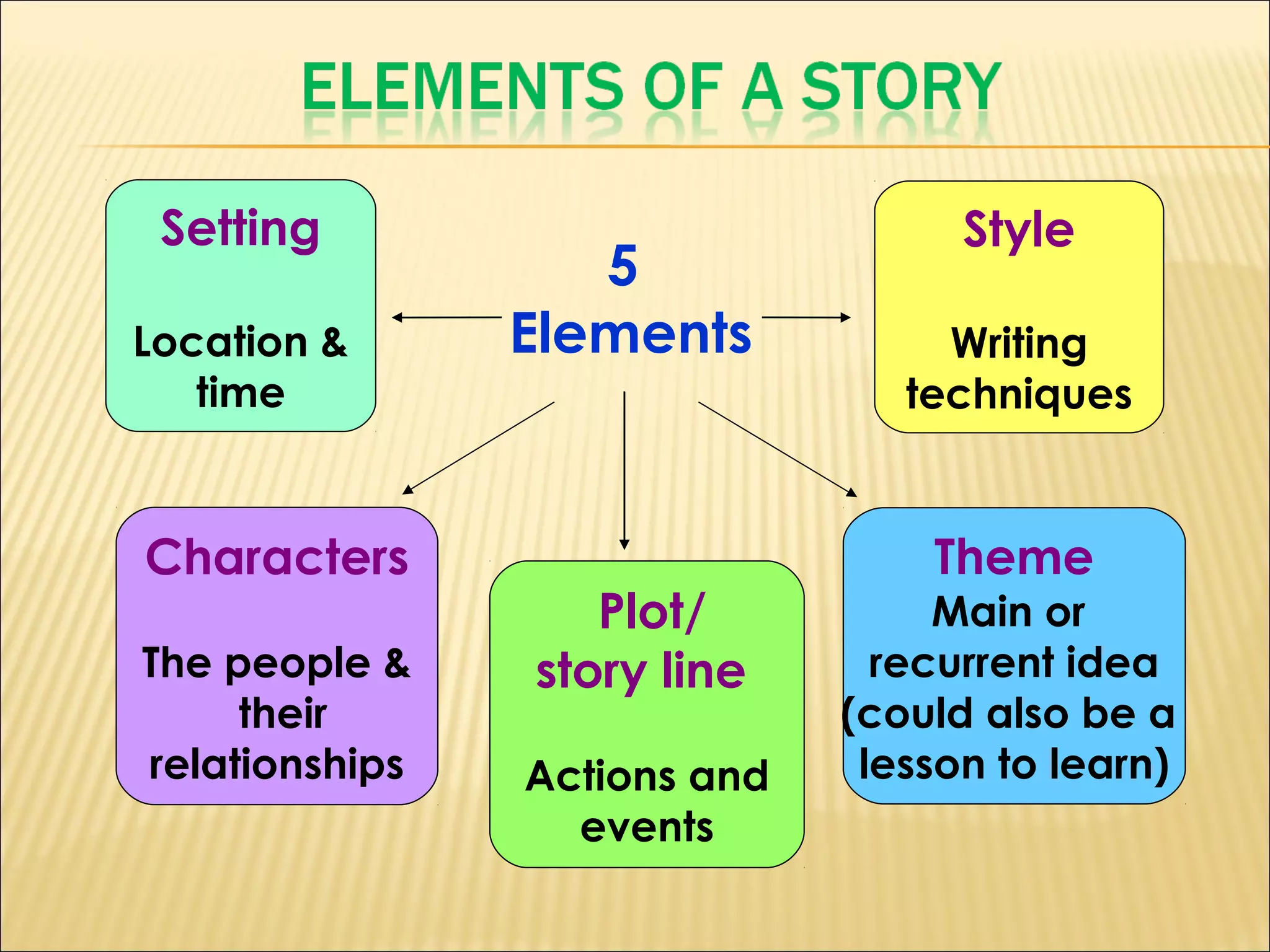
Setting
 

Location &
time

5
Elements

Style
Writing
techniques


Characters


The people &
their
relationships

Plot/
story line
Actions and
events

Theme

Main or
recurrent idea
(could also be a
lesson to learn)
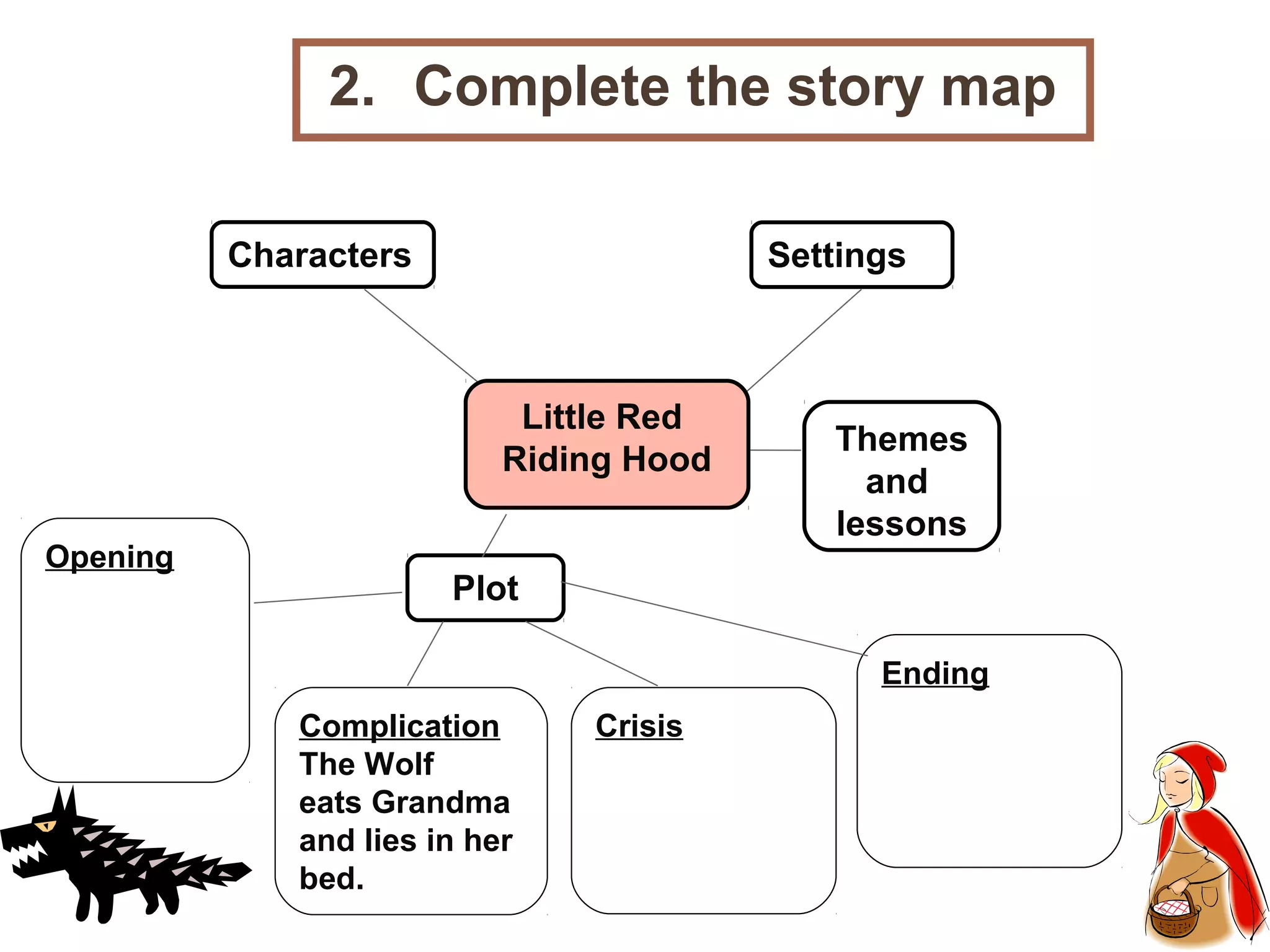
2. Complete the story map
Characters

Settings

Little Red
Riding Hood
Opening

Themes
and
lessons

Plot
Ending
Complication
The Wolf
eats Grandma
and lies in her
bed.

Crisis
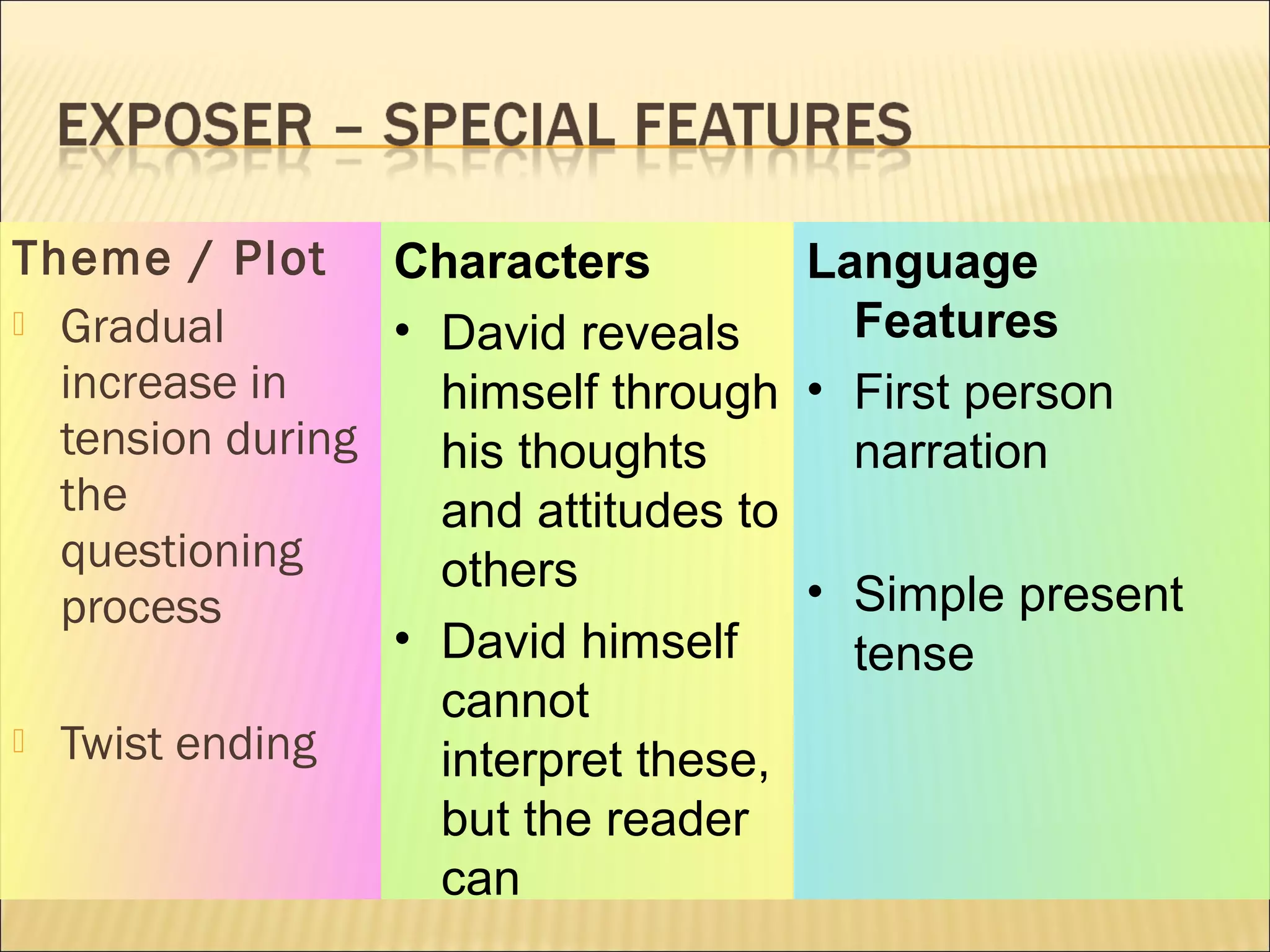
Theme / Plot Characters
Language
 Gradual
Features
• David reveals
increase in
himself through • First person
tension during
his thoughts
narration
the
and attitudes to
questioning
others
• Simple present
process
• David himself
tense
cannot
 Twist ending
interpret these,
but the reader
can
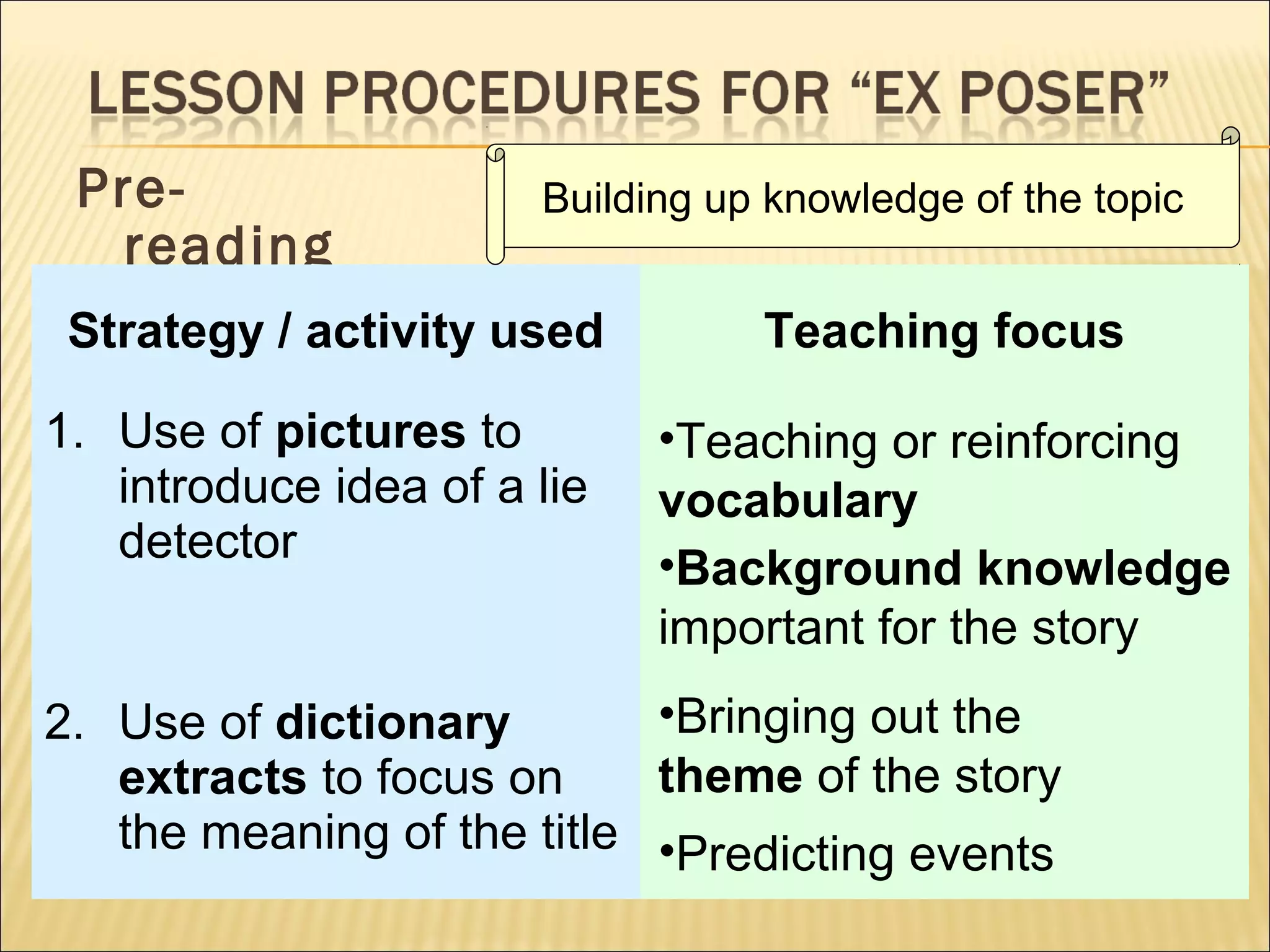
Prereading

Building up knowledge of the topic

Strategy / activity used
1. Use of pictures to
introduce idea of a lie
detector

Teaching focus
•Teaching or reinforcing
vocabulary
•Background knowledge
important for the story

•Bringing out the
2. Use of dictionary
theme of the story
extracts to focus on
the meaning of the title •Predicting events
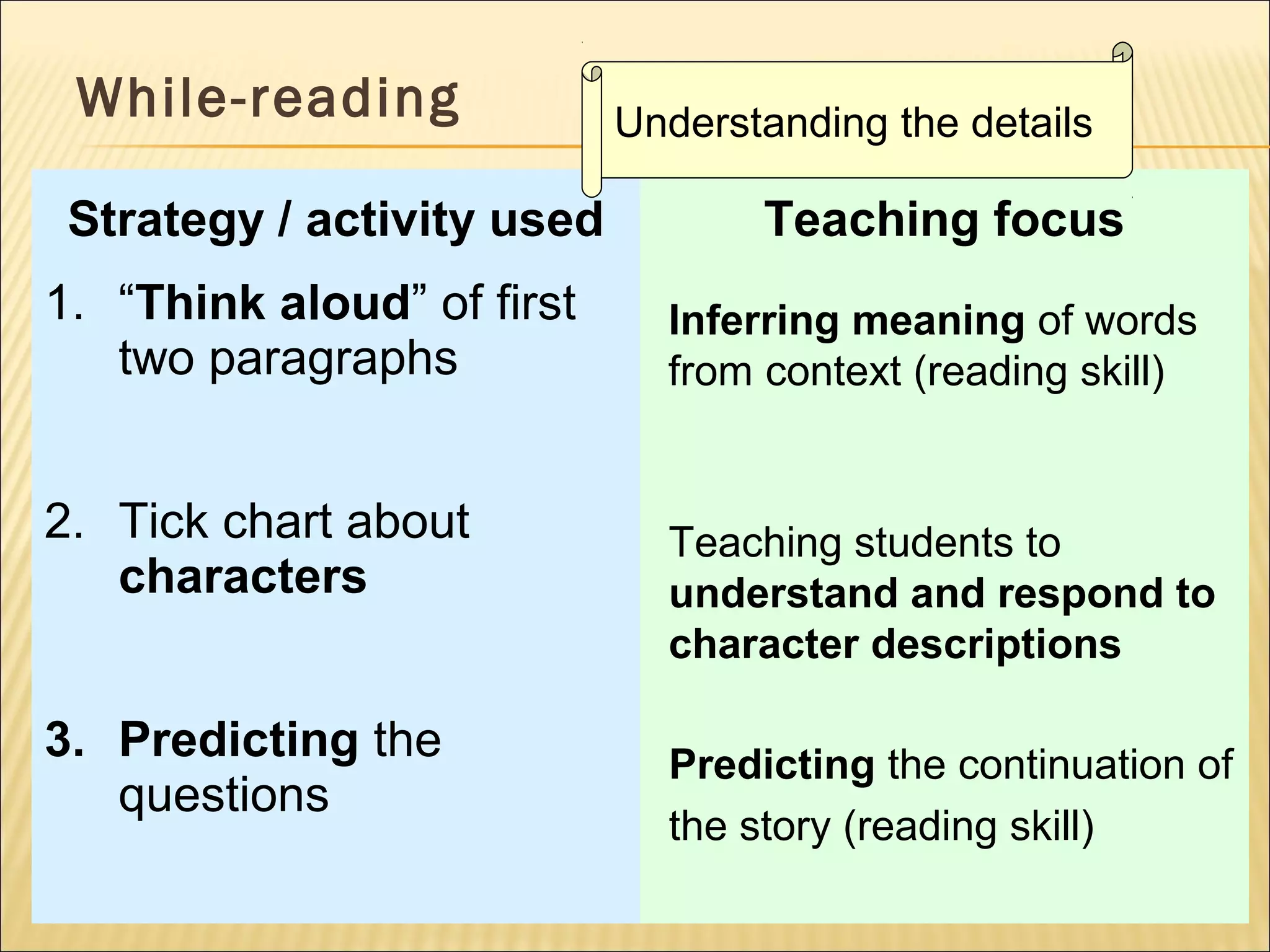
While-reading
Strategy / activity used
1. “Think aloud” of first
two paragraphs
2. Tick chart about
characters
3. Predicting the
questions

Understanding the details

Teaching focus
Inferring meaning of words
from context (reading skill)

Teaching students to
understand and respond to
character descriptions
Predicting the continuation of
the story (reading skill)
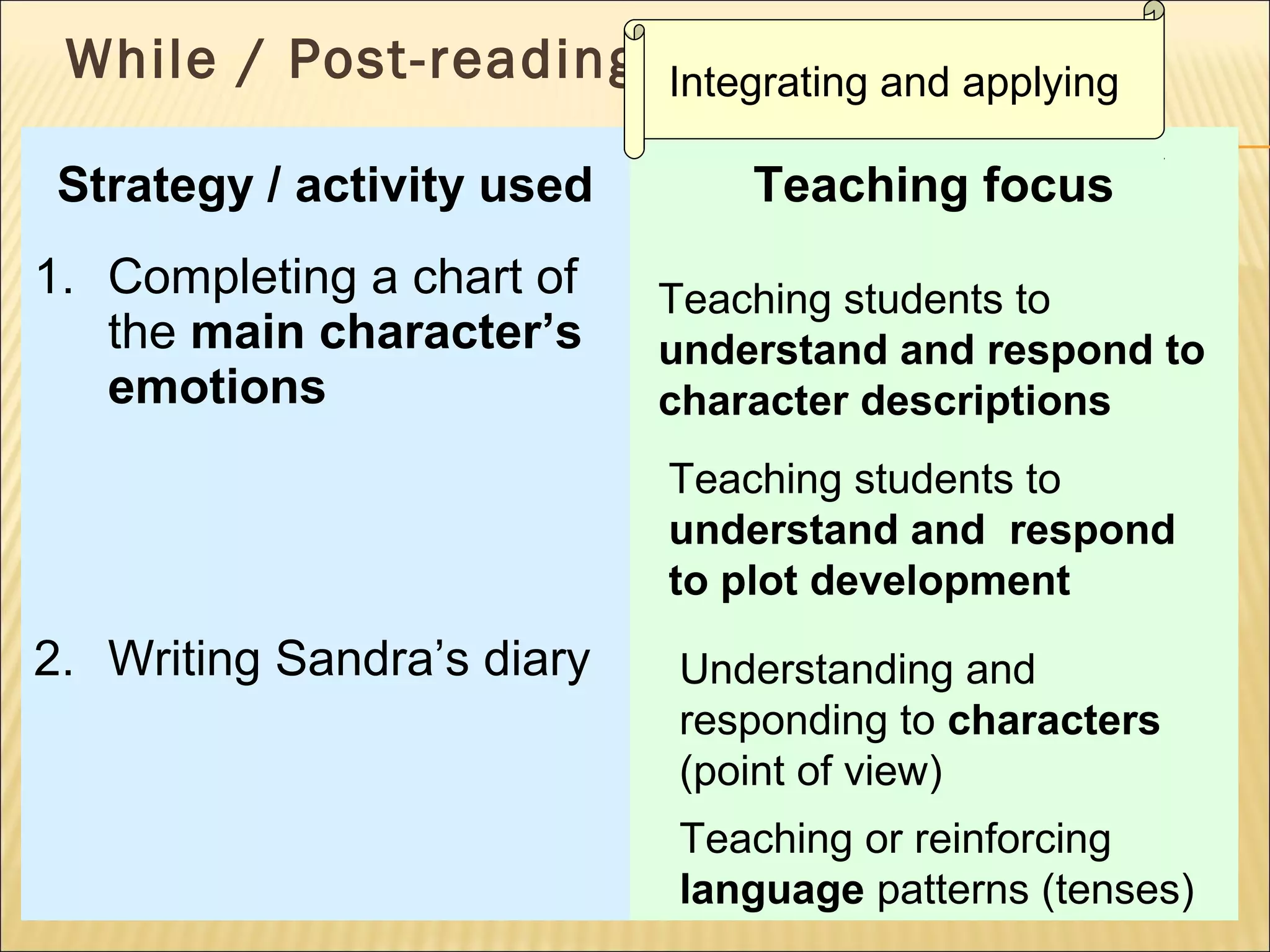
While / Post-reading
Strategy / activity used
1. Completing a chart of
the main character’s
emotions

Integrating and applying

Teaching focus
Teaching students to
understand and respond to
character descriptions
Teaching students to
understand and respond
to plot development

2. Writing Sandra’s diary

Understanding and
responding to characters
(point of view)
Teaching or reinforcing
language patterns (tenses)
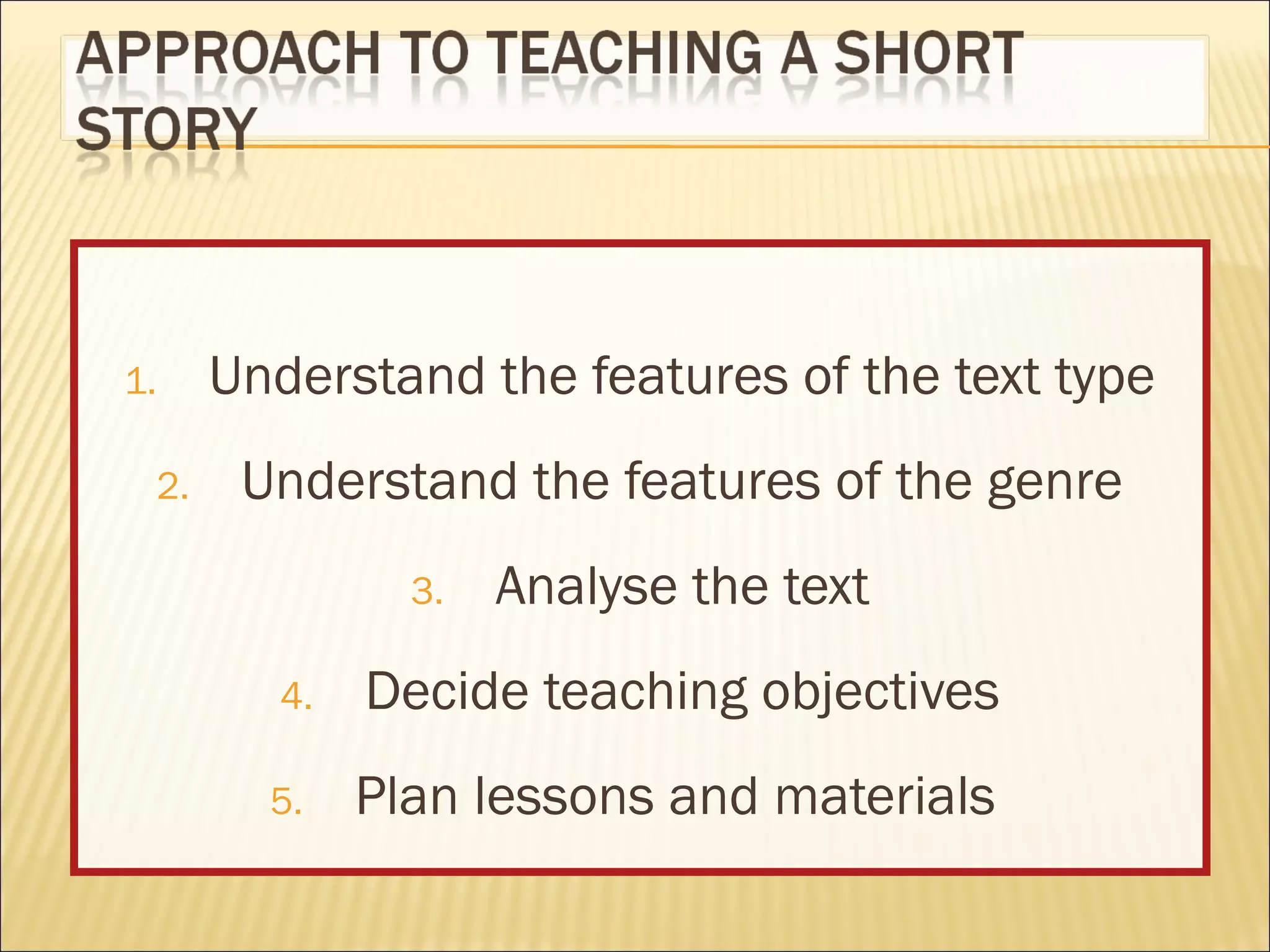
1.
2.

Understand the features of the text type
Understand the features of the genre
3.

Analyse the text

4.

Decide teaching objectives

5.

Plan lessons and materials
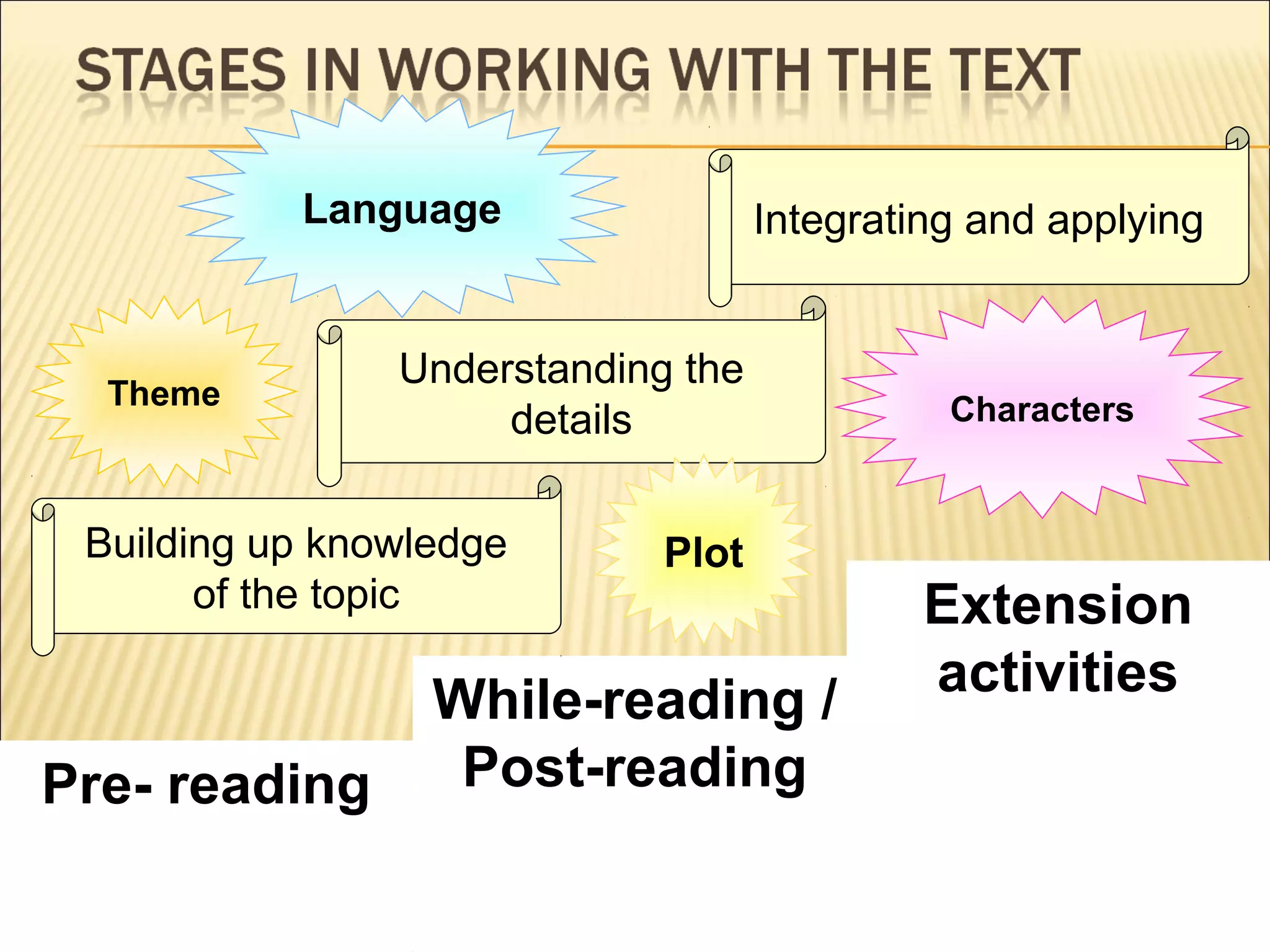
Language

Theme

Understanding the
details

Building up knowledge
of the topic

Pre- reading

Integrating and applying

Plot

While-reading /
Post-reading

Characters

Extension
activities
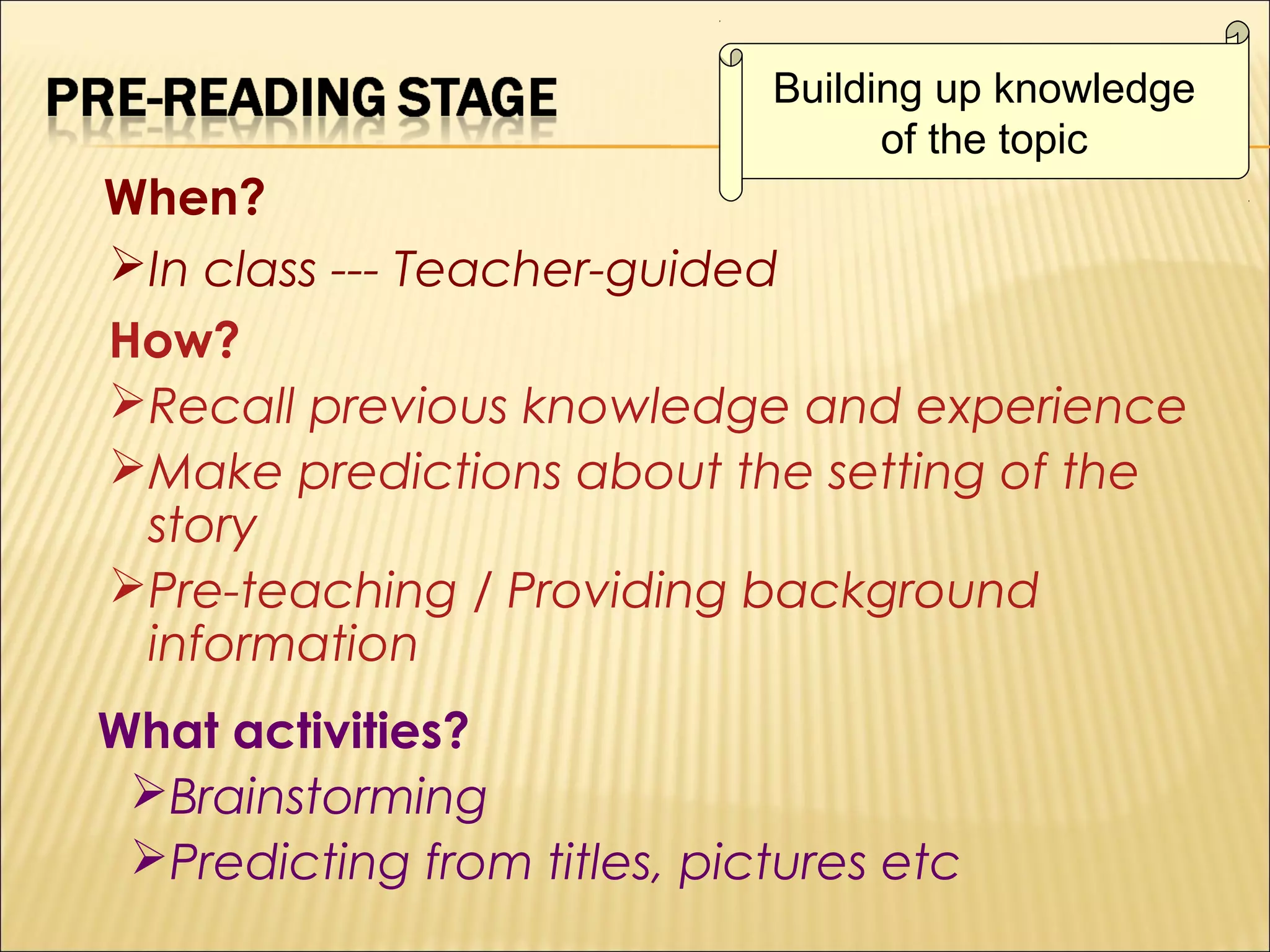
Building up knowledge
of the topic

When?
In class --- Teacher-guided
How?
Recall previous knowledge and experience
Make predictions about the setting of the
story
Pre-teaching / Providing background
information
What activities?
Brainstorming
Predicting from titles, pictures etc
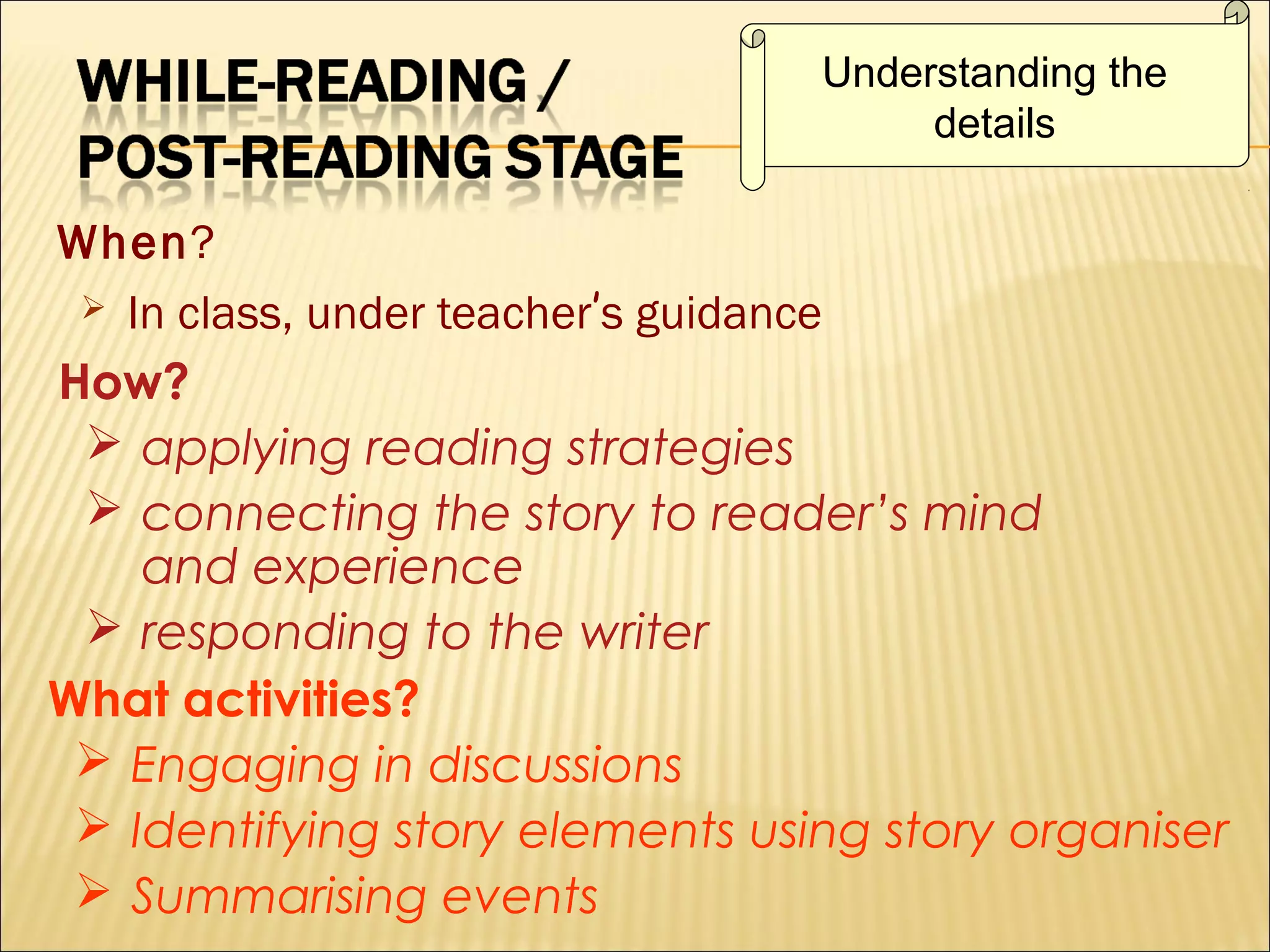
Understanding the
details

When?
 In class, under teacher’s guidance
How?
 applying reading strategies
 connecting the story to reader’s mind
and experience
 responding to the writer
What activities?
 Engaging in discussions
 Identifying story elements using story organiser
 Summarising events
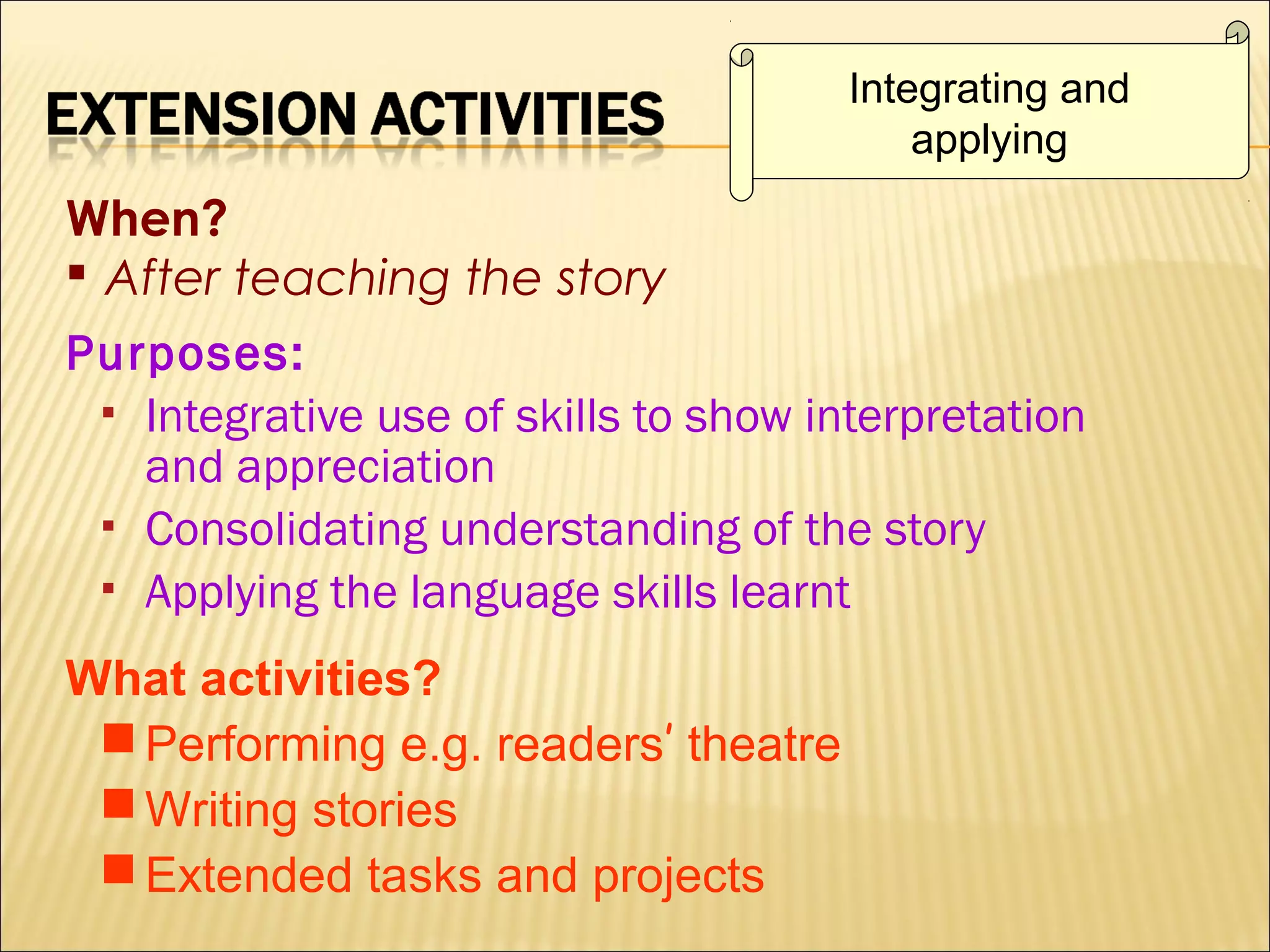
Integrating and
applying

When?
 After teaching the story
Purposes:
 Integrative use of skills to show interpretation
and appreciation
 Consolidating understanding of the story
 Applying the language skills learnt
What activities?
 Performing e.g. readers’ theatre
 Writing stories
 Extended tasks and projects
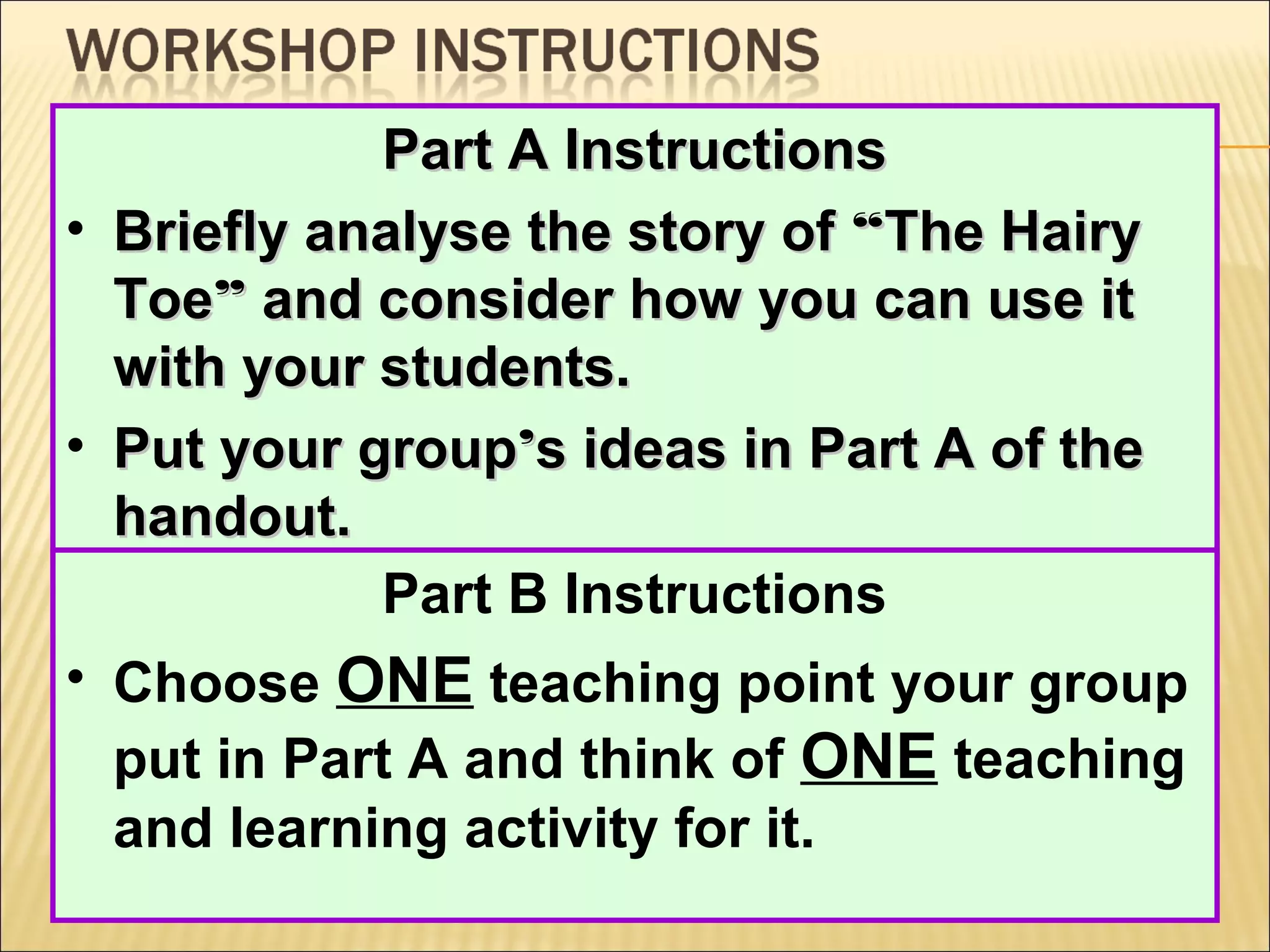
Part A Instructions
• Briefly analyse the story of “The Hairy
Toe” and consider how you can use it
with your students.
• Put your group’s ideas in Part A of the
handout.
Part B Instructions
• Choose ONE teaching point your group
put in Part A and think of ONE teaching
and learning activity for it.
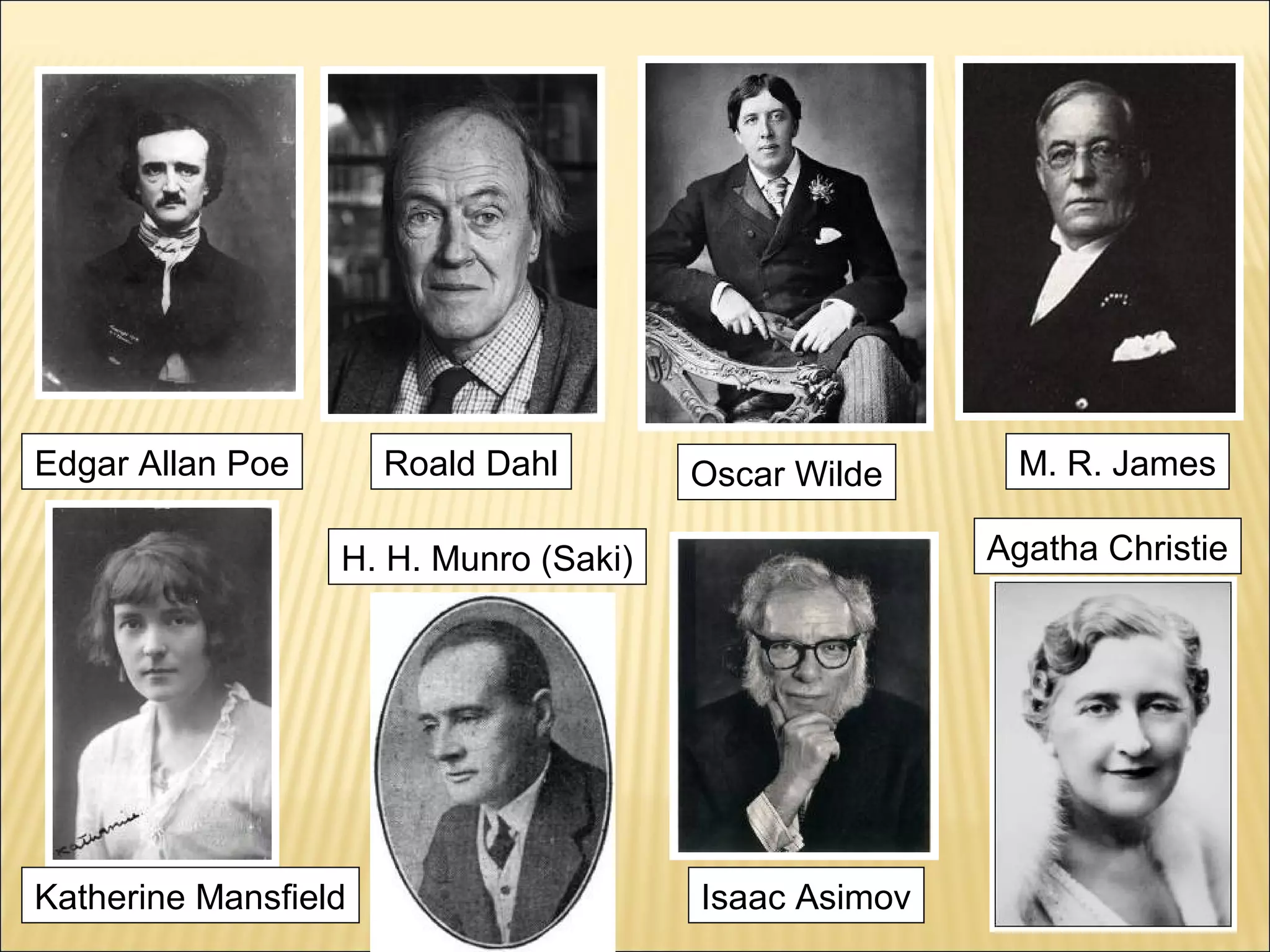
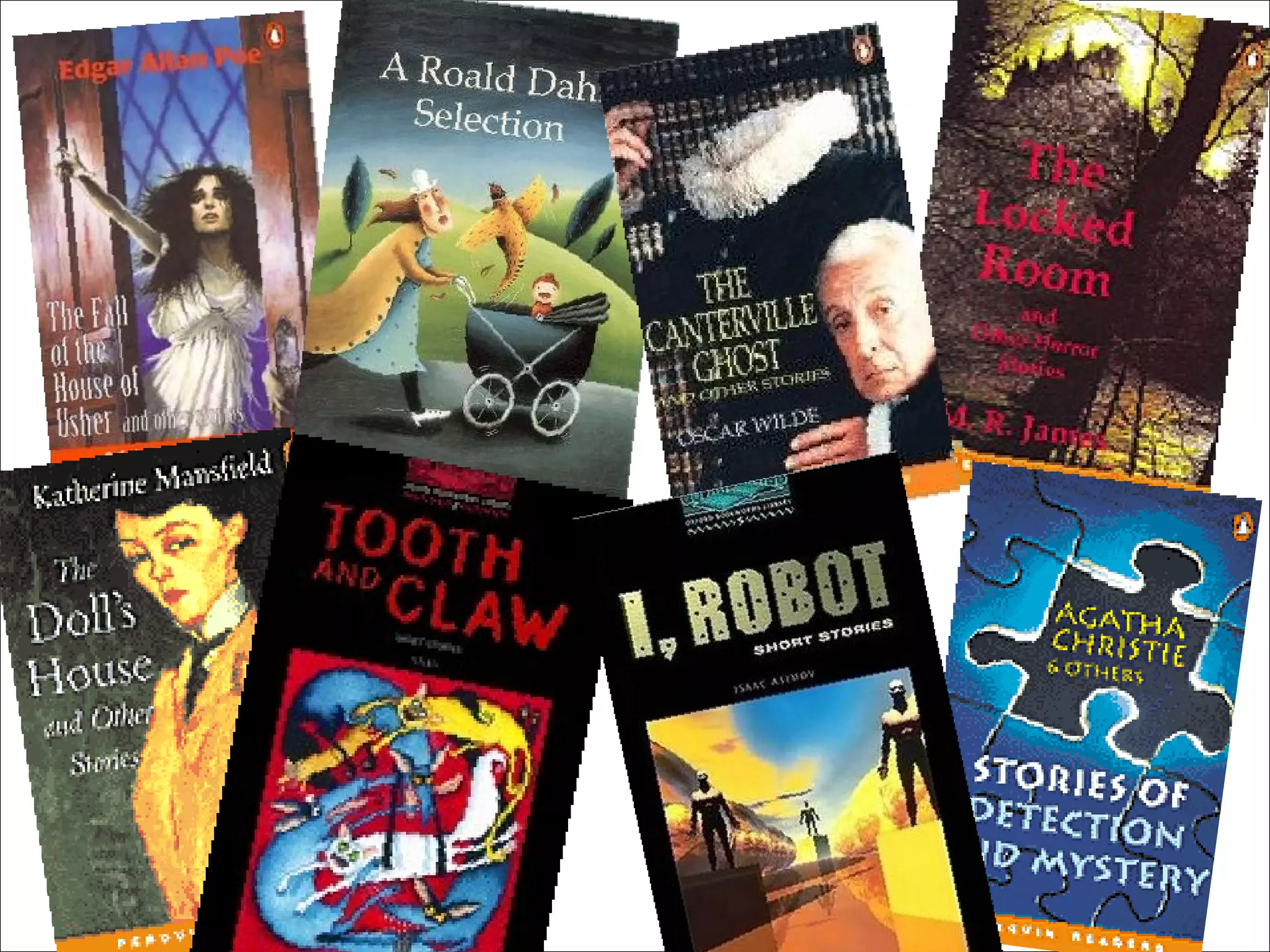
Edgar Allan Poe

Roald Dahl

Oscar Wilde

Agatha Christie

H. H. Munro (Saki)

Katherine Mansfield

M. R. James

Isaac Asimov
East of the Web: Short Stories Teaching Resources:
http://www.eastoftheweb.com/short-stories/teacher.html
BBC/British Council Teaching English: British Literature:
http://www.teachingenglish.org.uk/download/britlit/britlit.sht
ml
Merlyn’s Pen: http://www.merlynspen.org/
American Folklore:
http://www.americanfolklore.net/index.html
Story Arts: Storytelling Activities and Lesson Ideas:
http://www.storyarts.org/lessonplans/lessonideas/index.htm
l
Language Learning Support Section
http://cd1.edb.hkedcity.net/cd/languagesupport/article/inde
x_e.htm

Understanding and teaching short stories handout version

  • 3.
    A shor tstor y……..  can be read in one sitting (Edgar Allan Poe “The Philosophy of Composition” 1846)   is 1,000 – 20,000 words long has a limited set of characters, a single setting, and a simple plot
  • 4.
    •Responding to texts •Givingopinions •Justifying opinions •Knowledge of text features •Applying knowledge to their writing •Reading skills •Making inferences •Getting the main idea •Predicting events •Responding to characters •Responding to plot •Responding to themes •(writing, oral, performance)
  • 5.
        Fairy tales tendto be about royalty, fairies, wicked stepmothers, giants and talking animals. Settings often include castles, forests, cottages and the time is often “long ago” Events are magical and supernatural. The good live happily ever after at the end and the bad are punished in some way. Formulaic language, including rhyme and repetition, is common.
  • 6.
      Usually refers tothe stories told by Jesus in the New Testament They are used to explain difficult theological concepts in terms which people can easily understand
  • 7.
      Characters are usuallyanimals, plants, inanimate objects, or forces of nature which are given human qualities. They illustrate a moral lesson which is often expressed explicitly at the end Slow and steady wins the race!
  • 8.
        Myths tend tobe about gods or supernatural beings. Often tell about events from the distant past Sometimes creation stories or explain natural phenomena Legends are similar, but usually about heroes rather than gods.
  • 9.
       Folktales are similarto fairy tales, except that they usually concern ordinary people rather than royalty Values such as thrift, kindness, honesty and diligence are usually rewarded As with fairy tales, formulaic language is common
  • 10.
       Also called “mystery” genreor “whodunnits” Mystery plots always involve characters trying to discover a vital piece of information which is kept hidden until the climax. Solving crimes by the use of clues is common in this genre. Characters usually include detectives, criminals, or the police.
  • 11.
       Science fiction plotscommonly explore ideas like space travel, cloning, time travel, or aliens. Fantastical things happen but all have a scientific explanation.  No use of magic. Settings often include other planets, space ships, or futuristic cities. These may be described in detail Characters will often include robots, aliens, astronauts, or scientists
  • 12.
        The plot isalways a horror experience and it usually involves the intrusion of a supernatural element into everyday human experience. Characters are often ordinary but vulnerable people, such as children and women. Settings vary but they are usually secluded and isolated places. Atmosphere is often created by description of the setting.
  • 13.
       Plots of romancerevolve around two people as they develop romantic love for each other and work to build a relationship together. Both the conflict and the climax of the story should be directly related to that core theme of developing a romantic relationship. There is often a happy ending.
  • 14.
         Realistic fiction isusually set in modern times. It can also have a historical setting - events usually have something to do with an important historical event Characters will be ordinary, believable people. Stories may be funny or serious Dialogue will be realistic
  • 15.
    Traditional stories  “flat”characters  unspecified settings  simple and fast moving plot  ending is clear and usually happy  formulaic language  simple past tense  third person narration Modern stories  “round” characters  setting may be described in detail  may not be much background at beginning  ending may be inconclusive  present tenses may be used  first person narration can be used
  • 16.
    Setting   Location & time 5 Elements Style Writing techniques   Characters     The people& their relationships Plot/ story line Actions and events Theme Main or recurrent idea (could also be a lesson to learn)
  • 17.
    2. Complete thestory map Characters Settings Little Red Riding Hood Opening Themes and lessons Plot Ending Complication The Wolf eats Grandma and lies in her bed. Crisis
  • 18.
    Theme / PlotCharacters Language  Gradual Features • David reveals increase in himself through • First person tension during his thoughts narration the and attitudes to questioning others • Simple present process • David himself tense cannot  Twist ending interpret these, but the reader can
  • 19.
    Prereading Building up knowledgeof the topic Strategy / activity used 1. Use of pictures to introduce idea of a lie detector Teaching focus •Teaching or reinforcing vocabulary •Background knowledge important for the story •Bringing out the 2. Use of dictionary theme of the story extracts to focus on the meaning of the title •Predicting events
  • 20.
    While-reading Strategy / activityused 1. “Think aloud” of first two paragraphs 2. Tick chart about characters 3. Predicting the questions Understanding the details Teaching focus Inferring meaning of words from context (reading skill) Teaching students to understand and respond to character descriptions Predicting the continuation of the story (reading skill)
  • 21.
    While / Post-reading Strategy/ activity used 1. Completing a chart of the main character’s emotions Integrating and applying Teaching focus Teaching students to understand and respond to character descriptions Teaching students to understand and respond to plot development 2. Writing Sandra’s diary Understanding and responding to characters (point of view) Teaching or reinforcing language patterns (tenses)
  • 22.
    1. 2. Understand the featuresof the text type Understand the features of the genre 3. Analyse the text 4. Decide teaching objectives 5. Plan lessons and materials
  • 23.
    Language Theme Understanding the details Building upknowledge of the topic Pre- reading Integrating and applying Plot While-reading / Post-reading Characters Extension activities
  • 24.
    Building up knowledge ofthe topic When? In class --- Teacher-guided How? Recall previous knowledge and experience Make predictions about the setting of the story Pre-teaching / Providing background information What activities? Brainstorming Predicting from titles, pictures etc
  • 25.
    Understanding the details When?  Inclass, under teacher’s guidance How?  applying reading strategies  connecting the story to reader’s mind and experience  responding to the writer What activities?  Engaging in discussions  Identifying story elements using story organiser  Summarising events
  • 26.
    Integrating and applying When?  Afterteaching the story Purposes:  Integrative use of skills to show interpretation and appreciation  Consolidating understanding of the story  Applying the language skills learnt What activities?  Performing e.g. readers’ theatre  Writing stories  Extended tasks and projects
  • 27.
    Part A Instructions •Briefly analyse the story of “The Hairy Toe” and consider how you can use it with your students. • Put your group’s ideas in Part A of the handout. Part B Instructions • Choose ONE teaching point your group put in Part A and think of ONE teaching and learning activity for it.
  • 28.
    Edgar Allan Poe RoaldDahl Oscar Wilde Agatha Christie H. H. Munro (Saki) Katherine Mansfield M. R. James Isaac Asimov
  • 30.
    East of theWeb: Short Stories Teaching Resources: http://www.eastoftheweb.com/short-stories/teacher.html BBC/British Council Teaching English: British Literature: http://www.teachingenglish.org.uk/download/britlit/britlit.sht ml Merlyn’s Pen: http://www.merlynspen.org/ American Folklore: http://www.americanfolklore.net/index.html Story Arts: Storytelling Activities and Lesson Ideas: http://www.storyarts.org/lessonplans/lessonideas/index.htm l Language Learning Support Section http://cd1.edb.hkedcity.net/cd/languagesupport/article/inde x_e.htm

Editor's Notes

  • #17 Writing technique ------- sentence structure, diction, use of dialogues, imagery, author’s points of view Characters ---- the people and their relationship family background, education, personality, their beliefs and feelings, how s/he feels, what s/he does and say What others do to her/him, what they say about him/her, how the author describe him/her
  • #18 The plot of a story refers to the sequence of events involving characters in conflict situations. Very often it is based on the goals of one or more characters and the processes they go through to attain these goals. The main characters want to achieve a goal, and other characters are introduced to oppose the main characters or prevent them from being successful. The story events are put in motion by characters as they attempt to overcome conflict, reach their goals, and solve their problems.