Professor Adia Edwards, M.A.
In this course, we have two major goals:
1. To identify and analyze the literary
characteristics from a cross-cultural sample
of American short stories and novels:
presentation of setting, conflict,
characterization, dialogue, theme,
figurative language, and symbol.
2. To demonstrate literary judgment by
applying the techniques of analyses,
criticism, and evaluation in critical essays.
In the book, Zenzele: A Letter to my Daughter
Zimbabwean writer N. Nozipo Maire writes,
“What is a life after all but a story- some
truth and some fiction. In the end
there are words- they are the very
manifestations of our immortality.”
Basically, we ALL have a story to tell and even
when we die, our stories will live on through
words (written and oral). Examples include:
 Our obituaries
 Stories our families tell about us
 Journals/Diaries
 Gossip that is passed in communities
WORDS OUTLIVE US!
People have been telling stories orally since
the beginning of time to teach, to entertain
and even to explain events.
Then people began to draw pictures along with
their stories & they saved these writings to
share with later generations.
 Now people all over the world create and
share stories with one another.
 Fiction allows us to use our imaginations.
 When we read fiction, we are reading stories
that are created (fake characters, imaginary
places, etc.)
 Sometimes they are based on the truth but
the author may add untrue elements.
 We will look at stories across different
cultures.
 We will read about 7 short stories & one
novel by the critically-acclaimed African-
American writer Toni Morrison.
 We will try to make connections between the
stories we read- the characters, settings,
etc. and learn from them.
 We are going to read for meaning, to
understand the characters and their lives.
 Please take lots of notes when you read.
 Read each story twice to really get the
meaning.
 We will look critically at each story.
 We will examine certain literary elements in
each story.
 In this class, we will examine these literary
characteristics or parts that make up a story:
 Setting
 Conflict
 Characterization
 Plot
 Theme
 Figurative language
 Symbolism
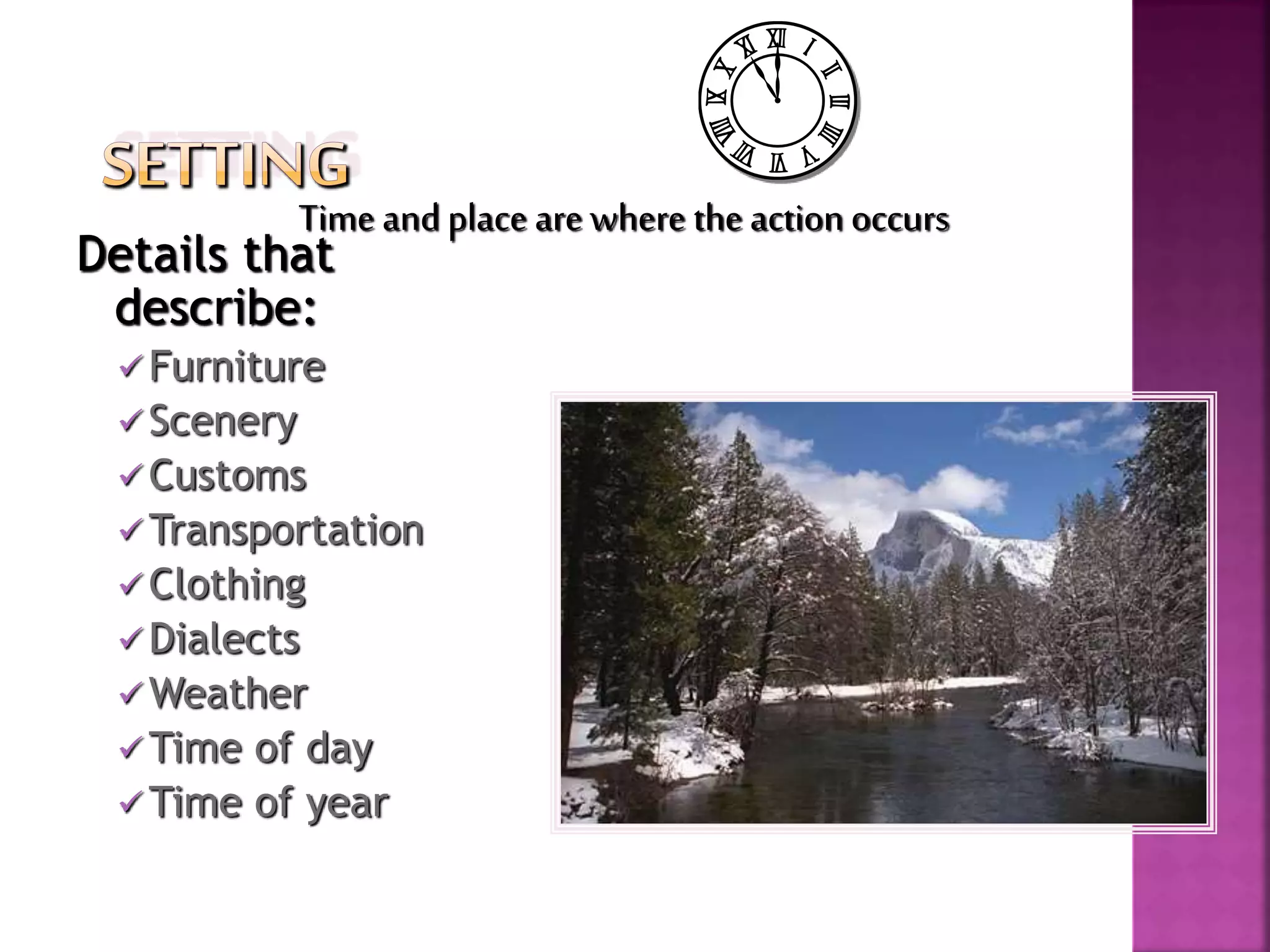
Details that
describe:
 Furniture
 Scenery
 Customs
 Transportation
 Clothing
 Dialects
 Weather
 Time of day
 Time of year
Time and place are where the action occurs
Setting
Place
Atmosphere
Time
History
EraLife
Mood
Weather
Feelings
Word
Choice
Location
Physical
Day
Use as activator to activate prior knowledge. Write
the web on the board or overhead and students
create one at their seats. Then as class share and fill
in.
 To create a mood or
atmosphere
 To show a reader a
different way of life
 To make action seem
more real
 To be the source of
conflict or struggle
 To symbolize an idea
We left the home place behind,
mile by slow mile, heading for the
mountains, across the prairie where the
wind blew forever.
At first there were four of us with
one horse wagon and its skimpy load.
Pa and I walked, because I was a big boy
of eleven. My two little sisters romped
and trotted until they got tired and had
to be boosted up to the wagon bed.
That was no covered Conestoga,
like Pa’s folks came West in, but just an
old farm wagon, drawn by one weary
horse, creaking and rumbling westward
to the mountains, toward the little
woods town where Pa thought he had an
old uncle who owned a little two-bit
sawmill.
Taken from “The Day the Sun Came Out” by D.
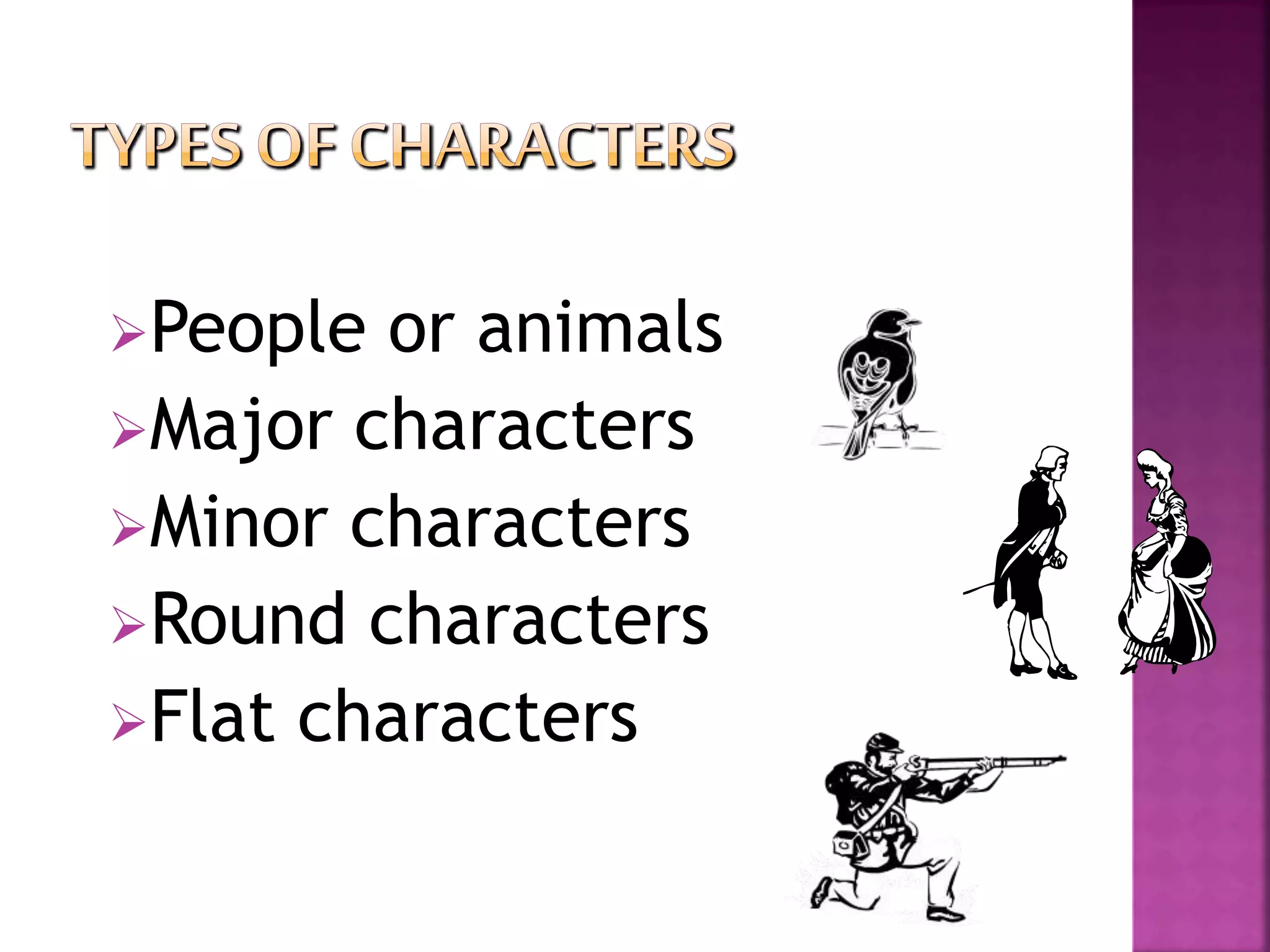
People or animals
Major characters
Minor characters
Round characters
Flat characters
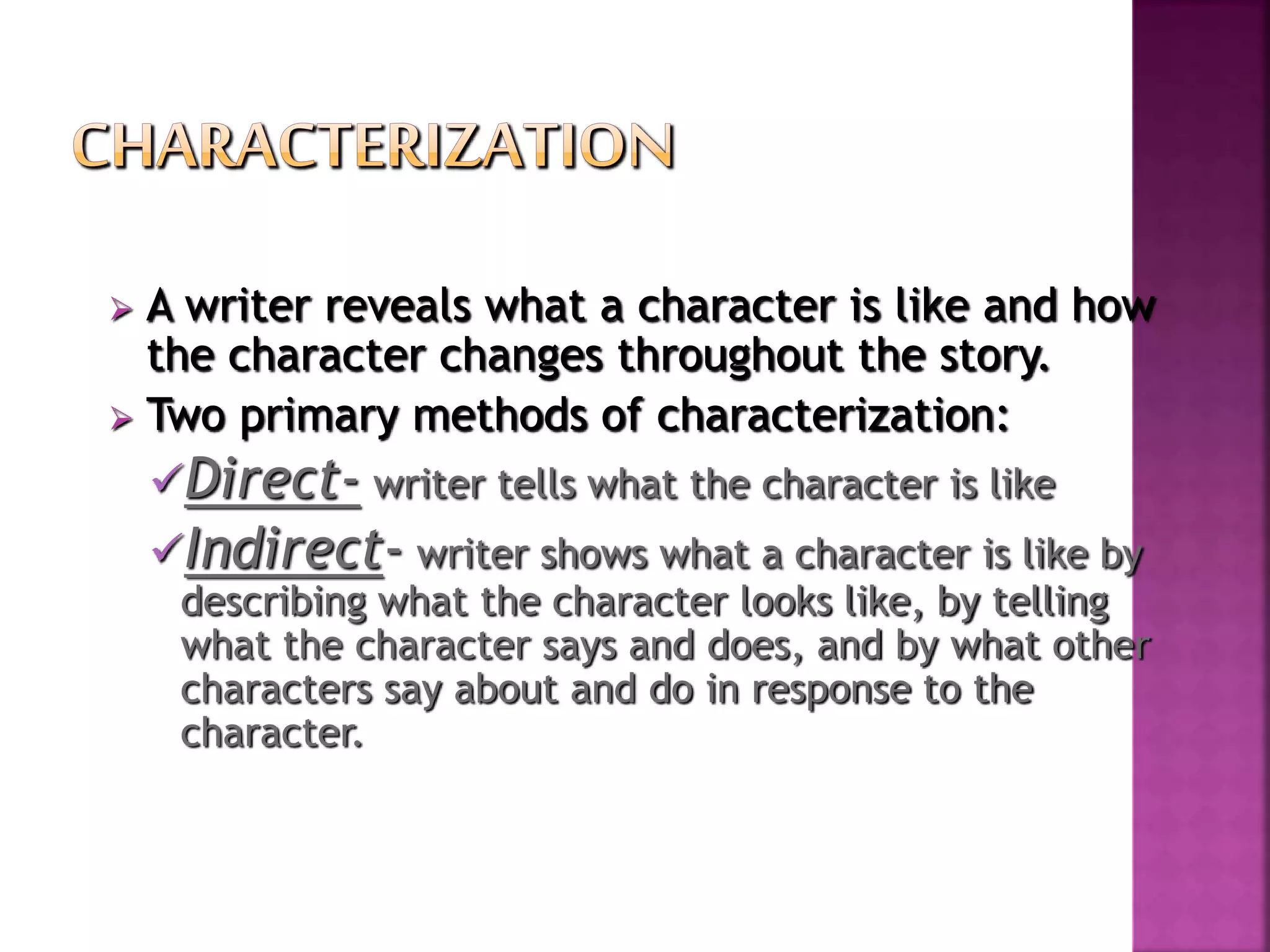
 A writer reveals what a character is like and how
the character changes throughout the story.
 Two primary methods of characterization:
Direct- writer tells what the character is like
Indirect- writer shows what a character is like by
describing what the character looks like, by telling
what the character says and does, and by what other
characters say about and do in response to the
character.
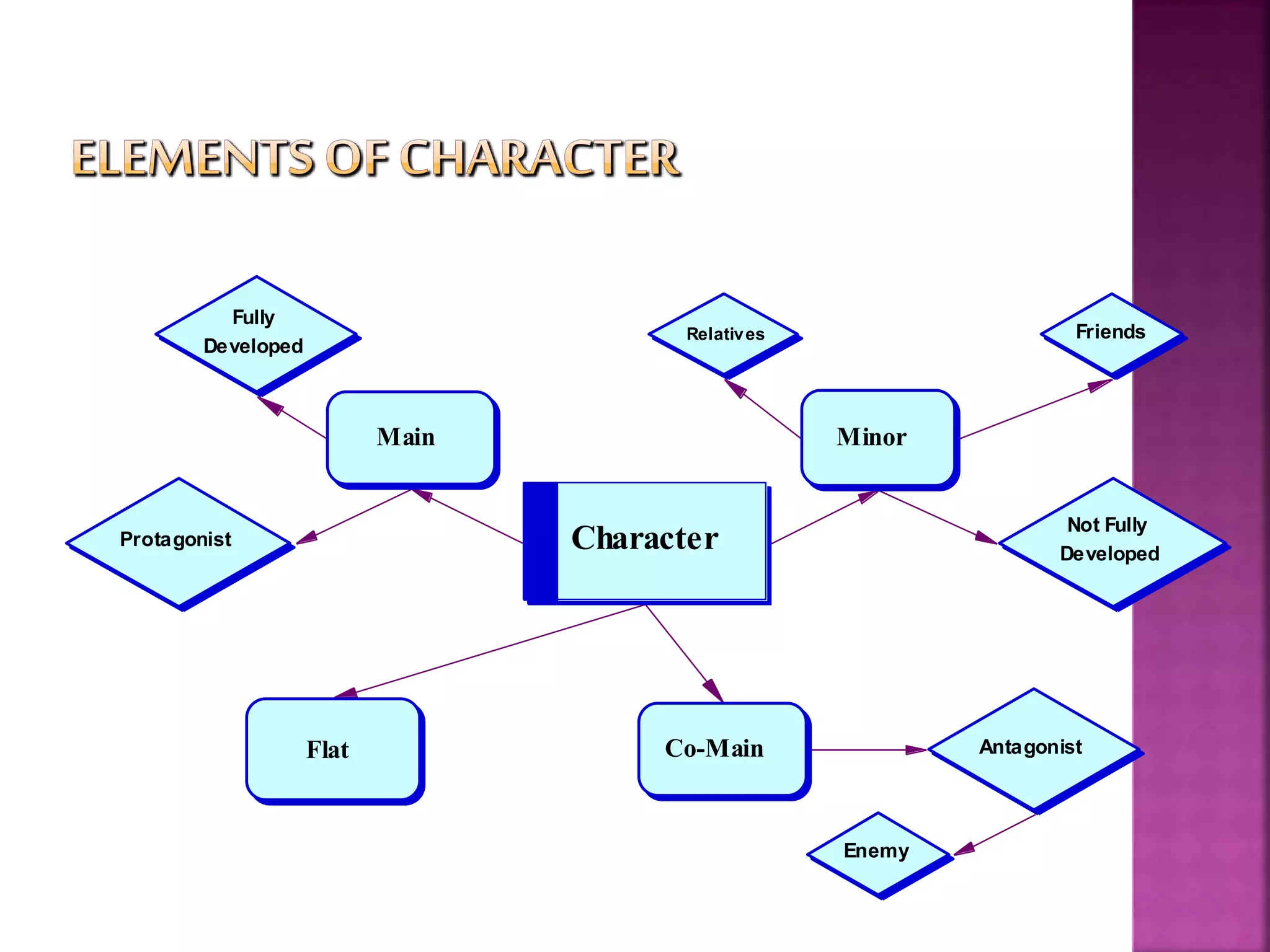
Character
Main
Flat
Minor
Not Fully
Developed
FriendsRelatives
Fully
Developed
Protagonist
AntagonistCo-Main
Enemy
 Physical appearance of character
 Personality
 Background/personal history
 Motivation
 Relationships
 Conflict
 Does character change?
Plot is what happens and how
it happens in a narrative. A
narrative is any work that tells
a story, such as a short story, a
novel, a drama, or a narrative
poem.
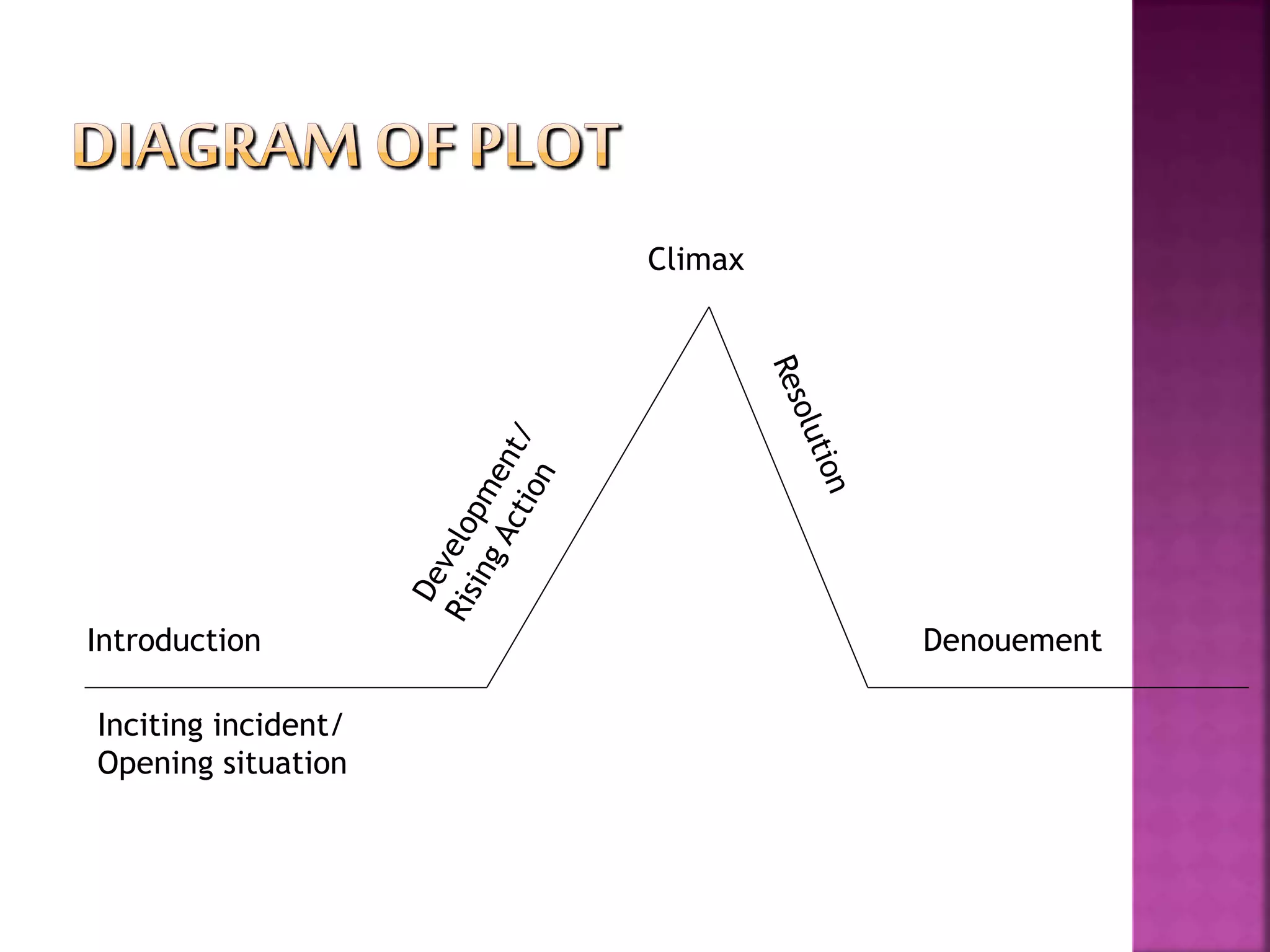
Inciting incident/
Opening situation
Introduction
Climax
Denouement
 Suspense- excitement or tension
 Foreshadowing- hint or clue about what will
happen in story
 Flashback- interrupts the normal sequence of
events to tell about something that
happened in the past
 Surprise Ending- conclusion that reader does
not expect
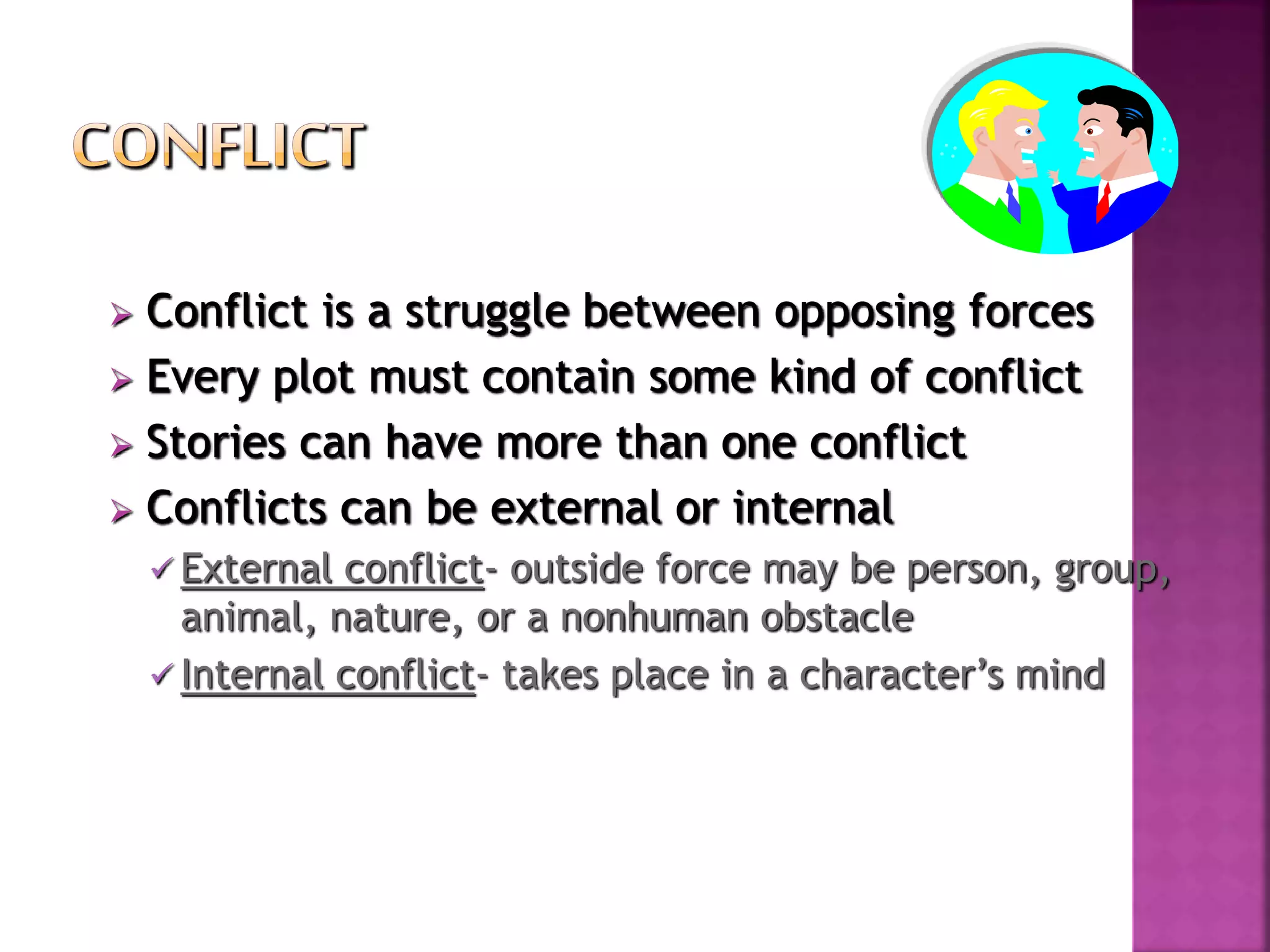
 Conflict is a struggle between opposing forces
 Every plot must contain some kind of conflict
 Stories can have more than one conflict
 Conflicts can be external or internal
 External conflict- outside force may be person, group,
animal, nature, or a nonhuman obstacle
 Internal conflict- takes place in a character’s mind
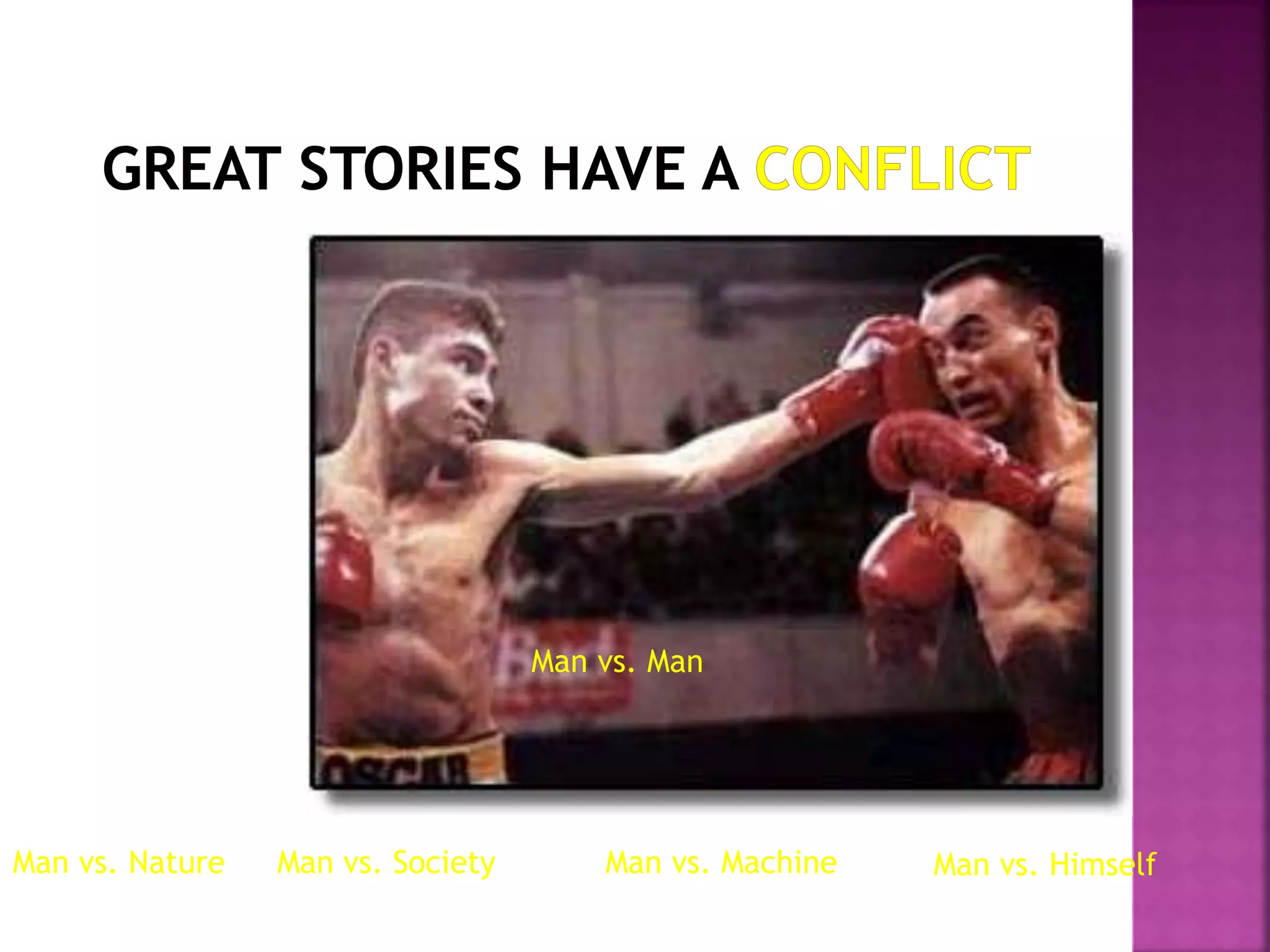
Man vs. Man
Man vs. Nature Man vs. Society Man vs. HimselfMan vs. Machine
A central message, concern, or
insight into life expressed through
a literary work
Can be expressed by one or two
sentence statement about human
beings or about life
May be stated directly or implied
Interpretation uncovers the theme
“Every man needs to feel
allegiance to his native country,
whether he always appreciates
that country or not.”
From “A Man Without a Country” by Edward Hale
pg. 185 in Prentice Hall Literature book
 Figurative Language is language that does
not mean exactly what it says.
 For example, you can call someone that is
very angry, “steaming.”
 Unless steam was actually coming out of your
ears, you were using figurative language.
 Involves imaginative words that use the
senses.
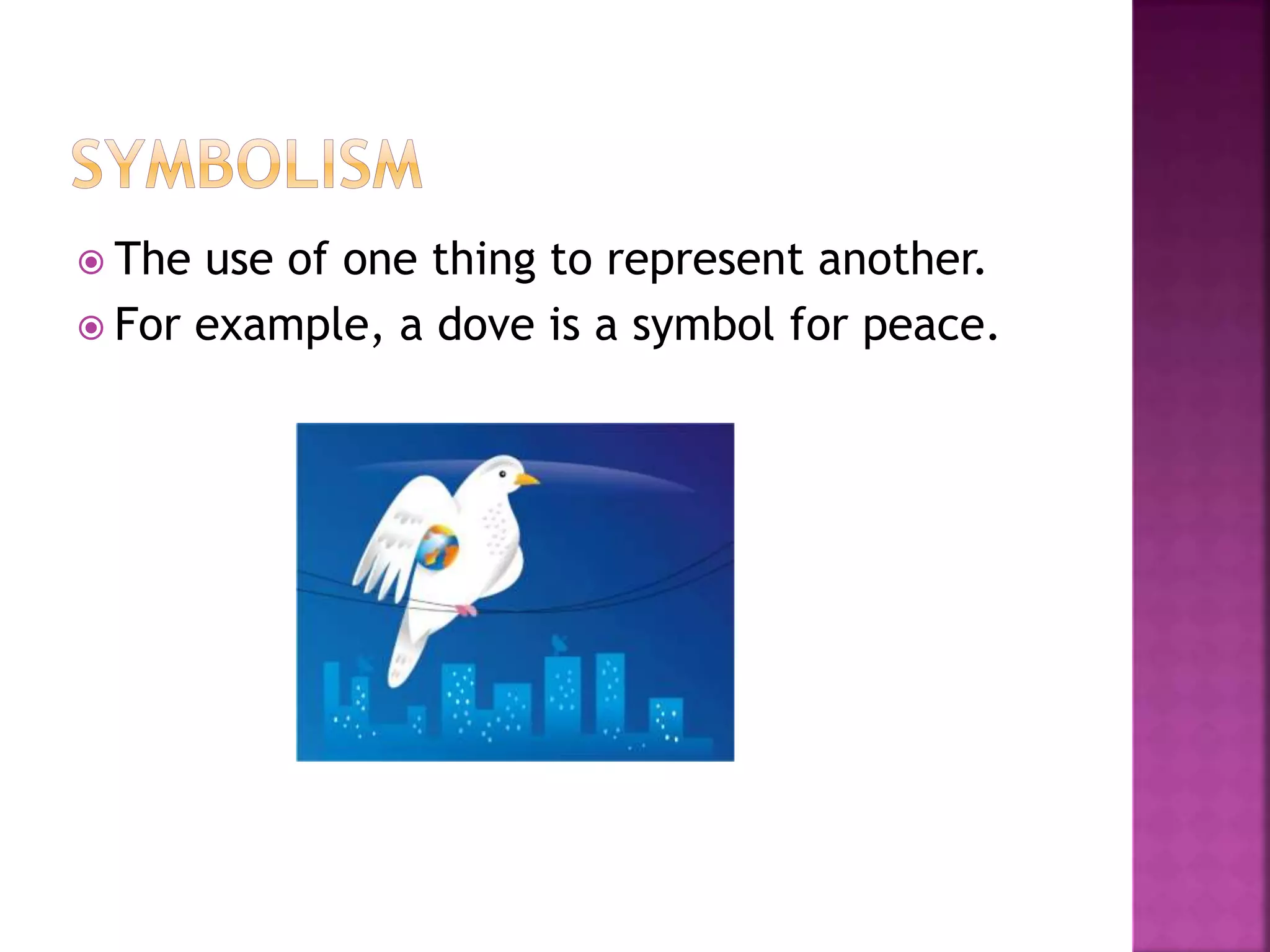
 The use of one thing to represent another.
 For example, a dove is a symbol for peace.
 This week you will read the short story, “The
Tell-Tale Heart.”
 In addition, you will read the first section of
the novel, The Bluest Eye
 Write a one-page typed response paper to
what you have read.
 Include this information in your response:
 Give a short (one paragraph) summary of what
you read for both or one of the selections
 How did you like the character(s)?
 Where did the story take place?
 What did you like or dislike about what you read?
 You can earn up to 15 points each week for
your reading response paper.
 You will be graded on completeness and the
quality of your thought (not grammar).
 Take a moment to proofread your response.
 Each response should be double-spaced,
Times New Roman 12 font.
 E-mail your instructor your reading response
via an attachment each week by Friday at
midnight.
 Two points are automatically deducted per
day for responses handed in AFTER Friday.
 You can earn 15 Points each week for
engaging in dialogue on the Discussion Board.
 Give your insights and thoughts, be honest
while being respectful of your classmates.
 Do not simply repeat or “copy” what one of
your classmates wrote.
 You can post on the discussion forum from
Tuesday evening until Sunday evening each
week.
Enjoy reading “The Tell-Tale Heart” and
“The Bluest Eye”

English 220 week #1.pptm

  • 1.
  • 2.
    In this course,we have two major goals: 1. To identify and analyze the literary characteristics from a cross-cultural sample of American short stories and novels: presentation of setting, conflict, characterization, dialogue, theme, figurative language, and symbol. 2. To demonstrate literary judgment by applying the techniques of analyses, criticism, and evaluation in critical essays.
  • 4.
    In the book,Zenzele: A Letter to my Daughter Zimbabwean writer N. Nozipo Maire writes, “What is a life after all but a story- some truth and some fiction. In the end there are words- they are the very manifestations of our immortality.”
  • 5.
    Basically, we ALLhave a story to tell and even when we die, our stories will live on through words (written and oral). Examples include:  Our obituaries  Stories our families tell about us  Journals/Diaries  Gossip that is passed in communities WORDS OUTLIVE US!
  • 6.
    People have beentelling stories orally since the beginning of time to teach, to entertain and even to explain events. Then people began to draw pictures along with their stories & they saved these writings to share with later generations.
  • 7.
     Now peopleall over the world create and share stories with one another.  Fiction allows us to use our imaginations.  When we read fiction, we are reading stories that are created (fake characters, imaginary places, etc.)  Sometimes they are based on the truth but the author may add untrue elements.
  • 8.
     We willlook at stories across different cultures.  We will read about 7 short stories & one novel by the critically-acclaimed African- American writer Toni Morrison.  We will try to make connections between the stories we read- the characters, settings, etc. and learn from them.
  • 9.
     We aregoing to read for meaning, to understand the characters and their lives.  Please take lots of notes when you read.  Read each story twice to really get the meaning.  We will look critically at each story.  We will examine certain literary elements in each story.
  • 10.
     In thisclass, we will examine these literary characteristics or parts that make up a story:  Setting  Conflict  Characterization  Plot  Theme  Figurative language  Symbolism
  • 11.
    Details that describe:  Furniture Scenery  Customs  Transportation  Clothing  Dialects  Weather  Time of day  Time of year Time and place are where the action occurs
  • 12.
    Setting Place Atmosphere Time History EraLife Mood Weather Feelings Word Choice Location Physical Day Use as activatorto activate prior knowledge. Write the web on the board or overhead and students create one at their seats. Then as class share and fill in.
  • 13.
     To createa mood or atmosphere  To show a reader a different way of life  To make action seem more real  To be the source of conflict or struggle  To symbolize an idea We left the home place behind, mile by slow mile, heading for the mountains, across the prairie where the wind blew forever. At first there were four of us with one horse wagon and its skimpy load. Pa and I walked, because I was a big boy of eleven. My two little sisters romped and trotted until they got tired and had to be boosted up to the wagon bed. That was no covered Conestoga, like Pa’s folks came West in, but just an old farm wagon, drawn by one weary horse, creaking and rumbling westward to the mountains, toward the little woods town where Pa thought he had an old uncle who owned a little two-bit sawmill. Taken from “The Day the Sun Came Out” by D.
  • 14.
    People or animals Majorcharacters Minor characters Round characters Flat characters
  • 15.
     A writerreveals what a character is like and how the character changes throughout the story.  Two primary methods of characterization: Direct- writer tells what the character is like Indirect- writer shows what a character is like by describing what the character looks like, by telling what the character says and does, and by what other characters say about and do in response to the character.
  • 16.
  • 17.
     Physical appearanceof character  Personality  Background/personal history  Motivation  Relationships  Conflict  Does character change?
  • 18.
    Plot is whathappens and how it happens in a narrative. A narrative is any work that tells a story, such as a short story, a novel, a drama, or a narrative poem.
  • 19.
  • 20.
     Suspense- excitementor tension  Foreshadowing- hint or clue about what will happen in story  Flashback- interrupts the normal sequence of events to tell about something that happened in the past  Surprise Ending- conclusion that reader does not expect
  • 21.
     Conflict isa struggle between opposing forces  Every plot must contain some kind of conflict  Stories can have more than one conflict  Conflicts can be external or internal  External conflict- outside force may be person, group, animal, nature, or a nonhuman obstacle  Internal conflict- takes place in a character’s mind
  • 22.
    Man vs. Man Manvs. Nature Man vs. Society Man vs. HimselfMan vs. Machine
  • 23.
    A central message,concern, or insight into life expressed through a literary work Can be expressed by one or two sentence statement about human beings or about life May be stated directly or implied Interpretation uncovers the theme
  • 24.
    “Every man needsto feel allegiance to his native country, whether he always appreciates that country or not.” From “A Man Without a Country” by Edward Hale pg. 185 in Prentice Hall Literature book
  • 25.
     Figurative Languageis language that does not mean exactly what it says.  For example, you can call someone that is very angry, “steaming.”  Unless steam was actually coming out of your ears, you were using figurative language.  Involves imaginative words that use the senses.
  • 26.
     The useof one thing to represent another.  For example, a dove is a symbol for peace.
  • 27.
     This weekyou will read the short story, “The Tell-Tale Heart.”  In addition, you will read the first section of the novel, The Bluest Eye  Write a one-page typed response paper to what you have read.
  • 28.
     Include thisinformation in your response:  Give a short (one paragraph) summary of what you read for both or one of the selections  How did you like the character(s)?  Where did the story take place?  What did you like or dislike about what you read?
  • 29.
     You canearn up to 15 points each week for your reading response paper.  You will be graded on completeness and the quality of your thought (not grammar).  Take a moment to proofread your response.
  • 30.
     Each responseshould be double-spaced, Times New Roman 12 font.  E-mail your instructor your reading response via an attachment each week by Friday at midnight.  Two points are automatically deducted per day for responses handed in AFTER Friday.
  • 31.
     You canearn 15 Points each week for engaging in dialogue on the Discussion Board.  Give your insights and thoughts, be honest while being respectful of your classmates.  Do not simply repeat or “copy” what one of your classmates wrote.  You can post on the discussion forum from Tuesday evening until Sunday evening each week.
  • 32.
    Enjoy reading “TheTell-Tale Heart” and “The Bluest Eye”