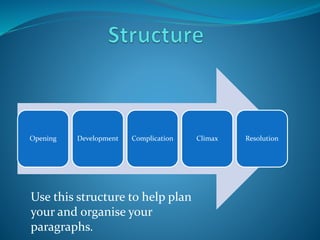
Opening Development Complication Climax Resolution 
Use this structure to help plan 
your and organise your 
paragraphs.
Opening 
Introduce your characters and setting. This is where the 
threads of the story are started. 
The young wizard went for a walk in the 
enchanted forest. As he was leaving, his 
teacher Merlin offered some advice: 
“ Remember it’s an enchanted forest. Don’t 
stray from the main path!”
Development 
 Explain the events that lead up to the big dilema in the 
story. 
 Give more information about the characters and the 
setting. 
 The threads of the story begin to get tangled. 
It was getting late and Roger was starting 
to fell hungry. He decided to ignore his 
master’s advice and take a short cut .
Complication 
 This is the heart of your story and explains the problem 
your characters have to overcome. 
 The threads of the story begin to get tangled, almost like a 
knot. 
Sudenly, the forest got darker and the 
spooky,trees seemed to be moving, clawing at 
him with their branches! Roger was scaredand 
lost. He didn’t know what to do. He started 
to cry.
Climax 
 This is the most exciting part of the story where all the 
action happens 
He ran trying to escape the bracnches. 
Everywhere he turned his path was 
blocked by terrifying trees.
Resolution 
 This is where the problem is solved or not. 
 This is where the bits of the story are untangled and 
tied together. 
All of a sudden a bright light appeared 
before him. Merlin appeared. He waved 
his wand and the trees became as still as 
statues. He was saved!!!
Make your work come to life with varied and interesting language 
Adjectives 
Connectors 
Adverbs 
Similes 
Alliteration 
Dialogue 
Onomatopeia
Adjectives 
Adjectives are describing words used with nouns. 
Make your work more lively and interesting by 
using them. 
The witch becomes the scary, old witch.
Connectors 
Connectors are linking words . Make your work 
more fluid by using them. 
He wanted to go to the cinema. He couldn’t because he had 
no money. 
He wanted to go to the cinema however he couldn’t because 
he had no money.
Adverbs 
Adverbs are describing words used with verbs. 
Make your work more lively and interesting by 
using them. 
He looked at the boy. 
H e looked angrily at the boy.
Similes 
Similes are used to describe something in a way 
that readers can visualize it. They add effect to 
your writing. 
The cake was as big as an elephant!
Alliteration 
Alliteration is when words beginning with the 
same letter are used together. These are used to 
create interest and add effect. 
The slithering snake slid across the floor.
Dialogue 
Dialogue is when you write about what characters 
said to each other. You can use it to create 
interaction between the characters, move the 
story along and to explain parts of the story 
Top tip: vary your work by using alternatives to said 
and adverbs together 
“What are you doing?” asked the policeman suspiciously . 
“Sorry, I am lost I don’t know where the bus station is.” replied the boy 
nervously.
Onomatopeia 
Onomatopeia is when you use words that sound 
like the noises they describe. 
The ducks in the pond quacked with delight.

Compose a course paper

  • 2.
    Opening Development ComplicationClimax Resolution Use this structure to help plan your and organise your paragraphs.
  • 3.
    Opening Introduce yourcharacters and setting. This is where the threads of the story are started. The young wizard went for a walk in the enchanted forest. As he was leaving, his teacher Merlin offered some advice: “ Remember it’s an enchanted forest. Don’t stray from the main path!”
  • 4.
    Development  Explainthe events that lead up to the big dilema in the story.  Give more information about the characters and the setting.  The threads of the story begin to get tangled. It was getting late and Roger was starting to fell hungry. He decided to ignore his master’s advice and take a short cut .
  • 5.
    Complication  Thisis the heart of your story and explains the problem your characters have to overcome.  The threads of the story begin to get tangled, almost like a knot. Sudenly, the forest got darker and the spooky,trees seemed to be moving, clawing at him with their branches! Roger was scaredand lost. He didn’t know what to do. He started to cry.
  • 6.
    Climax  Thisis the most exciting part of the story where all the action happens He ran trying to escape the bracnches. Everywhere he turned his path was blocked by terrifying trees.
  • 7.
    Resolution  Thisis where the problem is solved or not.  This is where the bits of the story are untangled and tied together. All of a sudden a bright light appeared before him. Merlin appeared. He waved his wand and the trees became as still as statues. He was saved!!!
  • 8.
    Make your workcome to life with varied and interesting language Adjectives Connectors Adverbs Similes Alliteration Dialogue Onomatopeia
  • 9.
    Adjectives Adjectives aredescribing words used with nouns. Make your work more lively and interesting by using them. The witch becomes the scary, old witch.
  • 10.
    Connectors Connectors arelinking words . Make your work more fluid by using them. He wanted to go to the cinema. He couldn’t because he had no money. He wanted to go to the cinema however he couldn’t because he had no money.
  • 11.
    Adverbs Adverbs aredescribing words used with verbs. Make your work more lively and interesting by using them. He looked at the boy. H e looked angrily at the boy.
  • 12.
    Similes Similes areused to describe something in a way that readers can visualize it. They add effect to your writing. The cake was as big as an elephant!
  • 13.
    Alliteration Alliteration iswhen words beginning with the same letter are used together. These are used to create interest and add effect. The slithering snake slid across the floor.
  • 14.
    Dialogue Dialogue iswhen you write about what characters said to each other. You can use it to create interaction between the characters, move the story along and to explain parts of the story Top tip: vary your work by using alternatives to said and adverbs together “What are you doing?” asked the policeman suspiciously . “Sorry, I am lost I don’t know where the bus station is.” replied the boy nervously.
  • 15.
    Onomatopeia Onomatopeia iswhen you use words that sound like the noises they describe. The ducks in the pond quacked with delight.