Fiction
Works of prose in which
imaginary stories either
realistic or unrealistic are told.
The Early Types of Fiction are :
1- Fairy Tales:
Are imaginary stories that tell the story of
supernatural characters
Example:
Cinderella and Aladdin and His Magic Lamp
The stories in Arabian Nights
2- Fables: are stories in which animals can talk
and are very intelligent
Examples: The Panchatantra or stories about the
Phoenix or dragons.
Modern Fiction
• Novels arrived in English in the
18th century.
The First great novel in English
was Tom Jones by Fielding
Every novel has these five elements:
1. Setting - When and where the story takes place.
2. Characters - The people (or sometimes animals) the
story is about.
3. Plot - What happens in the story.
4. Theme - The lesson the writer of the story is trying to
teach the reader. The "message".
5. Point of view - Who is telling the story.
-First person point of view uses "I", and is told by one of
the characters of the story.
-Third person point of view uses an unnamed
narrator who knows what all (or most) of the story's
characters are thinking.
Types of Novels:
1- A Social Novel: is any novel that describe the ordinary social
life of people.
Example: The Mayor of Casterbridge – Hard Times – Vanity Fair
2- A Domestic Novel: is a portrayal of domestic life. Example:
Pride and Prejudice
3- Historical Novels: are drawn from history. Example: A Tale of
Two Cities
4- Autobiographical Novels: based on the life and experiences of
their authors. Example: David Copperfield
5- Epistolary Novels: kinds of novels that are written in the form
of a series of letters exchange between characters. Example :
Pamela
6- Stream of Consciousness Novels: Novels that
concentrate on the inner minds of the characters
and their mental reactions.
Examples: Novels by Virgina Woolf and James
Joyce. Mrs. Dalloway
7- Science Fiction: the effect of scientific discoveries
in the 19th century has influenced the creation of
novels. Example: The First Men on the Moon.
8- Novels of Terror : arouse the feelings of terror
and mystery in the reader. Example: The Castle of
Toranto .
9- Detective Fiction: the plot of such novels is
woven around an investigation of crime or a
murder. Example: Agatha Christie’s novels
The Short Story
The short story is a brief work of literature,
usually written in narrative prose.
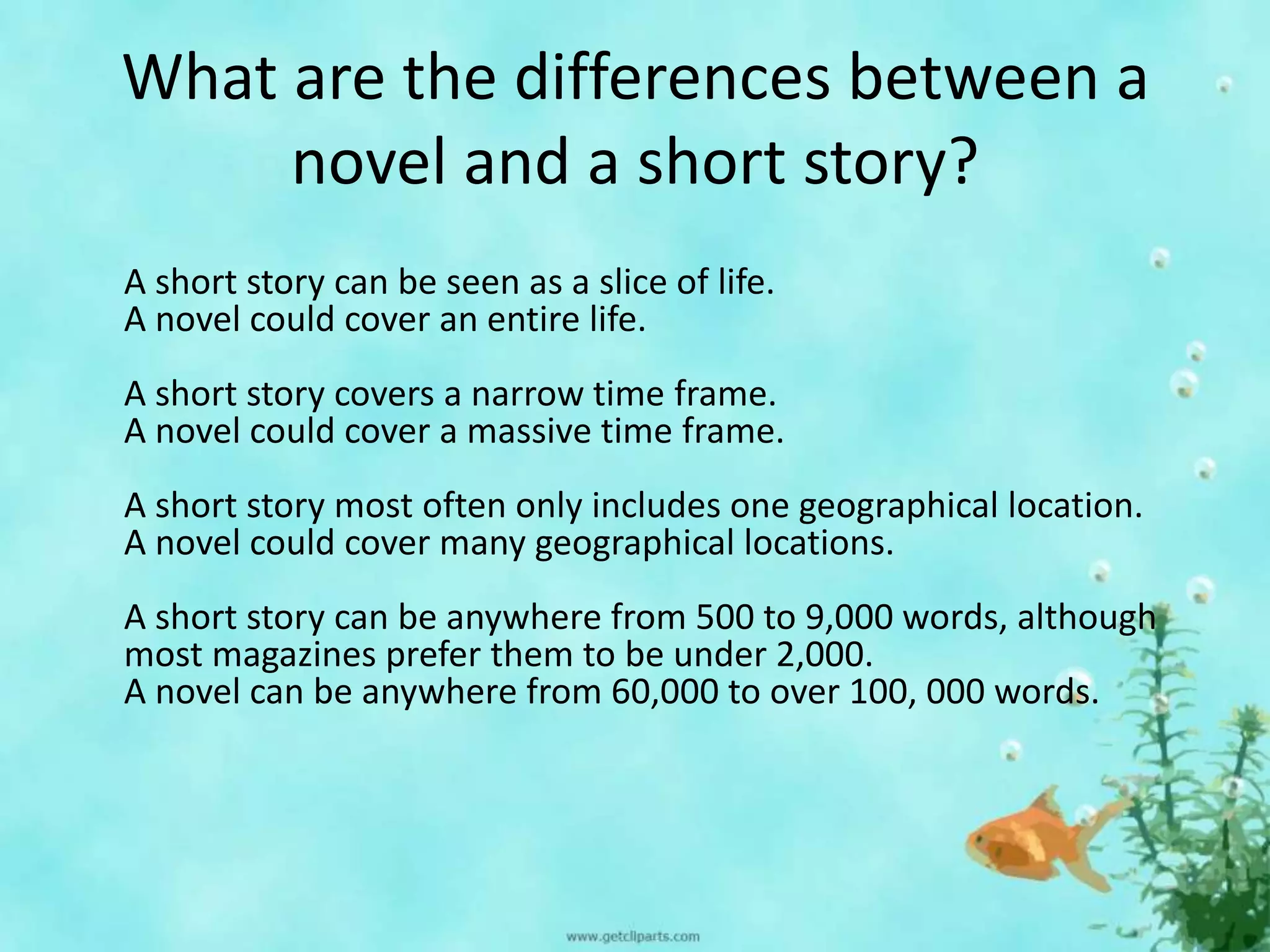
What are the differences between a
novel and a short story?
A short story can be seen as a slice of life.
A novel could cover an entire life.
A short story covers a narrow time frame.
A novel could cover a massive time frame.
A short story most often only includes one geographical location.
A novel could cover many geographical locations.
A short story can be anywhere from 500 to 9,000 words, although
most magazines prefer them to be under 2,000.
A novel can be anywhere from 60,000 to over 100, 000 words.
What are the similarities?
Both a novel and short story should have a beginning, middle and end and
follow the three act time frame.
Both should start with a great hook, so that the reader doesn't want to put
it down until the book/short story is finished.
Both should have an inciting incident .
Both should have the characters facing obstacles, setbacks, and minor
victories .
Both should end with the climax of the story.
Both should have a conclusion to the story.
While the short story helps the author become clear and concise, the
novel offers the opportunity to expand and elaborate descriptions,
subplots, and character.

Fiction (Novel + short stories)

  • 1.
    Fiction Works of prosein which imaginary stories either realistic or unrealistic are told.
  • 2.
    The Early Typesof Fiction are : 1- Fairy Tales: Are imaginary stories that tell the story of supernatural characters Example: Cinderella and Aladdin and His Magic Lamp The stories in Arabian Nights 2- Fables: are stories in which animals can talk and are very intelligent Examples: The Panchatantra or stories about the Phoenix or dragons.
  • 3.
    Modern Fiction • Novelsarrived in English in the 18th century. The First great novel in English was Tom Jones by Fielding
  • 4.
    Every novel hasthese five elements: 1. Setting - When and where the story takes place. 2. Characters - The people (or sometimes animals) the story is about. 3. Plot - What happens in the story. 4. Theme - The lesson the writer of the story is trying to teach the reader. The "message". 5. Point of view - Who is telling the story. -First person point of view uses "I", and is told by one of the characters of the story. -Third person point of view uses an unnamed narrator who knows what all (or most) of the story's characters are thinking.
  • 5.
    Types of Novels: 1-A Social Novel: is any novel that describe the ordinary social life of people. Example: The Mayor of Casterbridge – Hard Times – Vanity Fair 2- A Domestic Novel: is a portrayal of domestic life. Example: Pride and Prejudice 3- Historical Novels: are drawn from history. Example: A Tale of Two Cities 4- Autobiographical Novels: based on the life and experiences of their authors. Example: David Copperfield 5- Epistolary Novels: kinds of novels that are written in the form of a series of letters exchange between characters. Example : Pamela
  • 6.
    6- Stream ofConsciousness Novels: Novels that concentrate on the inner minds of the characters and their mental reactions. Examples: Novels by Virgina Woolf and James Joyce. Mrs. Dalloway 7- Science Fiction: the effect of scientific discoveries in the 19th century has influenced the creation of novels. Example: The First Men on the Moon. 8- Novels of Terror : arouse the feelings of terror and mystery in the reader. Example: The Castle of Toranto . 9- Detective Fiction: the plot of such novels is woven around an investigation of crime or a murder. Example: Agatha Christie’s novels
  • 7.
    The Short Story Theshort story is a brief work of literature, usually written in narrative prose.
  • 8.
    What are thedifferences between a novel and a short story? A short story can be seen as a slice of life. A novel could cover an entire life. A short story covers a narrow time frame. A novel could cover a massive time frame. A short story most often only includes one geographical location. A novel could cover many geographical locations. A short story can be anywhere from 500 to 9,000 words, although most magazines prefer them to be under 2,000. A novel can be anywhere from 60,000 to over 100, 000 words.
  • 9.
    What are thesimilarities? Both a novel and short story should have a beginning, middle and end and follow the three act time frame. Both should start with a great hook, so that the reader doesn't want to put it down until the book/short story is finished. Both should have an inciting incident . Both should have the characters facing obstacles, setbacks, and minor victories . Both should end with the climax of the story. Both should have a conclusion to the story. While the short story helps the author become clear and concise, the novel offers the opportunity to expand and elaborate descriptions, subplots, and character.