what is
Thermionic
emission
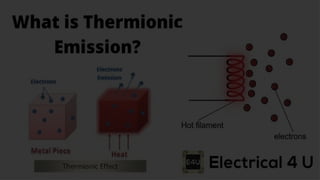
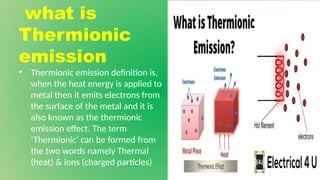
• Thermionicemission definition is,
when the heat energy is applied to
metal then it emits electrons from
the surface of the metal and it is
also known as the thermionic
emission effect. The term
‘Thermionic’ can be formed from
the two words namely Thermal
(heat) & ions (charged particles)
4.
What Causes
Thermionic
Emission?
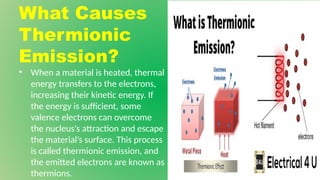
• Whena material is heated, thermal
energy transfers to the electrons,
increasing their kinetic energy. If
the energy is sufficient, some
valence electrons can overcome
the nucleus’s attraction and escape
the material’s surface. This process
is called thermionic emission, and
the emitted electrons are known as
thermions.
5.
• When amaterial is heated,
thermal energy transfers to the
electrons, increasing their kinetic
energy. If the energy is sufficient,
some valence electrons can
overcome the nucleus’s attraction
and escape the material’s surface.
This process is called thermionic
emission, and the emitted
electrons are known as thermions.
6.
What Factors Affect
ThermionicEmission?
There are three factors
that affect this emission
like
1.Metal surface
temperature,
2.Metal surface area &
3.the function of the metal.
7.
What Factors Affect
ThermionicEmission?
The temperature of Metal Surface:- When the
metal surface temperature is high then the emission
rate of electrons from the metal surface is higher.
Metal Surface Area :-When the metal surface area is
larger, then the rate of electrons emitted from the
metal surface is high.
Function of Metal :-The work function of the metal
is low then the rate of electrons emission from the
metal surface is high.
8.
How Do WeMeasure
Thermionic Emission?
The rate of thermionic emission is the number of
electrons emitted per unit time from a material.
This rate is expressed as thermionic current,
which is the electric current generated by the flow
of thermions. To measure thermionic current,
place an anode near the emitting electrode
(cathode) and apply a positive voltage to attract
the emitted electrons.
9.
How Do WeMeasure
Thermionic Emission?
The relationship between thermionic current and temperature can be
described by the Richardson-Dushman equation, which is given
by:Where:
J is the thermionic current density (in A/m<sup>2</sup>), which is the
current per unit area of the cathode
A is the Richardson constant (in A/m<sup>2</sup>K<sup>2</sup>),
which depends on the type of material
T is the absolute temperature (in K) of the cathode
ϕ is the work function (in eV) of the cathode
k is the Boltzmann constant (in eV/K), which is equal to 8.617 x 10<sup>-
5</sup eV), and
T is the absolute temperature (in K) of the cathode
10.
What are theTypes of
Thermionic Emitters?
There are three main types of thermionic
emitters:
1.tungsten,
2. thoriated tungsten, and
3.oxide-coated emitters.
11.
What are theTypes of
Thermionic Emitters?
• Tungsten Emitters:- Tungsten emitters are
made of pure tungsten metal or tungsten wire.
Tungsten has a high melting point (3650 K), a
high mechanical strength (100000 – 500000 psi
at room temperature), and a low vapor
pressure. These properties make tungsten
suitable for high-temperature and high-voltage
applications, such as X-ray tubes and electron
microscopes.
12.
What are theTypes of
Thermionic Emitters?
• Thoriated Tungsten EmittersThoriated tungsten emitters are made
of tungsten alloyed with a small amount of thorium (1-2%).
Thorium is a radioactive element that has a lower work function
(3.4 eV) than tungsten. When thorium is mixed with tungsten, it
forms a thin layer of thorium oxide on the surface of the cathode,
which reduces the effective work function to 2.63 eV. This allows
thoriated tungsten emitters to operate at a lower temperature
(1700 °C) than pure tungsten emitters, and to have a higher
emission efficiency (20 mA/W).
13.
What are theTypes of
Thermionic Emitters?
• Oxide-Coated Emitters Oxide-coated emitters are made of nickel
ribbons or tubes coated with barium oxide and strontium oxide.
These oxides have very low work functions (1.1 eV), which enable
oxide-coated emitters to operate at a very low temperature (750
°C) compared to other types of emitters. This results in a very high
emission efficiency (200 mA/W) and a long lifetime due to reduced
evaporation and contamination of the cathode surface.
14.
How are Thermionic
EmittersConstructed?
The construction of thermionic emitters depends
on whether they are directly heated or indirectly
heated by an electric current.
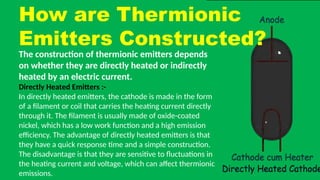
Directly Heated Emitters :-
In directly heated emitters, the cathode is made in the form
of a filament or coil that carries the heating current directly
through it. The filament is usually made of oxide-coated
nickel, which has a low work function and a high emission
efficiency. The advantage of directly heated emitters is that
they have a quick response time and a simple construction.
The disadvantage is that they are sensitive to fluctuations in
the heating current and voltage, which can affect thermionic
emissions.
15.
How are Thermionic
Emitters
Constructed?
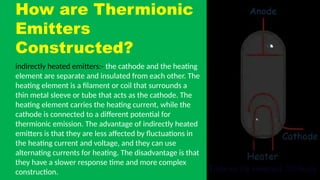
indirectlyheated emitters:- the cathode and the heating
element are separate and insulated from each other. The
heating element is a filament or coil that surrounds a
thin metal sleeve or tube that acts as the cathode. The
heating element carries the heating current, while the
cathode is connected to a different potential for
thermionic emission. The advantage of indirectly heated
emitters is that they are less affected by fluctuations in
the heating current and voltage, and they can use
alternating currents for heating. The disadvantage is that
they have a slower response time and more complex
construction.
16.
What are the
Applicationsof
Thermionic Emission?
Vacuum tubes can be used as amplifiers, oscillators, switches, rectifiers, and
modulators of electric signals. Vacuum tubes were widely used in radio, television,
radar, computers, and other electronic devices before the invention of transistors
Diode valves
They can be used as rectifiers to convert alternating current into direct current, or as
detectors to demodulate radio signals.
Cathode ray tubes
They can be used to create images on a phosphorescent screen, such as in television
sets, computer monitors, oscilloscopes, and radar displays.
17.
What are the
Applicationsof
Thermionic Emission?
X-ray tubes: X-ray tubes are devices that use electron beams to generate X-rays for
medical imaging, industrial inspection, security screening, and scientific research.