The Significance of Sound and Culture from the Great Below
" The mainstream comes to you, but you have to go to the underground.“  – Frank Zappa 1.) Of or relating to an avant-garde movement or its films, publications, and art, usually privately produced and of special appeal and often concerned with social or artistic experiment. 2.) A genre in music and other forms of media intended for an elite audience, that is often characterized by its high levels of originality and experimentation, and does not conform to typical standards,  trends, or hypes as set by the  popular mainstream media.
Music isn't found on MTV or the radio (unless it's a local or amateur station) Music not found in major record stores or online distributors (i.e. Amazon) Music usually confined to local geographic areas or if from elsewhere got there on a tight budget. Independent music, (“indie”) lacking major commercial record label support. Usually with a Do-It-Yourself approach to recording, publishing and performing.
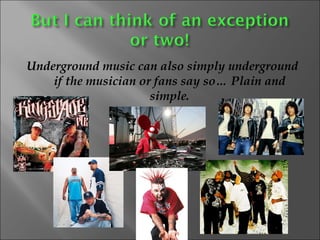
Underground music can also simply underground if the musician or fans say so… Plain and simple.
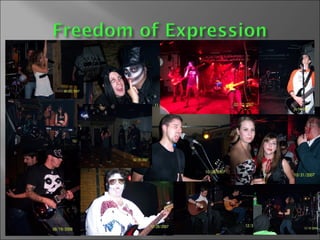
As with any art form, localized individualist creations are made without the help of anyone but the creators These creators often value their own expression and the appreciation of an elite group over selling a product As such, keeping out of mainstream adds “value” and legitimization Us vs. Them
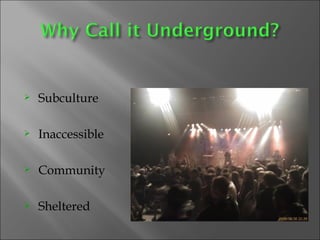
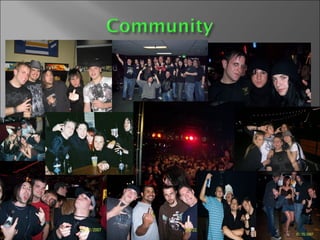
Subculture Inaccessible Community Sheltered
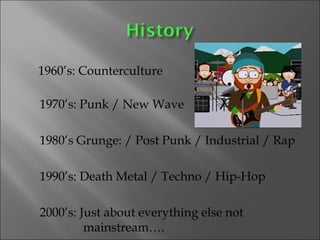
1960’s: Counterculture  1970’s: Punk / New Wave 1980’s Grunge: / Post Punk / Industrial / Rap 1990’s: Death Metal / Techno / Hip-Hop 2000’s: Just about everything else not  mainstream….
As with it’s definition, Underground Music and its history are difficult to define… Much room for interpretation, speculation, inclusion and exclusion. Who’s who, what’s what and who started it are often open topics for debate. Internet and “new media” created new dynamic, good for some, bad for others.


Underground music defines itself not only by what it is, but what it is NOT.  Commonality of seeking what is “real” by defining what isn’t. Confronts “heavy” topics such as government, religion, mortality, etc…
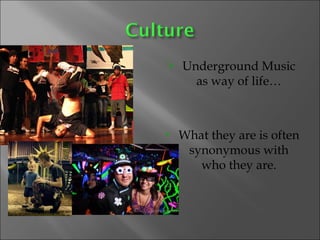
Underground Music as way of life… What they are is often synonymous with who they are.
Cultural representation through art, fashion, behavior, association, location… etc.  The desire to obtain symbolic goods leads to additional creative expression. This same desire also can create the bridge from Underground Music to the Capitalist Economy…  Symbolic goods can become mass marketed commodity
Underground music incorporates cultural and social capital with the great potential for economic capital…  Cultural Capital + Social Capital = Cool.  Cool = status & symbolic power  (creating new and unique underground “scenes” and social hierarchies.)
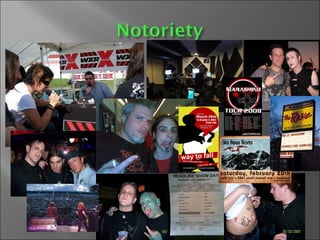
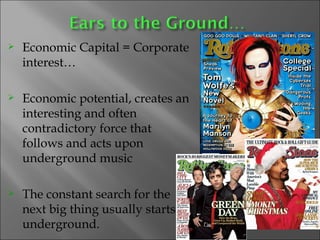
Economic Capital = Corporate interest… Economic potential, creates an interesting and often contradictory force that follows and acts upon underground music  The constant search for the next big thing usually starts underground.
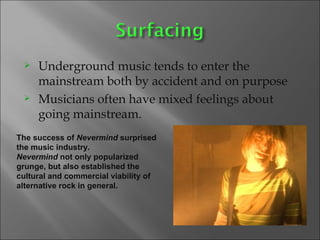
Underground music tends to enter the mainstream both by accident and on purpose Musicians often have mixed feelings about going mainstream. The success of  Nevermind  surprised the music industry.  Nevermind  not only popularized grunge, but also established the cultural and commercial viability of alternative rock in general.
Most likely bright for Underground Music New mediums and ways to share More reasons to be separate  Easy of creation compared to previous decades

Underground music

  • 1.
    The Significance ofSound and Culture from the Great Below
  • 2.
    " The mainstreamcomes to you, but you have to go to the underground.“ – Frank Zappa 1.) Of or relating to an avant-garde movement or its films, publications, and art, usually privately produced and of special appeal and often concerned with social or artistic experiment. 2.) A genre in music and other forms of media intended for an elite audience, that is often characterized by its high levels of originality and experimentation, and does not conform to typical standards, trends, or hypes as set by the popular mainstream media.
  • 3.
    Music isn't foundon MTV or the radio (unless it's a local or amateur station) Music not found in major record stores or online distributors (i.e. Amazon) Music usually confined to local geographic areas or if from elsewhere got there on a tight budget. Independent music, (“indie”) lacking major commercial record label support. Usually with a Do-It-Yourself approach to recording, publishing and performing.
  • 4.
    Underground music canalso simply underground if the musician or fans say so… Plain and simple.
  • 5.
    As with anyart form, localized individualist creations are made without the help of anyone but the creators These creators often value their own expression and the appreciation of an elite group over selling a product As such, keeping out of mainstream adds “value” and legitimization Us vs. Them
  • 6.
  • 7.
    1960’s: Counterculture 1970’s: Punk / New Wave 1980’s Grunge: / Post Punk / Industrial / Rap 1990’s: Death Metal / Techno / Hip-Hop 2000’s: Just about everything else not mainstream….
  • 8.
    As with it’sdefinition, Underground Music and its history are difficult to define… Much room for interpretation, speculation, inclusion and exclusion. Who’s who, what’s what and who started it are often open topics for debate. Internet and “new media” created new dynamic, good for some, bad for others.
  • 9.
  • 10.
  • 11.
  • 12.
    Underground music definesitself not only by what it is, but what it is NOT. Commonality of seeking what is “real” by defining what isn’t. Confronts “heavy” topics such as government, religion, mortality, etc…
  • 13.
    Underground Music asway of life… What they are is often synonymous with who they are.
  • 14.
    Cultural representation throughart, fashion, behavior, association, location… etc. The desire to obtain symbolic goods leads to additional creative expression. This same desire also can create the bridge from Underground Music to the Capitalist Economy… Symbolic goods can become mass marketed commodity
  • 15.
    Underground music incorporatescultural and social capital with the great potential for economic capital… Cultural Capital + Social Capital = Cool. Cool = status & symbolic power (creating new and unique underground “scenes” and social hierarchies.)
  • 16.
    Economic Capital =Corporate interest… Economic potential, creates an interesting and often contradictory force that follows and acts upon underground music The constant search for the next big thing usually starts underground.
  • 17.
    Underground music tendsto enter the mainstream both by accident and on purpose Musicians often have mixed feelings about going mainstream. The success of Nevermind surprised the music industry. Nevermind not only popularized grunge, but also established the cultural and commercial viability of alternative rock in general.
  • 18.
    Most likely brightfor Underground Music New mediums and ways to share More reasons to be separate Easy of creation compared to previous decades