THE MUSIC INDUSTRY
MIMI LAI
THE MUSIC INDUSTRY
• Dominated by 3 transnational corporations
• Universal
• Sony
• Warner Bros
• Known as ‘The Majors’
THE MUSIC INDUSTRY
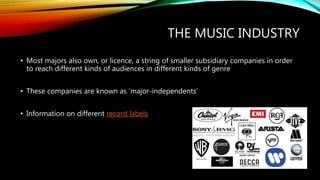
• Most majors also own, or licence, a string of smaller subsidiary companies in order
to reach different kinds of audiences in different kinds of genre
• These companies are known as ‘major-independents’
• Information on different record labels
THE MUSIC INDUSTRY
• Finally, there are a huge number if small companies with little or no financial
connection to the majors
• These companies often concentrate on a small number of artists, within specialized
niched in the industry
• Known as ‘independents’
EXAMPLE
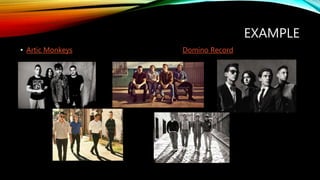
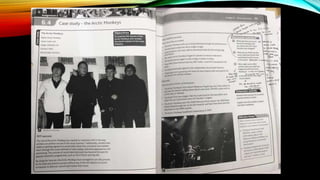
• Artic Monkeys Domino Record
THE MUSIC INDUSTRY
• It is misleading to see the industry simplely as a ‘hierarchy’, dominated by the
majors
• A better description is a ‘web’ of companies(Negus - Producing Pop), whose
connections allow:
• Smaller companies to gain access to bigger markets
• Bigger companies to gain access to new artists and movement in popular music
THE MUSIC INDUSTRY
• In turn, most record companies organize themselves internally into several key
areas:
• Artists and Repertoire (A&R)
• Marketing/Artist Development
• Promotions
• Legal
• Financial
• Refer to diagram of record label
• The music deal
THE MUSIC INDUSTRY
• The industry as a whole has a complex relationship with a number of different
media..
• Radio, TV, Print media, Film, New Media
• Synergy and symbiosis ( work hand in hand )
MUSIC VIDEO
• Music video servers a number of different function:
• Promotes a specific single and, normally, an album
• Promotes a specific artist or band
• Creates, adapts or feed into a ‘star image’
• Entertains as production in its own right
• Reinforces, adapts or undermines the ‘meanings’ of a song
IDEOLOGIES OF CREATIVITY
• Keith Negus – Producing Pop
• Identifies two distinct ways of thinking about potential artists from within the music
industry.
• These ideologies shape the way in which the artists’ image and careers are
developed, and the way that they are marketed towards specific target audiences.
• The organic ideology of creativity and
• The synthetic ideology of creativity
THE ORGANIC IDEOLOGY OF
CREATIVITY 1
• The seeds of success are within the artists, who have to be ‘nurtured’ by the record
company.
• The image of the artist is ‘enhanced’ by the record company.
• The artist is given time to evolve and progress through their career.
• Example: Beyond, Kaytrandon.
THE ORGANIC IDEOLOGY OF
CREATIVITY2
• Emphasis is given to album sales and the construction of a successful back
catalogue
• Often aimed at older or more sophisticated consumers
• Profits generated by this kind of act tend to be part of a long term strategy by the
record company
THE SYNTHETIC IDEOLOGY OF
CREATIVITY1
• Executives attempt to construct successful acts out of the artists and the song at
their disposal
• The image of the artist is often constructed by the record company
• The artist will be given a short time to prove their success before other
combinations will be tried out
• Example: Justin Bieber, one direction, Kate petty, Adele
THE SYNTHETIC IDEOLOGY OF
CREATIVITY2
• Emphasis is given to single sales and to promoting first albums
• Often aimed at younger, less sophisticated audiences
• Profits generated by this kind of artist tend to be part of immediate, short term
strategy by the record company
BALANCING THE TWO
• In practice, the success of synthetic acts will fund the development and investment
in organic acts
• Most big record labels will look to balance their roster with a combination of
successful synthetic and organic acts to ensure that there are funds available for the
day-to-day running of the company as well as long term profit making potential – it
is a business strategy.
PROMOTING ORGANIC AND
SYNTHETIC ACTS
• Organic acts are often sold on their ‘authenticity’, both musically and socially
• The image of the artist appears ‘unconstructed’ (although, of course, this is in itself a
carefully constructed look)
• Synthetic acts are often sold on their ‘look’ or personalities
• The image of the artist is carefully and unashamedly constructed
END

Media

  • 1.
  • 2.
    THE MUSIC INDUSTRY •Dominated by 3 transnational corporations • Universal • Sony • Warner Bros • Known as ‘The Majors’
  • 3.
    THE MUSIC INDUSTRY •Most majors also own, or licence, a string of smaller subsidiary companies in order to reach different kinds of audiences in different kinds of genre • These companies are known as ‘major-independents’ • Information on different record labels
  • 4.
    THE MUSIC INDUSTRY •Finally, there are a huge number if small companies with little or no financial connection to the majors • These companies often concentrate on a small number of artists, within specialized niched in the industry • Known as ‘independents’
  • 5.
  • 7.
    THE MUSIC INDUSTRY •It is misleading to see the industry simplely as a ‘hierarchy’, dominated by the majors • A better description is a ‘web’ of companies(Negus - Producing Pop), whose connections allow: • Smaller companies to gain access to bigger markets • Bigger companies to gain access to new artists and movement in popular music
  • 8.
    THE MUSIC INDUSTRY •In turn, most record companies organize themselves internally into several key areas: • Artists and Repertoire (A&R) • Marketing/Artist Development • Promotions • Legal • Financial • Refer to diagram of record label • The music deal
  • 9.
    THE MUSIC INDUSTRY •The industry as a whole has a complex relationship with a number of different media.. • Radio, TV, Print media, Film, New Media • Synergy and symbiosis ( work hand in hand )
  • 10.
    MUSIC VIDEO • Musicvideo servers a number of different function: • Promotes a specific single and, normally, an album • Promotes a specific artist or band • Creates, adapts or feed into a ‘star image’ • Entertains as production in its own right • Reinforces, adapts or undermines the ‘meanings’ of a song
  • 11.
    IDEOLOGIES OF CREATIVITY •Keith Negus – Producing Pop • Identifies two distinct ways of thinking about potential artists from within the music industry. • These ideologies shape the way in which the artists’ image and careers are developed, and the way that they are marketed towards specific target audiences. • The organic ideology of creativity and • The synthetic ideology of creativity
  • 12.
    THE ORGANIC IDEOLOGYOF CREATIVITY 1 • The seeds of success are within the artists, who have to be ‘nurtured’ by the record company. • The image of the artist is ‘enhanced’ by the record company. • The artist is given time to evolve and progress through their career. • Example: Beyond, Kaytrandon.
  • 13.
    THE ORGANIC IDEOLOGYOF CREATIVITY2 • Emphasis is given to album sales and the construction of a successful back catalogue • Often aimed at older or more sophisticated consumers • Profits generated by this kind of act tend to be part of a long term strategy by the record company
  • 14.
    THE SYNTHETIC IDEOLOGYOF CREATIVITY1 • Executives attempt to construct successful acts out of the artists and the song at their disposal • The image of the artist is often constructed by the record company • The artist will be given a short time to prove their success before other combinations will be tried out • Example: Justin Bieber, one direction, Kate petty, Adele
  • 15.
    THE SYNTHETIC IDEOLOGYOF CREATIVITY2 • Emphasis is given to single sales and to promoting first albums • Often aimed at younger, less sophisticated audiences • Profits generated by this kind of artist tend to be part of immediate, short term strategy by the record company
  • 16.
    BALANCING THE TWO •In practice, the success of synthetic acts will fund the development and investment in organic acts • Most big record labels will look to balance their roster with a combination of successful synthetic and organic acts to ensure that there are funds available for the day-to-day running of the company as well as long term profit making potential – it is a business strategy.
  • 17.
    PROMOTING ORGANIC AND SYNTHETICACTS • Organic acts are often sold on their ‘authenticity’, both musically and socially • The image of the artist appears ‘unconstructed’ (although, of course, this is in itself a carefully constructed look) • Synthetic acts are often sold on their ‘look’ or personalities • The image of the artist is carefully and unashamedly constructed
  • 18.