Indie Music:
                 An Entertainment Industry
                        Innovation


Rebecca Horton
23 May 2012
Independence means not
           having to answer to anyone,
           really-that’s what it means in
                     my mind.
                            -Geoff Travis, founder and
                            director of Rough Trade


As cited in King, R. 2012                                2
Why Study Indie?

•  Modern relevance
•  Broad-sweeping impact
•  Rootedness in local, start-up
   communities


                                   3
BUT FIRST...


               4
What is Innovation?
Simply put, an innovation is a lever of change
within a larger system.

Relying upon the foundations of systems theory
and actor-network theory this definition supports
the notion that ideas never exist in a vacuum, and
it is the combination of forces surrounding those
ideas that ultimately make them prosper or fail.


                                                     5
What is Technology?
 Technology is not a thing, or an outcome; rather
 it’s a “process of development.”


Based upon the work of Feenberg, A.                 6
A BIT OF CONTEXT...


                      7
Indies                 Vs.         Majors
 Music labels with a small,          Music labels that own their
 devoted fan base that are           own distribution channels.
not heavily focused on sales
 but rather are focused on
     the craft of music.


                                                               8
Power
  Grip
 Of the Majors


                 9
Untethered   Indies   10
“As soon as a major label opens it wallet, all this
     rebel independent stuff goes out the window.”
            -Jim Nash, President, Wax Trax Records, 1990


As cited in Popular Music                                  11
INCREMENTAL BUT POWERFUL


                           12
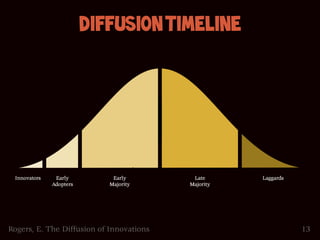
Diffusion Timeline


 Innovators    Early         Early         Late      Laggards
              Adopters      Majority      Majority


Rogers, E. The Diffusion of Innovations                         13
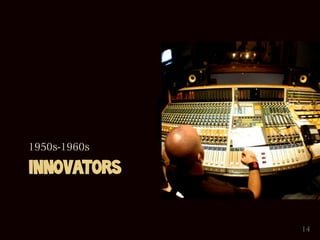
1950s-1960s

INNOVATORS


              14
15
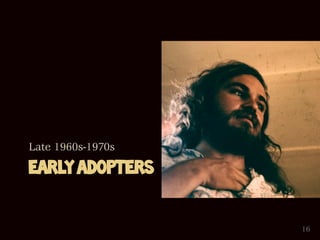
Late 1960s-1970s

EARLY ADOPTERS


                   16
17
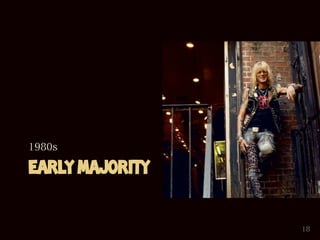
1980s

EARLY MAJORITY


                 18
19
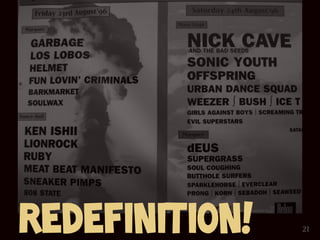
1990s

LATE MAJORITY


                20
Redefinition!   21
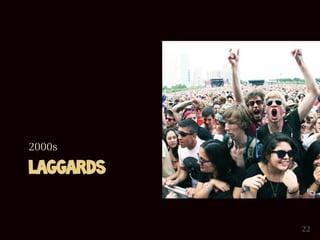
2000s

LAGGARDS


           22
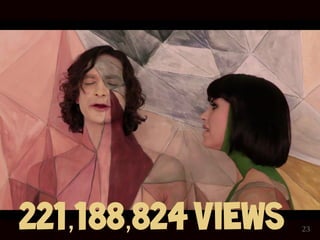
221,188,824 views   23
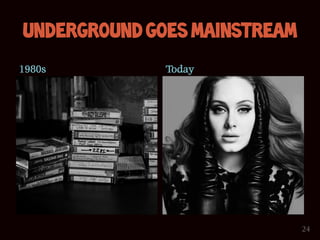
Underground goes mainstream
1980s         Today


                              24
“[W]e no longer live in a world of the Mainstream
     and the Counterculture. We live in a world of
     multiple mainstreams and countless counter-, sub-
     and counter-sub-cultures.”


Walker, R. The Brand Underground.                        25
ANALYSIS OF INNOVATION


                         26
27
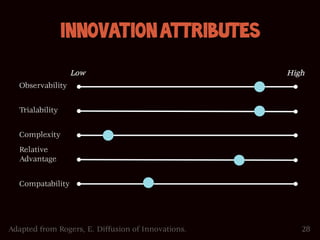
Innovation Attributes
                   Low                              High
   Observability


   Trialability


   Complexity
   Relative
   Advantage


   Compatability


Adapted from Rogers, E. Diffusion of Innovations.      28
CONCLUSION


             29
Indie is the New Norm
But what does that mean for
 the professional musician
who needs to make a living?


                              30
Indie is No longer Just about
             Music...
Its tentacles have spread into
 art, fashion, the DIY/maker
     movement, and more


                                 31
Bibliography
•    Bower, J. & Christensen, C. Disruptive Technologies. Harvard Business
     Review, 1995.
•    “Billy Corgan Rants About ‘Posers’ at SXSW.” Rolling Stone, 2012.
•    Feenberg, A. Critical Theory of Technology. 1991.
•    King, R. How Soon is Now: The Madmen and Mavericks who made
     Independent Music 1975-2005. Digital release, Faber and Faber, 2012.
•    Nash, J., 1990. As cited in Popular Music.
•    Oakes, K. Slanted and Enchanted. Holt Paperbacks, 2009.
•    Rogers, E. Diffusion of Innovations. Free Press, 2003, 5th ed.
•    Walker, R. “The Brand Underground.” 30 Jul. 2006, New York Times.
     http://www.nytimes.com/2006/07/30/magazine/30brand.html?
     pagewanted=2&_r=1
•    “What Is Indie?” Movie Trailer. http://www.youtube.com/watch?
     v=5rLLqdnGwqQ
Image Sources
•    sketch_biphop via flickr
•    jkgroove via flickr,
•    Dana Slaymaker, 1970 via Artstor
•    Style.MTV.com
•    The macinator via flickr
•    Pitchfork Magazine
•    Wildner via flickr
•    Toniblay via flickr
•    ListenMissy via flickr
•    Shiftingpixel.com
•    Youtube.com screenshot
•    Vogue Magazine
•    Jima via flickr
•    Declann jewel via flickr
I think in the music business you have to
          give up on making money…marketing is the
             new money in music, if you can get the
           right partners in the internet to work with
           you and use their marketing power, that is
           the new money. You’re not gonna make it
                  selling a CD more than likely.
                                                 -Billy Corgan


Corgan, B. Interview with Rolling Stone, 2012.                   34

Indie final preso r horton

  • 1.
    Indie Music: An Entertainment Industry Innovation Rebecca Horton 23 May 2012
  • 2.
    Independence means not having to answer to anyone, really-that’s what it means in my mind. -Geoff Travis, founder and director of Rough Trade As cited in King, R. 2012 2
  • 3.
    Why Study Indie? • Modern relevance •  Broad-sweeping impact •  Rootedness in local, start-up communities 3
  • 4.
  • 5.
    What is Innovation? Simplyput, an innovation is a lever of change within a larger system. Relying upon the foundations of systems theory and actor-network theory this definition supports the notion that ideas never exist in a vacuum, and it is the combination of forces surrounding those ideas that ultimately make them prosper or fail. 5
  • 6.
    What is Technology? Technology is not a thing, or an outcome; rather it’s a “process of development.” Based upon the work of Feenberg, A. 6
  • 7.
    A BIT OFCONTEXT... 7
  • 8.
    Indies Vs. Majors Music labels with a small, Music labels that own their devoted fan base that are own distribution channels. not heavily focused on sales but rather are focused on the craft of music. 8
  • 9.
    Power Grip Of the Majors 9
  • 10.
    Untethered Indies 10
  • 11.
    “As soon asa major label opens it wallet, all this rebel independent stuff goes out the window.” -Jim Nash, President, Wax Trax Records, 1990 As cited in Popular Music 11
  • 12.
  • 13.
    Diffusion Timeline Innovators Early Early Late Laggards Adopters Majority Majority Rogers, E. The Diffusion of Innovations 13
  • 14.
  • 15.
  • 16.
  • 17.
  • 18.
  • 19.
  • 20.
  • 21.
  • 22.
  • 23.
  • 24.
  • 25.
    “[W]e no longerlive in a world of the Mainstream and the Counterculture. We live in a world of multiple mainstreams and countless counter-, sub- and counter-sub-cultures.” Walker, R. The Brand Underground. 25
  • 26.
  • 27.
  • 28.
    Innovation Attributes Low High Observability Trialability Complexity Relative Advantage Compatability Adapted from Rogers, E. Diffusion of Innovations. 28
  • 29.
  • 30.
    Indie is theNew Norm But what does that mean for the professional musician who needs to make a living? 30
  • 31.
    Indie is Nolonger Just about Music... Its tentacles have spread into art, fashion, the DIY/maker movement, and more 31
  • 32.
    Bibliography •  Bower, J. & Christensen, C. Disruptive Technologies. Harvard Business Review, 1995. •  “Billy Corgan Rants About ‘Posers’ at SXSW.” Rolling Stone, 2012. •  Feenberg, A. Critical Theory of Technology. 1991. •  King, R. How Soon is Now: The Madmen and Mavericks who made Independent Music 1975-2005. Digital release, Faber and Faber, 2012. •  Nash, J., 1990. As cited in Popular Music. •  Oakes, K. Slanted and Enchanted. Holt Paperbacks, 2009. •  Rogers, E. Diffusion of Innovations. Free Press, 2003, 5th ed. •  Walker, R. “The Brand Underground.” 30 Jul. 2006, New York Times. http://www.nytimes.com/2006/07/30/magazine/30brand.html? pagewanted=2&_r=1 •  “What Is Indie?” Movie Trailer. http://www.youtube.com/watch? v=5rLLqdnGwqQ
  • 33.
    Image Sources •  sketch_biphop via flickr •  jkgroove via flickr, •  Dana Slaymaker, 1970 via Artstor •  Style.MTV.com •  The macinator via flickr •  Pitchfork Magazine •  Wildner via flickr •  Toniblay via flickr •  ListenMissy via flickr •  Shiftingpixel.com •  Youtube.com screenshot •  Vogue Magazine •  Jima via flickr •  Declann jewel via flickr
  • 34.
    I think inthe music business you have to give up on making money…marketing is the new money in music, if you can get the right partners in the internet to work with you and use their marketing power, that is the new money. You’re not gonna make it selling a CD more than likely. -Billy Corgan Corgan, B. Interview with Rolling Stone, 2012. 34