Available online at https://www.ijasrd.org/
International Journal of Advanced Scientific
Research & Development
Vol. 06, Iss. 03, Ver. I, Mar’ 2019, pp. 61 – 67
Cite this article as: Smith, S., & Khanka, S. S., “Uncompressed Video Streaming in Wireless Channel without Interpolation
using Search Algorithms”. International Journal of Advanced Scientific Research & Development (IJASRD), 06 (03/I), 2019,
pp. 61 – 67. https://doi.org/10.26836/ijasrd/2019/v6/i3/60309.
* Corresponding Author: K. Mohana Chandricka, chandrickamuthu@gmail.com
e-ISSN: 2395-6089
p-ISSN: 2394-8906
UNCOMPRESSED VIDEO STREAMING IN WIRELESS
CHANNEL WITHOUT INTERPOLATION USING SEARCH
ALGORITHMS
K. Mohana Chandricka1* and Dr. K. Priyadarshini2
1 PG Scholar, Department of ECE, K.Ramakrishnan College of Engineering, Samapuram, Trichy.
2 Professor, Department of ECE, K.Ramakrishnan College of Engineering, Samapuram, Trichy.
ARTICLE INFO
Article History:
Received: 22 Mar 2019;
Received in revised form:
02 Apr 2019;
Accepted: 02 Apr 2019;
Published online: 10 Apr 2019.
Key words:
Uncompressedvideo,
Multi-level UPA,
Visual Quality,
Transmission Efficiency,
Mean Square Error,
Peak-to-Average Ratio (PAPR),
Motionestimation,
Linearreduction.
ABSTRACT
Uncompressed video transmission recently paying attention
because low end-to-end latency, good video quality and low
convolution. In this method put forward a real-time
uncompressed video diffusion system, where Unequal bit
Allocation (UBA) approach are adopted to the end-to-end
mean square error (MSE). Based on the Full search and
logarithm search algorithm using the method. Video is
improved largely and it provides that the different-level UBA
scheme outperforms the conservative two-level of unequal bit
allocation scheme in the stipulations of the average peak-
signalto-noise (PSNR) at restrained SNRs, and the proposed
adaptive UBA approach can good visual quality and the
wireless communication.The pixel motion estimation is used
correct the motion vector prediction in the H.264/AVC video
coding. The proposed method solves the more complexity of
the calculation of the fractional-pixel motion estimated video
coding resolution is increased.
Copyright © 2019 IJASRD. This is an open access article distributed under the Creative Common Attribution
License, which permits unrestricted use, distribution, and reproduction in any medium, provided the original
work is properly cited.
INTRODUCTION
Motion estimation in the block of encoded vector called the motion estimation,
motion estimation is due. Termined to the motion vector two type the motion estimation
temporal and spatial estimation, spatial estimation finding the two methods, pixel based
method and feature based method, pixel based method also called direct method, feature
based method also called indirect method in a direct method have a four types. There are
block matching algorithm, pixel recursive algorithm, optical flow and phase correlation
methods. Black matching algorithm processed in the difference search methods search
algorithm evaluation metrics Mean Squared Error (MSE) and power signal to noise ratio
Uncompressed Video Streaming in Wireless Channel without Interpolation using Search Algorithms
Volume 06, Issue 03, Version I, Mar’ 2019 62
performance. Motion vector can be determined the current frame and reference frame. I-
frame can be used toencoding the pixel value and the P-frame can be using the forward
picture prediction, B-frame can be using the bidirectional picture prediction method. The
most important improvement of inter-frame prediction implementation methods with
regards provides the most flexible partionblock, pixel motion resolution and multiple
reference. Many images and videos processing important in the interpolation method small
image and the interpolation process can determined large software using, there are the
various method interpolation the integer pixel interpolation, quarter-pixel interpolation,
half-pixel and sub-pixel interpolation, sub-pixel technique reduce the number of search
point motion estimation can be defined the two methods, the methods are mechanical
method, electronic method. The methods can be determined the infrared and optics this
method can be using the sensor.
Motion estimation important in many video coding standards in MPEG-2 and HVEC
to be used in real time uncompressed video application sub-pixel motion estimation can be
reach the global minimum and reduce the complexity. In this paper proposed full search
algorithm logarithmic algorithm. Full search algorithm can be produced the optimal
estimation solution and expansive computational method the complexity can be measured
the computing average number and checking points of motion vector generation, motion
estimation evaluation approach the location of a global optimum method.
SEARCH ALGORITHMS
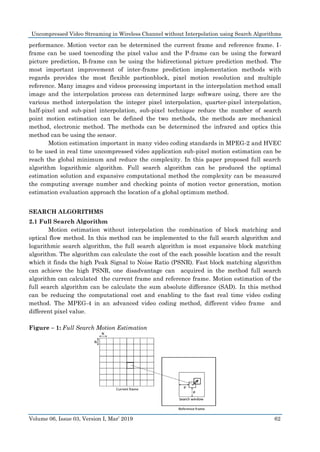
2.1 Full Search Algorithm
Motion estimation without interpolation the combination of block matching and
optical flow method. In this method can be implemented to the full search algorithm and
logarithmic search algorithm, the full search algorithm is most expansive block matching
algorithm. The algorithm can calculate the cost of the each possible location and the result
which it finds the high Peak Signal to Noise Ratio (PSNR). Fast block matching algorithm
can achieve the high PSNR, one disadvantage can acquired in the method full search
algorithm can calculated the current frame and reference frame. Motion estimation of the
full search algorithm can be calculate the sum absolute differance (SAD). In this method
can be reducing the computational cost and enabling to the fast real time video coding
method. The MPEG-4 in an advanced video coding method, different video frame and
different pixel value.
Figure – 1: Full Search Motion Estimation
Chandricka and Priyadarshini (2019)
63 Volume 06, Issue 03, Version I, Mar’ 2019
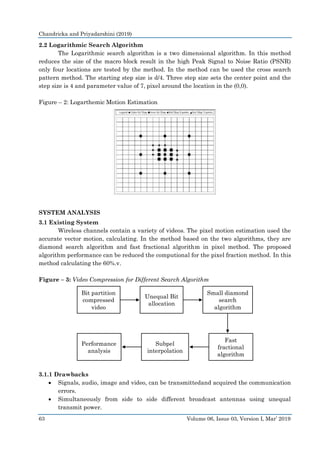
2.2 Logarithmic Search Algorithm
The Logarithmic search algorithm is a two dimensional algorithm. In this method
reduces the size of the macro block result in the high Peak Signal to Noise Ratio (PSNR)
only four locations are tested by the method. In the method can be used the cross search
pattern method. The starting step size is d/4. Three step size sets the center point and the
step size is 4 and parameter value of 7, pixel around the location in the (0,0).
Figure – 2: Logarthemic Motion Estimation
SYSTEM ANALYSIS
3.1 Existing System
Wireless channels contain a variety of videos. The pixel motion estimation used the
accurate vector motion, calculating. In the method based on the two algorithms, they are
diamond search algorithm and fast fractional algorithm in pixel method. The proposed
algorithm performance can be reduced the computional for the pixel fraction method. In this
method calculating the 60%.v.
Figure – 3: Video Compression for Different Search Algorithm
Bit partition
compressed
video
Small diamond
search
algorithm
Unequal Bit
allocation
Performance
analysis
Fast
fractional
algorithm
Subpel
interpolation
3.1.1 Drawbacks
 Signals, audio, image and video, can be transmittedand acquired the communication
errors.
 Simultaneously from side to side different broadcast antennas using unequal
transmit power.
Uncompressed Video Streaming in Wireless Channel without Interpolation using Search Algorithms
Volume 06, Issue 03, Version I, Mar’ 2019 64
3.2 Proposed System
The optimum dependable transmission can be achieved the video coding from the
channel coding. A frame network, which is competent of providing different pixel value, can
be corresponding the each layer at its corresponding priority. Pixel motion, estimate on used
to vector motion calculating in this method based on the two algorithms. One is full search
algorithm and logarithmic search algorithm. The experimental result the Peak Signal to
Noise Ratio (PSNR) Performance is high, Mean Square Error (MSE) value is good.
3.2.1 Advantages
 It avoids the loss of in sequence during video density.
 Uncompressed video transmission brings low difficulty.
 Higher protection is provided to stream of greater significance by allocating more
power.
Figure – 4: Video Compression
Bit partition
compressed
video
Full search
algorithm
Unequal Bit
allocation
Performance
analysis
Log search
algorithm
Subpel
interpolation
FRAME ESTIMATION
The first stage is used to determine the difference the video sequence and the second
stage the selection of the MB mode, the search of the motion vector can be execute the
different level.
Figure – 5: Select the Video Frame
Video Sequence
Difference between
video frames
Select MB modes
Select MB vector
Encoded Video
Chandricka and Priyadarshini (2019)
65 Volume 06, Issue 03, Version I, Mar’ 2019
The proposed method new approach used to reduce time. For scalable video coding
through the minimize the time.
(a) First Stage: Meauring the difference between video sequance and test frame.
(b) Second Stage: Select the Macro block mode.
(c) Third Stage: Choose the method of Motion Estimation to Calculate the
Motion vector.
The search of the motion vector at cascade three levels
 Full pixel
 Half pixel
 Quarter pixel
RESULT AND DISCUSSION
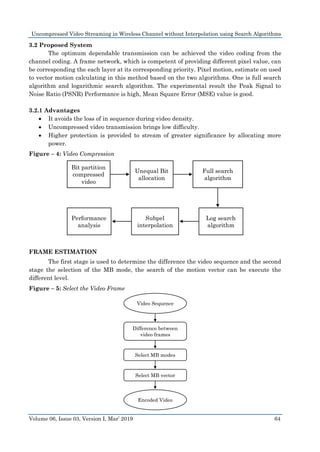
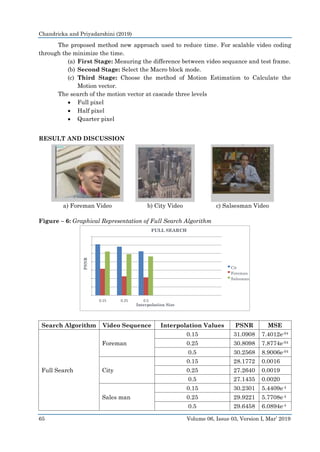
a) Foreman Video b) City Video c) Salsesman Video
Figure – 6: Graphical Representation of Full Search Algorithm
0.15 0.25 0.5
PSNR
Interpolation Size
FULL SEARCH
Cit
yForeman
Salesman
Search Algorithm Video Sequence Interpolation Values PSNR MSE
Full Search
Foreman
0.15 31.0908 7.4012e-04
0.25 30.8098 7.8774e-04
0.5 30.2568 8.9006e-04
City
0.15 28.1772 0.0016
0.25 27.2640 0.0019
0.5 27.1435 0.0020
Sales man
0.15 30.2301 5.4409e-4
0.25 29.9221 5.7708e-4
0.5 29.6458 6.0894e-4
Uncompressed Video Streaming in Wireless Channel without Interpolation using Search Algorithms
Volume 06, Issue 03, Version I, Mar’ 2019 66
Figure – 7: Graphical Representation of Video Compression
CONCLUSION
This project presents an unequal Bit allocation Method for the broadcast of Video
firmness to Wireless channels systems. The video was divided into multiple streams the
proposed stream of the uncompressed video streaming and using to the search algorithm.
Subpixel motion estimation implemented to the two algorithm full search and logarithmic
algorithm the result compared based on two performance can be measure the MSE & PSNR
In future, the research work may enhance in the direction of compressing stereo
video files. The researcher consider only a monochrome image pair, it may be extended for
color stereo image pair. The quality of stereo image compression may compared by applying
different block matching algorithms.
REFERENCES
[1] P. G. Sherwood and K. Zeger, “Error protection for progressive image transmission over
memoryless and fading channels,” IEEE Transactions on Communications, vol. 46,
no. 12, pp. 1555–1559, 1998.
[2] V. Stankovic, R. Hamzaoui, and Z. Xiong, “Product code error protection of packetized
multimedia bit streams,” in Proceedings of the 2003 International Conference on
Image Processing, ICIP’03. 2003 International Conference on, 2003, vol. 1.
Chandricka and Priyadarshini (2019)
67 Volume 06, Issue 03, Version I, Mar’ 2019
[3] N. Thomos, N. V. Boulgouris, and M. G. Strintzis, “Optimized transmission of jpeg2000
streams over wireless channels,” IEEE Transactions on Image Processing, vol. 15,
no. 1, pp. 54–67, 2006.
[4] M. Murroni, “A power-based unequal error protection system for digital cinema
broadcasting over wireless channels,” Signal Processing: Image Communication, vol.
22, no. 3, pp. 331–339, 2007.
[5] M.F. Sabir, R.W. Heath Jr, and A.C. Bovik, “Unequal power allocation for JPEG
transmission over MIMO systems,” Signals, Systems and Computers Conference,
IEEE, 2005.
[6] J. W. Modestino and D. G. Daut, “Combined source-channel coding of images,” IEEE
Trans. Commun., vol. COM-27, no. 11, pp. 1644–1659, Nov. 1979.
[7] J. W. Modestino, D. G. Daut, and A. L. Vickers, “Combined source channel coding of
images using the block cosine transform,” IEEE Trans. Commun., vol. COM-29, pp.
1261–1274, Sep. 1981.
[8] V. Chande and N. Farvardin, “Progressive transmission of images over memoryless
noisy channels,” IEEE J. Sel. Areas Commun., vol. 18, no. 6, pp. 850–860, Jun. 2000.
[9] P G. Sherwood and K. Zeger, “Progressive image coding for noisy channels,” IEEE Signal
Process. Lett., vol. 4, no. 7, pp. 189–191, Jul. 1997.
[10] Y. Eisenberg, C. Luna, T. Pappas, R. Berry, and A. Katsaggelos, “Joint source coding
and transmission power management for energy efficient wireless video
communications,” IEEE Trans. Circuits Syst. Video Technol., vol. 12, no. 6, pp. 411–
424, Jun. 2002.
[11] L. Atzori, “Transmission of JPEG2000 images over wireless channels with unequal
power distribution,” IEEE Trans. Consum. Electron., vol. 49, no. 11, pp. 883–888,
Nov. 2003.
[12] J. F. Chang and J. J. Leou, “A quadratic prediction based fractional-pixel motion
estimation algorithm for H.264,” in Proc. Seventh IEEE International Symposium on
Multimedia, 2005.
[13] K. Priyadarshini, and D. Jackuline Moni “A high performance VLSI architecture with
half pel and quarter pel interpolation for a single frame,” in Proc International
Science Press, pp. 673- 680, 2016.
[14] K. Priyadarshini, and D. Jackuline Moni “Analysis of block matching algorithm based
on particle swarm optimization and differential evolution”. International Journal of
applied engineering research.
[15] K. Priyadarshini, and D. Jackuline Moni “Multiframe fast search motion estimation
and VLSI architecture” International Journal of Scientific and Research
Publications, July 2012.
[16] K. Priyadarshini and D. Jackuline Moni, “Power consume and aware VLSI
architecture for motion estimation,” International Journal of Advanced Computer
Technology, 2 (3).

Uncompressed Video Streaming in Wireless Channel without Interpolation using Search Algorithms

  • 1.
    Available online athttps://www.ijasrd.org/ International Journal of Advanced Scientific Research & Development Vol. 06, Iss. 03, Ver. I, Mar’ 2019, pp. 61 – 67 Cite this article as: Smith, S., & Khanka, S. S., “Uncompressed Video Streaming in Wireless Channel without Interpolation using Search Algorithms”. International Journal of Advanced Scientific Research & Development (IJASRD), 06 (03/I), 2019, pp. 61 – 67. https://doi.org/10.26836/ijasrd/2019/v6/i3/60309. * Corresponding Author: K. Mohana Chandricka, chandrickamuthu@gmail.com e-ISSN: 2395-6089 p-ISSN: 2394-8906 UNCOMPRESSED VIDEO STREAMING IN WIRELESS CHANNEL WITHOUT INTERPOLATION USING SEARCH ALGORITHMS K. Mohana Chandricka1* and Dr. K. Priyadarshini2 1 PG Scholar, Department of ECE, K.Ramakrishnan College of Engineering, Samapuram, Trichy. 2 Professor, Department of ECE, K.Ramakrishnan College of Engineering, Samapuram, Trichy. ARTICLE INFO Article History: Received: 22 Mar 2019; Received in revised form: 02 Apr 2019; Accepted: 02 Apr 2019; Published online: 10 Apr 2019. Key words: Uncompressedvideo, Multi-level UPA, Visual Quality, Transmission Efficiency, Mean Square Error, Peak-to-Average Ratio (PAPR), Motionestimation, Linearreduction. ABSTRACT Uncompressed video transmission recently paying attention because low end-to-end latency, good video quality and low convolution. In this method put forward a real-time uncompressed video diffusion system, where Unequal bit Allocation (UBA) approach are adopted to the end-to-end mean square error (MSE). Based on the Full search and logarithm search algorithm using the method. Video is improved largely and it provides that the different-level UBA scheme outperforms the conservative two-level of unequal bit allocation scheme in the stipulations of the average peak- signalto-noise (PSNR) at restrained SNRs, and the proposed adaptive UBA approach can good visual quality and the wireless communication.The pixel motion estimation is used correct the motion vector prediction in the H.264/AVC video coding. The proposed method solves the more complexity of the calculation of the fractional-pixel motion estimated video coding resolution is increased. Copyright © 2019 IJASRD. This is an open access article distributed under the Creative Common Attribution License, which permits unrestricted use, distribution, and reproduction in any medium, provided the original work is properly cited. INTRODUCTION Motion estimation in the block of encoded vector called the motion estimation, motion estimation is due. Termined to the motion vector two type the motion estimation temporal and spatial estimation, spatial estimation finding the two methods, pixel based method and feature based method, pixel based method also called direct method, feature based method also called indirect method in a direct method have a four types. There are block matching algorithm, pixel recursive algorithm, optical flow and phase correlation methods. Black matching algorithm processed in the difference search methods search algorithm evaluation metrics Mean Squared Error (MSE) and power signal to noise ratio
  • 2.
    Uncompressed Video Streamingin Wireless Channel without Interpolation using Search Algorithms Volume 06, Issue 03, Version I, Mar’ 2019 62 performance. Motion vector can be determined the current frame and reference frame. I- frame can be used toencoding the pixel value and the P-frame can be using the forward picture prediction, B-frame can be using the bidirectional picture prediction method. The most important improvement of inter-frame prediction implementation methods with regards provides the most flexible partionblock, pixel motion resolution and multiple reference. Many images and videos processing important in the interpolation method small image and the interpolation process can determined large software using, there are the various method interpolation the integer pixel interpolation, quarter-pixel interpolation, half-pixel and sub-pixel interpolation, sub-pixel technique reduce the number of search point motion estimation can be defined the two methods, the methods are mechanical method, electronic method. The methods can be determined the infrared and optics this method can be using the sensor. Motion estimation important in many video coding standards in MPEG-2 and HVEC to be used in real time uncompressed video application sub-pixel motion estimation can be reach the global minimum and reduce the complexity. In this paper proposed full search algorithm logarithmic algorithm. Full search algorithm can be produced the optimal estimation solution and expansive computational method the complexity can be measured the computing average number and checking points of motion vector generation, motion estimation evaluation approach the location of a global optimum method. SEARCH ALGORITHMS 2.1 Full Search Algorithm Motion estimation without interpolation the combination of block matching and optical flow method. In this method can be implemented to the full search algorithm and logarithmic search algorithm, the full search algorithm is most expansive block matching algorithm. The algorithm can calculate the cost of the each possible location and the result which it finds the high Peak Signal to Noise Ratio (PSNR). Fast block matching algorithm can achieve the high PSNR, one disadvantage can acquired in the method full search algorithm can calculated the current frame and reference frame. Motion estimation of the full search algorithm can be calculate the sum absolute differance (SAD). In this method can be reducing the computational cost and enabling to the fast real time video coding method. The MPEG-4 in an advanced video coding method, different video frame and different pixel value. Figure – 1: Full Search Motion Estimation
  • 3.
    Chandricka and Priyadarshini(2019) 63 Volume 06, Issue 03, Version I, Mar’ 2019 2.2 Logarithmic Search Algorithm The Logarithmic search algorithm is a two dimensional algorithm. In this method reduces the size of the macro block result in the high Peak Signal to Noise Ratio (PSNR) only four locations are tested by the method. In the method can be used the cross search pattern method. The starting step size is d/4. Three step size sets the center point and the step size is 4 and parameter value of 7, pixel around the location in the (0,0). Figure – 2: Logarthemic Motion Estimation SYSTEM ANALYSIS 3.1 Existing System Wireless channels contain a variety of videos. The pixel motion estimation used the accurate vector motion, calculating. In the method based on the two algorithms, they are diamond search algorithm and fast fractional algorithm in pixel method. The proposed algorithm performance can be reduced the computional for the pixel fraction method. In this method calculating the 60%.v. Figure – 3: Video Compression for Different Search Algorithm Bit partition compressed video Small diamond search algorithm Unequal Bit allocation Performance analysis Fast fractional algorithm Subpel interpolation 3.1.1 Drawbacks  Signals, audio, image and video, can be transmittedand acquired the communication errors.  Simultaneously from side to side different broadcast antennas using unequal transmit power.
  • 4.
    Uncompressed Video Streamingin Wireless Channel without Interpolation using Search Algorithms Volume 06, Issue 03, Version I, Mar’ 2019 64 3.2 Proposed System The optimum dependable transmission can be achieved the video coding from the channel coding. A frame network, which is competent of providing different pixel value, can be corresponding the each layer at its corresponding priority. Pixel motion, estimate on used to vector motion calculating in this method based on the two algorithms. One is full search algorithm and logarithmic search algorithm. The experimental result the Peak Signal to Noise Ratio (PSNR) Performance is high, Mean Square Error (MSE) value is good. 3.2.1 Advantages  It avoids the loss of in sequence during video density.  Uncompressed video transmission brings low difficulty.  Higher protection is provided to stream of greater significance by allocating more power. Figure – 4: Video Compression Bit partition compressed video Full search algorithm Unequal Bit allocation Performance analysis Log search algorithm Subpel interpolation FRAME ESTIMATION The first stage is used to determine the difference the video sequence and the second stage the selection of the MB mode, the search of the motion vector can be execute the different level. Figure – 5: Select the Video Frame Video Sequence Difference between video frames Select MB modes Select MB vector Encoded Video
  • 5.
    Chandricka and Priyadarshini(2019) 65 Volume 06, Issue 03, Version I, Mar’ 2019 The proposed method new approach used to reduce time. For scalable video coding through the minimize the time. (a) First Stage: Meauring the difference between video sequance and test frame. (b) Second Stage: Select the Macro block mode. (c) Third Stage: Choose the method of Motion Estimation to Calculate the Motion vector. The search of the motion vector at cascade three levels  Full pixel  Half pixel  Quarter pixel RESULT AND DISCUSSION a) Foreman Video b) City Video c) Salsesman Video Figure – 6: Graphical Representation of Full Search Algorithm 0.15 0.25 0.5 PSNR Interpolation Size FULL SEARCH Cit yForeman Salesman Search Algorithm Video Sequence Interpolation Values PSNR MSE Full Search Foreman 0.15 31.0908 7.4012e-04 0.25 30.8098 7.8774e-04 0.5 30.2568 8.9006e-04 City 0.15 28.1772 0.0016 0.25 27.2640 0.0019 0.5 27.1435 0.0020 Sales man 0.15 30.2301 5.4409e-4 0.25 29.9221 5.7708e-4 0.5 29.6458 6.0894e-4
  • 6.
    Uncompressed Video Streamingin Wireless Channel without Interpolation using Search Algorithms Volume 06, Issue 03, Version I, Mar’ 2019 66 Figure – 7: Graphical Representation of Video Compression CONCLUSION This project presents an unequal Bit allocation Method for the broadcast of Video firmness to Wireless channels systems. The video was divided into multiple streams the proposed stream of the uncompressed video streaming and using to the search algorithm. Subpixel motion estimation implemented to the two algorithm full search and logarithmic algorithm the result compared based on two performance can be measure the MSE & PSNR In future, the research work may enhance in the direction of compressing stereo video files. The researcher consider only a monochrome image pair, it may be extended for color stereo image pair. The quality of stereo image compression may compared by applying different block matching algorithms. REFERENCES [1] P. G. Sherwood and K. Zeger, “Error protection for progressive image transmission over memoryless and fading channels,” IEEE Transactions on Communications, vol. 46, no. 12, pp. 1555–1559, 1998. [2] V. Stankovic, R. Hamzaoui, and Z. Xiong, “Product code error protection of packetized multimedia bit streams,” in Proceedings of the 2003 International Conference on Image Processing, ICIP’03. 2003 International Conference on, 2003, vol. 1.
  • 7.
    Chandricka and Priyadarshini(2019) 67 Volume 06, Issue 03, Version I, Mar’ 2019 [3] N. Thomos, N. V. Boulgouris, and M. G. Strintzis, “Optimized transmission of jpeg2000 streams over wireless channels,” IEEE Transactions on Image Processing, vol. 15, no. 1, pp. 54–67, 2006. [4] M. Murroni, “A power-based unequal error protection system for digital cinema broadcasting over wireless channels,” Signal Processing: Image Communication, vol. 22, no. 3, pp. 331–339, 2007. [5] M.F. Sabir, R.W. Heath Jr, and A.C. Bovik, “Unequal power allocation for JPEG transmission over MIMO systems,” Signals, Systems and Computers Conference, IEEE, 2005. [6] J. W. Modestino and D. G. Daut, “Combined source-channel coding of images,” IEEE Trans. Commun., vol. COM-27, no. 11, pp. 1644–1659, Nov. 1979. [7] J. W. Modestino, D. G. Daut, and A. L. Vickers, “Combined source channel coding of images using the block cosine transform,” IEEE Trans. Commun., vol. COM-29, pp. 1261–1274, Sep. 1981. [8] V. Chande and N. Farvardin, “Progressive transmission of images over memoryless noisy channels,” IEEE J. Sel. Areas Commun., vol. 18, no. 6, pp. 850–860, Jun. 2000. [9] P G. Sherwood and K. Zeger, “Progressive image coding for noisy channels,” IEEE Signal Process. Lett., vol. 4, no. 7, pp. 189–191, Jul. 1997. [10] Y. Eisenberg, C. Luna, T. Pappas, R. Berry, and A. Katsaggelos, “Joint source coding and transmission power management for energy efficient wireless video communications,” IEEE Trans. Circuits Syst. Video Technol., vol. 12, no. 6, pp. 411– 424, Jun. 2002. [11] L. Atzori, “Transmission of JPEG2000 images over wireless channels with unequal power distribution,” IEEE Trans. Consum. Electron., vol. 49, no. 11, pp. 883–888, Nov. 2003. [12] J. F. Chang and J. J. Leou, “A quadratic prediction based fractional-pixel motion estimation algorithm for H.264,” in Proc. Seventh IEEE International Symposium on Multimedia, 2005. [13] K. Priyadarshini, and D. Jackuline Moni “A high performance VLSI architecture with half pel and quarter pel interpolation for a single frame,” in Proc International Science Press, pp. 673- 680, 2016. [14] K. Priyadarshini, and D. Jackuline Moni “Analysis of block matching algorithm based on particle swarm optimization and differential evolution”. International Journal of applied engineering research. [15] K. Priyadarshini, and D. Jackuline Moni “Multiframe fast search motion estimation and VLSI architecture” International Journal of Scientific and Research Publications, July 2012. [16] K. Priyadarshini and D. Jackuline Moni, “Power consume and aware VLSI architecture for motion estimation,” International Journal of Advanced Computer Technology, 2 (3).