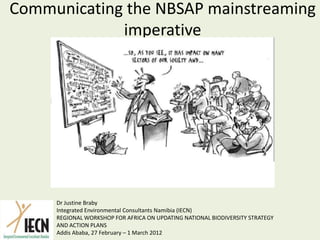
Communicating the NBSAP mainstreaming
             imperative


     Dr Justine Braby
     Integrated Environmental Consultants Namibia (IECN)
     REGIONAL WORKSHOP FOR AFRICA ON UPDATING NATIONAL BIODIVERSITY STRATEGY
     AND ACTION PLANS
     Addis Ababa, 27 February – 1 March 2012
What are the take home messages?


1. Effective communication is key to NBSAP
   impact!

2. Effective communication is a two-way street!

3. Internal communication first before external!

4. Analyse and understand your audience!
The fictitious case of Nilia….
Example 1:
Nilia has just developed her NBSAP. As part of Aichi Target 5 “By 2020, the rate
of loss of all natural habitats, including forests, is at least halved and where
feasible brought close to zero, and degradation and fragmentation is
significantly reduced”, Nilia’s NBSAP has a target “Identify areas of importance
to the integral function of ecosystem services by 2014”.

During this development, the Ministry of Mines comes across a substantial
Phosphate deposit in one of these areas. No one at the Ministry of Mines is
aware of the NBSAP nor has an understanding of the importance of ecosystem
services. The mining potential will create, in the short term, 1000 jobs and
contribute significantly to the economy. However, the ecosystem services here
are so important, that their degradation due to mining would contribute to the
direct loss of human lives in years to come, and in the long-term cause
breakdowns in livelihoods of people who are indirectly dependent on these
ecosystem services.
The fictitious case of Otumbi….
Example 2:

Otumbi has just developed her NBSAP and, also under Target 5, has
developed a target stating “Increase protected areas by 10% by 2018”.

As part of this national target, the Ministry of Environment decides to
make a state nature reserve to protect its forests and biodiversity.
However it includes a settlement of people who were previously
accustomed to go to the forest for their hunting and fishing. The day
the forest becomes legally part of the nature reserve, the local people
have to stop this activity. This means that they lose any possibility to
supply their families with forest products which are important for their
families’ income.
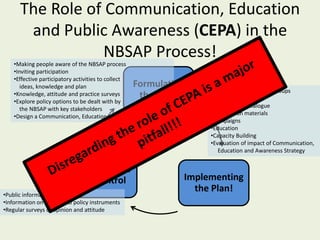
The Role of Communication, Education
       and Public Awareness (CEPA) in the
                  NBSAP Process!
    •Making people aware of the NBSAP process
    •Inviting participation
    •Effective participatory activities to collect
       ideas, knowledge and plan                Formulating
                                                                     •Networking to mobilise groups
    •Knowledge, attitude and practice surveys    the Plan!           •Partnerships
    •Explore policy options to be dealt with by
                                                                     •Inter-sectoral dialogue
       the NBSAP with key stakeholders
                                                                     •Information materials
    •Design a Communication, Education and Awareness Strategy
                                                                     •Campaigns
                                                                     •Education
                                                                     •Capacity Building
                                                                     •Evaluation of impact of Communication,
                                                                        Education and Awareness Strategy


                          Management
                          and control                           Implementing
                                                                  the Plan!
•Public information
•Information on changes to policy instruments
•Regular surveys of opinion and attitude
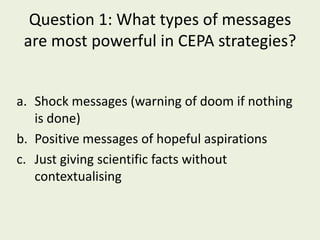
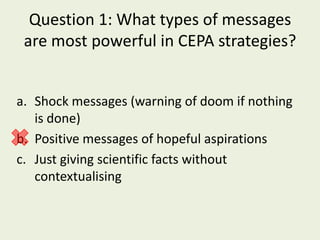
Question 1: What types of messages
 are most powerful in CEPA strategies?


a. Shock messages (warning of doom if nothing
   is done)
b. Positive messages of hopeful aspirations
c. Just giving scientific facts without
   contextualising
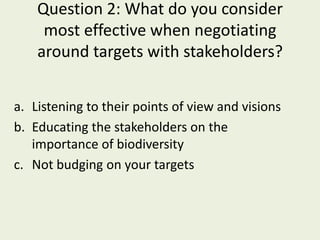
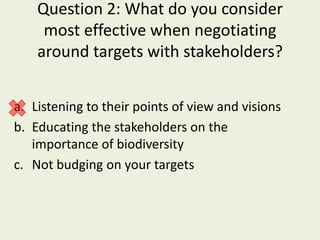
Question 2: What do you consider
     most effective when negotiating
    around targets with stakeholders?


a. Listening to their points of view and visions
b. Educating the stakeholders on the
   importance of biodiversity
c. Not budging on your targets
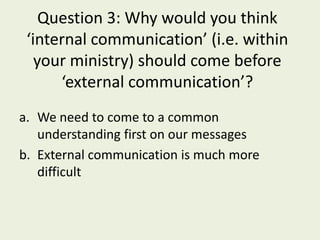
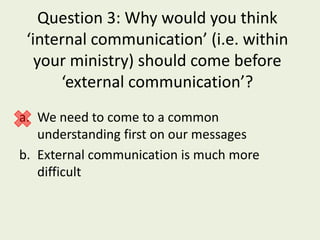
Question 3: Why would you think
 ‘internal communication’ (i.e. within
   your ministry) should come before
      ‘external communication’?
a. We need to come to a common
   understanding first on our messages
b. External communication is much more
   difficult
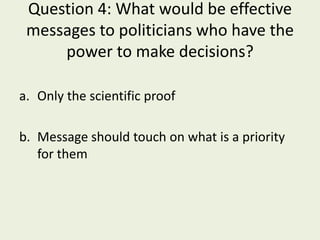
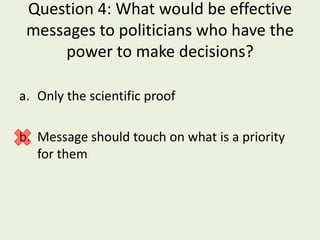
Question 4: What would be effective
 messages to politicians who have the
     power to make decisions?

a. Only the scientific proof

b. Message should touch on what is a priority
   for them
Question 1: What types of messages
 are most powerful in CEPA strategies?


a. Shock messages (warning of doom if nothing
   is done)
b. Positive messages of hopeful aspirations
c. Just giving scientific facts without
   contextualising
Question 2: What do you consider
     most effective when negotiating
    around targets with stakeholders?


a. Listening to their points of view and visions
b. Educating the stakeholders on the
   importance of biodiversity
c. Not budging on your targets
Question 3: Why would you think
 ‘internal communication’ (i.e. within
   your ministry) should come before
      ‘external communication’?
a. We need to come to a common
   understanding first on our messages
b. External communication is much more
   difficult
Question 4: What would be effective
 messages to politicians who have the
     power to make decisions?

a. Only the scientific proof

b. Message should touch on what is a priority
   for them
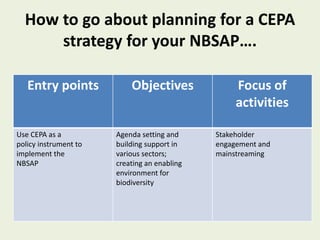
How to go about planning for a CEPA
      strategy for your NBSAP….

   Entry points            Objectives              Focus of
                                                   activities

Use CEPA as a          Agenda setting and     Stakeholder
policy instrument to   building support in    engagement and
implement the          various sectors;       mainstreaming
NBSAP                  creating an enabling
                       environment for
                       biodiversity
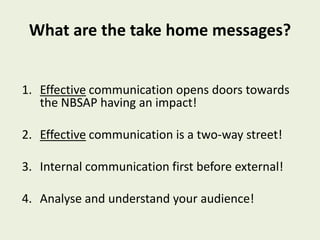
What are the take home messages?


1. Effective communication opens doors towards
   the NBSAP having an impact!

2. Effective communication is a two-way street!

3. Internal communication first before external!

4. Analyse and understand your audience!

Communicating the NBSAP mainstreaming imperative

  • 1.
    Communicating the NBSAPmainstreaming imperative Dr Justine Braby Integrated Environmental Consultants Namibia (IECN) REGIONAL WORKSHOP FOR AFRICA ON UPDATING NATIONAL BIODIVERSITY STRATEGY AND ACTION PLANS Addis Ababa, 27 February – 1 March 2012
  • 2.
    What are thetake home messages? 1. Effective communication is key to NBSAP impact! 2. Effective communication is a two-way street! 3. Internal communication first before external! 4. Analyse and understand your audience!
  • 3.
    The fictitious caseof Nilia…. Example 1: Nilia has just developed her NBSAP. As part of Aichi Target 5 “By 2020, the rate of loss of all natural habitats, including forests, is at least halved and where feasible brought close to zero, and degradation and fragmentation is significantly reduced”, Nilia’s NBSAP has a target “Identify areas of importance to the integral function of ecosystem services by 2014”. During this development, the Ministry of Mines comes across a substantial Phosphate deposit in one of these areas. No one at the Ministry of Mines is aware of the NBSAP nor has an understanding of the importance of ecosystem services. The mining potential will create, in the short term, 1000 jobs and contribute significantly to the economy. However, the ecosystem services here are so important, that their degradation due to mining would contribute to the direct loss of human lives in years to come, and in the long-term cause breakdowns in livelihoods of people who are indirectly dependent on these ecosystem services.
  • 4.
    The fictitious caseof Otumbi…. Example 2: Otumbi has just developed her NBSAP and, also under Target 5, has developed a target stating “Increase protected areas by 10% by 2018”. As part of this national target, the Ministry of Environment decides to make a state nature reserve to protect its forests and biodiversity. However it includes a settlement of people who were previously accustomed to go to the forest for their hunting and fishing. The day the forest becomes legally part of the nature reserve, the local people have to stop this activity. This means that they lose any possibility to supply their families with forest products which are important for their families’ income.
  • 5.
    The Role ofCommunication, Education and Public Awareness (CEPA) in the NBSAP Process! •Making people aware of the NBSAP process •Inviting participation •Effective participatory activities to collect ideas, knowledge and plan Formulating •Networking to mobilise groups •Knowledge, attitude and practice surveys the Plan! •Partnerships •Explore policy options to be dealt with by •Inter-sectoral dialogue the NBSAP with key stakeholders •Information materials •Design a Communication, Education and Awareness Strategy •Campaigns •Education •Capacity Building •Evaluation of impact of Communication, Education and Awareness Strategy Management and control Implementing the Plan! •Public information •Information on changes to policy instruments •Regular surveys of opinion and attitude
  • 6.
    Question 1: Whattypes of messages are most powerful in CEPA strategies? a. Shock messages (warning of doom if nothing is done) b. Positive messages of hopeful aspirations c. Just giving scientific facts without contextualising
  • 7.
    Question 2: Whatdo you consider most effective when negotiating around targets with stakeholders? a. Listening to their points of view and visions b. Educating the stakeholders on the importance of biodiversity c. Not budging on your targets
  • 8.
    Question 3: Whywould you think ‘internal communication’ (i.e. within your ministry) should come before ‘external communication’? a. We need to come to a common understanding first on our messages b. External communication is much more difficult
  • 9.
    Question 4: Whatwould be effective messages to politicians who have the power to make decisions? a. Only the scientific proof b. Message should touch on what is a priority for them
  • 10.
    Question 1: Whattypes of messages are most powerful in CEPA strategies? a. Shock messages (warning of doom if nothing is done) b. Positive messages of hopeful aspirations c. Just giving scientific facts without contextualising
  • 11.
    Question 2: Whatdo you consider most effective when negotiating around targets with stakeholders? a. Listening to their points of view and visions b. Educating the stakeholders on the importance of biodiversity c. Not budging on your targets
  • 12.
    Question 3: Whywould you think ‘internal communication’ (i.e. within your ministry) should come before ‘external communication’? a. We need to come to a common understanding first on our messages b. External communication is much more difficult
  • 13.
    Question 4: Whatwould be effective messages to politicians who have the power to make decisions? a. Only the scientific proof b. Message should touch on what is a priority for them
  • 14.
    How to goabout planning for a CEPA strategy for your NBSAP…. Entry points Objectives Focus of activities Use CEPA as a Agenda setting and Stakeholder policy instrument to building support in engagement and implement the various sectors; mainstreaming NBSAP creating an enabling environment for biodiversity
  • 15.
    What are thetake home messages? 1. Effective communication opens doors towards the NBSAP having an impact! 2. Effective communication is a two-way street! 3. Internal communication first before external! 4. Analyse and understand your audience!