Splenomegaly
DR TANIYA PRUTHI
Introduction
• Reticuloendothelial organ
• Origin in dorsal mesogastrium at about 5th
week.
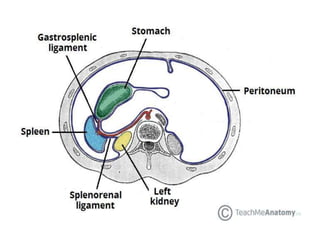
• Attached to stomach through gastrolienal
ligament and to kidney via lienorenal ligament
• Originates in series of hillocks
• If hillocks fail to unify, it will produce accessory
spleen seen in 20%.
Functions
• Quality check over the red blood cells by
removing senescent and defective rbcs from
the circulation in the red pulp
• Synthesis of antibodies in white pulp
• Removal of antibody coated rbc or bacteria
from circulation
• Has a role in portal circulation
Anatomical details
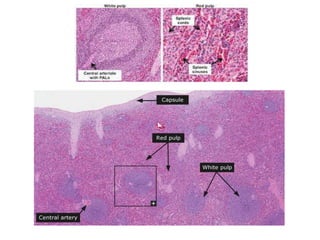
• It has a white and red pulp
• Major blood flows into the central arterioles
• Through it will enter into cords and sinuses but will find
its way back into circulation.
• Old and damaged rbcs are less deformable so they stay
back in the cords where they are destroyed and
components are recycled.
• Normal human spleen does not store rbc and contract
in response to sympathetic stimulation
• Contain one third of total body platelets and
marginated neutrophils
• Spleen weighs <250grams
• Entirely fits within the rib cage
• On ultrasound-max cepahlo-caudal diameter
is 13cm
• Not palpable normally
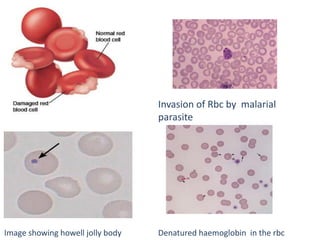
Invasion of Rbc by malarial
parasite
Image showing howell jolly body Denatured haemoglobin in the rbc
Adaptive function
• Clear bacteria from the circulation
• Generate immune response against the
pathogen
• Extramedullary hematopiesis
Clinical approach
• Common symptoms seen are pain and
heaviness in the left upper quadrant.
• Causes of pain are-
1)Acute swelling of the spleen
and stretching of the capsule
3)Infarction
2) Inflammation of the capsule 4)Sickle cell crises
• Rupture of spleen itself can be painless
Physical examination
• On inspection-fullness in the left upper
quadrant which descends with inspiration
seen in massive splenomegaly
• For palpation-
1)Bimanual palpation
2)ballotment
3)Palpation from above(middleton maneuvre)
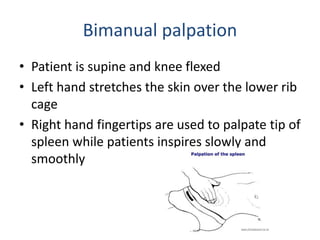
Bimanual palpation
• Patient is supine and knee flexed
• Left hand stretches the skin over the lower rib
cage
• Right hand fingertips are used to palpate tip of
spleen while patients inspires slowly and
smoothly
• For percussion three methods can be used
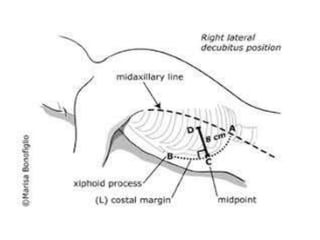
1. Nixons method-
A. Patient is placed on the right side
B. Follow posterior axillary line percussion
begins at lower level of pulmonary resonance
and proceed diagonally along prependicular
line towards the lower midanterior costal
margin
C. Upper border of dullness is 6-8cm above the
costal margin
D. Dullness of >8cm suggests splenomegaly
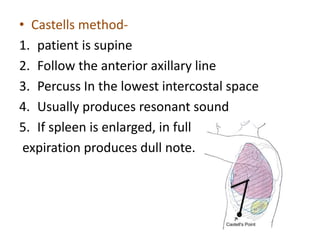
• Castells method-
1. patient is supine
2. Follow the anterior axillary line
3. Percuss In the lowest intercostal space
4. Usually produces resonant sound
5. If spleen is enlarged, in full
expiration produces dull note.
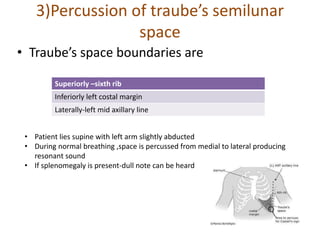
3)Percussion of traube’s semilunar
space
• Traube’s space boundaries are
Superiorly –sixth rib
Inferiorly left costal margin
Laterally-left mid axillary line
• Patient lies supine with left arm slightly abducted
• During normal breathing ,space is percussed from medial to lateral producing
resonant sound
• If splenomegaly is present-dull note can be heard
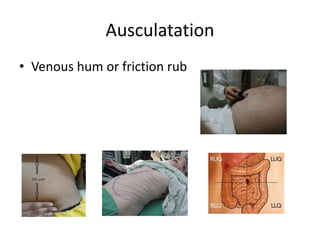
Ausculatation
• Venous hum or friction rub
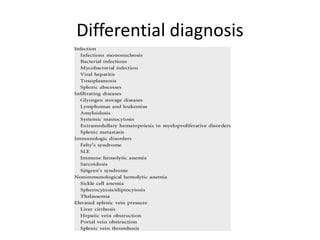
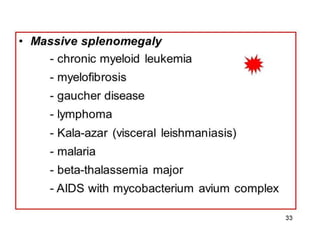
Differential diagnosis
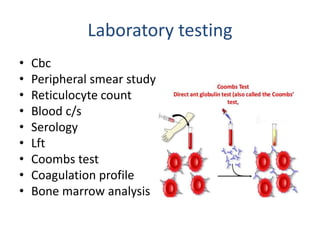
Laboratory testing
• Cbc
• Peripheral smear study
• Reticulocyte count
• Blood c/s
• Serology
• Lft
• Coombs test
• Coagulation profile
• Bone marrow analysis
imaging
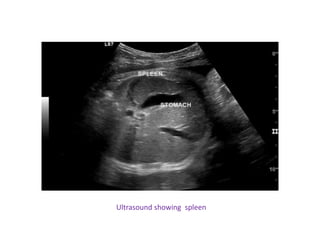
• Ultrasound-sensitive and non invasive
• CT scan-can detect splenic
mets,abcess,cyst,retroperitoneal lyph node
• Mri/doppler ultrasound-portal and splenic
vein thrombosis
• PET scan-for diagnosis and staging of
lymphomas
Ultrasound showing spleen
Management
• Treat the underlying cause
• Follow up the patient for any increase in size
• If causing complications-remove the spleen
known as splenectomy
• To reduce risk of infections after surgery-
Vaccinations before and after surgery includes-
pneumococcal vaccine,hemophilus influenza
type b vaccine, meningococcal vaccine.
Thank you!!!

Splenomegaly

  • 1.
  • 2.
    Introduction • Reticuloendothelial organ •Origin in dorsal mesogastrium at about 5th week. • Attached to stomach through gastrolienal ligament and to kidney via lienorenal ligament • Originates in series of hillocks • If hillocks fail to unify, it will produce accessory spleen seen in 20%.
  • 4.
    Functions • Quality checkover the red blood cells by removing senescent and defective rbcs from the circulation in the red pulp • Synthesis of antibodies in white pulp • Removal of antibody coated rbc or bacteria from circulation • Has a role in portal circulation
  • 5.
    Anatomical details • Ithas a white and red pulp • Major blood flows into the central arterioles • Through it will enter into cords and sinuses but will find its way back into circulation. • Old and damaged rbcs are less deformable so they stay back in the cords where they are destroyed and components are recycled. • Normal human spleen does not store rbc and contract in response to sympathetic stimulation • Contain one third of total body platelets and marginated neutrophils
  • 6.
    • Spleen weighs<250grams • Entirely fits within the rib cage • On ultrasound-max cepahlo-caudal diameter is 13cm • Not palpable normally
  • 8.
    Invasion of Rbcby malarial parasite Image showing howell jolly body Denatured haemoglobin in the rbc
  • 9.
    Adaptive function • Clearbacteria from the circulation • Generate immune response against the pathogen • Extramedullary hematopiesis
  • 10.
    Clinical approach • Commonsymptoms seen are pain and heaviness in the left upper quadrant. • Causes of pain are- 1)Acute swelling of the spleen and stretching of the capsule 3)Infarction 2) Inflammation of the capsule 4)Sickle cell crises • Rupture of spleen itself can be painless
  • 11.
    Physical examination • Oninspection-fullness in the left upper quadrant which descends with inspiration seen in massive splenomegaly • For palpation- 1)Bimanual palpation 2)ballotment 3)Palpation from above(middleton maneuvre)
  • 12.
    Bimanual palpation • Patientis supine and knee flexed • Left hand stretches the skin over the lower rib cage • Right hand fingertips are used to palpate tip of spleen while patients inspires slowly and smoothly
  • 13.
    • For percussionthree methods can be used 1. Nixons method- A. Patient is placed on the right side B. Follow posterior axillary line percussion begins at lower level of pulmonary resonance and proceed diagonally along prependicular line towards the lower midanterior costal margin C. Upper border of dullness is 6-8cm above the costal margin D. Dullness of >8cm suggests splenomegaly
  • 15.
    • Castells method- 1.patient is supine 2. Follow the anterior axillary line 3. Percuss In the lowest intercostal space 4. Usually produces resonant sound 5. If spleen is enlarged, in full expiration produces dull note.
  • 16.
    3)Percussion of traube’ssemilunar space • Traube’s space boundaries are Superiorly –sixth rib Inferiorly left costal margin Laterally-left mid axillary line • Patient lies supine with left arm slightly abducted • During normal breathing ,space is percussed from medial to lateral producing resonant sound • If splenomegaly is present-dull note can be heard
  • 17.
  • 18.
  • 20.
    Laboratory testing • Cbc •Peripheral smear study • Reticulocyte count • Blood c/s • Serology • Lft • Coombs test • Coagulation profile • Bone marrow analysis
  • 21.
    imaging • Ultrasound-sensitive andnon invasive • CT scan-can detect splenic mets,abcess,cyst,retroperitoneal lyph node • Mri/doppler ultrasound-portal and splenic vein thrombosis • PET scan-for diagnosis and staging of lymphomas
  • 22.
  • 23.
    Management • Treat theunderlying cause • Follow up the patient for any increase in size • If causing complications-remove the spleen known as splenectomy • To reduce risk of infections after surgery- Vaccinations before and after surgery includes- pneumococcal vaccine,hemophilus influenza type b vaccine, meningococcal vaccine.
  • 24.