BRITISH  CULTURE
The concept of culture something difficult to  define.
The concept of culture something difficult to  define.   The New Oxford Dictionary of English:
The concept of culture something difficult to  define.   The New Oxford Dictionary of English: “ The customs, social institutions, arts, and achievements of a particular na-tion, region, people or any other social group”
The concept of culture something difficult to  define.   The New Oxford Dictionary of English: “ The customs, social institutions, arts, and achievements of a particular na-tion, region, people or any other social group” A second-foreign  language  cannot  be learned or  taught without  addressing the culture of the community in which it is used
 
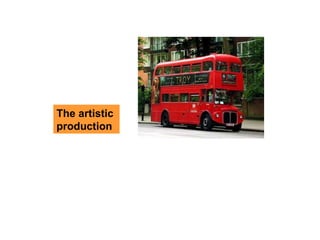
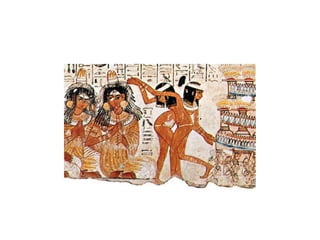
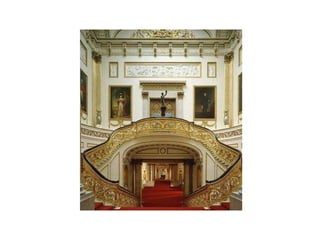
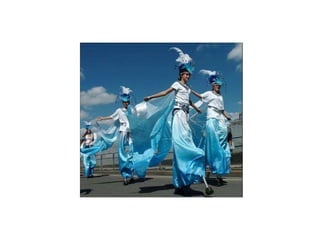
The artistic  production
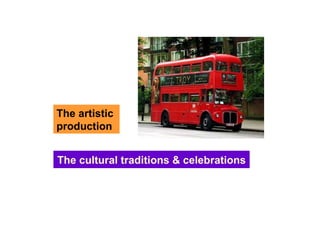
The cultural traditions & celebrations The artistic  production
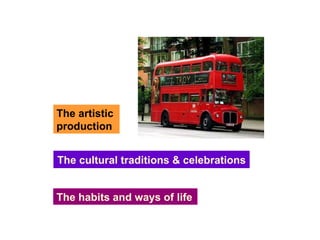
The habits and ways of life The cultural traditions & celebrations The artistic  production
HOW   much   do you   know   about british culture  ?
 
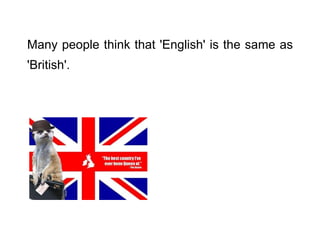
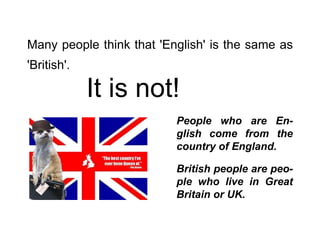
Many people think that 'English' is the same as 'British'.
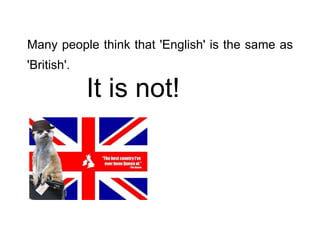
Many people think that 'English' is the same as 'British'.   It is not!
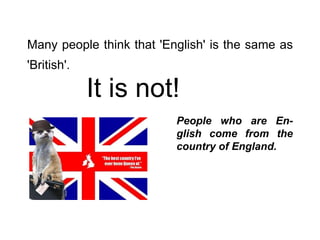
Many people think that 'English' is the same as 'British'.   It is not! People who are En-glish come from the country of England.
Many people think that 'English' is the same as 'British'.   It is not! People who are En-glish come from the country of England. British people are peo-ple who live in Great Britain or UK.
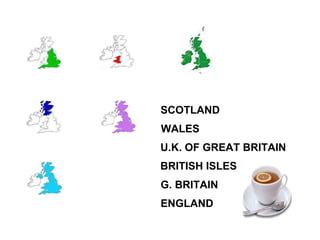
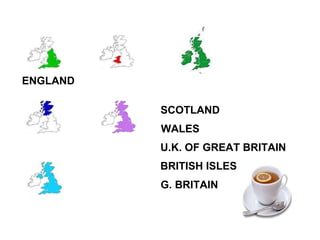
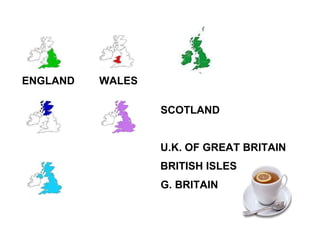
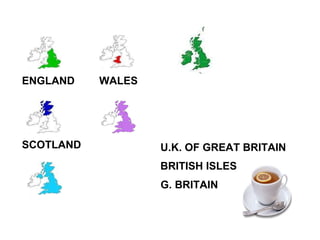
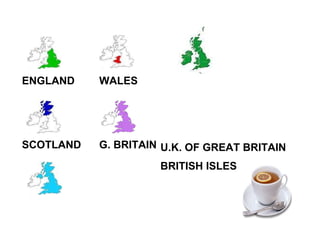
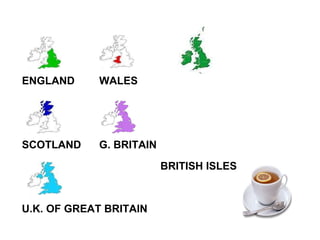
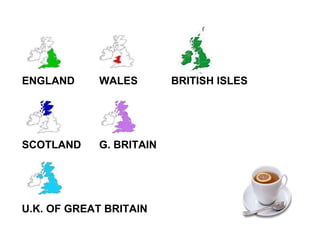
ENGLAND SCOTLAND WALES G. BRITAIN U.K. OF GREAT BRITAIN BRITISH ISLES
1.-What nationality is a person born in Nothern Ireland? Irish English British
Thousands of years ago, Great Britain was joined to Europe and was covered with ice. About 15,000 years ago, the weather became warmer. The ice melted and the sea level rose. Great Britain became an island about 8000 years ago
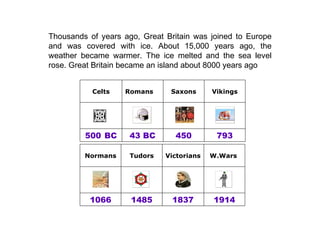
Thousands of years ago, Great Britain was joined to Europe and was covered with ice. About 15,000 years ago, the weather became warmer. The ice melted and the sea level rose. Great Britain became an island about 8000 years ago 500   BC Celts 793 450 43 BC               Vikings Saxons Romans 1914 1837 1485 1066                  W.Wars  Victorians Tudors Normans
 
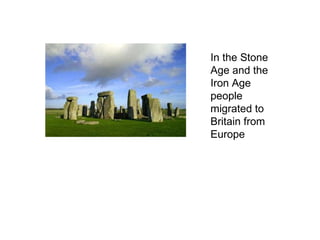
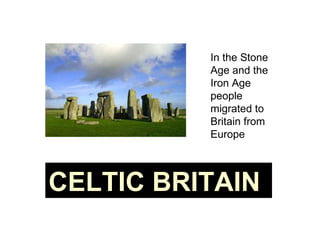
In the Stone Age and the Iron Age people migrated to Britain from Europe
In the Stone Age and the Iron Age people migrated to Britain from Europe  CELTIC BRITAIN
 
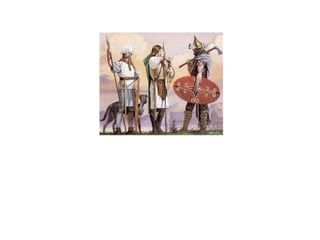
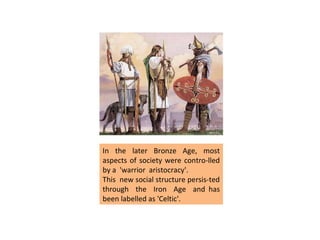
In the later Bronze Age, most aspects of society were contro-lled by a  'warrior  aristocracy'.  This  new social structure persis-ted through  the  Iron  Age  and has been labelled as 'Celtic'.
 
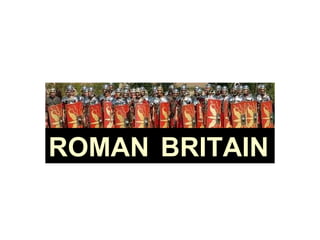
ROMAN   BRITAIN
 
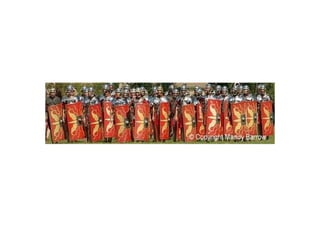
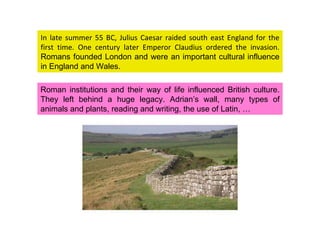
In late summer 55 BC, Julius Caesar raided south east England for the first time. One century later Emperor Claudius ordered the invasion.  Romans founded London and were an important cultural influence in England and Wales.
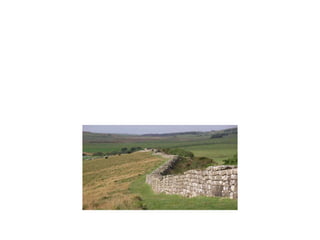
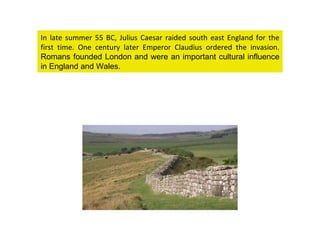
In late summer 55 BC, Julius Caesar raided south east England for the first time. One century later Emperor Claudius ordered the invasion.  Romans founded London and were an important cultural influence in England and Wales.  Roman institutions and their way of life influenced British culture. They left behind a huge legacy. Adrian’s wall, many types of animals and plants, reading and writing, the use of Latin, …
 
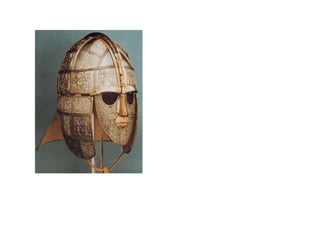
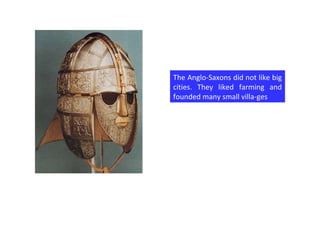
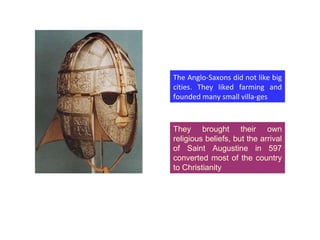
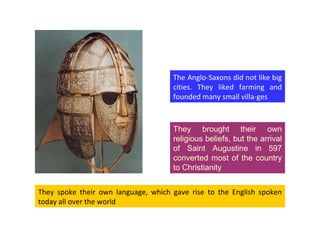
ANGLO-SAXON BRITAIN
 
The Anglo-Saxons did not like big cities. They liked farming and founded many small villa-ges
They brought their own religious beliefs, but the arrival of Saint Augustine in 597 converted most of the country to Christianity The Anglo-Saxons did not like big cities. They liked farming and founded many small villa-ges
They spoke their own language, which gave rise to the English spoken today all over the world They brought their own religious beliefs, but the arrival of Saint Augustine in 597 converted most of the country to Christianity The Anglo-Saxons did not like big cities. They liked farming and founded many small villa-ges
 
VIKING BRITAIN
 
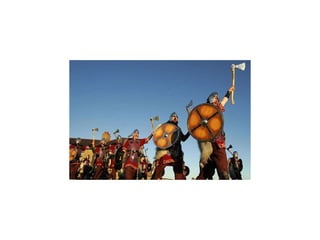
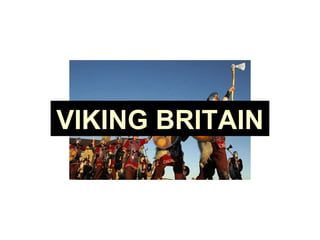
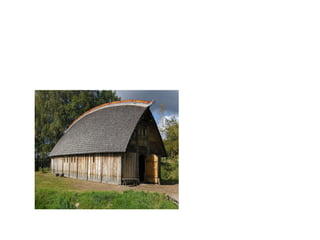
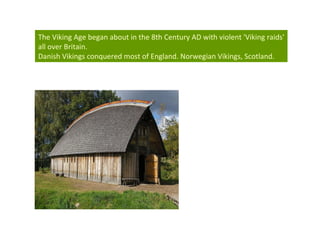
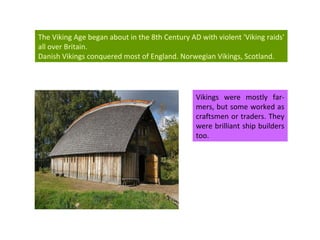
The Viking Age began about in the 8th Century AD with  violent 'Viking raids' all over Britain.  Danish Vikings conquered most of England.  Norwegian Vikings, Scotland.
Vikings were mostly far-mers, but some worked as craftsmen or traders. They were brilliant ship builders too. The Viking Age began about in the 8th Century AD with  violent 'Viking raids' all over Britain.  Danish Vikings conquered most of England.  Norwegian Vikings, Scotland.
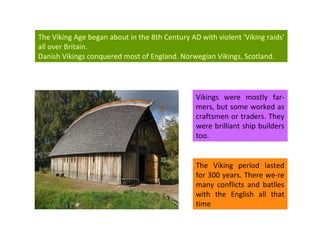
Vikings were mostly far-mers, but some worked as craftsmen or traders. They were brilliant ship builders too. The Viking Age began about in the 8th Century AD with  violent 'Viking raids' all over Britain.  Danish Vikings conquered most of England.  Norwegian Vikings, Scotland. The Viking period lasted for 300 years. There we-re many conflicts and batlles with t he English all that time
 
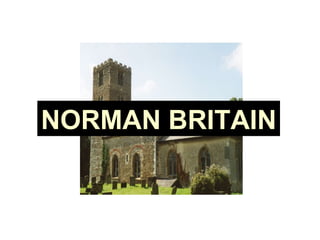
NORMAN BRITAIN
 
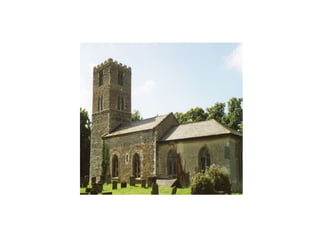
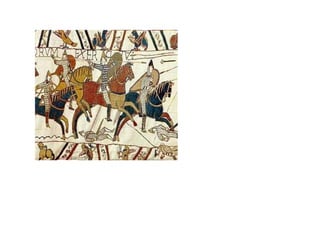
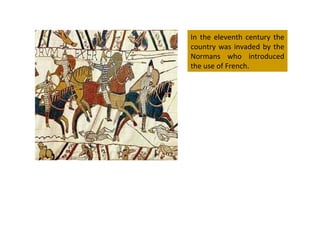
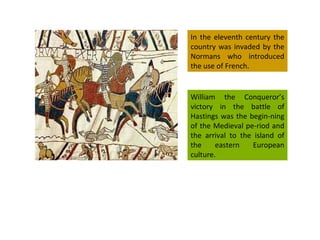
In the eleventh century the country was invaded by the Normans who introduced the use of French.
In the eleventh century the country was invaded by the Normans who introduced the use of French. William the Conqueror’s victory in the battle of Hastings was the begin-ning of the Medieval pe-riod and the arrival to the island of the eastern European culture.
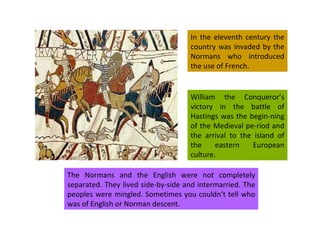
In the eleventh century the country was invaded by the Normans who introduced the use of French. William the Conqueror’s victory in the battle of Hastings was the begin-ning of the Medieval pe-riod and the arrival to the island of the eastern European culture. The Normans and the English were not completely separated. They lived side-by-side and intermarried. The peoples were mingled. Sometimes you couldn’t tell who was of English or Norman descent.
 
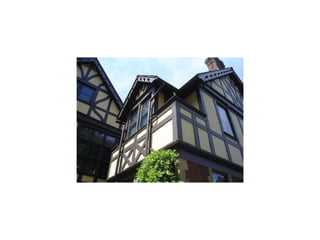
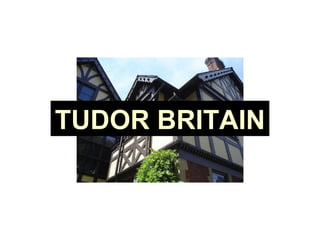
TUDOR BRITAIN
 
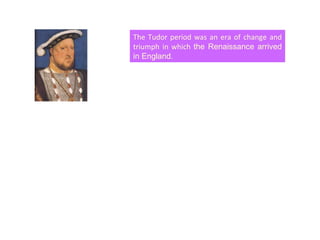
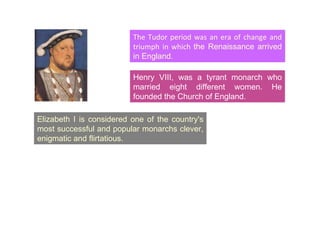
The Tudor period was an era of change and triumph in which  the Renaissance arrived in England.
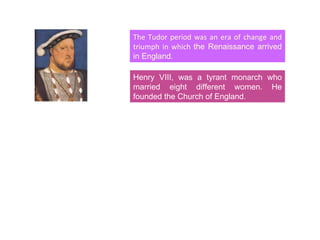
The Tudor period was an era of change and triumph in which  the Renaissance arrived in England. Henry VIII, was a tyrant monarch who married eight different women. He founded the Church of England.
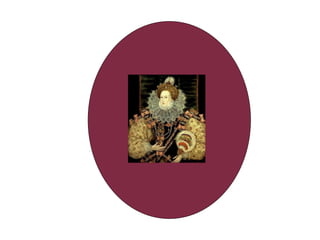
The Tudor period was an era of change and triumph in which  the Renaissance arrived in England. Elizabeth I is considered one of the country's most successful and popular monarchs clever, enigmatic and flirtatious. Henry VIII, was a tyrant monarch who married eight different women. He founded the Church of England.
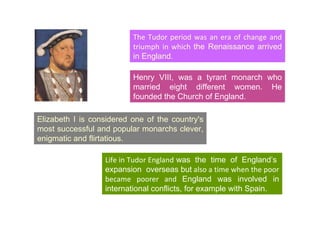
The Tudor period was an era of change and triumph in which  the Renaissance arrived in England. Elizabeth I is considered one of the country's most successful and popular monarchs clever, enigmatic and flirtatious. Henry VIII, was a tyrant monarch who married eight different women. He founded the Church of England. Life in Tudor England  was  the  time  of  England’s  expansion  overseas but  also a time when the poor became poorer and  England was involved in international conflicts, for example with Spain.
 
VICTORIAN BRITAIN
 
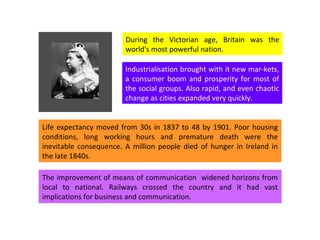
During the Victorian age, Britain was the world's most powerful nation.
During the Victorian age, Britain was the world's most powerful nation.  Industrialisation brought with it new mar-kets, a consumer boom and prosperity for most of the social groups. Also rapid, and even chaotic change as cities expanded very quickly.
During the Victorian age, Britain was the world's most powerful nation.  Industrialisation brought with it new mar-kets, a consumer boom and prosperity for most of the social groups. Also rapid, and even chaotic change as cities expanded very quickly.  Life expectancy moved from 30s in 1837 to 48 by 1901. Poor housing conditions, long working hours and premature death were the inevitable consequence. A million people died of hunger in Ireland in the late 1840s.
During the Victorian age, Britain was the world's most powerful nation.  Industrialisation brought with it new mar-kets, a consumer boom and prosperity for most of the social groups. Also rapid, and even chaotic change as cities expanded very quickly.  Life expectancy moved from 30s in 1837 to 48 by 1901. Poor housing conditions, long working hours and premature death were the inevitable consequence. A million people died of hunger in Ireland in the late 1840s. The improvement of means of communication  widened horizons from local to national. Railways crossed the country and it had vast implications for business and communication.
 
TWENTIETH CENTURY
2.-Who is the current British Prime Minister? The Duke of Edimburg Gordon Brown Barack Obama
 
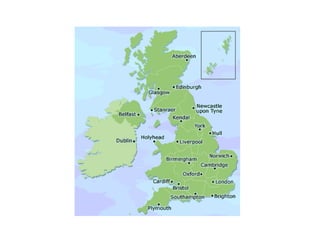
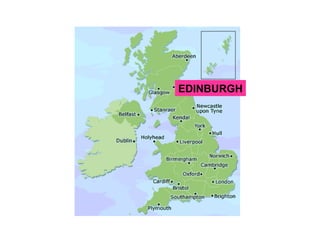
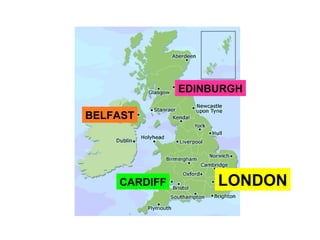
EDINBURGH
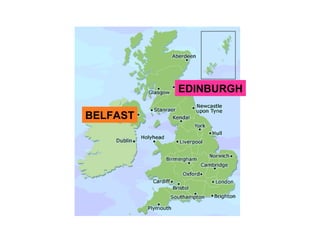
EDINBURGH BELFAST
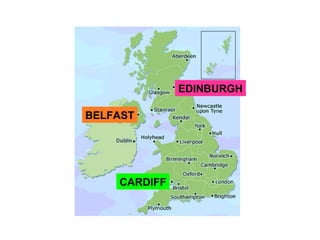
EDINBURGH BELFAST CARDIFF
LONDON EDINBURGH BELFAST CARDIFF
3.-Which of these languages are spoken in UK nowadays? Gaelic and Irish Scots and Welsh . English and Cornish
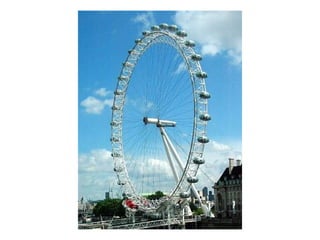
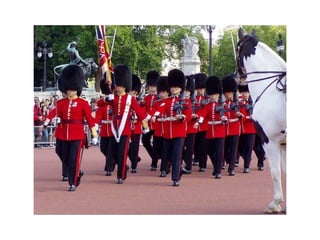
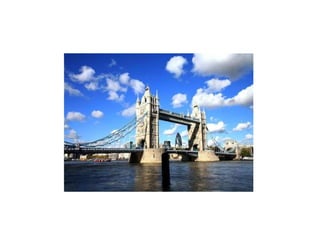
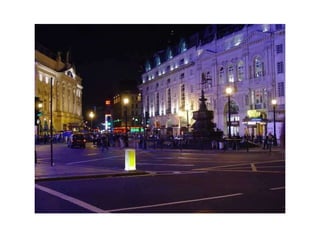
THERE ARE MANY INTERESTING PLACES TO  VISIT  IN  LONDON


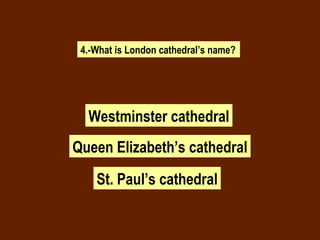
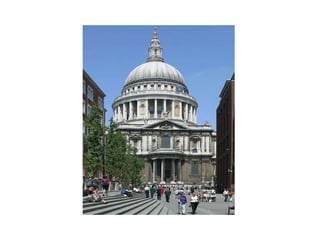
4.-What is London cathedral’s name? Westminster cathedral Queen Elizabeth’s cathedral St. Paul’s cathedral
 
London, the capital of England and the UK, occupies over 620 square miles and is the most populous city in the European Union.
London, the capital of England and the UK, occupies over 620 square miles and is the most populous city in the European Union. The population of London peaked in 1951 when the census of that year recorded about 8,346,000. Nowadays, there are about  seven million residents in London.
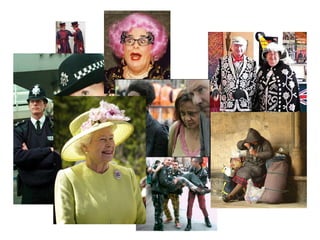
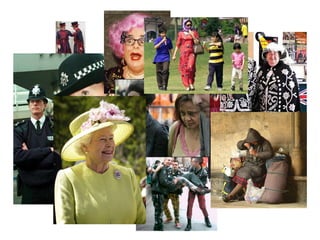
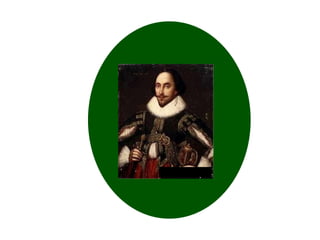
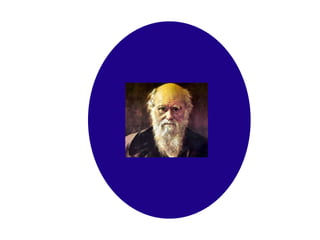
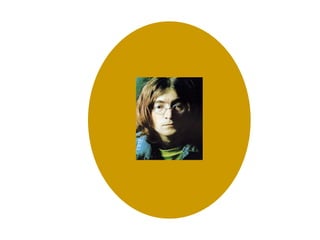
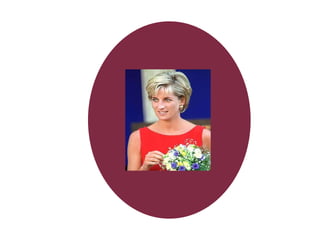
London, the capital of England and the UK, occupies over 620 square miles and is the most populous city in the European Union. The population of London peaked in 1951 when the census of that year recorded about 8,346,000. Nowadays, there are about  seven million residents in London.  YOU CAN FIND INTERESTING PEOPLE IF YOU  VISIT LONDON


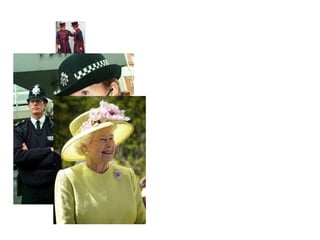
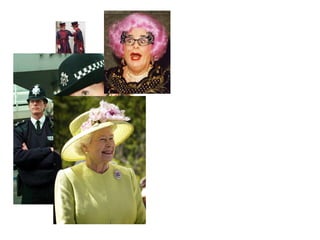
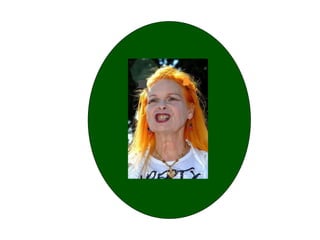
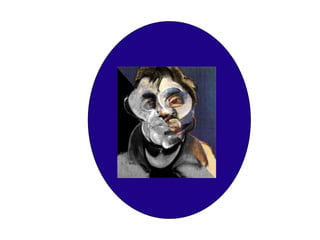
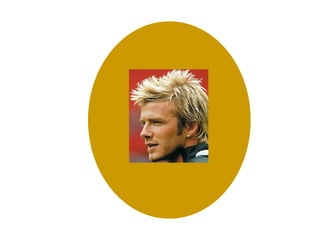
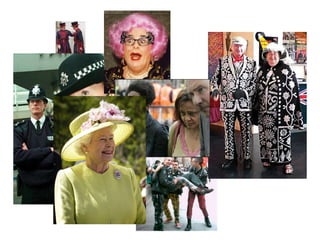
5.- If you are introduced one of these persons the usual formal greeting is a 'How do you do?' and A kiss if she is a girl A firm handshake   Two kisses if she is a girl


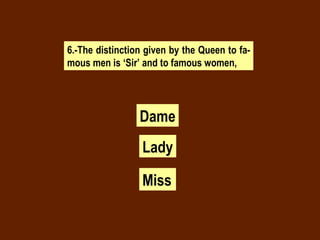
6.-The distinction given by the Queen to fa-mous men is ‘Sir’ and to famous women, Dame Lady Miss .
Pop music is an important part of British culture.   There are many different kinds of music (musical gen-res) that have helped shape British youth. It is not just as an expression of Englishness, but as a indicator of the multicultural nature of Britain today.  CAN YOU  IDENTIFY THESE?
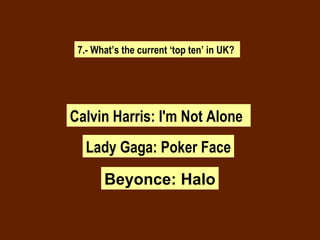
7.- What’s the current ‘top ten’ in UK? Calvin Harris: I'm Not Alone Lady Gaga: Poker Face Beyonce: Halo
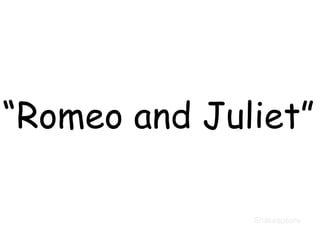
“ Romeo and Juliet”   Shakespeare
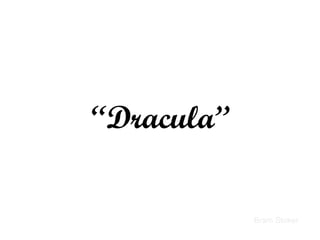
“ Dracula” Bram Stoker
“ The Canterville Ghost” O. Wilde
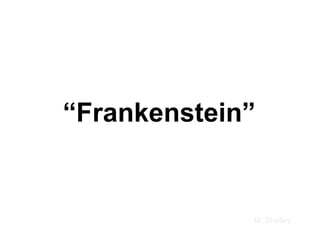
“ Frankenstein” M. Shelley
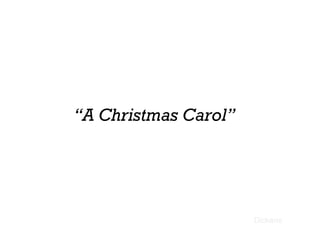
“ A Christmas Carol” Dickens
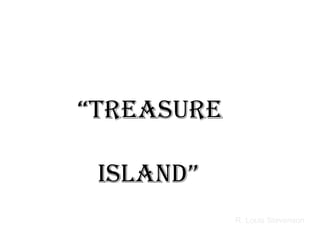
“ Treasure  Island” R. Louis Stevenson
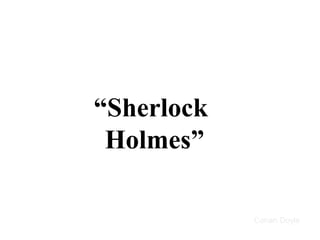
“ Sherlock  Holmes” Conan Doyle
“ The Legend of King Arthur”
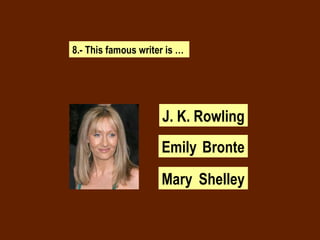
8.- This famous writer is … J. K. Rowling Emily  Bronte Mary  Shelley
British people place considerable value on punc-tuality. If you agree to meet friends at three o'clock, you can bet that they'll be there just after three. Since Britons are so time conscious, the pace of life may seem very rushed.
British people place considerable value on punc-tuality. If you agree to meet friends at three o'clock, you can bet that they'll be there just after three. Since Britons are so time conscious, the pace of life may seem very rushed. It is often considered impolite to arrive even a few minutes late. If you are unable to keep an appoint-ment, it is expected that you call the person you are meeting.
British people place considerable value on punc-tuality. If you agree to meet friends at three o'clock, you can bet that they'll be there just after three. Since Britons are so time conscious, the pace of life may seem very rushed. It is often considered impolite to arrive even a few minutes late. If you are unable to keep an appoint-ment, it is expected that you call the person you are meeting.  “ Come and see me soon” is an idiom often used but seldom meant to be taken literally. It is wise to telephone before visiting someone at home.
The English are said to be reserved in manners, dress and speech. We are famous for our politeness, self-discipline and especially for our sense of hu-mour. Basic politeness (please, thank you, excuse me) is expected.
The English are said to be reserved in manners, dress and speech. We are famous for our politeness, self-discipline and especially for our sense of hu-mour. Basic politeness (please, thank you, excuse me) is expected.   English people are quite reserved when greeting one another. A greeting can be 'Hello' 'Hi' or 'Good morning', when you arrive at work or at school.
The English are said to be reserved in manners, dress and speech. We are famous for our politeness, self-discipline and especially for our sense of hu-mour. Basic politeness (please, thank you, excuse me) is expected.   English people are quite reserved when greeting one another. A greeting can be 'Hello' 'Hi' or 'Good morning', when you arrive at work or at school.  If you talk to a British person, remember that it is very good manners to say "please" and "thank you". It is considered rude if you don't. You will notice in England that we say 'thank you' a lot.
In England people like to form orderly queues (standing in line) and wait patiently for their turn e.g. boarding a bus. It is usual to queue when required, and expected that you will take your correct turn and not push in front. 'Queue jumping' is frowned upon.
In England people like to form orderly queues (standing in line) and wait patiently for their turn e.g. boarding a bus. It is usual to queue when required, and expected that you will take your correct turn and not push in front. 'Queue jumping' is frowned upon.   If someone is blocking your way and you would like them to move, say excuse me and they will move out of your way. If you accidentally bump into someone, say 'sorry'. They probably will too, even if it was your fault! This is an amusing habit.
In England people like to form orderly queues (standing in line) and wait patiently for their turn e.g. boarding a bus. It is usual to queue when required, and expected that you will take your correct turn and not push in front. 'Queue jumping' is frowned upon.   If someone is blocking your way and you would like them to move, say excuse me and they will move out of your way. If you accidentally bump into someone, say 'sorry'. They probably will too, even if it was your fault! This is an amusing habit.  The British generally pay a lot of attention to good table manners. People always eat with knife and fork.
9.- If you are invited for dinner in U.K. NEVER … Eat pizza with your fingers Say thank you when served something   Take food from your neighbour’s plate
Superstitions can be defined as "irrational beliefs, especially with regard to the unknown“
Superstitions can be defined as "irrational beliefs, especially with regard to the unknown“ Different things that bring good luck:  A black cat  A horse shoe Touch wood  Putting money in the pocket of new clothes  Clover plants with four leaves
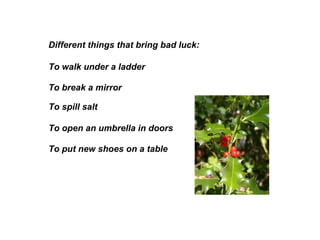
Different things that bring bad luck:  To break a mirror To walk under a ladder To spill salt To open an umbrella in doors  To put new shoes on a table
10.- On the first day of the month before uttering your first word of the day it is lucky to say …
T h e   e n d

British culture

  • 1.
  • 2.
  • 3.
    The concept ofculture something difficult to define.
  • 4.
    The concept ofculture something difficult to define. The New Oxford Dictionary of English:
  • 5.
    The concept ofculture something difficult to define. The New Oxford Dictionary of English: “ The customs, social institutions, arts, and achievements of a particular na-tion, region, people or any other social group”
  • 6.
    The concept ofculture something difficult to define. The New Oxford Dictionary of English: “ The customs, social institutions, arts, and achievements of a particular na-tion, region, people or any other social group” A second-foreign language cannot be learned or taught without addressing the culture of the community in which it is used
  • 7.
  • 8.
    The artistic production
  • 9.
    The cultural traditions& celebrations The artistic production
  • 10.
    The habits andways of life The cultural traditions & celebrations The artistic production
  • 11.
    HOW much do you know about british culture ?
  • 12.
  • 13.
    Many people thinkthat 'English' is the same as 'British'.
  • 14.
    Many people thinkthat 'English' is the same as 'British'. It is not!
  • 15.
    Many people thinkthat 'English' is the same as 'British'. It is not! People who are En-glish come from the country of England.
  • 16.
    Many people thinkthat 'English' is the same as 'British'. It is not! People who are En-glish come from the country of England. British people are peo-ple who live in Great Britain or UK.
  • 17.
    ENGLAND SCOTLAND WALESG. BRITAIN U.K. OF GREAT BRITAIN BRITISH ISLES
  • 18.
    ENGLAND SCOTLAND WALESG. BRITAIN U.K. OF GREAT BRITAIN BRITISH ISLES
  • 19.
    ENGLAND SCOTLAND WALESG. BRITAIN U.K. OF GREAT BRITAIN BRITISH ISLES
  • 20.
    ENGLAND SCOTLAND WALESG. BRITAIN U.K. OF GREAT BRITAIN BRITISH ISLES
  • 21.
    ENGLAND SCOTLAND WALESG. BRITAIN U.K. OF GREAT BRITAIN BRITISH ISLES
  • 22.
    ENGLAND SCOTLAND WALESG. BRITAIN U.K. OF GREAT BRITAIN BRITISH ISLES
  • 23.
    ENGLAND SCOTLAND WALESG. BRITAIN U.K. OF GREAT BRITAIN BRITISH ISLES
  • 24.
    1.-What nationality isa person born in Nothern Ireland? Irish English British
  • 25.
    Thousands of yearsago, Great Britain was joined to Europe and was covered with ice. About 15,000 years ago, the weather became warmer. The ice melted and the sea level rose. Great Britain became an island about 8000 years ago
  • 26.
    Thousands of yearsago, Great Britain was joined to Europe and was covered with ice. About 15,000 years ago, the weather became warmer. The ice melted and the sea level rose. Great Britain became an island about 8000 years ago 500 BC Celts 793 450 43 BC               Vikings Saxons Romans 1914 1837 1485 1066                  W.Wars Victorians Tudors Normans
  • 27.
  • 28.
    In the StoneAge and the Iron Age people migrated to Britain from Europe
  • 29.
    In the StoneAge and the Iron Age people migrated to Britain from Europe CELTIC BRITAIN
  • 30.
  • 31.
    In the laterBronze Age, most aspects of society were contro-lled by a 'warrior aristocracy'. This new social structure persis-ted through the Iron Age and has been labelled as 'Celtic'.
  • 32.
  • 33.
    ROMAN BRITAIN
  • 34.
  • 35.
    In late summer55 BC, Julius Caesar raided south east England for the first time. One century later Emperor Claudius ordered the invasion. Romans founded London and were an important cultural influence in England and Wales.
  • 36.
    In late summer55 BC, Julius Caesar raided south east England for the first time. One century later Emperor Claudius ordered the invasion. Romans founded London and were an important cultural influence in England and Wales. Roman institutions and their way of life influenced British culture. They left behind a huge legacy. Adrian’s wall, many types of animals and plants, reading and writing, the use of Latin, …
  • 37.
  • 38.
  • 39.
  • 40.
    The Anglo-Saxons didnot like big cities. They liked farming and founded many small villa-ges
  • 41.
    They brought theirown religious beliefs, but the arrival of Saint Augustine in 597 converted most of the country to Christianity The Anglo-Saxons did not like big cities. They liked farming and founded many small villa-ges
  • 42.
    They spoke theirown language, which gave rise to the English spoken today all over the world They brought their own religious beliefs, but the arrival of Saint Augustine in 597 converted most of the country to Christianity The Anglo-Saxons did not like big cities. They liked farming and founded many small villa-ges
  • 43.
  • 44.
  • 45.
  • 46.
    The Viking Agebegan about in the 8th Century AD with violent 'Viking raids' all over Britain. Danish Vikings conquered most of England. Norwegian Vikings, Scotland.
  • 47.
    Vikings were mostlyfar-mers, but some worked as craftsmen or traders. They were brilliant ship builders too. The Viking Age began about in the 8th Century AD with violent 'Viking raids' all over Britain. Danish Vikings conquered most of England. Norwegian Vikings, Scotland.
  • 48.
    Vikings were mostlyfar-mers, but some worked as craftsmen or traders. They were brilliant ship builders too. The Viking Age began about in the 8th Century AD with violent 'Viking raids' all over Britain. Danish Vikings conquered most of England. Norwegian Vikings, Scotland. The Viking period lasted for 300 years. There we-re many conflicts and batlles with t he English all that time
  • 49.
  • 50.
  • 51.
  • 52.
    In the eleventhcentury the country was invaded by the Normans who introduced the use of French.
  • 53.
    In the eleventhcentury the country was invaded by the Normans who introduced the use of French. William the Conqueror’s victory in the battle of Hastings was the begin-ning of the Medieval pe-riod and the arrival to the island of the eastern European culture.
  • 54.
    In the eleventhcentury the country was invaded by the Normans who introduced the use of French. William the Conqueror’s victory in the battle of Hastings was the begin-ning of the Medieval pe-riod and the arrival to the island of the eastern European culture. The Normans and the English were not completely separated. They lived side-by-side and intermarried. The peoples were mingled. Sometimes you couldn’t tell who was of English or Norman descent.
  • 55.
  • 56.
  • 57.
  • 58.
    The Tudor periodwas an era of change and triumph in which the Renaissance arrived in England.
  • 59.
    The Tudor periodwas an era of change and triumph in which the Renaissance arrived in England. Henry VIII, was a tyrant monarch who married eight different women. He founded the Church of England.
  • 60.
    The Tudor periodwas an era of change and triumph in which the Renaissance arrived in England. Elizabeth I is considered one of the country's most successful and popular monarchs clever, enigmatic and flirtatious. Henry VIII, was a tyrant monarch who married eight different women. He founded the Church of England.
  • 61.
    The Tudor periodwas an era of change and triumph in which the Renaissance arrived in England. Elizabeth I is considered one of the country's most successful and popular monarchs clever, enigmatic and flirtatious. Henry VIII, was a tyrant monarch who married eight different women. He founded the Church of England. Life in Tudor England was the time of England’s expansion overseas but also a time when the poor became poorer and England was involved in international conflicts, for example with Spain.
  • 62.
  • 63.
  • 64.
  • 65.
    During the Victorianage, Britain was the world's most powerful nation.
  • 66.
    During the Victorianage, Britain was the world's most powerful nation. Industrialisation brought with it new mar-kets, a consumer boom and prosperity for most of the social groups. Also rapid, and even chaotic change as cities expanded very quickly.
  • 67.
    During the Victorianage, Britain was the world's most powerful nation. Industrialisation brought with it new mar-kets, a consumer boom and prosperity for most of the social groups. Also rapid, and even chaotic change as cities expanded very quickly. Life expectancy moved from 30s in 1837 to 48 by 1901. Poor housing conditions, long working hours and premature death were the inevitable consequence. A million people died of hunger in Ireland in the late 1840s.
  • 68.
    During the Victorianage, Britain was the world's most powerful nation. Industrialisation brought with it new mar-kets, a consumer boom and prosperity for most of the social groups. Also rapid, and even chaotic change as cities expanded very quickly. Life expectancy moved from 30s in 1837 to 48 by 1901. Poor housing conditions, long working hours and premature death were the inevitable consequence. A million people died of hunger in Ireland in the late 1840s. The improvement of means of communication widened horizons from local to national. Railways crossed the country and it had vast implications for business and communication.
  • 69.
  • 70.
  • 71.
    2.-Who is thecurrent British Prime Minister? The Duke of Edimburg Gordon Brown Barack Obama
  • 72.
  • 73.
  • 74.
  • 75.
  • 76.
  • 77.
    3.-Which of theselanguages are spoken in UK nowadays? Gaelic and Irish Scots and Welsh . English and Cornish
  • 78.
    THERE ARE MANYINTERESTING PLACES TO VISIT IN LONDON
  • 79.
  • 80.
  • 81.
  • 82.
  • 83.
  • 84.
  • 85.
  • 86.
  • 87.
    4.-What is Londoncathedral’s name? Westminster cathedral Queen Elizabeth’s cathedral St. Paul’s cathedral
  • 88.
  • 89.
    London, the capitalof England and the UK, occupies over 620 square miles and is the most populous city in the European Union.
  • 90.
    London, the capitalof England and the UK, occupies over 620 square miles and is the most populous city in the European Union. The population of London peaked in 1951 when the census of that year recorded about 8,346,000. Nowadays, there are about seven million residents in London.
  • 91.
    London, the capitalof England and the UK, occupies over 620 square miles and is the most populous city in the European Union. The population of London peaked in 1951 when the census of that year recorded about 8,346,000. Nowadays, there are about seven million residents in London. YOU CAN FIND INTERESTING PEOPLE IF YOU VISIT LONDON
  • 92.
  • 93.
  • 94.
  • 95.
  • 96.
  • 97.
  • 98.
  • 99.
  • 100.
  • 101.
    5.- If youare introduced one of these persons the usual formal greeting is a 'How do you do?' and A kiss if she is a girl A firm handshake Two kisses if she is a girl
  • 102.
  • 103.
  • 104.
  • 105.
  • 106.
  • 107.
  • 108.
  • 109.
  • 110.
    6.-The distinction givenby the Queen to fa-mous men is ‘Sir’ and to famous women, Dame Lady Miss .
  • 111.
    Pop music isan important part of British culture. There are many different kinds of music (musical gen-res) that have helped shape British youth. It is not just as an expression of Englishness, but as a indicator of the multicultural nature of Britain today. CAN YOU IDENTIFY THESE?
  • 112.
    7.- What’s thecurrent ‘top ten’ in UK? Calvin Harris: I'm Not Alone Lady Gaga: Poker Face Beyonce: Halo
  • 113.
    “ Romeo andJuliet” Shakespeare
  • 114.
  • 115.
    “ The CantervilleGhost” O. Wilde
  • 116.
  • 117.
    “ A ChristmasCarol” Dickens
  • 118.
    “ Treasure Island” R. Louis Stevenson
  • 119.
    “ Sherlock Holmes” Conan Doyle
  • 120.
    “ The Legendof King Arthur”
  • 121.
    8.- This famouswriter is … J. K. Rowling Emily Bronte Mary Shelley
  • 122.
    British people placeconsiderable value on punc-tuality. If you agree to meet friends at three o'clock, you can bet that they'll be there just after three. Since Britons are so time conscious, the pace of life may seem very rushed.
  • 123.
    British people placeconsiderable value on punc-tuality. If you agree to meet friends at three o'clock, you can bet that they'll be there just after three. Since Britons are so time conscious, the pace of life may seem very rushed. It is often considered impolite to arrive even a few minutes late. If you are unable to keep an appoint-ment, it is expected that you call the person you are meeting.
  • 124.
    British people placeconsiderable value on punc-tuality. If you agree to meet friends at three o'clock, you can bet that they'll be there just after three. Since Britons are so time conscious, the pace of life may seem very rushed. It is often considered impolite to arrive even a few minutes late. If you are unable to keep an appoint-ment, it is expected that you call the person you are meeting. “ Come and see me soon” is an idiom often used but seldom meant to be taken literally. It is wise to telephone before visiting someone at home.
  • 125.
    The English aresaid to be reserved in manners, dress and speech. We are famous for our politeness, self-discipline and especially for our sense of hu-mour. Basic politeness (please, thank you, excuse me) is expected.
  • 126.
    The English aresaid to be reserved in manners, dress and speech. We are famous for our politeness, self-discipline and especially for our sense of hu-mour. Basic politeness (please, thank you, excuse me) is expected. English people are quite reserved when greeting one another. A greeting can be 'Hello' 'Hi' or 'Good morning', when you arrive at work or at school.
  • 127.
    The English aresaid to be reserved in manners, dress and speech. We are famous for our politeness, self-discipline and especially for our sense of hu-mour. Basic politeness (please, thank you, excuse me) is expected. English people are quite reserved when greeting one another. A greeting can be 'Hello' 'Hi' or 'Good morning', when you arrive at work or at school. If you talk to a British person, remember that it is very good manners to say "please" and "thank you". It is considered rude if you don't. You will notice in England that we say 'thank you' a lot.
  • 128.
    In England peoplelike to form orderly queues (standing in line) and wait patiently for their turn e.g. boarding a bus. It is usual to queue when required, and expected that you will take your correct turn and not push in front. 'Queue jumping' is frowned upon.
  • 129.
    In England peoplelike to form orderly queues (standing in line) and wait patiently for their turn e.g. boarding a bus. It is usual to queue when required, and expected that you will take your correct turn and not push in front. 'Queue jumping' is frowned upon. If someone is blocking your way and you would like them to move, say excuse me and they will move out of your way. If you accidentally bump into someone, say 'sorry'. They probably will too, even if it was your fault! This is an amusing habit.
  • 130.
    In England peoplelike to form orderly queues (standing in line) and wait patiently for their turn e.g. boarding a bus. It is usual to queue when required, and expected that you will take your correct turn and not push in front. 'Queue jumping' is frowned upon. If someone is blocking your way and you would like them to move, say excuse me and they will move out of your way. If you accidentally bump into someone, say 'sorry'. They probably will too, even if it was your fault! This is an amusing habit. The British generally pay a lot of attention to good table manners. People always eat with knife and fork.
  • 131.
    9.- If youare invited for dinner in U.K. NEVER … Eat pizza with your fingers Say thank you when served something Take food from your neighbour’s plate
  • 132.
    Superstitions can bedefined as "irrational beliefs, especially with regard to the unknown“
  • 133.
    Superstitions can bedefined as "irrational beliefs, especially with regard to the unknown“ Different things that bring good luck: A black cat A horse shoe Touch wood Putting money in the pocket of new clothes Clover plants with four leaves
  • 134.
    Different things thatbring bad luck: To break a mirror To walk under a ladder To spill salt To open an umbrella in doors To put new shoes on a table
  • 135.
    Different things thatbring bad luck: To break a mirror To walk under a ladder To spill salt To open an umbrella in doors To put new shoes on a table
  • 136.
    10.- On thefirst day of the month before uttering your first word of the day it is lucky to say …
  • 137.
    T h e e n d