April Jeane Marie B. Absin
UNDERSTANDING CULTURE SOCIETY AND
POLITICS 11
2
INTRODUCTION
Any state in the world formulates its
own government agency to achieve
the needs of its people. However, in
most democratic society, the
government allows business
individuals, corporations, and non-
profit organizations to deliver goods
and services for the citizens (De
Leon, 2008).
The government is at its best in
providing the necessity of its people
by allocating all its resources to
meet the demands of its citizenry.
However, like an ordinary family, no
matter how the government work to
make both ends meet, there is
always some issues that needs to
be worked upon (Panopio 1995).
On the other hand, non-state
institutions are created to back up
the government in filling in the gap
between the state and its people. In
order to achieve their mission, non-
state institutions produce results
that uplift the condition of the
people in general. Banks,
corporations, trade unions,
cooperatives, development
agencies, civil organizations and
transnational advocacy group
STATE
• It is a community of
persons more or less
numerous,
permanently
occupying a definite
portion of a territory,
having a government
of their own to which
a great body of
inhabitants render
obedience, and
enjoying freedom
TWO MAJOR TYPES
OF STATE OR SOCIAL
INSTITUTIONS
Sample Footer Text 3
 Based on Capitalism;
 The government provides the major industries but
allows the private entities or individuals to
produce goods and services for the people;
 Citizens are given much freedom to choose for
themselves.
The
Communist
Democracy
 Based on command economy;
 Most communist countries like the
USSR, and North Korea are
governed by their respective
governments alone. The economy is
solely controlled by the state and
private companies are not allowed to
do business thus;
 The people have no opportunity to
choose because the government
decides what is best for their own
citizens.
POLITICAL AND
STATE
INSTITUTIONS
 These are organized political
bodies, government-controlled
institutions to fulfill the wishes of
a state: public service and
public control
 Examples of state institutions in
the Philippines:
 Armed Forces of the
Philippines (AFP)
 Local Government Units
(LGU’s)
 Department of Education
(DepEd)
 Branches of the Government
(Executive, Legislative and
Judiciary)
Helps the government maintains peace throughout
its territory
To cater the needs of local barangays or
communities.
Ensures a quality education based on the needs
and norms of the society.
Create, implement, and interpret the laws we use
as guide for our conduct.
NON-STATE
INSTITUTIONS
 These are establishments which
are not owned and controlled by
the government but are regulated
through laws and statutes of the
state.
 These are organized by private
individuals or groups for the
purpose of providing services to
the members of the society.
 These include the following:
banks, corporations, trade
unions, cooperatives,
development agencies, civil
organizations and transnational
advocacy groups.
 Help us keep our money, avail different kinds of loan, and
exchange currencies. The accumulated money of the bank is
invested to some projects to gain profit; this is how our banks
pay their workers and depositors ‘ interest depending on the
agreed terms.
 BANKING INSTITUTIONS
 The Bangko Sentral ng Pilipinas (BSP) is known as the banks
of all banks in the Philippines. It is the bank responsible for the
regulation, creation, and management of monetary supply in
the country.
Statute - it is a written law
enacted by the legislature of a
state.
1. Banks
DIFFERENT TYPES OF BANKS:
 COMMERCIAL BANKS accept savings deposits, check deposits,
and time deposits. Examples: Bank of Philippine Islands,
Landbank and Metrobank
 THRIFT BANKS are categorized into stock savings and loan
associations, savings and mortgage banks, and private
development banks. Thrift banks prioritize serving the local
community by offering competitive deposit returns and low-interest
rates on mortgage loans. Examples: All Bank Inc., BPI Direct
BanKo, Philippine Savings Bank
 RURAL BANKS cater primarily to farmers and small business
people, mostly in rural areas. Examples: Rural Bank of Bacong,
Dumaguete Rural Bank, Inc., Rural Bank of Amlan
2.
Corporation
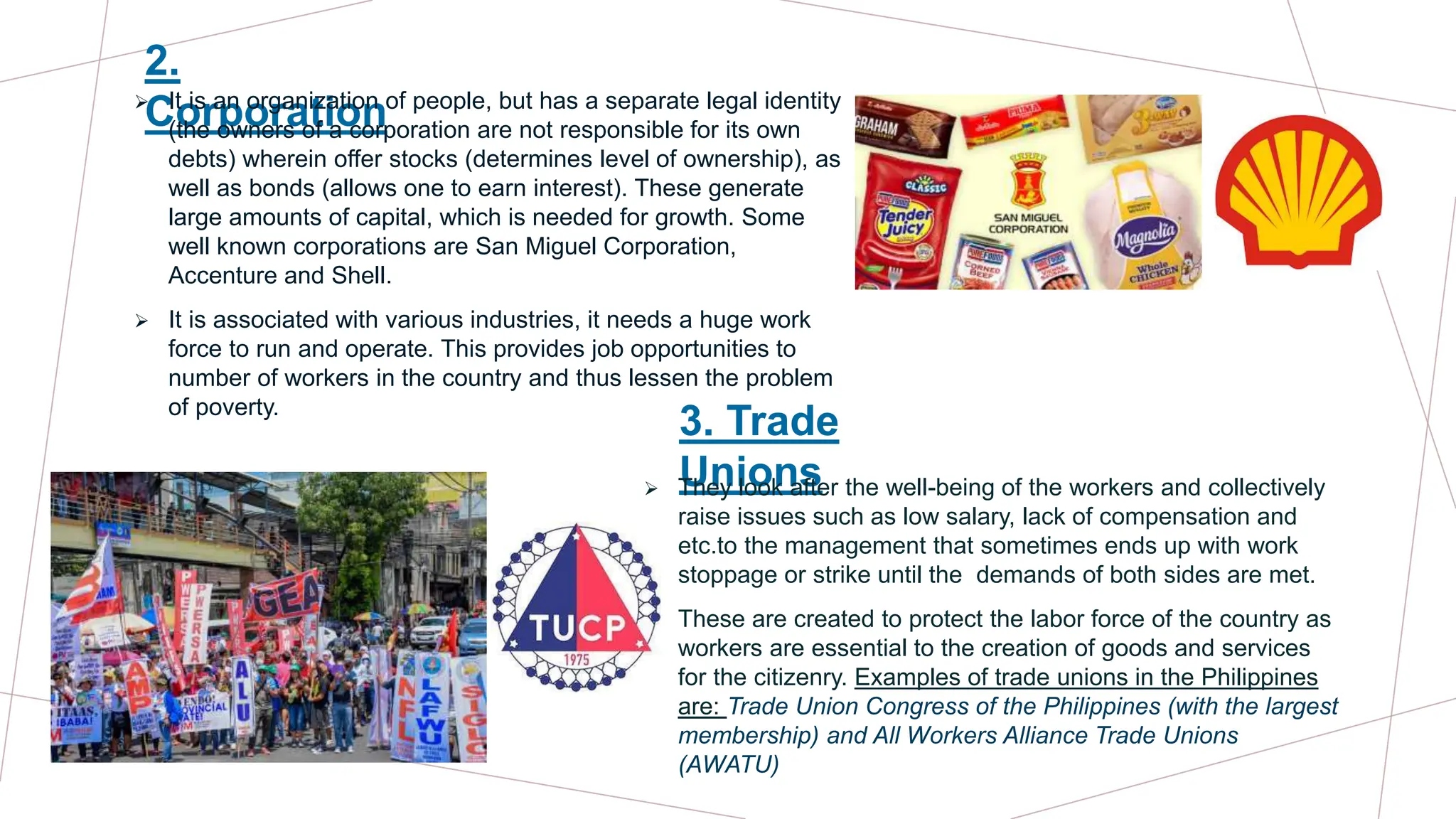
 It is an organization of people, but has a separate legal identity
(the owners of a corporation are not responsible for its own
debts) wherein offer stocks (determines level of ownership), as
well as bonds (allows one to earn interest). These generate
large amounts of capital, which is needed for growth. Some
well known corporations are San Miguel Corporation,
Accenture and Shell.
 It is associated with various industries, it needs a huge work
force to run and operate. This provides job opportunities to
number of workers in the country and thus lessen the problem
of poverty.
3. Trade
Unions
 They look after the well-being of the workers and collectively
raise issues such as low salary, lack of compensation and
etc.to the management that sometimes ends up with work
stoppage or strike until the demands of both sides are met.
 These are created to protect the labor force of the country as
workers are essential to the creation of goods and services
for the citizenry. Examples of trade unions in the Philippines
are: Trade Union Congress of the Philippines (with the largest
membership) and All Workers Alliance Trade Unions
(AWATU)
4.
Cooperative
s
 Are made up of people with common interest who
agreed to work together for easy, safe, and
affordable access to commodities, loans and other
services. They are created to help and empower
one another with a minimum help from the
government. Farmer’s cooperatives and teacher’s
cooperatives are common examples.
5. Development
Agencies
 They promote progress by engaging in projects,
policy-making, and dialogue. Some countries with
active agencies in the Philippines are Japan
International Cooperation Agency (JICA), Canada
International Development Agency (CIDA) and
United States of America International
Development (USAID). Those providing financial
assistance include Asian Development Bank
(ADB).
6. Civil
Organizations
 These include academic institutions, research
teams, mass media, religious organizations, and
people’s organizations.
 These organizations are created to expose the
conditions of the marginalized sector of the society
by using mass media as its platforms as they
raise critical issues to the government.
7. Transnational
Advocacy Groups
 These influence the government to take action on
matters commonly neglected. A group maybe a
national or an international organization that
promotes and advocates progress an development
related to particular issues of the society.
Greenpeace and Human Rights Watch are
some examples.
“The government’s job is not just to
make your life comfortable, but also
to allow others to do that to you.”
 Based on the quotation, I learned that
_________________________________________________
_________________________________________________
_________________________________________________
_________________________________________________
_________________________________________________
_________________________.

State and Non-State Institutions G11 - 2nd Sem.pptx

  • 1.
    April Jeane MarieB. Absin UNDERSTANDING CULTURE SOCIETY AND POLITICS 11
  • 2.
    2 INTRODUCTION Any state inthe world formulates its own government agency to achieve the needs of its people. However, in most democratic society, the government allows business individuals, corporations, and non- profit organizations to deliver goods and services for the citizens (De Leon, 2008). The government is at its best in providing the necessity of its people by allocating all its resources to meet the demands of its citizenry. However, like an ordinary family, no matter how the government work to make both ends meet, there is always some issues that needs to be worked upon (Panopio 1995). On the other hand, non-state institutions are created to back up the government in filling in the gap between the state and its people. In order to achieve their mission, non- state institutions produce results that uplift the condition of the people in general. Banks, corporations, trade unions, cooperatives, development agencies, civil organizations and transnational advocacy group STATE • It is a community of persons more or less numerous, permanently occupying a definite portion of a territory, having a government of their own to which a great body of inhabitants render obedience, and enjoying freedom
  • 3.
    TWO MAJOR TYPES OFSTATE OR SOCIAL INSTITUTIONS Sample Footer Text 3  Based on Capitalism;  The government provides the major industries but allows the private entities or individuals to produce goods and services for the people;  Citizens are given much freedom to choose for themselves. The Communist Democracy  Based on command economy;  Most communist countries like the USSR, and North Korea are governed by their respective governments alone. The economy is solely controlled by the state and private companies are not allowed to do business thus;  The people have no opportunity to choose because the government decides what is best for their own citizens.
  • 4.
    POLITICAL AND STATE INSTITUTIONS  Theseare organized political bodies, government-controlled institutions to fulfill the wishes of a state: public service and public control  Examples of state institutions in the Philippines:  Armed Forces of the Philippines (AFP)  Local Government Units (LGU’s)  Department of Education (DepEd)  Branches of the Government (Executive, Legislative and Judiciary) Helps the government maintains peace throughout its territory To cater the needs of local barangays or communities. Ensures a quality education based on the needs and norms of the society. Create, implement, and interpret the laws we use as guide for our conduct.
  • 5.
    NON-STATE INSTITUTIONS  These areestablishments which are not owned and controlled by the government but are regulated through laws and statutes of the state.  These are organized by private individuals or groups for the purpose of providing services to the members of the society.  These include the following: banks, corporations, trade unions, cooperatives, development agencies, civil organizations and transnational advocacy groups.  Help us keep our money, avail different kinds of loan, and exchange currencies. The accumulated money of the bank is invested to some projects to gain profit; this is how our banks pay their workers and depositors ‘ interest depending on the agreed terms.  BANKING INSTITUTIONS  The Bangko Sentral ng Pilipinas (BSP) is known as the banks of all banks in the Philippines. It is the bank responsible for the regulation, creation, and management of monetary supply in the country. Statute - it is a written law enacted by the legislature of a state. 1. Banks DIFFERENT TYPES OF BANKS:  COMMERCIAL BANKS accept savings deposits, check deposits, and time deposits. Examples: Bank of Philippine Islands, Landbank and Metrobank  THRIFT BANKS are categorized into stock savings and loan associations, savings and mortgage banks, and private development banks. Thrift banks prioritize serving the local community by offering competitive deposit returns and low-interest rates on mortgage loans. Examples: All Bank Inc., BPI Direct BanKo, Philippine Savings Bank  RURAL BANKS cater primarily to farmers and small business people, mostly in rural areas. Examples: Rural Bank of Bacong, Dumaguete Rural Bank, Inc., Rural Bank of Amlan
  • 6.
    2. Corporation  It isan organization of people, but has a separate legal identity (the owners of a corporation are not responsible for its own debts) wherein offer stocks (determines level of ownership), as well as bonds (allows one to earn interest). These generate large amounts of capital, which is needed for growth. Some well known corporations are San Miguel Corporation, Accenture and Shell.  It is associated with various industries, it needs a huge work force to run and operate. This provides job opportunities to number of workers in the country and thus lessen the problem of poverty. 3. Trade Unions  They look after the well-being of the workers and collectively raise issues such as low salary, lack of compensation and etc.to the management that sometimes ends up with work stoppage or strike until the demands of both sides are met.  These are created to protect the labor force of the country as workers are essential to the creation of goods and services for the citizenry. Examples of trade unions in the Philippines are: Trade Union Congress of the Philippines (with the largest membership) and All Workers Alliance Trade Unions (AWATU)
  • 7.
    4. Cooperative s  Are madeup of people with common interest who agreed to work together for easy, safe, and affordable access to commodities, loans and other services. They are created to help and empower one another with a minimum help from the government. Farmer’s cooperatives and teacher’s cooperatives are common examples. 5. Development Agencies  They promote progress by engaging in projects, policy-making, and dialogue. Some countries with active agencies in the Philippines are Japan International Cooperation Agency (JICA), Canada International Development Agency (CIDA) and United States of America International Development (USAID). Those providing financial assistance include Asian Development Bank (ADB).
  • 8.
    6. Civil Organizations  Theseinclude academic institutions, research teams, mass media, religious organizations, and people’s organizations.  These organizations are created to expose the conditions of the marginalized sector of the society by using mass media as its platforms as they raise critical issues to the government. 7. Transnational Advocacy Groups  These influence the government to take action on matters commonly neglected. A group maybe a national or an international organization that promotes and advocates progress an development related to particular issues of the society. Greenpeace and Human Rights Watch are some examples.
  • 9.
    “The government’s jobis not just to make your life comfortable, but also to allow others to do that to you.”  Based on the quotation, I learned that _________________________________________________ _________________________________________________ _________________________________________________ _________________________________________________ _________________________________________________ _________________________.