POLITICS,
POWER,
AND
AUTHORITY
The most significant
developments were the
formulation of laws that defined
social behavior, promoted social
order, and settled disputes.
Leaders emerged and they
began to take on more
responsibilities, and exercised
vast authority over various
aspects of social life.
POLITICS
Refers to activities through
which people make, preserve,
and amend the general rules
under which they live. It
involves dynamics of conflict
resolution and cooperation, as
well as the exercise of power.
POWER
Refers to the ability to do something
in order to achieve a desired outcome.
Person with power has the capability
to control people or make them do
something that they would not do
otherwise.
Power involves a relationship – there
is one who exercises power and
another who is subject to it.
AUTHORITY
A legitimate power
A person who has authority has
the right to exercise power.
The exercise of authority means
that the person who exercise the
power is obeyed by the people
because he or she is recognized as
the rightful or legitimate ruler or
leader.
DEVELOPMENT
STRUCTURES
AND
INSTITUTIONS:
A TREND
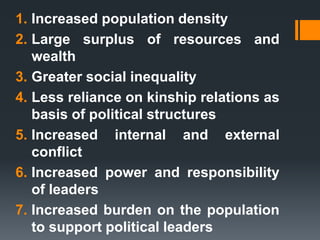
1. Increased population density
2. Large surplus of resources and
wealth
3. Greater social inequality
4. Less reliance on kinship relations as
basis of political structures
5. Increased internal and external
conflict
6. Increased power and responsibility
of leaders
7. Increased burden on the population
to support political leaders
LEGITIMACY
AND TYPES
OF
AUTHORITY
LEGITIMACY
From the Latin word LEGITIMARE, meaning to
declare lawful, and probably defined as
rightfulness.
It confers on an order or command an
authoritative or binding character, thus
transforming power into authority.
Political philosophers treat legitimacy as moral
or rational principle that is the ground on which
governments may demand obedience from
citizens. The claim to legitimacy is thus more
important than the fact of obedience.
Political scientists, however,
usually see legitimacy in
sociological terms; that is, as a
willingness to comply with a
system of rule regardless of how
this is achieved.
Max Weber studied the
transformation of societies and
observed that the bases of
legitimacy of rule vary in different
types of societies.
He came up with three types of
authority: traditional, charismatic,
and legal-rational. For Weber,
there must be an explanation or
justification why certain men rise
to positions of authority or
superiority and why people obey
them. Thus, the important
question to be asked is what
makes a rule or a law accepted
and obeyed by people.
TRADITIONAL AUTHORITY
In many societies, authority is
based on a system that is believed
to have always existed.", This is
what is referred to as traditional
authority. Some people have this
type of authority because they
inherited it or they occupy a
position that has been passed on to
them.
The legitimacy of this type of
authority is based on long-
established customs and
traditions that do not need to be
justified.
Examples of traditional authority
are those exercised by elders in a
tribe or an indigenous people's
group as well as by monarchs who
have inherited their power and
authority.
CHARISMATIC AUTHORITY
Charismatic authority is based on the
presumed special and extraordinary
characteristics or qualities
possessed by a certain individual.
People with charisma are often very
popular, highly persuasive, and
inspire loyalty and obedience from
other people. They are also often
seen as "born leaders" and "heroes“.
Charisma is generally considered a gift
or an innate quality unique to a person,
but there are also instances when it can
be manufactured through the use of
propaganda.
Historical figures who exemplified
charismatic authority include
revolutionary Cuban leaders Fidel
Castro and Che Guevara, Chinese
revólutionary leader Mao Tse Tung, US
President John F. Kennedy, UK Prime
Minister Margaret Thatcher, and
Philippine President Ramon Magsaysay.
However, charismatic
authority is the most unstable
type of authority as leaders
may eventually "lose" their
charisma when people's
views regarding them change.
Death or an illness may also
diminish the level of charisma
of a certain authority figure.
LEGAL-RATIONAL
Legal-rational authority is the most
typical type of authority in modern
societies. Power and authority in a legal-
rational context are legitimized by a
clearly defined set of written rules and
laws.
Leaders can rightfully wield authority if
they obtain their positions according to
established procedures such as
elections or through appointment.
Heads of governments such as
presidents and prime ministers
possess legal-rational authority.
Economically-developed societies
are most likely to have undergone
the processes of rationalization
and bureaucratization and adhere
most closely to the legal-rational
concept of authority. Among the
three types of authority, a legal-
rational system has the highest
degree of stability.
The three types of
authority identified by
Weber are what he referred
to as the ideal or pure
types.“ In practice, the type
of authority that is
recognized in a certain
society or state may be a
mix of these different types.
TYPES OF
POLITICAL
ORGANIZATIONS
AND LEADERSHIP
STRUCTURES
Anthropologists define political
organizations as the groups within
a culture that are responsible for
public decision-making and
leadership, maintaining social
cohesion and order, protecting
group rights, and ensuring safety
from external threats.“
Political and leadership structures
have evolved as societies
progressed over time.
From the emergence of simple bands,
tribes, and chiefdoms, to the
establishment of modern nation-states,
different types of political
organizations and leadership
|structures emerged as social
interactions underwent
transformations.
The earlier types of societies such as
bands and tribes were basically
dominated by personal and familial
ties as these were comprised of
families and clans.
In short, the leaders were not simply
political leaders or those who made
decisions for the society. The leaders
exercised their authority to settle
disputes among the people. They also
decided on economic matters like the
distribution of food, the selection of
crops, determining harvest periods, and
securing territory.
In a nutshell, the leader was seen as the
head of the community who ensured
peace and security within society. He was
seen as a patriarch or a patron and
people depended on him for many things.
POLITICAL DYNASTIES
POLITICAL DYNASTIES are believed to
have always existed even in advanced
democratic states. A "dynasty" refers to
a succession from rulers from the same
line of descent.
Thus, relatives who stay in power
specifically, members of one family who
continuously hold elective political
positions-are considered members of a
political dynasty.
Meanwhile, political clientelism
(or clientelistic politics) is defined
by Susan Stokes as "giving
material goods in return for
electoral support" The
relationship involves two parties:
the patron (politician)and the
client (voter).
These two political trends
continue to be a challenge to the
Philippine political and leadership
system.
The onset of the Industrial Revolution
brought about significant changes in the
economic, social, and political life of
societies. Most significant of these changes
was the rise of the modern nation-state.
The terms "nation". and "state" are often
used interchangeably in everyday life.
However, the distinctions between these
two have to be recognízed. A nation
consists of a distinct population of people
bound together by a common culture,
history, and tradition who are typically
concentrated within a specific geographic
region.
The state, on the other hand, is a political
unit that has sovereignty-the legitimate and
ultimate authority of the state-over an area
of territory and the people within it. In an
attempt to clarify the distinction between the
nation and the state, it has been pointed out
that the nation has two aspects-a cultural
community and a political community.
However, not all nations are recognized as
states. Likewise, a state is not equivalent to
a single nation and may in fact be
composed of several nations. For example,
Taiwan asserted its independence from
China and established its own government.
However, many states have not
recognized Taiwan's status as an
independent state and some consider it
as a province of China. Another
example are the Kurdish people who
compose a nation but are found in
different states in the Middle East such
as Iran, Iraq, Syria, and Turkey. Thus, a
state is a political unit that
encompasses several communities,
has a bureaucracy, and has leaders
that possess legitimate power
In contrast to the leaders of bands,
tribes, and chiefdoms, leaders of
states have more responsibilities
such as the maintenande of law
and order, securng state territory,
engaging in international relations,
and preserving social control.
weber observed that the processes
of rationalization and
bureaucratization that happened in
Western European societies were a
consequence of industrialization.
The expansion of economic activities led to the
rationalization of economic functions of
individuals which in turn paved the way for the
growth of bureaucracy.
The term bureaucracy means Tule by officials."
For Weber. the bureaucracy is characterized by
"rationality, rule-governed behavior, and
impersonal behavior." Another significant
process that happened in Western Europe was
political liberalization. This refers to the
emergence of liberal-democratic regimes that
are characterized by a representative form of
democracy where political office is gained
through formal, competitive elections in many
Western societies.
Thus, institutions such as political parties
emerged. Principles such as political
equality and electoral choice also
developed. This led to the emergence of an
impersonal and legally-based type of
leadership and this soon became the norm
in many European societies.
However, not all societies around the world
went through the same processes
experienced in the West. For example, in
the Philippines, the attempt to establish
political institutions patterned after the
American model did not necessarily bring
about the type of liberal democracy
existing in the United States.
Scholars agree that this is largely due to a
variety of factors, including the type of
political culture that exists in societies.
Political culture refers to the pattern of
orientation to political objects such as
parties, government, and constitution,
expressed in beliefs, symbols, and values.
People generally acquire values and
attitudes about politics and political
institutions through the process of political
socialization. Since societies have varied
characteristics, the effects of certain
processes and how institutions work may
also differ.
For example, the features of an ideal
type of bureaucracy conceptualized
by Weber were not necessarily
observed in all societies.
Since the bureaucracy was assumed
to be a rational institution, the
exercise of authority within the
bureaucracy was expected to be
impersonal. However, impersonality
in the exercise of authority is
something that is not present in all
bureaucracies
Even in politics, the persistence of
clientelism, which was typical in
tribes and chiefdoms, indicates
that the ties between a patron" (or
one who gives benefits) and a
“client" (the recipient of the
benefits) have not ceased to exist
in some societies. Clientelistic
behavior has also been observed
even in the conduct of democratic
elections.
For example, in some areas in the
Philippines, voters still tend to
choose candidates whom they
have personal ties with,
particularly those who have served
as their benefactors, and have
provided them various forms of
assistance such as paying for their
medical expenses, providing them
jobs, and giving scholarships to
their children.
THANK
YOU!!!

UCSP-Q2-WEEK2.pptx

  • 1.
  • 2.
    The most significant developmentswere the formulation of laws that defined social behavior, promoted social order, and settled disputes. Leaders emerged and they began to take on more responsibilities, and exercised vast authority over various aspects of social life.
  • 3.
    POLITICS Refers to activitiesthrough which people make, preserve, and amend the general rules under which they live. It involves dynamics of conflict resolution and cooperation, as well as the exercise of power.
  • 4.
    POWER Refers to theability to do something in order to achieve a desired outcome. Person with power has the capability to control people or make them do something that they would not do otherwise. Power involves a relationship – there is one who exercises power and another who is subject to it.
  • 5.
    AUTHORITY A legitimate power Aperson who has authority has the right to exercise power. The exercise of authority means that the person who exercise the power is obeyed by the people because he or she is recognized as the rightful or legitimate ruler or leader.
  • 6.
  • 7.
    1. Increased populationdensity 2. Large surplus of resources and wealth 3. Greater social inequality 4. Less reliance on kinship relations as basis of political structures 5. Increased internal and external conflict 6. Increased power and responsibility of leaders 7. Increased burden on the population to support political leaders
  • 8.
  • 9.
    LEGITIMACY From the Latinword LEGITIMARE, meaning to declare lawful, and probably defined as rightfulness. It confers on an order or command an authoritative or binding character, thus transforming power into authority. Political philosophers treat legitimacy as moral or rational principle that is the ground on which governments may demand obedience from citizens. The claim to legitimacy is thus more important than the fact of obedience.
  • 10.
    Political scientists, however, usuallysee legitimacy in sociological terms; that is, as a willingness to comply with a system of rule regardless of how this is achieved. Max Weber studied the transformation of societies and observed that the bases of legitimacy of rule vary in different types of societies.
  • 11.
    He came upwith three types of authority: traditional, charismatic, and legal-rational. For Weber, there must be an explanation or justification why certain men rise to positions of authority or superiority and why people obey them. Thus, the important question to be asked is what makes a rule or a law accepted and obeyed by people.
  • 12.
    TRADITIONAL AUTHORITY In manysocieties, authority is based on a system that is believed to have always existed.", This is what is referred to as traditional authority. Some people have this type of authority because they inherited it or they occupy a position that has been passed on to them.
  • 13.
    The legitimacy ofthis type of authority is based on long- established customs and traditions that do not need to be justified. Examples of traditional authority are those exercised by elders in a tribe or an indigenous people's group as well as by monarchs who have inherited their power and authority.
  • 14.
    CHARISMATIC AUTHORITY Charismatic authorityis based on the presumed special and extraordinary characteristics or qualities possessed by a certain individual. People with charisma are often very popular, highly persuasive, and inspire loyalty and obedience from other people. They are also often seen as "born leaders" and "heroes“.
  • 15.
    Charisma is generallyconsidered a gift or an innate quality unique to a person, but there are also instances when it can be manufactured through the use of propaganda. Historical figures who exemplified charismatic authority include revolutionary Cuban leaders Fidel Castro and Che Guevara, Chinese revólutionary leader Mao Tse Tung, US President John F. Kennedy, UK Prime Minister Margaret Thatcher, and Philippine President Ramon Magsaysay.
  • 16.
    However, charismatic authority isthe most unstable type of authority as leaders may eventually "lose" their charisma when people's views regarding them change. Death or an illness may also diminish the level of charisma of a certain authority figure.
  • 17.
    LEGAL-RATIONAL Legal-rational authority isthe most typical type of authority in modern societies. Power and authority in a legal- rational context are legitimized by a clearly defined set of written rules and laws. Leaders can rightfully wield authority if they obtain their positions according to established procedures such as elections or through appointment.
  • 18.
    Heads of governmentssuch as presidents and prime ministers possess legal-rational authority. Economically-developed societies are most likely to have undergone the processes of rationalization and bureaucratization and adhere most closely to the legal-rational concept of authority. Among the three types of authority, a legal- rational system has the highest degree of stability.
  • 19.
    The three typesof authority identified by Weber are what he referred to as the ideal or pure types.“ In practice, the type of authority that is recognized in a certain society or state may be a mix of these different types.
  • 20.
  • 21.
    Anthropologists define political organizationsas the groups within a culture that are responsible for public decision-making and leadership, maintaining social cohesion and order, protecting group rights, and ensuring safety from external threats.“ Political and leadership structures have evolved as societies progressed over time.
  • 22.
    From the emergenceof simple bands, tribes, and chiefdoms, to the establishment of modern nation-states, different types of political organizations and leadership |structures emerged as social interactions underwent transformations. The earlier types of societies such as bands and tribes were basically dominated by personal and familial ties as these were comprised of families and clans.
  • 23.
    In short, theleaders were not simply political leaders or those who made decisions for the society. The leaders exercised their authority to settle disputes among the people. They also decided on economic matters like the distribution of food, the selection of crops, determining harvest periods, and securing territory. In a nutshell, the leader was seen as the head of the community who ensured peace and security within society. He was seen as a patriarch or a patron and people depended on him for many things.
  • 24.
    POLITICAL DYNASTIES POLITICAL DYNASTIESare believed to have always existed even in advanced democratic states. A "dynasty" refers to a succession from rulers from the same line of descent. Thus, relatives who stay in power specifically, members of one family who continuously hold elective political positions-are considered members of a political dynasty.
  • 25.
    Meanwhile, political clientelism (orclientelistic politics) is defined by Susan Stokes as "giving material goods in return for electoral support" The relationship involves two parties: the patron (politician)and the client (voter). These two political trends continue to be a challenge to the Philippine political and leadership system.
  • 26.
    The onset ofthe Industrial Revolution brought about significant changes in the economic, social, and political life of societies. Most significant of these changes was the rise of the modern nation-state. The terms "nation". and "state" are often used interchangeably in everyday life. However, the distinctions between these two have to be recognízed. A nation consists of a distinct population of people bound together by a common culture, history, and tradition who are typically concentrated within a specific geographic region.
  • 27.
    The state, onthe other hand, is a political unit that has sovereignty-the legitimate and ultimate authority of the state-over an area of territory and the people within it. In an attempt to clarify the distinction between the nation and the state, it has been pointed out that the nation has two aspects-a cultural community and a political community. However, not all nations are recognized as states. Likewise, a state is not equivalent to a single nation and may in fact be composed of several nations. For example, Taiwan asserted its independence from China and established its own government.
  • 28.
    However, many stateshave not recognized Taiwan's status as an independent state and some consider it as a province of China. Another example are the Kurdish people who compose a nation but are found in different states in the Middle East such as Iran, Iraq, Syria, and Turkey. Thus, a state is a political unit that encompasses several communities, has a bureaucracy, and has leaders that possess legitimate power
  • 29.
    In contrast tothe leaders of bands, tribes, and chiefdoms, leaders of states have more responsibilities such as the maintenande of law and order, securng state territory, engaging in international relations, and preserving social control. weber observed that the processes of rationalization and bureaucratization that happened in Western European societies were a consequence of industrialization.
  • 30.
    The expansion ofeconomic activities led to the rationalization of economic functions of individuals which in turn paved the way for the growth of bureaucracy. The term bureaucracy means Tule by officials." For Weber. the bureaucracy is characterized by "rationality, rule-governed behavior, and impersonal behavior." Another significant process that happened in Western Europe was political liberalization. This refers to the emergence of liberal-democratic regimes that are characterized by a representative form of democracy where political office is gained through formal, competitive elections in many Western societies.
  • 31.
    Thus, institutions suchas political parties emerged. Principles such as political equality and electoral choice also developed. This led to the emergence of an impersonal and legally-based type of leadership and this soon became the norm in many European societies. However, not all societies around the world went through the same processes experienced in the West. For example, in the Philippines, the attempt to establish political institutions patterned after the American model did not necessarily bring about the type of liberal democracy existing in the United States.
  • 32.
    Scholars agree thatthis is largely due to a variety of factors, including the type of political culture that exists in societies. Political culture refers to the pattern of orientation to political objects such as parties, government, and constitution, expressed in beliefs, symbols, and values. People generally acquire values and attitudes about politics and political institutions through the process of political socialization. Since societies have varied characteristics, the effects of certain processes and how institutions work may also differ.
  • 33.
    For example, thefeatures of an ideal type of bureaucracy conceptualized by Weber were not necessarily observed in all societies. Since the bureaucracy was assumed to be a rational institution, the exercise of authority within the bureaucracy was expected to be impersonal. However, impersonality in the exercise of authority is something that is not present in all bureaucracies
  • 34.
    Even in politics,the persistence of clientelism, which was typical in tribes and chiefdoms, indicates that the ties between a patron" (or one who gives benefits) and a “client" (the recipient of the benefits) have not ceased to exist in some societies. Clientelistic behavior has also been observed even in the conduct of democratic elections.
  • 35.
    For example, insome areas in the Philippines, voters still tend to choose candidates whom they have personal ties with, particularly those who have served as their benefactors, and have provided them various forms of assistance such as paying for their medical expenses, providing them jobs, and giving scholarships to their children.
  • 36.