SOMETHING OLD,
SOMETHING NEW:
MITIGATING
INAPPROPRIATE STUDENT
AI-USE, BY PROMOTING
DIGITAL PRIMARY
SOURCES & POSITIVE,
APPROPRIATE AI-USE IN
THE CLASSROOM TO
TEACHING FACULTY.
HELEN FARRELL, MU
LIBRARY, MAYNOOTH
UNIVERSITY, IRELAND
CONUL 2024
COMPONENTS USED:Part of three, short 30-40 min webinars for MU faculty on T&L
support 22-24: DPS and AI / AI use in the classroom.
LibGuide on Digital Primary Sources in Action:
https://nuim.libguides.com/4Staff/DigitalPrimarySourcesMU
What was the "old"? Material from ProQuest & AM Explorer
for use in the classroom, plus OA material online.
What was the "new"? ChatGPT 3.5
Hard-copy Special Collections & Archival material could be used
too; would open SC&A to a wider audience, via AI adaptation &
pedagogical innovation.
Based some of the content in the webinars on needs identified
in my pre-session surveys on LibWizard.
Photo by Andrew Neel from Pexels: https://www.pexels.com/photo/computer-monitor-with-openai-
website-loading-screen-15863000/
NEEDS IDENTIFIED BY FACULTY?
Practical tips on using
AI in personal work and
student
projects/assignments
Understanding student
use of AI, its risks, and
limitations to prevent
cheating
Learning AI applications
in teaching,
assessment, and big
data analysis, and from
others' experiences &
practices with AI
Identifying useful AI
tools and resources,
and understanding
their caveats
Evaluating AI's potential
benefits, opportunities,
challenges, and its
value beyond
"solutionism"
Strategies for
maintaining academic
integrity while using AI
Insights into
departmental AI
policies and practices
Understanding AI's role
in supporting, but not
completing, student
assignments
Detecting misuse of AI
in assignments where
its use is restricted
Using AI tools like
ChatGPT for tasks such
as checking references
OpenAI. (2024).ChatGPT 3.5 [Large language model]. https://chat.openai.com/
WHY DO I
FEELTHERE IS
A NEED FOR
THESE
SESSIONS?
• Major paradigm-shift in the information society and our
software tools.
• Standalone textual / graphic / audio / etc. Gen-AI.
• AI capabilities increasingly integrated into academic
software.
• Faculty need direction, encouragement & inspiration
in AI-use.
• Encourage appropriate use of AI in student submissions
and study.
• Encourage critical thinking, engage with special
collections.
• Break down barriers to primary-source adoption
reduce inappropriate use of AI in student work.
AI DEVELOPMENTS?
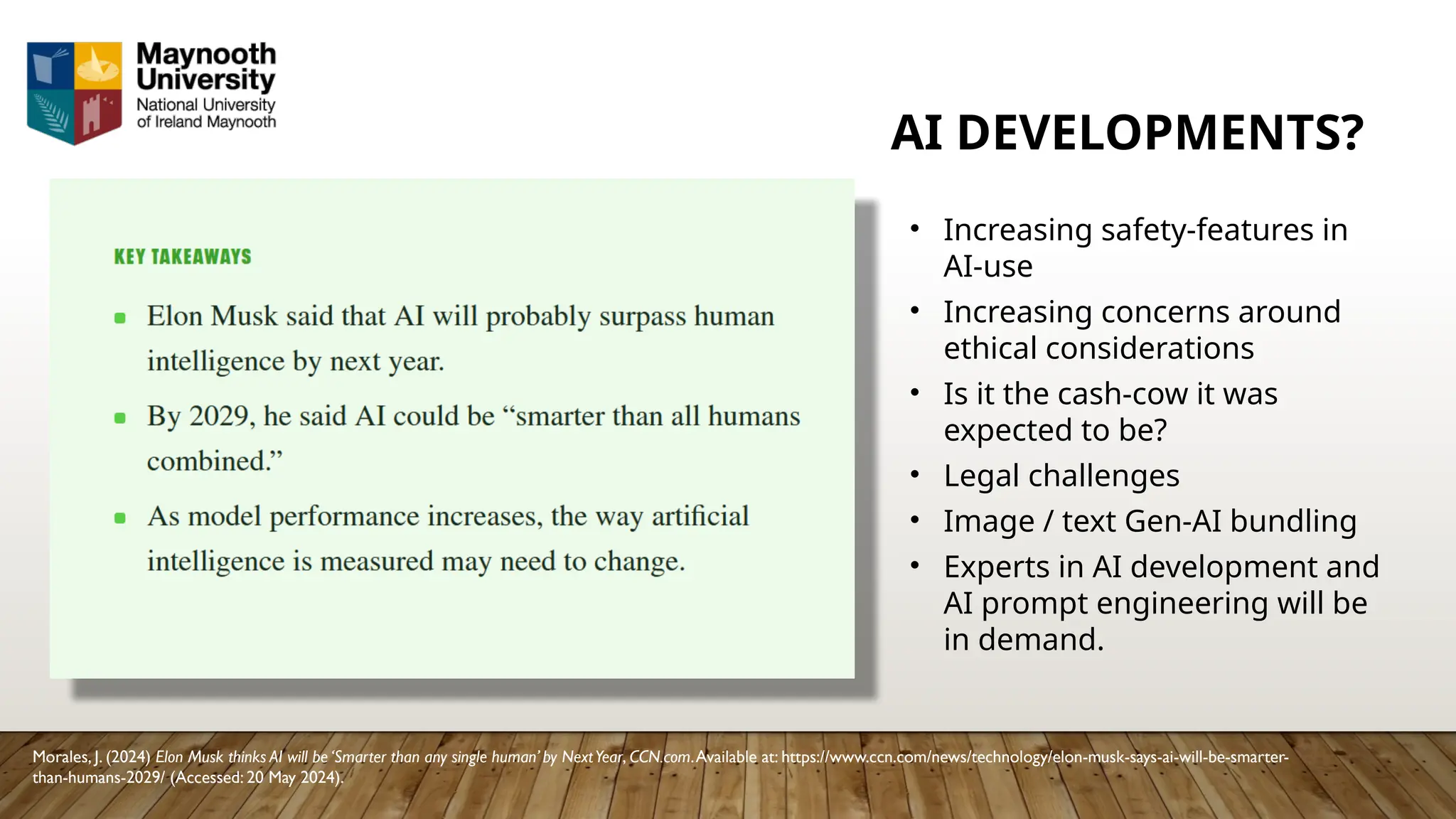
Morales, J. (2024) Elon Musk thinks AI will be ‘Smarter than any single human’ by NextYear, CCN.com.Available at: https://www.ccn.com/news/technology/elon-musk-says-ai-will-be-smarter-
than-humans-2029/ (Accessed: 20 May 2024).
• Increasing safety-features in
AI-use
• Increasing concerns around
ethical considerations
• Is it the cash-cow it was
expected to be?
• Legal challenges
• Image / text Gen-AI bundling
• Experts in AI development and
AI prompt engineering will be
in demand.
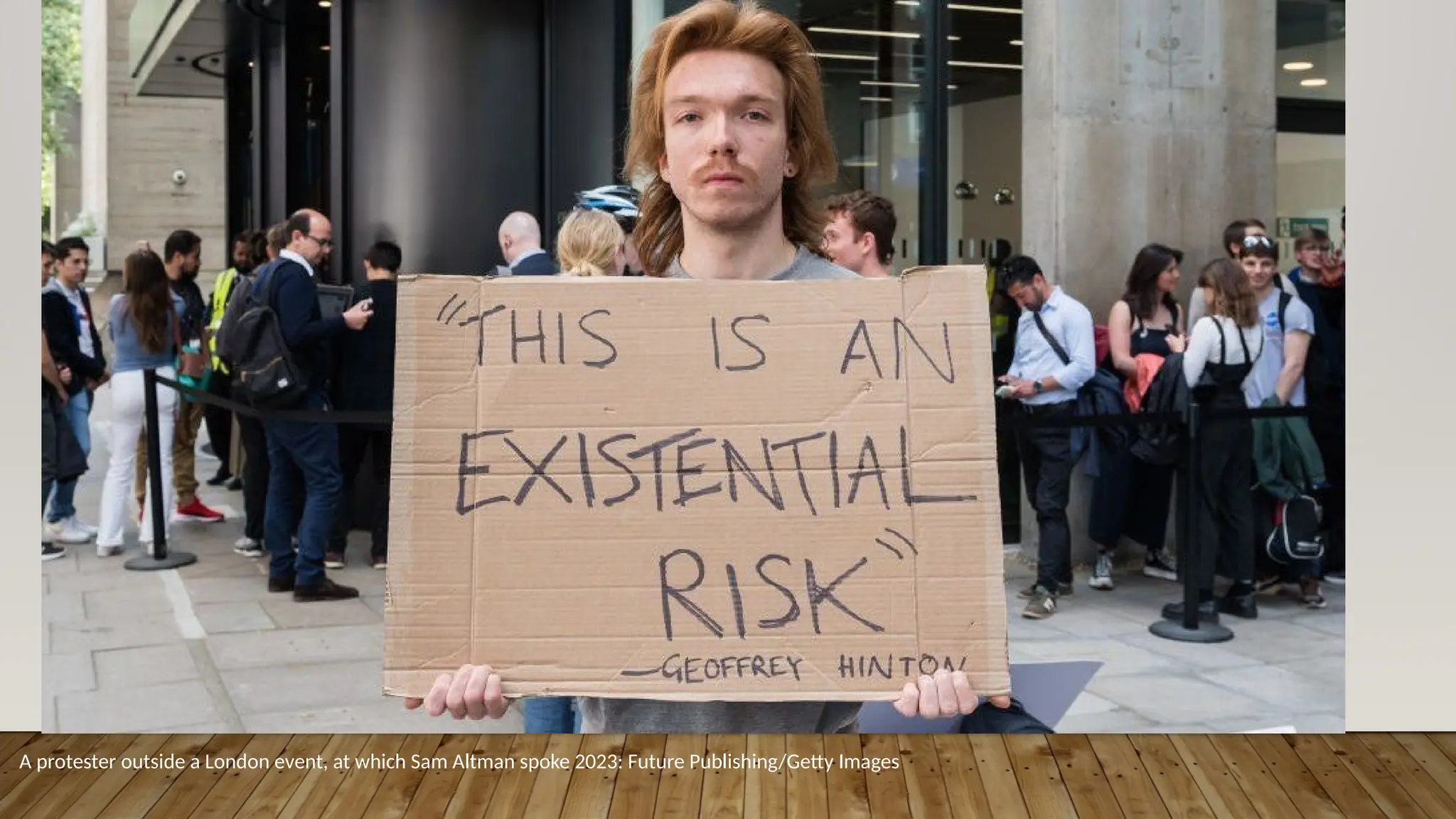
A protester outside a London event, at which Sam Altman spoke 2023: Future Publishing/Getty Images
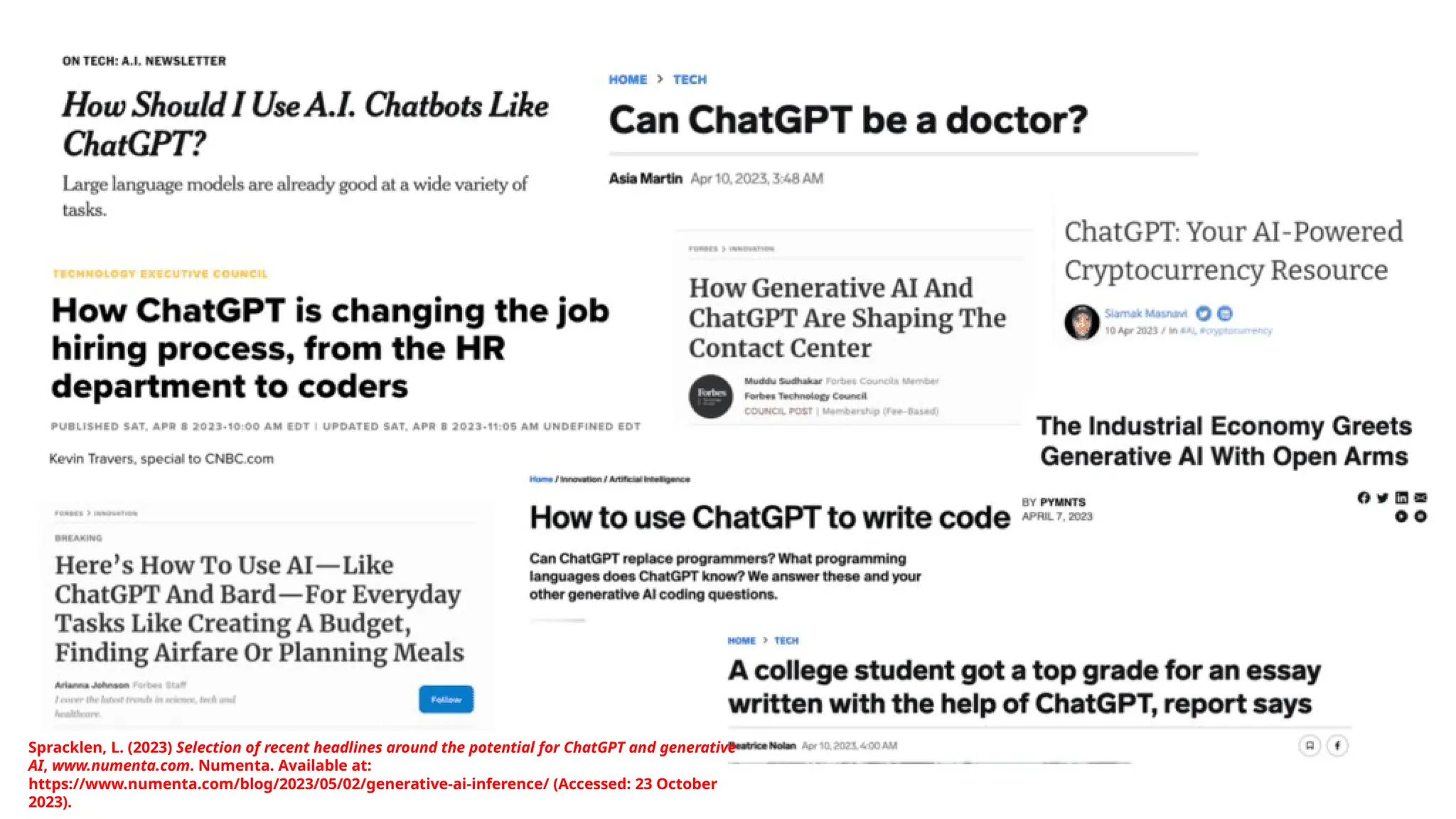
Spracklen, L. (2023) Selection of recent headlines around the potential for ChatGPT and generative
AI, www.numenta.com. Numenta. Available at:
https://www.numenta.com/blog/2023/05/02/generative-ai-inference/ (Accessed: 23 October
2023).
PROVOCATION
• Popular Generative AI, such as ChatGPT, is built on training
data that:
 has an unclear origin and scope,
 does not provide attribution, and
 does not reference sources.
• As librarians, how do we address the requirement for
academic integrity in academia - including referencing AI
tools used- yet many generative text AI tools are built using
unknown, un-referenced training data?
• How do we feel about this dichotomy?
BENEFITS OF USING DIGITAL
PRIMARY SOURCES (WITH GEN-AI)
• Have not been used as training data for AI, that we know of.
• Is unlikely to be immediately familiar to students.
• Is memorable to students - the immediacy of primary
sources makes an impression in the way an article may not.
• Is likely to require a considered analysis by students.
• Lends itself to aligning with learning outcomes for classes.
• Many additions, explanations, gamification, level
adjustments and glossary extraction that AI can make from
DPS content.
WHAT I COVERED IN SESSIONS
• Encouraging faculty to think creatively about using AI as a structural tool.
• Gave faculty some confidence in using DPS to enrich their pedagogy, and for livening up module
delivery.
• Faculty benefited from hearing of the breadth of digital primary sources available, plus I could showcase
some online supports, module alignment reports & built-in tools with them.
• Co-creation with students can be a great approach; get them to spot mistakes in AI output or start them off
with a task using AI structurally, then get them to add their own input to the assignment.
• Of 15 responses of faculty attending one of my sessions, 100% had no support in using AI, or they were
not sure if they had any access to support.
OpenAI. (2024).ChatGPT 3.5 [Large language model]. https://chat.openai.com/
WAYS OF USING PRIMARY
SOURCES IN THE CLASSROOM
•Get students to analyse a primary source object to:
• assess how the physical document or resource can tell
us more about the creator or the setting it was created
in)
• decipher old handwriting (paleography), layout
and phrasing,
• assess the resource used, its condition how it differs to a
modern equivalent.
• put the document in the context with what was
happening at the time.
•For more ideas, I have a section on my LibGuide on
Module Planning for faculty here:
https://nuim.libguides.com/c.php?g=654727&p=4877228#s
-lg-box-wrapper-19051273
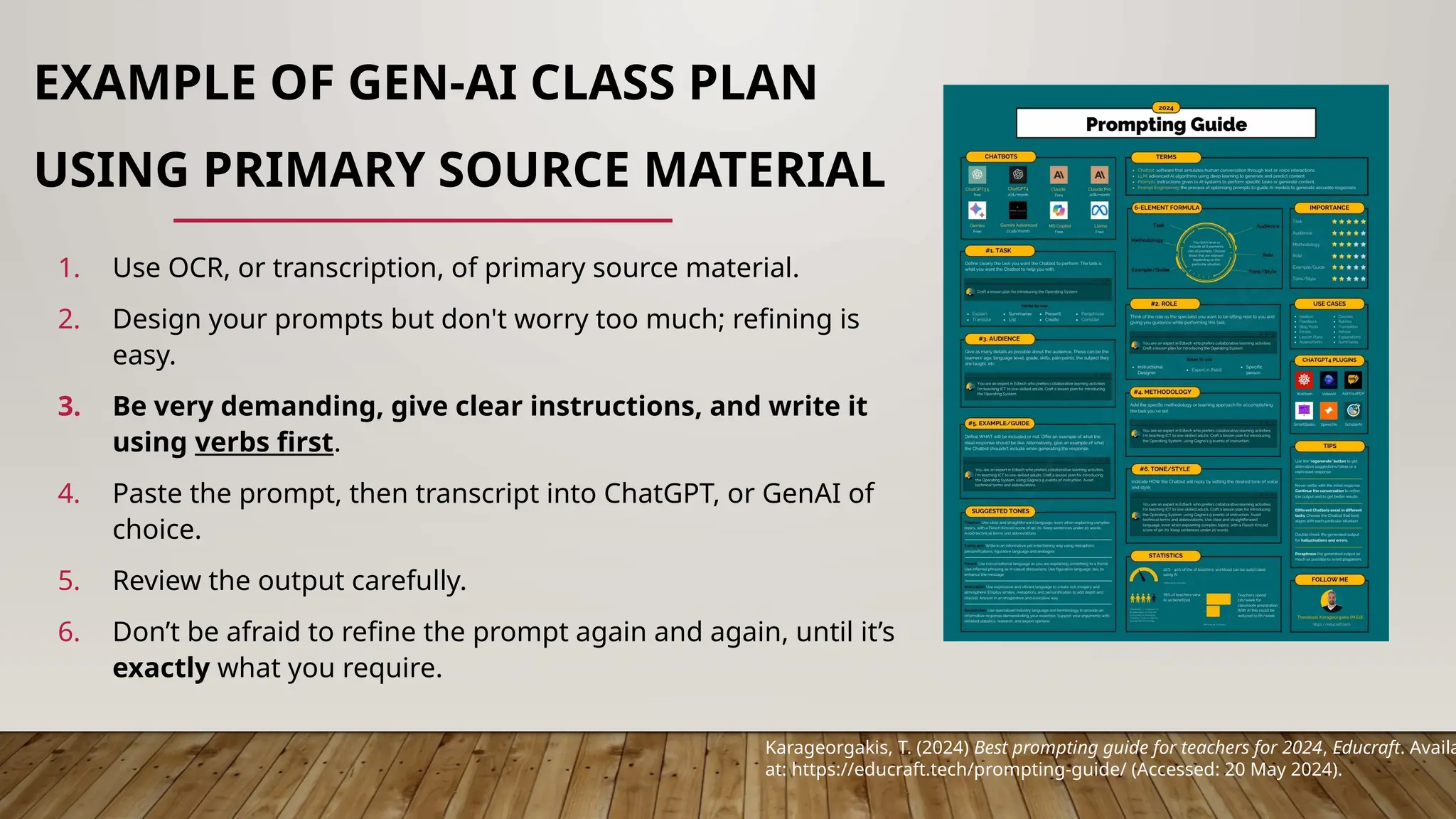
EXAMPLE OF GEN-AI CLASS PLAN
USING PRIMARY SOURCE MATERIAL
1. Use OCR, or transcription, of primary source material.
2. Design your prompts but don't worry too much; refining is
easy.
3. Be very demanding, give clear instructions, and write it
using verbs first.
4. Paste the prompt, then transcript into ChatGPT, or GenAI of
choice.
5. Review the output carefully.
6. Don’t be afraid to refine the prompt again and again, until it’s
exactly what you require.
Karageorgakis, T. (2024) Best prompting guide for teachers for 2024, Educraft. Availa
at: https://educraft.tech/prompting-guide/ (Accessed: 20 May 2024).
To be peremptor[ILL]y Sold, Pursuant to a Decree of the Court of Chancery, for the County Palatine
of Lancaster, before the Register of the said Court, or his Deputy, at the House of James Lamb,
known by the Sign of the Ram's-Head, in Ormskirk, in the said County, onThursday the 2d Day of
July next, PART of the Estate of John Longworth, the Elder, late of Ormskirk aforesaid, Gentle- man,
deceased to wit,Two undivided third Parts of several Closes of Lands in Skelmersdale, about 6 Acres
and 3 Roods, in the Possession of Roger Scarisbrick. One undivided Moiety of a Messuage,
Tenement, and Cottage, in Skelmersdale, (theTimberTrees growing thereon excepted) about 26
Acres, in the Possession of James Bold, subject to a Lease for one Life, aged about 55Years, under
theYearly reserved Rent of 12s. 6d.A Messuage andTenement in Ashton within Mack- erfield,
about 18 Acres, in the Possession of John Jen- kinson, subject to a Lease for three Lives, under the
Yearly reserved Rent of 4s. 2d.A Messuage andTenement called Longworth's House, in Blackrod,
about twenty-two Acres and a Half. in the Possession of George Longworth, subject to a Lease for
three Lives, under theYearly reserved Rent of 1l. 10s.A Messuage and Cottage, (in five Dwellings)
and about one Rood of Land, in Blackrod, in the Posses- sion of AlexanderTyrer, subject to a Lease
for two Lives, under theYearly reserved Rent of 3s. 6d. Several Closes of Land in Feeleston, near
Croston, about ten Acres, in the Possession of Richard Sibberin, subject to a Lease for three Lives,
under theYearly reserved Rent of 10s.A Messuage andTenement, called Commissarys, in Charnock
Richard, about sixteen Acres, in the Possession of Seth Blackburn, subject to a Lease for three Lives,
under theYearly reserved Rent of 1l.All in the said County of Lancaster. Further Particulars may be
had at the said Regi- ster's Office.
Design me a lesson plan for a third-
year undergraduate history module
on the social history of the 18th
century in Britain and Ireland, using
the quotation below to follow. Break
the lesson plan into numbered
sections, give clear instructions for
teaching and extract a glossary of
unusual terms at the end. Develop a
10-point MCQ based on this content
to test the knowledge of the
undergraduate class in the general
social history of 18th
century UK and
Ireland. Give two practical exercises
for the students within the lesson
plan. Ensure you write the output in
AI & ACADEMIC INTEGRITY
• Currently, MU has convened an AI-taskforce to examine the issues around AI and academic integrity and will develop
a university policy on AI-use for students, staff and researchers (Áine Carey & Laura Connaughton are library reps).
• MU Generative AI statement: https://www.maynoothuniversity.ie/sites/default/files/assets/document//ChatGPT%20insight%2021%20Feb%2023%20final.pdf
• In-depth exploration of MU Academic Integrity policy that mentions AI-use / or guidelines on use by faculty or students:
Academic Integrity and Artificial Intelligence | Maynooth University and QQI academic-integrity-guidelines.pdf (maynoothuniversity.ie)
• Referencing AI as a structural tool vs. as a source of information
• Different departments and schools have widely different positions on AI-use
• Departments using AI (anecdotal) in MU in 2023– History, Theoretical Physics, Library
• Departments not using AI at all in MU (also anecdotal) 2023 – Psychology, Geography, Froebel
• Departments using AI with provisos (anecdotal) 2023 – Education, Anthropology, School of Business.
LIBGUIDE ON DIGITAL PRIMARY SOURCES / AI
•LibGuide on DPS & AI –
https://nuim.libguides.com/4Staff/DigitalPrimarySourcesMU?preview=0aba44f4def74dd0337b8d6dd0127c9a
•Practical resources include a table with all primary source databases listed & scope notes.
•Information on module alignment reports or services, guidance, webinars, infographics, on adoption & use.
•Specific guidance for faculty for using the material in innovative ways.
•Work to continue for my LibGuide:
•add links to MU official guidance when it’s produced,
•more links to pre-recorded webinars, and related initiatives by others
•infographics, further training.
•Promote LibGuide via normal engagement channels.
OUTCOME OF SESSIONS
01/13/2025
• The sessions were really great. I think if possible, a 5-min activity might be included, e.g., where the participants
could just do a random simple query related to their specific field in MU library resources, and could share any
feedback or queries in run-time.
• It was too quick, but that was due to technical problems on the part of the facilitator; there was nothing else that
could have been done. The part about AI making mistakes was interesting, as I've already encountered some with
Excel - the AI analytics tool that incorrectly calculates figures.
• i attended one live and missed the other but reviewed the PPT. it was great to get it but it reinforeced how much i
missed by missing the live session. I would have loved it to be recorded.
• It was great to get the slides afterwards as I was able to concentrate on the content at the time, and then go to
the slides to review the info & follow links.
• Great overview; would like to know about specific workshops for some of the digital repositories mentioned at the
end.
OBSERVATION: it was spoken about amongst faculty, generated some interest and made some teaching faculty
consider planning modules with more DPS material or AI-use integrated into it.
MY OWN
PLANNING FOR
FUTURE WORK
ON THIS AREA
FOR FACULTY &
COLLEAGUES
• Double the session-length & deliver it as an in-person
workshop, with plenty of hands-on exercises.
• More hands-on, practical exercises for attendees, using
a variety of Gen-AI tools,
• Look at the increasingly integrated AI-tools in academic
software.
• Using identified areas of heavy workload for faculty,
devise practical examples to support their work.
• Offer it within library to faculty, as well as to small
departmental groups?
CONCLUSION
•Ronan Madden & colleagues in UCC; scope for more collaboration across CONUL / LAI?
•Marie Cullen and I (MU Library) are planning an AI workshop for library colleagues S1 2024, sectional
examples.
•Perhaps add more LibGuides or sessions on using DPS / AI, for different audiences?
1. UG / PG / PhD
2. Library colleagues
3. Professional services
• Intersection of OER production and AI?
• Can we continue to use new world / old world intersections for innovative practice: creativity lies here?
THANK YOU
• Please get in contact if you are
working in this area?
• Helen.farrell@mu.ie
• LinkedIn
https://www.linkedin.com/in/hel
en-farrell/
• X @consultantlibra
Photo byVie Studio: https://www.pexels.com/photo/word-goodbye-on-white-
surface-4439451/

Something old, something new; mitigating inappropriate student AI-use, by promoting digital primary sources and positive, appropriate AI-use in the classroom, to teaching faculty.

  • 1.
    SOMETHING OLD, SOMETHING NEW: MITIGATING INAPPROPRIATESTUDENT AI-USE, BY PROMOTING DIGITAL PRIMARY SOURCES & POSITIVE, APPROPRIATE AI-USE IN THE CLASSROOM TO TEACHING FACULTY. HELEN FARRELL, MU LIBRARY, MAYNOOTH UNIVERSITY, IRELAND CONUL 2024
  • 2.
    COMPONENTS USED:Part ofthree, short 30-40 min webinars for MU faculty on T&L support 22-24: DPS and AI / AI use in the classroom. LibGuide on Digital Primary Sources in Action: https://nuim.libguides.com/4Staff/DigitalPrimarySourcesMU What was the "old"? Material from ProQuest & AM Explorer for use in the classroom, plus OA material online. What was the "new"? ChatGPT 3.5 Hard-copy Special Collections & Archival material could be used too; would open SC&A to a wider audience, via AI adaptation & pedagogical innovation. Based some of the content in the webinars on needs identified in my pre-session surveys on LibWizard. Photo by Andrew Neel from Pexels: https://www.pexels.com/photo/computer-monitor-with-openai- website-loading-screen-15863000/
  • 3.
    NEEDS IDENTIFIED BYFACULTY? Practical tips on using AI in personal work and student projects/assignments Understanding student use of AI, its risks, and limitations to prevent cheating Learning AI applications in teaching, assessment, and big data analysis, and from others' experiences & practices with AI Identifying useful AI tools and resources, and understanding their caveats Evaluating AI's potential benefits, opportunities, challenges, and its value beyond "solutionism" Strategies for maintaining academic integrity while using AI Insights into departmental AI policies and practices Understanding AI's role in supporting, but not completing, student assignments Detecting misuse of AI in assignments where its use is restricted Using AI tools like ChatGPT for tasks such as checking references OpenAI. (2024).ChatGPT 3.5 [Large language model]. https://chat.openai.com/
  • 4.
    WHY DO I FEELTHEREIS A NEED FOR THESE SESSIONS? • Major paradigm-shift in the information society and our software tools. • Standalone textual / graphic / audio / etc. Gen-AI. • AI capabilities increasingly integrated into academic software. • Faculty need direction, encouragement & inspiration in AI-use. • Encourage appropriate use of AI in student submissions and study. • Encourage critical thinking, engage with special collections. • Break down barriers to primary-source adoption reduce inappropriate use of AI in student work.
  • 5.
    AI DEVELOPMENTS? Morales, J.(2024) Elon Musk thinks AI will be ‘Smarter than any single human’ by NextYear, CCN.com.Available at: https://www.ccn.com/news/technology/elon-musk-says-ai-will-be-smarter- than-humans-2029/ (Accessed: 20 May 2024). • Increasing safety-features in AI-use • Increasing concerns around ethical considerations • Is it the cash-cow it was expected to be? • Legal challenges • Image / text Gen-AI bundling • Experts in AI development and AI prompt engineering will be in demand.
  • 6.
    A protester outsidea London event, at which Sam Altman spoke 2023: Future Publishing/Getty Images
  • 7.
    Spracklen, L. (2023)Selection of recent headlines around the potential for ChatGPT and generative AI, www.numenta.com. Numenta. Available at: https://www.numenta.com/blog/2023/05/02/generative-ai-inference/ (Accessed: 23 October 2023).
  • 8.
    PROVOCATION • Popular GenerativeAI, such as ChatGPT, is built on training data that:  has an unclear origin and scope,  does not provide attribution, and  does not reference sources. • As librarians, how do we address the requirement for academic integrity in academia - including referencing AI tools used- yet many generative text AI tools are built using unknown, un-referenced training data? • How do we feel about this dichotomy?
  • 9.
    BENEFITS OF USINGDIGITAL PRIMARY SOURCES (WITH GEN-AI) • Have not been used as training data for AI, that we know of. • Is unlikely to be immediately familiar to students. • Is memorable to students - the immediacy of primary sources makes an impression in the way an article may not. • Is likely to require a considered analysis by students. • Lends itself to aligning with learning outcomes for classes. • Many additions, explanations, gamification, level adjustments and glossary extraction that AI can make from DPS content.
  • 10.
    WHAT I COVEREDIN SESSIONS • Encouraging faculty to think creatively about using AI as a structural tool. • Gave faculty some confidence in using DPS to enrich their pedagogy, and for livening up module delivery. • Faculty benefited from hearing of the breadth of digital primary sources available, plus I could showcase some online supports, module alignment reports & built-in tools with them. • Co-creation with students can be a great approach; get them to spot mistakes in AI output or start them off with a task using AI structurally, then get them to add their own input to the assignment. • Of 15 responses of faculty attending one of my sessions, 100% had no support in using AI, or they were not sure if they had any access to support. OpenAI. (2024).ChatGPT 3.5 [Large language model]. https://chat.openai.com/
  • 11.
    WAYS OF USINGPRIMARY SOURCES IN THE CLASSROOM •Get students to analyse a primary source object to: • assess how the physical document or resource can tell us more about the creator or the setting it was created in) • decipher old handwriting (paleography), layout and phrasing, • assess the resource used, its condition how it differs to a modern equivalent. • put the document in the context with what was happening at the time. •For more ideas, I have a section on my LibGuide on Module Planning for faculty here: https://nuim.libguides.com/c.php?g=654727&p=4877228#s -lg-box-wrapper-19051273
  • 12.
    EXAMPLE OF GEN-AICLASS PLAN USING PRIMARY SOURCE MATERIAL 1. Use OCR, or transcription, of primary source material. 2. Design your prompts but don't worry too much; refining is easy. 3. Be very demanding, give clear instructions, and write it using verbs first. 4. Paste the prompt, then transcript into ChatGPT, or GenAI of choice. 5. Review the output carefully. 6. Don’t be afraid to refine the prompt again and again, until it’s exactly what you require. Karageorgakis, T. (2024) Best prompting guide for teachers for 2024, Educraft. Availa at: https://educraft.tech/prompting-guide/ (Accessed: 20 May 2024).
  • 13.
    To be peremptor[ILL]ySold, Pursuant to a Decree of the Court of Chancery, for the County Palatine of Lancaster, before the Register of the said Court, or his Deputy, at the House of James Lamb, known by the Sign of the Ram's-Head, in Ormskirk, in the said County, onThursday the 2d Day of July next, PART of the Estate of John Longworth, the Elder, late of Ormskirk aforesaid, Gentle- man, deceased to wit,Two undivided third Parts of several Closes of Lands in Skelmersdale, about 6 Acres and 3 Roods, in the Possession of Roger Scarisbrick. One undivided Moiety of a Messuage, Tenement, and Cottage, in Skelmersdale, (theTimberTrees growing thereon excepted) about 26 Acres, in the Possession of James Bold, subject to a Lease for one Life, aged about 55Years, under theYearly reserved Rent of 12s. 6d.A Messuage andTenement in Ashton within Mack- erfield, about 18 Acres, in the Possession of John Jen- kinson, subject to a Lease for three Lives, under the Yearly reserved Rent of 4s. 2d.A Messuage andTenement called Longworth's House, in Blackrod, about twenty-two Acres and a Half. in the Possession of George Longworth, subject to a Lease for three Lives, under theYearly reserved Rent of 1l. 10s.A Messuage and Cottage, (in five Dwellings) and about one Rood of Land, in Blackrod, in the Posses- sion of AlexanderTyrer, subject to a Lease for two Lives, under theYearly reserved Rent of 3s. 6d. Several Closes of Land in Feeleston, near Croston, about ten Acres, in the Possession of Richard Sibberin, subject to a Lease for three Lives, under theYearly reserved Rent of 10s.A Messuage andTenement, called Commissarys, in Charnock Richard, about sixteen Acres, in the Possession of Seth Blackburn, subject to a Lease for three Lives, under theYearly reserved Rent of 1l.All in the said County of Lancaster. Further Particulars may be had at the said Regi- ster's Office. Design me a lesson plan for a third- year undergraduate history module on the social history of the 18th century in Britain and Ireland, using the quotation below to follow. Break the lesson plan into numbered sections, give clear instructions for teaching and extract a glossary of unusual terms at the end. Develop a 10-point MCQ based on this content to test the knowledge of the undergraduate class in the general social history of 18th century UK and Ireland. Give two practical exercises for the students within the lesson plan. Ensure you write the output in
  • 14.
    AI & ACADEMICINTEGRITY • Currently, MU has convened an AI-taskforce to examine the issues around AI and academic integrity and will develop a university policy on AI-use for students, staff and researchers (Áine Carey & Laura Connaughton are library reps). • MU Generative AI statement: https://www.maynoothuniversity.ie/sites/default/files/assets/document//ChatGPT%20insight%2021%20Feb%2023%20final.pdf • In-depth exploration of MU Academic Integrity policy that mentions AI-use / or guidelines on use by faculty or students: Academic Integrity and Artificial Intelligence | Maynooth University and QQI academic-integrity-guidelines.pdf (maynoothuniversity.ie) • Referencing AI as a structural tool vs. as a source of information • Different departments and schools have widely different positions on AI-use • Departments using AI (anecdotal) in MU in 2023– History, Theoretical Physics, Library • Departments not using AI at all in MU (also anecdotal) 2023 – Psychology, Geography, Froebel • Departments using AI with provisos (anecdotal) 2023 – Education, Anthropology, School of Business.
  • 15.
    LIBGUIDE ON DIGITALPRIMARY SOURCES / AI •LibGuide on DPS & AI – https://nuim.libguides.com/4Staff/DigitalPrimarySourcesMU?preview=0aba44f4def74dd0337b8d6dd0127c9a •Practical resources include a table with all primary source databases listed & scope notes. •Information on module alignment reports or services, guidance, webinars, infographics, on adoption & use. •Specific guidance for faculty for using the material in innovative ways. •Work to continue for my LibGuide: •add links to MU official guidance when it’s produced, •more links to pre-recorded webinars, and related initiatives by others •infographics, further training. •Promote LibGuide via normal engagement channels.
  • 16.
    OUTCOME OF SESSIONS 01/13/2025 •The sessions were really great. I think if possible, a 5-min activity might be included, e.g., where the participants could just do a random simple query related to their specific field in MU library resources, and could share any feedback or queries in run-time. • It was too quick, but that was due to technical problems on the part of the facilitator; there was nothing else that could have been done. The part about AI making mistakes was interesting, as I've already encountered some with Excel - the AI analytics tool that incorrectly calculates figures. • i attended one live and missed the other but reviewed the PPT. it was great to get it but it reinforeced how much i missed by missing the live session. I would have loved it to be recorded. • It was great to get the slides afterwards as I was able to concentrate on the content at the time, and then go to the slides to review the info & follow links. • Great overview; would like to know about specific workshops for some of the digital repositories mentioned at the end. OBSERVATION: it was spoken about amongst faculty, generated some interest and made some teaching faculty consider planning modules with more DPS material or AI-use integrated into it.
  • 17.
    MY OWN PLANNING FOR FUTUREWORK ON THIS AREA FOR FACULTY & COLLEAGUES • Double the session-length & deliver it as an in-person workshop, with plenty of hands-on exercises. • More hands-on, practical exercises for attendees, using a variety of Gen-AI tools, • Look at the increasingly integrated AI-tools in academic software. • Using identified areas of heavy workload for faculty, devise practical examples to support their work. • Offer it within library to faculty, as well as to small departmental groups?
  • 18.
    CONCLUSION •Ronan Madden &colleagues in UCC; scope for more collaboration across CONUL / LAI? •Marie Cullen and I (MU Library) are planning an AI workshop for library colleagues S1 2024, sectional examples. •Perhaps add more LibGuides or sessions on using DPS / AI, for different audiences? 1. UG / PG / PhD 2. Library colleagues 3. Professional services • Intersection of OER production and AI? • Can we continue to use new world / old world intersections for innovative practice: creativity lies here?
  • 19.
    THANK YOU • Pleaseget in contact if you are working in this area? • Helen.farrell@mu.ie • LinkedIn https://www.linkedin.com/in/hel en-farrell/ • X @consultantlibra Photo byVie Studio: https://www.pexels.com/photo/word-goodbye-on-white- surface-4439451/