Introduction to Sound Unit 8 Class 1 E. Alexander Burt
What is sound? (Conceptual introduction) Sound is both physics and biology Physics:  Sound is a longitudinal pressure wave.  For us humans, this wave is usually in air. Biology:  Sound is how we perceive and respond to the pressure wave.
The physics side: New words for terms we already know. It’s a longitudinal wave – the “crests” are areas of high pressure – called “compression.” The “troughs” are areas of low pressure – called “rarefaction.” If we plot air pressure vs time on a graph we would “see” the sound wave. The variations in air pressure are very small compared to the normal atmospheric pressure.
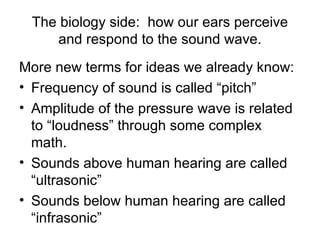
The biology side:  how our ears perceive and respond to the sound wave. More new terms for ideas we already know: Frequency of sound is called “pitch” Amplitude of the pressure wave is related to “loudness” through some complex math. Sounds above human hearing are called “ultrasonic” Sounds below human hearing are called “infrasonic”
Doppler effect Definition:  a change in the observed frequency due to the relative motion of the sound source or observer. Source approaching observer: frequency higher – hear a higher pitch Source moving away from observer:  frequency lower – hear a lower pitch

U8 Cn1 Sound Class Notes 1

  • 1.
    Introduction to SoundUnit 8 Class 1 E. Alexander Burt
  • 2.
    What is sound?(Conceptual introduction) Sound is both physics and biology Physics: Sound is a longitudinal pressure wave. For us humans, this wave is usually in air. Biology: Sound is how we perceive and respond to the pressure wave.
  • 3.
    The physics side:New words for terms we already know. It’s a longitudinal wave – the “crests” are areas of high pressure – called “compression.” The “troughs” are areas of low pressure – called “rarefaction.” If we plot air pressure vs time on a graph we would “see” the sound wave. The variations in air pressure are very small compared to the normal atmospheric pressure.
  • 4.
    The biology side: how our ears perceive and respond to the sound wave. More new terms for ideas we already know: Frequency of sound is called “pitch” Amplitude of the pressure wave is related to “loudness” through some complex math. Sounds above human hearing are called “ultrasonic” Sounds below human hearing are called “infrasonic”
  • 5.
    Doppler effect Definition: a change in the observed frequency due to the relative motion of the sound source or observer. Source approaching observer: frequency higher – hear a higher pitch Source moving away from observer: frequency lower – hear a lower pitch