Science Ace-SoundBy: Mark Soh 2A226
AgendaReason for doing soundIntroduction to soundTerminology in soundOur ears and hearing aidsSound wavesDecibels  Sound in natureEchoes
Reason for doing soundIf you could remember I did light last term. I realized that light and sound was sort of a ‘package’ in life as they together are able to form the most amazing things such as television shows and music videos. So I decided to do this ace regarding sound.
Introduction to soundBasically sound is what we hear around us. If I were to draw a map on how sound has been like since young…Babies make A LOT of sound ( eg. Crying )Children make considerably loud noise, especially in class, with no doubt is because they are talking
Then comes the teenagers. In this case you realize they stay cool in a corner. BUT the music they play on their iPods I deafeningAs they turn into adults, they start to hate noise and prefer the peace in the hillside or somethingAs they turn into old people, the most commonly used phrase would be : What did you say?This is our life with sound
Terminology in soundTerminology would refer to the words used when referring to sound scientifically.AMPLITUDE – It means how loud something is. Stronger sound waves (explained later) means louder sounds or greater amplitude. Amplitude also comes from the word ample which means plentiful (as said by dictionary.com)
Terminology in soundFREQUENCY – Frequency means the number of vibrations a second that make up the sound. Take a bat squeak compared to a dog’s bark for example. The bat’s squeak is of a higher frequency than a dog’s bark because it’s sound produced is higher. This is measured in hertz (written Hz). Hence higher frequency makes more hertz.
Terminology in soundTONE – This is a sound with one frequency. Hence in songs the tone varies. If it doesn’t, it would sound monotonous. This can be produced by hitting a tuning fork.RESONANCE – This is when vibrations hit an object at a certain frequency. As the object vibrates more, the sound gets louder and louder.
Terminology in soundHARMONICS – All sounds are made up of harmonics. As long as the harmonics are working on the same frequency, the sound produced would be nice to listen to. If it is still unclear, harmonics are the basis of all songs. Harmonics in songs are like the ‘timers’ in frequency, setting when the best time for a certain frequency to turn up. Hence it can be harmonious.
Our ears Our ears consists of these parts:The ears itselfEar-drumEar boneOval WindowThe nerves that go from the ear to the brain
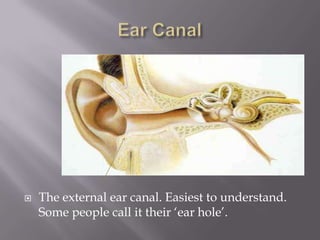
Ear CanalThe external ear canal. Easiest to understand. Some people call it their ‘ear hole’.
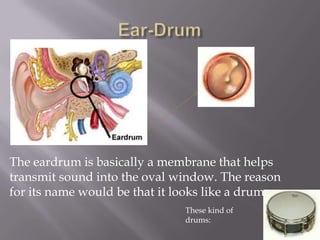
Ear-DrumThe eardrum is basically a membrane that helps transmit sound into the oval window. The reason for its name would be that it looks like a drum. These kind of drums:
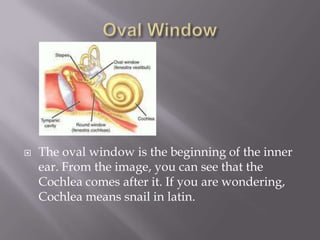
Oval WindowThe oval window is the beginning of the inner ear. From the image, you can see that the Cochlea comes after it. If you are wondering, Cochlea means snail in latin.
The nervesThey are basically used to transmit the sound messages to the brain.
Hearing aidsHearing aids come in play when people start to complain of hearing problems.A hearing aid is basically a miniature microphone linked to an amplifier that makes sound louder.A cochlea implant (another hearing aid) is a tiny radio receiver fitted under the skin that receives radio signals from the earpiece under the ear. The implant then converts the signals to electrical pulses that trigger signals along the nerves to the brain.And they work together, the hearing aid and the cochlea implant.
A story about the hearing aidIn the USA, there was a man named Henry Koch that complained of hearing music in his head. Test had showed that a tiny lump of carborundum, a hard block chemical from a dentist drill had stuck in his tooth. The crystals in the chemical were picking up and boosting the power of radio waves from a nearby transmitter. This triggered vibrations which he heard as music.
Sound wavesA sound wave happens when tiny air molecules are shoved together and bump apart again. As they leap apart some molecules bump into others further away. So you would get a wave of bumpy molecules moving outwards like the ripples on a pond.
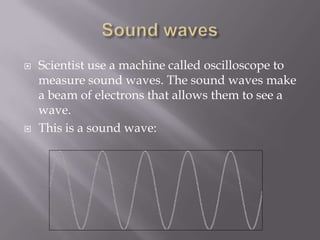
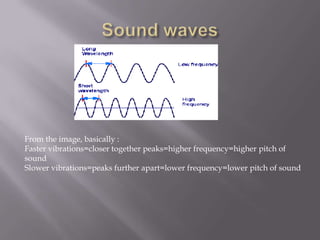
Sound wavesScientist use a machine called oscilloscope to measure sound waves. The sound waves make a beam of electrons that allows them to see a wave.  This is a sound wave:
Sound wavesFrom the image, basically :Faster vibrations=closer together peaks=higher frequency=higher pitch of soundSlower vibrations=peaks further apart=lower frequency=lower pitch of sound
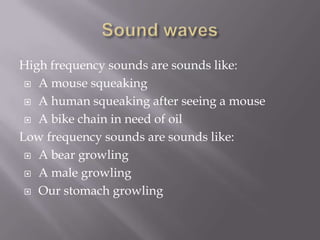
Sound wavesHigh frequency sounds are sounds like:A mouse squeaking A human squeaking after seeing a mouseA bike chain in need of oilLow frequency sounds are sounds like:A bear growlingA male growlingOur stomach growling
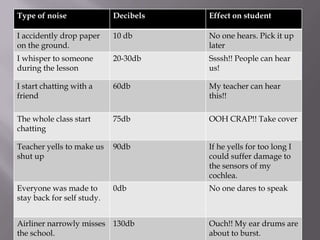
DecibelsDecibels, in a casual way of expressing it, would be how loud something is. Taking a scene from a classroom, it can show how much decibels are produced.The next slide…
Sound in natureSimilar to humans, animals make noise too! And if you are complaining that we make too much noise, they make louder noises!!
Sound in nature-AnimalsThe Frog. It’s loud croak is made louder thanks to their vibrating air-filled pouches in their throat.The rats. It is famous for it’s squeak that has a high frequency that sometimes is too loud for us to hear.Song birds. As the name goes, they can sing, because of their singing syrinxes, which is the skin stretched over their windpipes.
Sound in nature- AnimalsHowler monkey. It’s voice is so loud that these monkeys can be heard at a distance of 15km away from them.Woodpeckers. More than making sounds from their own vocal organs, they make a repetitive sound by pecking a tree constantly using their toughened beak.Cicadas. They are insects that make sounds using the vibrating sound inside their abdomens.
EchoesFacts about them:An echo is made by sound waves bouncing off a surface in the same way light bounces of a mirror.An old castle in Milan, Italy has walls that trap the sound waves so they continue bouncing backwards and forwards about 40 times.Alpine horns, those long horns that people in Switzerland use, use echoes to boost their range.
EchoesFog horns used echoes to carry their message by making the sound waves bounce of cliffs and rocks, to help warn of danger ahead.Thunder uses echoes too! It is by bouncing the sounds of the clouds.
BibliographyHorrible Science- Sounds DreadfulWikipedia- http://en.wikipedia.org/wiki/EarGoogle images
The End              Hope that this ACE was beneficial!!

Science ace sound

  • 1.
  • 2.
    AgendaReason for doingsoundIntroduction to soundTerminology in soundOur ears and hearing aidsSound wavesDecibels Sound in natureEchoes
  • 3.
    Reason for doingsoundIf you could remember I did light last term. I realized that light and sound was sort of a ‘package’ in life as they together are able to form the most amazing things such as television shows and music videos. So I decided to do this ace regarding sound.
  • 4.
    Introduction to soundBasicallysound is what we hear around us. If I were to draw a map on how sound has been like since young…Babies make A LOT of sound ( eg. Crying )Children make considerably loud noise, especially in class, with no doubt is because they are talking
  • 5.
    Then comes theteenagers. In this case you realize they stay cool in a corner. BUT the music they play on their iPods I deafeningAs they turn into adults, they start to hate noise and prefer the peace in the hillside or somethingAs they turn into old people, the most commonly used phrase would be : What did you say?This is our life with sound
  • 6.
    Terminology in soundTerminologywould refer to the words used when referring to sound scientifically.AMPLITUDE – It means how loud something is. Stronger sound waves (explained later) means louder sounds or greater amplitude. Amplitude also comes from the word ample which means plentiful (as said by dictionary.com)
  • 7.
    Terminology in soundFREQUENCY– Frequency means the number of vibrations a second that make up the sound. Take a bat squeak compared to a dog’s bark for example. The bat’s squeak is of a higher frequency than a dog’s bark because it’s sound produced is higher. This is measured in hertz (written Hz). Hence higher frequency makes more hertz.
  • 8.
    Terminology in soundTONE– This is a sound with one frequency. Hence in songs the tone varies. If it doesn’t, it would sound monotonous. This can be produced by hitting a tuning fork.RESONANCE – This is when vibrations hit an object at a certain frequency. As the object vibrates more, the sound gets louder and louder.
  • 9.
    Terminology in soundHARMONICS– All sounds are made up of harmonics. As long as the harmonics are working on the same frequency, the sound produced would be nice to listen to. If it is still unclear, harmonics are the basis of all songs. Harmonics in songs are like the ‘timers’ in frequency, setting when the best time for a certain frequency to turn up. Hence it can be harmonious.
  • 10.
    Our ears Ourears consists of these parts:The ears itselfEar-drumEar boneOval WindowThe nerves that go from the ear to the brain
  • 11.
    Ear CanalThe externalear canal. Easiest to understand. Some people call it their ‘ear hole’.
  • 12.
    Ear-DrumThe eardrum isbasically a membrane that helps transmit sound into the oval window. The reason for its name would be that it looks like a drum. These kind of drums:
  • 13.
    Oval WindowThe ovalwindow is the beginning of the inner ear. From the image, you can see that the Cochlea comes after it. If you are wondering, Cochlea means snail in latin.
  • 14.
    The nervesThey arebasically used to transmit the sound messages to the brain.
  • 15.
    Hearing aidsHearing aidscome in play when people start to complain of hearing problems.A hearing aid is basically a miniature microphone linked to an amplifier that makes sound louder.A cochlea implant (another hearing aid) is a tiny radio receiver fitted under the skin that receives radio signals from the earpiece under the ear. The implant then converts the signals to electrical pulses that trigger signals along the nerves to the brain.And they work together, the hearing aid and the cochlea implant.
  • 16.
    A story aboutthe hearing aidIn the USA, there was a man named Henry Koch that complained of hearing music in his head. Test had showed that a tiny lump of carborundum, a hard block chemical from a dentist drill had stuck in his tooth. The crystals in the chemical were picking up and boosting the power of radio waves from a nearby transmitter. This triggered vibrations which he heard as music.
  • 17.
    Sound wavesA soundwave happens when tiny air molecules are shoved together and bump apart again. As they leap apart some molecules bump into others further away. So you would get a wave of bumpy molecules moving outwards like the ripples on a pond.
  • 18.
    Sound wavesScientist usea machine called oscilloscope to measure sound waves. The sound waves make a beam of electrons that allows them to see a wave. This is a sound wave:
  • 19.
    Sound wavesFrom theimage, basically :Faster vibrations=closer together peaks=higher frequency=higher pitch of soundSlower vibrations=peaks further apart=lower frequency=lower pitch of sound
  • 20.
    Sound wavesHigh frequencysounds are sounds like:A mouse squeaking A human squeaking after seeing a mouseA bike chain in need of oilLow frequency sounds are sounds like:A bear growlingA male growlingOur stomach growling
  • 21.
    DecibelsDecibels, in acasual way of expressing it, would be how loud something is. Taking a scene from a classroom, it can show how much decibels are produced.The next slide…
  • 23.
    Sound in natureSimilarto humans, animals make noise too! And if you are complaining that we make too much noise, they make louder noises!!
  • 24.
    Sound in nature-AnimalsTheFrog. It’s loud croak is made louder thanks to their vibrating air-filled pouches in their throat.The rats. It is famous for it’s squeak that has a high frequency that sometimes is too loud for us to hear.Song birds. As the name goes, they can sing, because of their singing syrinxes, which is the skin stretched over their windpipes.
  • 25.
    Sound in nature-AnimalsHowler monkey. It’s voice is so loud that these monkeys can be heard at a distance of 15km away from them.Woodpeckers. More than making sounds from their own vocal organs, they make a repetitive sound by pecking a tree constantly using their toughened beak.Cicadas. They are insects that make sounds using the vibrating sound inside their abdomens.
  • 26.
    EchoesFacts about them:Anecho is made by sound waves bouncing off a surface in the same way light bounces of a mirror.An old castle in Milan, Italy has walls that trap the sound waves so they continue bouncing backwards and forwards about 40 times.Alpine horns, those long horns that people in Switzerland use, use echoes to boost their range.
  • 27.
    EchoesFog horns usedechoes to carry their message by making the sound waves bounce of cliffs and rocks, to help warn of danger ahead.Thunder uses echoes too! It is by bouncing the sounds of the clouds.
  • 28.
    BibliographyHorrible Science- SoundsDreadfulWikipedia- http://en.wikipedia.org/wiki/EarGoogle images
  • 29.
    The End Hope that this ACE was beneficial!!