STA6166-RegBasics 1
Regression Basics (§11.1 – 11.3)
Regression Unit Outline
• What is Regression?
• How is a Simple Linear Regression Analysis done?
• Outline the analysis protocol.
• Work an example.
• Examine the details (a little theory).
• Related items.
• When is simple linear regression appropriate?
STA6166-RegBasics 2
Relationships
In science, we frequently measure two or more variables on the same
individual (case, object, etc). We do this to explore the nature of the
relationship among these variables. There are two basic types of
relationships.
• Cause-and-effect relationships.
• Functional relationships.
Function: a mathematical relationship enabling us to predict what
values of one variable (Y) correspond to given values of another
variable (X).
• Y: is referred to as the dependent variable, the response
variable or the predicted variable.
• X: is referred to as the independent variable, the explanatory
variable or the predictor variable.
What is Regression?
STA6166-RegBasics 3
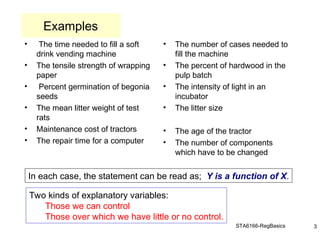
Examples
• The time needed to fill a soft
drink vending machine
• The tensile strength of wrapping
paper
• Percent germination of begonia
seeds
• The mean litter weight of test
rats
• Maintenance cost of tractors
• The repair time for a computer
• The number of cases needed to
fill the machine
• The percent of hardwood in the
pulp batch
• The intensity of light in an
incubator
• The litter size
• The age of the tractor
• The number of components
which have to be changed
In each case, the statement can be read as; Y is a function of X.
Two kinds of explanatory variables:
Those we can control
Those over which we have little or no control.
STA6166-RegBasics 4
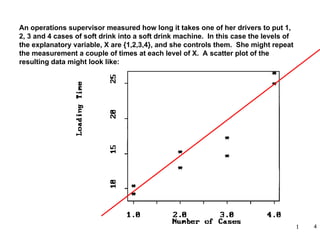
An operations supervisor measured how long it takes one of her drivers to put 1,
2, 3 and 4 cases of soft drink into a soft drink machine. In this case the levels of
the explanatory variable, X are {1,2,3,4}, and she controls them. She might repeat
the measurement a couple of times at each level of X. A scatter plot of the
resulting data might look like:
STA6166-RegBasics 5
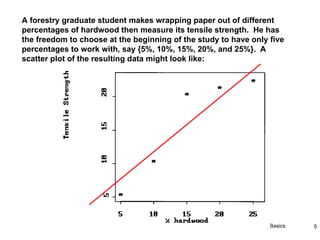
A forestry graduate student makes wrapping paper out of different
percentages of hardwood then measure its tensile strength. He has
the freedom to choose at the beginning of the study to have only five
percentages to work with, say {5%, 10%, 15%, 20%, and 25%}. A
scatter plot of the resulting data might look like:
STA6166-RegBasics 6
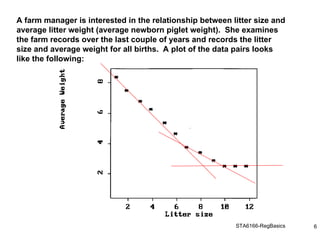
A farm manager is interested in the relationship between litter size and
average litter weight (average newborn piglet weight). She examines
the farm records over the last couple of years and records the litter
size and average weight for all births. A plot of the data pairs looks
like the following:
STA6166-RegBasics 7
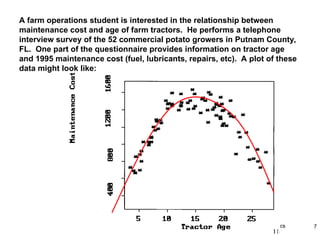
A farm operations student is interested in the relationship between
maintenance cost and age of farm tractors. He performs a telephone
interview survey of the 52 commercial potato growers in Putnam County,
FL. One part of the questionnaire provides information on tractor age
and 1995 maintenance cost (fuel, lubricants, repairs, etc). A plot of these
data might look like:
STA6166-RegBasics 8
• What is the association between Y and X?
• How can changes in Y be explained by changes in X?
• What are the functional relationships between Y and X?
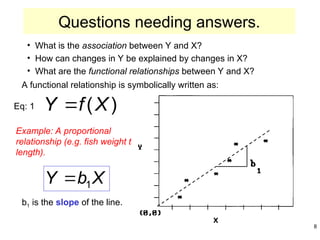
A functional relationship is symbolically written as:
)
(X
f
Y 
Eq: 1
Example: A proportional
relationship (e.g. fish weight to
length).
X
b
Y 1

b1 is the slope of the line.
Questions needing answers.
STA6166-RegBasics 9
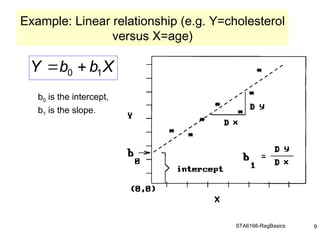
b0 is the intercept,
b1 is the slope.
X
b
b
Y 1
0 

Example: Linear relationship (e.g. Y=cholesterol
versus X=age)
STA6166-RegBasics 10
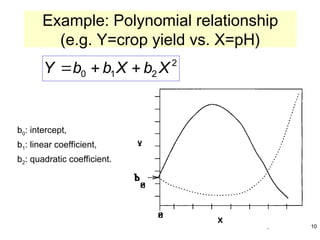
b0: intercept,
b1: linear coefficient,
b2: quadratic coefficient.
2
2
1
0 X
b
X
b
b
Y 


Example: Polynomial relationship
(e.g. Y=crop yield vs. X=pH)
STA6166-RegBasics 11
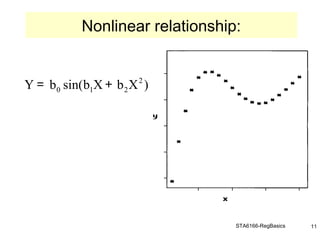
2
0 1 2
Y b sin(b X b X )
= +
Nonlinear relationship:
STA6166-RegBasics 12
• The proposed functional relationship will not fit
exactly, i.e. something is either wrong with the
data (errors in measurement), or the model is
inadequate (errors in specification).
• The relationship is not truly known until we
assign values to the parameters of the model.
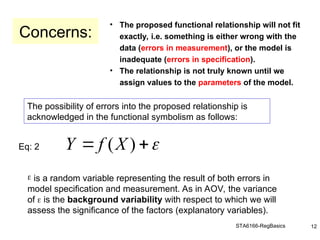
The possibility of errors into the proposed relationship is
acknowledged in the functional symbolism as follows:


 )
(X
f
Y
Eq: 2
 is a random variable representing the result of both errors in
model specification and measurement. As in AOV, the variance
of  is the background variability with respect to which we will
assess the significance of the factors (explanatory variables).
Concerns:
STA6166-RegBasics 13
Another way to emphasize
)
(X
f
Y 


Eq: 3
or, emphasizing that f(X) depends on unknown parameters.


 
 )
,
|
( 1
0
X
f
Y
Eq: 4
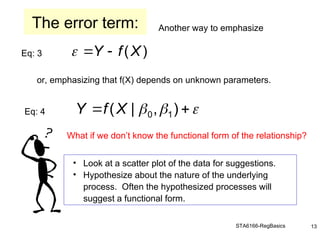
What if we don’t know the functional form of the relationship?
• Look at a scatter plot of the data for suggestions.
• Hypothesize about the nature of the underlying
process. Often the hypothesized processes will
suggest a functional form.
The error term:
STA6166-RegBasics 14
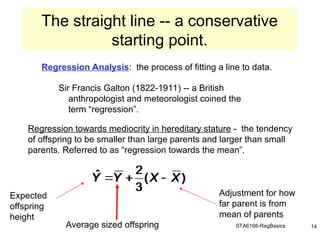
Regression Analysis: the process of fitting a line to data.
Sir Francis Galton (1822-1911) -- a British
anthropologist and meteorologist coined the
term “regression”.
Regression towards mediocrity in hereditary stature - the tendency
of offspring to be smaller than large parents and larger than small
parents. Referred to as “regression towards the mean”.
)
(
3
2
ˆ X
X
Y
Y 


The straight line -- a conservative
starting point.
)
(
3
2
ˆ X
X
Y
Y 


Average sized offspring
Adjustment for how
far parent is from
mean of parents
Expected
offspring
height
STA6166-RegBasics 15
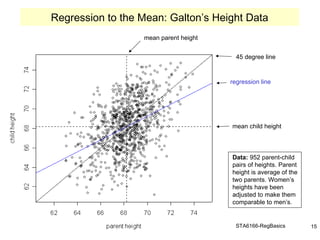
Regression to the Mean: Galton’s Height Data
45 degree line
regression line
mean child height
mean parent height
mean parent height
Data: 952 parent-child
pairs of heights. Parent
height is average of the
two parents. Women’s
heights have been
adjusted to make them
comparable to men’s.
STA6166-RegBasics 16
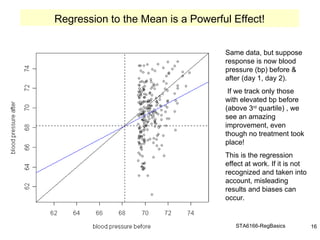
Regression to the Mean is a Powerful Effect!
Same data, but suppose
response is now blood
pressure (bp) before &
after (day 1, day 2).
If we track only those
with elevated bp before
(above 3rd
quartile) , we
see an amazing
improvement, even
though no treatment took
place!
This is the regression
effect at work. If it is not
recognized and taken into
account, misleading
results and biases can
occur.
STA6166-RegBasics 17
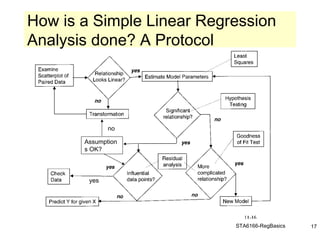
How is a Simple Linear Regression
Analysis done? A Protocol
Assumption
s OK?
no
yes
STA6166-RegBasics 18
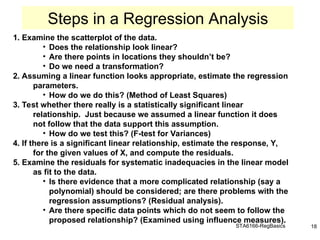
1. Examine the scatterplot of the data.
• Does the relationship look linear?
• Are there points in locations they shouldn’t be?
• Do we need a transformation?
2. Assuming a linear function looks appropriate, estimate the regression
parameters.
• How do we do this? (Method of Least Squares)
3. Test whether there really is a statistically significant linear
relationship. Just because we assumed a linear function it does
not follow that the data support this assumption.
• How do we test this? (F-test for Variances)
4. If there is a significant linear relationship, estimate the response, Y,
for the given values of X, and compute the residuals.
5. Examine the residuals for systematic inadequacies in the linear model
as fit to the data.
• Is there evidence that a more complicated relationship (say a
polynomial) should be considered; are there problems with the
regression assumptions? (Residual analysis).
• Are there specific data points which do not seem to follow the
proposed relationship? (Examined using influence measures).
Steps in a Regression Analysis
STA6166-RegBasics 19
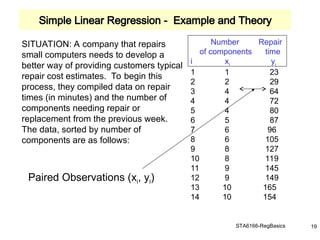
SITUATION: A company that repairs
small computers needs to develop a
better way of providing customers typical
repair cost estimates. To begin this
process, they compiled data on repair
times (in minutes) and the number of
components needing repair or
replacement from the previous week.
The data, sorted by number of
components are as follows:
Number Repair
of components time
i xi yi
1 1 23
2 2 29
3 4 64
4 4 72
5 4 80
6 5 87
7 6 96
8 6 105
9 8 127
10 8 119
11 9 145
12 9 149
13 10 165
14 10 154
Paired Observations (xi, yi)
Simple Linear Regression - Example and Theory
STA6166-RegBasics 20
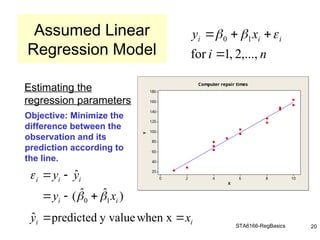
Estimating the
regression parameters
Objective: Minimize the
difference between the
observation and its
prediction according to
the line.
Assumed Linear
Regression Model n
i
x
y i
i
i
,...,
2
,
1
for
1
0



 


)
ˆ
ˆ
(
ˆ
1
0 i
i
i
i
i
x
y
y
y








X
Y
10
8
6
4
2
0
180
160
140
120
100
80
60
40
20
Computer repair times
i
i x
y 
 when x
y value
predicted
ˆ
STA6166-RegBasics 21
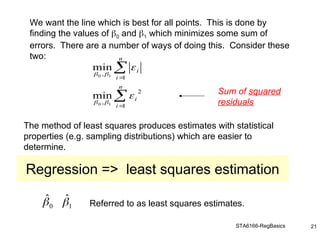
We want the line which is best for all points. This is done by
finding the values of 0 and 1 which minimizes some sum of
errors. There are a number of ways of doing this. Consider these
two:
The method of least squares produces estimates with statistical
properties (e.g. sampling distributions) which are easier to
determine.
Referred to as least squares estimates.
Sum of squared
residuals
Regression => least squares estimation




n
i
i
n
i
i
1
2
,
1
,
1
0
1
0
min
min






1
0
ˆ
ˆ 

STA6166-RegBasics 22
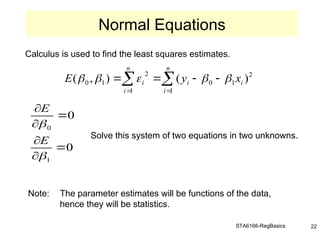
Calculus is used to find the least squares estimates.
Solve this system of two equations in two unknowns.
Note: The parameter estimates will be functions of the data,
hence they will be statistics.
Normal Equations

 





n
i
i
i
n
i
i x
y
E
1
2
1
0
1
2
1
0 )
(
)
,
( 




0
0
1
0








E
E
STA6166-RegBasics 23
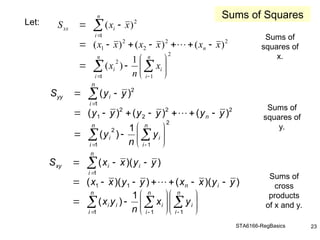
Let:
 

 


















n
i
n
i
i
i
n
n
i
i
xx
x
n
x
x
x
x
x
x
x
x
x
S
1
2
1
2
2
2
2
2
1
1
2
1
)
(
)
(
)
(
)
(
)
(

 

 




















n
i
n
i
i
i
n
n
i
i
yy
y
n
y
y
y
y
y
y
y
y
y
S
1
2
1
2
2
2
2
2
1
1
2
1
)
(
)
(
)
(
)
(
)
(

 


 






























n
i
n
i
i
n
i
i
i
i
i
n
n
i
i
i
xy
y
x
n
y
x
y
y
x
x
y
y
x
x
y
y
x
x
S
1 1
1
1
1
1
1
)
(
)
)(
(
)
)(
(
)
)(
(

Sums of
squares of
x.
Sums of
squares of
y.
Sums of
cross
products
of x and y.
Sums of Squares
STA6166-RegBasics 24
Easy to compute with a spreadsheet program.
Easier to do with a statistical analysis package.
Example:
Prediction
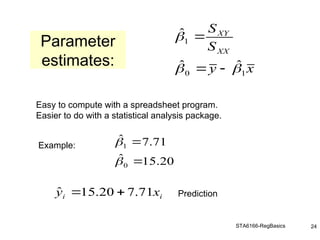
Parameter
estimates: x
y
S
S
XX
XY
1
0
1
ˆ
ˆ
ˆ






20
.
15
ˆ
71
.
7
ˆ
0
1




i
i x
y 71
.
7
20
.
15
ˆ 

STA6166-RegBasics 25
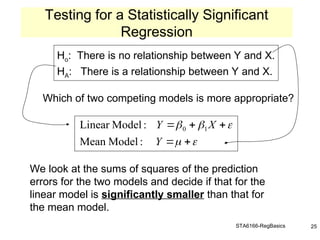
Ho: There is no relationship between Y and X.
HA: There is a relationship between Y and X.
Which of two competing models is more appropriate?
We look at the sums of squares of the prediction
errors for the two models and decide if that for the
linear model is significantly smaller than that for
the mean model.
Testing for a Statistically Significant
Regression










Y
X
Y
:
Model
Mean
:
Model
Linear 1
0
STA6166-RegBasics 26
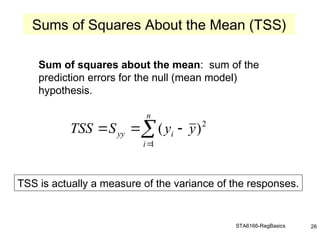
Sum of squares about the mean: sum of the
prediction errors for the null (mean model)
hypothesis.
Sums of Squares About the Mean (TSS)
TSS is actually a measure of the variance of the responses.





n
i
i
yy y
y
S
TSS
1
2
)
(
STA6166-RegBasics 27
Residual Sums of Squares
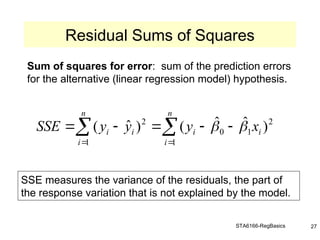
Sum of squares for error: sum of the prediction errors
for the alternative (linear regression model) hypothesis.
SSE measures the variance of the residuals, the part of
the response variation that is not explained by the model.

 






n
i
i
i
n
i
i
i x
y
y
y
SSE
1
2
1
0
1
2
)
ˆ
ˆ
(
)
ˆ
( 

STA6166-RegBasics 28
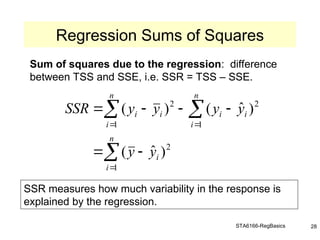
Regression Sums of Squares
Sum of squares due to the regression: difference
between TSS and SSE, i.e. SSR = TSS – SSE.
SSR measures how much variability in the response is
explained by the regression.












n
i
i
n
i
i
i
n
i
i
i
y
y
y
y
y
y
SSR
1
2
1
2
1
2
)
ˆ
(
)
ˆ
(
)
(
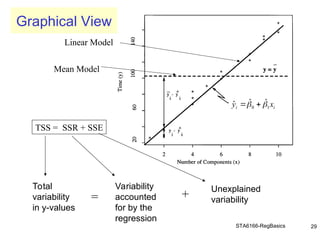
STA6166-RegBasics 29
i
i x
y 1
0
ˆ
ˆ
ˆ 
 

Mean Model
Linear Model
Total
variability
in y-values
=
Variability
accounted
for by the
regression
+
Unexplained
variability
TSS = SSR + SSE
Graphical View
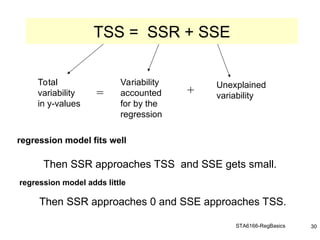
STA6166-RegBasics 30
Total
variability
in y-values
=
Variability
accounted
for by the
regression
+ Unexplained
variability
Then SSR approaches TSS and SSE gets small.
Then SSR approaches 0 and SSE approaches TSS.
TSS = SSR + SSE
regression model fits well
regression model adds little
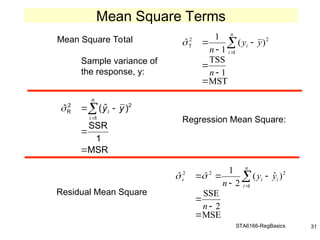
STA6166-RegBasics 31
Sample variance of
the response, y:
MST
1
TSS
)
(
1
1
ˆ
1
2
2
T





 

n
y
y
n
n
i
i

Mean Square Total
Regression Mean Square:
MSR
1
SSR
)
ˆ
(
ˆ
1
2
2
R





n
i
i y
y

MSE
2
SSE
)
ˆ
(
2
1
ˆ
ˆ
1
2
2
2






 

n
y
y
n
n
i
i
i


Residual Mean Square
Mean Square Terms
STA6166-RegBasics 32
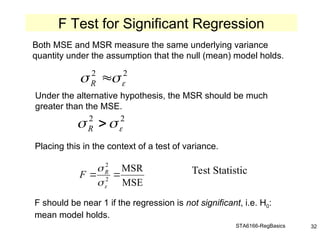
Both MSE and MSR measure the same underlying variance
quantity under the assumption that the null (mean) model holds.
Under the alternative hypothesis, the MSR should be much
greater than the MSE.
Placing this in the context of a test of variance.
2
2


 
R
2
2


 
R
MSE
MSR
2
2




 R
F Test Statistic
F should be near 1 if the regression is not significant, i.e. H0:
mean model holds.
F Test for Significant Regression
STA6166-RegBasics 33
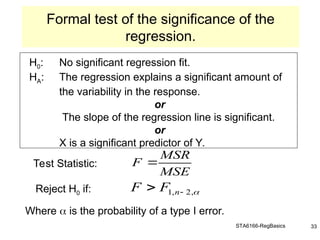
H0: No significant regression fit.
HA: The regression explains a significant amount of
the variability in the response.
or
The slope of the regression line is significant.
or
X is a significant predictor of Y.
Reject H0 if:
Where  is the probability of a type I error.
Formal test of the significance of the
regression.
Test Statistic:

,
2
,
1 
 n
F
F
MSE
MSR
F 
STA6166-RegBasics 34
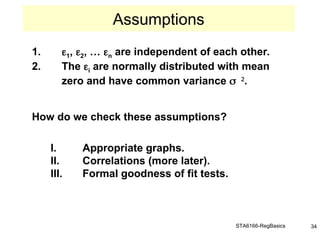
1. 1, 2, … n are independent of each other.
2. The i are normally distributed with mean
zero and have common variance 
.
How do we check these assumptions?
I. Appropriate graphs.
II. Correlations (more later).
III. Formal goodness of fit tests.
Assumptions
STA6166-RegBasics 35
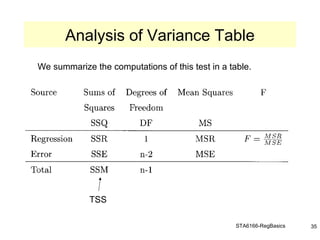
We summarize the computations of this test in a table.
Analysis of Variance Table
TSS
STA6166-RegBasics 36
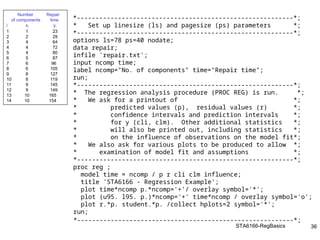
Number Repair
of components time
i xi yi
1 1 23
2 2 29
3 4 64
4 4 72
5 4 80
6 5 87
7 6 96
8 6 105
9 8 127
10 8 119
11 9 145
12 9 149
13 10 165
14 10 154
*----------------------------------------------------------*;
* Set up linesize (ls) and pagesize (ps) parameters *;
*----------------------------------------------------------*;
options ls=78 ps=40 nodate;
data repair;
infile 'repair.txt';
input ncomp time;
label ncomp="No. of components" time="Repair time";
run;
*----------------------------------------------------------*;
* The regression analysis procedure (PROC REG) is run. *;
* We ask for a printout of *;
* predicted values (p), residual values (r) *;
* confidence intervals and prediction intervals *;
* for y (cli, clm). Other additional statistics *;
* will also be printed out, including statistics *;
* on the influence of observations on the model fit*;
* We also ask for various plots to be produced to allow *;
* examination of model fit and assumptions *;
*----------------------------------------------------------*;
proc reg ;
model time = ncomp / p r cli clm influence;
title 'STA6166 - Regression Example';
plot time*ncomp p.*ncomp='+'/ overlay symbol='*';
plot (u95. l95. p.)*ncomp='+' time*ncomp / overlay symbol='o';
plot r.*p. student.*p. /collect hplots=2 symbol='*';
run;
*----------------------------------------------------------*;
STA6166-RegBasics 37
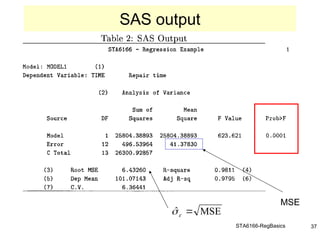
MSE
ˆ 


MSE
SAS output
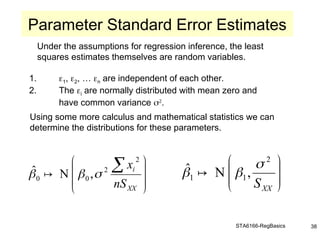
STA6166-RegBasics 38
Under the assumptions for regression inference, the least
squares estimates themselves are random variables.
1. 1, 2, … n are independent of each other.
2. The i are normally distributed with mean zero and
have common variance 
.
Using some more calculus and mathematical statistics we can
determine the distributions for these parameters.
Parameter Standard Error Estimates







 
XX
i
nS
x
2
2
0
0 ,
N
ˆ 

  







XX
S
2
1
1 ,
N
ˆ 

 
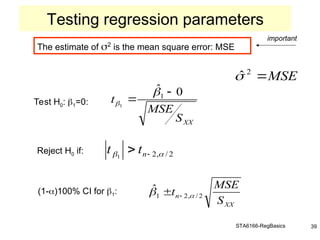
STA6166-RegBasics 39
The estimate of 2
is the mean square error: MSE
important
Test H0: 1=0:
Reject H0 if:
(1-)100% CI for 1:
Testing regression parameters
2
/
,
2
1 
 
 n
t
t
XX
n
S
MSE
t 2
/
,
2
1
ˆ

 

MSE

2
ˆ

XX
S
MSE
t
0
ˆ
1
1




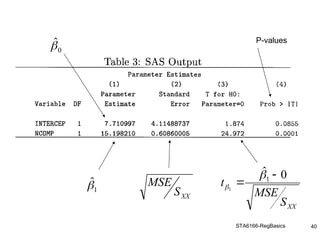
STA6166-RegBasics 40
0
̂
1
̂
XX
S
MSE
t
0
ˆ
1
1




XX
S
MSE
P-values
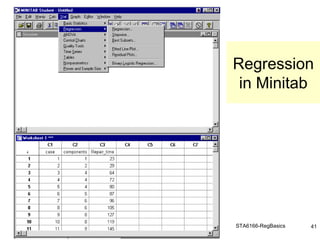
STA6166-RegBasics 41
Regression
in Minitab
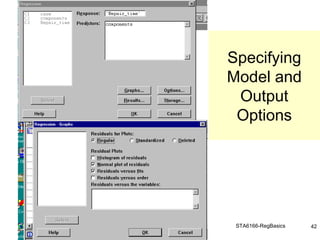
STA6166-RegBasics 42
Specifying
Model and
Output
Options
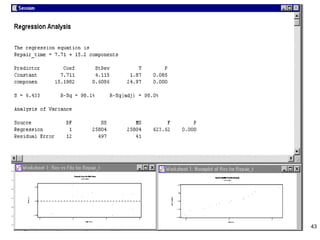
STA6166-RegBasics 43
STA6166-RegBasics 44
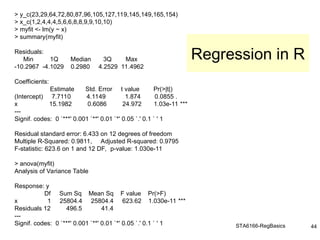
Regression in R
> y_c(23,29,64,72,80,87,96,105,127,119,145,149,165,154)
> x_c(1,2,4,4,4,5,6,6,8,8,9,9,10,10)
> myfit <- lm(y ~ x)
> summary(myfit)
Residuals:
Min 1Q Median 3Q Max
-10.2967 -4.1029 0.2980 4.2529 11.4962
Coefficients:
Estimate Std. Error t value Pr(>|t|)
(Intercept) 7.7110 4.1149 1.874 0.0855 .
x 15.1982 0.6086 24.972 1.03e-11 ***
---
Signif. codes: 0 `***' 0.001 `**' 0.01 `*' 0.05 `.' 0.1 ` ' 1
Residual standard error: 6.433 on 12 degrees of freedom
Multiple R-Squared: 0.9811, Adjusted R-squared: 0.9795
F-statistic: 623.6 on 1 and 12 DF, p-value: 1.030e-11
> anova(myfit)
Analysis of Variance Table
Response: y
Df Sum Sq Mean Sq F value Pr(>F)
x 1 25804.4 25804.4 623.62 1.030e-11 ***
Residuals 12 496.5 41.4
---
Signif. codes: 0 `***' 0.001 `**' 0.01 `*' 0.05 `.' 0.1 ` ' 1
STA6166-RegBasics 45
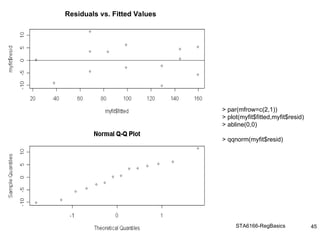
> par(mfrow=c(2,1))
> plot(myfit$fitted,myfit$resid)
> abline(0,0)
> qqnorm(myfit$resid)
Residuals vs. Fitted Values

U6.1-RegressionBasics (1).pptfgfdgfgfdgfdgfg

  • 1.
    STA6166-RegBasics 1 Regression Basics(§11.1 – 11.3) Regression Unit Outline • What is Regression? • How is a Simple Linear Regression Analysis done? • Outline the analysis protocol. • Work an example. • Examine the details (a little theory). • Related items. • When is simple linear regression appropriate?
  • 2.
    STA6166-RegBasics 2 Relationships In science,we frequently measure two or more variables on the same individual (case, object, etc). We do this to explore the nature of the relationship among these variables. There are two basic types of relationships. • Cause-and-effect relationships. • Functional relationships. Function: a mathematical relationship enabling us to predict what values of one variable (Y) correspond to given values of another variable (X). • Y: is referred to as the dependent variable, the response variable or the predicted variable. • X: is referred to as the independent variable, the explanatory variable or the predictor variable. What is Regression?
  • 3.
    STA6166-RegBasics 3 Examples • Thetime needed to fill a soft drink vending machine • The tensile strength of wrapping paper • Percent germination of begonia seeds • The mean litter weight of test rats • Maintenance cost of tractors • The repair time for a computer • The number of cases needed to fill the machine • The percent of hardwood in the pulp batch • The intensity of light in an incubator • The litter size • The age of the tractor • The number of components which have to be changed In each case, the statement can be read as; Y is a function of X. Two kinds of explanatory variables: Those we can control Those over which we have little or no control.
  • 4.
    STA6166-RegBasics 4 An operationssupervisor measured how long it takes one of her drivers to put 1, 2, 3 and 4 cases of soft drink into a soft drink machine. In this case the levels of the explanatory variable, X are {1,2,3,4}, and she controls them. She might repeat the measurement a couple of times at each level of X. A scatter plot of the resulting data might look like:
  • 5.
    STA6166-RegBasics 5 A forestrygraduate student makes wrapping paper out of different percentages of hardwood then measure its tensile strength. He has the freedom to choose at the beginning of the study to have only five percentages to work with, say {5%, 10%, 15%, 20%, and 25%}. A scatter plot of the resulting data might look like:
  • 6.
    STA6166-RegBasics 6 A farmmanager is interested in the relationship between litter size and average litter weight (average newborn piglet weight). She examines the farm records over the last couple of years and records the litter size and average weight for all births. A plot of the data pairs looks like the following:
  • 7.
    STA6166-RegBasics 7 A farmoperations student is interested in the relationship between maintenance cost and age of farm tractors. He performs a telephone interview survey of the 52 commercial potato growers in Putnam County, FL. One part of the questionnaire provides information on tractor age and 1995 maintenance cost (fuel, lubricants, repairs, etc). A plot of these data might look like:
  • 8.
    STA6166-RegBasics 8 • Whatis the association between Y and X? • How can changes in Y be explained by changes in X? • What are the functional relationships between Y and X? A functional relationship is symbolically written as: ) (X f Y  Eq: 1 Example: A proportional relationship (e.g. fish weight to length). X b Y 1  b1 is the slope of the line. Questions needing answers.
  • 9.
    STA6166-RegBasics 9 b0 isthe intercept, b1 is the slope. X b b Y 1 0   Example: Linear relationship (e.g. Y=cholesterol versus X=age)
  • 10.
    STA6166-RegBasics 10 b0: intercept, b1:linear coefficient, b2: quadratic coefficient. 2 2 1 0 X b X b b Y    Example: Polynomial relationship (e.g. Y=crop yield vs. X=pH)
  • 11.
    STA6166-RegBasics 11 2 0 12 Y b sin(b X b X ) = + Nonlinear relationship:
  • 12.
    STA6166-RegBasics 12 • Theproposed functional relationship will not fit exactly, i.e. something is either wrong with the data (errors in measurement), or the model is inadequate (errors in specification). • The relationship is not truly known until we assign values to the parameters of the model. The possibility of errors into the proposed relationship is acknowledged in the functional symbolism as follows:    ) (X f Y Eq: 2  is a random variable representing the result of both errors in model specification and measurement. As in AOV, the variance of  is the background variability with respect to which we will assess the significance of the factors (explanatory variables). Concerns:
  • 13.
    STA6166-RegBasics 13 Another wayto emphasize ) (X f Y    Eq: 3 or, emphasizing that f(X) depends on unknown parameters.      ) , | ( 1 0 X f Y Eq: 4 What if we don’t know the functional form of the relationship? • Look at a scatter plot of the data for suggestions. • Hypothesize about the nature of the underlying process. Often the hypothesized processes will suggest a functional form. The error term:
  • 14.
    STA6166-RegBasics 14 Regression Analysis:the process of fitting a line to data. Sir Francis Galton (1822-1911) -- a British anthropologist and meteorologist coined the term “regression”. Regression towards mediocrity in hereditary stature - the tendency of offspring to be smaller than large parents and larger than small parents. Referred to as “regression towards the mean”. ) ( 3 2 ˆ X X Y Y    The straight line -- a conservative starting point. ) ( 3 2 ˆ X X Y Y    Average sized offspring Adjustment for how far parent is from mean of parents Expected offspring height
  • 15.
    STA6166-RegBasics 15 Regression tothe Mean: Galton’s Height Data 45 degree line regression line mean child height mean parent height mean parent height Data: 952 parent-child pairs of heights. Parent height is average of the two parents. Women’s heights have been adjusted to make them comparable to men’s.
  • 16.
    STA6166-RegBasics 16 Regression tothe Mean is a Powerful Effect! Same data, but suppose response is now blood pressure (bp) before & after (day 1, day 2). If we track only those with elevated bp before (above 3rd quartile) , we see an amazing improvement, even though no treatment took place! This is the regression effect at work. If it is not recognized and taken into account, misleading results and biases can occur.
  • 17.
    STA6166-RegBasics 17 How isa Simple Linear Regression Analysis done? A Protocol Assumption s OK? no yes
  • 18.
    STA6166-RegBasics 18 1. Examinethe scatterplot of the data. • Does the relationship look linear? • Are there points in locations they shouldn’t be? • Do we need a transformation? 2. Assuming a linear function looks appropriate, estimate the regression parameters. • How do we do this? (Method of Least Squares) 3. Test whether there really is a statistically significant linear relationship. Just because we assumed a linear function it does not follow that the data support this assumption. • How do we test this? (F-test for Variances) 4. If there is a significant linear relationship, estimate the response, Y, for the given values of X, and compute the residuals. 5. Examine the residuals for systematic inadequacies in the linear model as fit to the data. • Is there evidence that a more complicated relationship (say a polynomial) should be considered; are there problems with the regression assumptions? (Residual analysis). • Are there specific data points which do not seem to follow the proposed relationship? (Examined using influence measures). Steps in a Regression Analysis
  • 19.
    STA6166-RegBasics 19 SITUATION: Acompany that repairs small computers needs to develop a better way of providing customers typical repair cost estimates. To begin this process, they compiled data on repair times (in minutes) and the number of components needing repair or replacement from the previous week. The data, sorted by number of components are as follows: Number Repair of components time i xi yi 1 1 23 2 2 29 3 4 64 4 4 72 5 4 80 6 5 87 7 6 96 8 6 105 9 8 127 10 8 119 11 9 145 12 9 149 13 10 165 14 10 154 Paired Observations (xi, yi) Simple Linear Regression - Example and Theory
  • 20.
    STA6166-RegBasics 20 Estimating the regressionparameters Objective: Minimize the difference between the observation and its prediction according to the line. Assumed Linear Regression Model n i x y i i i ,..., 2 , 1 for 1 0        ) ˆ ˆ ( ˆ 1 0 i i i i i x y y y         X Y 10 8 6 4 2 0 180 160 140 120 100 80 60 40 20 Computer repair times i i x y   when x y value predicted ˆ
  • 21.
    STA6166-RegBasics 21 We wantthe line which is best for all points. This is done by finding the values of 0 and 1 which minimizes some sum of errors. There are a number of ways of doing this. Consider these two: The method of least squares produces estimates with statistical properties (e.g. sampling distributions) which are easier to determine. Referred to as least squares estimates. Sum of squared residuals Regression => least squares estimation     n i i n i i 1 2 , 1 , 1 0 1 0 min min       1 0 ˆ ˆ  
  • 22.
    STA6166-RegBasics 22 Calculus isused to find the least squares estimates. Solve this system of two equations in two unknowns. Note: The parameter estimates will be functions of the data, hence they will be statistics. Normal Equations         n i i i n i i x y E 1 2 1 0 1 2 1 0 ) ( ) , (      0 0 1 0         E E
  • 23.
    STA6166-RegBasics 23 Let:                       n i n i i i n n i i xx x n x x x x x x x x x S 1 2 1 2 2 2 2 2 1 1 2 1 ) ( ) ( ) ( ) ( ) (                           n i n i i i n n i i yy y n y y y y y y y y y S 1 2 1 2 2 2 2 2 1 1 2 1 ) ( ) ( ) ( ) ( ) (                                      n i n i i n i i i i i n n i i i xy y x n y x y y x x y y x x y y x x S 1 1 1 1 1 1 1 ) ( ) )( ( ) )( ( ) )( (  Sums of squares of x. Sums of squares of y. Sums of cross products of x and y. Sums of Squares
  • 24.
    STA6166-RegBasics 24 Easy tocompute with a spreadsheet program. Easier to do with a statistical analysis package. Example: Prediction Parameter estimates: x y S S XX XY 1 0 1 ˆ ˆ ˆ       20 . 15 ˆ 71 . 7 ˆ 0 1     i i x y 71 . 7 20 . 15 ˆ  
  • 25.
    STA6166-RegBasics 25 Ho: Thereis no relationship between Y and X. HA: There is a relationship between Y and X. Which of two competing models is more appropriate? We look at the sums of squares of the prediction errors for the two models and decide if that for the linear model is significantly smaller than that for the mean model. Testing for a Statistically Significant Regression           Y X Y : Model Mean : Model Linear 1 0
  • 26.
    STA6166-RegBasics 26 Sum ofsquares about the mean: sum of the prediction errors for the null (mean model) hypothesis. Sums of Squares About the Mean (TSS) TSS is actually a measure of the variance of the responses.      n i i yy y y S TSS 1 2 ) (
  • 27.
    STA6166-RegBasics 27 Residual Sumsof Squares Sum of squares for error: sum of the prediction errors for the alternative (linear regression model) hypothesis. SSE measures the variance of the residuals, the part of the response variation that is not explained by the model.          n i i i n i i i x y y y SSE 1 2 1 0 1 2 ) ˆ ˆ ( ) ˆ (  
  • 28.
    STA6166-RegBasics 28 Regression Sumsof Squares Sum of squares due to the regression: difference between TSS and SSE, i.e. SSR = TSS – SSE. SSR measures how much variability in the response is explained by the regression.             n i i n i i i n i i i y y y y y y SSR 1 2 1 2 1 2 ) ˆ ( ) ˆ ( ) (
  • 29.
    STA6166-RegBasics 29 i i x y1 0 ˆ ˆ ˆ     Mean Model Linear Model Total variability in y-values = Variability accounted for by the regression + Unexplained variability TSS = SSR + SSE Graphical View
  • 30.
    STA6166-RegBasics 30 Total variability in y-values = Variability accounted forby the regression + Unexplained variability Then SSR approaches TSS and SSE gets small. Then SSR approaches 0 and SSE approaches TSS. TSS = SSR + SSE regression model fits well regression model adds little
  • 31.
    STA6166-RegBasics 31 Sample varianceof the response, y: MST 1 TSS ) ( 1 1 ˆ 1 2 2 T         n y y n n i i  Mean Square Total Regression Mean Square: MSR 1 SSR ) ˆ ( ˆ 1 2 2 R      n i i y y  MSE 2 SSE ) ˆ ( 2 1 ˆ ˆ 1 2 2 2          n y y n n i i i   Residual Mean Square Mean Square Terms
  • 32.
    STA6166-RegBasics 32 Both MSEand MSR measure the same underlying variance quantity under the assumption that the null (mean) model holds. Under the alternative hypothesis, the MSR should be much greater than the MSE. Placing this in the context of a test of variance. 2 2     R 2 2     R MSE MSR 2 2      R F Test Statistic F should be near 1 if the regression is not significant, i.e. H0: mean model holds. F Test for Significant Regression
  • 33.
    STA6166-RegBasics 33 H0: Nosignificant regression fit. HA: The regression explains a significant amount of the variability in the response. or The slope of the regression line is significant. or X is a significant predictor of Y. Reject H0 if: Where  is the probability of a type I error. Formal test of the significance of the regression. Test Statistic:  , 2 , 1   n F F MSE MSR F 
  • 34.
    STA6166-RegBasics 34 1. 1,2, … n are independent of each other. 2. The i are normally distributed with mean zero and have common variance  . How do we check these assumptions? I. Appropriate graphs. II. Correlations (more later). III. Formal goodness of fit tests. Assumptions
  • 35.
    STA6166-RegBasics 35 We summarizethe computations of this test in a table. Analysis of Variance Table TSS
  • 36.
    STA6166-RegBasics 36 Number Repair ofcomponents time i xi yi 1 1 23 2 2 29 3 4 64 4 4 72 5 4 80 6 5 87 7 6 96 8 6 105 9 8 127 10 8 119 11 9 145 12 9 149 13 10 165 14 10 154 *----------------------------------------------------------*; * Set up linesize (ls) and pagesize (ps) parameters *; *----------------------------------------------------------*; options ls=78 ps=40 nodate; data repair; infile 'repair.txt'; input ncomp time; label ncomp="No. of components" time="Repair time"; run; *----------------------------------------------------------*; * The regression analysis procedure (PROC REG) is run. *; * We ask for a printout of *; * predicted values (p), residual values (r) *; * confidence intervals and prediction intervals *; * for y (cli, clm). Other additional statistics *; * will also be printed out, including statistics *; * on the influence of observations on the model fit*; * We also ask for various plots to be produced to allow *; * examination of model fit and assumptions *; *----------------------------------------------------------*; proc reg ; model time = ncomp / p r cli clm influence; title 'STA6166 - Regression Example'; plot time*ncomp p.*ncomp='+'/ overlay symbol='*'; plot (u95. l95. p.)*ncomp='+' time*ncomp / overlay symbol='o'; plot r.*p. student.*p. /collect hplots=2 symbol='*'; run; *----------------------------------------------------------*;
  • 37.
  • 38.
    STA6166-RegBasics 38 Under theassumptions for regression inference, the least squares estimates themselves are random variables. 1. 1, 2, … n are independent of each other. 2. The i are normally distributed with mean zero and have common variance  . Using some more calculus and mathematical statistics we can determine the distributions for these parameters. Parameter Standard Error Estimates          XX i nS x 2 2 0 0 , N ˆ             XX S 2 1 1 , N ˆ    
  • 39.
    STA6166-RegBasics 39 The estimateof 2 is the mean square error: MSE important Test H0: 1=0: Reject H0 if: (1-)100% CI for 1: Testing regression parameters 2 / , 2 1     n t t XX n S MSE t 2 / , 2 1 ˆ     MSE  2 ˆ  XX S MSE t 0 ˆ 1 1    
  • 40.
  • 41.
  • 42.
  • 43.
  • 44.
    STA6166-RegBasics 44 Regression inR > y_c(23,29,64,72,80,87,96,105,127,119,145,149,165,154) > x_c(1,2,4,4,4,5,6,6,8,8,9,9,10,10) > myfit <- lm(y ~ x) > summary(myfit) Residuals: Min 1Q Median 3Q Max -10.2967 -4.1029 0.2980 4.2529 11.4962 Coefficients: Estimate Std. Error t value Pr(>|t|) (Intercept) 7.7110 4.1149 1.874 0.0855 . x 15.1982 0.6086 24.972 1.03e-11 *** --- Signif. codes: 0 `***' 0.001 `**' 0.01 `*' 0.05 `.' 0.1 ` ' 1 Residual standard error: 6.433 on 12 degrees of freedom Multiple R-Squared: 0.9811, Adjusted R-squared: 0.9795 F-statistic: 623.6 on 1 and 12 DF, p-value: 1.030e-11 > anova(myfit) Analysis of Variance Table Response: y Df Sum Sq Mean Sq F value Pr(>F) x 1 25804.4 25804.4 623.62 1.030e-11 *** Residuals 12 496.5 41.4 --- Signif. codes: 0 `***' 0.001 `**' 0.01 `*' 0.05 `.' 0.1 ` ' 1
  • 45.
    STA6166-RegBasics 45 > par(mfrow=c(2,1)) >plot(myfit$fitted,myfit$resid) > abline(0,0) > qqnorm(myfit$resid) Residuals vs. Fitted Values