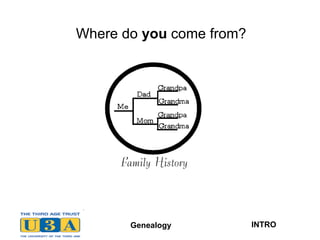
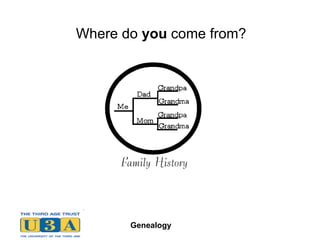
Where do  you  come from? INTRO
U3A The Third Age Trust is the national representative body for the Universities of Third Age (U3As) in the UK.  U3As are self-help, self-managed lifelong learning co-operatives for older people no longer in full time work, providing opportunities for their members to share learning experiences in a wide range of interest groups and to pursue learning not for qualifications, but for fun.
Potential Subjects of Interest FREEBMD and other BMD Records Censuses Parish Records National Burial Index ROOTSWEB The National Archives Wills and Probate Using GOOGLE for research DNA and Genetics in Genealogy Family Search, IGI and BVRI Surnames War and Military records Immigration / Emigration Non-conformist records Adoption Monumental Inscriptions Irish and Scottish records Overcoming brick walls Old Handwriting / transcription Obituaries Trade Directories Genes Reunited Genealogy Software Choices
 
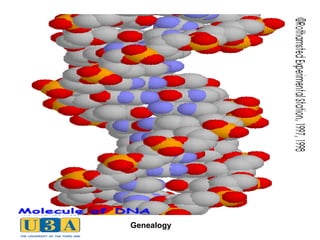
DNA and Chromosomes 22 X chromosome pairs Some characteristics from both parents 23 rd  chromosome determines male or female X + X or X + Y? Y chromosome traces back through the male line largely unchanged Mitochondrial DNA traces back through the female line largely unchanged
Who am I? As they get older, many people start to wonder where they came from, who they came from, and who else followed a similar path… i.e. their relatives, known and unknown……………
For me……… Find out about my families More than names and dates More time to do so later in life Realising I am just a link in the family chain Intellectual challenge in overcoming brick walls
How Many? Remember, you are descended from both your father and mother.  You have two parents  Four grand parents  Eight great grandparents  Sixteen great-great grandparents  Thirty-two great, great, great, grandparents (3g grandparents)  Sixty-four 4g grandparents  One hundred twenty-eight 5g grandparents and so on.  By the time you have gone back ten generations, you will be looking for 1,024 ancestors in this tenth generation.
Do…….. Define your goals Be methodical in your research Get organised…chart, forms, logs, etc Use primary sources where possible Keep track of your sources Be persistent when you hit brick walls Enjoy the discovery process, no matter where it takes you!
Don’t…. Expect any of your ancestors to be royalty or famous Assume Family History research is a simple process Assume everything you find on the internet or someone else’s family tree is correct Expect to find all the information in 1 day Forget your female lines
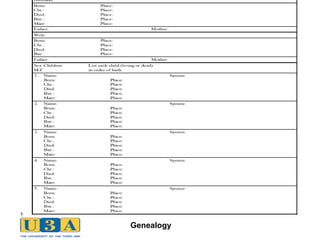
How to Proceed Gather records that you already have   Document what you already know List all of your blood relatives and people who have married into the family Talk to relatives and document what they know Gather records that they have
Existing family history records including: Birth / baptism / marriage / divorce / death / funeral certificates and documents Diaries / Family bibles / photographs /  correspondence / personal possessions School records Call-up records, Service records, medals Newspaper items
How to Proceed Determine how you are going to keep your family history information Start entering the information Broaden the net of informants by joining Genes Reunited Add any information found Move onto central registration documents and census returns
Genes Reunited Website to compare people in your family trees to people in other family trees Find someone who may be “shared”, ask the other people to compare what is known about their equivalent to your information Gain access to their family trees information with their permission
A word of warning With any information obtained from other family researchers, treat it with some suspicion Chinese whispers, misunderstandings, leaps of faith Always try to check the original records, especially where they relate to a key person in your family chain
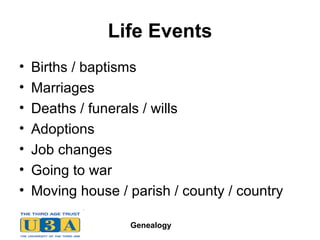
Life Events Births / baptisms Marriages Deaths / funerals / wills Adoptions Job changes Going to war Moving house / parish / county / country
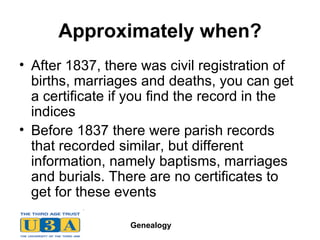
Approximately when? After 1837, there was civil registration of births, marriages and deaths, you can get a certificate if you find the record in the indices Before 1837 there were parish records that recorded similar, but different information, namely baptisms, marriages and burials. There are no certificates to get for these events
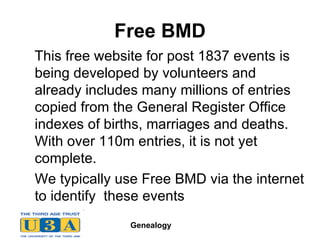
Free BMD   This free website for post 1837 events is being developed by volunteers and already includes many millions of entries copied from the General Register Office indexes of births, marriages and deaths. With over 110m entries, it is not yet complete.  We typically use Free BMD via the internet to identify  these events
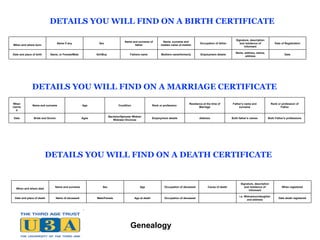
DETAILS YOU WILL FIND ON A MARRIAGE CERTIFICATE DETAILS YOU WILL FIND ON A BIRTH CERTIFICATE DETAILS YOU WILL FIND ON A DEATH CERTIFICATE When married Name and surname Age Condition Rank or profession  Residence at the time of Marriage Father’s name and surname Rank or profession of Father Date Bride and Groom Ages Bachelor/Spinster Widow/Widower Divorcee Employment details Address Both father’s names Both Father’s professions When and where born Name if any Sex Name and surname of father Name, surname and maiden name of mother Occupation of father Signature, description and residence of informant Date of Registration Date and place of birth Name, or Female/Male Girl/Boy Fathers name Mothers name/formerly Employment details Name, address, status, address Date When and where died Name and surname Sex Age Occupation of deceased  Cause of death Signature, description and residence of informant When registered Date and place of death Name of deceased Male/Female Age at death Occupation of deceased   i.e. Widow/son/daughter and address Date death registered
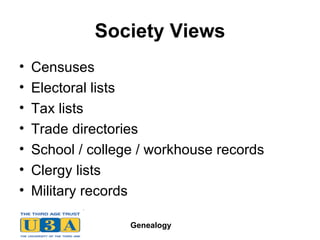
Society Views Censuses Electoral lists Tax lists Trade directories School / college / workhouse records Clergy lists Military records
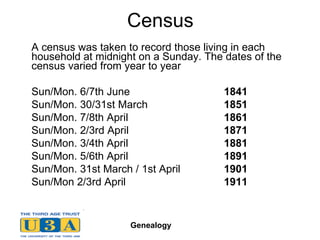
Census A census was taken to record those living in each household at midnight on a Sunday. The dates of the census varied from year to year Sun/Mon. 6/7th June  1841  Sun/Mon. 30/31st March  1851  Sun/Mon. 7/8th April  1861  Sun/Mon. 2/3rd April 1871   Sun/Mon. 3/4th April  1881  Sun/Mon. 5/6th April  1891   Sun/Mon. 31st March / 1st April  1901  Sun/Mon  2/3rd April 1911
 
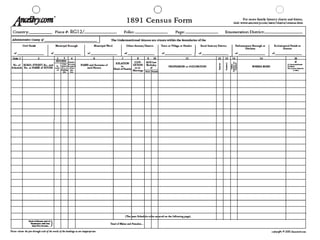
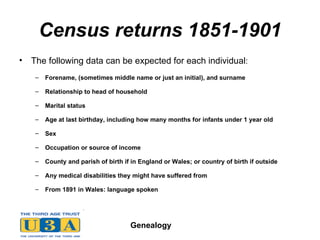
Census returns 1851-1901 The following data can be expected for each individual :  Forename, (sometimes middle name or just an initial), and surname  Relationship to head of household  Marital status  Age at last birthday, including how many months for infants under 1 year old  Sex  Occupation or source of income  County and parish of birth if in England or Wales; or country of birth if outside  Any medical disabilities they might have suffered from  From 1891 in Wales: language spoken
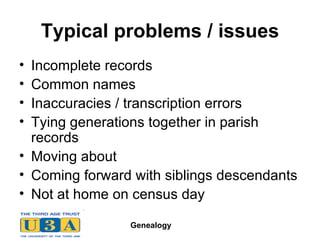
Typical problems / issues Incomplete records Common names Inaccuracies / transcription errors Tying generations together in parish records Moving about Coming forward with siblings descendants Not at home on census day
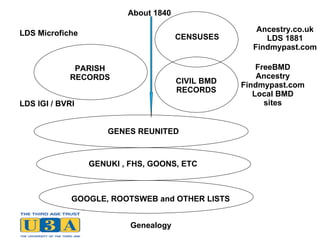
CENSUSES CIVIL BMD RECORDS About 1840 PARISH RECORDS GENES REUNITED GENUKI , FHS, GOONS, ETC GOOGLE, ROOTSWEB and OTHER LISTS Ancestry.co.uk LDS 1881 Findmypast.com FreeBMD Ancestry Findmypast.com Local BMD sites LDS Microfiche LDS IGI / BVRI
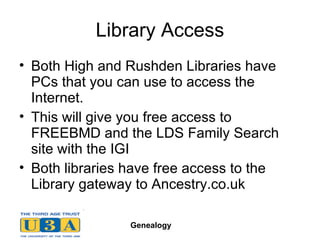
Library Access Both High and Rushden Libraries have PCs that you can use to access the Internet. This will give you free access to FREEBMD and the LDS Family Search site with the IGI Both libraries have free access to the Library gateway to Ancestry.co.uk
 
 
Where do  you  come from?

U3A Genealogy Group introduction

  • 1.
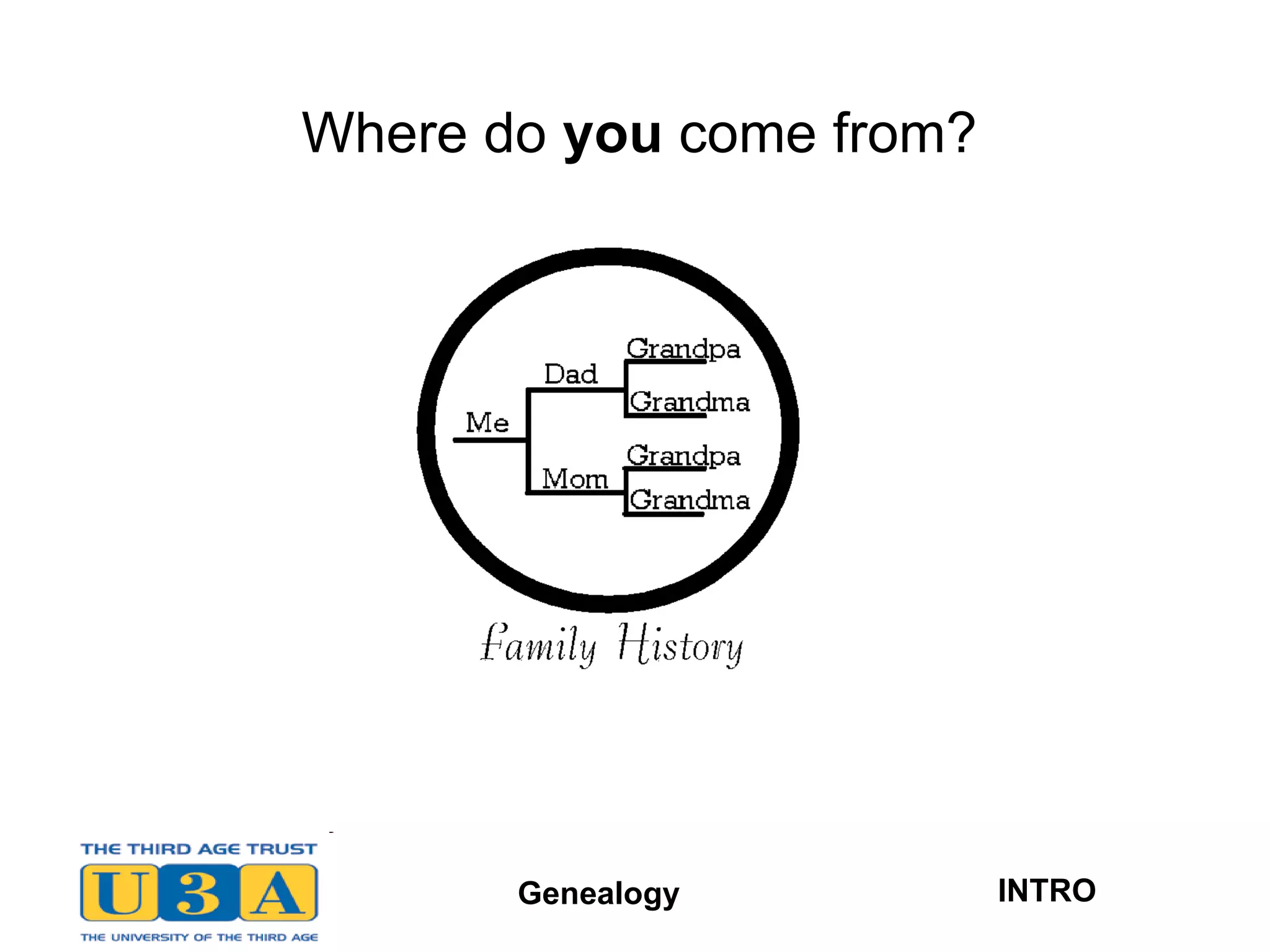
    Where do you come from? INTRO
  • 2.
    U3A The ThirdAge Trust is the national representative body for the Universities of Third Age (U3As) in the UK.  U3As are self-help, self-managed lifelong learning co-operatives for older people no longer in full time work, providing opportunities for their members to share learning experiences in a wide range of interest groups and to pursue learning not for qualifications, but for fun.
  • 3.
    Potential Subjects ofInterest FREEBMD and other BMD Records Censuses Parish Records National Burial Index ROOTSWEB The National Archives Wills and Probate Using GOOGLE for research DNA and Genetics in Genealogy Family Search, IGI and BVRI Surnames War and Military records Immigration / Emigration Non-conformist records Adoption Monumental Inscriptions Irish and Scottish records Overcoming brick walls Old Handwriting / transcription Obituaries Trade Directories Genes Reunited Genealogy Software Choices
  • 4.
  • 5.
    DNA and Chromosomes22 X chromosome pairs Some characteristics from both parents 23 rd chromosome determines male or female X + X or X + Y? Y chromosome traces back through the male line largely unchanged Mitochondrial DNA traces back through the female line largely unchanged
  • 6.
    Who am I?As they get older, many people start to wonder where they came from, who they came from, and who else followed a similar path… i.e. their relatives, known and unknown……………
  • 7.
    For me……… Findout about my families More than names and dates More time to do so later in life Realising I am just a link in the family chain Intellectual challenge in overcoming brick walls
  • 8.
    How Many? Remember,you are descended from both your father and mother. You have two parents Four grand parents Eight great grandparents Sixteen great-great grandparents Thirty-two great, great, great, grandparents (3g grandparents) Sixty-four 4g grandparents One hundred twenty-eight 5g grandparents and so on. By the time you have gone back ten generations, you will be looking for 1,024 ancestors in this tenth generation.
  • 9.
    Do…….. Define yourgoals Be methodical in your research Get organised…chart, forms, logs, etc Use primary sources where possible Keep track of your sources Be persistent when you hit brick walls Enjoy the discovery process, no matter where it takes you!
  • 10.
    Don’t…. Expect anyof your ancestors to be royalty or famous Assume Family History research is a simple process Assume everything you find on the internet or someone else’s family tree is correct Expect to find all the information in 1 day Forget your female lines
  • 11.
    How to ProceedGather records that you already have Document what you already know List all of your blood relatives and people who have married into the family Talk to relatives and document what they know Gather records that they have
  • 12.
    Existing family historyrecords including: Birth / baptism / marriage / divorce / death / funeral certificates and documents Diaries / Family bibles / photographs / correspondence / personal possessions School records Call-up records, Service records, medals Newspaper items
  • 13.
    How to ProceedDetermine how you are going to keep your family history information Start entering the information Broaden the net of informants by joining Genes Reunited Add any information found Move onto central registration documents and census returns
  • 14.
    Genes Reunited Websiteto compare people in your family trees to people in other family trees Find someone who may be “shared”, ask the other people to compare what is known about their equivalent to your information Gain access to their family trees information with their permission
  • 15.
    A word ofwarning With any information obtained from other family researchers, treat it with some suspicion Chinese whispers, misunderstandings, leaps of faith Always try to check the original records, especially where they relate to a key person in your family chain
  • 16.
    Life Events Births/ baptisms Marriages Deaths / funerals / wills Adoptions Job changes Going to war Moving house / parish / county / country
  • 17.
    Approximately when? After1837, there was civil registration of births, marriages and deaths, you can get a certificate if you find the record in the indices Before 1837 there were parish records that recorded similar, but different information, namely baptisms, marriages and burials. There are no certificates to get for these events
  • 18.
    Free BMD  This free website for post 1837 events is being developed by volunteers and already includes many millions of entries copied from the General Register Office indexes of births, marriages and deaths. With over 110m entries, it is not yet complete. We typically use Free BMD via the internet to identify these events
  • 19.
    DETAILS YOU WILLFIND ON A MARRIAGE CERTIFICATE DETAILS YOU WILL FIND ON A BIRTH CERTIFICATE DETAILS YOU WILL FIND ON A DEATH CERTIFICATE When married Name and surname Age Condition Rank or profession Residence at the time of Marriage Father’s name and surname Rank or profession of Father Date Bride and Groom Ages Bachelor/Spinster Widow/Widower Divorcee Employment details Address Both father’s names Both Father’s professions When and where born Name if any Sex Name and surname of father Name, surname and maiden name of mother Occupation of father Signature, description and residence of informant Date of Registration Date and place of birth Name, or Female/Male Girl/Boy Fathers name Mothers name/formerly Employment details Name, address, status, address Date When and where died Name and surname Sex Age Occupation of deceased Cause of death Signature, description and residence of informant When registered Date and place of death Name of deceased Male/Female Age at death Occupation of deceased   i.e. Widow/son/daughter and address Date death registered
  • 20.
    Society Views CensusesElectoral lists Tax lists Trade directories School / college / workhouse records Clergy lists Military records
  • 21.
    Census A censuswas taken to record those living in each household at midnight on a Sunday. The dates of the census varied from year to year Sun/Mon. 6/7th June 1841 Sun/Mon. 30/31st March 1851 Sun/Mon. 7/8th April 1861 Sun/Mon. 2/3rd April 1871 Sun/Mon. 3/4th April 1881 Sun/Mon. 5/6th April 1891 Sun/Mon. 31st March / 1st April 1901 Sun/Mon 2/3rd April 1911
  • 22.
  • 23.
    Census returns 1851-1901The following data can be expected for each individual : Forename, (sometimes middle name or just an initial), and surname Relationship to head of household Marital status Age at last birthday, including how many months for infants under 1 year old Sex Occupation or source of income County and parish of birth if in England or Wales; or country of birth if outside Any medical disabilities they might have suffered from From 1891 in Wales: language spoken
  • 24.
    Typical problems /issues Incomplete records Common names Inaccuracies / transcription errors Tying generations together in parish records Moving about Coming forward with siblings descendants Not at home on census day
  • 25.
    CENSUSES CIVIL BMDRECORDS About 1840 PARISH RECORDS GENES REUNITED GENUKI , FHS, GOONS, ETC GOOGLE, ROOTSWEB and OTHER LISTS Ancestry.co.uk LDS 1881 Findmypast.com FreeBMD Ancestry Findmypast.com Local BMD sites LDS Microfiche LDS IGI / BVRI
  • 26.
    Library Access BothHigh and Rushden Libraries have PCs that you can use to access the Internet. This will give you free access to FREEBMD and the LDS Family Search site with the IGI Both libraries have free access to the Library gateway to Ancestry.co.uk
  • 27.
  • 28.
  • 29.
    Where do you come from?