Steps to conducting family history research


                Organized by: Jessica Shultz


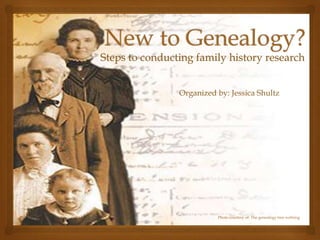
                          Photo courtesy of: The genealogy tree webring
Step 1: Connect with family
          members
                             
 Find out as much background knowledge as you can.
 Gather together all family history sources that exist
  within your personal residences.
  o Sources might include birth certificates, letters and family
    photographs.
 Actively engage in discussion with family members
  concerning family history, especially with elderly family
  members who can provide information on past generations.
  o Record all unknown and known information that is
    communicated. This will assist in present research and to
    preserve the accounts for the future.
Step 2: Organize
                   
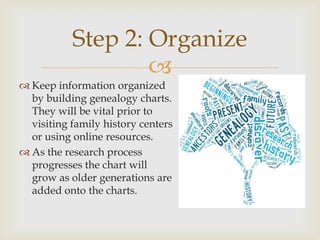
 Keep information organized
  by building genealogy charts.
  They will be vital prior to
  visiting family history centers
  or using online resources.
 As the research process
  progresses the chart will
  grow as older generations are
  added onto the charts.
Step 3: Utilize local resources
                            
 Visit local genealogy centers and archives to get
  additional records such as census, birth, marriage, or
  death.
 The most important information to gather when
  beginning your search are the names of direct
  ancestors, including the maiden names of women, and
  dates and places of birth, marriage and death.
 Also, look for the places your ancestral families lived
  and the names of family members, such as the
  siblings, cousins, aunts and uncles of your
  ancestors, and religious affiliation and military service.
Step 4: Dig deeper. Ask
       distinct questions.
                         
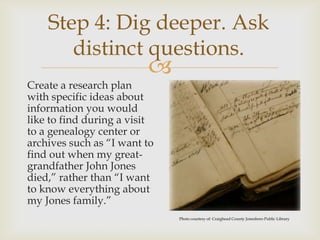
Create a research plan
with specific ideas about
information you would
like to find during a visit
to a genealogy center or
archives such as “I want to
find out when my great-
grandfather John Jones
died,” rather than “I want
to know everything about
my Jones family.”
                              Photo courtesy of: Craighead County Jonesboro Public Library
Resources
                         
 Allen County Public Library Genealogy Center, Fort Wayne , IN
  http://www.genealogycenter.org/Pathfinders/GettingStarted.aspx

 The Genealogy Tree Webring
  http://www.thegenealogytree.com/webrings/about-the-genealogy-tree-
  webring.htm

 Craighead County Jonesboro Public Library, Jonesboro, AR
  http://www.libraryinjonesboro.org/?q=node/21

New to genealogy

  • 1.
    Steps to conductingfamily history research Organized by: Jessica Shultz Photo courtesy of: The genealogy tree webring
  • 2.
    Step 1: Connectwith family members   Find out as much background knowledge as you can.  Gather together all family history sources that exist within your personal residences. o Sources might include birth certificates, letters and family photographs.  Actively engage in discussion with family members concerning family history, especially with elderly family members who can provide information on past generations. o Record all unknown and known information that is communicated. This will assist in present research and to preserve the accounts for the future.
  • 3.
    Step 2: Organize   Keep information organized by building genealogy charts. They will be vital prior to visiting family history centers or using online resources.  As the research process progresses the chart will grow as older generations are added onto the charts.
  • 4.
    Step 3: Utilizelocal resources   Visit local genealogy centers and archives to get additional records such as census, birth, marriage, or death.  The most important information to gather when beginning your search are the names of direct ancestors, including the maiden names of women, and dates and places of birth, marriage and death.  Also, look for the places your ancestral families lived and the names of family members, such as the siblings, cousins, aunts and uncles of your ancestors, and religious affiliation and military service.
  • 5.
    Step 4: Digdeeper. Ask distinct questions.  Create a research plan with specific ideas about information you would like to find during a visit to a genealogy center or archives such as “I want to find out when my great- grandfather John Jones died,” rather than “I want to know everything about my Jones family.” Photo courtesy of: Craighead County Jonesboro Public Library
  • 6.
    Resources   Allen County Public Library Genealogy Center, Fort Wayne , IN http://www.genealogycenter.org/Pathfinders/GettingStarted.aspx  The Genealogy Tree Webring http://www.thegenealogytree.com/webrings/about-the-genealogy-tree- webring.htm  Craighead County Jonesboro Public Library, Jonesboro, AR http://www.libraryinjonesboro.org/?q=node/21