Organization Power &
Structure
Subject- Organization Behavior
Unit-4
BBA-II
2
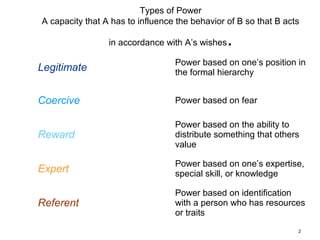
Types of Power
A capacity that A has to influence the behavior of B so that B acts
in accordance with A’s wishes.
Legitimate
Power based on one’s position in
the formal hierarchy
Coercive Power based on fear
Reward
Power based on the ability to
distribute something that others
value
Expert
Power based on one’s expertise,
special skill, or knowledge
Referent
Power based on identification
with a person who has resources
or traits
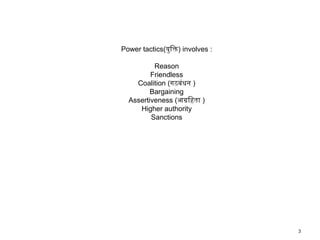
Power tactics(युिक) involves :
Reason
Friendless
Coalition (गठबंधन )
Bargaining
Assertiveness (आगिहता )
Higher authority
Sanctions
3
4
Creating Matrix Organizations
• Matrix Organization
– An organization structure in which
employees are permanently attached to
one department but also simultaneously
have ongoing assignments in which they
report to project, customer, product, or
geographic unit heads.
– The Matrix Structure (ppt 19)
• Used in advertising agencies, aerospace firms,
research and development laboratories,
construction companies, hospitals, and so on.
• The matrix combines two forms of
departmentalization—functional and product.
• The strength of functional departmentalization is
that it puts like specialists together.
5
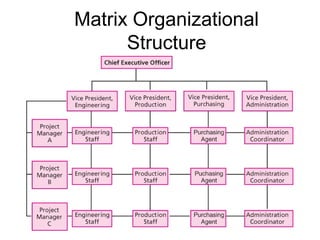
Matrix Organizational Structure
• The matrix organizational structure is one in
which functional and staff personnel are
assigned to both a basic functional area and
to a project or product manager
• The matrix form is intended to make the best
use of talented people within a firm by
combining the advantages of functional
specialization and product-project
specialization
Matrix Organizational
Structure
8
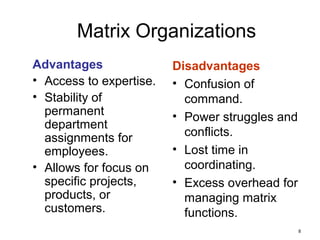
Matrix Organizations
Advantages
• Access to expertise.
• Stability of
permanent
department
assignments for
employees.
• Allows for focus on
specific projects,
products, or
customers.
Disadvantages
• Confusion of
command.
• Power struggles and
conflicts.
• Lost time in
coordinating.
• Excess overhead for
managing matrix
functions.
9
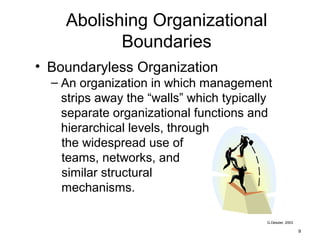
Abolishing Organizational
Boundaries
• Boundaryless Organization
– An organization in which management
strips away the “walls” which typically
separate organizational functions and
hierarchical levels, through
the widespread use of
teams, networks, and
similar structural
mechanisms.
G.Dessler, 2003
– The Boundaryless Organization
• Former General Electric chairman, Jack Welch,
coined the term boundaryless organization to
describe what he wanted GE to become.
– The boundaryless organization seeks to eliminate the
chain of command, have limitless spans of control,
and replace departments with empowered teams.
• By removing vertical boundaries, management
flattens the hierarchy.
– Status and rank are minimized.
– And the organization looks more like a silo than a
pyra-mid.
– Cross-hierarchical teams, participative decision-
making practices, and the use of 360-degree
performance appraisals are examples of what GE is
doing to break down vertical boundaries.
10
• Functional departments create horizontal boundaries.
– Reduce these barriers with cross-functional teams and
organize activities around processes.
– Cut through horizontal barriers using lateral transfers and
rotate people into and out of different functional areas. This
approach turns spe-cialists into generalists.
• When fully operational, the boundaryless organization also
breaks down barriers to external constituencies and barriers
created by geography.
• Globalization, strategic alliances, customer-organization
linkages, and telecommuting are all ex-amples of practices that
reduce external boundaries.
• The one common technological thread that makes the
boundaryless organi-zation possible is networked computers.
– They allow people to communicate across
intraorganizational and interorganizational boundaries.
11
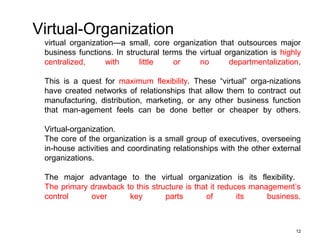
Virtual-Organization
virtual organization—a small, core organization that outsources major
business functions. In structural terms the virtual organization is highly
centralized, with little or no departmentalization.
This is a quest for maximum flexibility. These “virtual” orga-nizations
have created networks of relationships that allow them to contract out
manufacturing, distribution, marketing, or any other business function
that man-agement feels can be done better or cheaper by others.
Virtual-organization.
The core of the organization is a small group of executives, overseeing
in-house activities and coordinating relationships with the other external
organizations.
The major advantage to the virtual organization is its flexibility.
The primary drawback to this structure is that it reduces management’s
control over key parts of its business.
12
13
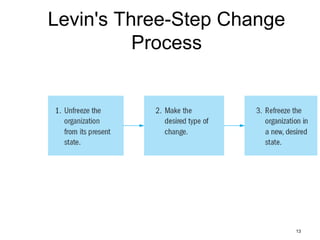
Levin's Three-Step Change
Process
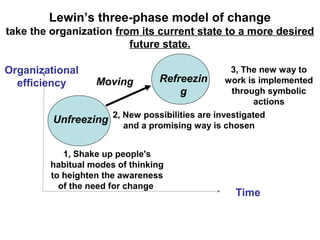
Unfreezing
Refreezin
g
Moving
Time
Organizational
efficiency
2, New possibilities are investigated
and a promising way is chosen
3, The new way to
work is implemented
through symbolic
actions
1, Shake up people's
habitual modes of thinking
to heighten the awareness
of the need for change
Lewin’s three-phase model of change
take the organization from its current state to a more desired
future state.
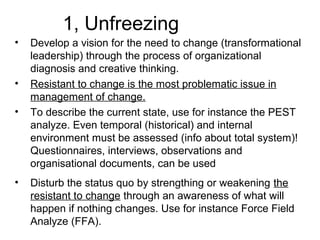
1, Unfreezing
• Develop a vision for the need to change (transformational
leadership) through the process of organizational
diagnosis and creative thinking.
• Resistant to change is the most problematic issue in
management of change.
• To describe the current state, use for instance the PEST
analyze. Even temporal (historical) and internal
environment must be assessed (info about total system)!
Questionnaires, interviews, observations and
organisational documents, can be used
• Disturb the status quo by strengthing or weakening the
resistant to change through an awareness of what will
happen if nothing changes. Use for instance Force Field
Analyze (FFA).
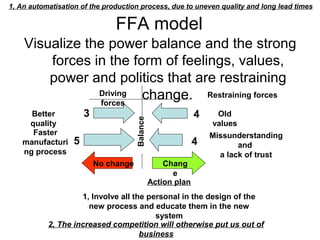
FFA model
Visualize the power balance and the strong
forces in the form of feelings, values,
power and politics that are restraining
change.
Balance
Driving
forces
Restraining forces
Old
values
Missunderstanding
and
a lack of trust
Better
quality
Faster
manufacturi
ng process
1, An automatisation of the production process, due to uneven quality and long lead times
No change Chang
e
3
5
4
4
Action plan
1, Involve all the personal in the design of the
new process and educate them in the new
system
2, The increased competition will otherwise put us out of
business
2, Changing
• A systematic (brainstorming – research)
search for new ideas to take the organization
from its current state to a desired future state
through dialogue with all concerned in order
to create an understanding for the need to
change and to use all ideas and
creativeness of the people involved.
3, Refreezing
• The use of continuous data collection and feedback is
essential to keep track of how the change is
progressing and to monitor for further change in the
light of environmental changes.
• The use of surveys and interviews is one way of
collecting data. (Data to be collected depends on the
situation)
• Symbolic actions, such as change of logo, forms of
dress and ways of grouping people, as well as
leadership could be one way to manifest ”the new way
to work”.

U 4.1 ob bba-ii organization power & structure

  • 1.
    Organization Power & Structure Subject-Organization Behavior Unit-4 BBA-II
  • 2.
    2 Types of Power Acapacity that A has to influence the behavior of B so that B acts in accordance with A’s wishes. Legitimate Power based on one’s position in the formal hierarchy Coercive Power based on fear Reward Power based on the ability to distribute something that others value Expert Power based on one’s expertise, special skill, or knowledge Referent Power based on identification with a person who has resources or traits
  • 3.
    Power tactics(युिक) involves: Reason Friendless Coalition (गठबंधन ) Bargaining Assertiveness (आगिहता ) Higher authority Sanctions 3
  • 4.
    4 Creating Matrix Organizations •Matrix Organization – An organization structure in which employees are permanently attached to one department but also simultaneously have ongoing assignments in which they report to project, customer, product, or geographic unit heads.
  • 5.
    – The MatrixStructure (ppt 19) • Used in advertising agencies, aerospace firms, research and development laboratories, construction companies, hospitals, and so on. • The matrix combines two forms of departmentalization—functional and product. • The strength of functional departmentalization is that it puts like specialists together. 5
  • 6.
    Matrix Organizational Structure •The matrix organizational structure is one in which functional and staff personnel are assigned to both a basic functional area and to a project or product manager • The matrix form is intended to make the best use of talented people within a firm by combining the advantages of functional specialization and product-project specialization
  • 7.
  • 8.
    8 Matrix Organizations Advantages • Accessto expertise. • Stability of permanent department assignments for employees. • Allows for focus on specific projects, products, or customers. Disadvantages • Confusion of command. • Power struggles and conflicts. • Lost time in coordinating. • Excess overhead for managing matrix functions.
  • 9.
    9 Abolishing Organizational Boundaries • BoundarylessOrganization – An organization in which management strips away the “walls” which typically separate organizational functions and hierarchical levels, through the widespread use of teams, networks, and similar structural mechanisms. G.Dessler, 2003
  • 10.
    – The BoundarylessOrganization • Former General Electric chairman, Jack Welch, coined the term boundaryless organization to describe what he wanted GE to become. – The boundaryless organization seeks to eliminate the chain of command, have limitless spans of control, and replace departments with empowered teams. • By removing vertical boundaries, management flattens the hierarchy. – Status and rank are minimized. – And the organization looks more like a silo than a pyra-mid. – Cross-hierarchical teams, participative decision- making practices, and the use of 360-degree performance appraisals are examples of what GE is doing to break down vertical boundaries. 10
  • 11.
    • Functional departmentscreate horizontal boundaries. – Reduce these barriers with cross-functional teams and organize activities around processes. – Cut through horizontal barriers using lateral transfers and rotate people into and out of different functional areas. This approach turns spe-cialists into generalists. • When fully operational, the boundaryless organization also breaks down barriers to external constituencies and barriers created by geography. • Globalization, strategic alliances, customer-organization linkages, and telecommuting are all ex-amples of practices that reduce external boundaries. • The one common technological thread that makes the boundaryless organi-zation possible is networked computers. – They allow people to communicate across intraorganizational and interorganizational boundaries. 11
  • 12.
    Virtual-Organization virtual organization—a small,core organization that outsources major business functions. In structural terms the virtual organization is highly centralized, with little or no departmentalization. This is a quest for maximum flexibility. These “virtual” orga-nizations have created networks of relationships that allow them to contract out manufacturing, distribution, marketing, or any other business function that man-agement feels can be done better or cheaper by others. Virtual-organization. The core of the organization is a small group of executives, overseeing in-house activities and coordinating relationships with the other external organizations. The major advantage to the virtual organization is its flexibility. The primary drawback to this structure is that it reduces management’s control over key parts of its business. 12
  • 13.
  • 14.
    Unfreezing Refreezin g Moving Time Organizational efficiency 2, New possibilitiesare investigated and a promising way is chosen 3, The new way to work is implemented through symbolic actions 1, Shake up people's habitual modes of thinking to heighten the awareness of the need for change Lewin’s three-phase model of change take the organization from its current state to a more desired future state.
  • 15.
    1, Unfreezing • Developa vision for the need to change (transformational leadership) through the process of organizational diagnosis and creative thinking. • Resistant to change is the most problematic issue in management of change. • To describe the current state, use for instance the PEST analyze. Even temporal (historical) and internal environment must be assessed (info about total system)! Questionnaires, interviews, observations and organisational documents, can be used • Disturb the status quo by strengthing or weakening the resistant to change through an awareness of what will happen if nothing changes. Use for instance Force Field Analyze (FFA).
  • 16.
    FFA model Visualize thepower balance and the strong forces in the form of feelings, values, power and politics that are restraining change. Balance Driving forces Restraining forces Old values Missunderstanding and a lack of trust Better quality Faster manufacturi ng process 1, An automatisation of the production process, due to uneven quality and long lead times No change Chang e 3 5 4 4 Action plan 1, Involve all the personal in the design of the new process and educate them in the new system 2, The increased competition will otherwise put us out of business
  • 17.
    2, Changing • Asystematic (brainstorming – research) search for new ideas to take the organization from its current state to a desired future state through dialogue with all concerned in order to create an understanding for the need to change and to use all ideas and creativeness of the people involved.
  • 18.
    3, Refreezing • Theuse of continuous data collection and feedback is essential to keep track of how the change is progressing and to monitor for further change in the light of environmental changes. • The use of surveys and interviews is one way of collecting data. (Data to be collected depends on the situation) • Symbolic actions, such as change of logo, forms of dress and ways of grouping people, as well as leadership could be one way to manifest ”the new way to work”.