Grade 9 Science
Week 1 – Quarter 3
Learning Objectives:
a. describe the different
types of volcanoes and
volcanic eruption;
b. compare the four
types of volcano
according to their
UNLOCKING OF
DIFFICULTIES
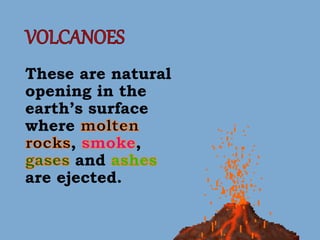
These are natural
opening in the
earth’s surface
where
, ,
and
are ejected.
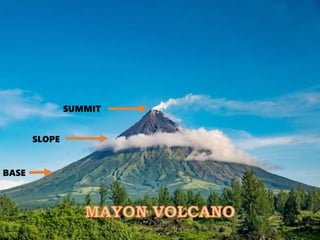
BASE
SLOPE
SUMMIT
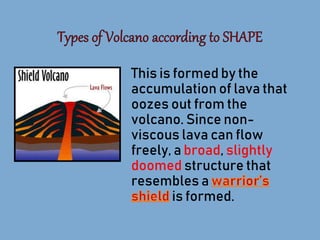
This is formed by the
accumulation of lava that
oozes out from the
volcano. Since non-
viscous lava can flow
freely, a broad, slightly
doomed structure that
resembles a
is formed.
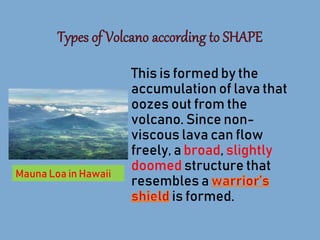
This is formed by the
accumulation of lava that
oozes out from the
volcano. Since non-
viscous lava can flow
freely, a broad, slightly
doomed structure that
resembles a
is formed.
Mauna Loa in Hawaii
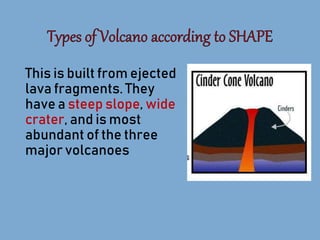
This is built from ejected
lava fragments. They
have a steep slope, wide
crater, and is most
abundant of the three
major volcanoes
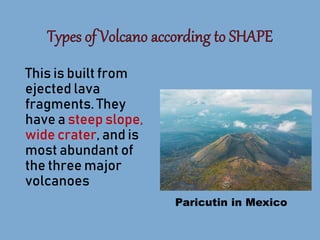
This is built from
ejected lava
fragments. They
have a steep slope,
wide crater, and is
most abundant of
the three major
volcanoes
Paricutin in Mexico
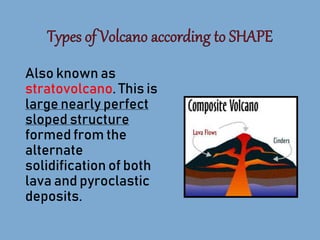
Also known as
stratovolcano. This is
large nearly perfect
sloped structure
formed from the
alternate
solidification of both
lava and pyroclastic
deposits.
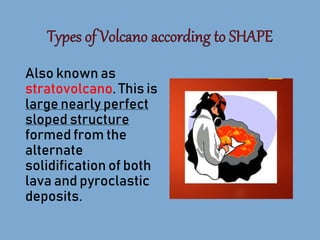
Also known as
stratovolcano. This is
large nearly perfect
sloped structure
formed from the
alternate
solidification of both
lava and pyroclastic
deposits.
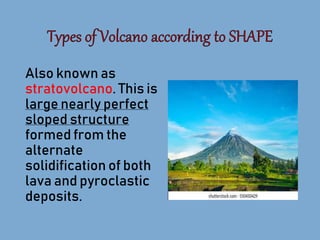
Also known as
stratovolcano. This is
large nearly perfect
sloped structure
formed from the
alternate
solidification of both
lava and pyroclastic
deposits.
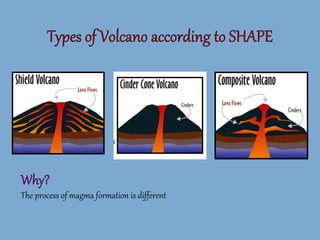
The process of magma formation is different
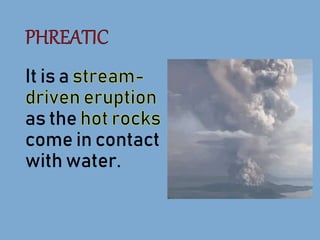
It is a
as the
come in contact
with water.
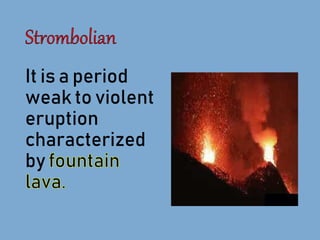
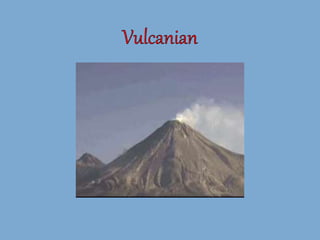
It is a period
weak to violent
eruption
characterized
by
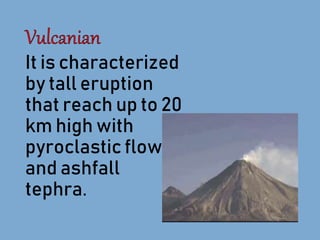
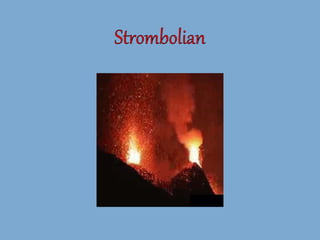
It is characterized
by tall eruption
that reach up to 20
km high with
pyroclastic flow
and ashfall
tephra.
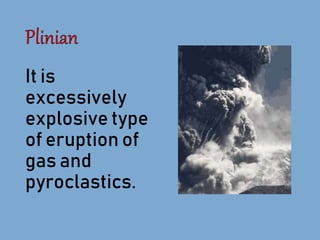
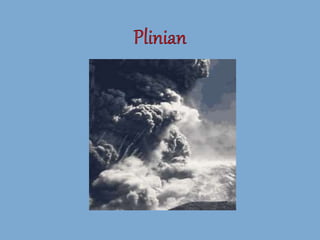
It is
excessively
explosive type
of eruption of
gas and
pyroclastics.
types of volcano according to structures

types of volcano according to structures

  • 1.
    Grade 9 Science Week1 – Quarter 3
  • 2.
    Learning Objectives: a. describethe different types of volcanoes and volcanic eruption; b. compare the four types of volcano according to their
  • 3.
  • 4.
    These are natural openingin the earth’s surface where , , and are ejected.
  • 5.
  • 12.
    This is formedby the accumulation of lava that oozes out from the volcano. Since non- viscous lava can flow freely, a broad, slightly doomed structure that resembles a is formed.
  • 13.
    This is formedby the accumulation of lava that oozes out from the volcano. Since non- viscous lava can flow freely, a broad, slightly doomed structure that resembles a is formed. Mauna Loa in Hawaii
  • 14.
    This is builtfrom ejected lava fragments. They have a steep slope, wide crater, and is most abundant of the three major volcanoes
  • 15.
    This is builtfrom ejected lava fragments. They have a steep slope, wide crater, and is most abundant of the three major volcanoes Paricutin in Mexico
  • 16.
    Also known as stratovolcano.This is large nearly perfect sloped structure formed from the alternate solidification of both lava and pyroclastic deposits.
  • 17.
    Also known as stratovolcano.This is large nearly perfect sloped structure formed from the alternate solidification of both lava and pyroclastic deposits.
  • 18.
    Also known as stratovolcano.This is large nearly perfect sloped structure formed from the alternate solidification of both lava and pyroclastic deposits.
  • 19.
    The process ofmagma formation is different
  • 21.
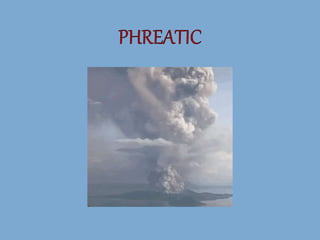
    It is a asthe come in contact with water.
  • 23.
    It is aperiod weak to violent eruption characterized by
  • 24.
    It is characterized bytall eruption that reach up to 20 km high with pyroclastic flow and ashfall tephra.
  • 25.
    It is excessively explosive type oferuption of gas and pyroclastics.

Editor's Notes

  • #2 Good day ! Students,. First of all I want to congratulate everyone because we are now halfway completing grade 9 science. We are now in quarter 3 which is all about earth science. Our first lesson in this quarter is all about the different types of volcano. This is our learning objectives.
  • #3 So listen carefully and keep on watching
  • #4 Before we start let us have some unlocking of difficulties. Let us define some terms that you will encounter let us define what volcano is
  • #6 Have you seen mayon volcano located in albay, bicol, Philippines? Did you know that mayon volcano is one of the world’s most active volcano and it is very popular because of its perfect cone. Volcano has three basic parts namely the base, slope and summit where the crater or opening is located. Speaking of crater
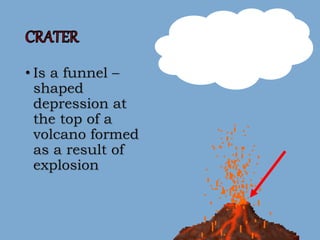
  • #7 It is the mouth or the opening of the volcano.
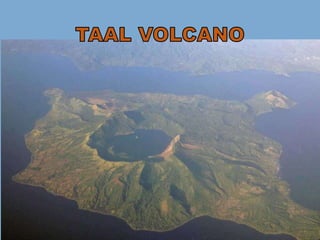
  • #8 Do you know this volcano this is taal volcano located in Batangas, Philippines. This volcano has 47 craters. Amazing ! Right?
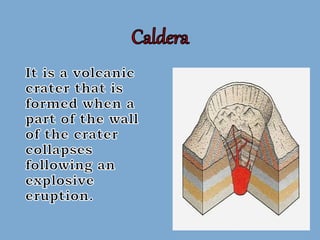
  • #9 A caldera collapse is usually triggered the emptying of the magma chamber beneath the volcano as a result of a large volcanic eruption
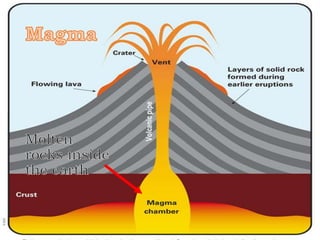
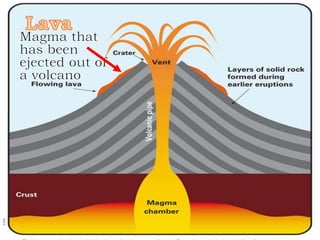
  • #10 When we say magma it a hot fluid or semi fluid material below or within earths crust that is usually made from molten rocks. When the magma ejected out of a volcano it is now called lava.
  • #11 Lava is an Italian word which means to slide which is molten rocks does, once it reaches the surface
  • #12 Now, let us proceed to the different types of volcano, Volcanoes can be classified according to its shape and according to its eruption. Let us have first the types of volcano according to its shape.
  • #13 The first type is shield volcano. That is why it is called shield volcano because it looks like a warrior’s shield
  • #14 Example is Mauna Loa in Hawaii
  • #15 The second type is cinder cone volcano. It is also known as scoria cone
  • #16 Example is mt. Paricutin in Mexico. As you can see it has a steep slope and has a wide crater that are characteristics of a cinder cone
  • #17 Lastly we have composite volcano
  • #18 According to volcanologist or the people who study about volcanoes some of the earth’s grandest mountain are composite or stratovolcano
  • #19 One good example is our very own mayon volcano. And those are the three type of volcano according to its shape.
  • #20 Again we have shield volcano, cinder cone volcano and composite volcano but why do volcanoes have different types it is because the process of magma formation is different at each type of plate boundary, therefore the composition of magma differs in each tectonic setting.
  • #21 Now let us proceed to the types of volcano according to its eruption
  • #22 It is also known as hydrothermal. Phreatic eruption is a type of eruption that happens in taal volcano last January 12, 2020
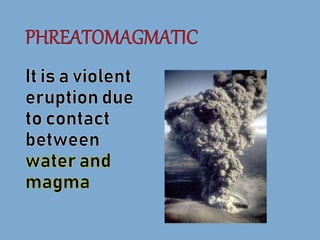
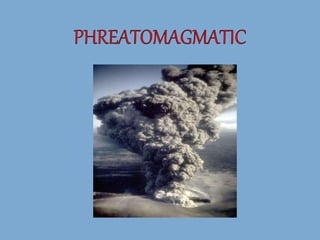
  • #23 Next we have phreatomagmatic. Unlike phreatic that happens because hot rocks come in contact water. Phreatomagmatic eruption happens if there’s an interaction between water and magma. Resulting to a violent fine ash eruption
  • #24 The third is strombolian
  • #26 It is intensely violent kind of eruption that happens to mt. Pinatubo year 1991 again the 5 types of volcanic eruptions are
  • #32 More over we can also classify volcano according to its record of eruption. Active volcano, a volcano is active if it has a record of eruption on the otherside a volcano is inactive if it shows no activity an no record of eruption just like mt. kanlaon in negros occidental, Philippines . We’re going to discuss more about this on our next lesson. To end our lesson we can thank volcanoes for life on earth to put simply volcanoes keep the earth warm and wet which are two critical elements for sustaining life