Presented by:
CRISTY V. GESTA
CONTEN
T
🠶Introduction
🠶Process of volcanic eruption
🠶Types of volcanic eruption
🠶Reasons of volcanic eruption
🠶 Effects of volcanic eruption
🠶 Top 10 deadliest volcanic
eruption
VOLCANIC ERUPTION
🠶A volcano is a mountain where lava (hot, liquid rock) comes
from a magma chamber under the ground. Most volcanoes have
a volcanic crater at the top. When a volcano is active, materials
come out of it. The materials include lava, steam, gaseous
sulfur compounds, ash and broken rock pieces.
🠶When there is enough pressure, it causes the volcano to erupt.
The pressure blows off the top of the volcano. The magma
comes out, sometimes quickly and sometimes slowly.
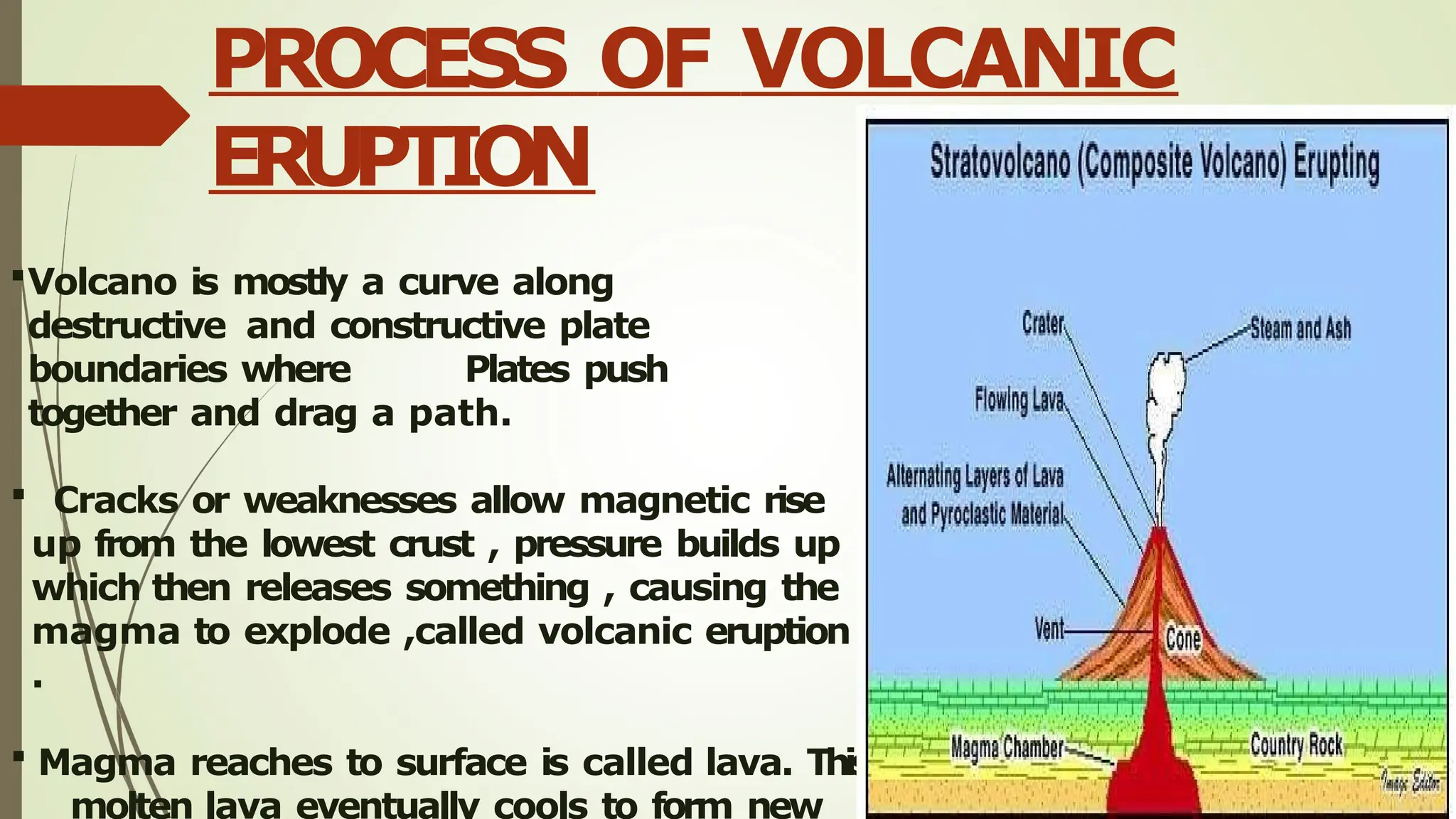
Volcano is mostly a curve along
destructive and constructive plate
boundaries where Plates push
together and drag a path.
 Cracks or weaknesses allow magnetic rise
up from the lowest crust , pressure builds up
which then releases something , causing the
magma to explode ,called volcanic eruption
.
 Magma reaches to surface is called lava. This
molten lava eventually cools to form new
PROCESS OF VOLCANIC
ERUPTION
 After more eruption every time magma
builds up and form the cone shaped
volcano which have the key structure .
 Collection of magma underneath the
volcano forms hot bubbling furnace called
magma chamber.
 The main vent allows this magma to escape
and secondary vents are the small holes from
which the magma can flow .
 The caved in surface is called the crater . I
t
created after Eruption blows the top of the
volcano.
 Eruption occurs when pressure forces magma
Types Of Volcanic Eruption
 Strombolian Eruptions
 Vulcanian Eruptions
 Plinian Eruptions
 Pelean Eruptions
Strombolian Eruptions
🠶These are short meters tall.
🠶Explosive bursts accompanied
by booming sounds.
🠶 Caused by bursting gas
bubbles.
Vulcanian Eruptions
🠶These are much stronger and more
destructive with time.
🠶Their dome gets damaged.
🠶 Leads to a more continuous lava
flow instead of short bursts of lava.
Plinian Eruptions
🠶The most effective of all eruptions
🠶 These eruptions are caused by very
viscous magma with a high gas
content
🠶 Forming tall columns of gas.
🠶These eruptions often occur abruptly,
remaining inactive for centuries.
Pelean Eruptions
🠶It's major damage comes from landslides
of ash flowing slopes at high speeds.
🠶 Plinian Eruption has tall columns of ash
and smoke.
🠶It is almost similar to plinian eruption
REASONS
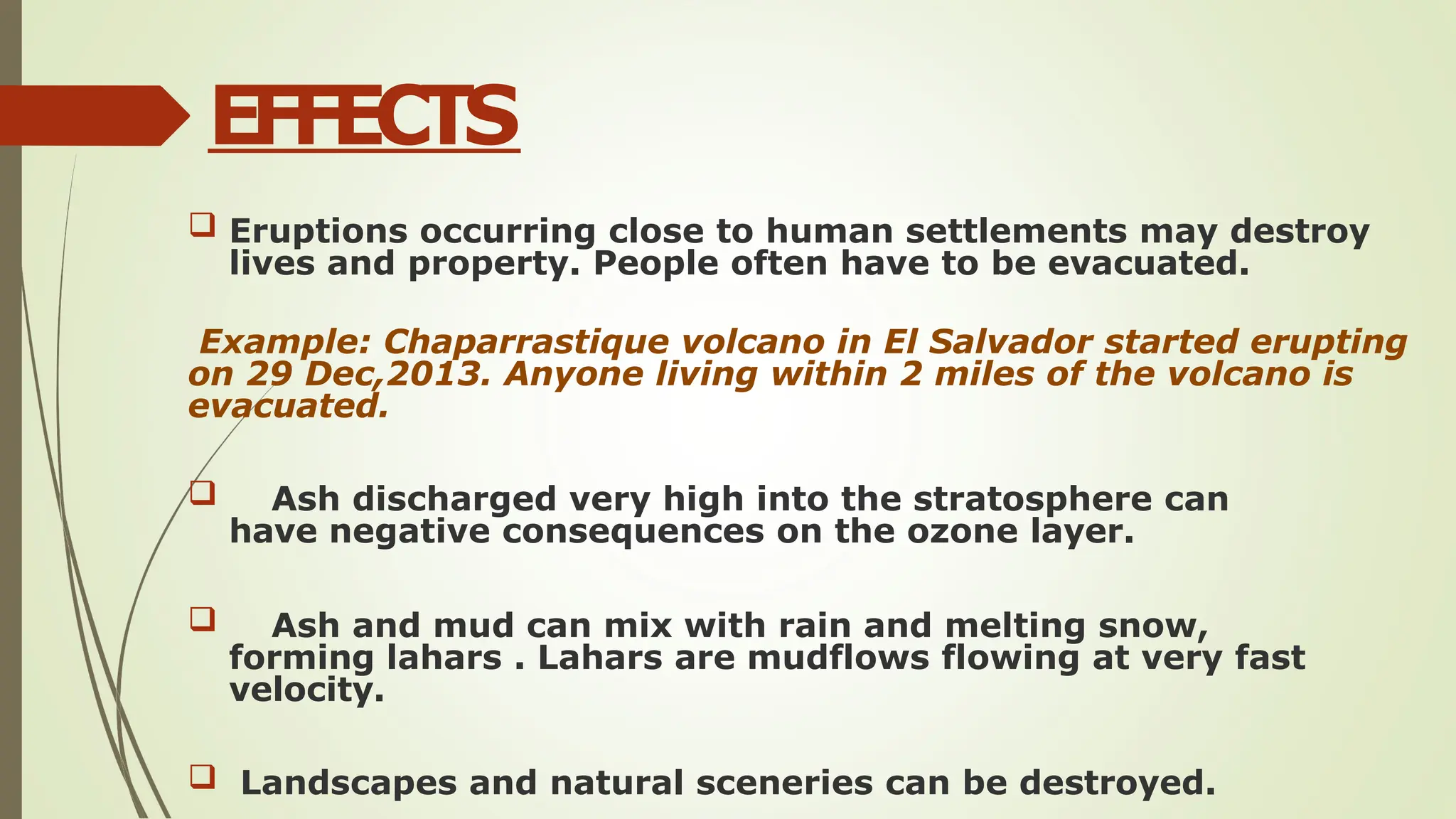
There are three dominating theories to
explain what causes a volcano to erupt –
 Due to Density-difference in Magma
 Pressure of Released Gases
 Injection of New Magma
Due to Density-difference in
Magma
🠶 Due to heat and pressure in the Earth's mantle,
solid rocks melt, to form magma. Magma has the
same mass as the solid rock, but more volume,
making it lighter. So, it will attempt to rise, if this
magma continues to encounter high-density
material till it reaches the Earth's crust, volcanic
eruption occurs. It can either be in the form of a
lava-flow or may be explosive.
Pressure of Released Gases
🠶magma contains dissolved substances such as water,
sulfur dioxide and carbon dioxide. The solubility of
magma decreases with the decrease in pressure as it
rises up towards the crust, and the gases get released
in the form of bubbles. When the volume of the gas
bubbles in magma reaches around 75%, magma
disintegrates into pyroclasts, a mixture of partially
molten and solid fragments. The bursting of pyroclasts
is very explosive and the cause of some of the most
violent eruptions on the surface of Earth.
Injection of New Magma
🠶 when new magma enters a chamber
already overflowing with magma, the
volcano erupts due to the additional
pressure exerted by the injection of
new magma. This type of eruption can
be placid or violent.
EFFECTS
 Eruptions occurring close to human settlements may destroy
lives and property. People often have to be evacuated.
Example: Chaparrastique volcano in El Salvador started erupting
on 29 Dec,2013. Anyone living within 2 miles of the volcano is
evacuated.
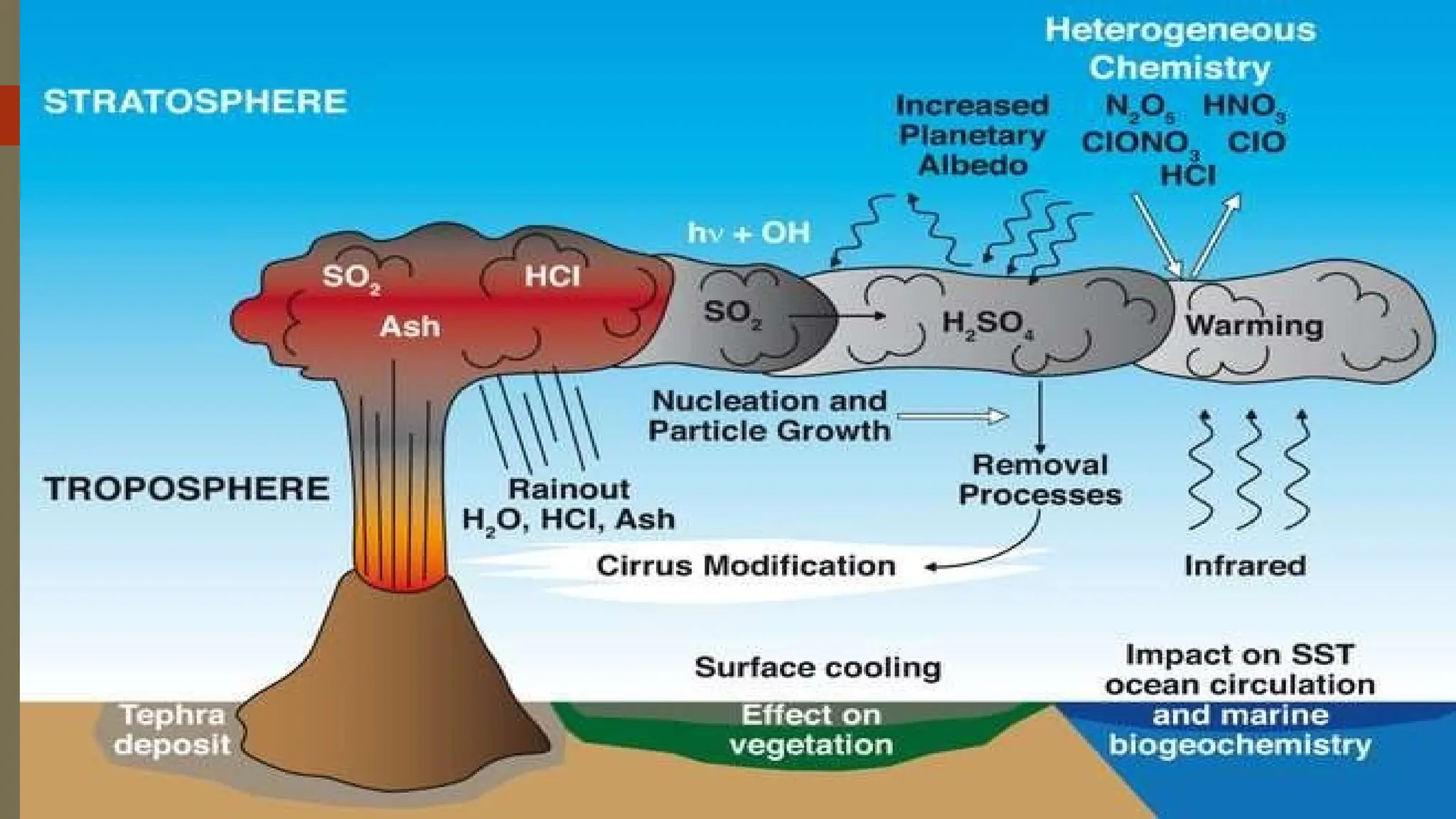
 Ash discharged very high into the stratosphere can
have negative consequences on the ozone layer.
 Ash and mud can mix with rain and melting snow,
forming lahars . Lahars are mudflows flowing at very fast
velocity.
 Landscapes and natural sceneries can be destroyed.
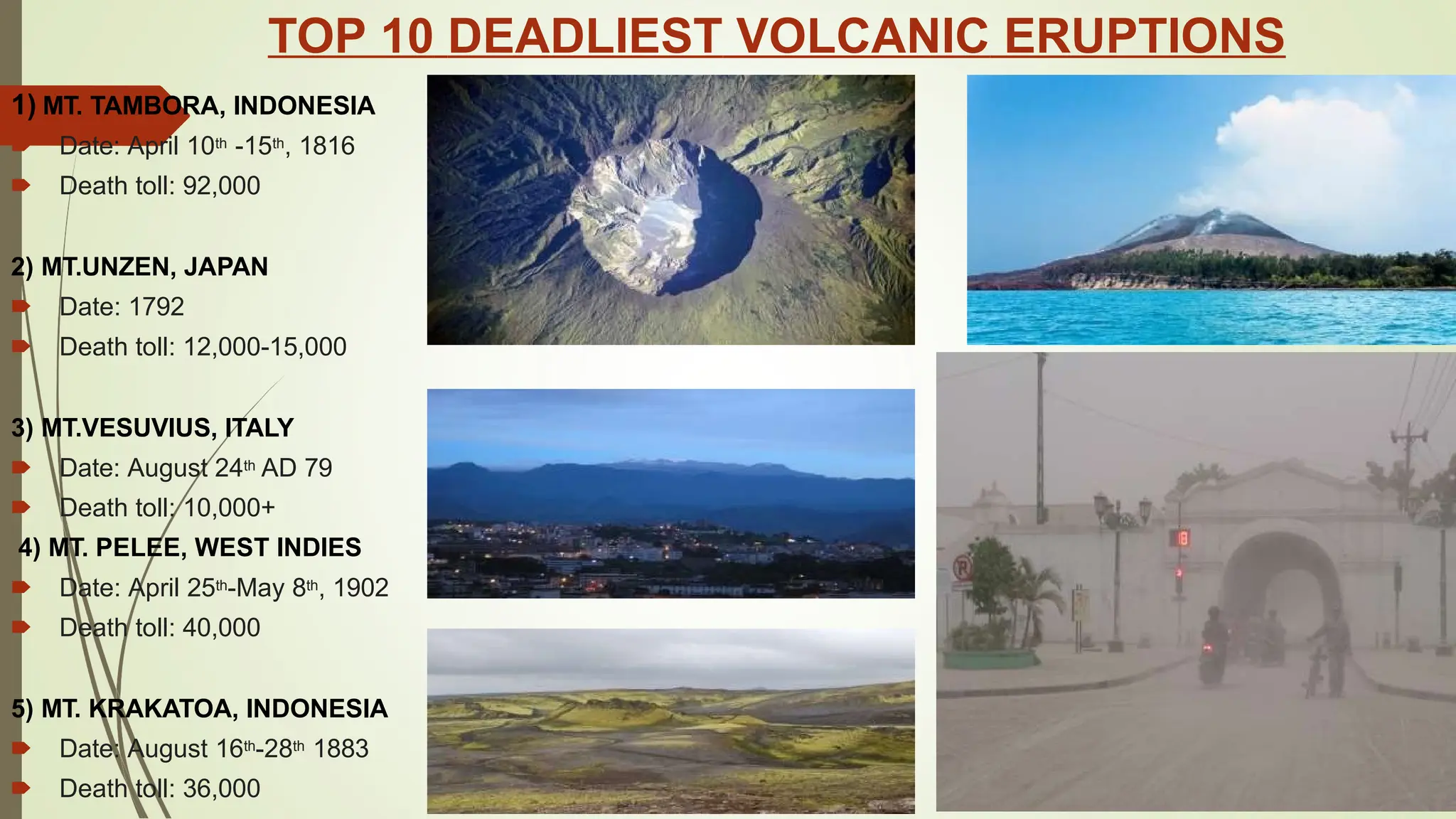
TOP 10 DEADLIEST VOLCANIC ERUPTIONS
1) MT. TAMBORA, INDONESIA
🠶 Date: April 10th -15th, 1816
🠶 Death toll: 92,000
2) MT.UNZEN, JAPAN
🠶 Date: 1792
🠶 Death toll: 12,000-15,000
3) MT.VESUVIUS, ITALY
🠶 Date: August 24th AD 79
🠶 Death toll: 10,000+
4) MT. PELEE, WEST INDIES
🠶 Date: April 25th-May 8th, 1902
🠶 Death toll: 40,000
5) MT. KRAKATOA, INDONESIA
🠶 Date: August 16th-28th 1883
🠶 Death toll: 36,000
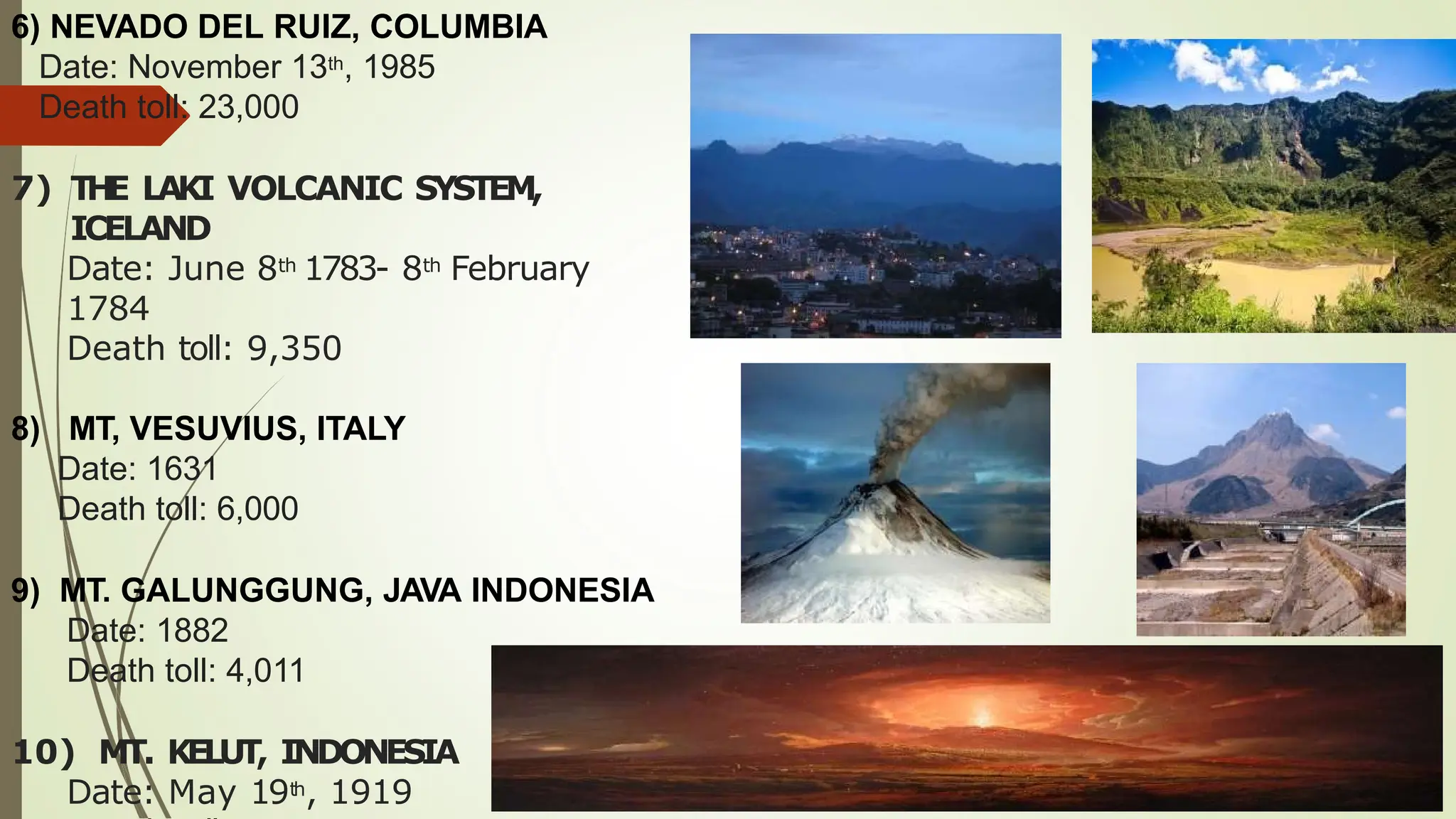
6) NEVADO DEL RUIZ, COLUMBIA
Date: November 13th, 1985
Death toll: 23,000
7) TH
E LAKI VOLCANIC SYSTEM,
ICELAND
Date: June 8th 1783- 8th February
1784
Death toll: 9,350
8) MT, VESUVIUS, ITALY
Date: 1631
Death toll: 6,000
9) MT. GALUNGGUNG, JAVA INDONESIA
Date: 1882
Death toll: 4,011
10) MT. KELUT, INDONESIA
Date: May 19th, 1919
SAFETY
T
I
P
S
🠶 Stay away from active volcanoes.
🠶 If you live near an active volcano, keep goggles and a
mask in an emergency kit, along with a flashlight .
🠶 Know your evacuation route. Keep gas in your car
🠶Before you leave the house, change into long-
sleeved shirts and long pants.
🠶 If you are not evacuating, close windows and doors
and block chimneys and other vents, to prevent ash
from coming into the house.
CONCLUSION
We need to understand about volcanoes, structure
of volcanoes, types of volcanoes to reduce the
negative impact of volcano eruptions and take
advantage of its benefits on people and
environment.Vulcanologists and Geologists conduct
research and recommend preventive measures.
We must follow the preventive measures to reduce
danger to life.
REFERENC
E
🠶http://www.buzzle.com/articles/volcanic-eruptions-what-
causes-volcanoes-to-erupt.html
🠶http://eschooltoday.com/volcanoes/effects-of-
volcanic-eruptions.html
🠶http://environment.nationalgeographic.com/envir
onment/natural-disasters/volcano-safety-tips/
🠶http://www.heritagedaily.com/2014/08/top-10-
deadliest-volcanic-eruptions/104313
Explain what happens when volcanoes erupt ppt.pptx

Explain what happens when volcanoes erupt ppt.pptx

  • 1.
  • 2.
    CONTEN T 🠶Introduction 🠶Process of volcaniceruption 🠶Types of volcanic eruption 🠶Reasons of volcanic eruption 🠶 Effects of volcanic eruption 🠶 Top 10 deadliest volcanic eruption
  • 3.
    VOLCANIC ERUPTION 🠶A volcanois a mountain where lava (hot, liquid rock) comes from a magma chamber under the ground. Most volcanoes have a volcanic crater at the top. When a volcano is active, materials come out of it. The materials include lava, steam, gaseous sulfur compounds, ash and broken rock pieces. 🠶When there is enough pressure, it causes the volcano to erupt. The pressure blows off the top of the volcano. The magma comes out, sometimes quickly and sometimes slowly.
  • 4.
    Volcano is mostlya curve along destructive and constructive plate boundaries where Plates push together and drag a path.  Cracks or weaknesses allow magnetic rise up from the lowest crust , pressure builds up which then releases something , causing the magma to explode ,called volcanic eruption .  Magma reaches to surface is called lava. This molten lava eventually cools to form new PROCESS OF VOLCANIC ERUPTION
  • 5.
     After moreeruption every time magma builds up and form the cone shaped volcano which have the key structure .  Collection of magma underneath the volcano forms hot bubbling furnace called magma chamber.  The main vent allows this magma to escape and secondary vents are the small holes from which the magma can flow .  The caved in surface is called the crater . I t created after Eruption blows the top of the volcano.  Eruption occurs when pressure forces magma
  • 6.
    Types Of VolcanicEruption  Strombolian Eruptions  Vulcanian Eruptions  Plinian Eruptions  Pelean Eruptions
  • 7.
    Strombolian Eruptions 🠶These areshort meters tall. 🠶Explosive bursts accompanied by booming sounds. 🠶 Caused by bursting gas bubbles.
  • 8.
    Vulcanian Eruptions 🠶These aremuch stronger and more destructive with time. 🠶Their dome gets damaged. 🠶 Leads to a more continuous lava flow instead of short bursts of lava.
  • 9.
    Plinian Eruptions 🠶The mosteffective of all eruptions 🠶 These eruptions are caused by very viscous magma with a high gas content 🠶 Forming tall columns of gas. 🠶These eruptions often occur abruptly, remaining inactive for centuries.
  • 10.
    Pelean Eruptions 🠶It's majordamage comes from landslides of ash flowing slopes at high speeds. 🠶 Plinian Eruption has tall columns of ash and smoke. 🠶It is almost similar to plinian eruption
  • 11.
    REASONS There are threedominating theories to explain what causes a volcano to erupt –  Due to Density-difference in Magma  Pressure of Released Gases  Injection of New Magma
  • 12.
    Due to Density-differencein Magma 🠶 Due to heat and pressure in the Earth's mantle, solid rocks melt, to form magma. Magma has the same mass as the solid rock, but more volume, making it lighter. So, it will attempt to rise, if this magma continues to encounter high-density material till it reaches the Earth's crust, volcanic eruption occurs. It can either be in the form of a lava-flow or may be explosive.
  • 13.
    Pressure of ReleasedGases 🠶magma contains dissolved substances such as water, sulfur dioxide and carbon dioxide. The solubility of magma decreases with the decrease in pressure as it rises up towards the crust, and the gases get released in the form of bubbles. When the volume of the gas bubbles in magma reaches around 75%, magma disintegrates into pyroclasts, a mixture of partially molten and solid fragments. The bursting of pyroclasts is very explosive and the cause of some of the most violent eruptions on the surface of Earth.
  • 14.
    Injection of NewMagma 🠶 when new magma enters a chamber already overflowing with magma, the volcano erupts due to the additional pressure exerted by the injection of new magma. This type of eruption can be placid or violent.
  • 15.
    EFFECTS  Eruptions occurringclose to human settlements may destroy lives and property. People often have to be evacuated. Example: Chaparrastique volcano in El Salvador started erupting on 29 Dec,2013. Anyone living within 2 miles of the volcano is evacuated.  Ash discharged very high into the stratosphere can have negative consequences on the ozone layer.  Ash and mud can mix with rain and melting snow, forming lahars . Lahars are mudflows flowing at very fast velocity.  Landscapes and natural sceneries can be destroyed.
  • 17.
    TOP 10 DEADLIESTVOLCANIC ERUPTIONS 1) MT. TAMBORA, INDONESIA 🠶 Date: April 10th -15th, 1816 🠶 Death toll: 92,000 2) MT.UNZEN, JAPAN 🠶 Date: 1792 🠶 Death toll: 12,000-15,000 3) MT.VESUVIUS, ITALY 🠶 Date: August 24th AD 79 🠶 Death toll: 10,000+ 4) MT. PELEE, WEST INDIES 🠶 Date: April 25th-May 8th, 1902 🠶 Death toll: 40,000 5) MT. KRAKATOA, INDONESIA 🠶 Date: August 16th-28th 1883 🠶 Death toll: 36,000
  • 18.
    6) NEVADO DELRUIZ, COLUMBIA Date: November 13th, 1985 Death toll: 23,000 7) TH E LAKI VOLCANIC SYSTEM, ICELAND Date: June 8th 1783- 8th February 1784 Death toll: 9,350 8) MT, VESUVIUS, ITALY Date: 1631 Death toll: 6,000 9) MT. GALUNGGUNG, JAVA INDONESIA Date: 1882 Death toll: 4,011 10) MT. KELUT, INDONESIA Date: May 19th, 1919
  • 19.
    SAFETY T I P S 🠶 Stay awayfrom active volcanoes. 🠶 If you live near an active volcano, keep goggles and a mask in an emergency kit, along with a flashlight . 🠶 Know your evacuation route. Keep gas in your car 🠶Before you leave the house, change into long- sleeved shirts and long pants. 🠶 If you are not evacuating, close windows and doors and block chimneys and other vents, to prevent ash from coming into the house.
  • 20.
    CONCLUSION We need tounderstand about volcanoes, structure of volcanoes, types of volcanoes to reduce the negative impact of volcano eruptions and take advantage of its benefits on people and environment.Vulcanologists and Geologists conduct research and recommend preventive measures. We must follow the preventive measures to reduce danger to life.
  • 21.