Chapter 12
Organization and Outlines
Speech is power; speech is to persuade, to convert, to compel.
Ralph Waldo Emerson
Getting Started
In earlier stages of preparation for a speech, you have gained a
good idea of who your audience is and what information you
want to focus on. This chapter will help you consider how to
organize the information to cover your topic. You may be
tempted to think that you know enough about your topic that
you can just “wing it” or go “freestyling.” Your organization
might be something like this: “First, I’ll talk about this, then
I’ll give this example, and I’ll wrap it up with this.” While
knowledge on your topic is key to an effective speech, do not
underestimate the importance of organization. You may start to
give your speech thinking you’ll follow the “outline” in your
mind, and then suddenly your mind will go blank. If it doesn’t
go blank, you may finish what was planned as a five-minute
speech with three minutes remaining, sit down, and then start to
remember all the things you intended to say but didn’t.
Organization in your speech is helpful both to you and to your
audience. Your audience will appreciate hearing the information
presented in an organized way, and being well organized will
make the speaking situation much less stressful for you. You
might forget a point and be able to glance at your outline and
get back on track. Your listeners will see that you took your
responsibility as a speaker seriously and will be able to listen
more attentively. They’ll be able to link your key points in their
minds, and the result will be a more effective speech.
An extemporaneous speech involves flexibility and
organization. You know your material. You are prepared and
follow an outline. You do not read a script or PowerPoint
presentation, you do not memorize every single word in order
(though some parts may be memorized), but you also do not
make it up as you go along. Your presentation is scripted in the
sense that it is completely planned from start to finish, yet
every word is not explicitly planned, allowing for some
spontaneity and adaptation to the audience’s needs in the
moment. This extemporaneous approach is the most common
form used in business and industry today.
Your organization plan will serve you and your audience as a
guide, and help you present a more effective speech. If you are
concerned with grades, it will no doubt help you improve your
score as well. If you work in a career where your “grades” are
sales, and a sales increase means getting an “A,” then your
ability to organize will help you make the grade. Just as there is
no substitute for practice and preparation, there is no substitute
for organization and an outline when you need it the most: on
stage. Do yourself and the audience a favor and create an
outline with an organization pattern that best meets your needs.
In the 1991 film What about Bob? a psychiatrist presents the
simple idea to the patient, played by actor Bill Murray. If the
patient takes whatever he needs to do step by step, the process
he once perceived as complex becomes simple. In this same
way, your understanding of giving business presentations will
develop step by step, as the process and its important elements
unfold. Read and reflect on how each area might influence your
speech, how it might involve or impact your audience, and how
your purpose guides your strategies as you plan your speech.
If you take it step by step, presenting a speech can be an
exhilarating experience not unlike winning a marathon or
climbing a high peak. Every journey begins with a first step,
and in terms of communication, you’ve already taken countless
steps in your lifetime. Now we’ll take the next step and begin to
analyze the process of public speaking.
12.1 Rhetorical Situation
LEARNING OBJECTIVE
1. Label and discuss the three main components of the rhetorical
situation.
In the classical tradition, the art of public speaking is called
rhetoric; the circumstances in which you give your speech or
presentation are the rhetorical situation. By understanding the
rhetorical situation, you can gauge the best ways to reach your
listeners and get your points across. In so doing, you’ll make
the transition from your viewpoint to that of your audience
members. Remember that without an audience to listen and
respond to you, it’s really not much of a speech. The audience
gives you the space and time as a speaker to fulfill your role
and, hopefully, their expectations. Just as a group makes a
leader, an audience makes a speaker. By looking to your
audience, you shift your attention from an internal focus (you)
to an external (them/others) emphasis. This “other-orientation”
is key to your success as an effective speaker.
Several of the first questions any audience member asks himself
or herself are, “Why should I listen to you?” “What does what
you are saying have to do with me?” and “How does this help
me?” We communicate through the lens of personal experience
and it’s only natural that we would relate what others say to our
own needs and wants, but by recognizing that we share in our
humanity many of the same basic motivations, we can find
common ground of mutual interest. Generating interest in your
speech is only the first step as you guide perception through
selection, organization, and interpretation of content and ways
to communicate your point. Your understanding of the
rhetorical situation will guide you as you plan how to employ
various strategies to guide your listeners as they perceive and
interpret your message. Your awareness of the overall process
of building a speech will allow you to take it step by step and
focus on the immediate task at hand.
The rhetorical situation involves three elements: the set of
expectations inherent in the context, audience, and the purpose
of your speech or presentation.[1] This means you need to
consider, in essence, the “who, what, where, when, why, and
how” of your speech from the audience’s perspective.
Context
As we consider the rhetorical situation, we need to explore the
concept in depth. Your speech is not given in a space that has
no connection to the rest of the world. If you are going to be
presenting a speech in class, your context will be the familiar
space of your classroom. Other contexts might include a
business conference room, a restaurant where you are the
featured speaker for a dinner meeting, or a podium that has been
set up outdoors for a sports award ceremony.
The time of your speech will relate to people’s natural patterns
of behavior. If you give a speech right after lunch, you can
expect people to be a bit sleepy. Knowing this, you can take
steps to counter this element of the context by making your
presentation especially dynamic, such as having your audience
get up from their seats or calling on them to answer questions at
various points in your speech.
You can also place your topic within the frame of reference of
current events. If you are presenting a speech on the importance
of access to health care for everyone, and you are presenting it
in October of an election year, the current events that exist
outside your speech may be used to enhance it. Your listeners
might be very aware of the political climate, and relating your
topic to a larger context may effectively take into consideration
the circumstances in which your readers will use, apply, or
contemplate your information.
Audience
The receiver (i.e., listener or audience) is one of the basic
components of communication. Without a receiver, the source
(i.e., the speaker) has only himself or herself in which to send
the message. By extension, without an audience you can’t have
a speech. Your audience comes to you with expectations, prior
knowledge, and experience. They have a purpose that makes
them part of the audience instead of outside playing golf. They
have a wide range of characteristics like social class, gender,
age, race and ethnicity, cultural background, and language that
make them unique and diverse. What kind of audience will you
be speaking to? What do you know about their expectations,
prior knowledge or backgrounds, and how they plan to use your
information? Giving attention to this aspect of the rhetorical
situation will allow you to gain insight into how to craft your
message before you present it.
Purpose
A speech or oral presentation may be designed to inform,
demonstrate, persuade, motivate, or even entertain. You may
also overlap by design and both inform and persuade. The
purpose of your speech is central to its formation. You should
be able to state your purpose in one sentence or less, much like
an effective thesis statement in an essay. You also need to
consider alternate perspectives, as we’ve seen previously in this
chapter. Your purpose may be to persuade, but the audience
after lunch may want to be entertained, and your ability to adapt
can make use of a little entertainment that leads to persuasion.
[1] Kostelnick, C., & Roberts, D. (1998). Designing visual
language: Strategies for professional communicators. Needham
Heights, MA: Allyn & Bacon.
12.2 Strategies for Success
LEARNING OBJECTIVE
1. Identify and provide examples of at least five of the nine
basic cognate strategies in communication.
Given the diverse nature of audiences, the complexity of the
communication process, and the countless options and choices
to make when preparing your speech, you may feel
overwhelmed. One effective way to address this is to focus on
ways to reach, interact, or stimulate your audience. Humans
share many of the same basic needs, and meeting those needs
provides various strategies for action.
Charles Kostelnick and David Roberts outline
several cognate strategies, or ways of framing, expressing, and
representing a message to an audience, in Designing Visual
Language: Strategies for Professional Communicators.[1] The
word “cognate” refers to knowledge, and these strategies are
techniques to impart knowledge to your audience. Kostelnick
and Roberts’s strategies are cross-disciplinary in that they can
be applied to writing, graphic design, and verbal
communication. They help the writer, designer, or speaker
answer questions like “Does the audience understand how I’m
arranging my information?” “Am I emphasizing my key points
effectively?” and “How does my expression and representation
of information contribute to a relationship with the audience?”
They can serve you to better anticipate and meet your
audience’s basic needs.
Aristotle outlined three main forms of rhetorical proof: ethos,
logos, and pathos. Ethos involves the speaker’s character and
expertise. Logos is the logic of the speaker’s presentation—
something that will be greatly enhanced by a good
organizational plan. Aristotle discussed pathos as the use of
emotion as a persuasive element in the speech,[2] or “the
arousing of emotions in the audience.” We don’t always make
decisions based on clear thinking. Sometimes we are moved by
words, by a scene in a movie, or by other mediated forms of
communication. As the speaker, you may create a message by
selecting some aspects and rejecting others. A close-up picture
of a child starving to death can capture attention and arouse
emotions. If you use pathos in a strategic way, you are
following Aristotle’s notion of rhetorical proof as the available
means of persuasion. If logic and expertise don’t move the
audience, a tragic picture may do so.
The cognate strategies are in many ways expressions of these
three elements, but by focusing on individual characteristics,
can work towards being more effective in their preparation and
presentation. Many of these strategies build on basic ideas of
communication, such as verbal and nonverbal delivery. By
keeping that in mind, you’ll be more likely to see the
connections and help yourself organize your presentation
effectively.
Here we adapt and extend Kostelnick and Roberts’ strategies in
order to highlight ways to approach the preparation and
presentation of your message. Across the cognate strategies, we
can see Aristotle’s rhetorical elements through a range of
strategies to communicate better with our audience. There is a
degree of overlap, and many of the strategies draw on related
elements, but by examining each strategy as a technique for
engaging your audience, you can better craft your message to
meet their expectations.
Tone
From the choice of your words, to the choice of your dress, you
contribute to the tone of the speech. Tone, or the general
manner of expression of the message, will contribute to the
context of the presentation. First, consider your voice. Is it
relaxed, or shaky and nervous? Your voice is like a musical
instrument that, when played expressively, fulfills a central role
in your ability to communicate your message to your audience.
Next consider how your tone is expressed through your body
language. Are your arms straight down at your sides, or crossed
in front of you, or are they moving in a natural flow to the
rhythm and cadence of your speech? Your dress, your use of
space, and the degree to which you are comfortable with
yourself will all play a part in the expression of your message.
Emphasis
If everyone speaks at the same time, it’s hard for anyone to
listen. In the same way, if all your points are equally presented,
it can be hard to distinguish one from another, or to focus on
the points that are most important. As the speaker, you need to
consider how you place emphasis—stress, importance, or
prominence—on some aspects of your speech, and how you
lessen the impact of others. Perhaps you have a visual aid to
support your speech in the form of a visually arresting picture.
Imagine that you want to present a persuasive speech on
preventing skin cancer and you start with a photo of two people
wearing very little clothing. While the image may capture
attention, clearly placing emphasis on skin, it may prove to be
more of a distraction than an addition. Emphasis as a cognate
strategy asks you to consider relevance, and the degree to which
your focal point of attention contributes to or detracts from your
speech. You will need to consider how you link ideas through
transitions, how you repeat and rephrase, and how you place
your points in hierarchical order to address the strategy of
emphasis in your presentation.
Engagement
Before you start thinking about weddings, consider what key
element is necessary for one to occur? If you guessed a
relationship you were correct. Just as a couple forms an
interpersonal relationship, the speaker forms a relationship with
the audience members. Eye contact can be an engaging aspect of
this strategy, and can help you form a connection—an
engagement—with individual audience members. Looking at the
floor or ceiling may not display interest to the audience.
Engagement strategies develop the relationship with the
audience, and you will need to consider how your words,
visuals, and other relevant elements of your speech help this
relationship grow.
Clarity
As a speaker, you may have excellent ideas to present, but if
they are not made clear to the audience, your speech will be a
failure. “Clarity strategies help the receiver (audience) to
decode the message, to understand it quickly and completely,
and when necessary, to react without ambivalence.”[3] Your
word choices, how you say them, and in what order all relate to
clarity. If you use euphemisms, or indirect expressions, to
communicate a delicate idea, your audience may not follow you.
If you use a story, or an arresting image, and fail to connect it
clearly to your main point or idea, your audience will also fail
to see the connection. Depending on the rhetorical situation, the
use of jargon may clarify your message or confuse your
audience. You’ll also need to consider the visual elements of
your presentation and how they clarify your information. Is the
font sufficiently large on your PowerPoint slide to be read in
the back of the room? Is your slide so packed with words that
they key ideas are lost in a noise of text? Will it be clear to
your listeners how your pictures, motion clips, or audio files
relate to topic?
Conciseness
Being clear is part of being concise. Conciseness refers to being
brief and direct in the visual and verbal delivery of your
message, and avoiding unnecessary intricacy. It involves using
as many words as necessary to get your message across, and no
more. If you only have five to seven minutes, how will you
budget your time? Being economical with your time is a
pragmatic approach to insuring that your attention, and the
attention of your audience, is focused on the point at hand.
Arrangement
As the speaker, you will gather and present information in some
form. How that form follows the function of communicating
your message involves strategically grouping information.
“Arrangement means order, the organization of visual (and
verbal) elements[4] “in ways that allow the audience to
correctly interpret the structure, hierarchy, and relationships
among points of focus in your presentation. We will discuss the
importance of hierarchy, and which point comes first and last,
as we explore arguments and their impact on the perception of
your message.
Credibility
Here we can clearly see Aristotle’s ethos—character and
expertise. You will naturally develop a relationship with your
audience, and the need to make trust an element is key to that
development. The word “credibility” comes from the word
“credence,” or belief. Credibility involves your qualities,
capabilities, or power to elicit from the audience belief in your
character. Cultivating a sense of your character and credibility
may involve displaying your sense of humor, your ability to
laugh at yourself, your academic or profession-specific
credentials, or your personal insight into the topic you are
discussing.
For example, if you are going to present a persuasive speech on
the dangers of drinking and driving, and start with a short story
about how you helped implement a “designated driver” program,
the audience will understand your relationship to the message,
and form a positive perception of your credibility. If you are
going to persuade the audience to give blood, practice safe sex,
or get an HIV test, your credibility on the subject may come
from your studies in the medical or public health field, from
having volunteered at a blood drive, or perhaps from having had
a loved one who needed a blood transfusion. Consider
persuasive strategies that will appeal to your audience, build
trust, and convey your understanding of the rhetorical situation.
Expectation
Your audience, as we’ve addressed previously, will have
inherent expectations of themselves and of you depending on
the rhetorical situation. Expectations involve the often unstated,
eager anticipation of the norms, roles and outcomes of the
speaker and the speech. If you are giving an after-dinner speech
at a meeting where the audience members will have had plenty
to eat and drink immediately before you get up to speak, you
know that your audience’s attention may be influenced by their
state of mind. The “after-dinner speech” often incorporates
humor for this very reason, and the anticipation that you will be
positive, lighthearted and funny is implicit in the rhetorical
situation. If, on the other hand, you are going to address a high
school assembly on the importance of graduating from high
school and pursuing a college education, you may also be
motivational, funny, and lighthearted, but there will be an
expectation that you will also discuss some serious issues as a
part of your speech.
Reference
No one person knows everything all the time at any given
moment, and no two people have experienced life in the same
way. For this reason, use references
carefully. Referenceinvolves attention to the source and way
you present your information. If you are a licensed pilot and
want to inform your audience about the mistaken belief that
flying is more dangerous than driving, your credibility will play
a role. You might also say “according to the Federal Aviation
Administration” as you cite mortality statistics associated with
aviation accidents in a given year. The audience won’t expect
you to personally gather statistics and publish a study, but they
will expect you to state where you got your information. If you
are talking to a group of children who have never flown before,
and lack a frame of reference to the experience of flying, you
will need to consider how to reference key ideas within their
scope of experience.
A good way to visualize this is as a frame, where some
information you display to the audience is within the frame, and
other information (that you do not display) lies outside the
frame. You focus the information to improve clarity and
conciseness, and the audience will want to know why the
information you chose is included and where you got it. That
same frame may also be related to experience, and your choice
of terms, order or reliance on visual aids to communicate ideas.
If you are giving a speech on harvesting crops on an incline,
and your audience is made up of rural Bolivians who farm
manually, talking about a combine may not be as effective as
showing one in action in order to establish a frame of reference.
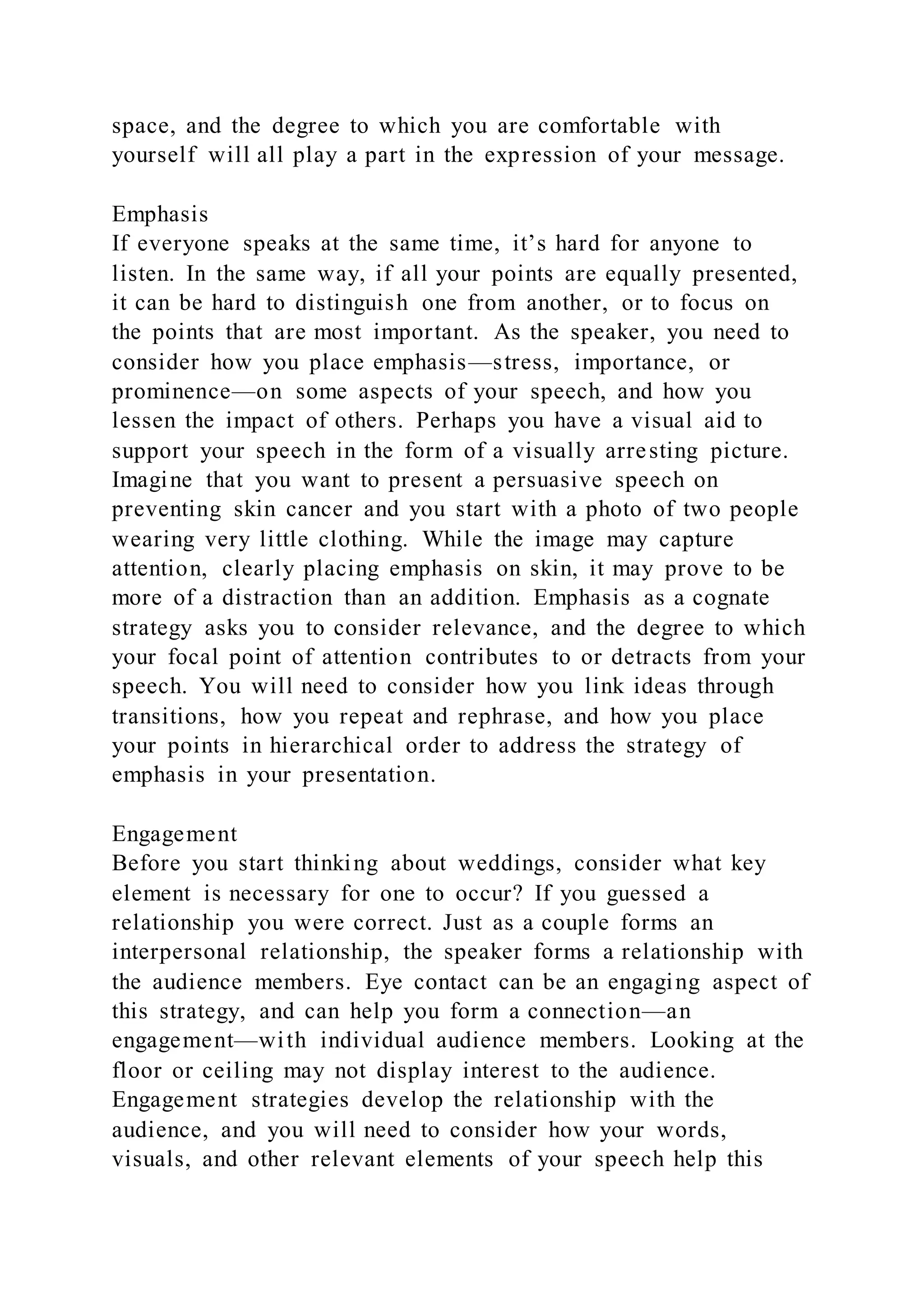
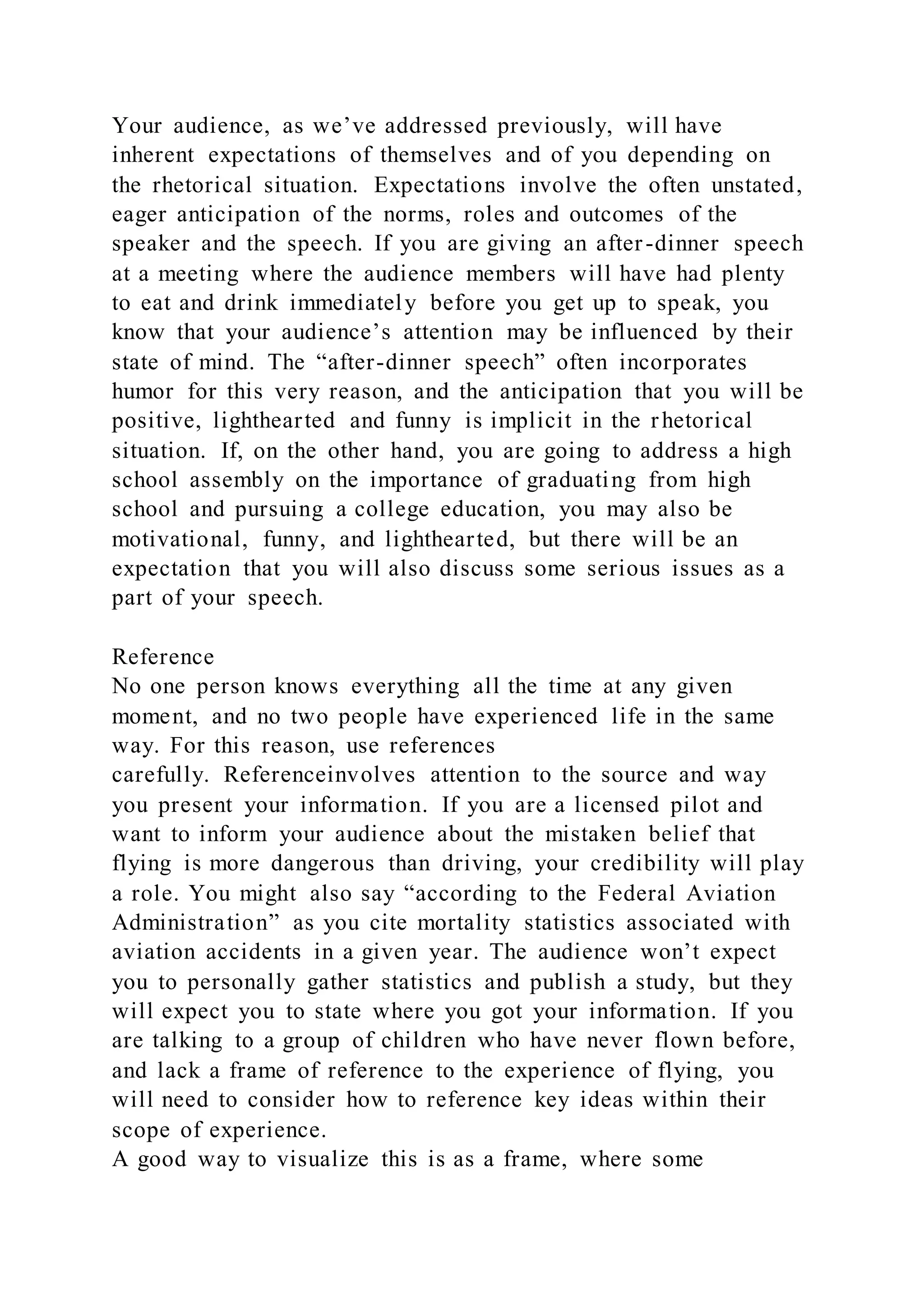
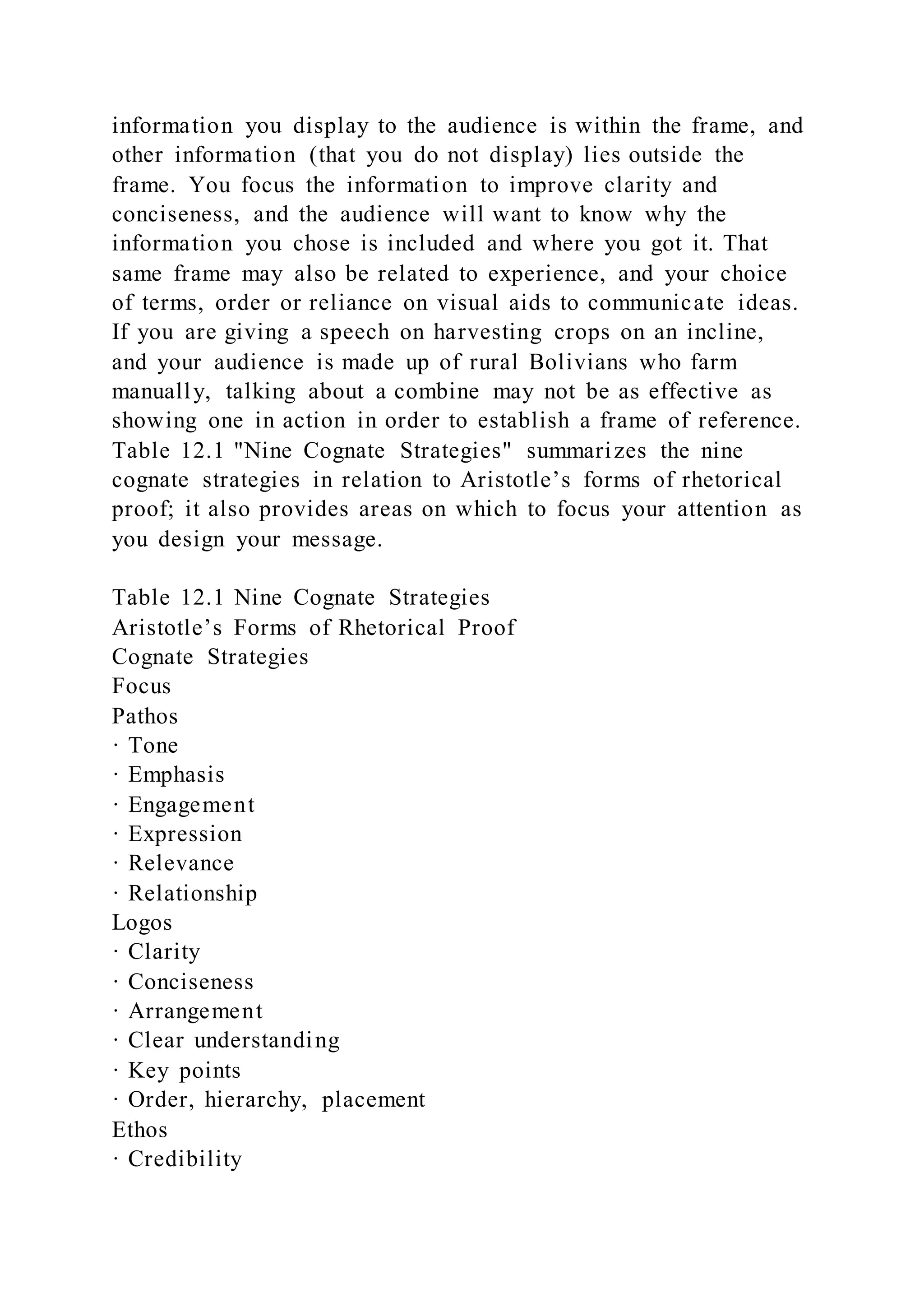
Table 12.1 "Nine Cognate Strategies" summarizes the nine
cognate strategies in relation to Aristotle’s forms of rhetorical
proof; it also provides areas on which to focus your attention as
you design your message.
Table 12.1 Nine Cognate Strategies
Aristotle’s Forms of Rhetorical Proof
Cognate Strategies
Focus
Pathos
· Tone
· Emphasis
· Engagement
· Expression
· Relevance
· Relationship
Logos
· Clarity
· Conciseness
· Arrangement
· Clear understanding
· Key points
· Order, hierarchy, placement
Ethos
· Credibility
· Expectation
· Reference
· Character, trust
· Norms and anticipated outcomes
· Sources and frames of reference
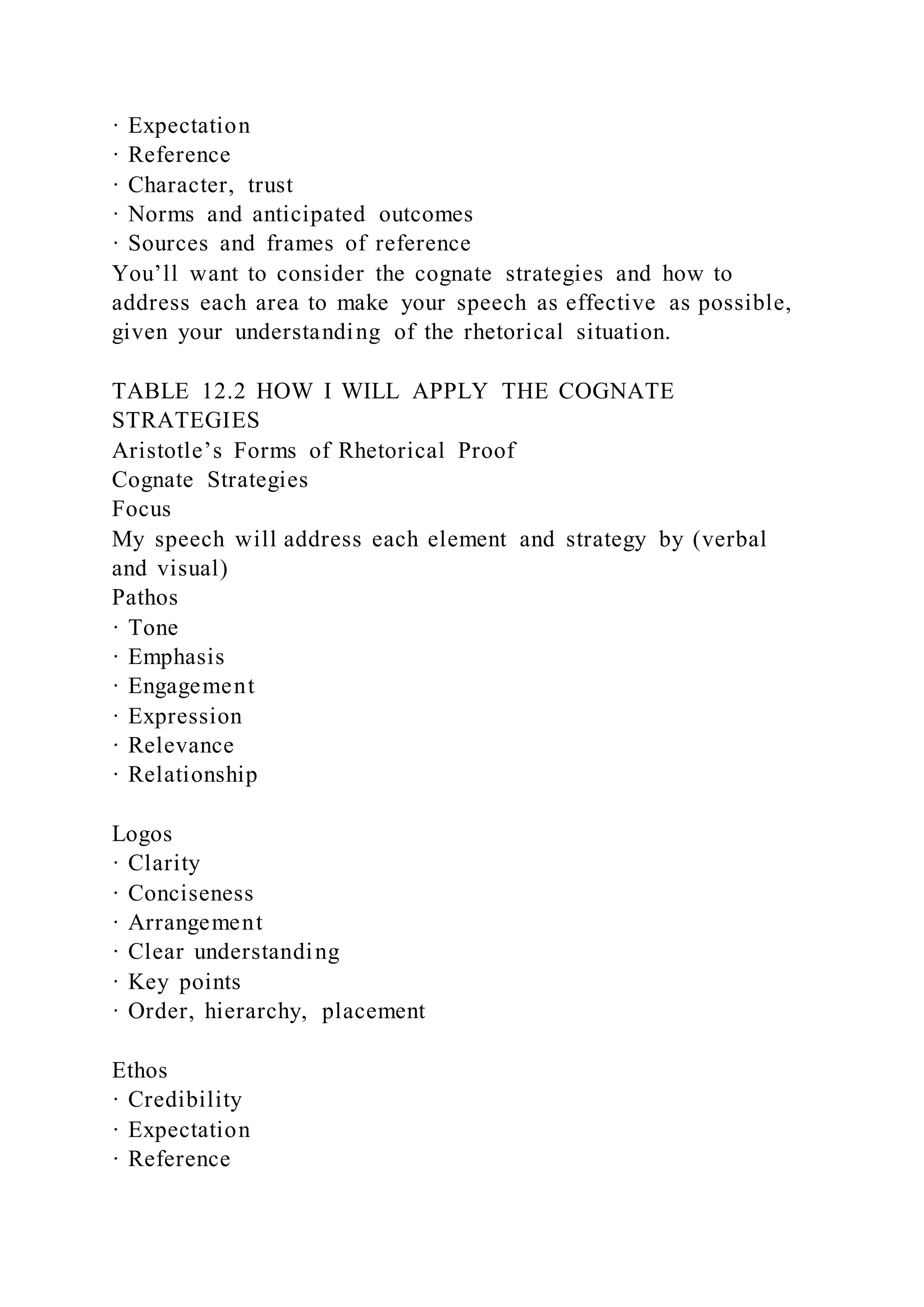
You’ll want to consider the cognate strategies and how to
address each area to make your speech as effective as possible,
given your understanding of the rhetorical situation.
TABLE 12.2 HOW I WILL APPLY THE COGNATE
STRATEGIES
Aristotle’s Forms of Rhetorical Proof
Cognate Strategies
Focus
My speech will address each element and strategy by (verbal
and visual)
Pathos
· Tone
· Emphasis
· Engagement
· Expression
· Relevance
· Relationship
Logos
· Clarity
· Conciseness
· Arrangement
· Clear understanding
· Key points
· Order, hierarchy, placement
Ethos
· Credibility
· Expectation
· Reference
· Character, trust
· Norms and anticipated outcomes
· Sources and frames of reference
[1] Kostelnick, C., & Roberts, D. (1998). Designing visual
language: Strategies for professional communicators. Needham
Heights, MA: Allyn & Bacon.
[2] Wisse, J. (1989). Ethos and pathos: From Aristotle to
Cicero. Amsterdam, Netherlands: Adolph M. Hakkert.
[3] Kostelnick, C., & Roberts, D. (1998). Designing visual
language: Strategies for professional communicators (p. 17).
Needham Heights, MA: Allyn & Bacon.
[4] Kostelnick, C., & Roberts, D. (1998). Designing visual
language: Strategies for professional communicators (p. 14).
Needham Heights, MA: Allyn & Bacon.
12.3 Building a Sample Speech
LEARNING OBJECTIVES
1. Demonstrate how to build a sample speech by expanding on
the main points you wish to convey.
2. Demonstrate how to use the five structural parts of any
speech.
As you begin to investigate your topic, make sure you consider
several sides of an issue. Let’s say you are going to do a speech
to inform on the history of the First Transcontinental Railroad.
At first you may have looked at just two sides, railroaders
versus local merchants. Railroad tycoons wanted to bring the
country together—moving people, goods, and services in a more
efficient way—and to make money. Local merchants wanted to
keep out competition and retain control of their individual
markets.
Take another look at this issue and you see that several other
perspectives have bearing on this issue. Shipping was done
primarily by boat prior to the railroad, so shippers would not
want the competition. Recent Chinese immigrants were in need
of work. Native Americans did not want to lose their culture or
way of life, and a railroad that crossed the country would cut
right through the buffalo’s migration patterns. We now have
five perspectives to the central issue, which makes the topic all
the more interesting.
The general purpose is to inform the audience on the First
Transcontinental Railroad and its impact on a young but
developing United States. The thesis statement focuses on
shipping, communication, and cultures across America.
· Topic. First Transcontinental Railroad
· General purpose statement. I want the audience to be more
informed about the impact of the First Transcontinental
Railroad.
· Thesis statement. The First Transcontinental Railroad changed
shipping, communication, and cultures across America.
With the information we have so far, we can now list three main
points:
1. Change in shipping
2. Change in communication
3. Change in cultures
Think of each one of these main points as a separate but shorter
speech. The point is to develop each of these main points like
you have developed your overall speech. What do you want to
focus on? The major types of shipping at the time of the First
Transcontinental Railroad? One aspect you may want consider
is to what degree is your audience familiar with this time in
history. If they are not very familiar, a little background and
context can help make your speech more meaningful and
enhance its relevance to your thesis statement. By taking time to
consider what you want to accomplish with each point, you will
help yourself begin to address how you need to approach each
point. Once you have thought about what you want to focus on
for each point, list each subheading next to the main points. For
example,
1. Change in shipping
A. Navigating the waterways via barges and boats
B. Overland stagecoaches
C. Timetables for modes of travel
Change in communication
A. Letters in the days of the Pony Express
B. How the Morse Code telegraph system followed railroad
lines
C. Bringing people together across distances
Change in cultures
A. Prerailroad immigration
B. Impact on Native Americans
C. Territories become States
By now you’ve identified your key points and are ready to start
planning your speech in more detail. While your organizational
structure will vary from speech to speech, there are nonetheless
five main parts of any speech: attention statement, introduction,
body, conclusion, and residual message. These are basic to the
rhetorical process and you will see time and time again,
regardless of audience or culture, these same elements in some
form utilized to communicate in public. They will serve to
guide you, and possibly even save you should you get a last
minute request to do a speech or presentation.
Place your hand on the table or desk and you’ll more likely see
a thumb and four fingers. Associate your hand with these five
elements. Each digit is independently quite weak, but together
they make a powerful fist. Your thumb is quite versatile and
your most important digit. It’s a lot like your attention
statement. If you don’t gain the audience’s attention, the rest of
the speech will be ineffective.
Each successive digit can represent the remaining four parts of
any speech. One day you will be asked to speak with little or no
time for preparation. By focusing on this organizational model,
and looking down at your hand, you can quickly and accurately
prepare your speech. With the luxury of time for preparation,
each step can even be further developed. Remember the five-
finger model of public speaking, as summarized in Table 12.3
"Five-Finger Model of Public Speaking", and you will always
stand out as a more effective speaker.
Table 12.3 Five-Finger Model of Public Speaking
Attention Statement
The attention statement is the way you focus the audience’s
attention on you and your speech.
Introduction
Your introduction introduces you and your topic, and should
establish a relationship with your audience and state your topic
clearly.
Body
In the body, or main content area of your speech, you will
naturally turn to one of the organizational patterns.
Conclusion
You conclusion should provide the audience with a sense of
closure by summarizing the main points and relating the points
to the overall topic.
Residual Message
The residual message is an idea or thought that stays with your
audience well after the speech.
12.4 Sample Speech Outlines
LEARNING OBJECTIVE
1. Understand how to create two different styles of outlines for
a speech.
Chances are you have learned the basic principles of outlining
in English writing courses: anoutline is a framework that
organizes main ideas and subordinate ideas in a hierarchical
series of roman numerals and alphabetical letters. The center
column of Table 12.4 "Speech Outline A" presents a generic
outline in a classical style. In the left column, the five main
structural elements of a speech are tied to the outline. Your task
is to fill in the center column outline with the actual ideas and
points you are making in your speech. Feel free to adapt it and
tailor it to your needs, depending on the specifics of your
speech. Next, fill in the right column with the verbal and visual
delivery features of your speech.
Table 12.4 Speech Outline A
Attention Statement
Device
Verbal and Visual Delivery
Introduction
· Main idea
· Common ground
Body
· I. Main idea: Point 1
· Subpoint 1
· A.1 specific information 1
· A.2 specific information 2
· II. Main idea: Point 2
· Subpoint 1
· B.1 specific information 1
· B.2 specific information 2
· III. Main idea: Point 3
· Subpoint 1
· C.1 specific information 1
· C.2 specific information 2
Conclusion
Summary, main points 1–3
Residual Message
Main idea
There is no law that says a speech outline has to follow a
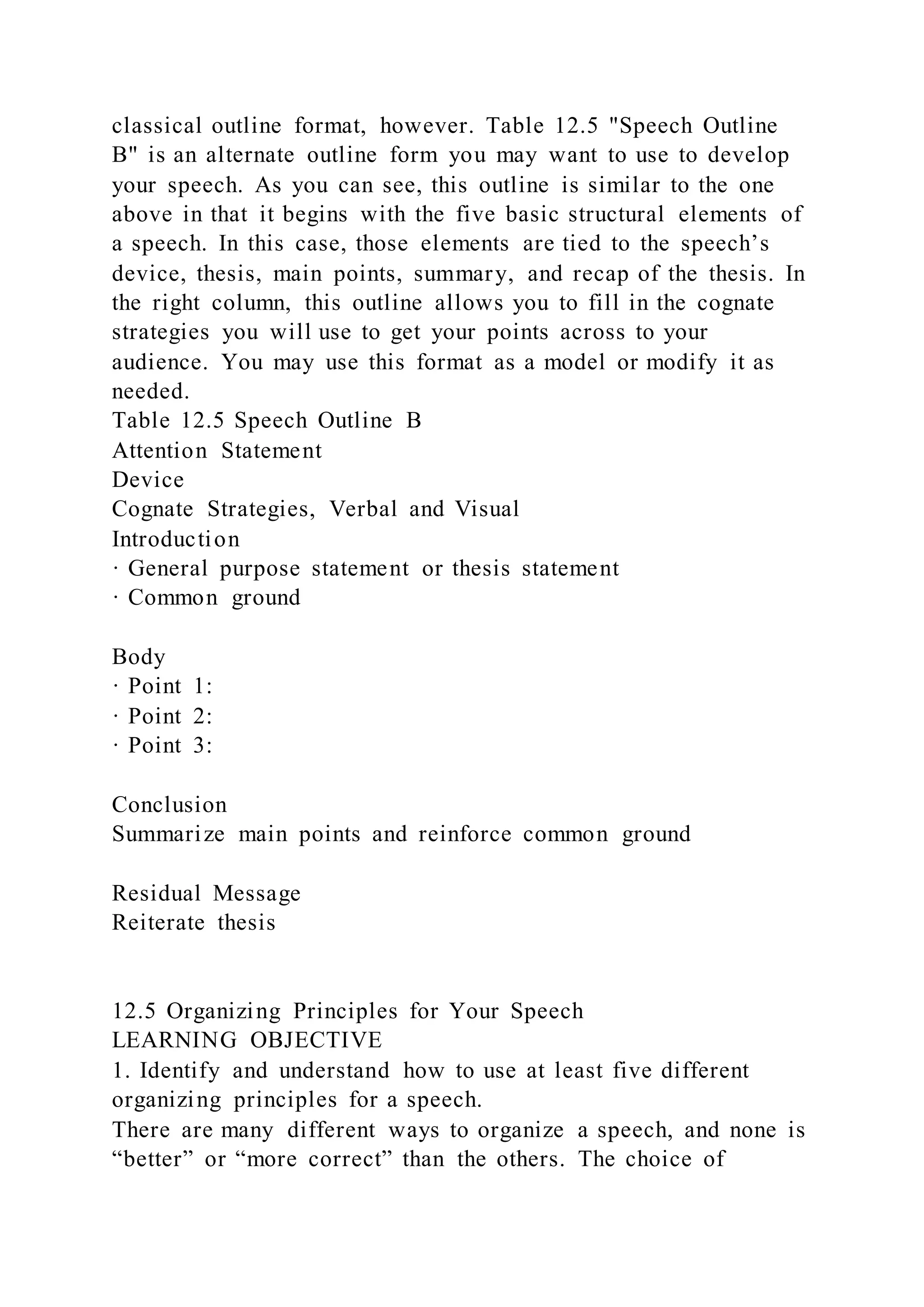
classical outline format, however. Table 12.5 "Speech Outline
B" is an alternate outline form you may want to use to develop
your speech. As you can see, this outline is similar to the one
above in that it begins with the five basic structural elements of
a speech. In this case, those elements are tied to the speech’s
device, thesis, main points, summary, and recap of the thesis. In
the right column, this outline allows you to fill in the cognate
strategies you will use to get your points across to your
audience. You may use this format as a model or modify it as
needed.
Table 12.5 Speech Outline B
Attention Statement
Device
Cognate Strategies, Verbal and Visual
Introduction
· General purpose statement or thesis statement
· Common ground
Body
· Point 1:
· Point 2:
· Point 3:
Conclusion
Summarize main points and reinforce common ground
Residual Message
Reiterate thesis
12.5 Organizing Principles for Your Speech
LEARNING OBJECTIVE
1. Identify and understand how to use at least five different
organizing principles for a speech.
There are many different ways to organize a speech, and none is
“better” or “more correct” than the others. The choice of
an organizing principle, or a core assumption around which
everything else is arranged, depends on the subject matter, the
rhetorical situation, and many other factors, including your
preference as speaker.
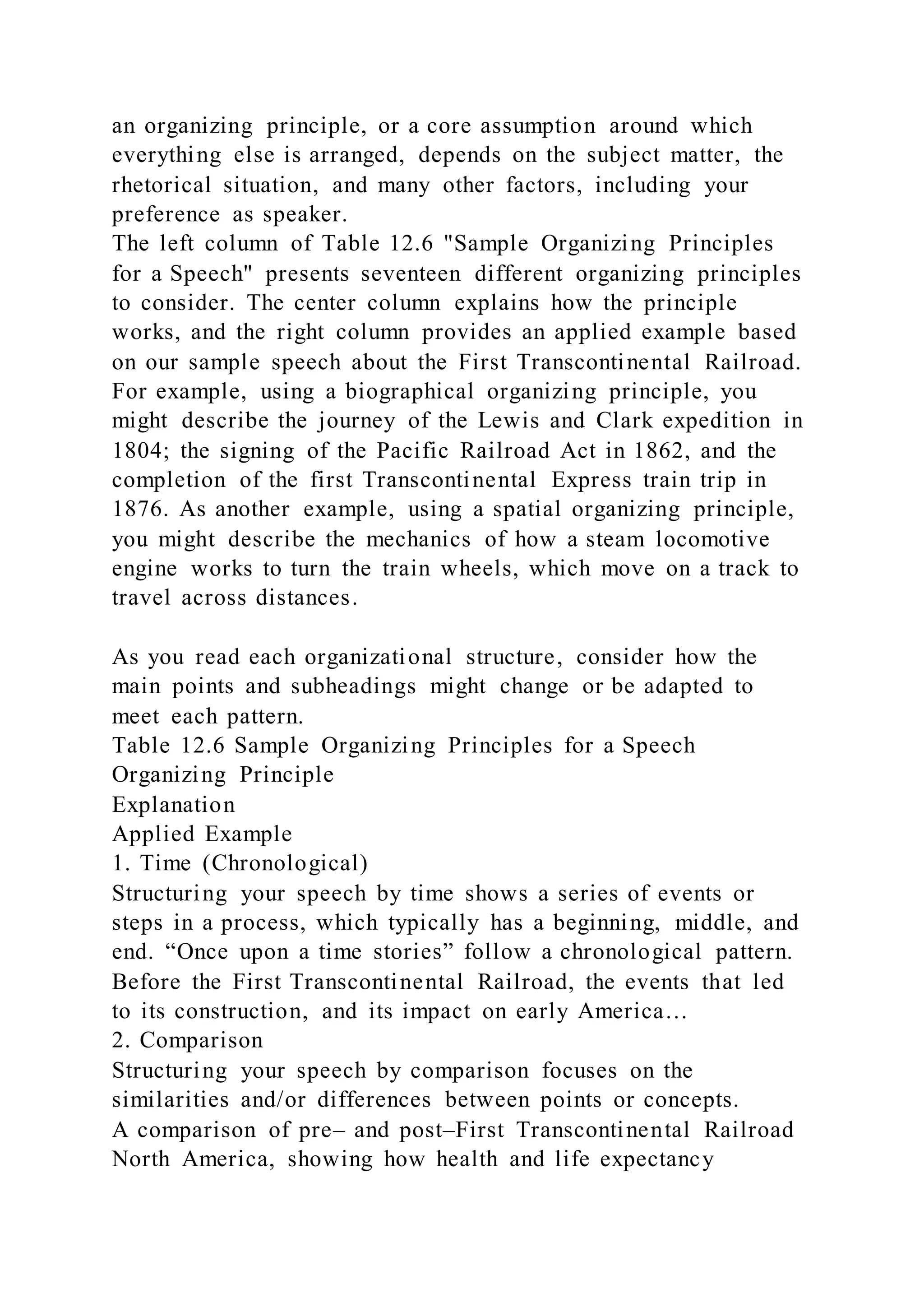
The left column of Table 12.6 "Sample Organizing Principles
for a Speech" presents seventeen different organizing principles
to consider. The center column explains how the principle
works, and the right column provides an applied example based
on our sample speech about the First Transcontinental Railroad.
For example, using a biographical organizing principle, you
might describe the journey of the Lewis and Clark expedition in
1804; the signing of the Pacific Railroad Act in 1862, and the
completion of the first Transcontinental Express train trip in
1876. As another example, using a spatial organizing principle,
you might describe the mechanics of how a steam locomotive
engine works to turn the train wheels, which move on a track to
travel across distances.
As you read each organizational structure, consider how the
main points and subheadings might change or be adapted to
meet each pattern.
Table 12.6 Sample Organizing Principles for a Speech
Organizing Principle
Explanation
Applied Example
1. Time (Chronological)
Structuring your speech by time shows a series of events or
steps in a process, which typically has a beginning, middle, and
end. “Once upon a time stories” follow a chronological pattern.
Before the First Transcontinental Railroad, the events that led
to its construction, and its impact on early America…
2. Comparison
Structuring your speech by comparison focuses on the
similarities and/or differences between points or concepts.
A comparison of pre– and post–First Transcontinental Railroad
North America, showing how health and life expectancy
remained the same.
3. Contrast
Structure your speech by using contrasting points highlights the
differences between items and concepts.
A contrast of pre– and post–First Transcontinental Railroad
North America, by shipping times, time it took to communicate
via letter, or how long it took to move out West.
4. Cause and Effect
Structuring your speech by cause and effect establishes a
relationship between two events or situations, making the
connection clear.
The movement of people and goods out West grew considerably
from 1750 to 1850. With the availability of a new and faster
way to go West, people generally supported its construction.
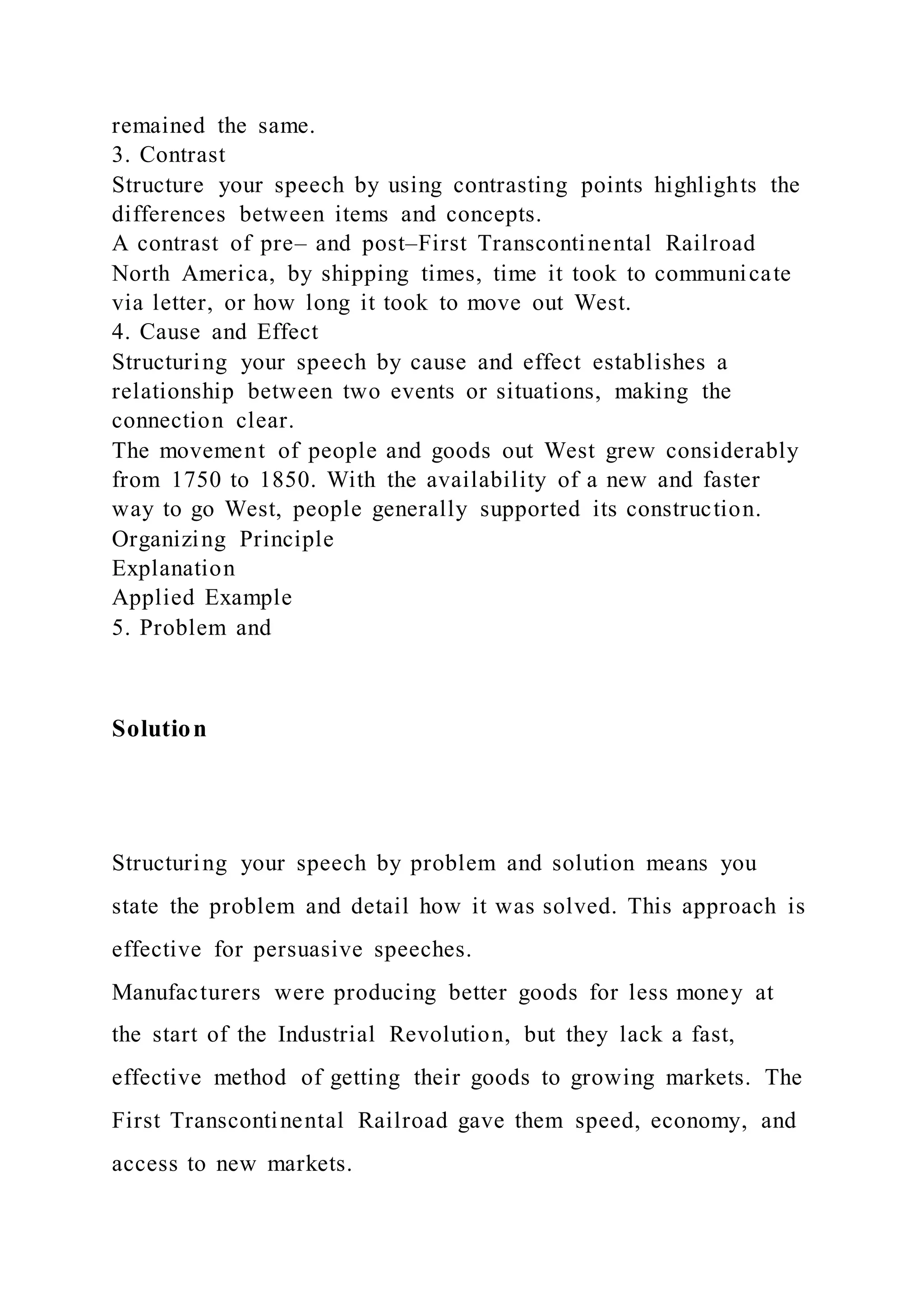
Organizing Principle
Explanation
Applied Example
5. Problem and
Solution
Structuring your speech by problem and solution means you
state the problem and detail how it was solved. This approach is
effective for persuasive speeches.
Manufacturers were producing better goods for less money at
the start of the Industrial Revolution, but they lack a fast,
effective method of getting their goods to growing markets. The
First Transcontinental Railroad gave them speed, economy, and
access to new markets.
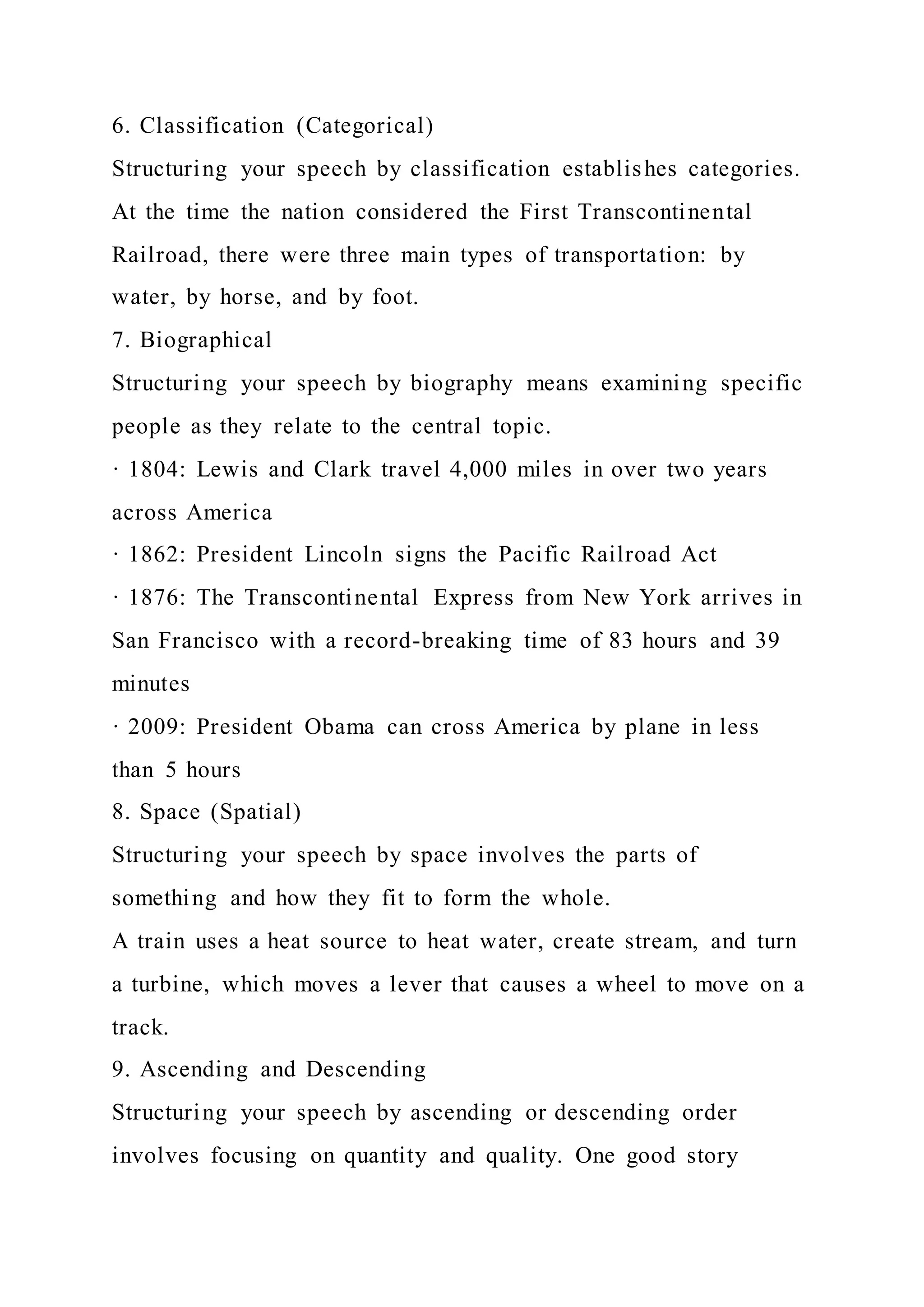
6. Classification (Categorical)
Structuring your speech by classification establishes categories.
At the time the nation considered the First Transcontinental
Railroad, there were three main types of transportation: by
water, by horse, and by foot.
7. Biographical
Structuring your speech by biography means examining specific
people as they relate to the central topic.
· 1804: Lewis and Clark travel 4,000 miles in over two years
across America
· 1862: President Lincoln signs the Pacific Railroad Act
· 1876: The Transcontinental Express from New York arrives in
San Francisco with a record-breaking time of 83 hours and 39
minutes
· 2009: President Obama can cross America by plane in less
than 5 hours
8. Space (Spatial)
Structuring your speech by space involves the parts of
something and how they fit to form the whole.
A train uses a heat source to heat water, create stream, and turn
a turbine, which moves a lever that causes a wheel to move on a
track.
9. Ascending and Descending
Structuring your speech by ascending or descending order
involves focusing on quantity and quality. One good story
(quality) leads to the larger picture, or the reverse.
A day in the life of a traveler in 1800. Incremental
developments in transportation to the present, expressed
through statistics, graphs, maps and charts.
10. Psychological
It is also called “Monroe’s Motivated Sequence.”[1]Structuring
your speech on the psychological aspects of the audience
involves focusing on their inherent needs and wants. See
Maslow[2] and Shutz.[3]The speaker calls attention to aneed,
then focuses on the satisfaction of the need,visualization of the
solution, and ends with a proposed or historical action. This is
useful for a persuasive speech.
When families in the year 1800 went out West, they rarely
returned to see family and friends. The country as a whole was
an extension of this distended family, separated by time and
distance. The railroad brought families and the country
together.
11. Elimination
Structuring your speech using the process of elimination
involves outlining all the possibilities.
The First Transcontinental Railroad helped pave the way for the
destruction of the Native American way of life in 1870. After
examining treaties, relocation and reservations, loss of the
buffalo, disease and war, the railroad can be accurately
considered the catalyst for the end of an era.
12. Ceremonial: Events, Ceremonies, or Celebrations
Structure your speech by focusing on the following:
1. Thank dignitaries and representatives.
2. Mention the importance of the event.
3. Mention the relationship of the event to the audience.
4. Thank the audience for their participation in the event,
ceremony, or celebration.
Thanking the representatives, builders, and everyone involved
with the construction of the Transcontinental Railroad. The
railroad will unite America, and bring us closer in terms of
trade, communication and family. Thank you for participating in
today’s dedication.
13. Awards
Structure your speech by focusing on the following:
1. Thank everyone for coming together.
2. Discuss the history and importance of the award.
3. Give a brief biography of the person who will receive the
award (often nonspecific to keep people guessing and to build
suspense).
4. Announce the name of the award recipient.
5. Present the award (present award with left hand, shake with
right).
6. Award recipient may give a speech.
7. Transition to the next item or thank everyone for
participating.
>Thank everyone for coming together. The Golden Spike Award
was created in honor of all the great men and women that made
today possible. The person receiving this award needs no
introduction. His/her tireless efforts to build partnerships,
coalitions, and raise support for the railroad have been
unwavering. (Name), please come and receive the Golden Spike
Award. (Speech/no speech.) Thank you, everyone, for coming.
14. Toast: Weddings or Similar Gatherings
Structure your speech by focusing on the following:
1. Thank everyone for coming together.
2. Discuss the importance of the event (wedding).
3. Mention the relationship of the couple to the audience or the
speaker to the person being celebrated.
4. Add one short sentence.
5. Optional: Conclude, thanking the audience for participation
in the event, ceremony, or celebration.
Thank everyone for coming together. I’ve know the groom since
he played with toy trains and only now, with (partner’s name),
can I see how far his involvement in our new cross-country train
got him. “All the best of healthy and happiness.” Thank you
everyone for joining us in this celebration of (name) and (name)
(point 5 is optional).
15. Speaker Introductions
Structure your speech by focusing on the following:
1. Thank everyone for coming together.
2. Provide a brief biography of the person who will speak or
establish their credibility.
3. Discuss the speaker and his or her topic.
4. Announce the name of the speaker, and possibly once their
speech has concluded.
5. Transition to the next item or thank everyone for
participating.
Thank everyone for coming together. Today’s speaker has a
long history in the development of the train, including
engineering technical aspects of steam locomotion. Today
he/she will address the steps that lead to our very own cross -
country railroad. Please help me welcome (name). (Optional
after speech: Thank you, everyone. Next we have…)
16. After-Dinner Speech
Structure your speech by focusing on the following:
1. Thank everyone for coming together.
2. Provide a fun or humorous attention statement.
3. Discuss the topic in a light-hearted manner with connected
stories, anecdotes, or even a joke or two.
4. Connect the humor to the topic of importance
5. Thank everyone for participating.
Thank you for coming together to celebrate the driving of the
Golden Spike. There have been many challenging moments
along the way that I would like to share tonight (stories,
anecdotes, or even a joke). While it’s been a long journey,
we’ve made it. Thank you for coming tonight.
17. Oral Interpretation
Structure your speech by focusing on the following:
1. Draw attention to the piece of literature.
2. Explain its significance, context, and background.
3. Interpret the manuscript for the audience.
4. Conclude with key points from the reading.
5. Reiterate the main point of the piece of literature.
Today I would like to share with you the proclamation that led
to the railroad you see before you today. (Interpret the
proclamation, using your voice to bring the written word alive.)
Without the foresight, vision and leadership we can now see,
this railroad might still be a dream.
[1] Ayres, J., & Miller, J. (1994). Effective public speaking (4th
ed., p 274). Madison, WI: Brown & Benchmark.
[2] Maslow, A. (1970). Motivation and personality (2nd ed.).
New York, NY: Harper & Row.
[3] Shutz, W. (1966). The interpersonal underworld. Palo Alto,
CA: Science and Behavior Books.
12.6 Transitions
LEARNING OBJECTIVE
1. Understand and demonstrate how to use transitions
effectively within your speech.
By now you have identified your main points, chosen your
organizational model, and are ready to begin putting your
speech together. If you were going to build a house, you would
need a strong foundation. Could the columns and beams hold
your roof in place without anything to keep them from falling
down? Of course not. In the same way, the columns or beams
are like the main ideas of your speech, and identifying them is
one important step. Another is to consider how to position them
securely to rest on a solid foundation, have sufficient
connection to each other that they become interdependent, and
to make sure they stay where you want them to so your house,
or your speech, doesn’t come crashing down.
Transitions are words, phrases, or visual devices that help the
audience follow the speaker’s ideas, connect the main points to
each other, and see the relationships you’ve created in the
information you are presenting. They are often described as
bridges between ideas, thought or concepts, providing some
sense of where you’ve been and where you are going with your
speech. Transitions are used by the speaker to guide the
audience in the progression from one significant idea, concept
or point to the next issue. They can also show the relationship
between the main point and the support the speaker uses to
illustrate, provide examples for, or reference outside sources.
Depending your purpose, transitions can serve different roles as
you help create the glue that will connect your points together
in a way the audience can easily follow.
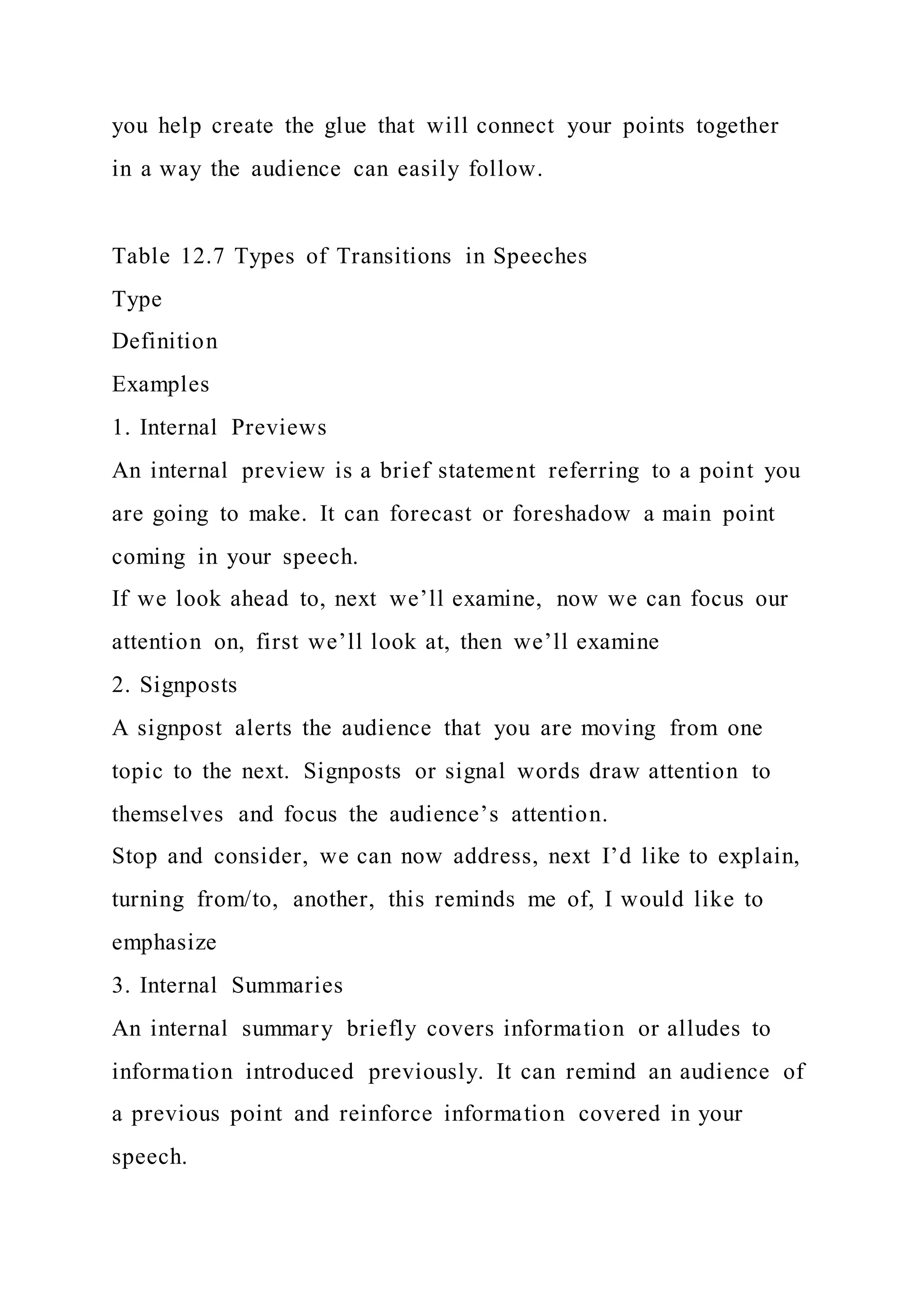
Table 12.7 Types of Transitions in Speeches
Type
Definition
Examples
1. Internal Previews
An internal preview is a brief statement referring to a point you
are going to make. It can forecast or foreshadow a main point
coming in your speech.
If we look ahead to, next we’ll examine, now we can focus our
attention on, first we’ll look at, then we’ll examine
2. Signposts
A signpost alerts the audience that you are moving from one
topic to the next. Signposts or signal words draw attention to
themselves and focus the audience’s attention.
Stop and consider, we can now address, next I’d like to explain,
turning from/to, another, this reminds me of, I would like to
emphasize
3. Internal Summaries
An internal summary briefly covers information or alludes to
information introduced previously. It can remind an audience of
a previous point and reinforce information covered in your
speech.
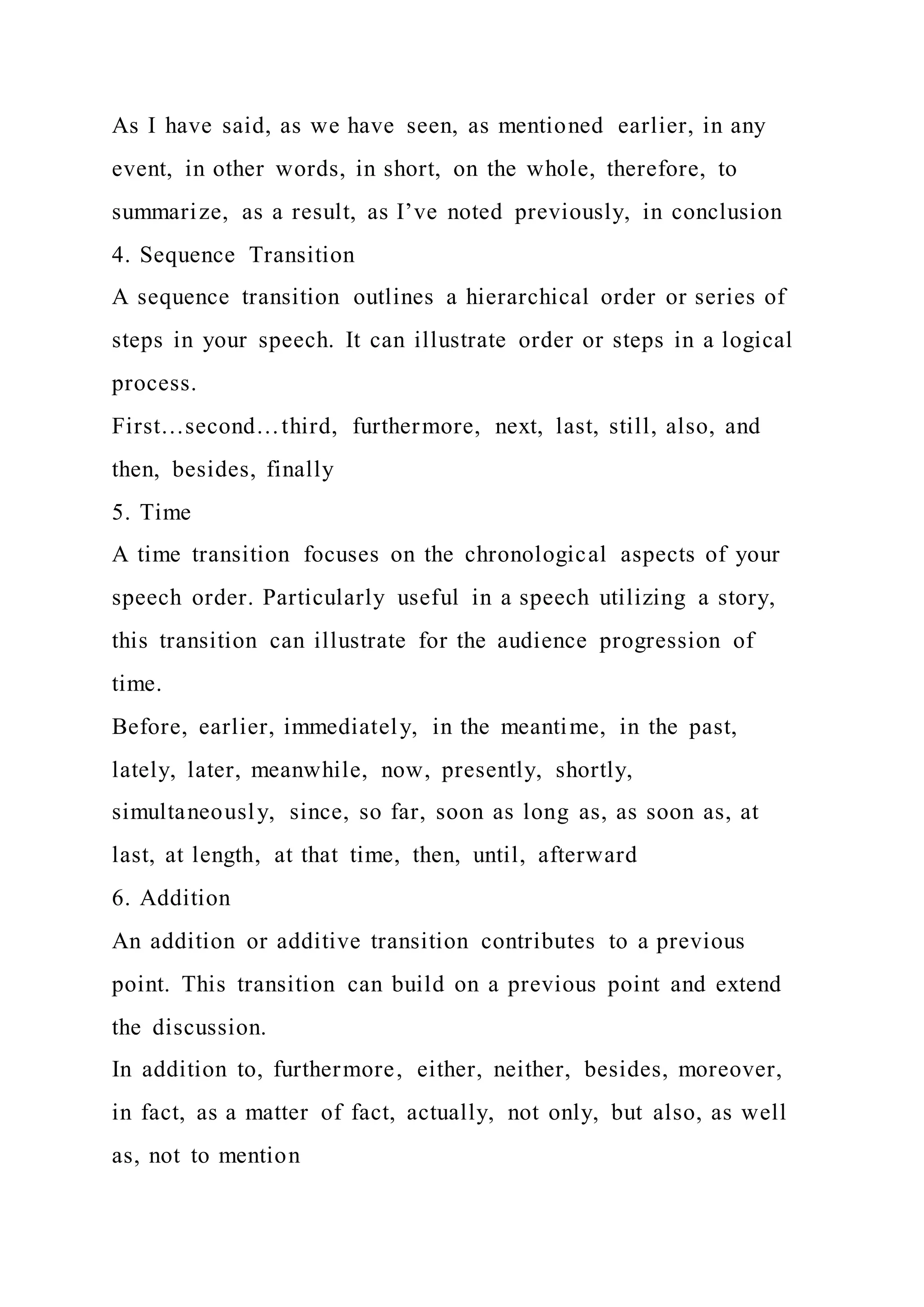
As I have said, as we have seen, as mentioned earlier, in any
event, in other words, in short, on the whole, therefore, to
summarize, as a result, as I’ve noted previously, in conclusion
4. Sequence Transition
A sequence transition outlines a hierarchical order or series of
steps in your speech. It can illustrate order or steps in a logical
process.
First…second…third, furthermore, next, last, still, also, and
then, besides, finally
5. Time
A time transition focuses on the chronological aspects of your
speech order. Particularly useful in a speech utilizing a story,
this transition can illustrate for the audience progression of
time.
Before, earlier, immediately, in the meantime, in the past,
lately, later, meanwhile, now, presently, shortly,
simultaneously, since, so far, soon as long as, as soon as, at
last, at length, at that time, then, until, afterward
6. Addition
An addition or additive transition contributes to a previous
point. This transition can build on a previous point and extend
the discussion.
In addition to, furthermore, either, neither, besides, moreover,
in fact, as a matter of fact, actually, not only, but also, as well
as, not to mention
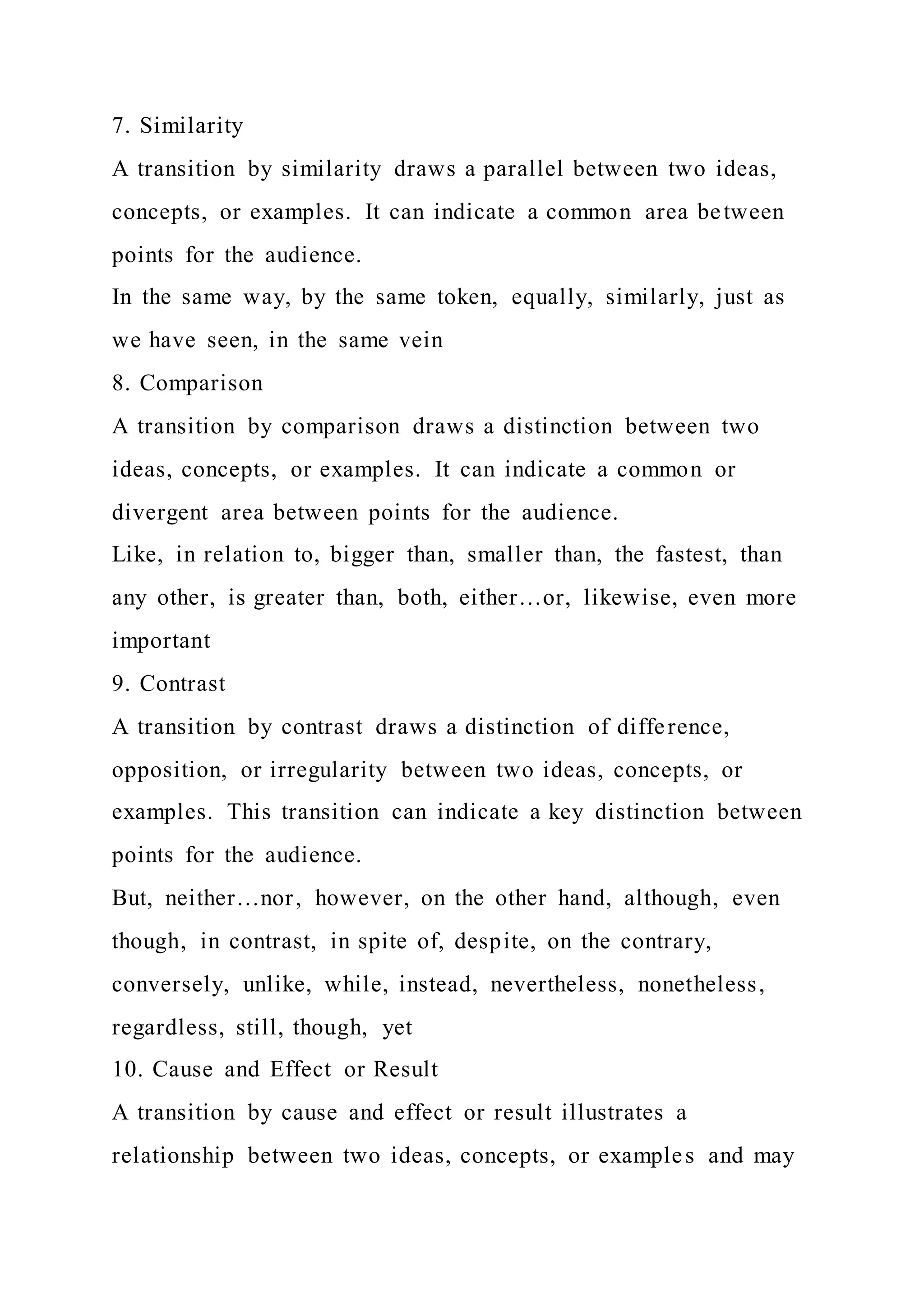
7. Similarity
A transition by similarity draws a parallel between two ideas,
concepts, or examples. It can indicate a common area between
points for the audience.
In the same way, by the same token, equally, similarly, just as
we have seen, in the same vein
8. Comparison
A transition by comparison draws a distinction between two
ideas, concepts, or examples. It can indicate a common or
divergent area between points for the audience.
Like, in relation to, bigger than, smaller than, the fastest, than
any other, is greater than, both, either…or, likewise, even more
important
9. Contrast
A transition by contrast draws a distinction of difference,
opposition, or irregularity between two ideas, concepts, or
examples. This transition can indicate a key distinction between
points for the audience.
But, neither…nor, however, on the other hand, although, even
though, in contrast, in spite of, despite, on the contrary,
conversely, unlike, while, instead, nevertheless, nonetheless,
regardless, still, though, yet
10. Cause and Effect or Result
A transition by cause and effect or result illustrates a
relationship between two ideas, concepts, or examples and may
focus on the outcome or result. It can illustrate a relationship
between points for the audience.
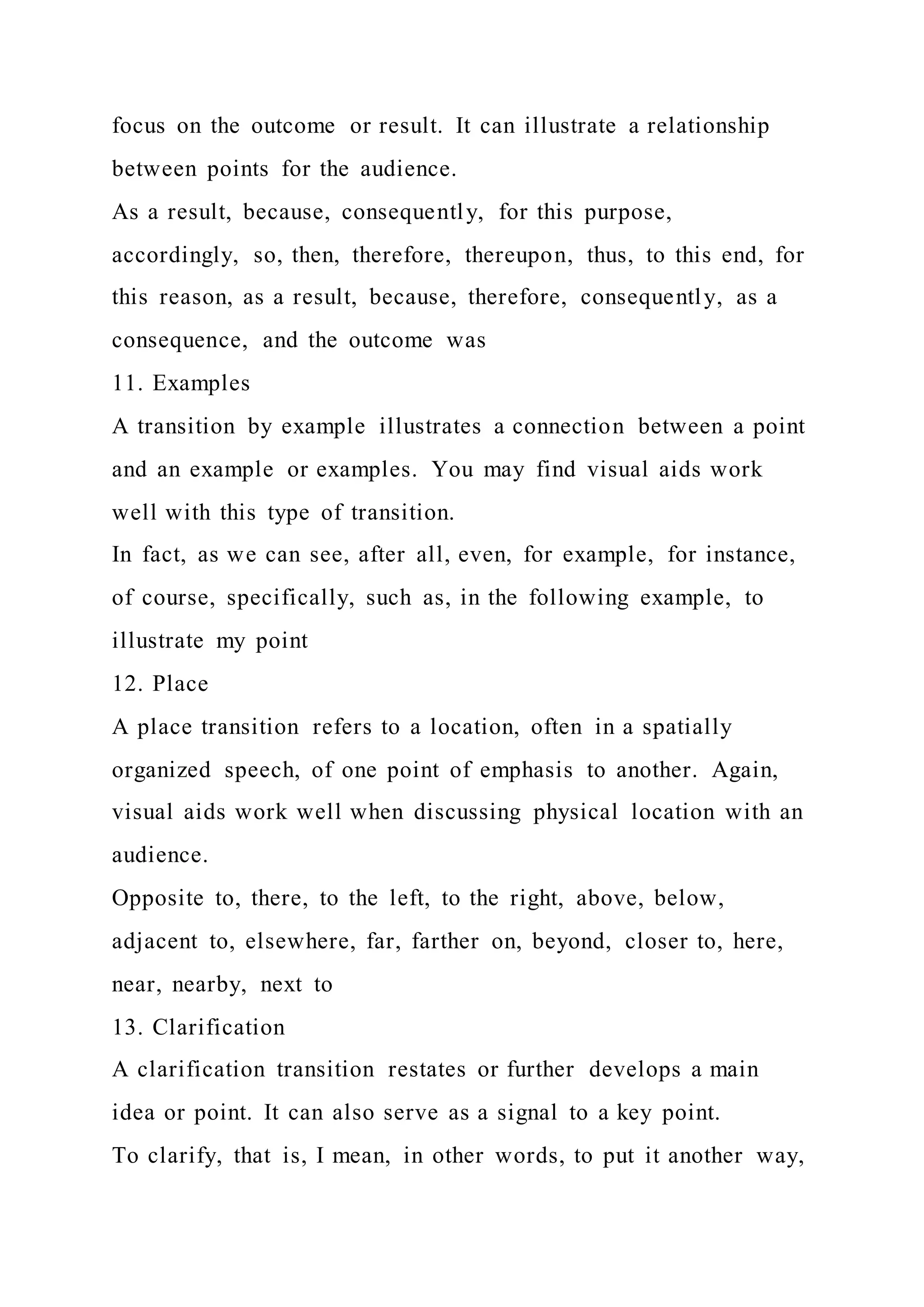
As a result, because, consequently, for this purpose,
accordingly, so, then, therefore, thereupon, thus, to this end, for
this reason, as a result, because, therefore, consequently, as a
consequence, and the outcome was
11. Examples
A transition by example illustrates a connection between a point
and an example or examples. You may find visual aids work
well with this type of transition.
In fact, as we can see, after all, even, for example, for instance,
of course, specifically, such as, in the following example, to
illustrate my point
12. Place
A place transition refers to a location, often in a spatially
organized speech, of one point of emphasis to another. Again,
visual aids work well when discussing physical location with an
audience.
Opposite to, there, to the left, to the right, above, below,
adjacent to, elsewhere, far, farther on, beyond, closer to, here,
near, nearby, next to
13. Clarification
A clarification transition restates or further develops a main
idea or point. It can also serve as a signal to a key point.
To clarify, that is, I mean, in other words, to put it another way,
that is to say, to rephrase it, in order to explain, this means
14. Concession
A concession transition indicates knowledge of contrary
information. It can address a perception the audience may hold
and allow for clarification.
We can see that while, although it is true that, granted that,
while it may appear that, naturally, of course, I can see that, I
admit that even though
Table 12.7 "Types of Transitions in Speeches" is a summary of
fourteen distinct types of transitions. As you contemplate how
to bring together your information, consider how you will use
various transitions, and note them on your outline.
12.7 Additional Resources
The commercial site from Inc. magazine presents an article on
organizing your speech by Patricia Fripp, former president of
the National Speakers
Association.http://www.inc.com/articles/2000/10/20844.html
Read a straightforward tutorial on speech organization by
Robert Gwynne on this University of Central Florida
site. http://pegasus.cc.ucf.edu/~rbrokaw/organizing.html
Read a straightforward tutorial on speech organization on the
University of Tennessee Toastmasters
website. http://www.uttoastmasters.com/organizespeech.html
View an eHow video on how to organize a speech. How does the
advice in this video differ from organizing advice given in this
chapter?http://www.ehow.com/video_4401082_organizing-
speech-parts.html
Read more about how to outline a speech on this site from John
Jay College of Criminal
Justice. http://www.lib.jjay.cuny.edu/research/outlining.html
Learn more about how to outline a speech from the Six Minutes
public speaking and presentation skills
blog. http://sixminutes.dlugan.com/2008/02/29/speech-
preparation-3-outline-examples
Chapter 11
Nonverbal Delivery
The most important thing in communication is hearing what
isn’t said.
Peter F. Drucker
But behavior in the human being is sometimes a defense, a way
of concealing motives and thoughts.
Abraham Maslow
Electric communication will never be a substitute for the face of
someone who with their soul encourages another person to be
brave and true.
Charles Dickens
Getting Started
In this chapter, we focus on how a speaker presents ideas, not
the ideas themselves. Have you ever been in class and found it
hard to listen to the professor, not because he or she wasn’t well
informed or the topic wasn’t interesting or important to you, but
because the style of presentation didn’t engage you as a
listener? If your answer is yes, then you know that you want to
avoid making the same mistake when you give a presentation.
It’s not always what you say, but how you say it that makes a
difference. We sometimes call this “body language,” or
“nonverbal communication,” and it is a key aspect of effective
business communication.
How do you know when your boss or instructors are pleased
with your progress (or not)? You might know from the smiles
on their faces, from the time and attention they give you, or
perhaps in other nonverbal ways, like a raise, a bonus, or a good
grade. Whether the interaction takes place face-to-face, or at a
distance, you can still experience and interpret nonverbal
responses.
Sometimes we place more emphasis on nonverbal aspects of
communication that they warrant. Suppose you have just gotten
home from your first date with Amanda and you feel it went
very well. How soon afterward should you call Amanda? There
are lots of advice columns, informal rules and customs, and
friends with opinions to offer you suggestions, but you know
what is right for you. You also know that texting her at five
o’clock the next morning might be a bit early. You may choose
to wait until a coffee break around 10 a.m. to send a short text
message, and realize that you might not get a response until
later that afternoon.
Does the lack of an immediate response have any meaning?
Does it mean Amanda is less interested in you than you are in
her? While you might give it more attention than it deserves,
and maybe let it weigh on your mind and distract you from other
tasks, the time interval for responding may not have as much
intentional meaning as you think. It might mean that Amanda
has a different sense of time urgency than you do, or that she
simply didn’t receive your message until later.
Timing is an important aspect of nonverbal communication, but
trying to understand what a single example of timing means is
challenging. Context may make a difference. For example, if
you have known someone for years who has always responded
promptly to your e-mails or texts, but now that person hasn’t
responded in over a day, you may have reason for concern. That
person’s behavior doesn’t match what you are familiar with, and
this sudden, unexplained change in the established pattern may
mean that you need to follow up.
11.1 Principles of Nonverbal Communication
LEARNING OBJECTIVES
1. Demonstrate nonverbal communication and describe its role
in the communication process.
2. Understand and explain the principles of nonverbal
communication.
Nonverbal Communication Is Fluid
Chances are you have had many experiences where words were
misunderstood, or where the meaning of words was unclear.
When it comes to nonverbal communication, meaning is even
harder to discern. We can sometimes tell what people are
communicating through their nonverbal communication, but
there is no foolproof “dictionary” of how to interpret nonverbal
messages. Nonverbal communication is the process of
conveying a message without the use of words. It can include
gestures and facial expressions, tone of voice, timing, posture
and where you stand as you communicate. It can help or hinder
the clear understanding of your message, but it doesn’t reveal
(and can even mask) what you are really thinking. Nonverbal
communication is far from simple, and its complexity makes our
study and our understanding a worthy but challenging goal.
Where does a wink start and a nod end? Nonverbal
communication involves the entire body, the space it occupies
and dominates, the time it interacts, and not only what is not
said, but how it is not said. Confused? Try to focus on just one
element of nonverbal communication and it will soon get lost
among all the other stimuli. Let’s consider eye contact. What
does it mean by itself without context, chin position, or
eyebrows to flag interest or signal a threat? Nonverbal action
flows almost seamlessly from one to the next, making it a
challenge to interpret one element, or even a series of elements.
We perceive time as linear, flowing along in a straight line. We
did one task, we’re doing another task now, and we are planning
on doing something else all the time. Sometimes we place more
emphasis on the future, or the past, forgetting that we are
actually living in the present moment whether we focus on “the
now” or not. Nonverbal communication is always in motion, as
long as we are, and is never the same twice.
Nonverbal communication is irreversible. In written
communication, you can write a clarification, correction, or
retraction. While it never makes the original statement go
completely away, it does allow for correction. Unlike written
communication, oral communication may allow “do-overs” on
the spot: you can explain and restate, hoping to clarify your
point. You can also dig the hole you are in just a little bit
deeper. The old sayings “when you find yourself in a hole, stop
digging” and “open mouth, insert foot” can sometimes apply to
oral communications. We’ve all said somethi ng we would give
anything to take back, but we all know we can’t. Oral
communication, like written communication, allows for some
correction, but it still doesn’t erase the original message or its
impact. Nonverbal communication takes it one step further. You
can’t separate one nonverbal action from the context of all the
other verbal and nonverbal communication acts, and you can’t
take it back.
In a speech, nonverbal communication is continuous in the
sense that it is always occurring, and because it is so fluid, it
can be hard to determine where one nonverbal message starts
and another stops. Words can be easily identified and isolated,
but if we try to single out a speaker’s gestures, smile, or stance
without looking at how they all come together in context, we
may miss the point and draw the wrong conclusion. You need to
be conscious of this aspect of public speaking because, to quote
another old saying, “Actions speak louder than words.” This is
true in the sense that people often pay more attention to your
nonverbal expressions more than your words. As a result,
nonverbal communication is a powerful way to contribute to (or
detract from) your success in communicating your message to
the audience.
Nonverbal Communication Is Fast
Let’s pretend you are at your computer at work. You see that an
e-mail has arrived, but you are right in the middle of tallying a
spreadsheet whose numbers just don’t add up. You see that the
e-mail is from a coworker and you click on it. The subject line
reads “pink slips.” You could interpret this to mean a
suggestion for a Halloween costume, or a challenge to race for
each other’s car ownership, but in the context of the workplace
you may assume it means layoffs.
Your emotional response is immediate. If the author of the e-
mail could see your face, they would know that your response
was one of disbelief and frustration, even anger, all via your
nonverbal communication. Yes, when a tree falls in the forest it
makes a sound, even if no one is there to hear it. In the same
way, you express yourself via nonverbal communication all the
time without much conscious thought at all. You may think
about how to share the news with your partner, and try to
display a smile and a sense of calm when you feel like anything
but smiling.
Nonverbal communication gives our thoughts and feelings away
before we are even aware of what we are thinking or how we
feel. People may see and hear more than you ever anticipated.
Your nonverbal communication includes both intentional and
unintentional messages, but since it all happens so fast, the
unintentional ones can contradict what you know you are
supposed to say or how you are supposed to react.
Nonverbal Communication Can Add to or Replace Verbal
Communication
People tend to pay more attention to how you say it than what
you actually say. In presenting a speech this is particularly true.
We communicate nonverbally more than we engage in verbal
communication, and often use nonverbal expressions to add to,
or even replace, words we might otherwise say. We use a
nonverbal gesture called an illustrator to communicate our
message effectively and reinforce our point. Your coworker
Andrew may ask you, “Barney’s Bar after work?” as he walks
by, and you simply nod and say “yeah.” Andrew may respond
with a nonverbal gesture, called an emblem, by signaling with
the “OK” sign as he walks away.
In addition to illustrators or emblematic nonverbal
communication, we also use regulators. “Regulators are
nonverbal messages which control, maintain or discourage
interaction.”[1]For example, if someone is telling you a
message that is confusing or upsetting, you may hold up your
hand, a commonly recognized regulator that asks the speaker to
stop talking.
Let’s say you are in a meeting presenting a speech that
introduces your company’s latest product. If your audience
members nod their heads in agreement on important points and
maintain good eye contact, it is a good sign. Nonverbally, they
are using regulators encouraging you to continue with your
presentation. In contrast, if they look away, tap their feet, and
begin drawing in the margins of their notebook, these are
regulators suggesting that you better think of a way to regain
their interest or else wrap up your presentation quickly.
“Affect displays are nonverbal communication that express
emotions or feelings.”[2] An affect display that might
accompany holding up your hand for silence would be to frown
and shake your head from side to side. When you and Andrew
are at Barney’s Bar, smiling and waving at coworkers who
arrive lets them know where you are seated and welcomes them.
“Adaptors are displays of nonverbal communication that help
you adapt to your environment and each context, helping you
feel comfortable and secure.”[3] A self-adaptor involves you
meeting your need for security, by playing with your hair for
example, by adapting something about yourself in way for
which it was not designed or for no apparent purpose. Combing
your hair would be an example of a purposeful action, unlike a
self-adaptive behavior. Anobject-adaptor involves the use of an
object in a way for which it was not designed. You may see
audience members tapping their pencils, chewing on them, or
playing with them, while ignoring you and your presentation. Or
perhaps someone pulls out a comb and repeatedly rubs a
thumbnail against the comb’s teeth. They are using the comb or
the pencil in a way other than its intended design, an object-
adaptor that communicates a lack of engagement or enthusiasm
in your speech.
Intentional nonverbal communication can complement, repeat,
replace, mask, or contradict what we say. When Andrew invited
you to Barney’s, you said, “Yeah” and nodded, complementing
and repeating the message. You could have simply nodded,
effectively replacing the “yes” with a nonverbal response. You
could also have decided to say no, but did not want to hurt
Andrew’s feelings. Shaking your head “no” while pointing to
your watch, communicating work and time issues, may mask
your real thoughts or feelings. Masking involves the
substitution of appropriate nonverbal communication for
nonverbal communication you may want to display.[4] Finally,
nonverbal messages that conflict with verbal communication
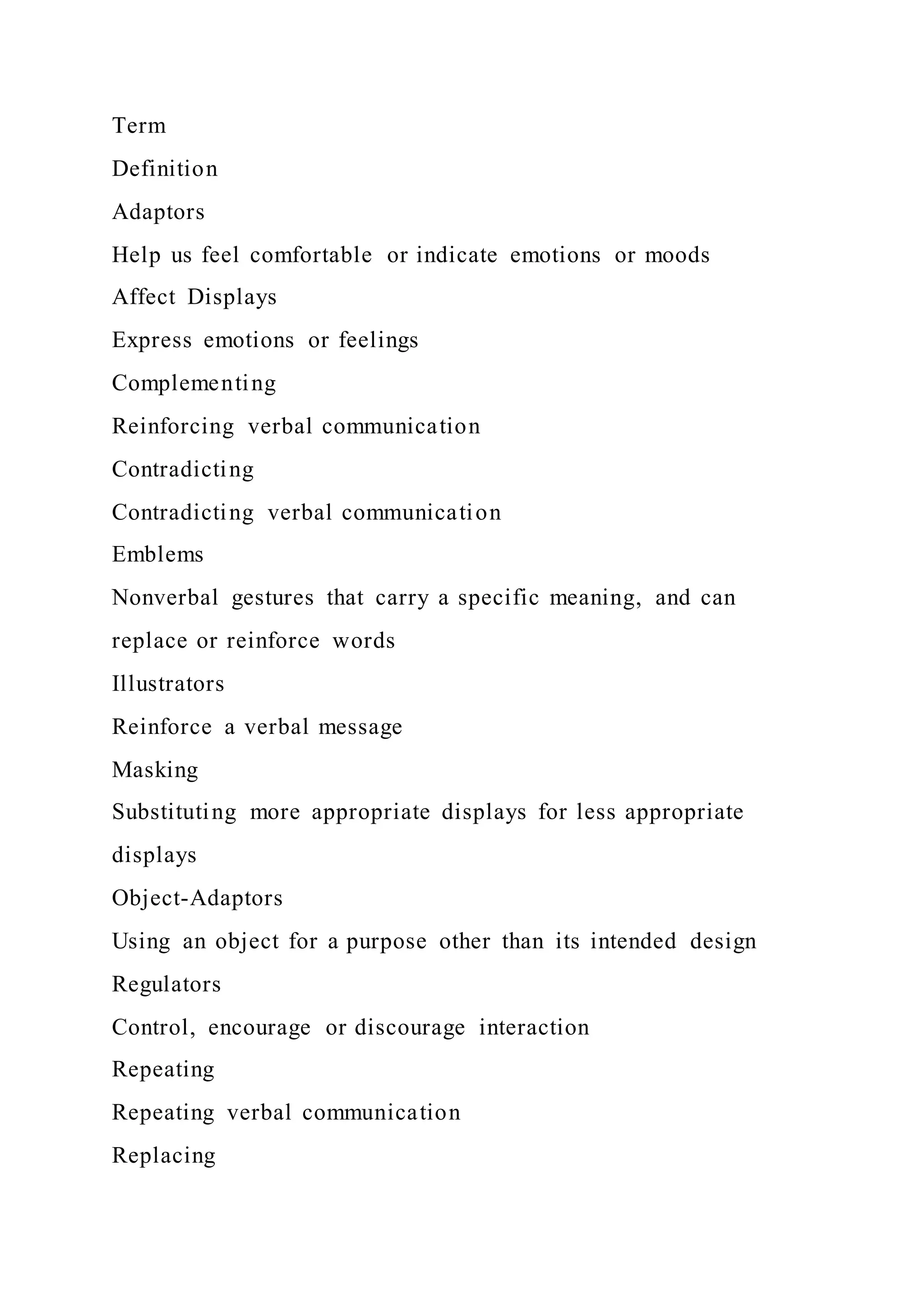
can confuse the listener. Table 11.1 "Some Nonverbal
Expressions" summarizes these concepts.
Table 11.1 Some Nonverbal Expressions
Term
Definition
Adaptors
Help us feel comfortable or indicate emotions or moods
Affect Displays
Express emotions or feelings
Complementing
Reinforcing verbal communication
Contradicting
Contradicting verbal communication
Emblems
Nonverbal gestures that carry a specific meaning, and can
replace or reinforce words
Illustrators
Reinforce a verbal message
Masking
Substituting more appropriate displays for less appropriate
displays
Object-Adaptors
Using an object for a purpose other than its intended design
Regulators
Control, encourage or discourage interaction
Repeating
Repeating verbal communication
Replacing
Replacing verbal communication
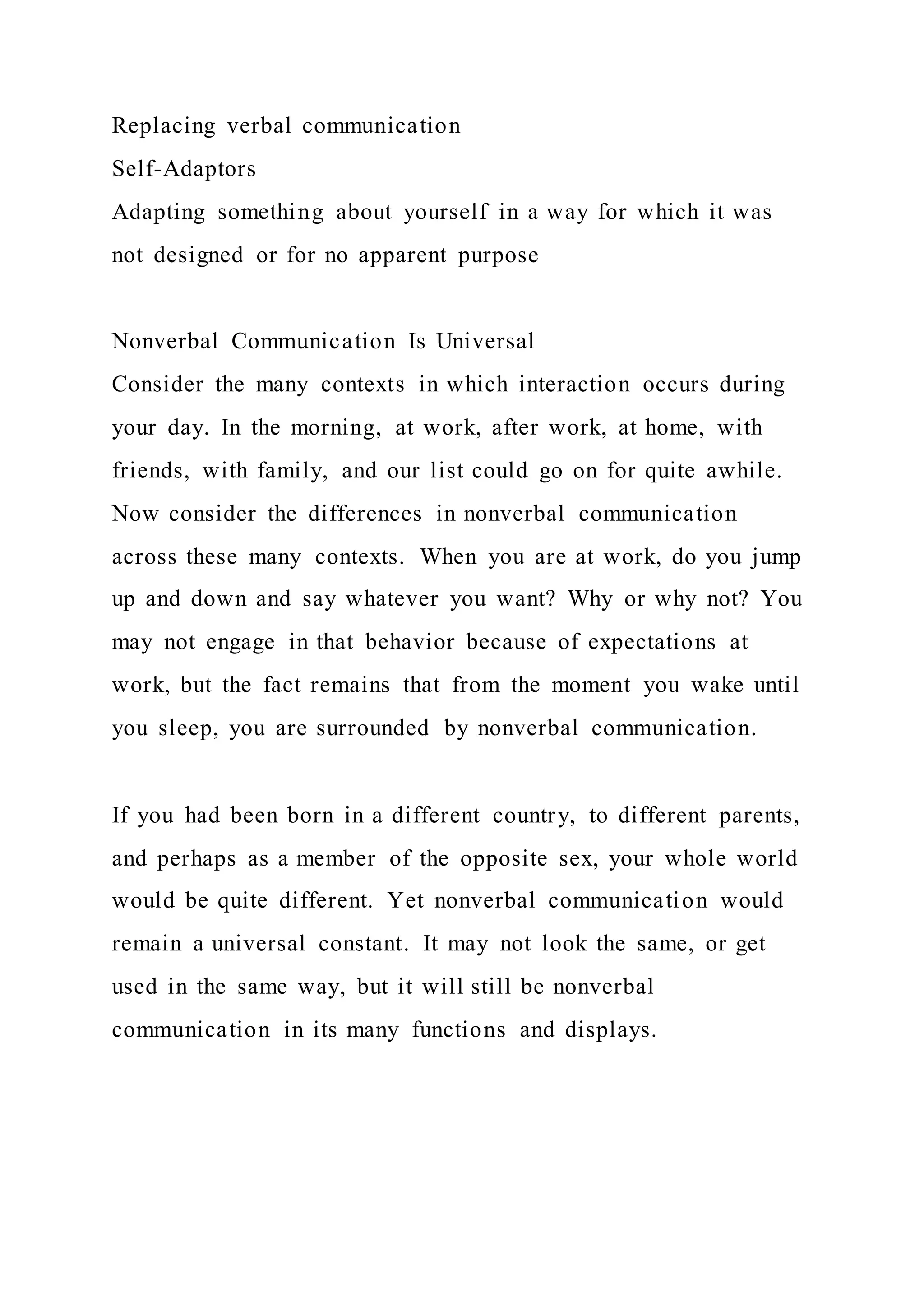
Self-Adaptors
Adapting something about yourself in a way for which it was
not designed or for no apparent purpose
Nonverbal Communication Is Universal
Consider the many contexts in which interaction occurs during
your day. In the morning, at work, after work, at home, with
friends, with family, and our list could go on for quite awhile.
Now consider the differences in nonverbal communication
across these many contexts. When you are at work, do you jump
up and down and say whatever you want? Why or why not? You
may not engage in that behavior because of expectations at
work, but the fact remains that from the moment you wake until
you sleep, you are surrounded by nonverbal communication.
If you had been born in a different country, to different parents,
and perhaps as a member of the opposite sex, your whole world
would be quite different. Yet nonverbal communication would
remain a universal constant. It may not look the same, or get
used in the same way, but it will still be nonverbal
communication in its many functions and displays.
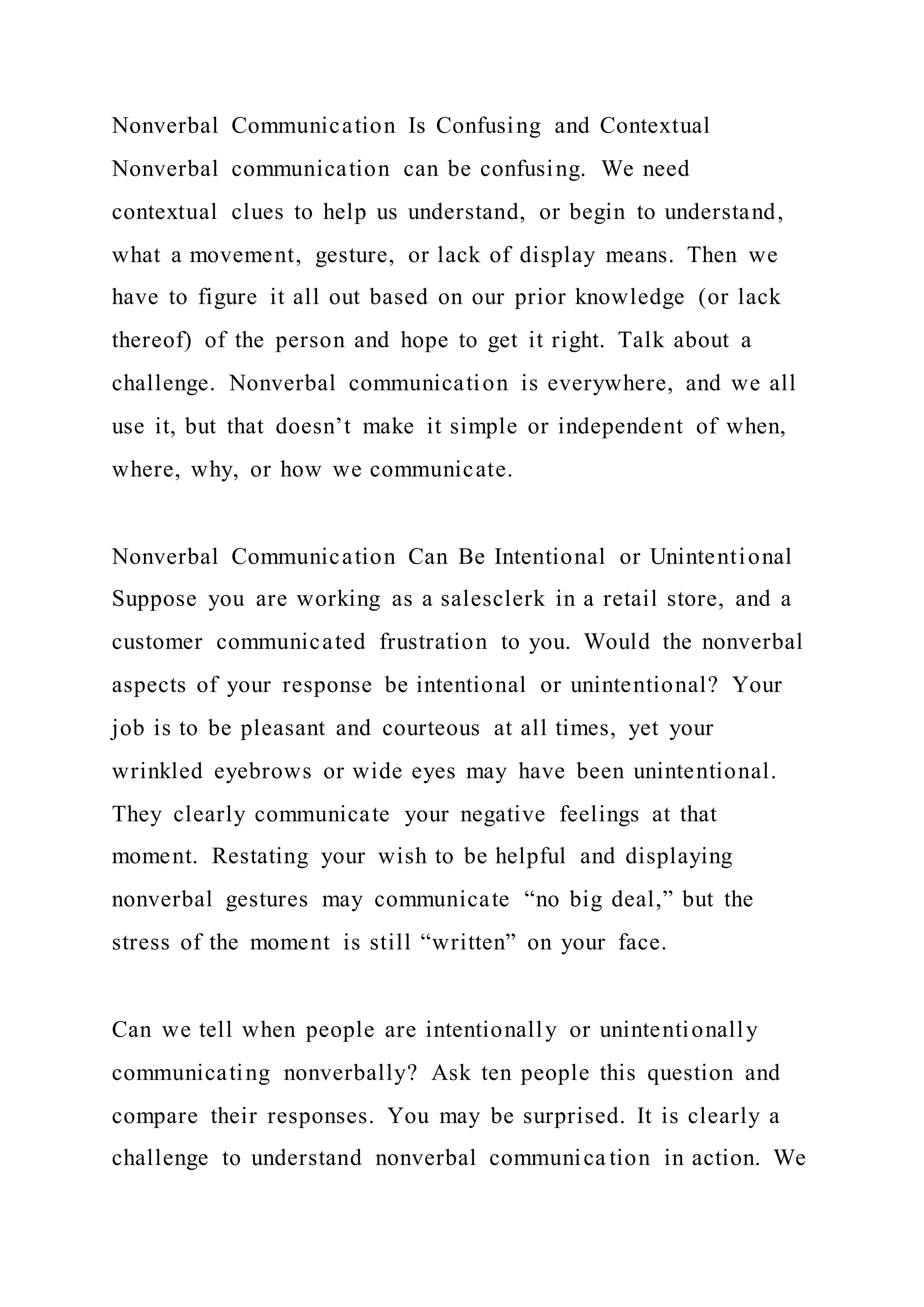
Nonverbal Communication Is Confusing and Contextual
Nonverbal communication can be confusing. We need
contextual clues to help us understand, or begin to understand,
what a movement, gesture, or lack of display means. Then we
have to figure it all out based on our prior knowledge (or lack
thereof) of the person and hope to get it right. Talk about a
challenge. Nonverbal communication is everywhere, and we all
use it, but that doesn’t make it simple or independent of when,
where, why, or how we communicate.
Nonverbal Communication Can Be Intentional or Unintentional
Suppose you are working as a salesclerk in a retail store, and a
customer communicated frustration to you. Would the nonverbal
aspects of your response be intentional or unintentional? Your
job is to be pleasant and courteous at all times, yet your
wrinkled eyebrows or wide eyes may have been unintentional.
They clearly communicate your negative feelings at that
moment. Restating your wish to be helpful and displaying
nonverbal gestures may communicate “no big deal,” but the
stress of the moment is still “written” on your face.
Can we tell when people are intentionally or unintentionally
communicating nonverbally? Ask ten people this question and
compare their responses. You may be surprised. It is clearly a
challenge to understand nonverbal communica tion in action. We
often assign intentional motives to nonverbal communication
when in fact their display is unintentional, and often hard to
interpret.
Nonverbal Messages Communicate Feelings and Attitudes
Steven Beebe, Susan Beebe, and Mark Redmond offer us three
additional principals of interpersonal nonverbal communication
that serve our discussion. One is that you often react faster than
you think. Your nonverbal responses communicate your initial
reaction before you can process it through language or
formulate an appropriate response. If your appropriate, spoken
response doesn’t match your nonverbal reaction, you may give
away your true feelings and attitudes.[5]
Albert Mehrabian asserts that we rarely communicate emotional
messages through the spoken word. According to Mehrabian, 93
percent of the time we communicate our emotions nonverbally,
with at least 55 percent associated with facial gestures. Vocal
cues, body position and movement, and normative space
between speaker and receiver can also be clues to feelings and
attitudes.[6]
Is your first emotional response always an accurate and true
representation of your feelings and attitudes, or does your
emotional response change across time? We are all changing all
the time, and sometimes a moment of frustration or a flash of
anger can signal to the receiver a feeling or emotion that existed
for a moment, but has since passed. Their response to your
communication will be based on that perception, even though
you might already be over the issue. This is where the spoken
word serves us well. You may need to articulate clearly that you
were frustrated, but not anymore. The words spoken out loud
can serve to clarify and invite additional discussion.
We Believe Nonverbal Communication More than Verbal
Building on the example of responding to a situation with facial
gestures associated with frustration before you even have time
to think of an appropriate verbal response, let’s ask the
question: what would you believe, someone’s actions or their
words? According to William Seiler and Melissa Beall, most
people tend to believe the nonverbal message over the verbal
message. People will often answer that “actions speak louder
than words” and place a disproportionate emphasis on the
nonverbal response.[7] Humans aren’t logical all the time, and
they do experience feelings and attitudes that change. Still, we
place more confidence in nonverbal communication, particularly
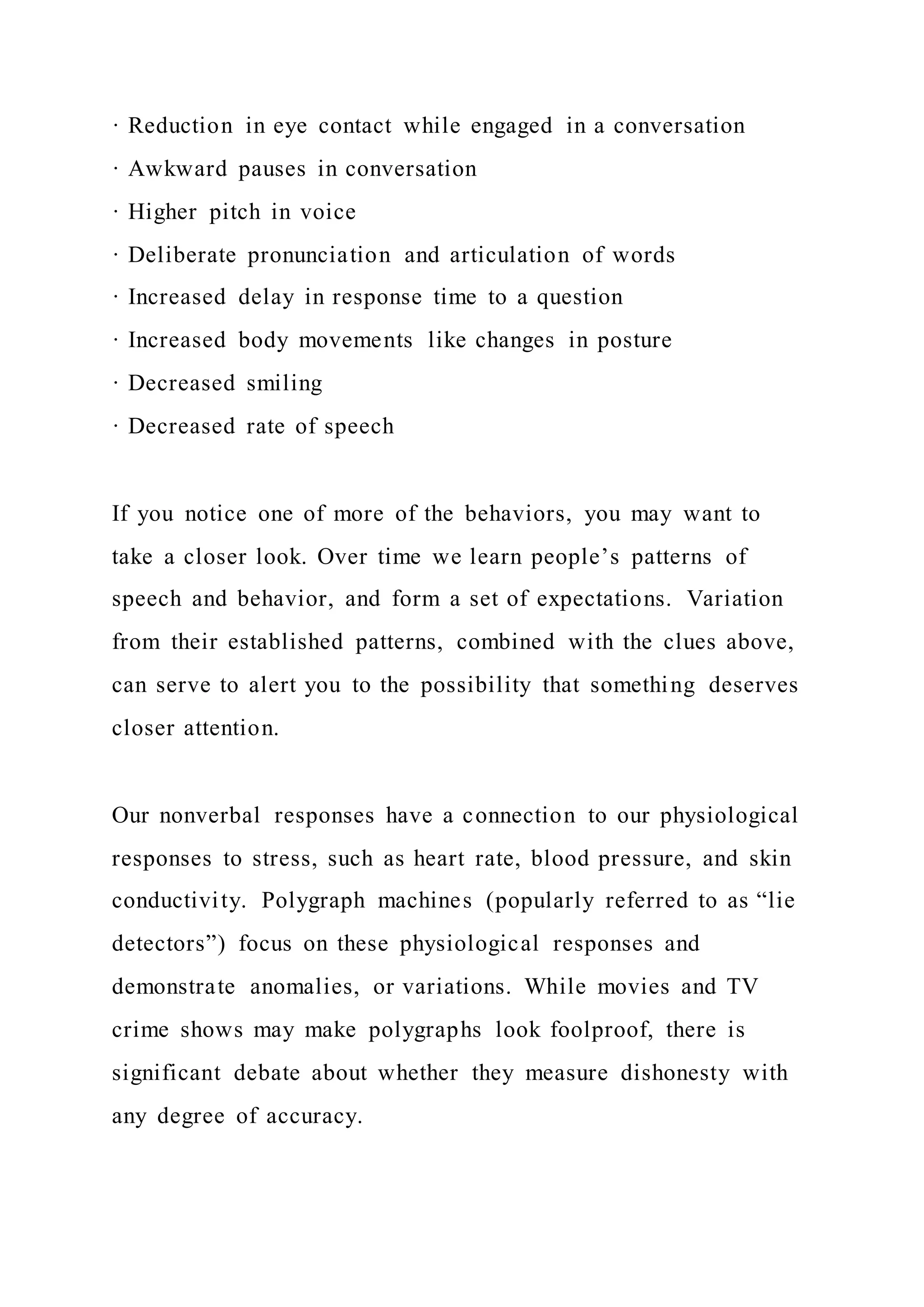
when it comes to lying behaviors. According to Miron
Zuckerman, Bella DePaulo, and Robert Rosenthal, there are
several behaviors people often display when they are being
deceptive:[8]
· Reduction in eye contact while engaged in a conversation
· Awkward pauses in conversation
· Higher pitch in voice
· Deliberate pronunciation and articulation of words
· Increased delay in response time to a question
· Increased body movements like changes in posture
· Decreased smiling
· Decreased rate of speech
If you notice one of more of the behaviors, you may want to
take a closer look. Over time we learn people’s patterns of
speech and behavior, and form a set of expectations. Variation
from their established patterns, combined with the clues above,
can serve to alert you to the possibility that something deserves
closer attention.
Our nonverbal responses have a connection to our physiological
responses to stress, such as heart rate, blood pressure, and skin
conductivity. Polygraph machines (popularly referred to as “lie
detectors”) focus on these physiological responses and
demonstrate anomalies, or variations. While movies and TV
crime shows may make polygraphs look foolproof, there is
significant debate about whether they measure dishonesty with
any degree of accuracy.
Can you train yourself to detect lies? It is unlikely. Our purpose
in studying nonverbal communication is not to uncover
dishonesty in others, but rather to help you understand how to
use the nonverbal aspects of communication to increase
understanding.
Nonverbal Communication Is Key in the Speaker/Audience
Relationship
When we first see each other, before anyone says a word, we are
already sizing each other up. Within the first few seconds we
have made judgments about each other based on what we wear,
our physical characteristics, even our posture. Are these
judgments accurate? That is hard to know without context, but
we can say that nonverbal communication certainly affects first
impressions, for better or worse. When a speaker and the
audience first meet, nonverbal communication in terms of space,
dress, and even personal characteristics can contribute to
assumed expectations. The expectations might not be accurate
or even fair, but it is important to recognize that they will be
present. There is truth in the saying, “You never get a second
chance to make a first impression.” Since beginnings are fragile
times, your attention to aspects you can control, both verbal and
nonverbal, will help contribute to the first step of forming a
relationship with your audience. Your eye contact with audience
members, use of space, and degree of formality will continue to
contribute to that relationship.
As a speaker, your nonverbal communication is part of the
message and can contribute to, or detract from, your overall
goals. By being aware of them, and practicing with a live
audience, you can learn to be more aware and in control.
[1] McLean, S. (2003). The basics of speech communication.
Boston, MA: Allyn & Bacon.
[2] McLean, S. (2003). The basics of speech communication (p.
77). Boston, MA: Allyn & Bacon.
[3] McLean, S. (2003). The basics of speech communication (p.
77). Boston, MA: Allyn & Bacon.
[4] McLean, S. (2003). The basics of speech communication (p.
77). Boston, MA: Allyn & Bacon.
[5] Beebe, S. [Steven], Beebe, S. [Susan], & Redmond, M.
(2002). Interpersonal communication relating to others (3rd
ed.). Boston, MA: Allyn & Bacon.
[6] Mehrabian, A. (1972). Nonverbal communication. Chicago,
IL: Aldine Atherton.
[7] Seiler, W., & Beall, M. (2000). Communication: Making
connections (4th ed.). Boston, MA: Allyn & Bacon.
[8] Zuckerman, M., DePaulo, B., & Rosenthal, R. (1981).
Verbal and nonverbal communication of deception. Advances in
Experimental Social Psychology, 14, 1–59.
11.2 Types of Nonverbal Communication
LEARNING OBJECTIVE
1. Describe the similarities and differences among eight general
types of nonverbal communication.
Now that we have discussed the general principles that apply to
nonverbal communication, let’s examine eight types of
nonverbal communication to further understand this challenging
aspect of communication:
1. Space
2. Time
3. Physical characteristics
4. Body movements
5. Touch
6. Paralanguage
7. Artifacts
8. Environment
Space
When we discuss space in a nonverbal context, we mean the
space between objects and people. Space is often associated
with social rank and is an important part of business
communication. Who gets the corner office? Why is the head of
the table important and who gets to sit there?
People from diverse cultures may have different normative
space expectations. If you are from a large urban area, having
people stand close to you may be normal. If you are from a rural
area or a culture where people expect more space, someone may
be standing “too close” for comfort and not know it.
Edward T. Hall, serving in the European and South Pacific
Regions in the Corps of Engineers during World War II,
traveled around the globe. As he moved from one place to
another, he noticed that people in different countries kept
different distances from each other. In France, they stood closer
to each other than they did in England. Hall wondered why that
was and began to study what he called proxemics, or the study
of the human use of space and distance in communication.[1]
In The Hidden Dimension, he indicated there are two main
aspects of space: territory and personal space. Hall drew on
anthropology to address the concepts of dominance and
submission, and noted that the more powerful person often
claims more space. This plays an important role in modern
society, from who gets the corner office to how we negotiate
space between vehicles. Road rage is increasingly common
where overcrowding occurs, and as more vehicles occupy the
same roads, tensions over space are predictable.
Territory is related to control. As a way of establishing control
over your own room, maybe you painted it your favorite color,
or put up posters that represent your interests or things you
consider unique about yourself. Families or households often
mark their space by putting up fences or walls around their
houses. This sense of a right to control your space is implici t in
territory. Territory means the space you claim as your own, are
responsible for, or are willing to defend.
The second aspect Hall highlights is personal space, or the
“bubble” of space surrounding each individual. As you walk
down a flight of stairs, which side do you choose? We may
choose the right side because we’ve learned that is what is
expected, and people coming up the same stair choose their
right. The right choice insures that personal space is not
compromised. But what happens when some comes up the wrong
side? They violate the understood rules of movement and often
correct themselves. But what happens if they don’t change lanes
as people move up and down the stairs? They may get dirty
looks or even get bumped as people in the crowd handle the
invasion of “their” space. There are no lane markers, and
bubbles of space around each person move with them, allowing
for the possibility of collision.
We recognize the basic need for personal space, but the
normative expectations for space vary greatly by culture. You
may perceive that in your home people sleep one to each bed,
but in many cultures people sleep two or more to a bed and it is
considered normal. If you were to share that bed, you might feel
uncomfortable, while someone raised with group sleeping norms
might feel uncomfortable sleeping alone. From where you stand
in an aerobics class in relation to others, to where you place
your book bag in class, your personal expectations of space are
often at variance with others.
As the context of a staircase has norms for nonverbal behavior,
so does the public speaking context. In North America, eye
contact with the audience is expected. Big movements and
gestures are not generally expected and can be distracting. The
speaker occupies a space on the “stage,” even if it’s in front of
the class. When you occupy that space, the audience will expect
to behave in certain ways. If you talk to the screen behind you
while displaying a PowerPoint presentation, the audience may
perceive that you are not paying attention to them. Speakers are
expected to pay attention to, and interact with, the audience,
even if in the feedback is primarily nonverbal. Your movements
should coordinate with the tone, rhythm, and content of your
speech. Pacing back and forth, keeping your hands in your
pockets, or crossing your arms may communicate nervousness,
or even defensiveness, and detract from your speech.
Figure 11.2 Space: Four Main Categories of Distance
As a general rule, try to act naturally, as if you were telling a
friend a story, so that your body will relax and your nonverbal
gestures will come more naturally. Practice is key to your level
of comfort; the more practice you get, the more comfortable and
less intimidating it will seem to you.
Hall articulated four main categories of distance used in
communication as shown in Figure 11.2 "Space: Four Main
Categories of Distance".[2]
Time
Do you know what time it is? How aware you are of time varies
by culture and normative expectations of adherence (or
ignorance) of time. Some people, and the communities and
cultures they represent, are very time-oriented. The Euro
Railways trains in Germany are famous for departing and
arriving according to the schedule. In contrast, if you take the
train in Argentina, you’ll find that the schedule is more of an
approximation of when the train will leave or arrive.
“Time is money” is a common saying across many cultures, and
reveals a high value for time. In social contexts, it often reveals
social status and power. Who are you willing to wait for? A
doctor for an office visit when you are sick? A potential
employer for a job interview? Your significant other or
children? Sometimes we get impatient, and our impatience
underscores our value for time.
When you give a presentation, does your audience have to wait
for you? Time is a relevant factor of the communication process
in your speech. The best way to show your audience respect is
to honor the time expectation associated with your speech.
Always try to stop speaking before the audience stops listening;
if the audience perceives that you have “gone over time,” they
will be less willing to listen. This in turn will have a negative
impact on your ability to communicate your message.
Suppose you are presenting a speech that has three main points.
Your audience expects you to regulate the time and attention to
each point, but if you spend all your time on the first two points
and rush through the third, your speech won’t be balanced and
will lose rhythm. The speaker occupies a position of some
power, but it is the audience that gives them that position. By
displaying respect and maintaining balance, you will move
through your points more effectively.
Chronemics is the study of how we refer to and perceive time.
Tom Bruneau at Radford University has spent a lifetime
investigating how time interacts in communication and
culture.[3],[4],[5] As he notes, across Western society, time is
often considered the equivalent of money. The value of speed is
highly prized in some societies.[6] In others, there is a great
respect for slowing down and taking a long-term view of time.
When you order a meal at a fast food restaurant, what are your
expectations for how long you will have to wait? When you
order a pizza online for delivery, when do you expect it will
arrive? If you order cable service for your home, when do you
expect it might be delivered? In the first case, you might
measure the delivery of a hamburger in a matter of seconds or
minutes, and perhaps thirty minutes for pizza delivery, but you
may measure the time from your order to working cable in days
or even weeks. You may even have to be at your home from 8
a.m. to noon, waiting for its installation. The expectations vary
by context, and we often grow frustrated in a time-sensitive
culture when the delivery does not match our expectations.
In the same way, how long should it take to respond to a
customer’s request for assistance or information? If they call on
the phone, how long should they be on hold? How soon should
they expect a response to an e-mail? As a skilled business
communicator, you will know to anticipate normative
expectations and do your best to meet those expectations more
quickly than anticipated. Your prompt reply or offer of help in
response to a request, even if you cannot solve the issue on the
spot, is often regarded positively, contributing to the formation
of positive communication interactions.
Across cultures the value of time may vary. Some Mexican
American friends may invite you to a barbecue at 8 p.m., but
when you arrive you are the first guest, because it is understood
that the gathering actually doesn’t start until after 9 p.m.
Similarly in France, an 8 p.m. party invitation would be
understood to indicate you should arrive around 8:30, but in
Sweden 8 p.m. means 8 p.m., and latecomers may not be
welcome. Some Native Americans, particularly elders, speak in
well-measured phrases and take long pauses between phrases.
They do not hurry their speech or compete for their turn,
knowing no one will interrupt them.[7] Some Orthodox Jews
observe religious days when they do not work, cook, drive, or
use electricity. People around the world have different ways of
expressing value for time.
Physical Characteristics
You didn’t choose your birth, your eye color, the natural color
of your hair, or your height, but people spend millions every
year trying to change their physical characteristics. You can get
colored contacts; dye your hair; and if you are shorter than
you’d like to be, buy shoes to raise your stature a couple of
inches. You won’t be able to change your birth, and no matter
how much you stoop to appear shorter, you won’t change your
height until time and age gradually makes itself apparent. If you
are tall, you might find the correct shoe size, pant length, or
even the length of mattress a challenge, but there are rewards.
Have you ever heard that taller people get paid more?[8] There
is some truth to that idea. There is also some truth to the notion
that people prefer symmetrical faces (where both sides are
equal) over asymmetrical faces (with unequal sides; like a
crooked nose or having one eye or ear slightly higher than the
other).[9]
We often make judgments about a person’s personality or
behavior based on physical characteristics, and researchers are
quick to note that those judgments are often
inaccurate.[10],[11] Regardless of your eye or hair color, or
even how tall you are, being comfortable with yourself is an
important part of your presentation. Act naturally and consider
aspects of your presentation you can control in order to
maximize a positive image for the audience.
Body Movements
The study of body movements, called kinesics, is key to
understanding nonverbal communication. Since your actions
will significantly contribute to the effectiveness of your
business interactions, let’s examine four distinct ways body
movements that complement, repeat, regulate, or replace your
verbal messages.
Body movements can complement the verbal message by
reinforcing the main idea. For example, you may be providing
an orientation presentation to a customer about a software
program. As you say, “Click on this tab,” you may also initiate
that action. Your verbal and nonverbal messages reinforce each
other. You can also reinforce the message by repeating it. If you
first say, “Click on the tab,” and then motion with your hand to
the right, indicating that the customer should move the cursor
arrow with the mouse to the tab, your repetition can help the
listener understand the message.
In addition to repeating your message, body movements can also
regulate conversations. Nodding your head to indicate that you
are listening may encourage the customer to continue asking
questions. Holding your hand up, palm out, may signal them to
stop and provide a pause where you can start to answer.
Body movements also substitute or replace verbal messages.
Ekman and Friesen found that facial features communicate to
others our feelings, but our body movements often reveal how
intensely we experience those feelings.[12] For example, if the
customer makes a face of frustration while trying to use the
software program, they may need assistance. If they push away
from the computer and separate themselves physically from
interacting with it, they may be extremely frustrated. Learning
to gauge feelings and their intensity as expressed by customers
takes time and patience, and your attention to them will improve
your ability to facilitate positive interactions.
Touch
Touch in communication interaction is called haptics, and
William Seiler and Meliss Beall[13] identify five distinct types
of touch, from impersonal to intimate, as listed in Table 11.2
"Types of Touch".
Table 11.2 Types of Touch
Term
Definition
1. Functional-Professional Touch
Medical examination, physical therapy, sports coach, music
teacher
2. Social-Polite Touch
Handshake
3. Friendship-Warmth Touch
Hug
4. Love-Intimacy Touch
Kiss between family members or romantic partners
5. Sexual-Arousal Touch
Sexual caressing and intercourse
Before giving your presentation, you may interact with people
by shaking hands and making casual conversation. This
interaction can help establish trust before you take the stage.
While speaking in public we do not often touch people in the
audience, but we do interact with visual aids, our note cards,
and other objects. How we handle them can communicate our
comfort level. It’s always a good idea to practice using the
technology, visual aids, or note cards you will use in a speech
during a practice session. Using the technology correctly by
clicking the right button on the mouse or pressing the right
switch on the overhead projector can contribute to your
credibility.
Paralanguage
Paralanguage is the exception to the definition of nonverbal
communication. You may recall that we defined nonverbal
communication as not involving words, but paralanguage exists
when we are speaking, using words. Paralanguage involves
verbal and nonverbal aspects of speech that influence meaning,
including tone, intensity, pausing, and even silence.
Perhaps you’ve also heard of a pregnant pause, a silence
between verbal messages that is full of meaning. The meaning
itself may be hard to understand or decipher, but it is there
nonetheless. For example, your coworker Jan comes back from a
sales meeting speechless and with a ghost-white complexion.
You may ask if the meeting went all right. “Well, ahh…” may
be the only response you get. The pause speaks volumes.
Something happened, though you may not know what. It could
be personal if Jan’s report was not well received, or it could b e
more systemic, like the news that sales figures are off by 40
percent and pink slips may not be far behind.
Silence or vocal pauses can communicate hesitation, indicate
the need to gather thought, or serve as a sign of respect. Keith
Basso quotes an anonymous source as stating, “It is not the case
that a man who is silent says nothing.”[14] Sometimes we learn
just as much, or even more, from what a person does not say as
what they do say. In addition, both Basso and Susan Philips
found that traditional speech among Native Americans places a
special emphasis on silence.[15]
Artifacts
Do you cover your tattoos when you are at work? Do you know
someone who does? Or perhaps you know someone who has a
tattoo and does not need to cover it up on their job?
Expectations vary a great deal, but body art or tattoos are still
controversial in the workplace. According to the San Diego
Union-Tribune,[16]
· 20 percent of workers indicated their body art had been held
against them on the job.
· 42 percent of employers said the presence of visible body art
lowered their opinion of workers.
· 44 percent of managers surveyed have body art.
· 52 percent of workers surveyed have body art.
· 67 percent of workers who have body art or piercings cover or
remove them during work hours.
In your line of work, a tattoo might be an important visual aid,
or it might detract from your effectiveness as a business
communicator. Body piercings may express individuality, but
you need to consider how these will be interpreted by employers
and customers.
Artifacts are forms of decorative ornamentation that are chosen
to represent self-concept. They can include rings and tattoos,
but may also include brand names and logos. From clothes to
cars, watches, briefcases, purses, and even eyeglasses, what we
choose to surround ourselves with communicates something
about our sense of self. They may project gender, role or
position, class or status, personality, and group membership or
affiliation. Paying attention to a customer’s artifacts can give
you a sense of the self they want to communicate, and may
allow you to more accurately adapt your message to meet their
needs.
Environment
Environment involves the physical and psychological aspects of
the communication context. More than the tables and chairs in
an office, environment is an important part of the dynamic
communication process. The perception of one’s environment
influences one’s reaction to it. For example, Google is famous
for its work environment, with spaces created for physical
activity and even in-house food service around the clock. The
expense is no doubt considerable, but Google’s actions speak
volumes. The results produced in the environment, designed to
facilitate creativity, interaction, and collaboration, are worth the
effort.
[1] Hall, E. T. (1963). Proxemics: The study of man’s spacial
relations and boundaries. In Iago Galdston (Ed.), Man’s image
in medicine and anthropology (pp. 422–445). New York, NY:
International Universities Press.
[2] Hall, E. (1966). The hidden dimension. New York, NY:
Doubleday.
[3] Bruneau, T. (1974). Time and nonverbal
communication. Journal of Poplular Culture, 8, 658–666.
[4] Bruneau, T. (1990). Chronemics: The study of time in
human interaction. In J. DeVito & M. Hecht (Eds.), The
nonverbal reader (pp. 301–311). Prospect Heights, IL:
Waveland Press.
[5] Bruneau, T., & Ishii, S. (1988). Communicative silence:
East and west. World Communication, 17, 1–33.
[6] Schwartz, T. (1989, January/February). Acceleration
syndrome: Does everyone live in the fast lane? Utne Reader, 31,
36–43.
[7] McLean, S. (1998). Turn-taking and the extended pause: A
study of interpersonal communication styles across generations
on the Warm Springs Indian reservation. In K. S. Sitaram & M.
Prosser (Eds.), Civic discourse: Multiculturalsim, cultural
diversity, and global communication (pp. 213–227). Stamford,
CT: Ablex Publishing Company.
[8] Burnham, T., & Phelan, J. (2000). Mean genes: From sex to
money to food: Taming our primal instincts. Cambridge, MA:
Perseus.
[9] Burnham, T., & Phelan, J. (2000). Mean genes: From sex to
money to food: Taming our primal instincts. Cambridge, MA:
Perseus.
[10] Wells, W., & Siegel, B. (1961). Stereotypes
somatypes. Psychological Reports, 8, 77–78.
[11] Cash, T., & Kilcullen, R. (1985). The eye of the beholder:
Susceptibility to sexism and beautyism in the evaluation of
managerial applicants. Journal of Applied Social Psychology,
15, 591–605.
[12] Ekman, P., & Friesen, W. (1967). Head and body cures in
the judgment of emotions: A reformulation. Perceptual and
Motor Skills, 24, 711–724.
[13] Seiler, W., & Beall, M. (2000). Communication: Making
connections (4th ed.). Boston, MA: Allyn & Bacon.
[14] Basso, K. A. (1970). To give up on words: Silence in
western Apache culture. In D. Carbaugh (Ed.), Cultural
communication and intercultural contact (pp. 301–318).
Hillsdale, NJ: Laurence Erlbaum.
[15] Philips, S. (1983). The invisible culture: Communication in
the classroom and community on the Warm Springs Indian
Reservation. Chicago, IL: Waveland Press.
[16] Kinsman, M. (2001, August 20). Tattoos and nose
rings. San Diego Union-Tribune, p. C1.
11.3 Movement in Your Speech
LEARNING OBJECTIVE
1. Demonstrate how to use movement to increase the
effectiveness of your presentation.
At some point in your business career you will be called upon to
give a speech. It may be to an audience of one on a sales floor,
or to a large audience at a national meeting. You already know
you need to make a positive first impression, but do you know
how to use movement in your presentation? In this section we’ll
examine several strategies for movement and their relative
advantages and disadvantages.
Customers and audiences respond well to speakers who are
comfortable with themselves. Comfortable doesn’t mean
overconfident or cocky, and it doesn’t mean shy or timid. It
means that an audience is far more likely to forgive the
occasional “umm” or “ahh,” or the nonverbal equivalent of a
misstep, if the speaker is comfortable with themselves and their
message.
Let’s start with behaviors to avoid. Who would you rather listen
to: a speaker who moves confidently across the stage or one
who hides behind the podium; one who expresses herself
nonverbally with purpose and meaning or one who crosses his
arms or clings to the lectern?
Audiences are most likely to respond positively to open,
dynamic speakers who convey the feeling of being at ease with
their bodies. The setting, combined with audience expectations,
will give a range of movement. If you are speaking at a formal
event, or if you are being covered by a stationary camera, you
may be expected to stay in one spot. If the stage allows you to
explore, closing the distance between yourself and your
audience may prove effective. Rather than focus on a list of
behaviors and their relationship to environment and context,
give emphasis to what your audience expects and what you
yourself would find more engaging instead.
Novice speakers are often told to keep their arms at their sides,
or to restrict their movement to only that which is absolutely
necessary. If you are in formal training for a military
presentation, or a forensics (speech and debate) competition,
this may hold true. But in business and industry, “whatever
works” rules the day. You can’t say that expressive gestures—
common among many cultural groups, like arm movement while
speaking—are not appropriate when they are, in fact, expected.
The questions are, again, what does your audience consider
appropriate and what do you feel comfortable doing during your
presentation? Since the emphasis is always on meeting the
needs of the customer, whether it is an audience of one on a
sales floor or a large national gathering, you may need to
stretch outside your comfort zone. On that same note, don’t
stretch too far and move yourself into the uncomfortable range.
Finding balance is a challenge, but no one ever said giving a
speech was easy.
Movement is an important aspect of your speech and requires
planning, the same as the words you choose and the visual aids
you design. Be natural, but do not naturally shuffle your feet,
pace back and forth, or rock on your heels through your entire
speech. These behaviors distract your audience from your
message and can communicate nervousness, undermining your
credibility.
Positions on the Stage
Figure 11.3 Speaker’s Triangle
In a classical speech presentation, positions on the stage serve
to guide both the speaker and the audience through transitions.
The speaker’s triangle (see Figure 11.3 "Speaker’s Triangle")
indicates where the speaker starts in the introduction, moves to
the second position for the first point, across for the second
point, then returns to the original position to make the third
point and conclusion. This movement technique can be quite
effective to help you remember each of your main points. It
allows you to break down your speech into manageable parts,
and putting tape on the floor to indicate position is a common
presentation trick. Your movement will demonstrate purpose
and reinforce your credibility.
Gestures
Gestures involve using your arms and hands while
communicating. Gestures provide a way to channel your
nervous energy into a positive activity that benefits your speech
and gives you something to do with your hands. For example,
watch people in normal, everyday conversations. They
frequently use their hands to express themselves. Do you
think theythink about how they use their hands? Most people do
not. Their arm and hand gestures come naturally as part of their
expression, often reflecting what they have learned withi n their
community.
For professional speakers this is also true, but deliberate
movement can reinforce, repeat, and even regulate an
audience’s response to their verbal and nonverbal messages.
You want to come across as comfortable and natural, and your
use of your arms and hands contributes to your presentation. We
can easily recognize that a well-chosen gesture can help make a
point memorable or lead the audience to the next point.
As professional speakers lead up to a main point, they raise
their hand slightly, perhaps waist high, often called
an anticipation step. The gesture clearly shows the audience
your anticipation of an upcoming point, serving as a nonverbal
form of foreshadowing.
The implementation step, which comes next, involves using
your arms and hands above your waist. By holding one hand at
waist level pointing outward, and raising it up with your palm
forward, as in the “stop” gesture, you signal the point. The
nonverbal gesture complements the spoken word, and as
students of speech have noted across time, audiences respond to
this nonverbal reinforcement. You then slowly lower your hand
down past your waistline and away from your body, letting go
of the gesture, and signaling your transition.
The relaxation step, where the letting go motion complements
your residual message, concludes the motion.
Facial Gestures
As you progress as a speaker from gestures and movement, you
will need to turn your attention to facial gestures and
expressions. Facial gestures involve using your face to display
feelings and attitudes nonverbally. They may reinforce, or
contradict, the spoken word, and their impact cannot be
underestimated. As we have discussed, people often focus more
on how we say something than what we actually say, and place
more importance on our nonverbal gestures.[1] As in other body
movements, your facial gestures should come naturally, but
giving them due thought and consideration can keep you aware
of how you are communicating the nonverbal message.
Facial gestures should reflect the tone and emotion of your
verbal communication. If you are using humor in your speech,
you will likely smile and wink to complement the amusement
expressed in your words. Smiling will be much less appropriate
if your presentation involves a serious subject such as cancer or
car accidents. Consider how you want your audience to feel in
response to your message, and identify the facial gestures you
can use to promote those feelings. Then practice in front of a
mirror so that the gestures come naturally.
The single most important facial gesture (in mainstream U.S.
culture) is eye contact.[2]Eye contact refers to the speaker’s
gaze that engages the audience members. It can vary in degree
and length, and in many cases, is culturally influenced. Both in
the speaker’s expectations and the audience member’s notion of
what is appropriate will influence normative expectations for
eye contact. In some cultures, there are understood behavioral
expectations for male gaze directed toward females, and vice
versa. In a similar way, children may have expectations of when
to look their elders in the eye, and when to gaze down.
Depending on the culture, both may be nonverbal signals of
listening. Understanding your audience is critical when it comes
to nonverbal expectations.
When giving a presentation, avoid looking over people’s heads,
staring at a point on the wall, or letting your eyes dart all over
the place. The audience will find these mannerisms unnerving.
They will not feel as connected, or receptive, to your message
and you will reduce your effectiveness. Move your eyes
gradually and naturally across the audience, both close to you
and toward the back of the room. Try to look for faces that look
interested and engaged in your message. Do not to focus on only
one or two audience members, as audiences may respond
negatively to perceived favoritism. Instead, try to give as much
eye contact as possible across the audience. Keep it natural, but
give it deliberate thought.
[1] Mehrabian, A. (1981). Silent messages: Implicit
communication of emotions and attitudes (2nd ed.). Belmont,
CA: Wadsworth.
[2] Seiler, W., & Beall, M. (2000). Communication: Making
connections (4th ed.). Boston, MA: Allyn & Bacon.
11.4 Visual Aids
LEARNING OBJECTIVE
1. Demonstrate how to use visual aids effectively in your
presentation.
Almost all presentations can be enhanced by the effective use of
visual aids. These can include handouts, overhead
transparencies, drawings on the whiteboard, PowerPoint slides,
and many other types of props. Visual aids are an important
nonverbal aspect of your speech that you can control. Once you
have chosen a topic, you need to consider how you are going to
show your audience what you are talking about.
Have you ever asked for driving directions and not understood
someone’s response? Did the person say, “Turn right at Sam’s
Grocery Store, the new one” or “I think you will turn at the
second light, but it might be the third one”? Chances are that
unless you know the town well or have a map handy, the visual
cue of a grocery store or a traffic light might be insufficient to
let you know where to turn. Your audience experiences the same
frustration, or sense of accomplishment, when they get lost or
find their way during your speech. Consider how you can
express yourself visually, providing common references,
illustrations, and images that lead the audience to understand
your point or issue.
Visual aids accomplish several goals:
· Make your speech more interesting
· Enhance your credibility as a speaker
· Serve as guides to transitions, helping the audience stay on
track
· Communicate complex or intriguing information in a short
period of time
· Reinforce your verbal message
· Help the audience use and retain the information
Purpose, Emphasis, Support, and Clarity
When you look at your own presentation from an audience
member’s perspective, you might consider how to distinguish
the main points from the rest of the information. You might also
consider the relationships being presented between ideas or
concepts, or how other aspects of the presentation can
complement the oral message.
Your audience naturally will want to know why you are
presenting the visual aid. The purpose for each visual aid should
be clear, and almost speak for itself. If you can’t quickly grasp
the purpose of a visual aid in a speech, you have to honestly
consider whether it should be used in the first place. Visual aids
can significantly develop the message of a speech, but they
must be used for a specific purpose the audience can easily
recognize.
Perhaps you want to highlight a trend between two related
issues, such as socioeconomic status and educational
attainment. A line graph might show effectively how, as
socioeconomic status rises, educational attainment also rises.
This use of a visual aid can provide emphasis, effectively
highlighting key words, ideas, or relationships for the audience.
Visual aids can also provide necessary support for your
position. Audience members may question your assertion of the
relationship between socioeconomic status and educational
attainment. To support your argument, you might include on the
slide, “According to the U.S. Department of Education Study
no. 12345,” or even use an image of the Department of
Education Web page projected on a large screen. You might
consider showing similar studies in graphic form, illustrating
similarities across a wide range of research.
Clarity is key in the use of visual aids. One way to improve
clarity is to limit the number of words on a PowerPoint slide.
No more than ten words per slide, with a font large enough to
be read at the back of the room or auditorium, is a good rule of
thumb. Key images that have a clear relationship to the verbal
message can also improve clarity. You may also choose to
illustrate the same data successively in two distinct formats,
perhaps a line graph followed by two pie graphs. Your central
goal is to ensure your visual aid is clear.
Methods and Materials
If you have been asked to give a presentation on a new product
idea that a team within your organization is considering, how
might you approach the challenge? You may consider a
chronological organization pattern, starting with background,
current market, and a trend analysis of what is to come—fair
enough, but how will you make it vivid for your audience? How
to represent information visually is a significant challenge, and
you have several options.
You may choose to use a chart or diagram to show a timeline of
events to date, from the first meeting about the proposed
product to the results from the latest focus group. This timeline
may work for you, but let’s say you would like to get into the
actual decision-making process that motivated your team to
design the product with specific features in the first place. You
may decide to use decision trees (or tree diagrams) showing the
variables and products in place at the beginning of your
discussions, and how each decision led to the next, bringing you
to the decision-making point where you are today.
To complement this comprehensive guide and help make a
transition to current content areas of questions, you may use a
bar or pie graph to show the percentage of competing products
in the market. If you have access to the Internet and a projector,
you may use a topographical map showing a three-dimensional
rendering of the local areas most likely to find your product
attractive. If actual hills and valleys have nothing to do with
your project, you can still represent the data you have collected
in three dimensions. Then you may show a comparable graph
illustrating the distribution of products and their relative degree
of market penetration.
Finally, you may move to the issue of results, and present the
audience with a model of your product and one from a
competitor, asking which they prefer. The object may be just
the visual aid you need to make your point and reinforce the
residual message. When we can see, feel, touch, or be in close
proximity to an object it often has a greater impact. In a world
of digital images and special effects, objects presented in real
time can still make a positive effect on the audience.
Additional visual aids you may choose include—but are not
limited to—sound and music, video, and even yourself. If your
speech is about how to use the product, your demonstration may
just be the best visual aid.
You will want to give some thought to how to portray your
chart, graph, or object when it’s time to use your visual aids.
The chalk or white board is common way of presenting visual
aids, but it can get messy. Your instructor may write key words
or diagrams on the boards while discussing a textbook chapter,
but can you read his or her writing? The same lesson holds true
for you. If you are going to use a white board and have a series
of words on it, write them out clearly before you start your
presentation.
Flip charts on a pedestal can also serve to show a series of steps
or break a chart down into its basic components. A poster board
is another common way of organizing your visual aids before a
speech, but given its often one-time use, it is losing out to the
computer screen. It is, however, portable and allows you a large
“blank page” with which to express your ideas.
Handouts may also serve to communicate complex or detailed
information to the audience, but be careful never to break
handout rule number one: never give handouts to the audience at
the beginning of your speech. Where do you want the audience
to look—at you or at the handout? Many novice speakers might
be tempted to say the handout, but you will no doubt recognize
how that diverts and divides the audience’s attention. People
will listen to the words from the handout in their minds and
tune you out. They will read at their own pace and have
questions. They may even be impolite enough to use them as
fans or paper airplanes. Handouts can be your worst enemy. If
you need to use one, state at the beginning of the speech that
you will be providing one at the conclusion of your
presentation. This will alleviate the audience’s worry about
capturing all your content by taking notes, and keep their
attention focused on you while you speak.
Transparencies and slides have been replaced by computer -
generated slide show programs like PowerPoint by Microsoft,
which we will discuss in greater detail later in this section.
These programs can be very helpful in presenting visual
information, but because computers and projectors sometimes
break down and fail to work as planned, you need a plan B. You
may need a poster board, or to write on the whiteboard or to
have a handout in reserve, but a Plan B is always a good idea
when it comes to presentations that integrate technology. You
may arrive at your destination and find the equipment is no
longer available, is incompatible with your media storage
device, or is simply not working, but the show must go on.
Video clips, such as those you might find on YouTube, can also
be effective visual aids. However, as with handouts, there is one
concern: You don’t want the audience to want to watch the
video more than they want to tune into your presentation. How
do you prevent this? Keep the clip short and make sure it
reinforces the central message of your presentation. Always
stop speaking before the audience stops listening, and the same
holds true for the mesmerizing force of moving images on a
screen. People are naturally attracted to them and will get
“sucked into” your video example rather quickly. Be a good
editor, introduce the clip and state what will happen out loud,
point out a key aspect of it to the audience while it plays
(overlap), and then make a clear transitional statement as you
turn it off. Transitions are often the hardest part of any speech
as the audience can get off track, and video clips are one of the
most challenging visual aids you can choose because of their
power to attract attention. Use that power wisely.
Preparing Visual Aids
Get started early so that you have time to create or research
visual aids that will truly support your presentation, not just
provide “fluff.” Make sure you use a font or image large enough
to be legible for those in the back of the room, and that you
actually test your visual aids before the day of your
presentation. Ask a friend to stand at the back of the room and
read or interpret your visual aid. If you are using computer -
generated slides, try them out in a practice setting, not just on
your computer screen. The slides will look different when
projected. Allow time for revision based on what you learn.
Your visual aids should meet the following criteria:
· Big. They should be legible for everyone, and should be “back
row certified.”
· Clear. Your audience should “get it” the first time they see it.
· Simple. They should serve to simplify the concepts they
illustrate.
· Consistent. They should reinforce continuity by using the
same visual style.
Using Visual Aids
Here are three general guidelines to follow when using visual
aids.[1] Here are some dos and don’ts:
1. Do make a clear connection between your words and the
visual aid for the audience.
2. Do not distract the audience with your visual aid, blocking
their view of you or adjusting the visual aid repeatedly while
trying to speak.
3. Do speak to your audience—not to the whiteboard, the video,
or other visual aids.
The timing of your presentation, and of your visual aids, can
also have good or bad consequences. According to a popular
joke, a good way to get your boss to approve just about
anything is to schedule a meeting after lunch, turn the lights
down, and present some boring PowerPoint slides. While the
idea of a drowsy boss signing off on a harebrained project is
amusing, in reality you will want to use visual aids not as a
sleeping potion but as a strategy to keep your presentation
lively and interesting.
Becoming proficient at using visual aids takes time and
practice, and the more you practice before your speech, the
more comfortable you will be with your visual aids and the role
they serve in illustrating your points. Planning ahead before
speaking will help, but when it comes time to actually give your
speech, make sure they work for the audience as they should.
Speaking to a visual aid (or reading it with your back to the
audience) is not an effective strategy. You should know your
material well enough that you refer to a visual aid, not rely on
it.
Using MS PowerPoint as a Visual Aid
MS PowerPoint and similar visual representation programs can
be an effective tool to help audiences remember your message,
but they can also be an annoying distraction to your speech.
How you prepare your slides and use the tool will determine
your effectiveness.
MS PowerPoint is a slideware program that you have no doubt
seen used in class, presentation at work, or perhaps used
yourself to support a presentation. MS PowerPoint and similar
slideware programs provide templates for
creating electronic slides to present visual information to the
audience, reinforcing the verbal message. You’ll be able to
import, or cut and paste, words from text files, images, or video
clips to create slides to represent your ideas. You can even
incorporate Web links. When using any software program, it’s
always a good idea to experiment with it long before you intend
to use it, explore its many options and functions, and see how it
can be an effective tool for you.
At first, you might be overwhelmed by the possibilities, and you
might be tempted to use all the bells, whistles, and sound
effects, not to mention the tumbling, flying, and animated
graphics. If used wisely, a dissolve or key transition can be like
a well-executed scene from a major motion picture film and lead
your audience to the next point. But if used indiscriminately, it
can annoy the audience to the point where they cringe in
anticipation of the sound effect at the start of each slide. This
danger is inherent in the tool, but you are in charge of it and
can make wise choices that enhance the understanding and
retention of your information.
The first point to consider is what is the most important visual
aid? The answer is you, the speaker. You will facilitate the
discussion, give life to the information, and help the audience
correlate the content to your goal or purpose. You don’t want to
be in a position where the PowerPoint presentation is the main
focus and you are on the side of the stage, simply helping the
audience follow along. It should support you in your
presentation, rather than the other way around. Just as there is a
number one rule for handouts, there is also one for MS
PowerPoints: do not use MS PowerPoints as a read-aloud script
for your speech. The MS PowerPoints should amplify and
illustrate your main points, not reproduce everything you are
going to say.
Your pictures are the second area of emphasis you’ll want to
consider. The tool will allow you to show graphs, charts and
illustrate relationships that words may only approach in terms
of communication, but your verbal support of the visual images
will make all the difference. Dense pictures or complicated
graphics will confuse more than clarify. Choose clear images
that have an immediate connection to both your content and the
audience, tailored to their specific needs. After images, consider
only key words that can be easily read to accompany your
pictures. The fewer words the better: try to keep each slide to a
total word count of less than ten words. Do not use full
sentences. Using key words provides support for your verbal
discussion, guiding you as well as your audience. The key
words can serve as signposts or signal words related to key
ideas.
A natural question at this point is, “How do I communicate
complex information simply?” The answer comes with several
options. The visual representation on the screen is for support
and illustration. Should you need to communicate more
technical, complex, or in-depth information in a visual way,
consider preparing a handout to distribute at the conclusion of
your speech. You may also consider using a printout of your
slide show with a “notes” section, but if you distribute it at the
beginning of your speech, you run the risk of turning your
presentation into a guided reading exercise and possibly
distracting or losing members of the audience. Everyone reads
at a different pace and takes notes in their own way. You don’t
want to be in the position of going back and forth between
slides to help people follow along.
Another point to consider is how you want to use the tool to
support your speech and how your audience will interpret its
presentation. Most audiences wouldn’t want to read a page of
text—as you might see in this book—on the big screen. They’ll
be far more likely to glance at the screen and assess the
information you present in relation to your discussion.
Therefore, it is key to consider one main idea, relationship, or
point per slide. The use of the tool should be guided with the
idea that its presentation is for the audience’s benefit, not
yours. People often understand pictures and images more
quickly and easily than text, and you can use this to your
advantage, using the knowledge that a picture is worth a
thousand words.
Use of Color
People love color, and understandably your audience will
appreciate the visual stimulation of a colorful presentation. If
you have ever seen a car painted a custom color that just didn’t
attract you, or seen colors put together in ways that made you
wonder what people were thinking when they did that, you will
recognize that color can also distract and turn off an audience.
Color is a powerful way to present information, and the power
should be used wisely. You will be selecting which color you
want to use for headers or key words, and how they relate the
colors in the visual images. Together, your images, key words,
and the use of color in fonts, backgrounds, table, and graphs can
have a significant impact on your audience. You will need to
give some thought and consideration to what type of impact you
want to make, how it will contribute or possibly distract, and
what will work well for you to produce an effective and
impressive presentation.
There are inherent relationships between colors, and while you
may have covered some of this information in art classes you
have taken, it is valuable to review here. According to the
standard color wheel, colors are grouped into primary,
secondary, and tertiary categories. Primary colors are the colors
from which other colors are made through various
combinations. Secondary colors represent a combination of two
primary colors, while tertiary colors are made from
combinations of primary and secondary colors.
· Primary colors. Red, blue and yellow
· Secondary colors. Green, violet, and orange
· Tertiary colors. Red-orange, red-violet, blue-violet, blue-
green, yellow-orange, and yellow-green
Colors have relationships depending on their location on the
wheel. Colors that are opposite each other are called
complementary and they contrast, creating a dynamic effect.
Analogous colors are located next to each other and promote
harmony, continuity, and sense of unity.
Your audience comes first: when considering your choice of
colors to use, legibility must be your priority. Contrast can help
the audience read your key terms more easily. Also, focus on
the background color and its relation to the images you plan to
incorporate to insure they complement each other. Consider
repetition of color, from your graphics to your text, to help
unify each slide. To reduce visual noise, try not to use more
than two or three additional colors. Use colors sparingly to
make a better impact, and consider the use of texture and
reverse color fonts (the same as a background or white) as an
option.
Be aware that many people are blue-green colorblind, and that
red-green colorblindness is also fairly common. With this in
mind, choose colors that most audience members will be able to
differentiate. If you are using a pie chart, for example, avoid
putting a blue segment next to a green one. Use labeling so that
even if someone is totally colorblind they will be able to tell the
relative sizes of the pie segments and what they signify.
Color is also a matter of culture. Some colors may be perceived
as formal or informal, or masculine or feminine. Recognize that
red is usually associated with danger, while green signals “go.”
Make sure the color associated with the word is reflected in
your choice. If you have a key word about nature, but the color
is metallic, the contrast may not contribute to the rhetorical
situation and confuse the audience.
Seeking a balance between professionalism and attractiveness
may seem to be a challenge, but experiment and test your drafts
with friends to see what works for you. Also consider
examining other examples, commonly available on the Internet,
but retain the viewpoint that not everything online is effective
nor should it be imitated. There are predetermined color
schemes already incorporated into PowerPoint that you can rely
on for your presentation.
We’ve given consideration to color in relation to fonts and the
representation of key words, but we also need to consider font
size and selection. MS PowerPoint will have default settings for
headlines and text, but you will need to consider what is most
appropriate for your rhetorical situation. Always think about the
person sitting in the back of the room. The title size should be
at least forty points, and the body text (used sparingly) should
be at least thirty-two points.
In Designing Visual Language: Strategies for Professional
Communicators,[2] Charles Kostelnick and David Roberts
provide a valuable discussion of fonts, font styles, and what to
choose to make an impact depending on your rhetorical
situation. One good principle they highlight is that sans serif
fonts such as Arial work better than serif fonts like Times New
Roman for images projected onto a screen. The thin lines and
extra aspects to serif the font may not portray themselves well
on a large screen or contribute to clarity. To you this may mean
that you choose Arial or a similar font to enhance clarity and
ease of reading. Kostelnick and Roberts also discuss the use of
grouping strategies to improve the communication of
information.[3] Bullets, the use of space, similarity, and
proximity all pertain to the process of perception, which differs
from one person to another.
Helpful Hints for Visual Aids
As we’ve discussed, visual aids can be a powerful tool when
used effectively, but can also run the risk of dominating your
presentation. As a speaker, you will need to consider your
audience and how the portrayal of images, text, graphic,
animated sequences, or sound files will contribute or detract
from your presentation. Here is a brief list of hints to keep in
mind as you prepare your presentation.
· Keep visual aids simple.
· Use one key idea per slide.
· Avoid clutter, noise, and overwhelming slides.
· Use large, bold fonts that the audience can read from at least
twenty feet from the screen.
· Use contrasting colors to create a dynamic effect.
· Use analogous colors to unify your presentation.
· Use clip art with permission and sparingly.
· Edit and proofread each slide with care and caution.
· Use copies of your visuals available as handouts after your
presentation.
· Check the presentation room beforehand.
· With a MS PowerPoint presentation, or any presentation
involving technology, have a backup plan, such as your visuals
printed on transparencies, should unexpected equipment or
interface compatibility problems arise
Becoming proficient at using visual aids takes time and
practice. The more you practice before your speech, the more
comfortable you will be with your visual aids and the role they
serve in illustrating your message. Giving thought to where to
place visual aids before speaking helps, but when the time
comes to actually give your speech, make sure you reassess
your plans and ensure that they work for the audience as they
should. Speaking to a visual aid (or reading it to the audience)
is not an effective strategy. Know your material well enough
that you refer to your visual aids, not rely on them.
[1] McLean, S. (2003). The basics of speech communication.
Boston, MA: Allyn & Bacon.
[2] Kostelnick, C., & Roberts, D. (1998). Designing visual
language: Strategies for professional communicators. Needham
Heights, MA: Allyn & Bacon.
[3] Kostelnick, C., & Roberts, D. (1998). Designing visual
language: Strategies for professional communicators. Needham
Heights, MA: Allyn & Bacon.
11.5 Nonverbal Strategies for Success with Your Audience
LEARNING OBJECTIVE
1. Demonstrate three ways to improve nonverbal
communication.
Nonverbal communication is an important aspect of business
communication, from the context of an interpersonal interaction
to a public presentation. It is a dynamic, complex, and
challenging aspect of communication. We are never done
learning and adapting to our environment and context, and
improving our understanding of nonverbal communication
comes with the territory.
When your audience first sees you, they begin to make
judgments and predictions about you and your potential, just as
an employer might do when you arrive for a job interview. If
you are well dressed and every crease is ironed, your audience
may notice your attention to detail. Wearing jeans with holes, a
torn T-shirt, and a baseball cap would send a different message.
Neither style of dress is “good” or “bad, but simply appropriate
or inappropriate depending on the environment and context.
Your skills as an effective business communicator will be called
upon when you contemplate your appearance. As a speaker,
your goal is to create common ground and reduce the distance
between the audience and yourself. You want your appearance
to help establish and reinforce your credibility.
In order to be a successful business communicator, you will
need to continually learn about nonverbal communication and
its impact on your interactions. Below are three ways to
examine nonverbal communication.
Watch Reactions
Market research is fundamental to success in business and
industry. So, too, you will need to do a bit of field research to
observe how, when, and why people communicate the way they
do. If you want to be able to communicate effectively with
customers, you will need to anticipate not only their needs, but
also how they communicate. They are far more likely to
communicate with someone whom they perceive as being like
them, than with a perceived stranger. From dress to mannerisms
and speech patterns, you can learn from your audience how to
be a more effective business communicator.
Enroll an Observer
Most communication in business and industry involves groups
and teams, even if the interpersonal context is a common
element. Enroll a coworker or colleague in your effort to learn
more about your audience, or even yourself. They can observe
your presentation and note areas you may not have noticed that
could benefit from revision. Perhaps the gestures you make
while speaking tend to distract rather than enhance your
presentations. You can also record a video of your performance
and play it for them, and yourself, to get a sense of how your
nonverbal communication complements or detracts from the
delivery of your message.
Focus on a Specific Type of Nonverbal Communication
What is the norm for eye contact where you work? Does this
change or differ based on gender, age, ethnicity, cultural
background, context, environment? Observation will help you
learn more about how people communicate; looking for trends
across a specific type of nonverbal communication can be an
effective strategy. Focus on one behavior you exhibit on your
videotape, like pacing, body movements across the stage, hand
gestures as you are making a point, or eye contact with the
audience.
11.6 Additional Resources
Visit this site for a library of University of California
videotapes on nonverbal communication produced by Dane
Archer of the University of California at Santa
Cruz.http://nonverbal.ucsc.edu
Read “Six Ways to Improve Your Nonverbal Communications”
by Vicki Ritts, St. Louis Community College at Florissant
Valley and James R. Stein, Southern Illinois University,
Edwardsville.http://honolulu.hawaii.edu/intranet/committees/Fa
cDevCom/guidebk/teachtip/commun-1.htm
Read “Listen With Your Eyes: Tips for Understanding
Nonverbal Communication,” an About.com article by Susan
Heathfield.http://humanresources.about.com/od/interpersonalco
mmunicatio1/a/nonverbal_com.htm
Presentation Magazine offers a wealth of ideas, tips, and
templates for designing effective visual
aids. http://www.presentationmagazine.com
The National Center for Education Statistics offers an easy-to-
use “Create a Graph” tutorial including bar, line, area, pie, and
other types of graphs. The site is made for kids, but it’s
worthwhile for adults
too. http://nces.ed.gov/nceskids/graphing/classic
Read “The Seven Sins of Visual Presentations” from
Presentation
Magazine.http://www.presentationmagazine.com/7sinsvisual.ht
m
Yale emeritus professor Edward Tufte is one of the top
authorities on the visual presentation of data. Learn about his
books on data presentation and a one-day course he
teaches.http://www.edwardtufte.com/tufte/courses
Greg Conley has produced an excellent discussion of color,
contrast, and tips for the use of color on his Web site and has
gracefully allowed it to be included here for your benefit. Check
out his site for more in-depth information and consider taking
an art course to further develop your awareness of
color. http://www.watercolorpainting.com/color.htm
Visit “Presenting Effective Presentations with Visual Aids”
from the U.S. Department of Labor, OSHA Office of Training
and
Education.http://www.osha.gov/doc/outreachtraining/htmlfiles/t
raintec.html
The American Psychological Association provides guidelines
for making presentations accessible for persons with
disabilities.http://www.apa.org/pi/disability/resources/conventio
n/index.aspx
Read “Using Visual Aids and Props for Giving More Powerful
Presentations” by Larry M.
Lynch. http://ezinearticles.com/?Using-Visual-Aids-and-Props-
for-Giving-More-Powerful-Presentations&id=100871
Is “how you say it” really more important than what you say?
Read an article by communications expert Dana Bristol-Smith
that debunks a popular
myth.http://www.sideroad.com/Public_Speaking/how-you-say-
not-more-important-what-you-say.html
Chapter 10
Developing Business Presentations
It usually takes me more than three weeks to prepare a good
impromptu speech.
Mark Twain
Being in the right does not depend on having a loud voice.
Chinese Proverb
Getting Started
Mark Twain makes a valid point that presentations require
preparation. If you have the luxury of time to prepare, take full
advantage of it. Speeches don’t always happen when or how we
envision them. Preparation becomes especially paramount when
the element of unknown is present, forcing us to improvise. One
mistake or misquote can and will be quickly rebroadcast,
creating lasting damage. Take full advantage of the time to
prepare for what you can anticipate, but also consider the
element of surprise. In this chapter we discuss the planning and
preparation necessary to prepare an effective presentation. You
will be judged on how well you present yourself, so take the
time when available to prepare.
Now that you are concerned with getting started and preparing a
speech for work or class, let’s consider the first step. It may be
that you are part of a team developing a sales presentation,
preparing to meet with a specific client in a one-on-one
meeting, or even setting up a teleconference. Your first
response may be that a meeting is not a speech, but your part of
the conversation has a lot in common with a formal
presentation. You need to prepare, you need to organize your
message, and you need to consider audience’s expectations,
their familiarity with the topic, and even individual word
choices that may improve your effectiveness. Regardless
whether your presentation is to one individual (interpersonal) or
many (group), it has as its foundation the act of communication.
Communication itself is a dynamic and complex process, and
the degree to which you can prepare and present effectively
across a range of settings will enhance your success as a
business communicator.
If you have been assigned a topic by the teacher or your
supervisor, you may be able to go straight to the section on
narrowing your topic. If not, then the first part of this chapter
will help you. This chapter will help you step by step in
preparing for your speech or oral presentation. By the time you
have finished this chapter, you will have chosen a topic for your
speech, narrowed the topic, and analyzed the appropriateness of
the topic for yourself as well as the audience. From this basis,
you will have formulated a general purpose statement and
specific thesis statement to further define the topic of your
speech. Building on the general and specific purpose statements
you formulate, you will create an outline for your oral
presentation.
Through this chapter, you will become more knowledgeable
about the process of creating a speech and gain confidence in
your organizational abilities. Preparation and organization are
two main areas that, when well developed prior to an oral
presentation, significantly contribute to reducing your level of
speech anxiety. If you are well prepared, you will be more
relaxed when it is time to give your speech. Effective business
communicators have excellent communication skills that can be
learned through experience and practice. In this chapter we will
work together to develop your skills in preparing clear and
concise messages to reach your target audience.
[1] Bremner, J., Haub, C., Lee, M., Mather, M., & Zuehlke, E.
(2009, September). World population highlights: Key findings
from PRB’s 2009 world population data sheet. Population
Bulletin, 64(3). Retrieved
from http://www.prb.org/pdf09/64.3highlights.pdf
[2] Rosenberg, M. (2009, October 15). Population growth rates
and doubling time. About.com Guide. Retrieved
from http://geography.about.com/od/populationgeography/a/pop
ulationgrow.htm
10.1 Before You Choose a Topic
LEARNING OBJECTIVE
1. Describe the steps in the process of planning a speech.
As you begin to think about choosing your topic, there are a few
key factors to consider. These include the purpose of the
speech, its projected time length, the appropriateness of the
topic for your audience, and your knowledge or the amount of
information you can access on the topic. Let’s examine each of
these factors.
Determine the General and Specific Purpose
It is important for you to have a clear understanding of your
purpose, as all the other factors depend on it. Here’s a brief
review of the five general purposes for speaking in public:
1. Speech to inform. Increase the audience’s knowledge, teach
about a topic or issue, and share your expertise.
2. Speech to demonstrate. Show the audience how to use,
operate, or do something.
3. Speech to persuade. Influence the audience by presenting
arguments intended to change attitudes, beliefs, or values.
4. Speech to entertain. Amuse the audience by engaging them in
a relatively light-hearted speech that may have a serious point
or goal.
5. Ceremonial speech. Perform a ritual function, such as give a
toast at a wedding reception or a eulogy at a funeral.
You should be able to choose one of these options. If you find
that your speech may fall into more than one category, you may
need to get a better understanding of the assignment or goal.
Starting out with a clear understanding of why you are doing
what you are supposed do will go a long way in helping you
organize, focus, prepare, and deliver your oral presentation.
Once you have determined your general purpose—or had it
determined for you, if this is an assigned speech—you will still
need to write your specific purpose. What specifically are you
going to inform, persuade, demonstrate, or entertain your
audience with? What type of ceremony is your speech intended
for? A clear goal makes it much easier to develop an effective
speech. Try to write in just one sentence exactly what you are
going to do.
Examples
To inform the audience about my favorite car, the Ford Mustang
To persuade the audience that global warming is a threat to the
environment
Notice that each example includes two pieces of information.
The first is the general purpose (to inform or to persuade) and
the second is the specific subject you intend to talk about.
Can I Cover the Topic in Time?
Your next key consideration is the amount of time in which you
intend to accomplish your purpose. Consider the depth, scope,
and amount of information available on the topic you have in
mind. In business situations, speeches or presentations vary
greatly in length, but most often the speaker needs to get the
message across as quickly as possible—for example, in less than
five minutes. If you are giving a speech in class, it will
typically be five to seven minutes; at most it may be up to ten
minutes. In those ten minutes, it would be impossible to tell
your audience about the complete history of the Ford Mustang
automobile. You could, however, tell them about four key body
style changes since 1965. If your topic is still too broad, narrow
it down into something you can reasonably cover in the time
allotted. For example, focus on just the classic Mustangs, the
individual differences by year, and how to tell them apart.
You may have been assigned a persuasive speech topic, linking
global warming to business, but have you been given enough
time to present a thorough speech on why human growth and
consumption is clearly linked to global warming? Are you
supposed to discuss “green” strategies of energy conservation in
business, for example? The topic of global warming is quite
complex, and by definition involves a great deal of information,
debate over interpretations of data, and analysis on the diverse
global impacts. Rather than try to explore the chemistry, the
corporate debates, or the current government activities that may
be involved, you can consider how visual aids may make the
speech vivid for the audience. You might decide to focus on
three clear examples of global warming to capture your
audience’s attention and move them closer to your stated
position: “green” and energy-saving strategies are good for
business.
Perhaps you’ll start with a brownie on a plate with a big scoop
of ice cream on top, asking your audience what will happen
when the ice cream melts. They will probably predict that the
melted ice cream will spread out over the plate in a puddle,
becoming a deeper puddle as the ice cream continues to melt.
Next, you might display a chart showing that globally,
temperatures have risen, followed by a map of the islands that
have lost beaches due to rising tides. To explain how this had
happened, you may show two pictures of Antarctica—one taken
in 1993 and the other in 2003, after it lost over 15 percent of its
total mass as the Ross Ice Shelf melted, cracked, and broke off
from the continent. You may then make a transition to what
happens when water evaporates as it goes into the atmosphere.
Show a picture of the hole in the ozone over Chile and much of
South America, and hold up a bottle of sunscreen, saying that
even SPF 45 isn’t strong enough to protect you. Finally, you
may show a pie graph that illustrates that customers are aware
of the environmental changes and the extent of their purchase
decision is based on the perception of a product’s “green”
features or support of related initiatives. In just a few minutes,
you’ve given seven visual examples to support your central
position and meet your stated purpose.
Will My Topic Be Interesting to My Audience?
Remember that communication is a two-way process; even if
you are the only one speaking the audience is an essential part
of your speech. Put yourself in their place and imagine how to
make your topic relevant for them. What information will they
actually use once your speech is over?
For example, if you are speaking to a group of auto mechanics
who specialize in repairing and maintaining classic cars, it
might make sense to inform them about the body features of the
Mustang, but they may already be quite knowledgeable about
these features. If you represent a new rust treatment product
used in the restoration process, they may be more interested in
how it works than any specific model of car. However, if your
audience belong to a general group of students or would-be car
buyers, it would be more useful to inform them about how to
buy a classic car and what to look for. General issues of rust
may be more relevant, and can still be clearly linked to your
new rust treatment product.
For a persuasive speech, in addition to considering the
audience’s interests, you will also want to gauge their attitudes
and beliefs. If you are speaking about global warming to a
group of scientists, you can probably assume that they are
familiar with the basic facts of melting glaciers, rising sea
levels, and ozone depletion. In that case, you might want to
focus on something more specific, such as strategies for
reducing greenhouse gases that can be implemented by business
and industry. Your goal might be to persuade this audience to
advocate for such strategies, and support or even endorse the
gradual implementation of the cost- and energy-saving methods
that may not solve all the problems at once, but serve as an
important first step.
In contrast, for a general audience, you may anticipate
skepticism that global warming is even occurring, or that it
poses any threat to the environment. Some audience members
may question the cost savings, while others may assert that the
steps are not nearly enough to make a difference. The clear,
visual examples described above will help get your point across,
but if you are also prepared to answer questions—for example,
“If the earth is heating up, why has it been so cold here lately?”
or “Isn’t this just part of a warming and cooling cycle that’s
been happening for millions of years?”—you may make your
speech ultimately more effective. By asking your listeners to
consider what other signs they can observe that global warming
is occurring, you might highlight a way for them to apply your
speech beyond the classroom setting. By taking small steps as
you introduce your assertions, rather than advocating a
complete overhaul of the system or even revolution, you will
more effectively engage a larger percentage of your audience.
How Much Information about My Topic Is Readily Available?
For a short speech, especially if it is a speech to entertain, you
may be able to rely completely on your knowledge and ideas.
But in most cases you will need to gather information so that
you can make your speech interesting by telling the audience
things they don’t already know. Try to choose a topic that can
be researched in your college or university libraries. You may
need to do some initial checking of sources to be sure the
material is available.
Putting It All Together
When you have determined your general purpose, the amount of
material appropriate to the time allowed for your speech, and
the appropriateness for your audience, then you should be well
on your way to identifying the topic for your speech. As a
double-check, you should be able to state your specific purpose
in one sentence. For example, the specific purpose of our
“Classic Cars” speech could be stated as, “By the end of my
speech, I want my audience to be more informed about the three
ways in which they can determine whether a classic car is a rust
bucket or diamond in the rough, and be aware of one product
solution.”
10.2 Choosing a Topic
LEARNING OBJECTIVE
1. Identify the general purpose and specific purpose of a speech
Now that you have a clear idea of your general and specific
purpose, the allotted time, your audience’s expectations, and the
amount of information available, you are ready to commit to a
topic. We have several strategies you can use to help select and
narrow the topic appropriately.
Know Yourself and Your Audience
The first strategy is to identify an area of knowledge or an issue
that deeply interests you. Identify three broad subject areas
where you have some knowledge or experience and consider at
least one link to business and industry for each area. Talking
about what you know will make you a more credibility speaker
but it must clearly connect with your employer’s goals for your
presentation. If, for example, you like creating a scrapbook,
what kind of glue do you prefer and why? That may make for a
natural speech topic that calls on your previous experience
while requiring you to learn more about the glue and its
properties. You may need to compare and contrast several types
of glues as part of your preparation. Your in-depth awareness of
scrapbooking and glue as a necessary ingredient will make you
a more credible speaker.
In the first of the Note 10.1 "Introductory Exercises" for this
chapter, you were asked to choose three questions from the list
and then survey people you know to find out which of the three
they prefer to hear about. Make sure you keep score by wri ting
down factors like age, gender, and any other elements you think
your audience may have in common. This exercise serves to
reinforce the idea of being audience-centered, or tailoring your
message to your specific audience. Our third of the Note 10.1
"Introductory Exercises" for this chapter should highlight that
our perception of the world is not always accurate, and there is
no substitute for thorough, objective research when preparing a
speech. The more you know, about yourself and your audience,
the better you can prepare to meet their needs and accomplish
your goals as a speaker.
You have now utilized the Note 10.1 "Introductory
Exercises" to help identify some broad topic areas that might
work for you. If you find the topic interesting, your enthusi asm
will show and your audience will become interested, too. Next,
you will want to decide which of these areas would work best
for your speech, and how to narrow it down.
Saving Time
Here are some strategies you can use to save yourself time in
selecting a speech topic.
First, consider the information you already have close at hand.
Do you already have a project you are working on, perhaps in
another course? What are you currently studying in your other
classes? What topics do you want to know more about? Which
issues or aspects initially drew you to this topic or area?
Chances are that whatever piqued your interest the first time
will also get your audience interested.
Next, conduct a search (online, in the library, or interview
people you know) in your subject area to get an overview of the
subject. Explore topics, issues, places, or people that fascinate
you.
Appeal, Appropriateness, and Ability
These are three main factors to consider when choosing a topic.
All three factors are related to one another, but by
systematically focusing on each one you will help address the
strengths and weaknesses of your chosen topic.
Appeal involves the attractive power of arousing a sympathetic,
stimulated response from the audience. Your audience will have
expectations of you as a speaker and of your purpose for
speaking. We all tend to seek novelty and find interesting,
attractive, or appealing, or something that is not part of
everyday life. A good example is the melting ice cream used in
the speech on global warming. The elements are nothing new.
We’ve all seen plates, brownies, and ice cream before, but how
many of us have seen a speaker use them together to symbolize
the melting ice caps associated with global warming? There is
an inherent novelty present when we adapt something from its
original purpose in order to make it appealing. You will need to
consider an appealing way to start your speech, and will look
for ways throughout your speech to reaffirm that appeal to the
audience. When considering a topic, also think about the visual
or auditory images that come to mind, or how you might
represent it to an audience in ways other than your words. This
can guide you as you proceed to select your topic, thinking
about what you can make appealing to your audience.
It also follows that appeal applies to the speaker as well as the
audience. You may find the prospect of discussing global
warming not very interesting, and if you feel this way, it will
come through in your speech. You need to be attracted,
interested or find your topic appealing in order to convey this
appeal to your audience. Find something that catches your
interest, and that same spark is what you will cultivate to
develop ways to stimulate the spark of curiosity in your
audience.
Appropriateness involves a topic that is especially suitable or
compatible with your audience’s interest, expectations, norms,
or customs. Everyone will have expectations about roles and
outcomes associated with your speech. Some may be looking for
information, while others may already know something about
your topic and want to learn more. You will need to reach both
groups within the audience. As we saw earlier in the Ford
Mustang example, a highly technical speech may lose the more
novice members of your audience.
Appropriateness is important because some topics do not work
as well in a classroom setting as others. Will everyone find a
new rust treatment product interesting? Will everyone find a car
speech interesting? Whether you are in the classroom or
business office setting, consider your audience and the
appropriateness of your topic.
Regardless where you give a speech, you should always choose
topics that will not promote harmful or illegal actions. It is also
important to consider whether your topic might offend members
of the audience. If this is a possibility, can you find a way to
present the topic that will minimize offense? Similarly, if your
topic is controversial and you know that your audience has
strong feelings about it, consider how you can convey your
message without alienating or antagonizing your listeners.
Finally, it is usually wise to avoid topics, which the audience
already knows a lot about.
Ability involves the natural aptitude or acquired proficiency to
be able to perform. If you have a lot of prior information on
flying, gained over years of experience being at the controls of
an aircraft, you may have a natural aptitude and knowledge base
to use to your advantage. If, however, you’ve never flown
before, you may need to gather information and go visit an
airport to be able to approach a proficient level of
understanding to discuss the topic.
In addition to your ability to draw on your natural strengths,
you’ll also want to consider your ability to research a topic
where you are located. If you want to develop a speech on a
particular topic but you find information hard to come by, this
will make your job even harder and could possibly have a
detrimental impact on your speech. You may find that two
similar topics interest you but your ability to gather information
from more diverse sources, from places that are more readily
available, or from your background and experience make one
topic more attractive than the other. Consider topics that are,
· new,
· possibly controversial,
· clear,
· supported by information you can find in outside sources,
· interesting to you.
Individual course guidelines vary, so make sure that your
instructor approves your topic, and that your topic is
appropriate for your audience. At some colleges and
universities, broad topics are designated as part of the
curriculum including, for example, environment, diversity, and
technology. In your class, you may be challenged to link any of
those topics to business, and to prepare an informative or
persuasive speech. Some colleges and university instructors may
also encourage you not to choose topics that have been done
repeatedly over the years, like abortion or the death penalty,
unless you can connect the issue to a current event or new
perspective. Don’t avoid all controversial topics, as they often
intrigue your audience and help maintain interest. Just make
sure to consider the pre-existing attitudes of your audience
when attempting to create an effective, engaging speech.
In a business setting, you will rarely be given complete freedom
to choose your topic. You may even have a script and visual
aids prepared in advance. In the real world the luxury of time
for preparation and topic selection are rare, but in a classroom
setting you are often given more of an opportunity to choose.
That choice should not be taken lightly, and should be viewed
as an opportunity. The classroom is a training ground, and your
freedom to explore and experiment is designed to build skills
and strengths. When you join an employer, you will be asked to
prepare a presentation as part of the job; more often than not,
there are clear guidelines on what is acceptable and your
professionalism is expected.
Use Your Self-Inventory
Choosing a topic can be difficult, but your self-inventory of
things you already know should get you started. By doing a
little exploring, you can often help yourself come up with
several possible topics. The topic itself will not exclusively
make a “good” or “bad” speech. How you develop that topic and
discuss its points and issues, however, will make a significant
impact. Before moving on to the next step in this chapter, make
sure you have a topic in which you are relatively confident. If
you have trouble selecting a topic, take your self-inventory to
your instructor or librarian. They may be able to help guide you
to a topic that works for you.
Here are some examples to get you started. “What do you play
or do for fun?” is to play sports, and it also happens to be one
way you are earning your way through school on a scholarship.
You could consider a topic like the history of your sport for an
informative speech, or how to tell the difference between three
classic types of pitches in baseball, and which you can involve
an audience member for a demonstrative speech. You could also
consider stereotypes of athletes in college and some of the
common misperceptions and persuade the audience that athletes
often handle the issues of time management well, can get good
grades (provide statistics as evidence and ask a coach for
examples), and are actively developing both their minds and
their bodies through participation in sports. You might even
take on a topic of why basketball is more interesting than
football, or vice versa. You might decide instead to entertain
the audience, and tell stories associated with game travel, buses
breaking down, or road trips gone bad. Finally, you might put
together a ceremonial speech honoring an Academic All-
American player, recognizing his or her excellence both in
academics and in athletics.
If you are not a student athlete, but a college student, you may
have answered that same question by indicating you are taking
classes for a degree as well as for fun. You could put together
an informative speech on the steps involved in applying for
financial aid, or produce a demonstrative speech on how to
gather the information required and complete the application
process. You might persuade the audience to apply for financial
aid, even if they think they might not be eligible, and cover the
options within the program. You might entertain the audience
with funny stories about the challenges of registering for
classes, completing financial aid, and completing the classes
you need to graduate. (There is always just one more class,
right?) You might also draft a ceremonial speech as if you were
presenting the commencement speech at your graduation.
These two scenarios should stimulate some ideas, or you might
already have a clear purpose and topic in mind. It’s important to
be clear on both your purpose and your topic as you begin to put
pencil to paper, or keystroke to computer, and begin the process
of writing your general purpose and thesis statements.
Writing Your Thesis Statement
Earlier in the chapter you wrote a statement expressing the
general and specific purpose of your speech. Now that you have
explored further and identified a definite topic, it’s time to
write a thesis statement. This thesis statement should be a short,
specific sentence capturing the central idea of your speech.
Steven Beebe and Susan Beebe[1] recommend five guiding
principles when considering your thesis statement. The thesis
statement should
1. be a declarative statement;
2. be a complete sentence;
3. use specific language, not vague generalities;
4. be a single idea;
5. reflect consideration of the audience.
For example, if you plan to inform a general audience about the
Ford Mustang, a good thesis statement might be, “Ford
produced five ‘generations’ of the Mustang, each with a
distinctive body style that audience members can learn to
recognize.” If you plan to persuade a group of investors that a
beachfront property could be threatened by rising sea levels, a
good thesis statement might be, “Sea levels are predicted to rise
because of global warming, and if these predictions are correct,
the beachfront property my audience is considering investing in
may be threatened.”
The thesis statement is key to the success of your speech. If
your audience has to work to find out what exactly you are
talking about, or what your stated purpose or goal is, they will
be less likely to listen, be impacted, or recall your speech. By
stating your point clearly in your introduction, and then
referring back to it during your speech, you promote the
cognitive strategies of emphasis, clarity, and conciseness, and
help your audience to listen while meeting the expectations of
the rhetorical context.
_____________________________________________________
_____________________________
[1] Beebe, S. [Steven], & Beebe, S. [Susan]. (1997). Public
speaking: An audience-centered approach(3rd ed.). Boston, MA:
Allyn & Bacon.
10.3 Finding Resources
LEARNING OBJECTIVES
1. Understand the importance of research in developing your
topic.
2. Use resources to gather information effectively.
3. Document your sources correctly and avoid plagiarism.
Now that you know your general purpose, have committed to a
topic, and have written your thesis statement, it’s time to gather
information. If you have chosen the topic from your list, you
probably already know a lot about it. But in most cases you will
still need information from sources other than yourself, to
establish credibility, create a more comprehensive speech, and
to make sure no important aspect of your topic is left out.
Your time is valuable and you’ll need to plan ahead to avoid a
rushed frenzy right before your due date. You’ll feel more
confident if you budget your time wisely and give yourself an
opportunity to reflect on what you have prepared, and this will
help you feel more relaxed as you deliver your speech, reducing
your speech anxiety.
Narrow Your Topic and Focus on Key Points
By now you have developed an idea of your topic, but even with
your purpose and thesis statement, you may still have a broad
subject that will be a challenge to cover within the allotted
time. You might want to revisit your purpose and thesis
statement and ask yourself: how specific is my topic? If flying
an airplane is your topic area and you are going to inform your
audience on the experience, discuss the history and basic
equipment, and cover the basic requirements necessary to go on
your first flight. Plus, look at reference information on where
your audience could go locally to take flying lessons, you might
find that five to seven minutes simply is not enough time.
Rather than stating that you need more time, or that you’ll just
rush through it, consider your audience and what they might
want to learn. How can you narrow your topic to better consider
their needs? As you edit your topic, considering what is
essential information and what can be cut, you’ll come to focus
on the key points naturally and reduce the pressure on yourself
to cover too much information in a short amount of time.
If you haven’t presented many speeches, five to seven minutes
may seem like an eternity, but when you are in front of the
audience, the time will pass quickly. Consider how you feel
about the areas of your speech and you’ll soon see how it could
easily turn into an hour-long presentation. You need to work
within the time limits, and show your audience respect as you
stay within them, recognizing that they too will be presenting
speeches in the same time frame. For yourself and your
audience, narrow your topic to just the key points. Perhaps you
will begin with a description and a visual image of your first
flight, followed by a list of the basic equipment and training
needed. Finally, a reference to local flying schools may help
you define your speech. While the history of flying may be
fascinating, and may serve as a topic in itself for another
speech, it would add too much information to this particular
brief speech.
As you begin this process, keep an open mind for the reference
materials available. The access to information on the Internet is
amazing, but not all the information has equal value. Try not to
just go with the first three examples, Web sites or sources you
run across but instead skim, rather than read in-depth, the
information at that relates to your topic and what you find of
interest. Look for abstracts, or brief summaries of information,
before you commit time to reading an article all the way
through. Look for indexes to identify key terms you might want
to cover before eliminating them as you narrow your topic. Take
notes as you search or bookmark pages with you Web browser
in order to go back to a site or source that at first you passed
over, but now think may make a relevant contribution to your
speech. Consider the source and their credibility. While a high
school Web page assignment may prove interesting, the link to
the research in the field, the author of a study, or a university
source may provide much credible information. Once you have
identified sources you consider to be valuable, you will
assemble the information and key points needed to make your
speech effective much better.
Plan Your Search for Information
When preparing a speech, it is important to gather information
from books, magazines, newspapers, electronic sources, and
interviews from people who know a lot about your topic. With
information from a variety of sources, you will have many
possibilities when it comes to developing your speech. If you
keep in mind the key information you need to support your
thesis, you will save yourself time, as you can choose and edit
information as you go along. Also, consider your other
responsibilities in other classes or with work and family. You’ll
have to schedule time for your investigation and make it a
priority, but it will necessarily compete with other priorities.
Perhaps scheduling for yourself time in the library, a visit to the
local flight school to interview a flight instructor, and some
Internet search time in the evenings may help you create a to-do
list that you can use to structure your research. Remember that
this investigation will be more fun if your topic is one in which
you are actually interested.
Before you go to the library, look over your information
sources. Do you read a magazine that relates to the topic? Did
you read a recent news article that might be relevant? Is there a
book, CD-ROM, or music that has information you can use?
Think of what you want your audience to know, and how you
could show it to them. Perhaps cover art from a CD, or line
from a poem may make an important contribution to your
speech. You might even know someone who has experience in
the area you want to research.
As you begin to investigate your topic, make sure you consider
several sides of an issue. Let’s say you are going to make an
informative speech at a town council meeting about the recent
history of commuter rail service in your town. At first, you may
have looked at two sides, rail versus private cars. Automobile
dealers, oil companies, and individual drivers wanted the
flexibility of travel by car, while rail advocates argued that
commuter trains would lower costs and energy consumption. If
you take another look, you see that several other perspectives
also have bearing on this issue. Many workers commuted by bus
prior to the railroad, so the bus companies would not want the
competition. Property owners objected to the noise of trains and
the issue of eminent domain (i.e., taking of private property by
the government). To serve several towns that are separated by
open space, the rail lines cut through wildlife habitat and
migration corridors. We now have five perspectives to the
central issue, which makes the topic all the more interesting.
Make sure, as you start your investigation for information, that
you always question the credibility of the information. Sources
may have no review by peers or editor, and the information may
be misleading, biased, or even false. Be a wise information
consumer.
Ethics, Content Selection, and Avoiding Plagiarism
An aspect of sifting and sorting information involves how you
will ethically present your material. You may be tempted to
omit information that may be perceived as negative or may not
be well received. For example, you may be tempted to omit
mention of several train accidents that have occurred, or of the
fact that train fares have risen as service has been cut back. If
your purpose is to inform, you owe it to your audience to give
an honest presentation of the available facts. By omitting
information, you are not presenting an accurate picture, and
may mislead your audience. Even if your purpose is to persuade,
omitting the opposing points will present a one-sided
presentation. The audience will naturally consider what you are
not telling them as well as what you are presenting, and will
raise questions. Instead, consider your responsibility as a
speaker to present all the information you understand to be
complete, and do it honestly and ethically.
As another example, suppose you work for a swimming pool
construction company and are speaking to inform a
neighborhood group about pool safety. You have photos of
pools you have worked on, but they aren’t very exciting. There
are many more glamorous swimming pool photos on free
Internet sites. Who can really tell if the pool in the picture is
yours or not? Furthermore, the “Terms of Use” on the site state
that photos may be downloaded for personal use. Wouldn’t this
speech to inform be considered personal use? In fact, it
probably would not, even if your informative speech is not a
direct sales pitch. And even if you don’t actually tell your
audience, “My company built this pool,” it would be reasonable
for them to assume you did unless you specifically tell them
otherwise.
As a student, you are no doubt already aware that failing to cite
sources or including a sentence or paragraph you copied from a
blog on the Internet for an English essay is called plagiarism
and is grounds for an F on your paper. At many schools,
plagiarism can even be grounds for expulsion. Similarly, in your
professional life it behooves you to be truthful with your
audience and give credit where credit is due for several reasons.
First, misrepresenting your employer’s work could be illegal
under statutes related to fraud; it could put not only your job
but also your employer’s contractor license in jeopardy. Second,
someone in your audience could recognize one of the photos
(after all, they can browse the Internet as easily as you can) and
embarrass you by pointing it out during your presentation.
Third, by using photos that display your company’s actual work
you will feel more confident, reducing your speech anxiety. You
have a responsibility to your audience and engaging in
plagiarism fails in that responsibility.
Staying Organized
Before you start browsing on your computer, go to the library,
or make the trip for an interview, make sure you have
designated a space where you can keep all your materials in one
place. Decide on a name for the project and use it to set up a
subdirectory in your computer as well as a physical receptacle,
such as a cardboard box or a manila folder.
As you gather information online, open a new document in
whatever writing program you use and save it as “Sources.”
Every time you find information that may prove useful, copy the
Web address or reference/citation information and paste it into
your document. If you are gathering information from books or
periodicals, use one sheet of paper as your “Sources” document.
This will save you a lot of time later when you are polishing
your speech.
Plan to use your time effectively. What information do you hope
to find in the library? Make a list. Try to combine tasks and get
your investigation completed efficiently. Go to the library once
with a list, rather than three times without one. Ask the research
librarian for assistance in grouping information and where to
find it.
As you search through articles, books, Web sites, and images
for your presentation, consider how each element relates
specifically to the key points in your speech. Don’t just look for
the first citation or reference that fits your list. Rushing through
the research process can result in leaving out key areas of
support or illustration in your speech, an outcome you may not
be happy with. Instead, enjoy the fun of searching for material
for your speech—but be aware that it is easy for your list under
each key point to grow and grow with “must include”
information. As we discussed earlier, narrowing your topic is a
key strategy in crafting a good speech. Try not to “commit” to
information until you have gathered more than you need, then
go back and choose the most relevant and most interesting facts,
quotations, and visual aids.
You might think of this as the “accordion phase” of preparing
your speech, as the amount of material first gets bigger and then
smaller. You’ll feel a sense of loss as you edit and come to
realize that your time frame simply does not allow for all the
great information you found—but remember that nobody else
will know what didn’t go into your speech, they will just
appreciate the good material you did choose. As you sift
through information, look for the promising, effective elements
to include and omit the rest. In your English class, you often
need to edit and revise a paper to produce a rough draft before
your final draft. This process parallels the production of a rough
draft. By taking notes with your key point in mind, you’ll begin
to see your speech come together.
Searching for Information on the Internet
Finding information on the Internet or in electronic databases
can decrease your search time, but you will still need to budget
time to accomplish the tasks associated with reviewing,
selecting, interpreting, and incorporating information to your
particular use.
The World Wide Web is an amazing source of information, but
for that very reason, it is difficult to get information you
actually need. Let’s look at two issues that can make searching
online easier: where and how to search for information.
Knowing where to go for information is as important as
knowing key words and concepts related to your topic. Do you
need general information? Do you need to survey what’s
available quickly? Do you prefer searching only reviewed sites?
Is your topic education-related? Depending on your answer, you
may want to consider where to start your search.
Table 10.1 "Some Examples of Internet Search Sites" presents a
summary of main search engines and how they might work for
you.
Table 10.1 Some Examples of Internet Search Sites
Description
URL
General Web searches that can also be customized according to
categories like news, maps, images, video
· http://www.google.com
· http://go.com
· http://www.itools.com/research-it
· http://www.metacrawler.com
· http://www.search.com
· http://www.yahoo.com
Dictionaries and encyclopedias
· http://www.britannica.com
· http://dictionary.reference.com
· http://encarta.msn.com
· http://www.encyclopedia.com
· http://www.merriam-webster.com
· http://en.wikipedia.org/wiki/Main_Page
Very basic information on a wide range of topics
· http://www.about.com
· http://www.answers.com
To find people or businesses in white pages or yellow pages
listings
· http://www.switchboard.com
· http://www.anywho.com
· http://www.whitepages.com
· http://www.yellowpages.com
Specialized databases—may be free, require registration, or
require a paid subscription
· http://www.apa.org/psycinfo
· http://www.northernlight.com
· http://www.zillow.com
· http://clinicaltrials.gov/ct/screen/AdvancedSearch
· http://www.peoplelookup.com
At the end of this chapter under “Additional Resources,” you
will find a list of many Web sites that may be useful for public
speaking research.
Evaluating Your Sources
It is important to be aware of how much online information is
incomplete, outdated, misleading, or downright false. Anyone
can put up a Web site, and once it is up the owner may or may
not enter updates or corrections on a regular basis. Anyone can
write a blog on any subject, whether or not that person actually
knows much about that subject. Anyone who wishes to
contribute to a Wikipedia article can do so—although the
postings are moderated by editors who have to register and
submit their qualifications. In the United States, the First
Amendment to the Constitution guarantees freedom of
expression. This freedom is restricted by laws against libel
(false accusations against a person) and indecency, especially
child pornography, but those laws can be difficult to enforce. It
is always important to look beyond the surface of a site to who
sponsors it, where the information displayed came from, and
whether the site owner has a certain agenda.
In gathering information for your speech, you will want to draw
on reputable, reliable sources—printed ones as well as
electronic ones—because they reflect on the credibility of the
message, and the messenger. Analyzing and assessing
information is an important skill in speech preparation, and here
are six main points to consider when evaluating a document,
presentation, or similar source of information.[1] In general,
documents that represent quality reasoning have
· a clearly articulated purpose and goal;
· a question, problem, or issue to address;
· information, data, and evidence that is clearly relevant to the
stated purpose and goals;
· inferences or interpretations that lead to conclusions based on
the presented information, data, and evidence;
· a frame of reference or point of view that is clearly
articulated;
· assumptions, concepts, and ideas that are clearly articulated
n additional question to ask is how credible the source is. This
question can be hard to answer even with years of training and
expertise. Academic researchers have been trained in the
objective, impartial use of the scientific method to determine
validity and reliability. But as research is increasingly
dependent on funding, and funding often brings specific points
of view and agendas with it, pure research can be—and has
been—compromised. You can no longer simply assume that
“studies show” something without finding out who conducted
the study, how it was conducted, and who funded the effort.
This may sound like a lot of investigation and present quite a
challenge, but again it is worth the effort.
Information literacy is an essential skill set in the process of
speech preparation. As you learn to spot key signs of
information that will not serve to enhance your credibility and
contribute to your presentation, you can increase your
effectiveness as you research and analyze your resources. For
example, suppose you are preparing an informative speech on
safety in the workplace. You might come upon a site owned by
a consulting company that specializes in safety analysis. The
site might give many statistics, illustrating the frequency of on-
the-job accidents, repetitive motion injuries, workplace
violence, and so on. But the sources of these percentage figures
may not be credited. As an intelligent researcher, you need to
ask yourself whether the consulting company that owns the site
performed its own research to get these numbers. Most likely it
did not—so why are the sources not cited? Moreover, such a site
would unlikely mention any free workplace safety resources
available and free from sources such as the U.S. Occupational
Safety and Health Administration (OSHA). Less biased sources
of information would be the American Management
Association, the U.S. Department of Labor, and other not-for-
profit organizations that study workplace safety.
The Internet also encompasses thousands of interactive sites
where readers can ask and answer questions. Some sites, like
Askville by Amazon.com, WikiAnswers, and Yahoo! Answers,
are open to almost any topic. Others, like ParentingQuestions
and WebMD, deal with specific topics. Chat rooms on bridal
Web sites allow couples who are planning a wedding to share
advice and compare prices for gowns, florists, caterers, and so
on. Reader comment sites like Newsvine facilitate discussions
about current events. Customer reviews are available for just
about everything imaginable, from hotels and restaurants to
personal care products, home improvement products, and sports
equipment. These contributors are not experts, nor do they
pretend to be. Some may have extreme opinions that are not
based in reality. Then, too, it is always possible for a vendor to
“plant” favorable customer reviews on the Internet to make its
product look good. Although the “terms of use,” which
contributors must agree to usually forbid the posting of
advertisements, profanity, or personal attacks, some sites do a
better job than others in monitoring and deleting such material.
Nevertheless, if your speech research involves finding out how
the “average person” feels about an issue in the news, or
whether a new type of home exercise device really works as
advertised, these comment and customer review sites can be
very useful indeed.
It may seem like it’s a hard work to assess your sources, to
make sure your information is accurate and truthful, but the
effort is worth it. Business and industry rely on reputation and
trust, just as we individuals do, in order to maintain healthy
relationships. Your speech is an important part of that
reputation and interaction.
Compiling Your Information
When you have investigated and narrowed your topic, it’s time
to compile your information. Compiling involves composing
your speech out of materials from the documents and other
sources you have collected. This process has seven major steps,
adapted from a model by Anderson, Anderson and Williams:
sensitivity, exposure, assimilation and accommodation,
incubation, incorporation, production and revision.[2]
Sensitivity refers to your capacity to respond to stimulation, be
excited, be responsive, or be susceptible to new information.
This starts with your self-inventory of what you are interested
or involved in as you did in the first of the Note 10.1
"Introductory Exercises" for this chapter. If you are intrigued
by a topic or area of interest, your enthusiasm will carry
through to your speech and make it more stimulating for your
audience. You may not have considered, or even noticed,
elements or ideas associated with your topic, but now that you
have begun the process of investigation, you see them
everywhere. For example, have you ever heard someone say a
word or phrase that you never heard before, but now that you
are familiar with it, you hear it everywhere? This same principle
applies to your sensitivity to ideas related to your topic. You’ll
notice information and it will help you as you develop your
awareness of your topic and the many directions you could take
the speech. Cognitive psychologist use the term “priming” to
refer to this excited state of awareness.[3]
Exposure involves your condition of being presented views,
ideas, experiences, or made known to you through direct
experience. If you are thinking of giving an informative speech
on flying an airplane but have never flown before, your level of
exposure may be low. Your level of awareness may be high,
however, in terms of the importance of security on commercial
airlines after reading about, watching on television, or hearing
on the radio stories after the events of September 11, 2001. You
may decide to expose yourself to more information through a
range of sources as you investigate the topic of airline security.
The more you become exposed to the issues, processes and
goals of your topic, the more likely you are to see areas of
interest, think of new ideas that might fit in your speech, and
form patterns of awareness you did not perceive previously.
Assimilation and accommodation refers to the process by which
you integrate (assimilate) new ideas into your thinking patterns,
and adopt (accommodate) or filter out new sources of
information as they relate to your goal. You may have had
preconceived notions or ideas about airline security before you
began your investigation, but new information has changed the
way you view your topic. You might also find issues (e.g., right
to privacy) that may be points of conflict with your beliefs as
you review information. This stage is important to the overall
process of developing your topic and takes time. You need time
to be able to contemplate, review, and reflect on how the new
information fits or fails to connect clearly to your chosen topic.
Incubation is the process by which you cause an idea or ideas to
develop in your mind. This might not happen all at once, and
you might spend time thinking about the new information,
directions, or ways you might develop or focus your topic.
Consider the meaning of the word “incubation” as it relates to
chickens and eggs. An egg may look ready to hatch as soon as
the hen lays it, but it needs time and a warm environment to
develop. You might have an idea but need to create an
environment for it to develop. This might involve further
investigation and exploration, or it may involve removing
yourself from active research to “digest” what you have already
learned. If you feel “stuck” on an idea or perceive an inability
to move on in the development of your ideas or topic, giving it
a rest may be the best course of action. You may also find that
just when you least expect it, an idea, fully formed, flashes into
your mind and you ask yourself, “Why didn’t I see that before?”
Before the idea escapes you, write it down and make sure you
can refer to it later.
Incorporation refers to the process by which you bring the
information into a whole or complete topic. By now you have
investigated, chosen some information over others, and have
started to see how the pieces will come together. Your
perceptions of how the elements come together will form the
basis for the organization of your speech. It will contribute to
the logic of your message and help you produce a coherent,
organized speech that your audience can follow clearly.
Production involves the act of creating your speech from the
elements you have gathered. You may start to consider what
comes first, what goes last, and how you will link your ideas
and examples together. You may find that you need additional
information, and can go back to your notes that you taken to
find the source quickly and easily. You may also start to
communicate with friends, sharing some of the elements or even
practicing the first drafts of your speech, learning where the
connections are clear and where they need work.
Revision is the process by which you look over your speech
again in order to correct or improve it. You will notice elements
that need further investigation, development, or additional
examples and visual aids as your produce your speech. This is
an important step to the overall production of your speech,
much like revising an essay for an English course. The first
time you said, thought, or wrote something it may have made
sense to you, but upon reflection and after trying an idea out,
you need it to be revised in order to work effectively as part of
your speech. You may revisit the place in which you started,
and start all speeches, by reconsidering the rhetorical situation
and see if what you have produces is in line with the
expectations of the audience. Your awareness of the content,
audience, and purpose of the rhetorical situation will guide you
through the revision process and contribute to the production of
a more effective speech.
[1] Paul, R., & Elder, L. (2007). The miniature guide to critical
thinking: Concepts and tools. Dillon Beach, CA: The
Foundation for Critical Thinking Press.
[2] Andrews, P., Andrews, J., & Williams, G. (1999). Public
speaking: Connecting you and your audience. Boston, MA:
Houghton Mifflin Company.
[3] Yaniv, I., & Meyer, D. (1987). Activation and metacognition
of inaccesible stored information: Potential bases for incubation
effects in problem loving. Journal of Experimental Psychology
Learning, Memory, and Cognition, 13, 187–205.
10.4 Myths and Realities of Public Speaking
LEARNING OBJECTIVE
1. Describe common myths and realities of public speaking.
Now that you have identified your purpose, chosen your topic
and thesis statement, gathered and organized your material, you
are almost ready to put your speech into its final form. At this
juncture, let’s examine some common public speaking myths
and outline the guidelines you’ll need to consider as you
prepare to face your audience. There are a lot of myths
associated with public speaking. In many ways these guidelines
dispel common perceptions of public speaking and may lead you
to be more open with yourself and your audience as you prepare
and present your speech.
Speaking in Public Is Not Like Killing Lions
From an evolutionary biology perspective, our bodies have
developed to respond to stress in advantageous ways. When we
needed to run from a bear, hunt a lion, or avoid a snake, our
bodies predictably got us prepared with a surge of
adrenaline.[1] Hunters who didn’t respond well to stress or
failed at hunting were less likely to live long enough to reach
maturity and reproduce. So we have the successful hunter to
thank for our genes, but people in developed countries today do
not need hunting skills to feed their families.
While food is still an issue in many parts of the world, our need
to respond to threats and stress has shifted from our
evolutionary roots to concern over our job, our relationships,
and how we negotiate a modern economy. Communication is a
great resource and tool, and we can apply the principles and
lessons to ourselves. We can create the perception that the
speech is like defeating the lion and really get ourselves worked
up. Or we can choose to see it as a natural extension of
communication with others.
Speaking in public itself is not inherently stressful, but our
response to the stimulus can contribute to or reduce our level of
stress. We all will have a stress response to a new, unknown, or
unfamiliar stimulus. Nevertheless, the butterflies in our stomach
are a response we can choose to control by becoming more
familiar with the expectations, preparation, and performance
associated with speaking in public.
You Don’t Have to Be Perfect
Letting go of perfection can be the hardest guideline to apply to
ourselves. It’s also in our nature to compare ourselves to others
and ourselves. You might forgive a classmate for the occasional
“umm” during a speech, but then turn right around and spend a
lot of mental effort chastising yourself for making the same
error in your presentation. We all have distinct strengths and
weaknesses. Knowing yourself and where you need to improve
is an important first step. Recognizing that Rome wasn’t built in
a day, and that you won’t become a world-class speaker
overnight, may be easier said than done.
It may help to recognize that your listeners don’t want to see
you fail; on the contrary, they want you to do well, because
when you do, they will be able to relax and enjoy your
presentation. You might be surprised to know that not everyone
counts each time you say “umm.” However, if “umm,” “ahhh,”
or “you know what I mean” are phrases that you tend to repeat,
they will distract your audience from your message. Eliminating
such distracting habits can become a goal for improvement.
Improvement is a process, not an end in itself; in fact, many
people believe that learning to speak in public is more about the
journey than the destination. Each new setting, context, and
audience will present new challenges, and your ability to adapt,
learned through your journey of experience, will help you
successfully meet each new challenge.
Organization Is Key to Success
Have you ever thought of a great comeback to something
someone said a while after they said it? Wouldn’t it have been
nice to be quick and articulate and able to deliver your
comeback right then and there? Speaking in public gives you a
distinct advantage over “off the cuff” improvisation and
stumbling for the right comeback. You get to prepare and be
organized. You know you’ll be speaking to an audience in order
to persuade them to do, think, or consider an idea or action.
What issues might they think of while you are speaking? What
comebacks or arguments might they say if it were a debate? You
get to anticipate what the audience will want to know, say, or
hear. You get to prepare your statements and visual aids to
support your speech and create the timing, organization, and
presentation of each point. Many times in life we are asked to
take a position and feel unprepared to respond. Speaking in
public gives you the distinct opportunity to prepare and
organize your ideas or points in order to make an impact and
respond effectively.
Speaking in Public Is Like Participating in a Conversation
This may sound odd at first, but consider the idea of an
“enlarged conversation” described by Julia T. Wood.[2] She
expresses a clear connection between everyday speech and
public dialogue. Sometimes we take a speech turn, while at
other times we remain silent while others take their turn. We do
this all day long and think nothing of it. We are often the focus
of attention from friends and colleagues and it hardly ever
makes us nervous. When we get on a stage, however, some
people perceive that the whole game has changed. It hasn’t. We
still take turns, and the speaker will take a longer turn as part of
an enlarged conversation. People in the audience will still
communicate feedback and the speaker will still negotiate his or
her turn just the way they would in an everyday conversation.
The difference is all about how we, as the speaker, perceive the
context.
Some people feel that the level of expectations, the need for
perfection, or the idealistic qualities we perceive in eloquent
speakers are required, and then focus on deficiencies, fears, and
the possibility of failing to measure up. By letting go of this
ideal, we can approach the challenge with a more pragmatic
frame of mind. The rules we play comfortably by in
conversation every day are the same as we shift to a larger
conversation within the context of public speaking. This
viewpoint can offer an alternative as you address your
apprehensions, and help you let go of unrealistic expectations.
[1] Burnham, T., & Phelan, J. (2000). Mean genes: From sex to
money to food: Taming our primal instincts. Cambridge, MA:
Perseus.
[2] Woods, J. (2001). Communication mosaics: An introduction
to the field of communication (2nd ed.). Belmont, CA:
Wadsworth.
10.5 Overcoming Obstacles in Your Presentation
LEARNING OBJECTIVE
1. Overcome common obstacles in public speaking.
We have examined steps to help you investigate and build an
effective speech, and discussed some myths, and realities,
associated with public speaking. In order to prepare you for
success, let’s revisit some obstacles you’ll want to avoid in
order to make your content as accessible to your audience as
possible. To build on what we covered, let’s examine three key
barriers to an effective speech: language, perception, and
ethnocentrism. As a speaker, you will need to make an effort to
consider each one and how you will create a bridge, rather than
contribute to a barrier, with your audience.
Language
Language serves both to bring us together and to help us
reinforce our group status. Language can include established
languages, like Spanish or French; dialects; or even subtle in-
group language styles within a larger language context. Have
you ever been part of a group that has its own words or phrases,
expressions that have meanings understood only by the members
of your group? It is not unusual for families, groups of close
friends, classmates, and romantic couples to develop these kinds
of “private language.” When a group communicates in its own
way, it can create a sense of belonging, reinforcing your
membership and place in that group.
People often tell each other stories, which often communicate a
value or meaning in the culture. Perhaps you have heard the
saying, “The early bird gets the worm,” with its underlying
meaning that the one who is prepared and ready gets the reward.
In North America, this saying is common, and reflects a cultural
value about promptness and competition. Diverse cultures have
diverse sayings that reflect differences in values, customs, and
traditions.
Judy Pearson, Paul Nelson,[1] and Joseph DeVito[2] describe
two key areas of language that serve to bring us together, but
because they involve a specialized knowledge unique to the
group or community, they can create barriers to outsiders. These
are often called co-languages, because they exist and interact
with a dominant language but are nonetheless distinct from
it. Jargon is an occupation-specific language used by people in a
given profession. Think of the way medical caregivers speak to
one another, frequently using abbreviations for procedures and
medications. Slang is the use of existing or newly invented
words to take the place of standard or traditional words with the
intent of adding an unconventional, nonstandard, humorous, or
rebellious effect. Think of how the words “cool,” “glitzy,” or
“scam” are used in casual conversation. In addition to language-
based barriers, there are also several factors, many of which we
have visited in previous chapters, which can act as barriers to
effective intercultural communication.
Nature of Perception
Perception is an important part of the communication process,
and it is important to recognize that other people’s perceptions
may be different from our own in several ways.
Your cultural value system, what you value and pay attention
to, will significantly affect your speech and how your listeners
perceive it. North American culture places an emphasis on
space, with an “appropriate” distance while shaking hands, for
example. If a North American travels to France, Spain, or Chile,
he or she will find that a much smaller sense of personal space
is the norm, and may receive a kiss on the cheek as a greeting
from a new acquaintance. If the North American is
uncomfortable, the person from France may not attribute his or
her discomfort to personal space, and they may have a
miscommunication. Learning about other cultures can help you
adapt your speech in diverse settings, and make you more
comfortable as you enter new situations where others’
perceptions are different from your own.
Role identities, which involve expected social behavior, are
another aspect of intercultural communication that can act as a
barrier to effective communication. How does your culture
expect men and women to act and behave? How about children,
or elders, and older citizens? The word “role” implies an
expectation of how one is supposed to act in certain settings and
scenes; just like in a play or a movie, each person has a
culturally bound set of role expectations. Who works as a
doctor, a lawyer, a nurse, or a welder? As times and cultures
change, so do role identities. Business management was once
perceived as a profession dominated by men, but in recent
decades women have become actively involved in starting,
developing, and facilitating the growth of businesses. As a
speaker, your role will necessarily involve preparation and
practice, and to a degree an element of leadership as you
present your content and guide your audience through it. Your
audience also has a role, which involves active listening and
displays of interest. Your overlapping roles of interest in the
topic are keys to an effective speech.
Goals reflect what we value and are willing to work for and
vary widely across cultures. In some cultures, an afternoon
lunch is the main meal of the day, a time with the family, which
is followed by a siesta or resting period. In the United States
and northern Europe, people often have a quick lunch or even a
“working lunch,” with the emphasis on continuing productivity
and the goal of personal and organizational achievement. The
differences in values, such as family time versus work time,
establish themselves in how we lead our lives. To a European
who is accustomed to a full month of vacation each year, the
thought of someone from the United States spending a few
intense, three-day power weekends hiking, skiing, or sailing
might seem stressful. To a goal-oriented North American, the
power weekend may be just the rejuvenation required to get
“back in the game.” Time, and limits on it, will be an important
goal in your speech.
Geert Hofstede has spent decades researching the concepts of
individualism versus collectivism across diverse cultures. He
characterized U.S. culture as strongly individualistic: people
perceive things primarily from their own viewpoint, see
themselves as individuals capable of making his or her own
decisions, and feel responsible for their actions and solving
their own problems.[3] He also found many countries in Asia
and South America to be much more collectivistic, focusing on
the needs of the family, community, or larger group. In this
context, cultural background can become a barrier to an
effective speech if your fail to consider your audience and their
needs.
In addition, there are other cultural dimensions that influence
how we relate to the world that impact our intercultural
communication. Carley Dodd discusses the degree to which
cultures communicate rules explicitly or implicitly.[4] In an
explicit context, the rules are discussed before we hold a
meeting, negotiate a contract, or even play a game. In the
United States, we want to make sure everyone knows the rules
beforehand and get frustrated if people do not follow the rules.
In the Middle East and Latin America, the rules are generally
understood by everyone, and people from these cultures tend to
be more accommodating to small differences and are less
concerned about whether or not everyone plays by the same
rules. Our ability to adapt to contexts that are explicit or
implicit is related to our ability to tolerate uncertainty.[5]
In the United States, we often look to guiding principles rather
than rules for every circumstance, and believe that with hard
work, we can achieve our goals even though we do not know the
outcome. In Peru, Chile, and Argentina, however, people prefer
to reduce ambiguity and uncertainty, and like to know exactly
what is expected and what the probable outcome will be.[6]
Table 10.2 Cultural Dimensions
Individualistic Cultures. People value individual freedom and
personal independence.
Collectivistic Cultures. People value the family or community
over the needs of the individual.
Explicit-Rule Cultures. People discuss rules and expectations
clearly to make sure the rules are known.
Implicit-Rule Cultures. People’s customs are implied and known
by everyone, but not always clearly stated.
Uncertainty-Accepting Cultures. People often focus on
principles, rather than having rules for every circumstance, and
accept that the outcome is not always known.
Uncertainty-Rejecting Cultures. People often focus on rules for
every circumstance and do not like ambiguity or not knowing
what the outcome will be.
When we consider whether a culture as a whole places more
emphasis on the individual or the community, we must be
careful to recognize that individual members of the culture may
hold beliefs or customs that do not follow a cultural
norm. Stereotypes, defined as generalizations about a group of
people that oversimplify their culture,[7] can be one significant
barrier to effective intercultural communication. Gordon
Allport, a pioneer in the field of communication research,
examined how and when we formulate or use stereotypes to
characterize distinct groups or communities. He found that we
tend to stereotype people and cultures with which we have little
contact.[8]
In addition, your first-hand experience will provide you with an
increased understanding of prejudice. Prejudice involves a
negative preconceived judgment or opinion that guides conduct
or social behavior. Within the United States, can you make a list
of people or groups that may be treated with prejudice by the
majority group? Your list may include specific ethnic, racial, or
cultural groups that are stereotyped in the media, but it could
also include socioeconomic groups or even different regions of
the United States. For example, Native Americans were long
treated with prejudice in early Western films. Can you imagine,
in other countries they may also treat groups with prejudice? In
many parts of South America, indigenous people are treated
poorly and their rights as citizens are sometimes not respected.
Has treatment of Native Americans changed in North America?
It has also changed, and continues to change in North and South
America.
People who treat other with prejudice often make judgments
about the group or communities. As Allport illustrated for us,
we often assume characteristics about groups with which we
have little contact. By extension, we can sometimes assume
similarity that people are all basically similar, in effect denying
cultural, racial, or ethnic differences. We sometimes describe
the United States as a “melting pot,” where individual and
cultural differences blend to become a homogeneous culture.
This “melting pot” often denies cultural differences. The
metaphor of a “salad bowl,” where communities and cultures
retain their distinctive characteristics or “flavor,” serves as
more equitable model. In this “salad bowl,” we value the
differences and what they contribute to the whole.
We can also run the risk of assuming familiarity with cultures
when we attribute characteristics of one group to everyone who
has connections to the larger culture. For example, people may
assume that we are familiar with all Native Americans if we
know one tribe in our community, forgetting the distinct
differences that exist between tribes and even between
individual Native Americans who live either in urban areas or
on reservations.
Ethnocentrism
Finally, your experience may help you to not view the world
and its diversity of cultures in an ethnocentric
way. Ethnocentrism means you go beyond pride in your culture,
heritage or background and hold the “conviction that (you)
know more and are better than those of different
cultures.”[9] This belief in the superiority of one’s own group
can guide individual and group behavior. If you visit a new
country where people do things differently, you would be
considered ethnocentric if you viewed their way as wrong
because it is not the same way you were taught. Groups are
considered ethnocentric if they prejudge individuals or other
groups of people based on negative preconceptions.
[1] Pearson, J., & Nelson, P. (2000). An introduction to human
communication: Understanding and sharing. Boston, MA:
McGraw-Hill.
[2] DeVito, J. (1986). The communication handbook: A
dictionary. New York, NY: Harper & Row.
[3] Hofstede, G. (1982). Culture’s consequences (2nd ed.).
Newbury Park, CA: Sage.
[4] Dodd, C. (1998). Dynamics of intercultural
communication (5th ed.). New York, NY: Harper & Row.
[5] Hofstede, G. (1982). Culture’s consequences (2nd ed.).
Newbury Park, CA: Sage.
[6] Samovar, L., Porter, R., & Stefani, L.
(1998). Communication between cultures (3rd ed.). Belmont,
CA: Wadsworth.
[7] Rogers, E., & Steinfatt, T. (1999). Intercultural
communication. Prospect Heights, IL: Waveland Press.
[8] Allport, G. (1958). The nature of prejudice. New York, NY:
Doubleday.
[9] Seiler, W., & Beall, M. (2000). Communication: Making
connections (4th ed.). Boston, MA: Allyn & Bacon.
10.6 Additional Resources
Oral communication skill is key to success in politics. Visit the
C-SPAN Web site to watch and listen to speeches, interviews,
and other public speaking events. http://www.c-
span.org/Topics/Politics.aspx
Schooltube.com offers a video archive of student government
speeches.http://www.schooltube.com/video/27713/2009-
Student-Government-Campaign-Speeches
The Nation’s Forum Collection of the Library of Congress
consists of recordings of dozens of speeches from the period
1918 to 1920. http://memory.loc.gov/ammem/nfhtml
The Copyright Office of the Library of Congress offers a wide
variety of resources for understanding copyright law and how to
avoid plagiarism. http://www.copyright.gov
Thunderbird School of Global Management operates
Thunderbird Knowledge Network, an interactive forum on
contemporary business issues delivered in stories, columns,
videos, podcasts, and
blogs. http://knowledgenetwork.thunderbird.edu/research
The U.S. Department of Labor’s Occupational Safety and Health
Administration (OSHA) sets the standards and conducts
inspections to ensure safety and prevent accidents in the
workplace. http://www.osha.gov
Watch an informative speech on “Avoiding Stereotypes in
Public Speaking” on
eHow.com.http://www.ehow.com/video_4401072_avoiding-
stereotypes-public-speaking.html
Chapter 12Organization and OutlinesSpeech is power; speech is

Chapter 12Organization and OutlinesSpeech is power; speech is

  • 1.
    Chapter 12 Organization andOutlines Speech is power; speech is to persuade, to convert, to compel. Ralph Waldo Emerson Getting Started In earlier stages of preparation for a speech, you have gained a good idea of who your audience is and what information you want to focus on. This chapter will help you consider how to organize the information to cover your topic. You may be tempted to think that you know enough about your topic that you can just “wing it” or go “freestyling.” Your organization might be something like this: “First, I’ll talk about this, then I’ll give this example, and I’ll wrap it up with this.” While knowledge on your topic is key to an effective speech, do not underestimate the importance of organization. You may start to give your speech thinking you’ll follow the “outline” in your mind, and then suddenly your mind will go blank. If it doesn’t go blank, you may finish what was planned as a five-minute speech with three minutes remaining, sit down, and then start to remember all the things you intended to say but didn’t. Organization in your speech is helpful both to you and to your audience. Your audience will appreciate hearing the information presented in an organized way, and being well organized will make the speaking situation much less stressful for you. You might forget a point and be able to glance at your outline and get back on track. Your listeners will see that you took your responsibility as a speaker seriously and will be able to listen more attentively. They’ll be able to link your key points in their minds, and the result will be a more effective speech. An extemporaneous speech involves flexibility and organization. You know your material. You are prepared and
  • 2.
    follow an outline.You do not read a script or PowerPoint presentation, you do not memorize every single word in order (though some parts may be memorized), but you also do not make it up as you go along. Your presentation is scripted in the sense that it is completely planned from start to finish, yet every word is not explicitly planned, allowing for some spontaneity and adaptation to the audience’s needs in the moment. This extemporaneous approach is the most common form used in business and industry today. Your organization plan will serve you and your audience as a guide, and help you present a more effective speech. If you are concerned with grades, it will no doubt help you improve your score as well. If you work in a career where your “grades” are sales, and a sales increase means getting an “A,” then your ability to organize will help you make the grade. Just as there is no substitute for practice and preparation, there is no substitute for organization and an outline when you need it the most: on stage. Do yourself and the audience a favor and create an outline with an organization pattern that best meets your needs. In the 1991 film What about Bob? a psychiatrist presents the simple idea to the patient, played by actor Bill Murray. If the patient takes whatever he needs to do step by step, the process he once perceived as complex becomes simple. In this same way, your understanding of giving business presentations will develop step by step, as the process and its important elements unfold. Read and reflect on how each area might influence your speech, how it might involve or impact your audience, and how your purpose guides your strategies as you plan your speech. If you take it step by step, presenting a speech can be an exhilarating experience not unlike winning a marathon or climbing a high peak. Every journey begins with a first step, and in terms of communication, you’ve already taken countless steps in your lifetime. Now we’ll take the next step and begin to
  • 3.
    analyze the processof public speaking. 12.1 Rhetorical Situation LEARNING OBJECTIVE 1. Label and discuss the three main components of the rhetorical situation. In the classical tradition, the art of public speaking is called rhetoric; the circumstances in which you give your speech or presentation are the rhetorical situation. By understanding the rhetorical situation, you can gauge the best ways to reach your listeners and get your points across. In so doing, you’ll make the transition from your viewpoint to that of your audience members. Remember that without an audience to listen and respond to you, it’s really not much of a speech. The audience gives you the space and time as a speaker to fulfill your role and, hopefully, their expectations. Just as a group makes a leader, an audience makes a speaker. By looking to your audience, you shift your attention from an internal focus (you) to an external (them/others) emphasis. This “other-orientation” is key to your success as an effective speaker. Several of the first questions any audience member asks himself or herself are, “Why should I listen to you?” “What does what you are saying have to do with me?” and “How does this help me?” We communicate through the lens of personal experience and it’s only natural that we would relate what others say to our own needs and wants, but by recognizing that we share in our humanity many of the same basic motivations, we can find common ground of mutual interest. Generating interest in your speech is only the first step as you guide perception through selection, organization, and interpretation of content and ways to communicate your point. Your understanding of the rhetorical situation will guide you as you plan how to employ various strategies to guide your listeners as they perceive and interpret your message. Your awareness of the overall process of building a speech will allow you to take it step by step and focus on the immediate task at hand.
  • 4.
    The rhetorical situationinvolves three elements: the set of expectations inherent in the context, audience, and the purpose of your speech or presentation.[1] This means you need to consider, in essence, the “who, what, where, when, why, and how” of your speech from the audience’s perspective. Context As we consider the rhetorical situation, we need to explore the concept in depth. Your speech is not given in a space that has no connection to the rest of the world. If you are going to be presenting a speech in class, your context will be the familiar space of your classroom. Other contexts might include a business conference room, a restaurant where you are the featured speaker for a dinner meeting, or a podium that has been set up outdoors for a sports award ceremony. The time of your speech will relate to people’s natural patterns of behavior. If you give a speech right after lunch, you can expect people to be a bit sleepy. Knowing this, you can take steps to counter this element of the context by making your presentation especially dynamic, such as having your audience get up from their seats or calling on them to answer questions at various points in your speech. You can also place your topic within the frame of reference of current events. If you are presenting a speech on the importance of access to health care for everyone, and you are presenting it in October of an election year, the current events that exist outside your speech may be used to enhance it. Your listeners might be very aware of the political climate, and relating your topic to a larger context may effectively take into consideration the circumstances in which your readers will use, apply, or contemplate your information. Audience
  • 5.
    The receiver (i.e.,listener or audience) is one of the basic components of communication. Without a receiver, the source (i.e., the speaker) has only himself or herself in which to send the message. By extension, without an audience you can’t have a speech. Your audience comes to you with expectations, prior knowledge, and experience. They have a purpose that makes them part of the audience instead of outside playing golf. They have a wide range of characteristics like social class, gender, age, race and ethnicity, cultural background, and language that make them unique and diverse. What kind of audience will you be speaking to? What do you know about their expectations, prior knowledge or backgrounds, and how they plan to use your information? Giving attention to this aspect of the rhetorical situation will allow you to gain insight into how to craft your message before you present it. Purpose A speech or oral presentation may be designed to inform, demonstrate, persuade, motivate, or even entertain. You may also overlap by design and both inform and persuade. The purpose of your speech is central to its formation. You should be able to state your purpose in one sentence or less, much like an effective thesis statement in an essay. You also need to consider alternate perspectives, as we’ve seen previously in this chapter. Your purpose may be to persuade, but the audience after lunch may want to be entertained, and your ability to adapt can make use of a little entertainment that leads to persuasion. [1] Kostelnick, C., & Roberts, D. (1998). Designing visual language: Strategies for professional communicators. Needham Heights, MA: Allyn & Bacon. 12.2 Strategies for Success LEARNING OBJECTIVE 1. Identify and provide examples of at least five of the nine basic cognate strategies in communication.
  • 6.
    Given the diversenature of audiences, the complexity of the communication process, and the countless options and choices to make when preparing your speech, you may feel overwhelmed. One effective way to address this is to focus on ways to reach, interact, or stimulate your audience. Humans share many of the same basic needs, and meeting those needs provides various strategies for action. Charles Kostelnick and David Roberts outline several cognate strategies, or ways of framing, expressing, and representing a message to an audience, in Designing Visual Language: Strategies for Professional Communicators.[1] The word “cognate” refers to knowledge, and these strategies are techniques to impart knowledge to your audience. Kostelnick and Roberts’s strategies are cross-disciplinary in that they can be applied to writing, graphic design, and verbal communication. They help the writer, designer, or speaker answer questions like “Does the audience understand how I’m arranging my information?” “Am I emphasizing my key points effectively?” and “How does my expression and representation of information contribute to a relationship with the audience?” They can serve you to better anticipate and meet your audience’s basic needs. Aristotle outlined three main forms of rhetorical proof: ethos, logos, and pathos. Ethos involves the speaker’s character and expertise. Logos is the logic of the speaker’s presentation— something that will be greatly enhanced by a good organizational plan. Aristotle discussed pathos as the use of emotion as a persuasive element in the speech,[2] or “the arousing of emotions in the audience.” We don’t always make decisions based on clear thinking. Sometimes we are moved by words, by a scene in a movie, or by other mediated forms of communication. As the speaker, you may create a message by selecting some aspects and rejecting others. A close-up picture of a child starving to death can capture attention and arouse
  • 7.
    emotions. If youuse pathos in a strategic way, you are following Aristotle’s notion of rhetorical proof as the available means of persuasion. If logic and expertise don’t move the audience, a tragic picture may do so. The cognate strategies are in many ways expressions of these three elements, but by focusing on individual characteristics, can work towards being more effective in their preparation and presentation. Many of these strategies build on basic ideas of communication, such as verbal and nonverbal delivery. By keeping that in mind, you’ll be more likely to see the connections and help yourself organize your presentation effectively. Here we adapt and extend Kostelnick and Roberts’ strategies in order to highlight ways to approach the preparation and presentation of your message. Across the cognate strategies, we can see Aristotle’s rhetorical elements through a range of strategies to communicate better with our audience. There is a degree of overlap, and many of the strategies draw on related elements, but by examining each strategy as a technique for engaging your audience, you can better craft your message to meet their expectations. Tone From the choice of your words, to the choice of your dress, you contribute to the tone of the speech. Tone, or the general manner of expression of the message, will contribute to the context of the presentation. First, consider your voice. Is it relaxed, or shaky and nervous? Your voice is like a musical instrument that, when played expressively, fulfills a central role in your ability to communicate your message to your audience. Next consider how your tone is expressed through your body language. Are your arms straight down at your sides, or crossed in front of you, or are they moving in a natural flow to the rhythm and cadence of your speech? Your dress, your use of
  • 8.
    space, and thedegree to which you are comfortable with yourself will all play a part in the expression of your message. Emphasis If everyone speaks at the same time, it’s hard for anyone to listen. In the same way, if all your points are equally presented, it can be hard to distinguish one from another, or to focus on the points that are most important. As the speaker, you need to consider how you place emphasis—stress, importance, or prominence—on some aspects of your speech, and how you lessen the impact of others. Perhaps you have a visual aid to support your speech in the form of a visually arresting picture. Imagine that you want to present a persuasive speech on preventing skin cancer and you start with a photo of two people wearing very little clothing. While the image may capture attention, clearly placing emphasis on skin, it may prove to be more of a distraction than an addition. Emphasis as a cognate strategy asks you to consider relevance, and the degree to which your focal point of attention contributes to or detracts from your speech. You will need to consider how you link ideas through transitions, how you repeat and rephrase, and how you place your points in hierarchical order to address the strategy of emphasis in your presentation. Engagement Before you start thinking about weddings, consider what key element is necessary for one to occur? If you guessed a relationship you were correct. Just as a couple forms an interpersonal relationship, the speaker forms a relationship with the audience members. Eye contact can be an engaging aspect of this strategy, and can help you form a connection—an engagement—with individual audience members. Looking at the floor or ceiling may not display interest to the audience. Engagement strategies develop the relationship with the audience, and you will need to consider how your words, visuals, and other relevant elements of your speech help this
  • 9.
    relationship grow. Clarity As aspeaker, you may have excellent ideas to present, but if they are not made clear to the audience, your speech will be a failure. “Clarity strategies help the receiver (audience) to decode the message, to understand it quickly and completely, and when necessary, to react without ambivalence.”[3] Your word choices, how you say them, and in what order all relate to clarity. If you use euphemisms, or indirect expressions, to communicate a delicate idea, your audience may not follow you. If you use a story, or an arresting image, and fail to connect it clearly to your main point or idea, your audience will also fail to see the connection. Depending on the rhetorical situation, the use of jargon may clarify your message or confuse your audience. You’ll also need to consider the visual elements of your presentation and how they clarify your information. Is the font sufficiently large on your PowerPoint slide to be read in the back of the room? Is your slide so packed with words that they key ideas are lost in a noise of text? Will it be clear to your listeners how your pictures, motion clips, or audio files relate to topic? Conciseness Being clear is part of being concise. Conciseness refers to being brief and direct in the visual and verbal delivery of your message, and avoiding unnecessary intricacy. It involves using as many words as necessary to get your message across, and no more. If you only have five to seven minutes, how will you budget your time? Being economical with your time is a pragmatic approach to insuring that your attention, and the attention of your audience, is focused on the point at hand. Arrangement As the speaker, you will gather and present information in some form. How that form follows the function of communicating
  • 10.
    your message involvesstrategically grouping information. “Arrangement means order, the organization of visual (and verbal) elements[4] “in ways that allow the audience to correctly interpret the structure, hierarchy, and relationships among points of focus in your presentation. We will discuss the importance of hierarchy, and which point comes first and last, as we explore arguments and their impact on the perception of your message. Credibility Here we can clearly see Aristotle’s ethos—character and expertise. You will naturally develop a relationship with your audience, and the need to make trust an element is key to that development. The word “credibility” comes from the word “credence,” or belief. Credibility involves your qualities, capabilities, or power to elicit from the audience belief in your character. Cultivating a sense of your character and credibility may involve displaying your sense of humor, your ability to laugh at yourself, your academic or profession-specific credentials, or your personal insight into the topic you are discussing. For example, if you are going to present a persuasive speech on the dangers of drinking and driving, and start with a short story about how you helped implement a “designated driver” program, the audience will understand your relationship to the message, and form a positive perception of your credibility. If you are going to persuade the audience to give blood, practice safe sex, or get an HIV test, your credibility on the subject may come from your studies in the medical or public health field, from having volunteered at a blood drive, or perhaps from having had a loved one who needed a blood transfusion. Consider persuasive strategies that will appeal to your audience, build trust, and convey your understanding of the rhetorical situation. Expectation
  • 11.
    Your audience, aswe’ve addressed previously, will have inherent expectations of themselves and of you depending on the rhetorical situation. Expectations involve the often unstated, eager anticipation of the norms, roles and outcomes of the speaker and the speech. If you are giving an after-dinner speech at a meeting where the audience members will have had plenty to eat and drink immediately before you get up to speak, you know that your audience’s attention may be influenced by their state of mind. The “after-dinner speech” often incorporates humor for this very reason, and the anticipation that you will be positive, lighthearted and funny is implicit in the rhetorical situation. If, on the other hand, you are going to address a high school assembly on the importance of graduating from high school and pursuing a college education, you may also be motivational, funny, and lighthearted, but there will be an expectation that you will also discuss some serious issues as a part of your speech. Reference No one person knows everything all the time at any given moment, and no two people have experienced life in the same way. For this reason, use references carefully. Referenceinvolves attention to the source and way you present your information. If you are a licensed pilot and want to inform your audience about the mistaken belief that flying is more dangerous than driving, your credibility will play a role. You might also say “according to the Federal Aviation Administration” as you cite mortality statistics associated with aviation accidents in a given year. The audience won’t expect you to personally gather statistics and publish a study, but they will expect you to state where you got your information. If you are talking to a group of children who have never flown before, and lack a frame of reference to the experience of flying, you will need to consider how to reference key ideas within their scope of experience. A good way to visualize this is as a frame, where some
  • 12.
    information you displayto the audience is within the frame, and other information (that you do not display) lies outside the frame. You focus the information to improve clarity and conciseness, and the audience will want to know why the information you chose is included and where you got it. That same frame may also be related to experience, and your choice of terms, order or reliance on visual aids to communicate ideas. If you are giving a speech on harvesting crops on an incline, and your audience is made up of rural Bolivians who farm manually, talking about a combine may not be as effective as showing one in action in order to establish a frame of reference. Table 12.1 "Nine Cognate Strategies" summarizes the nine cognate strategies in relation to Aristotle’s forms of rhetorical proof; it also provides areas on which to focus your attention as you design your message. Table 12.1 Nine Cognate Strategies Aristotle’s Forms of Rhetorical Proof Cognate Strategies Focus Pathos · Tone · Emphasis · Engagement · Expression · Relevance · Relationship Logos · Clarity · Conciseness · Arrangement · Clear understanding · Key points · Order, hierarchy, placement Ethos · Credibility
  • 13.
    · Expectation · Reference ·Character, trust · Norms and anticipated outcomes · Sources and frames of reference You’ll want to consider the cognate strategies and how to address each area to make your speech as effective as possible, given your understanding of the rhetorical situation. TABLE 12.2 HOW I WILL APPLY THE COGNATE STRATEGIES Aristotle’s Forms of Rhetorical Proof Cognate Strategies Focus My speech will address each element and strategy by (verbal and visual) Pathos · Tone · Emphasis · Engagement · Expression · Relevance · Relationship Logos · Clarity · Conciseness · Arrangement · Clear understanding · Key points · Order, hierarchy, placement Ethos · Credibility · Expectation · Reference
  • 14.
    · Character, trust ·Norms and anticipated outcomes · Sources and frames of reference [1] Kostelnick, C., & Roberts, D. (1998). Designing visual language: Strategies for professional communicators. Needham Heights, MA: Allyn & Bacon. [2] Wisse, J. (1989). Ethos and pathos: From Aristotle to Cicero. Amsterdam, Netherlands: Adolph M. Hakkert. [3] Kostelnick, C., & Roberts, D. (1998). Designing visual language: Strategies for professional communicators (p. 17). Needham Heights, MA: Allyn & Bacon. [4] Kostelnick, C., & Roberts, D. (1998). Designing visual language: Strategies for professional communicators (p. 14). Needham Heights, MA: Allyn & Bacon. 12.3 Building a Sample Speech LEARNING OBJECTIVES 1. Demonstrate how to build a sample speech by expanding on the main points you wish to convey. 2. Demonstrate how to use the five structural parts of any speech. As you begin to investigate your topic, make sure you consider several sides of an issue. Let’s say you are going to do a speech to inform on the history of the First Transcontinental Railroad. At first you may have looked at just two sides, railroaders versus local merchants. Railroad tycoons wanted to bring the country together—moving people, goods, and services in a more efficient way—and to make money. Local merchants wanted to keep out competition and retain control of their individual markets. Take another look at this issue and you see that several other perspectives have bearing on this issue. Shipping was done primarily by boat prior to the railroad, so shippers would not
  • 15.
    want the competition.Recent Chinese immigrants were in need of work. Native Americans did not want to lose their culture or way of life, and a railroad that crossed the country would cut right through the buffalo’s migration patterns. We now have five perspectives to the central issue, which makes the topic all the more interesting. The general purpose is to inform the audience on the First Transcontinental Railroad and its impact on a young but developing United States. The thesis statement focuses on shipping, communication, and cultures across America. · Topic. First Transcontinental Railroad · General purpose statement. I want the audience to be more informed about the impact of the First Transcontinental Railroad. · Thesis statement. The First Transcontinental Railroad changed shipping, communication, and cultures across America. With the information we have so far, we can now list three main points: 1. Change in shipping 2. Change in communication 3. Change in cultures Think of each one of these main points as a separate but shorter speech. The point is to develop each of these main points like you have developed your overall speech. What do you want to focus on? The major types of shipping at the time of the First Transcontinental Railroad? One aspect you may want consider is to what degree is your audience familiar with this time in history. If they are not very familiar, a little background and context can help make your speech more meaningful and enhance its relevance to your thesis statement. By taking time to consider what you want to accomplish with each point, you will help yourself begin to address how you need to approach each point. Once you have thought about what you want to focus on for each point, list each subheading next to the main points. For
  • 16.
    example, 1. Change inshipping A. Navigating the waterways via barges and boats B. Overland stagecoaches C. Timetables for modes of travel Change in communication A. Letters in the days of the Pony Express B. How the Morse Code telegraph system followed railroad lines C. Bringing people together across distances Change in cultures A. Prerailroad immigration B. Impact on Native Americans C. Territories become States By now you’ve identified your key points and are ready to start planning your speech in more detail. While your organizational structure will vary from speech to speech, there are nonetheless five main parts of any speech: attention statement, introduction, body, conclusion, and residual message. These are basic to the rhetorical process and you will see time and time again, regardless of audience or culture, these same elements in some form utilized to communicate in public. They will serve to guide you, and possibly even save you should you get a last minute request to do a speech or presentation. Place your hand on the table or desk and you’ll more likely see a thumb and four fingers. Associate your hand with these five elements. Each digit is independently quite weak, but together they make a powerful fist. Your thumb is quite versatile and your most important digit. It’s a lot like your attention statement. If you don’t gain the audience’s attention, the rest of the speech will be ineffective. Each successive digit can represent the remaining four parts of any speech. One day you will be asked to speak with little or no
  • 17.
    time for preparation.By focusing on this organizational model, and looking down at your hand, you can quickly and accurately prepare your speech. With the luxury of time for preparation, each step can even be further developed. Remember the five- finger model of public speaking, as summarized in Table 12.3 "Five-Finger Model of Public Speaking", and you will always stand out as a more effective speaker. Table 12.3 Five-Finger Model of Public Speaking Attention Statement The attention statement is the way you focus the audience’s attention on you and your speech. Introduction Your introduction introduces you and your topic, and should establish a relationship with your audience and state your topic clearly. Body In the body, or main content area of your speech, you will naturally turn to one of the organizational patterns. Conclusion You conclusion should provide the audience with a sense of closure by summarizing the main points and relating the points to the overall topic. Residual Message The residual message is an idea or thought that stays with your audience well after the speech. 12.4 Sample Speech Outlines LEARNING OBJECTIVE 1. Understand how to create two different styles of outlines for a speech. Chances are you have learned the basic principles of outlining in English writing courses: anoutline is a framework that organizes main ideas and subordinate ideas in a hierarchical series of roman numerals and alphabetical letters. The center column of Table 12.4 "Speech Outline A" presents a generic
  • 18.
    outline in aclassical style. In the left column, the five main structural elements of a speech are tied to the outline. Your task is to fill in the center column outline with the actual ideas and points you are making in your speech. Feel free to adapt it and tailor it to your needs, depending on the specifics of your speech. Next, fill in the right column with the verbal and visual delivery features of your speech. Table 12.4 Speech Outline A Attention Statement Device Verbal and Visual Delivery Introduction · Main idea · Common ground Body · I. Main idea: Point 1 · Subpoint 1 · A.1 specific information 1 · A.2 specific information 2 · II. Main idea: Point 2 · Subpoint 1 · B.1 specific information 1 · B.2 specific information 2 · III. Main idea: Point 3 · Subpoint 1 · C.1 specific information 1 · C.2 specific information 2 Conclusion Summary, main points 1–3 Residual Message Main idea There is no law that says a speech outline has to follow a
  • 19.
    classical outline format,however. Table 12.5 "Speech Outline B" is an alternate outline form you may want to use to develop your speech. As you can see, this outline is similar to the one above in that it begins with the five basic structural elements of a speech. In this case, those elements are tied to the speech’s device, thesis, main points, summary, and recap of the thesis. In the right column, this outline allows you to fill in the cognate strategies you will use to get your points across to your audience. You may use this format as a model or modify it as needed. Table 12.5 Speech Outline B Attention Statement Device Cognate Strategies, Verbal and Visual Introduction · General purpose statement or thesis statement · Common ground Body · Point 1: · Point 2: · Point 3: Conclusion Summarize main points and reinforce common ground Residual Message Reiterate thesis 12.5 Organizing Principles for Your Speech LEARNING OBJECTIVE 1. Identify and understand how to use at least five different organizing principles for a speech. There are many different ways to organize a speech, and none is “better” or “more correct” than the others. The choice of
  • 20.
    an organizing principle,or a core assumption around which everything else is arranged, depends on the subject matter, the rhetorical situation, and many other factors, including your preference as speaker. The left column of Table 12.6 "Sample Organizing Principles for a Speech" presents seventeen different organizing principles to consider. The center column explains how the principle works, and the right column provides an applied example based on our sample speech about the First Transcontinental Railroad. For example, using a biographical organizing principle, you might describe the journey of the Lewis and Clark expedition in 1804; the signing of the Pacific Railroad Act in 1862, and the completion of the first Transcontinental Express train trip in 1876. As another example, using a spatial organizing principle, you might describe the mechanics of how a steam locomotive engine works to turn the train wheels, which move on a track to travel across distances. As you read each organizational structure, consider how the main points and subheadings might change or be adapted to meet each pattern. Table 12.6 Sample Organizing Principles for a Speech Organizing Principle Explanation Applied Example 1. Time (Chronological) Structuring your speech by time shows a series of events or steps in a process, which typically has a beginning, middle, and end. “Once upon a time stories” follow a chronological pattern. Before the First Transcontinental Railroad, the events that led to its construction, and its impact on early America… 2. Comparison Structuring your speech by comparison focuses on the similarities and/or differences between points or concepts. A comparison of pre– and post–First Transcontinental Railroad North America, showing how health and life expectancy
  • 21.
    remained the same. 3.Contrast Structure your speech by using contrasting points highlights the differences between items and concepts. A contrast of pre– and post–First Transcontinental Railroad North America, by shipping times, time it took to communicate via letter, or how long it took to move out West. 4. Cause and Effect Structuring your speech by cause and effect establishes a relationship between two events or situations, making the connection clear. The movement of people and goods out West grew considerably from 1750 to 1850. With the availability of a new and faster way to go West, people generally supported its construction. Organizing Principle Explanation Applied Example 5. Problem and Solution Structuring your speech by problem and solution means you state the problem and detail how it was solved. This approach is effective for persuasive speeches. Manufacturers were producing better goods for less money at the start of the Industrial Revolution, but they lack a fast, effective method of getting their goods to growing markets. The First Transcontinental Railroad gave them speed, economy, and access to new markets.
  • 22.
    6. Classification (Categorical) Structuringyour speech by classification establishes categories. At the time the nation considered the First Transcontinental Railroad, there were three main types of transportation: by water, by horse, and by foot. 7. Biographical Structuring your speech by biography means examining specific people as they relate to the central topic. · 1804: Lewis and Clark travel 4,000 miles in over two years across America · 1862: President Lincoln signs the Pacific Railroad Act · 1876: The Transcontinental Express from New York arrives in San Francisco with a record-breaking time of 83 hours and 39 minutes · 2009: President Obama can cross America by plane in less than 5 hours 8. Space (Spatial) Structuring your speech by space involves the parts of something and how they fit to form the whole. A train uses a heat source to heat water, create stream, and turn a turbine, which moves a lever that causes a wheel to move on a track. 9. Ascending and Descending Structuring your speech by ascending or descending order involves focusing on quantity and quality. One good story
  • 23.
    (quality) leads tothe larger picture, or the reverse. A day in the life of a traveler in 1800. Incremental developments in transportation to the present, expressed through statistics, graphs, maps and charts. 10. Psychological It is also called “Monroe’s Motivated Sequence.”[1]Structuring your speech on the psychological aspects of the audience involves focusing on their inherent needs and wants. See Maslow[2] and Shutz.[3]The speaker calls attention to aneed, then focuses on the satisfaction of the need,visualization of the solution, and ends with a proposed or historical action. This is useful for a persuasive speech. When families in the year 1800 went out West, they rarely returned to see family and friends. The country as a whole was an extension of this distended family, separated by time and distance. The railroad brought families and the country together. 11. Elimination Structuring your speech using the process of elimination involves outlining all the possibilities. The First Transcontinental Railroad helped pave the way for the destruction of the Native American way of life in 1870. After examining treaties, relocation and reservations, loss of the buffalo, disease and war, the railroad can be accurately considered the catalyst for the end of an era.
  • 24.
    12. Ceremonial: Events,Ceremonies, or Celebrations Structure your speech by focusing on the following: 1. Thank dignitaries and representatives. 2. Mention the importance of the event. 3. Mention the relationship of the event to the audience. 4. Thank the audience for their participation in the event, ceremony, or celebration. Thanking the representatives, builders, and everyone involved with the construction of the Transcontinental Railroad. The railroad will unite America, and bring us closer in terms of trade, communication and family. Thank you for participating in today’s dedication. 13. Awards Structure your speech by focusing on the following: 1. Thank everyone for coming together. 2. Discuss the history and importance of the award. 3. Give a brief biography of the person who will receive the award (often nonspecific to keep people guessing and to build suspense). 4. Announce the name of the award recipient. 5. Present the award (present award with left hand, shake with right). 6. Award recipient may give a speech. 7. Transition to the next item or thank everyone for participating.
  • 25.
    >Thank everyone forcoming together. The Golden Spike Award was created in honor of all the great men and women that made today possible. The person receiving this award needs no introduction. His/her tireless efforts to build partnerships, coalitions, and raise support for the railroad have been unwavering. (Name), please come and receive the Golden Spike Award. (Speech/no speech.) Thank you, everyone, for coming. 14. Toast: Weddings or Similar Gatherings Structure your speech by focusing on the following: 1. Thank everyone for coming together. 2. Discuss the importance of the event (wedding). 3. Mention the relationship of the couple to the audience or the speaker to the person being celebrated. 4. Add one short sentence. 5. Optional: Conclude, thanking the audience for participation in the event, ceremony, or celebration. Thank everyone for coming together. I’ve know the groom since he played with toy trains and only now, with (partner’s name), can I see how far his involvement in our new cross-country train got him. “All the best of healthy and happiness.” Thank you everyone for joining us in this celebration of (name) and (name) (point 5 is optional). 15. Speaker Introductions Structure your speech by focusing on the following: 1. Thank everyone for coming together.
  • 26.
    2. Provide abrief biography of the person who will speak or establish their credibility. 3. Discuss the speaker and his or her topic. 4. Announce the name of the speaker, and possibly once their speech has concluded. 5. Transition to the next item or thank everyone for participating. Thank everyone for coming together. Today’s speaker has a long history in the development of the train, including engineering technical aspects of steam locomotion. Today he/she will address the steps that lead to our very own cross - country railroad. Please help me welcome (name). (Optional after speech: Thank you, everyone. Next we have…) 16. After-Dinner Speech Structure your speech by focusing on the following: 1. Thank everyone for coming together. 2. Provide a fun or humorous attention statement. 3. Discuss the topic in a light-hearted manner with connected stories, anecdotes, or even a joke or two. 4. Connect the humor to the topic of importance 5. Thank everyone for participating. Thank you for coming together to celebrate the driving of the Golden Spike. There have been many challenging moments along the way that I would like to share tonight (stories, anecdotes, or even a joke). While it’s been a long journey,
  • 27.
    we’ve made it.Thank you for coming tonight. 17. Oral Interpretation Structure your speech by focusing on the following: 1. Draw attention to the piece of literature. 2. Explain its significance, context, and background. 3. Interpret the manuscript for the audience. 4. Conclude with key points from the reading. 5. Reiterate the main point of the piece of literature. Today I would like to share with you the proclamation that led to the railroad you see before you today. (Interpret the proclamation, using your voice to bring the written word alive.) Without the foresight, vision and leadership we can now see, this railroad might still be a dream. [1] Ayres, J., & Miller, J. (1994). Effective public speaking (4th ed., p 274). Madison, WI: Brown & Benchmark. [2] Maslow, A. (1970). Motivation and personality (2nd ed.). New York, NY: Harper & Row. [3] Shutz, W. (1966). The interpersonal underworld. Palo Alto, CA: Science and Behavior Books. 12.6 Transitions LEARNING OBJECTIVE 1. Understand and demonstrate how to use transitions effectively within your speech.
  • 28.
    By now youhave identified your main points, chosen your organizational model, and are ready to begin putting your speech together. If you were going to build a house, you would need a strong foundation. Could the columns and beams hold your roof in place without anything to keep them from falling down? Of course not. In the same way, the columns or beams are like the main ideas of your speech, and identifying them is one important step. Another is to consider how to position them securely to rest on a solid foundation, have sufficient connection to each other that they become interdependent, and to make sure they stay where you want them to so your house, or your speech, doesn’t come crashing down. Transitions are words, phrases, or visual devices that help the audience follow the speaker’s ideas, connect the main points to each other, and see the relationships you’ve created in the information you are presenting. They are often described as bridges between ideas, thought or concepts, providing some sense of where you’ve been and where you are going with your speech. Transitions are used by the speaker to guide the audience in the progression from one significant idea, concept or point to the next issue. They can also show the relationship between the main point and the support the speaker uses to illustrate, provide examples for, or reference outside sources. Depending your purpose, transitions can serve different roles as
  • 29.
    you help createthe glue that will connect your points together in a way the audience can easily follow. Table 12.7 Types of Transitions in Speeches Type Definition Examples 1. Internal Previews An internal preview is a brief statement referring to a point you are going to make. It can forecast or foreshadow a main point coming in your speech. If we look ahead to, next we’ll examine, now we can focus our attention on, first we’ll look at, then we’ll examine 2. Signposts A signpost alerts the audience that you are moving from one topic to the next. Signposts or signal words draw attention to themselves and focus the audience’s attention. Stop and consider, we can now address, next I’d like to explain, turning from/to, another, this reminds me of, I would like to emphasize 3. Internal Summaries An internal summary briefly covers information or alludes to information introduced previously. It can remind an audience of a previous point and reinforce information covered in your speech.
  • 30.
    As I havesaid, as we have seen, as mentioned earlier, in any event, in other words, in short, on the whole, therefore, to summarize, as a result, as I’ve noted previously, in conclusion 4. Sequence Transition A sequence transition outlines a hierarchical order or series of steps in your speech. It can illustrate order or steps in a logical process. First…second…third, furthermore, next, last, still, also, and then, besides, finally 5. Time A time transition focuses on the chronological aspects of your speech order. Particularly useful in a speech utilizing a story, this transition can illustrate for the audience progression of time. Before, earlier, immediately, in the meantime, in the past, lately, later, meanwhile, now, presently, shortly, simultaneously, since, so far, soon as long as, as soon as, at last, at length, at that time, then, until, afterward 6. Addition An addition or additive transition contributes to a previous point. This transition can build on a previous point and extend the discussion. In addition to, furthermore, either, neither, besides, moreover, in fact, as a matter of fact, actually, not only, but also, as well as, not to mention
  • 31.
    7. Similarity A transitionby similarity draws a parallel between two ideas, concepts, or examples. It can indicate a common area between points for the audience. In the same way, by the same token, equally, similarly, just as we have seen, in the same vein 8. Comparison A transition by comparison draws a distinction between two ideas, concepts, or examples. It can indicate a common or divergent area between points for the audience. Like, in relation to, bigger than, smaller than, the fastest, than any other, is greater than, both, either…or, likewise, even more important 9. Contrast A transition by contrast draws a distinction of difference, opposition, or irregularity between two ideas, concepts, or examples. This transition can indicate a key distinction between points for the audience. But, neither…nor, however, on the other hand, although, even though, in contrast, in spite of, despite, on the contrary, conversely, unlike, while, instead, nevertheless, nonetheless, regardless, still, though, yet 10. Cause and Effect or Result A transition by cause and effect or result illustrates a relationship between two ideas, concepts, or examples and may
  • 32.
    focus on theoutcome or result. It can illustrate a relationship between points for the audience. As a result, because, consequently, for this purpose, accordingly, so, then, therefore, thereupon, thus, to this end, for this reason, as a result, because, therefore, consequently, as a consequence, and the outcome was 11. Examples A transition by example illustrates a connection between a point and an example or examples. You may find visual aids work well with this type of transition. In fact, as we can see, after all, even, for example, for instance, of course, specifically, such as, in the following example, to illustrate my point 12. Place A place transition refers to a location, often in a spatially organized speech, of one point of emphasis to another. Again, visual aids work well when discussing physical location with an audience. Opposite to, there, to the left, to the right, above, below, adjacent to, elsewhere, far, farther on, beyond, closer to, here, near, nearby, next to 13. Clarification A clarification transition restates or further develops a main idea or point. It can also serve as a signal to a key point. To clarify, that is, I mean, in other words, to put it another way,
  • 33.
    that is tosay, to rephrase it, in order to explain, this means 14. Concession A concession transition indicates knowledge of contrary information. It can address a perception the audience may hold and allow for clarification. We can see that while, although it is true that, granted that, while it may appear that, naturally, of course, I can see that, I admit that even though Table 12.7 "Types of Transitions in Speeches" is a summary of fourteen distinct types of transitions. As you contemplate how to bring together your information, consider how you will use various transitions, and note them on your outline. 12.7 Additional Resources The commercial site from Inc. magazine presents an article on organizing your speech by Patricia Fripp, former president of the National Speakers Association.http://www.inc.com/articles/2000/10/20844.html Read a straightforward tutorial on speech organization by Robert Gwynne on this University of Central Florida site. http://pegasus.cc.ucf.edu/~rbrokaw/organizing.html Read a straightforward tutorial on speech organization on the University of Tennessee Toastmasters website. http://www.uttoastmasters.com/organizespeech.html View an eHow video on how to organize a speech. How does the
  • 34.
    advice in thisvideo differ from organizing advice given in this chapter?http://www.ehow.com/video_4401082_organizing- speech-parts.html Read more about how to outline a speech on this site from John Jay College of Criminal Justice. http://www.lib.jjay.cuny.edu/research/outlining.html Learn more about how to outline a speech from the Six Minutes public speaking and presentation skills blog. http://sixminutes.dlugan.com/2008/02/29/speech- preparation-3-outline-examples Chapter 11 Nonverbal Delivery The most important thing in communication is hearing what isn’t said. Peter F. Drucker But behavior in the human being is sometimes a defense, a way of concealing motives and thoughts. Abraham Maslow Electric communication will never be a substitute for the face of someone who with their soul encourages another person to be brave and true.
  • 35.
    Charles Dickens Getting Started Inthis chapter, we focus on how a speaker presents ideas, not the ideas themselves. Have you ever been in class and found it hard to listen to the professor, not because he or she wasn’t well informed or the topic wasn’t interesting or important to you, but because the style of presentation didn’t engage you as a listener? If your answer is yes, then you know that you want to avoid making the same mistake when you give a presentation. It’s not always what you say, but how you say it that makes a difference. We sometimes call this “body language,” or “nonverbal communication,” and it is a key aspect of effective business communication. How do you know when your boss or instructors are pleased with your progress (or not)? You might know from the smiles on their faces, from the time and attention they give you, or perhaps in other nonverbal ways, like a raise, a bonus, or a good grade. Whether the interaction takes place face-to-face, or at a distance, you can still experience and interpret nonverbal responses. Sometimes we place more emphasis on nonverbal aspects of communication that they warrant. Suppose you have just gotten home from your first date with Amanda and you feel it went
  • 36.
    very well. Howsoon afterward should you call Amanda? There are lots of advice columns, informal rules and customs, and friends with opinions to offer you suggestions, but you know what is right for you. You also know that texting her at five o’clock the next morning might be a bit early. You may choose to wait until a coffee break around 10 a.m. to send a short text message, and realize that you might not get a response until later that afternoon. Does the lack of an immediate response have any meaning? Does it mean Amanda is less interested in you than you are in her? While you might give it more attention than it deserves, and maybe let it weigh on your mind and distract you from other tasks, the time interval for responding may not have as much intentional meaning as you think. It might mean that Amanda has a different sense of time urgency than you do, or that she simply didn’t receive your message until later. Timing is an important aspect of nonverbal communication, but trying to understand what a single example of timing means is challenging. Context may make a difference. For example, if you have known someone for years who has always responded promptly to your e-mails or texts, but now that person hasn’t responded in over a day, you may have reason for concern. That person’s behavior doesn’t match what you are familiar with, and
  • 37.
    this sudden, unexplainedchange in the established pattern may mean that you need to follow up. 11.1 Principles of Nonverbal Communication LEARNING OBJECTIVES 1. Demonstrate nonverbal communication and describe its role in the communication process. 2. Understand and explain the principles of nonverbal communication. Nonverbal Communication Is Fluid Chances are you have had many experiences where words were misunderstood, or where the meaning of words was unclear. When it comes to nonverbal communication, meaning is even harder to discern. We can sometimes tell what people are communicating through their nonverbal communication, but there is no foolproof “dictionary” of how to interpret nonverbal messages. Nonverbal communication is the process of conveying a message without the use of words. It can include gestures and facial expressions, tone of voice, timing, posture and where you stand as you communicate. It can help or hinder the clear understanding of your message, but it doesn’t reveal (and can even mask) what you are really thinking. Nonverbal communication is far from simple, and its complexity makes our study and our understanding a worthy but challenging goal.
  • 38.
    Where does awink start and a nod end? Nonverbal communication involves the entire body, the space it occupies and dominates, the time it interacts, and not only what is not said, but how it is not said. Confused? Try to focus on just one element of nonverbal communication and it will soon get lost among all the other stimuli. Let’s consider eye contact. What does it mean by itself without context, chin position, or eyebrows to flag interest or signal a threat? Nonverbal action flows almost seamlessly from one to the next, making it a challenge to interpret one element, or even a series of elements. We perceive time as linear, flowing along in a straight line. We did one task, we’re doing another task now, and we are planning on doing something else all the time. Sometimes we place more emphasis on the future, or the past, forgetting that we are actually living in the present moment whether we focus on “the now” or not. Nonverbal communication is always in motion, as long as we are, and is never the same twice. Nonverbal communication is irreversible. In written communication, you can write a clarification, correction, or retraction. While it never makes the original statement go completely away, it does allow for correction. Unlike written communication, oral communication may allow “do-overs” on the spot: you can explain and restate, hoping to clarify your point. You can also dig the hole you are in just a little bit deeper. The old sayings “when you find yourself in a hole, stop
  • 39.
    digging” and “openmouth, insert foot” can sometimes apply to oral communications. We’ve all said somethi ng we would give anything to take back, but we all know we can’t. Oral communication, like written communication, allows for some correction, but it still doesn’t erase the original message or its impact. Nonverbal communication takes it one step further. You can’t separate one nonverbal action from the context of all the other verbal and nonverbal communication acts, and you can’t take it back. In a speech, nonverbal communication is continuous in the sense that it is always occurring, and because it is so fluid, it can be hard to determine where one nonverbal message starts and another stops. Words can be easily identified and isolated, but if we try to single out a speaker’s gestures, smile, or stance without looking at how they all come together in context, we may miss the point and draw the wrong conclusion. You need to be conscious of this aspect of public speaking because, to quote another old saying, “Actions speak louder than words.” This is true in the sense that people often pay more attention to your nonverbal expressions more than your words. As a result, nonverbal communication is a powerful way to contribute to (or detract from) your success in communicating your message to the audience.
  • 40.
    Nonverbal Communication IsFast Let’s pretend you are at your computer at work. You see that an e-mail has arrived, but you are right in the middle of tallying a spreadsheet whose numbers just don’t add up. You see that the e-mail is from a coworker and you click on it. The subject line reads “pink slips.” You could interpret this to mean a suggestion for a Halloween costume, or a challenge to race for each other’s car ownership, but in the context of the workplace you may assume it means layoffs. Your emotional response is immediate. If the author of the e- mail could see your face, they would know that your response was one of disbelief and frustration, even anger, all via your nonverbal communication. Yes, when a tree falls in the forest it makes a sound, even if no one is there to hear it. In the same way, you express yourself via nonverbal communication all the time without much conscious thought at all. You may think about how to share the news with your partner, and try to display a smile and a sense of calm when you feel like anything but smiling. Nonverbal communication gives our thoughts and feelings away before we are even aware of what we are thinking or how we feel. People may see and hear more than you ever anticipated. Your nonverbal communication includes both intentional and
  • 41.
    unintentional messages, butsince it all happens so fast, the unintentional ones can contradict what you know you are supposed to say or how you are supposed to react. Nonverbal Communication Can Add to or Replace Verbal Communication People tend to pay more attention to how you say it than what you actually say. In presenting a speech this is particularly true. We communicate nonverbally more than we engage in verbal communication, and often use nonverbal expressions to add to, or even replace, words we might otherwise say. We use a nonverbal gesture called an illustrator to communicate our message effectively and reinforce our point. Your coworker Andrew may ask you, “Barney’s Bar after work?” as he walks by, and you simply nod and say “yeah.” Andrew may respond with a nonverbal gesture, called an emblem, by signaling with the “OK” sign as he walks away. In addition to illustrators or emblematic nonverbal communication, we also use regulators. “Regulators are nonverbal messages which control, maintain or discourage interaction.”[1]For example, if someone is telling you a message that is confusing or upsetting, you may hold up your hand, a commonly recognized regulator that asks the speaker to stop talking.
  • 42.
    Let’s say youare in a meeting presenting a speech that introduces your company’s latest product. If your audience members nod their heads in agreement on important points and maintain good eye contact, it is a good sign. Nonverbally, they are using regulators encouraging you to continue with your presentation. In contrast, if they look away, tap their feet, and begin drawing in the margins of their notebook, these are regulators suggesting that you better think of a way to regain their interest or else wrap up your presentation quickly. “Affect displays are nonverbal communication that express emotions or feelings.”[2] An affect display that might accompany holding up your hand for silence would be to frown and shake your head from side to side. When you and Andrew are at Barney’s Bar, smiling and waving at coworkers who arrive lets them know where you are seated and welcomes them. “Adaptors are displays of nonverbal communication that help you adapt to your environment and each context, helping you feel comfortable and secure.”[3] A self-adaptor involves you meeting your need for security, by playing with your hair for example, by adapting something about yourself in way for which it was not designed or for no apparent purpose. Combing your hair would be an example of a purposeful action, unlike a self-adaptive behavior. Anobject-adaptor involves the use of an
  • 43.
    object in away for which it was not designed. You may see audience members tapping their pencils, chewing on them, or playing with them, while ignoring you and your presentation. Or perhaps someone pulls out a comb and repeatedly rubs a thumbnail against the comb’s teeth. They are using the comb or the pencil in a way other than its intended design, an object- adaptor that communicates a lack of engagement or enthusiasm in your speech. Intentional nonverbal communication can complement, repeat, replace, mask, or contradict what we say. When Andrew invited you to Barney’s, you said, “Yeah” and nodded, complementing and repeating the message. You could have simply nodded, effectively replacing the “yes” with a nonverbal response. You could also have decided to say no, but did not want to hurt Andrew’s feelings. Shaking your head “no” while pointing to your watch, communicating work and time issues, may mask your real thoughts or feelings. Masking involves the substitution of appropriate nonverbal communication for nonverbal communication you may want to display.[4] Finally, nonverbal messages that conflict with verbal communication can confuse the listener. Table 11.1 "Some Nonverbal Expressions" summarizes these concepts. Table 11.1 Some Nonverbal Expressions
  • 44.
    Term Definition Adaptors Help us feelcomfortable or indicate emotions or moods Affect Displays Express emotions or feelings Complementing Reinforcing verbal communication Contradicting Contradicting verbal communication Emblems Nonverbal gestures that carry a specific meaning, and can replace or reinforce words Illustrators Reinforce a verbal message Masking Substituting more appropriate displays for less appropriate displays Object-Adaptors Using an object for a purpose other than its intended design Regulators Control, encourage or discourage interaction Repeating Repeating verbal communication Replacing
  • 45.
    Replacing verbal communication Self-Adaptors Adaptingsomething about yourself in a way for which it was not designed or for no apparent purpose Nonverbal Communication Is Universal Consider the many contexts in which interaction occurs during your day. In the morning, at work, after work, at home, with friends, with family, and our list could go on for quite awhile. Now consider the differences in nonverbal communication across these many contexts. When you are at work, do you jump up and down and say whatever you want? Why or why not? You may not engage in that behavior because of expectations at work, but the fact remains that from the moment you wake until you sleep, you are surrounded by nonverbal communication. If you had been born in a different country, to different parents, and perhaps as a member of the opposite sex, your whole world would be quite different. Yet nonverbal communication would remain a universal constant. It may not look the same, or get used in the same way, but it will still be nonverbal communication in its many functions and displays.
  • 46.
    Nonverbal Communication IsConfusing and Contextual Nonverbal communication can be confusing. We need contextual clues to help us understand, or begin to understand, what a movement, gesture, or lack of display means. Then we have to figure it all out based on our prior knowledge (or lack thereof) of the person and hope to get it right. Talk about a challenge. Nonverbal communication is everywhere, and we all use it, but that doesn’t make it simple or independent of when, where, why, or how we communicate. Nonverbal Communication Can Be Intentional or Unintentional Suppose you are working as a salesclerk in a retail store, and a customer communicated frustration to you. Would the nonverbal aspects of your response be intentional or unintentional? Your job is to be pleasant and courteous at all times, yet your wrinkled eyebrows or wide eyes may have been unintentional. They clearly communicate your negative feelings at that moment. Restating your wish to be helpful and displaying nonverbal gestures may communicate “no big deal,” but the stress of the moment is still “written” on your face. Can we tell when people are intentionally or unintentionally communicating nonverbally? Ask ten people this question and compare their responses. You may be surprised. It is clearly a challenge to understand nonverbal communica tion in action. We
  • 47.
    often assign intentionalmotives to nonverbal communication when in fact their display is unintentional, and often hard to interpret. Nonverbal Messages Communicate Feelings and Attitudes Steven Beebe, Susan Beebe, and Mark Redmond offer us three additional principals of interpersonal nonverbal communication that serve our discussion. One is that you often react faster than you think. Your nonverbal responses communicate your initial reaction before you can process it through language or formulate an appropriate response. If your appropriate, spoken response doesn’t match your nonverbal reaction, you may give away your true feelings and attitudes.[5] Albert Mehrabian asserts that we rarely communicate emotional messages through the spoken word. According to Mehrabian, 93 percent of the time we communicate our emotions nonverbally, with at least 55 percent associated with facial gestures. Vocal cues, body position and movement, and normative space between speaker and receiver can also be clues to feelings and attitudes.[6] Is your first emotional response always an accurate and true representation of your feelings and attitudes, or does your emotional response change across time? We are all changing all
  • 48.
    the time, andsometimes a moment of frustration or a flash of anger can signal to the receiver a feeling or emotion that existed for a moment, but has since passed. Their response to your communication will be based on that perception, even though you might already be over the issue. This is where the spoken word serves us well. You may need to articulate clearly that you were frustrated, but not anymore. The words spoken out loud can serve to clarify and invite additional discussion. We Believe Nonverbal Communication More than Verbal Building on the example of responding to a situation with facial gestures associated with frustration before you even have time to think of an appropriate verbal response, let’s ask the question: what would you believe, someone’s actions or their words? According to William Seiler and Melissa Beall, most people tend to believe the nonverbal message over the verbal message. People will often answer that “actions speak louder than words” and place a disproportionate emphasis on the nonverbal response.[7] Humans aren’t logical all the time, and they do experience feelings and attitudes that change. Still, we place more confidence in nonverbal communication, particularly when it comes to lying behaviors. According to Miron Zuckerman, Bella DePaulo, and Robert Rosenthal, there are several behaviors people often display when they are being deceptive:[8]
  • 49.
    · Reduction ineye contact while engaged in a conversation · Awkward pauses in conversation · Higher pitch in voice · Deliberate pronunciation and articulation of words · Increased delay in response time to a question · Increased body movements like changes in posture · Decreased smiling · Decreased rate of speech If you notice one of more of the behaviors, you may want to take a closer look. Over time we learn people’s patterns of speech and behavior, and form a set of expectations. Variation from their established patterns, combined with the clues above, can serve to alert you to the possibility that something deserves closer attention. Our nonverbal responses have a connection to our physiological responses to stress, such as heart rate, blood pressure, and skin conductivity. Polygraph machines (popularly referred to as “lie detectors”) focus on these physiological responses and demonstrate anomalies, or variations. While movies and TV crime shows may make polygraphs look foolproof, there is significant debate about whether they measure dishonesty with any degree of accuracy.
  • 50.
    Can you trainyourself to detect lies? It is unlikely. Our purpose in studying nonverbal communication is not to uncover dishonesty in others, but rather to help you understand how to use the nonverbal aspects of communication to increase understanding. Nonverbal Communication Is Key in the Speaker/Audience Relationship When we first see each other, before anyone says a word, we are already sizing each other up. Within the first few seconds we have made judgments about each other based on what we wear, our physical characteristics, even our posture. Are these judgments accurate? That is hard to know without context, but we can say that nonverbal communication certainly affects first impressions, for better or worse. When a speaker and the audience first meet, nonverbal communication in terms of space, dress, and even personal characteristics can contribute to assumed expectations. The expectations might not be accurate or even fair, but it is important to recognize that they will be present. There is truth in the saying, “You never get a second chance to make a first impression.” Since beginnings are fragile times, your attention to aspects you can control, both verbal and nonverbal, will help contribute to the first step of forming a relationship with your audience. Your eye contact with audience members, use of space, and degree of formality will continue to
  • 51.
    contribute to thatrelationship. As a speaker, your nonverbal communication is part of the message and can contribute to, or detract from, your overall goals. By being aware of them, and practicing with a live audience, you can learn to be more aware and in control. [1] McLean, S. (2003). The basics of speech communication. Boston, MA: Allyn & Bacon. [2] McLean, S. (2003). The basics of speech communication (p. 77). Boston, MA: Allyn & Bacon. [3] McLean, S. (2003). The basics of speech communication (p. 77). Boston, MA: Allyn & Bacon. [4] McLean, S. (2003). The basics of speech communication (p. 77). Boston, MA: Allyn & Bacon. [5] Beebe, S. [Steven], Beebe, S. [Susan], & Redmond, M. (2002). Interpersonal communication relating to others (3rd ed.). Boston, MA: Allyn & Bacon. [6] Mehrabian, A. (1972). Nonverbal communication. Chicago, IL: Aldine Atherton. [7] Seiler, W., & Beall, M. (2000). Communication: Making connections (4th ed.). Boston, MA: Allyn & Bacon. [8] Zuckerman, M., DePaulo, B., & Rosenthal, R. (1981). Verbal and nonverbal communication of deception. Advances in Experimental Social Psychology, 14, 1–59.
  • 52.
    11.2 Types ofNonverbal Communication LEARNING OBJECTIVE 1. Describe the similarities and differences among eight general types of nonverbal communication. Now that we have discussed the general principles that apply to nonverbal communication, let’s examine eight types of nonverbal communication to further understand this challenging aspect of communication: 1. Space 2. Time 3. Physical characteristics 4. Body movements 5. Touch 6. Paralanguage 7. Artifacts 8. Environment Space When we discuss space in a nonverbal context, we mean the space between objects and people. Space is often associated with social rank and is an important part of business communication. Who gets the corner office? Why is the head of the table important and who gets to sit there? People from diverse cultures may have different normative
  • 53.
    space expectations. Ifyou are from a large urban area, having people stand close to you may be normal. If you are from a rural area or a culture where people expect more space, someone may be standing “too close” for comfort and not know it. Edward T. Hall, serving in the European and South Pacific Regions in the Corps of Engineers during World War II, traveled around the globe. As he moved from one place to another, he noticed that people in different countries kept different distances from each other. In France, they stood closer to each other than they did in England. Hall wondered why that was and began to study what he called proxemics, or the study of the human use of space and distance in communication.[1] In The Hidden Dimension, he indicated there are two main aspects of space: territory and personal space. Hall drew on anthropology to address the concepts of dominance and submission, and noted that the more powerful person often claims more space. This plays an important role in modern society, from who gets the corner office to how we negotiate space between vehicles. Road rage is increasingly common where overcrowding occurs, and as more vehicles occupy the same roads, tensions over space are predictable. Territory is related to control. As a way of establishing control
  • 54.
    over your ownroom, maybe you painted it your favorite color, or put up posters that represent your interests or things you consider unique about yourself. Families or households often mark their space by putting up fences or walls around their houses. This sense of a right to control your space is implici t in territory. Territory means the space you claim as your own, are responsible for, or are willing to defend. The second aspect Hall highlights is personal space, or the “bubble” of space surrounding each individual. As you walk down a flight of stairs, which side do you choose? We may choose the right side because we’ve learned that is what is expected, and people coming up the same stair choose their right. The right choice insures that personal space is not compromised. But what happens when some comes up the wrong side? They violate the understood rules of movement and often correct themselves. But what happens if they don’t change lanes as people move up and down the stairs? They may get dirty looks or even get bumped as people in the crowd handle the invasion of “their” space. There are no lane markers, and bubbles of space around each person move with them, allowing for the possibility of collision. We recognize the basic need for personal space, but the normative expectations for space vary greatly by culture. You
  • 55.
    may perceive thatin your home people sleep one to each bed, but in many cultures people sleep two or more to a bed and it is considered normal. If you were to share that bed, you might feel uncomfortable, while someone raised with group sleeping norms might feel uncomfortable sleeping alone. From where you stand in an aerobics class in relation to others, to where you place your book bag in class, your personal expectations of space are often at variance with others. As the context of a staircase has norms for nonverbal behavior, so does the public speaking context. In North America, eye contact with the audience is expected. Big movements and gestures are not generally expected and can be distracting. The speaker occupies a space on the “stage,” even if it’s in front of the class. When you occupy that space, the audience will expect to behave in certain ways. If you talk to the screen behind you while displaying a PowerPoint presentation, the audience may perceive that you are not paying attention to them. Speakers are expected to pay attention to, and interact with, the audience, even if in the feedback is primarily nonverbal. Your movements should coordinate with the tone, rhythm, and content of your speech. Pacing back and forth, keeping your hands in your pockets, or crossing your arms may communicate nervousness, or even defensiveness, and detract from your speech.
  • 56.
    Figure 11.2 Space:Four Main Categories of Distance As a general rule, try to act naturally, as if you were telling a friend a story, so that your body will relax and your nonverbal gestures will come more naturally. Practice is key to your level of comfort; the more practice you get, the more comfortable and less intimidating it will seem to you. Hall articulated four main categories of distance used in communication as shown in Figure 11.2 "Space: Four Main Categories of Distance".[2] Time Do you know what time it is? How aware you are of time varies by culture and normative expectations of adherence (or ignorance) of time. Some people, and the communities and cultures they represent, are very time-oriented. The Euro Railways trains in Germany are famous for departing and arriving according to the schedule. In contrast, if you take the
  • 57.
    train in Argentina,you’ll find that the schedule is more of an approximation of when the train will leave or arrive. “Time is money” is a common saying across many cultures, and reveals a high value for time. In social contexts, it often reveals social status and power. Who are you willing to wait for? A doctor for an office visit when you are sick? A potential employer for a job interview? Your significant other or children? Sometimes we get impatient, and our impatience underscores our value for time. When you give a presentation, does your audience have to wait for you? Time is a relevant factor of the communication process in your speech. The best way to show your audience respect is to honor the time expectation associated with your speech. Always try to stop speaking before the audience stops listening; if the audience perceives that you have “gone over time,” they will be less willing to listen. This in turn will have a negative impact on your ability to communicate your message. Suppose you are presenting a speech that has three main points. Your audience expects you to regulate the time and attention to each point, but if you spend all your time on the first two points and rush through the third, your speech won’t be balanced and will lose rhythm. The speaker occupies a position of some
  • 58.
    power, but itis the audience that gives them that position. By displaying respect and maintaining balance, you will move through your points more effectively. Chronemics is the study of how we refer to and perceive time. Tom Bruneau at Radford University has spent a lifetime investigating how time interacts in communication and culture.[3],[4],[5] As he notes, across Western society, time is often considered the equivalent of money. The value of speed is highly prized in some societies.[6] In others, there is a great respect for slowing down and taking a long-term view of time. When you order a meal at a fast food restaurant, what are your expectations for how long you will have to wait? When you order a pizza online for delivery, when do you expect it will arrive? If you order cable service for your home, when do you expect it might be delivered? In the first case, you might measure the delivery of a hamburger in a matter of seconds or minutes, and perhaps thirty minutes for pizza delivery, but you may measure the time from your order to working cable in days or even weeks. You may even have to be at your home from 8 a.m. to noon, waiting for its installation. The expectations vary by context, and we often grow frustrated in a time-sensitive culture when the delivery does not match our expectations. In the same way, how long should it take to respond to a
  • 59.
    customer’s request forassistance or information? If they call on the phone, how long should they be on hold? How soon should they expect a response to an e-mail? As a skilled business communicator, you will know to anticipate normative expectations and do your best to meet those expectations more quickly than anticipated. Your prompt reply or offer of help in response to a request, even if you cannot solve the issue on the spot, is often regarded positively, contributing to the formation of positive communication interactions. Across cultures the value of time may vary. Some Mexican American friends may invite you to a barbecue at 8 p.m., but when you arrive you are the first guest, because it is understood that the gathering actually doesn’t start until after 9 p.m. Similarly in France, an 8 p.m. party invitation would be understood to indicate you should arrive around 8:30, but in Sweden 8 p.m. means 8 p.m., and latecomers may not be welcome. Some Native Americans, particularly elders, speak in well-measured phrases and take long pauses between phrases. They do not hurry their speech or compete for their turn, knowing no one will interrupt them.[7] Some Orthodox Jews observe religious days when they do not work, cook, drive, or use electricity. People around the world have different ways of expressing value for time. Physical Characteristics
  • 60.
    You didn’t chooseyour birth, your eye color, the natural color of your hair, or your height, but people spend millions every year trying to change their physical characteristics. You can get colored contacts; dye your hair; and if you are shorter than you’d like to be, buy shoes to raise your stature a couple of inches. You won’t be able to change your birth, and no matter how much you stoop to appear shorter, you won’t change your height until time and age gradually makes itself apparent. If you are tall, you might find the correct shoe size, pant length, or even the length of mattress a challenge, but there are rewards. Have you ever heard that taller people get paid more?[8] There is some truth to that idea. There is also some truth to the notion that people prefer symmetrical faces (where both sides are equal) over asymmetrical faces (with unequal sides; like a crooked nose or having one eye or ear slightly higher than the other).[9] We often make judgments about a person’s personality or behavior based on physical characteristics, and researchers are quick to note that those judgments are often inaccurate.[10],[11] Regardless of your eye or hair color, or even how tall you are, being comfortable with yourself is an important part of your presentation. Act naturally and consider aspects of your presentation you can control in order to maximize a positive image for the audience.
  • 61.
    Body Movements The studyof body movements, called kinesics, is key to understanding nonverbal communication. Since your actions will significantly contribute to the effectiveness of your business interactions, let’s examine four distinct ways body movements that complement, repeat, regulate, or replace your verbal messages. Body movements can complement the verbal message by reinforcing the main idea. For example, you may be providing an orientation presentation to a customer about a software program. As you say, “Click on this tab,” you may also initiate that action. Your verbal and nonverbal messages reinforce each other. You can also reinforce the message by repeating it. If you first say, “Click on the tab,” and then motion with your hand to the right, indicating that the customer should move the cursor arrow with the mouse to the tab, your repetition can help the listener understand the message. In addition to repeating your message, body movements can also regulate conversations. Nodding your head to indicate that you are listening may encourage the customer to continue asking questions. Holding your hand up, palm out, may signal them to stop and provide a pause where you can start to answer.
  • 62.
    Body movements alsosubstitute or replace verbal messages. Ekman and Friesen found that facial features communicate to others our feelings, but our body movements often reveal how intensely we experience those feelings.[12] For example, if the customer makes a face of frustration while trying to use the software program, they may need assistance. If they push away from the computer and separate themselves physically from interacting with it, they may be extremely frustrated. Learning to gauge feelings and their intensity as expressed by customers takes time and patience, and your attention to them will improve your ability to facilitate positive interactions. Touch Touch in communication interaction is called haptics, and William Seiler and Meliss Beall[13] identify five distinct types of touch, from impersonal to intimate, as listed in Table 11.2 "Types of Touch". Table 11.2 Types of Touch Term Definition 1. Functional-Professional Touch Medical examination, physical therapy, sports coach, music teacher 2. Social-Polite Touch
  • 63.
    Handshake 3. Friendship-Warmth Touch Hug 4.Love-Intimacy Touch Kiss between family members or romantic partners 5. Sexual-Arousal Touch Sexual caressing and intercourse Before giving your presentation, you may interact with people by shaking hands and making casual conversation. This interaction can help establish trust before you take the stage. While speaking in public we do not often touch people in the audience, but we do interact with visual aids, our note cards, and other objects. How we handle them can communicate our comfort level. It’s always a good idea to practice using the technology, visual aids, or note cards you will use in a speech during a practice session. Using the technology correctly by clicking the right button on the mouse or pressing the right switch on the overhead projector can contribute to your credibility. Paralanguage Paralanguage is the exception to the definition of nonverbal communication. You may recall that we defined nonverbal communication as not involving words, but paralanguage exists when we are speaking, using words. Paralanguage involves
  • 64.
    verbal and nonverbalaspects of speech that influence meaning, including tone, intensity, pausing, and even silence. Perhaps you’ve also heard of a pregnant pause, a silence between verbal messages that is full of meaning. The meaning itself may be hard to understand or decipher, but it is there nonetheless. For example, your coworker Jan comes back from a sales meeting speechless and with a ghost-white complexion. You may ask if the meeting went all right. “Well, ahh…” may be the only response you get. The pause speaks volumes. Something happened, though you may not know what. It could be personal if Jan’s report was not well received, or it could b e more systemic, like the news that sales figures are off by 40 percent and pink slips may not be far behind. Silence or vocal pauses can communicate hesitation, indicate the need to gather thought, or serve as a sign of respect. Keith Basso quotes an anonymous source as stating, “It is not the case that a man who is silent says nothing.”[14] Sometimes we learn just as much, or even more, from what a person does not say as what they do say. In addition, both Basso and Susan Philips found that traditional speech among Native Americans places a special emphasis on silence.[15] Artifacts
  • 65.
    Do you coveryour tattoos when you are at work? Do you know someone who does? Or perhaps you know someone who has a tattoo and does not need to cover it up on their job? Expectations vary a great deal, but body art or tattoos are still controversial in the workplace. According to the San Diego Union-Tribune,[16] · 20 percent of workers indicated their body art had been held against them on the job. · 42 percent of employers said the presence of visible body art lowered their opinion of workers. · 44 percent of managers surveyed have body art. · 52 percent of workers surveyed have body art. · 67 percent of workers who have body art or piercings cover or remove them during work hours. In your line of work, a tattoo might be an important visual aid, or it might detract from your effectiveness as a business communicator. Body piercings may express individuality, but you need to consider how these will be interpreted by employers and customers. Artifacts are forms of decorative ornamentation that are chosen to represent self-concept. They can include rings and tattoos, but may also include brand names and logos. From clothes to cars, watches, briefcases, purses, and even eyeglasses, what we choose to surround ourselves with communicates something
  • 66.
    about our senseof self. They may project gender, role or position, class or status, personality, and group membership or affiliation. Paying attention to a customer’s artifacts can give you a sense of the self they want to communicate, and may allow you to more accurately adapt your message to meet their needs. Environment Environment involves the physical and psychological aspects of the communication context. More than the tables and chairs in an office, environment is an important part of the dynamic communication process. The perception of one’s environment influences one’s reaction to it. For example, Google is famous for its work environment, with spaces created for physical activity and even in-house food service around the clock. The expense is no doubt considerable, but Google’s actions speak volumes. The results produced in the environment, designed to facilitate creativity, interaction, and collaboration, are worth the effort. [1] Hall, E. T. (1963). Proxemics: The study of man’s spacial relations and boundaries. In Iago Galdston (Ed.), Man’s image in medicine and anthropology (pp. 422–445). New York, NY: International Universities Press. [2] Hall, E. (1966). The hidden dimension. New York, NY:
  • 67.
    Doubleday. [3] Bruneau, T.(1974). Time and nonverbal communication. Journal of Poplular Culture, 8, 658–666. [4] Bruneau, T. (1990). Chronemics: The study of time in human interaction. In J. DeVito & M. Hecht (Eds.), The nonverbal reader (pp. 301–311). Prospect Heights, IL: Waveland Press. [5] Bruneau, T., & Ishii, S. (1988). Communicative silence: East and west. World Communication, 17, 1–33. [6] Schwartz, T. (1989, January/February). Acceleration syndrome: Does everyone live in the fast lane? Utne Reader, 31, 36–43. [7] McLean, S. (1998). Turn-taking and the extended pause: A study of interpersonal communication styles across generations on the Warm Springs Indian reservation. In K. S. Sitaram & M. Prosser (Eds.), Civic discourse: Multiculturalsim, cultural diversity, and global communication (pp. 213–227). Stamford, CT: Ablex Publishing Company. [8] Burnham, T., & Phelan, J. (2000). Mean genes: From sex to money to food: Taming our primal instincts. Cambridge, MA: Perseus. [9] Burnham, T., & Phelan, J. (2000). Mean genes: From sex to money to food: Taming our primal instincts. Cambridge, MA: Perseus. [10] Wells, W., & Siegel, B. (1961). Stereotypes
  • 68.
    somatypes. Psychological Reports,8, 77–78. [11] Cash, T., & Kilcullen, R. (1985). The eye of the beholder: Susceptibility to sexism and beautyism in the evaluation of managerial applicants. Journal of Applied Social Psychology, 15, 591–605. [12] Ekman, P., & Friesen, W. (1967). Head and body cures in the judgment of emotions: A reformulation. Perceptual and Motor Skills, 24, 711–724. [13] Seiler, W., & Beall, M. (2000). Communication: Making connections (4th ed.). Boston, MA: Allyn & Bacon. [14] Basso, K. A. (1970). To give up on words: Silence in western Apache culture. In D. Carbaugh (Ed.), Cultural communication and intercultural contact (pp. 301–318). Hillsdale, NJ: Laurence Erlbaum. [15] Philips, S. (1983). The invisible culture: Communication in the classroom and community on the Warm Springs Indian Reservation. Chicago, IL: Waveland Press. [16] Kinsman, M. (2001, August 20). Tattoos and nose rings. San Diego Union-Tribune, p. C1. 11.3 Movement in Your Speech LEARNING OBJECTIVE 1. Demonstrate how to use movement to increase the effectiveness of your presentation. At some point in your business career you will be called upon to
  • 69.
    give a speech.It may be to an audience of one on a sales floor, or to a large audience at a national meeting. You already know you need to make a positive first impression, but do you know how to use movement in your presentation? In this section we’ll examine several strategies for movement and their relative advantages and disadvantages. Customers and audiences respond well to speakers who are comfortable with themselves. Comfortable doesn’t mean overconfident or cocky, and it doesn’t mean shy or timid. It means that an audience is far more likely to forgive the occasional “umm” or “ahh,” or the nonverbal equivalent of a misstep, if the speaker is comfortable with themselves and their message. Let’s start with behaviors to avoid. Who would you rather listen to: a speaker who moves confidently across the stage or one who hides behind the podium; one who expresses herself nonverbally with purpose and meaning or one who crosses his arms or clings to the lectern? Audiences are most likely to respond positively to open, dynamic speakers who convey the feeling of being at ease with their bodies. The setting, combined with audience expectations, will give a range of movement. If you are speaking at a formal
  • 70.
    event, or ifyou are being covered by a stationary camera, you may be expected to stay in one spot. If the stage allows you to explore, closing the distance between yourself and your audience may prove effective. Rather than focus on a list of behaviors and their relationship to environment and context, give emphasis to what your audience expects and what you yourself would find more engaging instead. Novice speakers are often told to keep their arms at their sides, or to restrict their movement to only that which is absolutely necessary. If you are in formal training for a military presentation, or a forensics (speech and debate) competition, this may hold true. But in business and industry, “whatever works” rules the day. You can’t say that expressive gestures— common among many cultural groups, like arm movement while speaking—are not appropriate when they are, in fact, expected. The questions are, again, what does your audience consider appropriate and what do you feel comfortable doing during your presentation? Since the emphasis is always on meeting the needs of the customer, whether it is an audience of one on a sales floor or a large national gathering, you may need to stretch outside your comfort zone. On that same note, don’t stretch too far and move yourself into the uncomfortable range. Finding balance is a challenge, but no one ever said giving a speech was easy.
  • 71.
    Movement is animportant aspect of your speech and requires planning, the same as the words you choose and the visual aids you design. Be natural, but do not naturally shuffle your feet, pace back and forth, or rock on your heels through your entire speech. These behaviors distract your audience from your message and can communicate nervousness, undermining your credibility. Positions on the Stage Figure 11.3 Speaker’s Triangle In a classical speech presentation, positions on the stage serve to guide both the speaker and the audience through transitions. The speaker’s triangle (see Figure 11.3 "Speaker’s Triangle") indicates where the speaker starts in the introduction, moves to
  • 72.
    the second positionfor the first point, across for the second point, then returns to the original position to make the third point and conclusion. This movement technique can be quite effective to help you remember each of your main points. It allows you to break down your speech into manageable parts, and putting tape on the floor to indicate position is a common presentation trick. Your movement will demonstrate purpose and reinforce your credibility. Gestures Gestures involve using your arms and hands while communicating. Gestures provide a way to channel your nervous energy into a positive activity that benefits your speech and gives you something to do with your hands. For example, watch people in normal, everyday conversations. They frequently use their hands to express themselves. Do you think theythink about how they use their hands? Most people do not. Their arm and hand gestures come naturally as part of their expression, often reflecting what they have learned withi n their community. For professional speakers this is also true, but deliberate movement can reinforce, repeat, and even regulate an audience’s response to their verbal and nonverbal messages. You want to come across as comfortable and natural, and your
  • 73.
    use of yourarms and hands contributes to your presentation. We can easily recognize that a well-chosen gesture can help make a point memorable or lead the audience to the next point. As professional speakers lead up to a main point, they raise their hand slightly, perhaps waist high, often called an anticipation step. The gesture clearly shows the audience your anticipation of an upcoming point, serving as a nonverbal form of foreshadowing. The implementation step, which comes next, involves using your arms and hands above your waist. By holding one hand at waist level pointing outward, and raising it up with your palm forward, as in the “stop” gesture, you signal the point. The nonverbal gesture complements the spoken word, and as students of speech have noted across time, audiences respond to this nonverbal reinforcement. You then slowly lower your hand down past your waistline and away from your body, letting go of the gesture, and signaling your transition. The relaxation step, where the letting go motion complements your residual message, concludes the motion. Facial Gestures As you progress as a speaker from gestures and movement, you will need to turn your attention to facial gestures and expressions. Facial gestures involve using your face to display
  • 74.
    feelings and attitudesnonverbally. They may reinforce, or contradict, the spoken word, and their impact cannot be underestimated. As we have discussed, people often focus more on how we say something than what we actually say, and place more importance on our nonverbal gestures.[1] As in other body movements, your facial gestures should come naturally, but giving them due thought and consideration can keep you aware of how you are communicating the nonverbal message. Facial gestures should reflect the tone and emotion of your verbal communication. If you are using humor in your speech, you will likely smile and wink to complement the amusement expressed in your words. Smiling will be much less appropriate if your presentation involves a serious subject such as cancer or car accidents. Consider how you want your audience to feel in response to your message, and identify the facial gestures you can use to promote those feelings. Then practice in front of a mirror so that the gestures come naturally. The single most important facial gesture (in mainstream U.S. culture) is eye contact.[2]Eye contact refers to the speaker’s gaze that engages the audience members. It can vary in degree and length, and in many cases, is culturally influenced. Both in the speaker’s expectations and the audience member’s notion of what is appropriate will influence normative expectations for
  • 75.
    eye contact. Insome cultures, there are understood behavioral expectations for male gaze directed toward females, and vice versa. In a similar way, children may have expectations of when to look their elders in the eye, and when to gaze down. Depending on the culture, both may be nonverbal signals of listening. Understanding your audience is critical when it comes to nonverbal expectations. When giving a presentation, avoid looking over people’s heads, staring at a point on the wall, or letting your eyes dart all over the place. The audience will find these mannerisms unnerving. They will not feel as connected, or receptive, to your message and you will reduce your effectiveness. Move your eyes gradually and naturally across the audience, both close to you and toward the back of the room. Try to look for faces that look interested and engaged in your message. Do not to focus on only one or two audience members, as audiences may respond negatively to perceived favoritism. Instead, try to give as much eye contact as possible across the audience. Keep it natural, but give it deliberate thought. [1] Mehrabian, A. (1981). Silent messages: Implicit communication of emotions and attitudes (2nd ed.). Belmont, CA: Wadsworth. [2] Seiler, W., & Beall, M. (2000). Communication: Making
  • 76.
    connections (4th ed.).Boston, MA: Allyn & Bacon. 11.4 Visual Aids LEARNING OBJECTIVE 1. Demonstrate how to use visual aids effectively in your presentation. Almost all presentations can be enhanced by the effective use of visual aids. These can include handouts, overhead transparencies, drawings on the whiteboard, PowerPoint slides, and many other types of props. Visual aids are an important nonverbal aspect of your speech that you can control. Once you have chosen a topic, you need to consider how you are going to show your audience what you are talking about. Have you ever asked for driving directions and not understood someone’s response? Did the person say, “Turn right at Sam’s Grocery Store, the new one” or “I think you will turn at the second light, but it might be the third one”? Chances are that unless you know the town well or have a map handy, the visual cue of a grocery store or a traffic light might be insufficient to let you know where to turn. Your audience experiences the same frustration, or sense of accomplishment, when they get lost or find their way during your speech. Consider how you can express yourself visually, providing common references, illustrations, and images that lead the audience to understand your point or issue.
  • 77.
    Visual aids accomplishseveral goals: · Make your speech more interesting · Enhance your credibility as a speaker · Serve as guides to transitions, helping the audience stay on track · Communicate complex or intriguing information in a short period of time · Reinforce your verbal message · Help the audience use and retain the information Purpose, Emphasis, Support, and Clarity When you look at your own presentation from an audience member’s perspective, you might consider how to distinguish the main points from the rest of the information. You might also consider the relationships being presented between ideas or concepts, or how other aspects of the presentation can complement the oral message. Your audience naturally will want to know why you are presenting the visual aid. The purpose for each visual aid should be clear, and almost speak for itself. If you can’t quickly grasp the purpose of a visual aid in a speech, you have to honestly consider whether it should be used in the first place. Visual aids can significantly develop the message of a speech, but they
  • 78.
    must be usedfor a specific purpose the audience can easily recognize. Perhaps you want to highlight a trend between two related issues, such as socioeconomic status and educational attainment. A line graph might show effectively how, as socioeconomic status rises, educational attainment also rises. This use of a visual aid can provide emphasis, effectively highlighting key words, ideas, or relationships for the audience. Visual aids can also provide necessary support for your position. Audience members may question your assertion of the relationship between socioeconomic status and educational attainment. To support your argument, you might include on the slide, “According to the U.S. Department of Education Study no. 12345,” or even use an image of the Department of Education Web page projected on a large screen. You might consider showing similar studies in graphic form, illustrating similarities across a wide range of research. Clarity is key in the use of visual aids. One way to improve clarity is to limit the number of words on a PowerPoint slide. No more than ten words per slide, with a font large enough to be read at the back of the room or auditorium, is a good rule of thumb. Key images that have a clear relationship to the verbal
  • 79.
    message can alsoimprove clarity. You may also choose to illustrate the same data successively in two distinct formats, perhaps a line graph followed by two pie graphs. Your central goal is to ensure your visual aid is clear. Methods and Materials If you have been asked to give a presentation on a new product idea that a team within your organization is considering, how might you approach the challenge? You may consider a chronological organization pattern, starting with background, current market, and a trend analysis of what is to come—fair enough, but how will you make it vivid for your audience? How to represent information visually is a significant challenge, and you have several options. You may choose to use a chart or diagram to show a timeline of events to date, from the first meeting about the proposed product to the results from the latest focus group. This timeline may work for you, but let’s say you would like to get into the actual decision-making process that motivated your team to design the product with specific features in the first place. You may decide to use decision trees (or tree diagrams) showing the variables and products in place at the beginning of your discussions, and how each decision led to the next, bringing you to the decision-making point where you are today.
  • 80.
    To complement thiscomprehensive guide and help make a transition to current content areas of questions, you may use a bar or pie graph to show the percentage of competing products in the market. If you have access to the Internet and a projector, you may use a topographical map showing a three-dimensional rendering of the local areas most likely to find your product attractive. If actual hills and valleys have nothing to do with your project, you can still represent the data you have collected in three dimensions. Then you may show a comparable graph illustrating the distribution of products and their relative degree of market penetration. Finally, you may move to the issue of results, and present the audience with a model of your product and one from a competitor, asking which they prefer. The object may be just the visual aid you need to make your point and reinforce the residual message. When we can see, feel, touch, or be in close proximity to an object it often has a greater impact. In a world of digital images and special effects, objects presented in real time can still make a positive effect on the audience. Additional visual aids you may choose include—but are not limited to—sound and music, video, and even yourself. If your speech is about how to use the product, your demonstration may
  • 81.
    just be thebest visual aid. You will want to give some thought to how to portray your chart, graph, or object when it’s time to use your visual aids. The chalk or white board is common way of presenting visual aids, but it can get messy. Your instructor may write key words or diagrams on the boards while discussing a textbook chapter, but can you read his or her writing? The same lesson holds true for you. If you are going to use a white board and have a series of words on it, write them out clearly before you start your presentation. Flip charts on a pedestal can also serve to show a series of steps or break a chart down into its basic components. A poster board is another common way of organizing your visual aids before a speech, but given its often one-time use, it is losing out to the computer screen. It is, however, portable and allows you a large “blank page” with which to express your ideas. Handouts may also serve to communicate complex or detailed information to the audience, but be careful never to break handout rule number one: never give handouts to the audience at the beginning of your speech. Where do you want the audience to look—at you or at the handout? Many novice speakers might be tempted to say the handout, but you will no doubt recognize
  • 82.
    how that divertsand divides the audience’s attention. People will listen to the words from the handout in their minds and tune you out. They will read at their own pace and have questions. They may even be impolite enough to use them as fans or paper airplanes. Handouts can be your worst enemy. If you need to use one, state at the beginning of the speech that you will be providing one at the conclusion of your presentation. This will alleviate the audience’s worry about capturing all your content by taking notes, and keep their attention focused on you while you speak. Transparencies and slides have been replaced by computer - generated slide show programs like PowerPoint by Microsoft, which we will discuss in greater detail later in this section. These programs can be very helpful in presenting visual information, but because computers and projectors sometimes break down and fail to work as planned, you need a plan B. You may need a poster board, or to write on the whiteboard or to have a handout in reserve, but a Plan B is always a good idea when it comes to presentations that integrate technology. You may arrive at your destination and find the equipment is no longer available, is incompatible with your media storage device, or is simply not working, but the show must go on. Video clips, such as those you might find on YouTube, can also
  • 83.
    be effective visualaids. However, as with handouts, there is one concern: You don’t want the audience to want to watch the video more than they want to tune into your presentation. How do you prevent this? Keep the clip short and make sure it reinforces the central message of your presentation. Always stop speaking before the audience stops listening, and the same holds true for the mesmerizing force of moving images on a screen. People are naturally attracted to them and will get “sucked into” your video example rather quickly. Be a good editor, introduce the clip and state what will happen out loud, point out a key aspect of it to the audience while it plays (overlap), and then make a clear transitional statement as you turn it off. Transitions are often the hardest part of any speech as the audience can get off track, and video clips are one of the most challenging visual aids you can choose because of their power to attract attention. Use that power wisely. Preparing Visual Aids Get started early so that you have time to create or research visual aids that will truly support your presentation, not just provide “fluff.” Make sure you use a font or image large enough to be legible for those in the back of the room, and that you actually test your visual aids before the day of your presentation. Ask a friend to stand at the back of the room and read or interpret your visual aid. If you are using computer -
  • 84.
    generated slides, trythem out in a practice setting, not just on your computer screen. The slides will look different when projected. Allow time for revision based on what you learn. Your visual aids should meet the following criteria: · Big. They should be legible for everyone, and should be “back row certified.” · Clear. Your audience should “get it” the first time they see it. · Simple. They should serve to simplify the concepts they illustrate. · Consistent. They should reinforce continuity by using the same visual style. Using Visual Aids Here are three general guidelines to follow when using visual aids.[1] Here are some dos and don’ts: 1. Do make a clear connection between your words and the visual aid for the audience. 2. Do not distract the audience with your visual aid, blocking their view of you or adjusting the visual aid repeatedly while trying to speak. 3. Do speak to your audience—not to the whiteboard, the video, or other visual aids. The timing of your presentation, and of your visual aids, can also have good or bad consequences. According to a popular
  • 85.
    joke, a goodway to get your boss to approve just about anything is to schedule a meeting after lunch, turn the lights down, and present some boring PowerPoint slides. While the idea of a drowsy boss signing off on a harebrained project is amusing, in reality you will want to use visual aids not as a sleeping potion but as a strategy to keep your presentation lively and interesting. Becoming proficient at using visual aids takes time and practice, and the more you practice before your speech, the more comfortable you will be with your visual aids and the role they serve in illustrating your points. Planning ahead before speaking will help, but when it comes time to actually give your speech, make sure they work for the audience as they should. Speaking to a visual aid (or reading it with your back to the audience) is not an effective strategy. You should know your material well enough that you refer to a visual aid, not rely on it. Using MS PowerPoint as a Visual Aid MS PowerPoint and similar visual representation programs can be an effective tool to help audiences remember your message, but they can also be an annoying distraction to your speech. How you prepare your slides and use the tool will determine your effectiveness.
  • 86.
    MS PowerPoint isa slideware program that you have no doubt seen used in class, presentation at work, or perhaps used yourself to support a presentation. MS PowerPoint and similar slideware programs provide templates for creating electronic slides to present visual information to the audience, reinforcing the verbal message. You’ll be able to import, or cut and paste, words from text files, images, or video clips to create slides to represent your ideas. You can even incorporate Web links. When using any software program, it’s always a good idea to experiment with it long before you intend to use it, explore its many options and functions, and see how it can be an effective tool for you. At first, you might be overwhelmed by the possibilities, and you might be tempted to use all the bells, whistles, and sound effects, not to mention the tumbling, flying, and animated graphics. If used wisely, a dissolve or key transition can be like a well-executed scene from a major motion picture film and lead your audience to the next point. But if used indiscriminately, it can annoy the audience to the point where they cringe in anticipation of the sound effect at the start of each slide. This danger is inherent in the tool, but you are in charge of it and can make wise choices that enhance the understanding and retention of your information.
  • 87.
    The first pointto consider is what is the most important visual aid? The answer is you, the speaker. You will facilitate the discussion, give life to the information, and help the audience correlate the content to your goal or purpose. You don’t want to be in a position where the PowerPoint presentation is the main focus and you are on the side of the stage, simply helping the audience follow along. It should support you in your presentation, rather than the other way around. Just as there is a number one rule for handouts, there is also one for MS PowerPoints: do not use MS PowerPoints as a read-aloud script for your speech. The MS PowerPoints should amplify and illustrate your main points, not reproduce everything you are going to say. Your pictures are the second area of emphasis you’ll want to consider. The tool will allow you to show graphs, charts and illustrate relationships that words may only approach in terms of communication, but your verbal support of the visual images will make all the difference. Dense pictures or complicated graphics will confuse more than clarify. Choose clear images that have an immediate connection to both your content and the audience, tailored to their specific needs. After images, consider only key words that can be easily read to accompany your pictures. The fewer words the better: try to keep each slide to a total word count of less than ten words. Do not use full
  • 88.
    sentences. Using keywords provides support for your verbal discussion, guiding you as well as your audience. The key words can serve as signposts or signal words related to key ideas. A natural question at this point is, “How do I communicate complex information simply?” The answer comes with several options. The visual representation on the screen is for support and illustration. Should you need to communicate more technical, complex, or in-depth information in a visual way, consider preparing a handout to distribute at the conclusion of your speech. You may also consider using a printout of your slide show with a “notes” section, but if you distribute it at the beginning of your speech, you run the risk of turning your presentation into a guided reading exercise and possibly distracting or losing members of the audience. Everyone reads at a different pace and takes notes in their own way. You don’t want to be in the position of going back and forth between slides to help people follow along. Another point to consider is how you want to use the tool to support your speech and how your audience will interpret its presentation. Most audiences wouldn’t want to read a page of text—as you might see in this book—on the big screen. They’ll be far more likely to glance at the screen and assess the information you present in relation to your discussion.
  • 89.
    Therefore, it iskey to consider one main idea, relationship, or point per slide. The use of the tool should be guided with the idea that its presentation is for the audience’s benefit, not yours. People often understand pictures and images more quickly and easily than text, and you can use this to your advantage, using the knowledge that a picture is worth a thousand words. Use of Color People love color, and understandably your audience will appreciate the visual stimulation of a colorful presentation. If you have ever seen a car painted a custom color that just didn’t attract you, or seen colors put together in ways that made you wonder what people were thinking when they did that, you will recognize that color can also distract and turn off an audience. Color is a powerful way to present information, and the power should be used wisely. You will be selecting which color you want to use for headers or key words, and how they relate the colors in the visual images. Together, your images, key words, and the use of color in fonts, backgrounds, table, and graphs can have a significant impact on your audience. You will need to give some thought and consideration to what type of impact you want to make, how it will contribute or possibly distract, and what will work well for you to produce an effective and
  • 90.
    impressive presentation. There areinherent relationships between colors, and while you may have covered some of this information in art classes you have taken, it is valuable to review here. According to the standard color wheel, colors are grouped into primary, secondary, and tertiary categories. Primary colors are the colors from which other colors are made through various combinations. Secondary colors represent a combination of two primary colors, while tertiary colors are made from combinations of primary and secondary colors. · Primary colors. Red, blue and yellow · Secondary colors. Green, violet, and orange · Tertiary colors. Red-orange, red-violet, blue-violet, blue- green, yellow-orange, and yellow-green Colors have relationships depending on their location on the wheel. Colors that are opposite each other are called complementary and they contrast, creating a dynamic effect. Analogous colors are located next to each other and promote harmony, continuity, and sense of unity. Your audience comes first: when considering your choice of colors to use, legibility must be your priority. Contrast can help
  • 91.
    the audience readyour key terms more easily. Also, focus on the background color and its relation to the images you plan to incorporate to insure they complement each other. Consider repetition of color, from your graphics to your text, to help unify each slide. To reduce visual noise, try not to use more than two or three additional colors. Use colors sparingly to make a better impact, and consider the use of texture and reverse color fonts (the same as a background or white) as an option. Be aware that many people are blue-green colorblind, and that red-green colorblindness is also fairly common. With this in mind, choose colors that most audience members will be able to differentiate. If you are using a pie chart, for example, avoid putting a blue segment next to a green one. Use labeling so that even if someone is totally colorblind they will be able to tell the relative sizes of the pie segments and what they signify. Color is also a matter of culture. Some colors may be perceived as formal or informal, or masculine or feminine. Recognize that red is usually associated with danger, while green signals “go.” Make sure the color associated with the word is reflected in your choice. If you have a key word about nature, but the color is metallic, the contrast may not contribute to the rhetorical situation and confuse the audience.
  • 92.
    Seeking a balancebetween professionalism and attractiveness may seem to be a challenge, but experiment and test your drafts with friends to see what works for you. Also consider examining other examples, commonly available on the Internet, but retain the viewpoint that not everything online is effective nor should it be imitated. There are predetermined color schemes already incorporated into PowerPoint that you can rely on for your presentation. We’ve given consideration to color in relation to fonts and the representation of key words, but we also need to consider font size and selection. MS PowerPoint will have default settings for headlines and text, but you will need to consider what is most appropriate for your rhetorical situation. Always think about the person sitting in the back of the room. The title size should be at least forty points, and the body text (used sparingly) should be at least thirty-two points. In Designing Visual Language: Strategies for Professional Communicators,[2] Charles Kostelnick and David Roberts provide a valuable discussion of fonts, font styles, and what to choose to make an impact depending on your rhetorical situation. One good principle they highlight is that sans serif fonts such as Arial work better than serif fonts like Times New
  • 93.
    Roman for imagesprojected onto a screen. The thin lines and extra aspects to serif the font may not portray themselves well on a large screen or contribute to clarity. To you this may mean that you choose Arial or a similar font to enhance clarity and ease of reading. Kostelnick and Roberts also discuss the use of grouping strategies to improve the communication of information.[3] Bullets, the use of space, similarity, and proximity all pertain to the process of perception, which differs from one person to another. Helpful Hints for Visual Aids As we’ve discussed, visual aids can be a powerful tool when used effectively, but can also run the risk of dominating your presentation. As a speaker, you will need to consider your audience and how the portrayal of images, text, graphic, animated sequences, or sound files will contribute or detract from your presentation. Here is a brief list of hints to keep in mind as you prepare your presentation. · Keep visual aids simple. · Use one key idea per slide. · Avoid clutter, noise, and overwhelming slides. · Use large, bold fonts that the audience can read from at least twenty feet from the screen. · Use contrasting colors to create a dynamic effect. · Use analogous colors to unify your presentation.
  • 94.
    · Use clipart with permission and sparingly. · Edit and proofread each slide with care and caution. · Use copies of your visuals available as handouts after your presentation. · Check the presentation room beforehand. · With a MS PowerPoint presentation, or any presentation involving technology, have a backup plan, such as your visuals printed on transparencies, should unexpected equipment or interface compatibility problems arise Becoming proficient at using visual aids takes time and practice. The more you practice before your speech, the more comfortable you will be with your visual aids and the role they serve in illustrating your message. Giving thought to where to place visual aids before speaking helps, but when the time comes to actually give your speech, make sure you reassess your plans and ensure that they work for the audience as they should. Speaking to a visual aid (or reading it to the audience) is not an effective strategy. Know your material well enough that you refer to your visual aids, not rely on them. [1] McLean, S. (2003). The basics of speech communication. Boston, MA: Allyn & Bacon. [2] Kostelnick, C., & Roberts, D. (1998). Designing visual language: Strategies for professional communicators. Needham
  • 95.
    Heights, MA: Allyn& Bacon. [3] Kostelnick, C., & Roberts, D. (1998). Designing visual language: Strategies for professional communicators. Needham Heights, MA: Allyn & Bacon. 11.5 Nonverbal Strategies for Success with Your Audience LEARNING OBJECTIVE 1. Demonstrate three ways to improve nonverbal communication. Nonverbal communication is an important aspect of business communication, from the context of an interpersonal interaction to a public presentation. It is a dynamic, complex, and challenging aspect of communication. We are never done learning and adapting to our environment and context, and improving our understanding of nonverbal communication comes with the territory. When your audience first sees you, they begin to make judgments and predictions about you and your potential, just as an employer might do when you arrive for a job interview. If you are well dressed and every crease is ironed, your audience may notice your attention to detail. Wearing jeans with holes, a torn T-shirt, and a baseball cap would send a different message. Neither style of dress is “good” or “bad, but simply appropriate or inappropriate depending on the environment and context.
  • 96.
    Your skills asan effective business communicator will be called upon when you contemplate your appearance. As a speaker, your goal is to create common ground and reduce the distance between the audience and yourself. You want your appearance to help establish and reinforce your credibility. In order to be a successful business communicator, you will need to continually learn about nonverbal communication and its impact on your interactions. Below are three ways to examine nonverbal communication. Watch Reactions Market research is fundamental to success in business and industry. So, too, you will need to do a bit of field research to observe how, when, and why people communicate the way they do. If you want to be able to communicate effectively with customers, you will need to anticipate not only their needs, but also how they communicate. They are far more likely to communicate with someone whom they perceive as being like them, than with a perceived stranger. From dress to mannerisms and speech patterns, you can learn from your audience how to be a more effective business communicator. Enroll an Observer Most communication in business and industry involves groups
  • 97.
    and teams, evenif the interpersonal context is a common element. Enroll a coworker or colleague in your effort to learn more about your audience, or even yourself. They can observe your presentation and note areas you may not have noticed that could benefit from revision. Perhaps the gestures you make while speaking tend to distract rather than enhance your presentations. You can also record a video of your performance and play it for them, and yourself, to get a sense of how your nonverbal communication complements or detracts from the delivery of your message. Focus on a Specific Type of Nonverbal Communication What is the norm for eye contact where you work? Does this change or differ based on gender, age, ethnicity, cultural background, context, environment? Observation will help you learn more about how people communicate; looking for trends across a specific type of nonverbal communication can be an effective strategy. Focus on one behavior you exhibit on your videotape, like pacing, body movements across the stage, hand gestures as you are making a point, or eye contact with the audience. 11.6 Additional Resources Visit this site for a library of University of California videotapes on nonverbal communication produced by Dane
  • 98.
    Archer of theUniversity of California at Santa Cruz.http://nonverbal.ucsc.edu Read “Six Ways to Improve Your Nonverbal Communications” by Vicki Ritts, St. Louis Community College at Florissant Valley and James R. Stein, Southern Illinois University, Edwardsville.http://honolulu.hawaii.edu/intranet/committees/Fa cDevCom/guidebk/teachtip/commun-1.htm Read “Listen With Your Eyes: Tips for Understanding Nonverbal Communication,” an About.com article by Susan Heathfield.http://humanresources.about.com/od/interpersonalco mmunicatio1/a/nonverbal_com.htm Presentation Magazine offers a wealth of ideas, tips, and templates for designing effective visual aids. http://www.presentationmagazine.com The National Center for Education Statistics offers an easy-to- use “Create a Graph” tutorial including bar, line, area, pie, and other types of graphs. The site is made for kids, but it’s worthwhile for adults too. http://nces.ed.gov/nceskids/graphing/classic Read “The Seven Sins of Visual Presentations” from Presentation Magazine.http://www.presentationmagazine.com/7sinsvisual.ht m Yale emeritus professor Edward Tufte is one of the top authorities on the visual presentation of data. Learn about his
  • 99.
    books on datapresentation and a one-day course he teaches.http://www.edwardtufte.com/tufte/courses Greg Conley has produced an excellent discussion of color, contrast, and tips for the use of color on his Web site and has gracefully allowed it to be included here for your benefit. Check out his site for more in-depth information and consider taking an art course to further develop your awareness of color. http://www.watercolorpainting.com/color.htm Visit “Presenting Effective Presentations with Visual Aids” from the U.S. Department of Labor, OSHA Office of Training and Education.http://www.osha.gov/doc/outreachtraining/htmlfiles/t raintec.html The American Psychological Association provides guidelines for making presentations accessible for persons with disabilities.http://www.apa.org/pi/disability/resources/conventio n/index.aspx Read “Using Visual Aids and Props for Giving More Powerful Presentations” by Larry M. Lynch. http://ezinearticles.com/?Using-Visual-Aids-and-Props- for-Giving-More-Powerful-Presentations&id=100871 Is “how you say it” really more important than what you say? Read an article by communications expert Dana Bristol-Smith that debunks a popular myth.http://www.sideroad.com/Public_Speaking/how-you-say-
  • 100.
    not-more-important-what-you-say.html Chapter 10 Developing BusinessPresentations It usually takes me more than three weeks to prepare a good impromptu speech. Mark Twain Being in the right does not depend on having a loud voice. Chinese Proverb Getting Started Mark Twain makes a valid point that presentations require preparation. If you have the luxury of time to prepare, take full advantage of it. Speeches don’t always happen when or how we envision them. Preparation becomes especially paramount when the element of unknown is present, forcing us to improvise. One mistake or misquote can and will be quickly rebroadcast, creating lasting damage. Take full advantage of the time to prepare for what you can anticipate, but also consider the element of surprise. In this chapter we discuss the planning and preparation necessary to prepare an effective presentation. You will be judged on how well you present yourself, so take the time when available to prepare.
  • 101.
    Now that youare concerned with getting started and preparing a speech for work or class, let’s consider the first step. It may be that you are part of a team developing a sales presentation, preparing to meet with a specific client in a one-on-one meeting, or even setting up a teleconference. Your first response may be that a meeting is not a speech, but your part of the conversation has a lot in common with a formal presentation. You need to prepare, you need to organize your message, and you need to consider audience’s expectations, their familiarity with the topic, and even individual word choices that may improve your effectiveness. Regardless whether your presentation is to one individual (interpersonal) or many (group), it has as its foundation the act of communication. Communication itself is a dynamic and complex process, and the degree to which you can prepare and present effectively across a range of settings will enhance your success as a business communicator. If you have been assigned a topic by the teacher or your supervisor, you may be able to go straight to the section on narrowing your topic. If not, then the first part of this chapter will help you. This chapter will help you step by step in preparing for your speech or oral presentation. By the time you have finished this chapter, you will have chosen a topic for your speech, narrowed the topic, and analyzed the appropriateness of
  • 102.
    the topic foryourself as well as the audience. From this basis, you will have formulated a general purpose statement and specific thesis statement to further define the topic of your speech. Building on the general and specific purpose statements you formulate, you will create an outline for your oral presentation. Through this chapter, you will become more knowledgeable about the process of creating a speech and gain confidence in your organizational abilities. Preparation and organization are two main areas that, when well developed prior to an oral presentation, significantly contribute to reducing your level of speech anxiety. If you are well prepared, you will be more relaxed when it is time to give your speech. Effective business communicators have excellent communication skills that can be learned through experience and practice. In this chapter we will work together to develop your skills in preparing clear and concise messages to reach your target audience. [1] Bremner, J., Haub, C., Lee, M., Mather, M., & Zuehlke, E. (2009, September). World population highlights: Key findings from PRB’s 2009 world population data sheet. Population Bulletin, 64(3). Retrieved from http://www.prb.org/pdf09/64.3highlights.pdf [2] Rosenberg, M. (2009, October 15). Population growth rates
  • 103.
    and doubling time.About.com Guide. Retrieved from http://geography.about.com/od/populationgeography/a/pop ulationgrow.htm 10.1 Before You Choose a Topic LEARNING OBJECTIVE 1. Describe the steps in the process of planning a speech. As you begin to think about choosing your topic, there are a few key factors to consider. These include the purpose of the speech, its projected time length, the appropriateness of the topic for your audience, and your knowledge or the amount of information you can access on the topic. Let’s examine each of these factors. Determine the General and Specific Purpose It is important for you to have a clear understanding of your purpose, as all the other factors depend on it. Here’s a brief review of the five general purposes for speaking in public: 1. Speech to inform. Increase the audience’s knowledge, teach about a topic or issue, and share your expertise. 2. Speech to demonstrate. Show the audience how to use, operate, or do something. 3. Speech to persuade. Influence the audience by presenting arguments intended to change attitudes, beliefs, or values. 4. Speech to entertain. Amuse the audience by engaging them in
  • 104.
    a relatively light-heartedspeech that may have a serious point or goal. 5. Ceremonial speech. Perform a ritual function, such as give a toast at a wedding reception or a eulogy at a funeral. You should be able to choose one of these options. If you find that your speech may fall into more than one category, you may need to get a better understanding of the assignment or goal. Starting out with a clear understanding of why you are doing what you are supposed do will go a long way in helping you organize, focus, prepare, and deliver your oral presentation. Once you have determined your general purpose—or had it determined for you, if this is an assigned speech—you will still need to write your specific purpose. What specifically are you going to inform, persuade, demonstrate, or entertain your audience with? What type of ceremony is your speech intended for? A clear goal makes it much easier to develop an effective speech. Try to write in just one sentence exactly what you are going to do. Examples To inform the audience about my favorite car, the Ford Mustang To persuade the audience that global warming is a threat to the environment Notice that each example includes two pieces of information.
  • 105.
    The first isthe general purpose (to inform or to persuade) and the second is the specific subject you intend to talk about. Can I Cover the Topic in Time? Your next key consideration is the amount of time in which you intend to accomplish your purpose. Consider the depth, scope, and amount of information available on the topic you have in mind. In business situations, speeches or presentations vary greatly in length, but most often the speaker needs to get the message across as quickly as possible—for example, in less than five minutes. If you are giving a speech in class, it will typically be five to seven minutes; at most it may be up to ten minutes. In those ten minutes, it would be impossible to tell your audience about the complete history of the Ford Mustang automobile. You could, however, tell them about four key body style changes since 1965. If your topic is still too broad, narrow it down into something you can reasonably cover in the time allotted. For example, focus on just the classic Mustangs, the individual differences by year, and how to tell them apart. You may have been assigned a persuasive speech topic, linking global warming to business, but have you been given enough time to present a thorough speech on why human growth and consumption is clearly linked to global warming? Are you supposed to discuss “green” strategies of energy conservation in business, for example? The topic of global warming is quite
  • 106.
    complex, and bydefinition involves a great deal of information, debate over interpretations of data, and analysis on the diverse global impacts. Rather than try to explore the chemistry, the corporate debates, or the current government activities that may be involved, you can consider how visual aids may make the speech vivid for the audience. You might decide to focus on three clear examples of global warming to capture your audience’s attention and move them closer to your stated position: “green” and energy-saving strategies are good for business. Perhaps you’ll start with a brownie on a plate with a big scoop of ice cream on top, asking your audience what will happen when the ice cream melts. They will probably predict that the melted ice cream will spread out over the plate in a puddle, becoming a deeper puddle as the ice cream continues to melt. Next, you might display a chart showing that globally, temperatures have risen, followed by a map of the islands that have lost beaches due to rising tides. To explain how this had happened, you may show two pictures of Antarctica—one taken in 1993 and the other in 2003, after it lost over 15 percent of its total mass as the Ross Ice Shelf melted, cracked, and broke off from the continent. You may then make a transition to what happens when water evaporates as it goes into the atmosphere. Show a picture of the hole in the ozone over Chile and much of
  • 107.
    South America, andhold up a bottle of sunscreen, saying that even SPF 45 isn’t strong enough to protect you. Finally, you may show a pie graph that illustrates that customers are aware of the environmental changes and the extent of their purchase decision is based on the perception of a product’s “green” features or support of related initiatives. In just a few minutes, you’ve given seven visual examples to support your central position and meet your stated purpose. Will My Topic Be Interesting to My Audience? Remember that communication is a two-way process; even if you are the only one speaking the audience is an essential part of your speech. Put yourself in their place and imagine how to make your topic relevant for them. What information will they actually use once your speech is over? For example, if you are speaking to a group of auto mechanics who specialize in repairing and maintaining classic cars, it might make sense to inform them about the body features of the Mustang, but they may already be quite knowledgeable about these features. If you represent a new rust treatment product used in the restoration process, they may be more interested in how it works than any specific model of car. However, if your audience belong to a general group of students or would-be car buyers, it would be more useful to inform them about how to
  • 108.
    buy a classiccar and what to look for. General issues of rust may be more relevant, and can still be clearly linked to your new rust treatment product. For a persuasive speech, in addition to considering the audience’s interests, you will also want to gauge their attitudes and beliefs. If you are speaking about global warming to a group of scientists, you can probably assume that they are familiar with the basic facts of melting glaciers, rising sea levels, and ozone depletion. In that case, you might want to focus on something more specific, such as strategies for reducing greenhouse gases that can be implemented by business and industry. Your goal might be to persuade this audience to advocate for such strategies, and support or even endorse the gradual implementation of the cost- and energy-saving methods that may not solve all the problems at once, but serve as an important first step. In contrast, for a general audience, you may anticipate skepticism that global warming is even occurring, or that it poses any threat to the environment. Some audience members may question the cost savings, while others may assert that the steps are not nearly enough to make a difference. The clear, visual examples described above will help get your point across, but if you are also prepared to answer questions—for example,
  • 109.
    “If the earthis heating up, why has it been so cold here lately?” or “Isn’t this just part of a warming and cooling cycle that’s been happening for millions of years?”—you may make your speech ultimately more effective. By asking your listeners to consider what other signs they can observe that global warming is occurring, you might highlight a way for them to apply your speech beyond the classroom setting. By taking small steps as you introduce your assertions, rather than advocating a complete overhaul of the system or even revolution, you will more effectively engage a larger percentage of your audience. How Much Information about My Topic Is Readily Available? For a short speech, especially if it is a speech to entertain, you may be able to rely completely on your knowledge and ideas. But in most cases you will need to gather information so that you can make your speech interesting by telling the audience things they don’t already know. Try to choose a topic that can be researched in your college or university libraries. You may need to do some initial checking of sources to be sure the material is available. Putting It All Together When you have determined your general purpose, the amount of material appropriate to the time allowed for your speech, and the appropriateness for your audience, then you should be well
  • 110.
    on your wayto identifying the topic for your speech. As a double-check, you should be able to state your specific purpose in one sentence. For example, the specific purpose of our “Classic Cars” speech could be stated as, “By the end of my speech, I want my audience to be more informed about the three ways in which they can determine whether a classic car is a rust bucket or diamond in the rough, and be aware of one product solution.” 10.2 Choosing a Topic LEARNING OBJECTIVE 1. Identify the general purpose and specific purpose of a speech Now that you have a clear idea of your general and specific purpose, the allotted time, your audience’s expectations, and the amount of information available, you are ready to commit to a topic. We have several strategies you can use to help select and narrow the topic appropriately. Know Yourself and Your Audience The first strategy is to identify an area of knowledge or an issue that deeply interests you. Identify three broad subject areas where you have some knowledge or experience and consider at least one link to business and industry for each area. Talking about what you know will make you a more credibility speaker but it must clearly connect with your employer’s goals for your
  • 111.
    presentation. If, forexample, you like creating a scrapbook, what kind of glue do you prefer and why? That may make for a natural speech topic that calls on your previous experience while requiring you to learn more about the glue and its properties. You may need to compare and contrast several types of glues as part of your preparation. Your in-depth awareness of scrapbooking and glue as a necessary ingredient will make you a more credible speaker. In the first of the Note 10.1 "Introductory Exercises" for this chapter, you were asked to choose three questions from the list and then survey people you know to find out which of the three they prefer to hear about. Make sure you keep score by wri ting down factors like age, gender, and any other elements you think your audience may have in common. This exercise serves to reinforce the idea of being audience-centered, or tailoring your message to your specific audience. Our third of the Note 10.1 "Introductory Exercises" for this chapter should highlight that our perception of the world is not always accurate, and there is no substitute for thorough, objective research when preparing a speech. The more you know, about yourself and your audience, the better you can prepare to meet their needs and accomplish your goals as a speaker. You have now utilized the Note 10.1 "Introductory Exercises" to help identify some broad topic areas that might
  • 112.
    work for you.If you find the topic interesting, your enthusi asm will show and your audience will become interested, too. Next, you will want to decide which of these areas would work best for your speech, and how to narrow it down. Saving Time Here are some strategies you can use to save yourself time in selecting a speech topic. First, consider the information you already have close at hand. Do you already have a project you are working on, perhaps in another course? What are you currently studying in your other classes? What topics do you want to know more about? Which issues or aspects initially drew you to this topic or area? Chances are that whatever piqued your interest the first time will also get your audience interested. Next, conduct a search (online, in the library, or interview people you know) in your subject area to get an overview of the subject. Explore topics, issues, places, or people that fascinate you. Appeal, Appropriateness, and Ability These are three main factors to consider when choosing a topic. All three factors are related to one another, but by systematically focusing on each one you will help address the strengths and weaknesses of your chosen topic.
  • 113.
    Appeal involves theattractive power of arousing a sympathetic, stimulated response from the audience. Your audience will have expectations of you as a speaker and of your purpose for speaking. We all tend to seek novelty and find interesting, attractive, or appealing, or something that is not part of everyday life. A good example is the melting ice cream used in the speech on global warming. The elements are nothing new. We’ve all seen plates, brownies, and ice cream before, but how many of us have seen a speaker use them together to symbolize the melting ice caps associated with global warming? There is an inherent novelty present when we adapt something from its original purpose in order to make it appealing. You will need to consider an appealing way to start your speech, and will look for ways throughout your speech to reaffirm that appeal to the audience. When considering a topic, also think about the visual or auditory images that come to mind, or how you might represent it to an audience in ways other than your words. This can guide you as you proceed to select your topic, thinking about what you can make appealing to your audience. It also follows that appeal applies to the speaker as well as the audience. You may find the prospect of discussing global warming not very interesting, and if you feel this way, it will come through in your speech. You need to be attracted,
  • 114.
    interested or findyour topic appealing in order to convey this appeal to your audience. Find something that catches your interest, and that same spark is what you will cultivate to develop ways to stimulate the spark of curiosity in your audience. Appropriateness involves a topic that is especially suitable or compatible with your audience’s interest, expectations, norms, or customs. Everyone will have expectations about roles and outcomes associated with your speech. Some may be looking for information, while others may already know something about your topic and want to learn more. You will need to reach both groups within the audience. As we saw earlier in the Ford Mustang example, a highly technical speech may lose the more novice members of your audience. Appropriateness is important because some topics do not work as well in a classroom setting as others. Will everyone find a new rust treatment product interesting? Will everyone find a car speech interesting? Whether you are in the classroom or business office setting, consider your audience and the appropriateness of your topic. Regardless where you give a speech, you should always choose topics that will not promote harmful or illegal actions. It is also important to consider whether your topic might offend members
  • 115.
    of the audience.If this is a possibility, can you find a way to present the topic that will minimize offense? Similarly, if your topic is controversial and you know that your audience has strong feelings about it, consider how you can convey your message without alienating or antagonizing your listeners. Finally, it is usually wise to avoid topics, which the audience already knows a lot about. Ability involves the natural aptitude or acquired proficiency to be able to perform. If you have a lot of prior information on flying, gained over years of experience being at the controls of an aircraft, you may have a natural aptitude and knowledge base to use to your advantage. If, however, you’ve never flown before, you may need to gather information and go visit an airport to be able to approach a proficient level of understanding to discuss the topic. In addition to your ability to draw on your natural strengths, you’ll also want to consider your ability to research a topic where you are located. If you want to develop a speech on a particular topic but you find information hard to come by, this will make your job even harder and could possibly have a detrimental impact on your speech. You may find that two similar topics interest you but your ability to gather information from more diverse sources, from places that are more readily
  • 116.
    available, or fromyour background and experience make one topic more attractive than the other. Consider topics that are, · new, · possibly controversial, · clear, · supported by information you can find in outside sources, · interesting to you. Individual course guidelines vary, so make sure that your instructor approves your topic, and that your topic is appropriate for your audience. At some colleges and universities, broad topics are designated as part of the curriculum including, for example, environment, diversity, and technology. In your class, you may be challenged to link any of those topics to business, and to prepare an informative or persuasive speech. Some colleges and university instructors may also encourage you not to choose topics that have been done repeatedly over the years, like abortion or the death penalty, unless you can connect the issue to a current event or new perspective. Don’t avoid all controversial topics, as they often intrigue your audience and help maintain interest. Just make sure to consider the pre-existing attitudes of your audience when attempting to create an effective, engaging speech. In a business setting, you will rarely be given complete freedom
  • 117.
    to choose yourtopic. You may even have a script and visual aids prepared in advance. In the real world the luxury of time for preparation and topic selection are rare, but in a classroom setting you are often given more of an opportunity to choose. That choice should not be taken lightly, and should be viewed as an opportunity. The classroom is a training ground, and your freedom to explore and experiment is designed to build skills and strengths. When you join an employer, you will be asked to prepare a presentation as part of the job; more often than not, there are clear guidelines on what is acceptable and your professionalism is expected. Use Your Self-Inventory Choosing a topic can be difficult, but your self-inventory of things you already know should get you started. By doing a little exploring, you can often help yourself come up with several possible topics. The topic itself will not exclusively make a “good” or “bad” speech. How you develop that topic and discuss its points and issues, however, will make a significant impact. Before moving on to the next step in this chapter, make sure you have a topic in which you are relatively confident. If you have trouble selecting a topic, take your self-inventory to your instructor or librarian. They may be able to help guide you to a topic that works for you.
  • 118.
    Here are someexamples to get you started. “What do you play or do for fun?” is to play sports, and it also happens to be one way you are earning your way through school on a scholarship. You could consider a topic like the history of your sport for an informative speech, or how to tell the difference between three classic types of pitches in baseball, and which you can involve an audience member for a demonstrative speech. You could also consider stereotypes of athletes in college and some of the common misperceptions and persuade the audience that athletes often handle the issues of time management well, can get good grades (provide statistics as evidence and ask a coach for examples), and are actively developing both their minds and their bodies through participation in sports. You might even take on a topic of why basketball is more interesting than football, or vice versa. You might decide instead to entertain the audience, and tell stories associated with game travel, buses breaking down, or road trips gone bad. Finally, you might put together a ceremonial speech honoring an Academic All- American player, recognizing his or her excellence both in academics and in athletics. If you are not a student athlete, but a college student, you may have answered that same question by indicating you are taking classes for a degree as well as for fun. You could put together an informative speech on the steps involved in applying for
  • 119.
    financial aid, orproduce a demonstrative speech on how to gather the information required and complete the application process. You might persuade the audience to apply for financial aid, even if they think they might not be eligible, and cover the options within the program. You might entertain the audience with funny stories about the challenges of registering for classes, completing financial aid, and completing the classes you need to graduate. (There is always just one more class, right?) You might also draft a ceremonial speech as if you were presenting the commencement speech at your graduation. These two scenarios should stimulate some ideas, or you might already have a clear purpose and topic in mind. It’s important to be clear on both your purpose and your topic as you begin to put pencil to paper, or keystroke to computer, and begin the process of writing your general purpose and thesis statements. Writing Your Thesis Statement Earlier in the chapter you wrote a statement expressing the general and specific purpose of your speech. Now that you have explored further and identified a definite topic, it’s time to write a thesis statement. This thesis statement should be a short, specific sentence capturing the central idea of your speech. Steven Beebe and Susan Beebe[1] recommend five guiding principles when considering your thesis statement. The thesis
  • 120.
    statement should 1. bea declarative statement; 2. be a complete sentence; 3. use specific language, not vague generalities; 4. be a single idea; 5. reflect consideration of the audience. For example, if you plan to inform a general audience about the Ford Mustang, a good thesis statement might be, “Ford produced five ‘generations’ of the Mustang, each with a distinctive body style that audience members can learn to recognize.” If you plan to persuade a group of investors that a beachfront property could be threatened by rising sea levels, a good thesis statement might be, “Sea levels are predicted to rise because of global warming, and if these predictions are correct, the beachfront property my audience is considering investing in may be threatened.” The thesis statement is key to the success of your speech. If your audience has to work to find out what exactly you are talking about, or what your stated purpose or goal is, they will be less likely to listen, be impacted, or recall your speech. By stating your point clearly in your introduction, and then referring back to it during your speech, you promote the cognitive strategies of emphasis, clarity, and conciseness, and help your audience to listen while meeting the expectations of
  • 121.
    the rhetorical context. _____________________________________________________ _____________________________ [1]Beebe, S. [Steven], & Beebe, S. [Susan]. (1997). Public speaking: An audience-centered approach(3rd ed.). Boston, MA: Allyn & Bacon. 10.3 Finding Resources LEARNING OBJECTIVES 1. Understand the importance of research in developing your topic. 2. Use resources to gather information effectively. 3. Document your sources correctly and avoid plagiarism. Now that you know your general purpose, have committed to a topic, and have written your thesis statement, it’s time to gather information. If you have chosen the topic from your list, you probably already know a lot about it. But in most cases you will still need information from sources other than yourself, to establish credibility, create a more comprehensive speech, and to make sure no important aspect of your topic is left out. Your time is valuable and you’ll need to plan ahead to avoid a rushed frenzy right before your due date. You’ll feel more confident if you budget your time wisely and give yourself an opportunity to reflect on what you have prepared, and this will help you feel more relaxed as you deliver your speech, reducing
  • 122.
    your speech anxiety. NarrowYour Topic and Focus on Key Points By now you have developed an idea of your topic, but even with your purpose and thesis statement, you may still have a broad subject that will be a challenge to cover within the allotted time. You might want to revisit your purpose and thesis statement and ask yourself: how specific is my topic? If flying an airplane is your topic area and you are going to inform your audience on the experience, discuss the history and basic equipment, and cover the basic requirements necessary to go on your first flight. Plus, look at reference information on where your audience could go locally to take flying lessons, you might find that five to seven minutes simply is not enough time. Rather than stating that you need more time, or that you’ll just rush through it, consider your audience and what they might want to learn. How can you narrow your topic to better consider their needs? As you edit your topic, considering what is essential information and what can be cut, you’ll come to focus on the key points naturally and reduce the pressure on yourself to cover too much information in a short amount of time. If you haven’t presented many speeches, five to seven minutes may seem like an eternity, but when you are in front of the audience, the time will pass quickly. Consider how you feel about the areas of your speech and you’ll soon see how it could
  • 123.
    easily turn intoan hour-long presentation. You need to work within the time limits, and show your audience respect as you stay within them, recognizing that they too will be presenting speeches in the same time frame. For yourself and your audience, narrow your topic to just the key points. Perhaps you will begin with a description and a visual image of your first flight, followed by a list of the basic equipment and training needed. Finally, a reference to local flying schools may help you define your speech. While the history of flying may be fascinating, and may serve as a topic in itself for another speech, it would add too much information to this particular brief speech. As you begin this process, keep an open mind for the reference materials available. The access to information on the Internet is amazing, but not all the information has equal value. Try not to just go with the first three examples, Web sites or sources you run across but instead skim, rather than read in-depth, the information at that relates to your topic and what you find of interest. Look for abstracts, or brief summaries of information, before you commit time to reading an article all the way through. Look for indexes to identify key terms you might want to cover before eliminating them as you narrow your topic. Take notes as you search or bookmark pages with you Web browser in order to go back to a site or source that at first you passed
  • 124.
    over, but nowthink may make a relevant contribution to your speech. Consider the source and their credibility. While a high school Web page assignment may prove interesting, the link to the research in the field, the author of a study, or a university source may provide much credible information. Once you have identified sources you consider to be valuable, you will assemble the information and key points needed to make your speech effective much better. Plan Your Search for Information When preparing a speech, it is important to gather information from books, magazines, newspapers, electronic sources, and interviews from people who know a lot about your topic. With information from a variety of sources, you will have many possibilities when it comes to developing your speech. If you keep in mind the key information you need to support your thesis, you will save yourself time, as you can choose and edit information as you go along. Also, consider your other responsibilities in other classes or with work and family. You’ll have to schedule time for your investigation and make it a priority, but it will necessarily compete with other priorities. Perhaps scheduling for yourself time in the library, a visit to the local flight school to interview a flight instructor, and some Internet search time in the evenings may help you create a to-do
  • 125.
    list that youcan use to structure your research. Remember that this investigation will be more fun if your topic is one in which you are actually interested. Before you go to the library, look over your information sources. Do you read a magazine that relates to the topic? Did you read a recent news article that might be relevant? Is there a book, CD-ROM, or music that has information you can use? Think of what you want your audience to know, and how you could show it to them. Perhaps cover art from a CD, or line from a poem may make an important contribution to your speech. You might even know someone who has experience in the area you want to research. As you begin to investigate your topic, make sure you consider several sides of an issue. Let’s say you are going to make an informative speech at a town council meeting about the recent history of commuter rail service in your town. At first, you may have looked at two sides, rail versus private cars. Automobile dealers, oil companies, and individual drivers wanted the flexibility of travel by car, while rail advocates argued that commuter trains would lower costs and energy consumption. If you take another look, you see that several other perspectives also have bearing on this issue. Many workers commuted by bus prior to the railroad, so the bus companies would not want the
  • 126.
    competition. Property ownersobjected to the noise of trains and the issue of eminent domain (i.e., taking of private property by the government). To serve several towns that are separated by open space, the rail lines cut through wildlife habitat and migration corridors. We now have five perspectives to the central issue, which makes the topic all the more interesting. Make sure, as you start your investigation for information, that you always question the credibility of the information. Sources may have no review by peers or editor, and the information may be misleading, biased, or even false. Be a wise information consumer. Ethics, Content Selection, and Avoiding Plagiarism An aspect of sifting and sorting information involves how you will ethically present your material. You may be tempted to omit information that may be perceived as negative or may not be well received. For example, you may be tempted to omit mention of several train accidents that have occurred, or of the fact that train fares have risen as service has been cut back. If your purpose is to inform, you owe it to your audience to give an honest presentation of the available facts. By omitting information, you are not presenting an accurate picture, and may mislead your audience. Even if your purpose is to persuade, omitting the opposing points will present a one-sided
  • 127.
    presentation. The audiencewill naturally consider what you are not telling them as well as what you are presenting, and will raise questions. Instead, consider your responsibility as a speaker to present all the information you understand to be complete, and do it honestly and ethically. As another example, suppose you work for a swimming pool construction company and are speaking to inform a neighborhood group about pool safety. You have photos of pools you have worked on, but they aren’t very exciting. There are many more glamorous swimming pool photos on free Internet sites. Who can really tell if the pool in the picture is yours or not? Furthermore, the “Terms of Use” on the site state that photos may be downloaded for personal use. Wouldn’t this speech to inform be considered personal use? In fact, it probably would not, even if your informative speech is not a direct sales pitch. And even if you don’t actually tell your audience, “My company built this pool,” it would be reasonable for them to assume you did unless you specifically tell them otherwise. As a student, you are no doubt already aware that failing to cite sources or including a sentence or paragraph you copied from a blog on the Internet for an English essay is called plagiarism and is grounds for an F on your paper. At many schools, plagiarism can even be grounds for expulsion. Similarly, in your
  • 128.
    professional life itbehooves you to be truthful with your audience and give credit where credit is due for several reasons. First, misrepresenting your employer’s work could be illegal under statutes related to fraud; it could put not only your job but also your employer’s contractor license in jeopardy. Second, someone in your audience could recognize one of the photos (after all, they can browse the Internet as easily as you can) and embarrass you by pointing it out during your presentation. Third, by using photos that display your company’s actual work you will feel more confident, reducing your speech anxiety. You have a responsibility to your audience and engaging in plagiarism fails in that responsibility. Staying Organized Before you start browsing on your computer, go to the library, or make the trip for an interview, make sure you have designated a space where you can keep all your materials in one place. Decide on a name for the project and use it to set up a subdirectory in your computer as well as a physical receptacle, such as a cardboard box or a manila folder. As you gather information online, open a new document in whatever writing program you use and save it as “Sources.” Every time you find information that may prove useful, copy the Web address or reference/citation information and paste it into your document. If you are gathering information from books or
  • 129.
    periodicals, use onesheet of paper as your “Sources” document. This will save you a lot of time later when you are polishing your speech. Plan to use your time effectively. What information do you hope to find in the library? Make a list. Try to combine tasks and get your investigation completed efficiently. Go to the library once with a list, rather than three times without one. Ask the research librarian for assistance in grouping information and where to find it. As you search through articles, books, Web sites, and images for your presentation, consider how each element relates specifically to the key points in your speech. Don’t just look for the first citation or reference that fits your list. Rushing through the research process can result in leaving out key areas of support or illustration in your speech, an outcome you may not be happy with. Instead, enjoy the fun of searching for material for your speech—but be aware that it is easy for your list under each key point to grow and grow with “must include” information. As we discussed earlier, narrowing your topic is a key strategy in crafting a good speech. Try not to “commit” to information until you have gathered more than you need, then go back and choose the most relevant and most interesting facts, quotations, and visual aids.
  • 130.
    You might thinkof this as the “accordion phase” of preparing your speech, as the amount of material first gets bigger and then smaller. You’ll feel a sense of loss as you edit and come to realize that your time frame simply does not allow for all the great information you found—but remember that nobody else will know what didn’t go into your speech, they will just appreciate the good material you did choose. As you sift through information, look for the promising, effective elements to include and omit the rest. In your English class, you often need to edit and revise a paper to produce a rough draft before your final draft. This process parallels the production of a rough draft. By taking notes with your key point in mind, you’ll begin to see your speech come together. Searching for Information on the Internet Finding information on the Internet or in electronic databases can decrease your search time, but you will still need to budget time to accomplish the tasks associated with reviewing, selecting, interpreting, and incorporating information to your particular use. The World Wide Web is an amazing source of information, but for that very reason, it is difficult to get information you
  • 131.
    actually need. Let’slook at two issues that can make searching online easier: where and how to search for information. Knowing where to go for information is as important as knowing key words and concepts related to your topic. Do you need general information? Do you need to survey what’s available quickly? Do you prefer searching only reviewed sites? Is your topic education-related? Depending on your answer, you may want to consider where to start your search. Table 10.1 "Some Examples of Internet Search Sites" presents a summary of main search engines and how they might work for you. Table 10.1 Some Examples of Internet Search Sites Description URL General Web searches that can also be customized according to categories like news, maps, images, video · http://www.google.com · http://go.com · http://www.itools.com/research-it · http://www.metacrawler.com · http://www.search.com · http://www.yahoo.com
  • 132.
    Dictionaries and encyclopedias ·http://www.britannica.com · http://dictionary.reference.com · http://encarta.msn.com · http://www.encyclopedia.com · http://www.merriam-webster.com · http://en.wikipedia.org/wiki/Main_Page Very basic information on a wide range of topics · http://www.about.com · http://www.answers.com To find people or businesses in white pages or yellow pages listings · http://www.switchboard.com · http://www.anywho.com · http://www.whitepages.com · http://www.yellowpages.com Specialized databases—may be free, require registration, or require a paid subscription · http://www.apa.org/psycinfo · http://www.northernlight.com · http://www.zillow.com · http://clinicaltrials.gov/ct/screen/AdvancedSearch · http://www.peoplelookup.com At the end of this chapter under “Additional Resources,” you will find a list of many Web sites that may be useful for public
  • 133.
    speaking research. Evaluating YourSources It is important to be aware of how much online information is incomplete, outdated, misleading, or downright false. Anyone can put up a Web site, and once it is up the owner may or may not enter updates or corrections on a regular basis. Anyone can write a blog on any subject, whether or not that person actually knows much about that subject. Anyone who wishes to contribute to a Wikipedia article can do so—although the postings are moderated by editors who have to register and submit their qualifications. In the United States, the First Amendment to the Constitution guarantees freedom of expression. This freedom is restricted by laws against libel (false accusations against a person) and indecency, especially child pornography, but those laws can be difficult to enforce. It is always important to look beyond the surface of a site to who sponsors it, where the information displayed came from, and whether the site owner has a certain agenda. In gathering information for your speech, you will want to draw on reputable, reliable sources—printed ones as well as electronic ones—because they reflect on the credibility of the message, and the messenger. Analyzing and assessing information is an important skill in speech preparation, and here
  • 134.
    are six mainpoints to consider when evaluating a document, presentation, or similar source of information.[1] In general, documents that represent quality reasoning have · a clearly articulated purpose and goal; · a question, problem, or issue to address; · information, data, and evidence that is clearly relevant to the stated purpose and goals; · inferences or interpretations that lead to conclusions based on the presented information, data, and evidence; · a frame of reference or point of view that is clearly articulated; · assumptions, concepts, and ideas that are clearly articulated n additional question to ask is how credible the source is. This question can be hard to answer even with years of training and expertise. Academic researchers have been trained in the objective, impartial use of the scientific method to determine validity and reliability. But as research is increasingly dependent on funding, and funding often brings specific points of view and agendas with it, pure research can be—and has been—compromised. You can no longer simply assume that “studies show” something without finding out who conducted the study, how it was conducted, and who funded the effort. This may sound like a lot of investigation and present quite a
  • 135.
    challenge, but againit is worth the effort. Information literacy is an essential skill set in the process of speech preparation. As you learn to spot key signs of information that will not serve to enhance your credibility and contribute to your presentation, you can increase your effectiveness as you research and analyze your resources. For example, suppose you are preparing an informative speech on safety in the workplace. You might come upon a site owned by a consulting company that specializes in safety analysis. The site might give many statistics, illustrating the frequency of on- the-job accidents, repetitive motion injuries, workplace violence, and so on. But the sources of these percentage figures may not be credited. As an intelligent researcher, you need to ask yourself whether the consulting company that owns the site performed its own research to get these numbers. Most likely it did not—so why are the sources not cited? Moreover, such a site would unlikely mention any free workplace safety resources available and free from sources such as the U.S. Occupational Safety and Health Administration (OSHA). Less biased sources of information would be the American Management Association, the U.S. Department of Labor, and other not-for- profit organizations that study workplace safety. The Internet also encompasses thousands of interactive sites
  • 136.
    where readers canask and answer questions. Some sites, like Askville by Amazon.com, WikiAnswers, and Yahoo! Answers, are open to almost any topic. Others, like ParentingQuestions and WebMD, deal with specific topics. Chat rooms on bridal Web sites allow couples who are planning a wedding to share advice and compare prices for gowns, florists, caterers, and so on. Reader comment sites like Newsvine facilitate discussions about current events. Customer reviews are available for just about everything imaginable, from hotels and restaurants to personal care products, home improvement products, and sports equipment. These contributors are not experts, nor do they pretend to be. Some may have extreme opinions that are not based in reality. Then, too, it is always possible for a vendor to “plant” favorable customer reviews on the Internet to make its product look good. Although the “terms of use,” which contributors must agree to usually forbid the posting of advertisements, profanity, or personal attacks, some sites do a better job than others in monitoring and deleting such material. Nevertheless, if your speech research involves finding out how the “average person” feels about an issue in the news, or whether a new type of home exercise device really works as advertised, these comment and customer review sites can be very useful indeed. It may seem like it’s a hard work to assess your sources, to
  • 137.
    make sure yourinformation is accurate and truthful, but the effort is worth it. Business and industry rely on reputation and trust, just as we individuals do, in order to maintain healthy relationships. Your speech is an important part of that reputation and interaction. Compiling Your Information When you have investigated and narrowed your topic, it’s time to compile your information. Compiling involves composing your speech out of materials from the documents and other sources you have collected. This process has seven major steps, adapted from a model by Anderson, Anderson and Williams: sensitivity, exposure, assimilation and accommodation, incubation, incorporation, production and revision.[2] Sensitivity refers to your capacity to respond to stimulation, be excited, be responsive, or be susceptible to new information. This starts with your self-inventory of what you are interested or involved in as you did in the first of the Note 10.1 "Introductory Exercises" for this chapter. If you are intrigued by a topic or area of interest, your enthusiasm will carry through to your speech and make it more stimulating for your audience. You may not have considered, or even noticed, elements or ideas associated with your topic, but now that you have begun the process of investigation, you see them everywhere. For example, have you ever heard someone say a
  • 138.
    word or phrasethat you never heard before, but now that you are familiar with it, you hear it everywhere? This same principle applies to your sensitivity to ideas related to your topic. You’ll notice information and it will help you as you develop your awareness of your topic and the many directions you could take the speech. Cognitive psychologist use the term “priming” to refer to this excited state of awareness.[3] Exposure involves your condition of being presented views, ideas, experiences, or made known to you through direct experience. If you are thinking of giving an informative speech on flying an airplane but have never flown before, your level of exposure may be low. Your level of awareness may be high, however, in terms of the importance of security on commercial airlines after reading about, watching on television, or hearing on the radio stories after the events of September 11, 2001. You may decide to expose yourself to more information through a range of sources as you investigate the topic of airline security. The more you become exposed to the issues, processes and goals of your topic, the more likely you are to see areas of interest, think of new ideas that might fit in your speech, and form patterns of awareness you did not perceive previously. Assimilation and accommodation refers to the process by which you integrate (assimilate) new ideas into your thinking patterns, and adopt (accommodate) or filter out new sources of
  • 139.
    information as theyrelate to your goal. You may have had preconceived notions or ideas about airline security before you began your investigation, but new information has changed the way you view your topic. You might also find issues (e.g., right to privacy) that may be points of conflict with your beliefs as you review information. This stage is important to the overall process of developing your topic and takes time. You need time to be able to contemplate, review, and reflect on how the new information fits or fails to connect clearly to your chosen topic. Incubation is the process by which you cause an idea or ideas to develop in your mind. This might not happen all at once, and you might spend time thinking about the new information, directions, or ways you might develop or focus your topic. Consider the meaning of the word “incubation” as it relates to chickens and eggs. An egg may look ready to hatch as soon as the hen lays it, but it needs time and a warm environment to develop. You might have an idea but need to create an environment for it to develop. This might involve further investigation and exploration, or it may involve removing yourself from active research to “digest” what you have already learned. If you feel “stuck” on an idea or perceive an inability to move on in the development of your ideas or topic, giving it a rest may be the best course of action. You may also find that just when you least expect it, an idea, fully formed, flashes into your mind and you ask yourself, “Why didn’t I see that before?”
  • 140.
    Before the ideaescapes you, write it down and make sure you can refer to it later. Incorporation refers to the process by which you bring the information into a whole or complete topic. By now you have investigated, chosen some information over others, and have started to see how the pieces will come together. Your perceptions of how the elements come together will form the basis for the organization of your speech. It will contribute to the logic of your message and help you produce a coherent, organized speech that your audience can follow clearly. Production involves the act of creating your speech from the elements you have gathered. You may start to consider what comes first, what goes last, and how you will link your ideas and examples together. You may find that you need additional information, and can go back to your notes that you taken to find the source quickly and easily. You may also start to communicate with friends, sharing some of the elements or even practicing the first drafts of your speech, learning where the connections are clear and where they need work. Revision is the process by which you look over your speech again in order to correct or improve it. You will notice elements that need further investigation, development, or additional
  • 141.
    examples and visualaids as your produce your speech. This is an important step to the overall production of your speech, much like revising an essay for an English course. The first time you said, thought, or wrote something it may have made sense to you, but upon reflection and after trying an idea out, you need it to be revised in order to work effectively as part of your speech. You may revisit the place in which you started, and start all speeches, by reconsidering the rhetorical situation and see if what you have produces is in line with the expectations of the audience. Your awareness of the content, audience, and purpose of the rhetorical situation will guide you through the revision process and contribute to the production of a more effective speech. [1] Paul, R., & Elder, L. (2007). The miniature guide to critical thinking: Concepts and tools. Dillon Beach, CA: The Foundation for Critical Thinking Press. [2] Andrews, P., Andrews, J., & Williams, G. (1999). Public speaking: Connecting you and your audience. Boston, MA: Houghton Mifflin Company. [3] Yaniv, I., & Meyer, D. (1987). Activation and metacognition of inaccesible stored information: Potential bases for incubation effects in problem loving. Journal of Experimental Psychology Learning, Memory, and Cognition, 13, 187–205.
  • 142.
    10.4 Myths andRealities of Public Speaking LEARNING OBJECTIVE 1. Describe common myths and realities of public speaking. Now that you have identified your purpose, chosen your topic and thesis statement, gathered and organized your material, you are almost ready to put your speech into its final form. At this juncture, let’s examine some common public speaking myths and outline the guidelines you’ll need to consider as you prepare to face your audience. There are a lot of myths associated with public speaking. In many ways these guidelines dispel common perceptions of public speaking and may lead you to be more open with yourself and your audience as you prepare and present your speech. Speaking in Public Is Not Like Killing Lions From an evolutionary biology perspective, our bodies have developed to respond to stress in advantageous ways. When we needed to run from a bear, hunt a lion, or avoid a snake, our bodies predictably got us prepared with a surge of adrenaline.[1] Hunters who didn’t respond well to stress or failed at hunting were less likely to live long enough to reach maturity and reproduce. So we have the successful hunter to thank for our genes, but people in developed countries today do not need hunting skills to feed their families. While food is still an issue in many parts of the world, our need
  • 143.
    to respond tothreats and stress has shifted from our evolutionary roots to concern over our job, our relationships, and how we negotiate a modern economy. Communication is a great resource and tool, and we can apply the principles and lessons to ourselves. We can create the perception that the speech is like defeating the lion and really get ourselves worked up. Or we can choose to see it as a natural extension of communication with others. Speaking in public itself is not inherently stressful, but our response to the stimulus can contribute to or reduce our level of stress. We all will have a stress response to a new, unknown, or unfamiliar stimulus. Nevertheless, the butterflies in our stomach are a response we can choose to control by becoming more familiar with the expectations, preparation, and performance associated with speaking in public. You Don’t Have to Be Perfect Letting go of perfection can be the hardest guideline to apply to ourselves. It’s also in our nature to compare ourselves to others and ourselves. You might forgive a classmate for the occasional “umm” during a speech, but then turn right around and spend a lot of mental effort chastising yourself for making the same error in your presentation. We all have distinct strengths and weaknesses. Knowing yourself and where you need to improve
  • 144.
    is an importantfirst step. Recognizing that Rome wasn’t built in a day, and that you won’t become a world-class speaker overnight, may be easier said than done. It may help to recognize that your listeners don’t want to see you fail; on the contrary, they want you to do well, because when you do, they will be able to relax and enjoy your presentation. You might be surprised to know that not everyone counts each time you say “umm.” However, if “umm,” “ahhh,” or “you know what I mean” are phrases that you tend to repeat, they will distract your audience from your message. Eliminating such distracting habits can become a goal for improvement. Improvement is a process, not an end in itself; in fact, many people believe that learning to speak in public is more about the journey than the destination. Each new setting, context, and audience will present new challenges, and your ability to adapt, learned through your journey of experience, will help you successfully meet each new challenge. Organization Is Key to Success Have you ever thought of a great comeback to something someone said a while after they said it? Wouldn’t it have been nice to be quick and articulate and able to deliver your comeback right then and there? Speaking in public gives you a distinct advantage over “off the cuff” improvisation and stumbling for the right comeback. You get to prepare and be
  • 145.
    organized. You knowyou’ll be speaking to an audience in order to persuade them to do, think, or consider an idea or action. What issues might they think of while you are speaking? What comebacks or arguments might they say if it were a debate? You get to anticipate what the audience will want to know, say, or hear. You get to prepare your statements and visual aids to support your speech and create the timing, organization, and presentation of each point. Many times in life we are asked to take a position and feel unprepared to respond. Speaking in public gives you the distinct opportunity to prepare and organize your ideas or points in order to make an impact and respond effectively. Speaking in Public Is Like Participating in a Conversation This may sound odd at first, but consider the idea of an “enlarged conversation” described by Julia T. Wood.[2] She expresses a clear connection between everyday speech and public dialogue. Sometimes we take a speech turn, while at other times we remain silent while others take their turn. We do this all day long and think nothing of it. We are often the focus of attention from friends and colleagues and it hardly ever makes us nervous. When we get on a stage, however, some people perceive that the whole game has changed. It hasn’t. We still take turns, and the speaker will take a longer turn as part of an enlarged conversation. People in the audience will still
  • 146.
    communicate feedback andthe speaker will still negotiate his or her turn just the way they would in an everyday conversation. The difference is all about how we, as the speaker, perceive the context. Some people feel that the level of expectations, the need for perfection, or the idealistic qualities we perceive in eloquent speakers are required, and then focus on deficiencies, fears, and the possibility of failing to measure up. By letting go of this ideal, we can approach the challenge with a more pragmatic frame of mind. The rules we play comfortably by in conversation every day are the same as we shift to a larger conversation within the context of public speaking. This viewpoint can offer an alternative as you address your apprehensions, and help you let go of unrealistic expectations. [1] Burnham, T., & Phelan, J. (2000). Mean genes: From sex to money to food: Taming our primal instincts. Cambridge, MA: Perseus. [2] Woods, J. (2001). Communication mosaics: An introduction to the field of communication (2nd ed.). Belmont, CA: Wadsworth. 10.5 Overcoming Obstacles in Your Presentation LEARNING OBJECTIVE
  • 147.
    1. Overcome commonobstacles in public speaking. We have examined steps to help you investigate and build an effective speech, and discussed some myths, and realities, associated with public speaking. In order to prepare you for success, let’s revisit some obstacles you’ll want to avoid in order to make your content as accessible to your audience as possible. To build on what we covered, let’s examine three key barriers to an effective speech: language, perception, and ethnocentrism. As a speaker, you will need to make an effort to consider each one and how you will create a bridge, rather than contribute to a barrier, with your audience. Language Language serves both to bring us together and to help us reinforce our group status. Language can include established languages, like Spanish or French; dialects; or even subtle in- group language styles within a larger language context. Have you ever been part of a group that has its own words or phrases, expressions that have meanings understood only by the members of your group? It is not unusual for families, groups of close friends, classmates, and romantic couples to develop these kinds of “private language.” When a group communicates in its own way, it can create a sense of belonging, reinforcing your membership and place in that group.
  • 148.
    People often telleach other stories, which often communicate a value or meaning in the culture. Perhaps you have heard the saying, “The early bird gets the worm,” with its underlying meaning that the one who is prepared and ready gets the reward. In North America, this saying is common, and reflects a cultural value about promptness and competition. Diverse cultures have diverse sayings that reflect differences in values, customs, and traditions. Judy Pearson, Paul Nelson,[1] and Joseph DeVito[2] describe two key areas of language that serve to bring us together, but because they involve a specialized knowledge unique to the group or community, they can create barriers to outsiders. These are often called co-languages, because they exist and interact with a dominant language but are nonetheless distinct from it. Jargon is an occupation-specific language used by people in a given profession. Think of the way medical caregivers speak to one another, frequently using abbreviations for procedures and medications. Slang is the use of existing or newly invented words to take the place of standard or traditional words with the intent of adding an unconventional, nonstandard, humorous, or rebellious effect. Think of how the words “cool,” “glitzy,” or “scam” are used in casual conversation. In addition to language- based barriers, there are also several factors, many of which we have visited in previous chapters, which can act as barriers to
  • 149.
    effective intercultural communication. Natureof Perception Perception is an important part of the communication process, and it is important to recognize that other people’s perceptions may be different from our own in several ways. Your cultural value system, what you value and pay attention to, will significantly affect your speech and how your listeners perceive it. North American culture places an emphasis on space, with an “appropriate” distance while shaking hands, for example. If a North American travels to France, Spain, or Chile, he or she will find that a much smaller sense of personal space is the norm, and may receive a kiss on the cheek as a greeting from a new acquaintance. If the North American is uncomfortable, the person from France may not attribute his or her discomfort to personal space, and they may have a miscommunication. Learning about other cultures can help you adapt your speech in diverse settings, and make you more comfortable as you enter new situations where others’ perceptions are different from your own. Role identities, which involve expected social behavior, are another aspect of intercultural communication that can act as a barrier to effective communication. How does your culture expect men and women to act and behave? How about children,
  • 150.
    or elders, andolder citizens? The word “role” implies an expectation of how one is supposed to act in certain settings and scenes; just like in a play or a movie, each person has a culturally bound set of role expectations. Who works as a doctor, a lawyer, a nurse, or a welder? As times and cultures change, so do role identities. Business management was once perceived as a profession dominated by men, but in recent decades women have become actively involved in starting, developing, and facilitating the growth of businesses. As a speaker, your role will necessarily involve preparation and practice, and to a degree an element of leadership as you present your content and guide your audience through it. Your audience also has a role, which involves active listening and displays of interest. Your overlapping roles of interest in the topic are keys to an effective speech. Goals reflect what we value and are willing to work for and vary widely across cultures. In some cultures, an afternoon lunch is the main meal of the day, a time with the family, which is followed by a siesta or resting period. In the United States and northern Europe, people often have a quick lunch or even a “working lunch,” with the emphasis on continuing productivity and the goal of personal and organizational achievement. The differences in values, such as family time versus work time, establish themselves in how we lead our lives. To a European
  • 151.
    who is accustomedto a full month of vacation each year, the thought of someone from the United States spending a few intense, three-day power weekends hiking, skiing, or sailing might seem stressful. To a goal-oriented North American, the power weekend may be just the rejuvenation required to get “back in the game.” Time, and limits on it, will be an important goal in your speech. Geert Hofstede has spent decades researching the concepts of individualism versus collectivism across diverse cultures. He characterized U.S. culture as strongly individualistic: people perceive things primarily from their own viewpoint, see themselves as individuals capable of making his or her own decisions, and feel responsible for their actions and solving their own problems.[3] He also found many countries in Asia and South America to be much more collectivistic, focusing on the needs of the family, community, or larger group. In this context, cultural background can become a barrier to an effective speech if your fail to consider your audience and their needs. In addition, there are other cultural dimensions that influence how we relate to the world that impact our intercultural communication. Carley Dodd discusses the degree to which cultures communicate rules explicitly or implicitly.[4] In an
  • 152.
    explicit context, therules are discussed before we hold a meeting, negotiate a contract, or even play a game. In the United States, we want to make sure everyone knows the rules beforehand and get frustrated if people do not follow the rules. In the Middle East and Latin America, the rules are generally understood by everyone, and people from these cultures tend to be more accommodating to small differences and are less concerned about whether or not everyone plays by the same rules. Our ability to adapt to contexts that are explicit or implicit is related to our ability to tolerate uncertainty.[5] In the United States, we often look to guiding principles rather than rules for every circumstance, and believe that with hard work, we can achieve our goals even though we do not know the outcome. In Peru, Chile, and Argentina, however, people prefer to reduce ambiguity and uncertainty, and like to know exactly what is expected and what the probable outcome will be.[6] Table 10.2 Cultural Dimensions Individualistic Cultures. People value individual freedom and personal independence. Collectivistic Cultures. People value the family or community over the needs of the individual. Explicit-Rule Cultures. People discuss rules and expectations clearly to make sure the rules are known.
  • 153.
    Implicit-Rule Cultures. People’scustoms are implied and known by everyone, but not always clearly stated. Uncertainty-Accepting Cultures. People often focus on principles, rather than having rules for every circumstance, and accept that the outcome is not always known. Uncertainty-Rejecting Cultures. People often focus on rules for every circumstance and do not like ambiguity or not knowing what the outcome will be. When we consider whether a culture as a whole places more emphasis on the individual or the community, we must be careful to recognize that individual members of the culture may hold beliefs or customs that do not follow a cultural norm. Stereotypes, defined as generalizations about a group of people that oversimplify their culture,[7] can be one significant barrier to effective intercultural communication. Gordon Allport, a pioneer in the field of communication research, examined how and when we formulate or use stereotypes to characterize distinct groups or communities. He found that we tend to stereotype people and cultures with which we have little contact.[8] In addition, your first-hand experience will provide you with an increased understanding of prejudice. Prejudice involves a negative preconceived judgment or opinion that guides conduct or social behavior. Within the United States, can you make a list
  • 154.
    of people orgroups that may be treated with prejudice by the majority group? Your list may include specific ethnic, racial, or cultural groups that are stereotyped in the media, but it could also include socioeconomic groups or even different regions of the United States. For example, Native Americans were long treated with prejudice in early Western films. Can you imagine, in other countries they may also treat groups with prejudice? In many parts of South America, indigenous people are treated poorly and their rights as citizens are sometimes not respected. Has treatment of Native Americans changed in North America? It has also changed, and continues to change in North and South America. People who treat other with prejudice often make judgments about the group or communities. As Allport illustrated for us, we often assume characteristics about groups with which we have little contact. By extension, we can sometimes assume similarity that people are all basically similar, in effect denying cultural, racial, or ethnic differences. We sometimes describe the United States as a “melting pot,” where individual and cultural differences blend to become a homogeneous culture. This “melting pot” often denies cultural differences. The metaphor of a “salad bowl,” where communities and cultures retain their distinctive characteristics or “flavor,” serves as more equitable model. In this “salad bowl,” we value the
  • 155.
    differences and whatthey contribute to the whole. We can also run the risk of assuming familiarity with cultures when we attribute characteristics of one group to everyone who has connections to the larger culture. For example, people may assume that we are familiar with all Native Americans if we know one tribe in our community, forgetting the distinct differences that exist between tribes and even between individual Native Americans who live either in urban areas or on reservations. Ethnocentrism Finally, your experience may help you to not view the world and its diversity of cultures in an ethnocentric way. Ethnocentrism means you go beyond pride in your culture, heritage or background and hold the “conviction that (you) know more and are better than those of different cultures.”[9] This belief in the superiority of one’s own group can guide individual and group behavior. If you visit a new country where people do things differently, you would be considered ethnocentric if you viewed their way as wrong because it is not the same way you were taught. Groups are considered ethnocentric if they prejudge individuals or other groups of people based on negative preconceptions.
  • 156.
    [1] Pearson, J.,& Nelson, P. (2000). An introduction to human communication: Understanding and sharing. Boston, MA: McGraw-Hill. [2] DeVito, J. (1986). The communication handbook: A dictionary. New York, NY: Harper & Row. [3] Hofstede, G. (1982). Culture’s consequences (2nd ed.). Newbury Park, CA: Sage. [4] Dodd, C. (1998). Dynamics of intercultural communication (5th ed.). New York, NY: Harper & Row. [5] Hofstede, G. (1982). Culture’s consequences (2nd ed.). Newbury Park, CA: Sage. [6] Samovar, L., Porter, R., & Stefani, L. (1998). Communication between cultures (3rd ed.). Belmont, CA: Wadsworth. [7] Rogers, E., & Steinfatt, T. (1999). Intercultural communication. Prospect Heights, IL: Waveland Press. [8] Allport, G. (1958). The nature of prejudice. New York, NY: Doubleday. [9] Seiler, W., & Beall, M. (2000). Communication: Making connections (4th ed.). Boston, MA: Allyn & Bacon. 10.6 Additional Resources Oral communication skill is key to success in politics. Visit the C-SPAN Web site to watch and listen to speeches, interviews, and other public speaking events. http://www.c-
  • 157.
    span.org/Topics/Politics.aspx Schooltube.com offers avideo archive of student government speeches.http://www.schooltube.com/video/27713/2009- Student-Government-Campaign-Speeches The Nation’s Forum Collection of the Library of Congress consists of recordings of dozens of speeches from the period 1918 to 1920. http://memory.loc.gov/ammem/nfhtml The Copyright Office of the Library of Congress offers a wide variety of resources for understanding copyright law and how to avoid plagiarism. http://www.copyright.gov Thunderbird School of Global Management operates Thunderbird Knowledge Network, an interactive forum on contemporary business issues delivered in stories, columns, videos, podcasts, and blogs. http://knowledgenetwork.thunderbird.edu/research The U.S. Department of Labor’s Occupational Safety and Health Administration (OSHA) sets the standards and conducts inspections to ensure safety and prevent accidents in the workplace. http://www.osha.gov Watch an informative speech on “Avoiding Stereotypes in Public Speaking” on eHow.com.http://www.ehow.com/video_4401072_avoiding- stereotypes-public-speaking.html