APPLIED VS BASIC
RESEARCH PROBLEMS
Differentiate applied and basic
research problems STEM_RP12-IIa-e-2
Learning Competency
Learning Activity
Directions: Identify whether the given research problem is
APPLIED or BASIC.
1. Improving Transportation Efficiency: Developing
algorithms to optimize traffic flow in urban areas,
reducing congestion and commuting time
2. Enhancing Healthcare Delivery: Implementing
telemedicine solutions to improve access to healthcare
services in rural or underserved communities.
Learning Activity
Directions: Identify whether the given research problem is
APPLIED or BASIC.
3. Increasing Agricultural Sustainability: Studying the
effectiveness of organic farming methods in preserving
soil health and reducing environmental impact.
4. Addressing Climate Change: Investigating renewable
energy sources such as solar or wind power to reduce
greenhouse gas emissions and mitigate climate change
effects.
Learning Activity
Directions: Identify whether the given research problem is
APPLIED or BASIC.
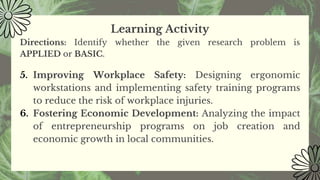
5. Improving Workplace Safety: Designing ergonomic
workstations and implementing safety training programs
to reduce the risk of workplace injuries.
6. Fostering Economic Development: Analyzing the impact
of entrepreneurship programs on job creation and
economic growth in local communities.
Learning Activity
Directions: Identify whether the given research problem is
APPLIED or BASIC.
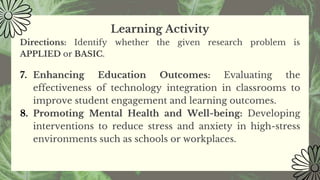
7. Enhancing Education Outcomes: Evaluating the
effectiveness of technology integration in classrooms to
improve student engagement and learning outcomes.
8. Promoting Mental Health and Well-being: Developing
interventions to reduce stress and anxiety in high-stress
environments such as schools or workplaces.
Learning Activity
Directions: Identify whether the given research problem is
APPLIED or BASIC.
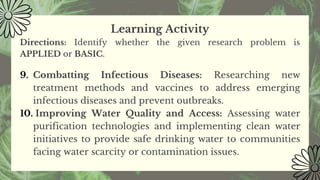
9. Combatting Infectious Diseases: Researching new
treatment methods and vaccines to address emerging
infectious diseases and prevent outbreaks.
10. Improving Water Quality and Access: Assessing water
purification technologies and implementing clean water
initiatives to provide safe drinking water to communities
facing water scarcity or contamination issues.
Learning Activity
Directions: Identify whether the given research problem is
APPLIED or BASIC.
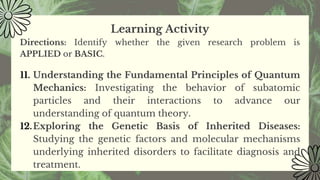
11. Understanding the Fundamental Principles of Quantum
Mechanics: Investigating the behavior of subatomic
particles and their interactions to advance our
understanding of quantum theory.
12.Exploring the Genetic Basis of Inherited Diseases:
Studying the genetic factors and molecular mechanisms
underlying inherited disorders to facilitate diagnosis and
treatment.
Learning Activity
Directions: Identify whether the given research problem is
APPLIED or BASIC.
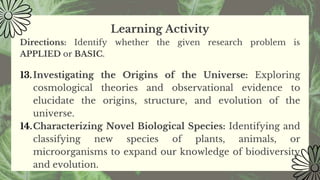
13.Investigating the Origins of the Universe: Exploring
cosmological theories and observational evidence to
elucidate the origins, structure, and evolution of the
universe.
14.Characterizing Novel Biological Species: Identifying and
classifying new species of plants, animals, or
microorganisms to expand our knowledge of biodiversity
and evolution.
Learning Activity
Directions: Identify whether the given research problem is
APPLIED or BASIC.
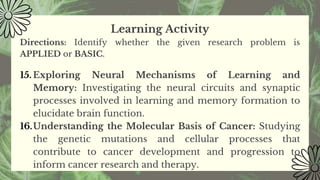
15. Exploring Neural Mechanisms of Learning and
Memory: Investigating the neural circuits and synaptic
processes involved in learning and memory formation to
elucidate brain function.
16.Understanding the Molecular Basis of Cancer: Studying
the genetic mutations and cellular processes that
contribute to cancer development and progression to
inform cancer research and therapy.
Learning Activity
Directions: Identify whether the given research problem is
APPLIED or BASIC.
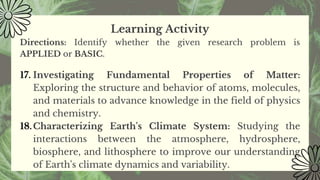
17. Investigating Fundamental Properties of Matter:
Exploring the structure and behavior of atoms, molecules,
and materials to advance knowledge in the field of physics
and chemistry.
18.Characterizing Earth's Climate System: Studying the
interactions between the atmosphere, hydrosphere,
biosphere, and lithosphere to improve our understanding
of Earth's climate dynamics and variability.
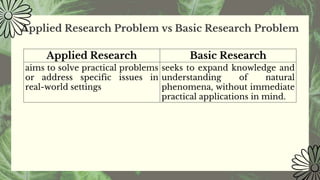
Applied Research Problem vs Basic Research Problem
Applied Research Basic Research
aims to solve practical problems
or address specific issues in
real-world settings
seeks to expand knowledge and
understanding of natural
phenomena, without immediate
practical applications in mind.
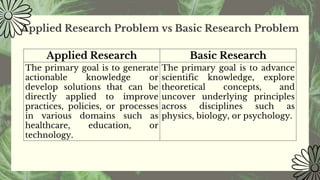
Applied Research Problem vs Basic Research Problem
Applied Research Basic Research
The primary goal is to generate
actionable knowledge or
develop solutions that can be
directly applied to improve
practices, policies, or processes
in various domains such as
healthcare, education, or
technology.
The primary goal is to advance
scientific knowledge, explore
theoretical concepts, and
uncover underlying principles
across disciplines such as
physics, biology, or psychology.
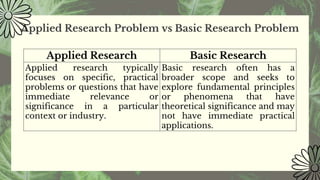
Applied Research Problem vs Basic Research Problem
Applied Research Basic Research
Applied research typically
focuses on specific, practical
problems or questions that have
immediate relevance or
significance in a particular
context or industry.
Basic research often has a
broader scope and seeks to
explore fundamental principles
or phenomena that have
theoretical significance and may
not have immediate practical
applications.
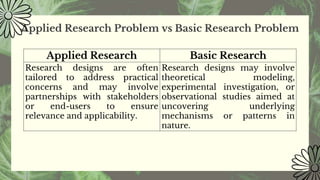
Applied Research Problem vs Basic Research Problem
Applied Research Basic Research
Research designs are often
tailored to address practical
concerns and may involve
partnerships with stakeholders
or end-users to ensure
relevance and applicability.
Research designs may involve
theoretical modeling,
experimental investigation, or
observational studies aimed at
uncovering underlying
mechanisms or patterns in
nature.
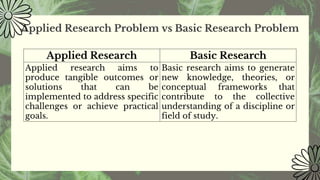
Applied Research Problem vs Basic Research Problem
Applied Research Basic Research
Applied research aims to
produce tangible outcomes or
solutions that can be
implemented to address specific
challenges or achieve practical
goals.
Basic research aims to generate
new knowledge, theories, or
conceptual frameworks that
contribute to the collective
understanding of a discipline or
field of study.
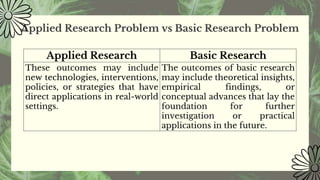
Applied Research Problem vs Basic Research Problem
Applied Research Basic Research
These outcomes may include
new technologies, interventions,
policies, or strategies that have
direct applications in real-world
settings.
The outcomes of basic research
may include theoretical insights,
empirical findings, or
conceptual advances that lay the
foundation for further
investigation or practical
applications in the future.
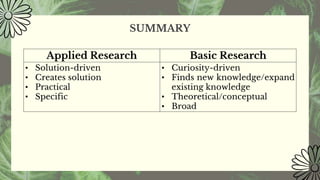
SUMMARY
Applied Research Basic Research
• Solution-driven
• Creates solution
• Practical
• Specific
• Curiosity-driven
• Finds new knowledge/expand
existing knowledge
• Theoretical/conceptual
• Broad
Thank you for listening!

Types of Research: Applied Research vs Basic Research.pptx

  • 1.
  • 2.
    Differentiate applied andbasic research problems STEM_RP12-IIa-e-2 Learning Competency
  • 3.
    Learning Activity Directions: Identifywhether the given research problem is APPLIED or BASIC. 1. Improving Transportation Efficiency: Developing algorithms to optimize traffic flow in urban areas, reducing congestion and commuting time 2. Enhancing Healthcare Delivery: Implementing telemedicine solutions to improve access to healthcare services in rural or underserved communities.
  • 4.
    Learning Activity Directions: Identifywhether the given research problem is APPLIED or BASIC. 3. Increasing Agricultural Sustainability: Studying the effectiveness of organic farming methods in preserving soil health and reducing environmental impact. 4. Addressing Climate Change: Investigating renewable energy sources such as solar or wind power to reduce greenhouse gas emissions and mitigate climate change effects.
  • 5.
    Learning Activity Directions: Identifywhether the given research problem is APPLIED or BASIC. 5. Improving Workplace Safety: Designing ergonomic workstations and implementing safety training programs to reduce the risk of workplace injuries. 6. Fostering Economic Development: Analyzing the impact of entrepreneurship programs on job creation and economic growth in local communities.
  • 6.
    Learning Activity Directions: Identifywhether the given research problem is APPLIED or BASIC. 7. Enhancing Education Outcomes: Evaluating the effectiveness of technology integration in classrooms to improve student engagement and learning outcomes. 8. Promoting Mental Health and Well-being: Developing interventions to reduce stress and anxiety in high-stress environments such as schools or workplaces.
  • 7.
    Learning Activity Directions: Identifywhether the given research problem is APPLIED or BASIC. 9. Combatting Infectious Diseases: Researching new treatment methods and vaccines to address emerging infectious diseases and prevent outbreaks. 10. Improving Water Quality and Access: Assessing water purification technologies and implementing clean water initiatives to provide safe drinking water to communities facing water scarcity or contamination issues.
  • 8.
    Learning Activity Directions: Identifywhether the given research problem is APPLIED or BASIC. 11. Understanding the Fundamental Principles of Quantum Mechanics: Investigating the behavior of subatomic particles and their interactions to advance our understanding of quantum theory. 12.Exploring the Genetic Basis of Inherited Diseases: Studying the genetic factors and molecular mechanisms underlying inherited disorders to facilitate diagnosis and treatment.
  • 9.
    Learning Activity Directions: Identifywhether the given research problem is APPLIED or BASIC. 13.Investigating the Origins of the Universe: Exploring cosmological theories and observational evidence to elucidate the origins, structure, and evolution of the universe. 14.Characterizing Novel Biological Species: Identifying and classifying new species of plants, animals, or microorganisms to expand our knowledge of biodiversity and evolution.
  • 10.
    Learning Activity Directions: Identifywhether the given research problem is APPLIED or BASIC. 15. Exploring Neural Mechanisms of Learning and Memory: Investigating the neural circuits and synaptic processes involved in learning and memory formation to elucidate brain function. 16.Understanding the Molecular Basis of Cancer: Studying the genetic mutations and cellular processes that contribute to cancer development and progression to inform cancer research and therapy.
  • 11.
    Learning Activity Directions: Identifywhether the given research problem is APPLIED or BASIC. 17. Investigating Fundamental Properties of Matter: Exploring the structure and behavior of atoms, molecules, and materials to advance knowledge in the field of physics and chemistry. 18.Characterizing Earth's Climate System: Studying the interactions between the atmosphere, hydrosphere, biosphere, and lithosphere to improve our understanding of Earth's climate dynamics and variability.
  • 12.
    Applied Research Problemvs Basic Research Problem Applied Research Basic Research aims to solve practical problems or address specific issues in real-world settings seeks to expand knowledge and understanding of natural phenomena, without immediate practical applications in mind.
  • 13.
    Applied Research Problemvs Basic Research Problem Applied Research Basic Research The primary goal is to generate actionable knowledge or develop solutions that can be directly applied to improve practices, policies, or processes in various domains such as healthcare, education, or technology. The primary goal is to advance scientific knowledge, explore theoretical concepts, and uncover underlying principles across disciplines such as physics, biology, or psychology.
  • 14.
    Applied Research Problemvs Basic Research Problem Applied Research Basic Research Applied research typically focuses on specific, practical problems or questions that have immediate relevance or significance in a particular context or industry. Basic research often has a broader scope and seeks to explore fundamental principles or phenomena that have theoretical significance and may not have immediate practical applications.
  • 15.
    Applied Research Problemvs Basic Research Problem Applied Research Basic Research Research designs are often tailored to address practical concerns and may involve partnerships with stakeholders or end-users to ensure relevance and applicability. Research designs may involve theoretical modeling, experimental investigation, or observational studies aimed at uncovering underlying mechanisms or patterns in nature.
  • 16.
    Applied Research Problemvs Basic Research Problem Applied Research Basic Research Applied research aims to produce tangible outcomes or solutions that can be implemented to address specific challenges or achieve practical goals. Basic research aims to generate new knowledge, theories, or conceptual frameworks that contribute to the collective understanding of a discipline or field of study.
  • 17.
    Applied Research Problemvs Basic Research Problem Applied Research Basic Research These outcomes may include new technologies, interventions, policies, or strategies that have direct applications in real-world settings. The outcomes of basic research may include theoretical insights, empirical findings, or conceptual advances that lay the foundation for further investigation or practical applications in the future.
  • 18.
    SUMMARY Applied Research BasicResearch • Solution-driven • Creates solution • Practical • Specific • Curiosity-driven • Finds new knowledge/expand existing knowledge • Theoretical/conceptual • Broad
  • 19.
    Thank you forlistening!