Institute for Microbiology, Medical Faculty of Masaryk University  and St. Anna Faculty Hospital in Brno Miroslav Votava, Vladana Woznicová COURSE AND FORMS OF INFECTION – I Lecture for 2nd-year students May  18 th , 200 9
Course of infection  – I  Incubation time  salmonellosis ½–1 day, influenza 1–2 days,  tbc 2–8 weeks, hepatitis B 90–100 days Prodroms   not always; nonspecific (   T, headache, feeling ill etc.), several hours t o  days Typical syndrome of infectious disease  as described in textbooks Convalescence  from subsiding troubles till normalization of results
Course of infection  – II  Relapse  the same agent,   infection comes on again during the convalescence Recurrence  the agent remains in the body, infection comes on again only after recovery (Brill-Zinsser disease = recurrence of epidemic typhus) Reinfection  new infection by the same agent from outside Superinfection  infection by  an other agent before recovery from the first infection
Forms of infection Inapparent infection (without symptoms)  production of antibodies Manifest infection (with symptoms) : subclinical :  non - characteristic signs only abortive :  some symptoms only or  merely little expressed ones clinical :  typical signs as in textbook foudroyant, fulminant :  very abrupt, with dramatic symptoms
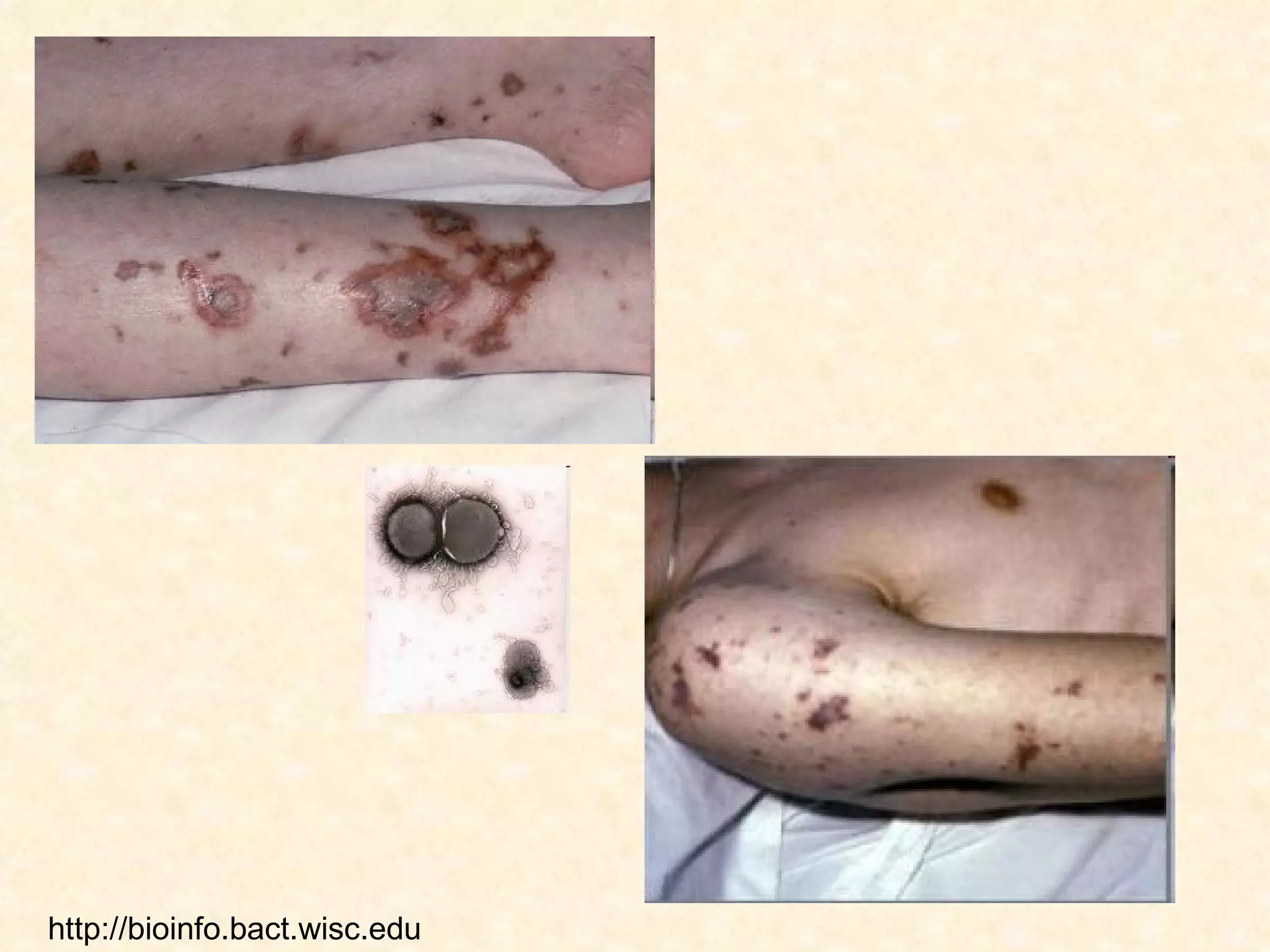
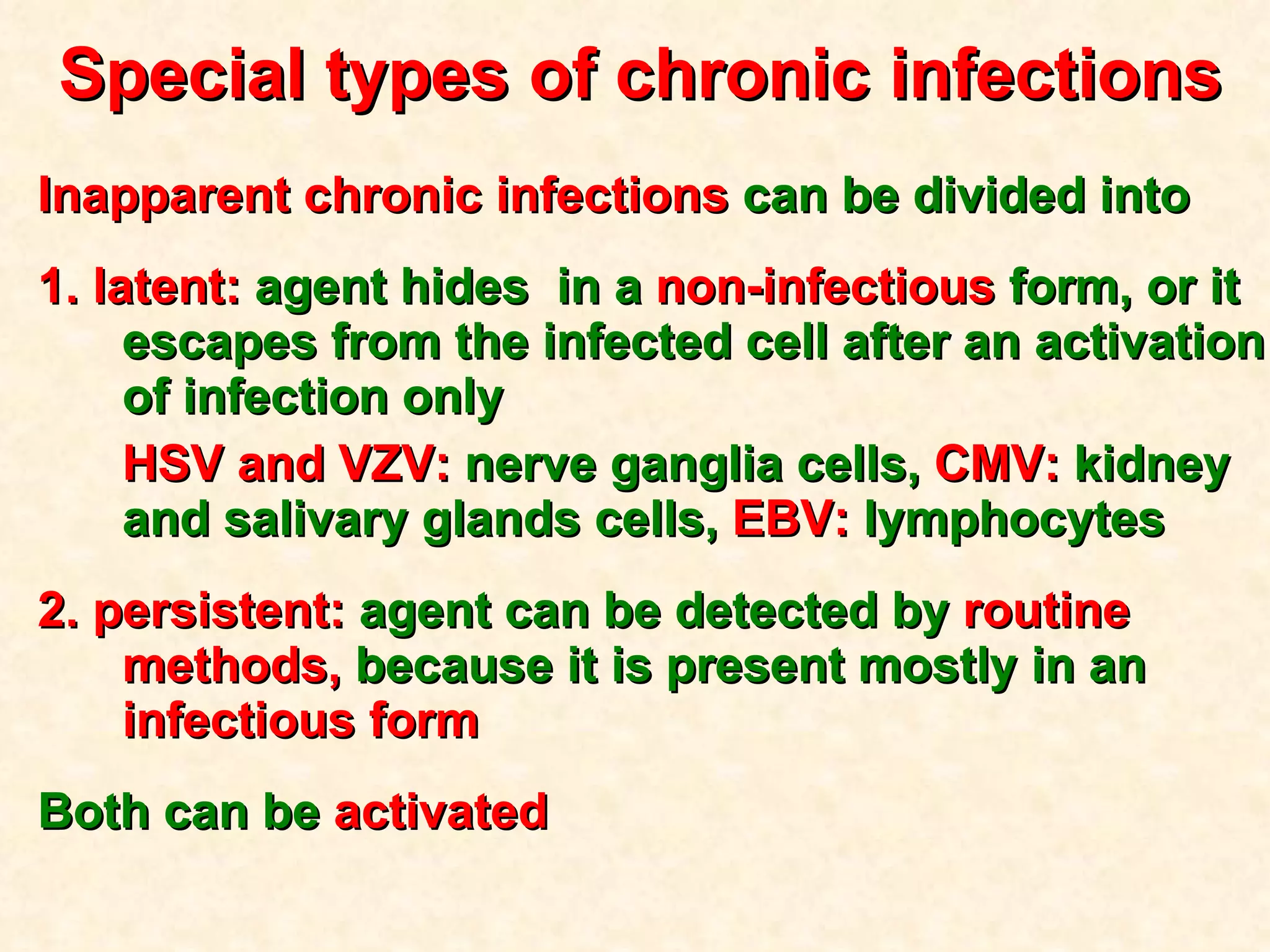
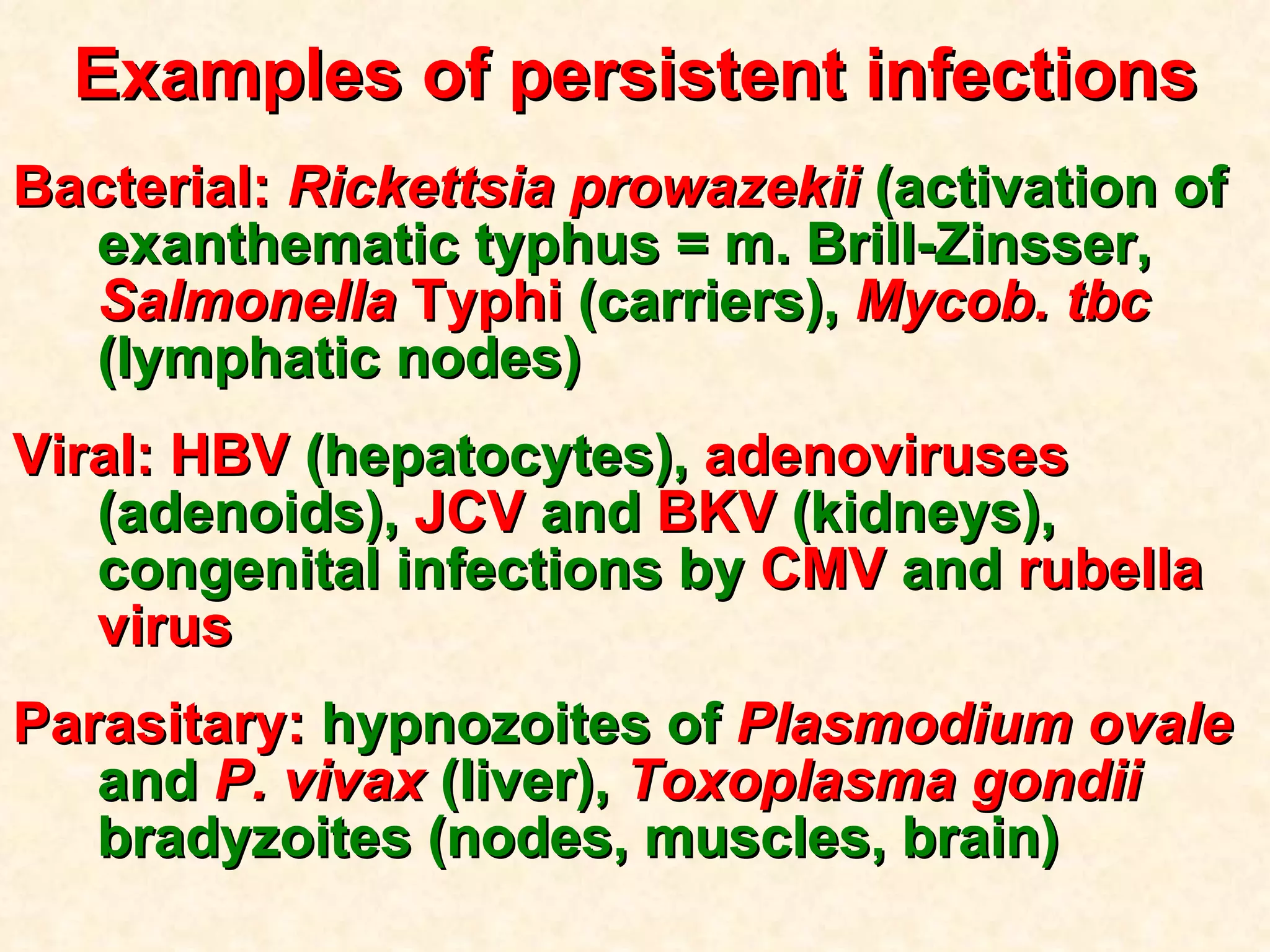
Duration of infection Acute: days  (common cold, salmonellosis) till weeks (majority of infections) Subacute: months  – either as a complication of any infection, or as the rule (some kinds of hepatitis, warts, sepsis lenta) Chronic: years  (tbc, lepra, dermatomycoses, parasitic infections) Fulminant, foudroyant:  very rapid course –  hours  (meningococcal sepsis)
http://bioinfo.bact.wisc.edu
Special types of chronic infections Inapparent chronic infections  can be divided into 1. latent:  agent hides  in a  non-infectious  form, or it escapes from the infected cell after an activation of infection only HSV and VZV:  nerve ganglia cells,  CMV:  kidney and salivary glands cells,  EBV:  lymphocytes 2. persistent:  agent can be detected by  routine methods,  because it is present mostly in an  infectious form   Both can be  activated
Examples of persistent infections Bacterial:  Rickettsia prowazekii  (activation of exanthematic typhus = m. Brill-Zinsser,   Salmonella  Typhi  (carriers),   Mycob. tbc  (lymphatic nodes) Viral: HBV  (hepatocytes),  adenoviruses  (adenoids),  JCV  and  BKV  (kidneys), congenital infections by  CMV  and  rubella virus  Parasitary:  hypnozoites of   Plasmodium ovale  and  P. vivax  (liver),  Toxoplasma gondii  bradyzoites (nodes, muscles, brain)
Primary infections primary  × secondary infection:  before the first (primary) infection is over the  secondary   infection  (superinfection)  caused by another microbe   supersedes  primary  × postprimary infection:  in  tbc only ;   in postprimary  infection the  late   hypersensitivity  has developed primary  × recurrent infection:  during  latent  infections,   e.g.  HSV :   primary infection = gingivostomatitis aphthosa; recurrent one = herpes labialis
Other types of infection  – I  Opportunist ic  infection :   infection on a weakened terrain, often secondary one   During  AIDS : CMV retinitis, CMV or candidal esophagitis, herpes zoster, cryptococcal meningitis, toxoplasmatic encephalitis, cryptosporidial or microsporidial enteritis, colibacillary and other types of   sepsis Nosocomial  (hospital-acquired)  infection :   in connection with the stay  in a hospital ,  often opportunist one Iatrogenic infection :   caused by a  medical intervention
Other types of infection  – II  Community-acquired infection:  infection obtained  in common population   Pyogenic infection:  is manifested by  suppuration Specific infection:  usually with typical pathology and histology, therefore  syphilis  or  tuberculosis Exogenous infection:  agent enters the body  from outside Endogenous infection:  agent =  member of normal microflora  (the disease is not contagious, it is not possible to determine the incubation time)
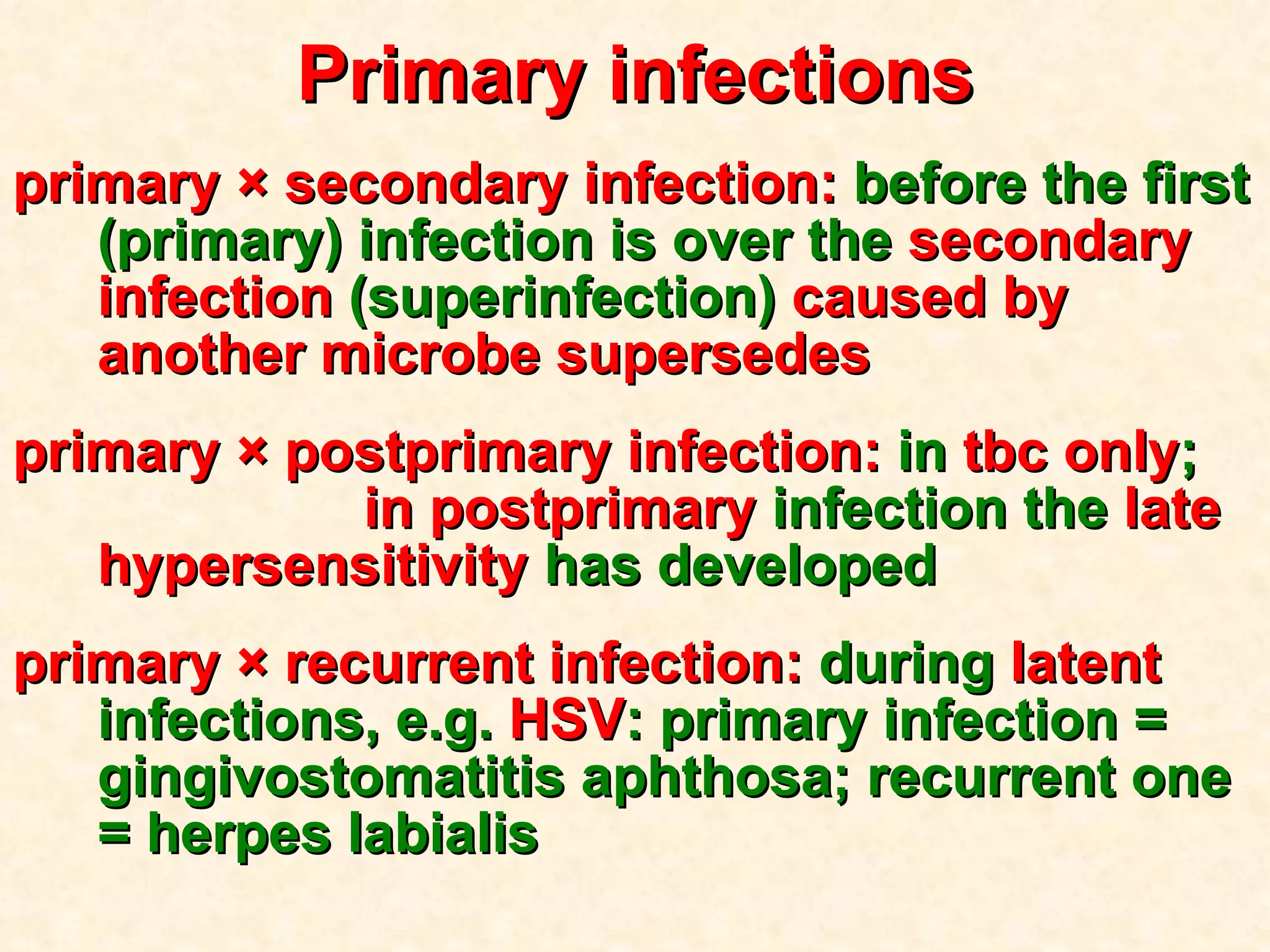
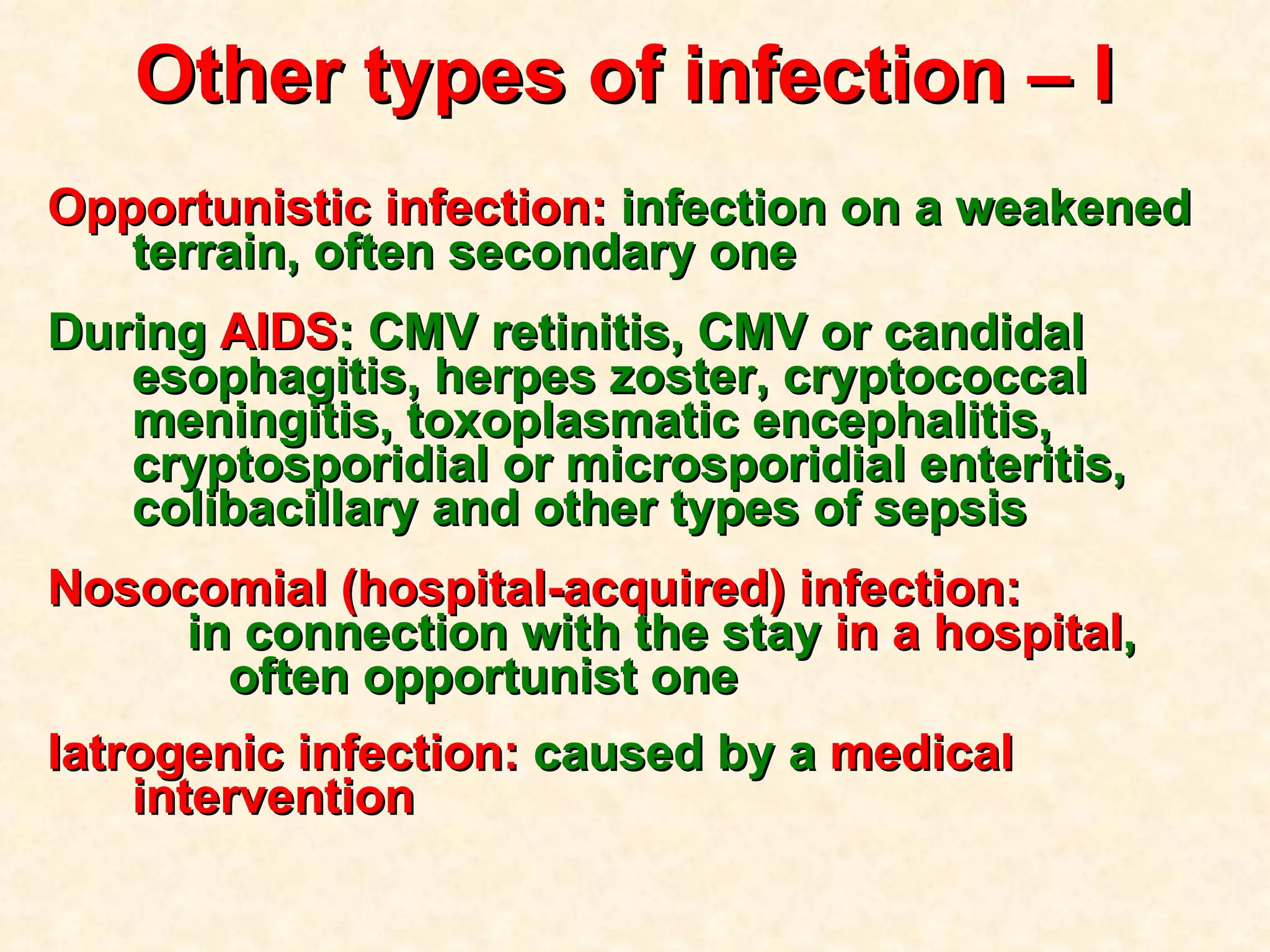
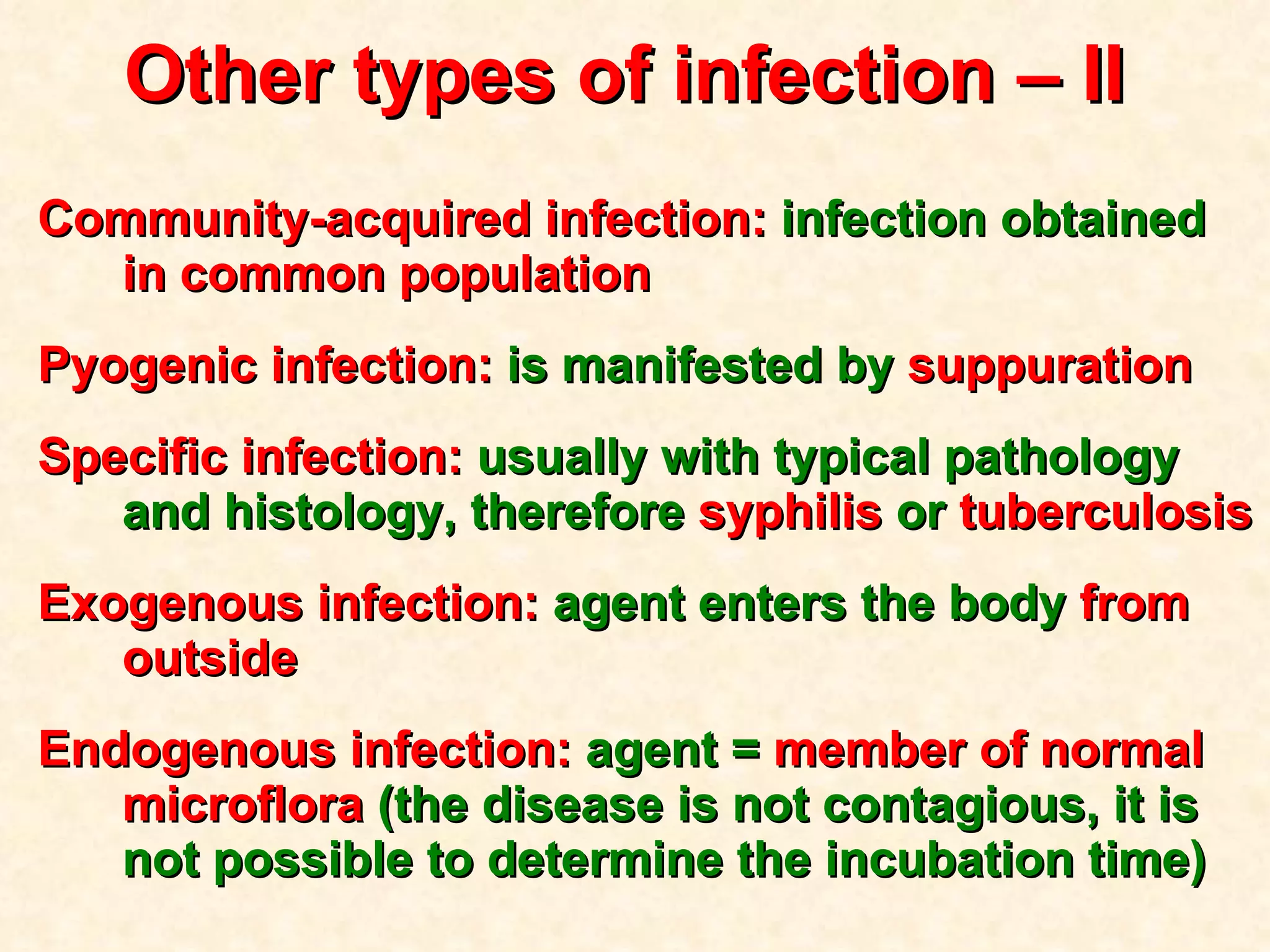
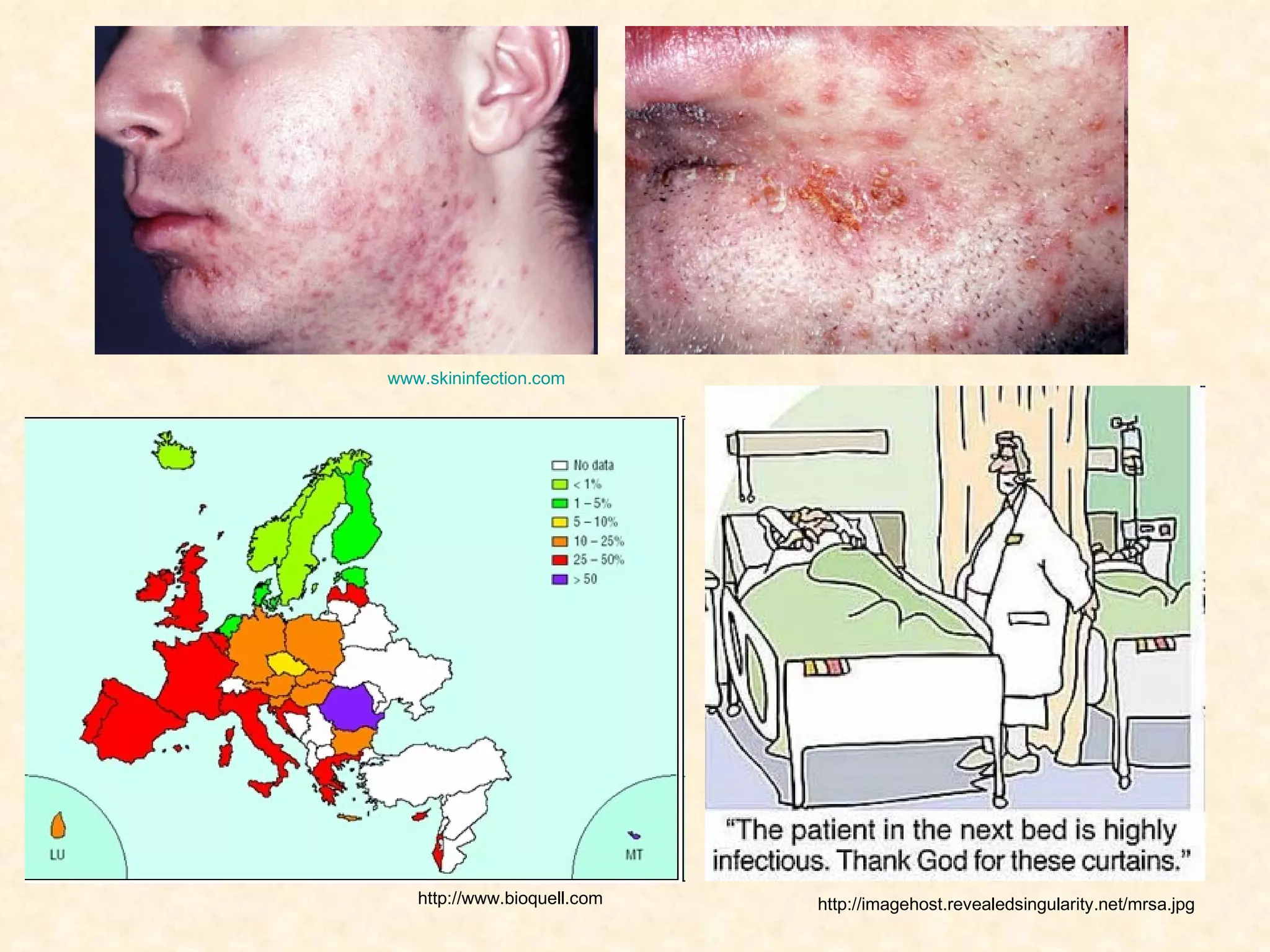
www.skininfection.com   http://imagehost.revealedsingularity.net/mrsa.jpg http://www.bioquell.com
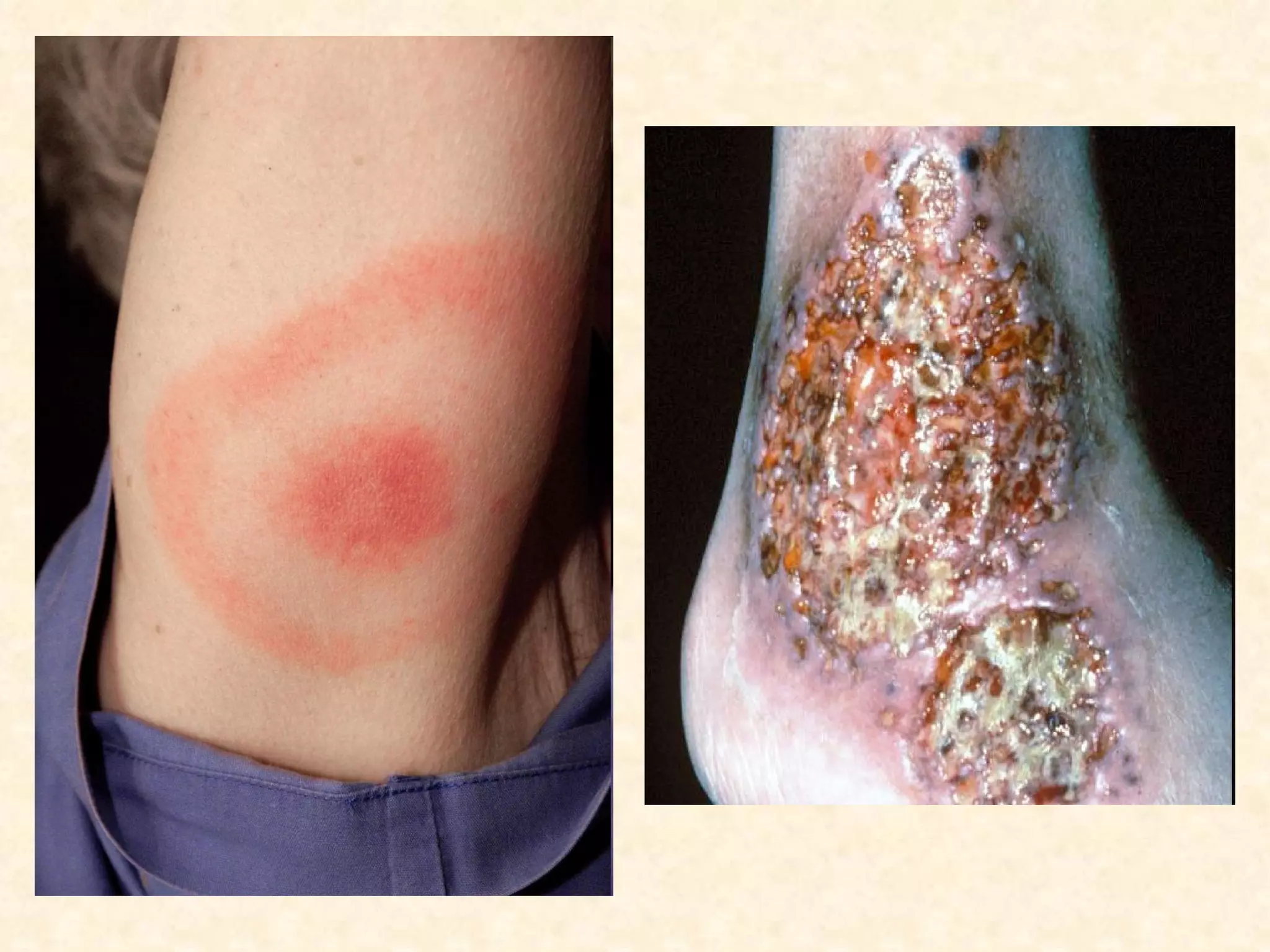
Other types of infection  – III  Anthroponoses =  infections transmisible  among human beings only  (typhoid fever, shigelloses, exanthematic viroses, venereal infections etc.) Zoonoses =  infections transmisible  from animals to man  and vice versa   (salmonelloses, tularemia, lyme borreliosis, tick-borne encephalitis, some types of ringworm etc.) Sapronoses =  infections acquired  from the environment ,   in which the agent actively multiplies (tetanus, gas gangraene, legionellosis, histoplasmosis, amoebic meningoencephalitis etc.)
 
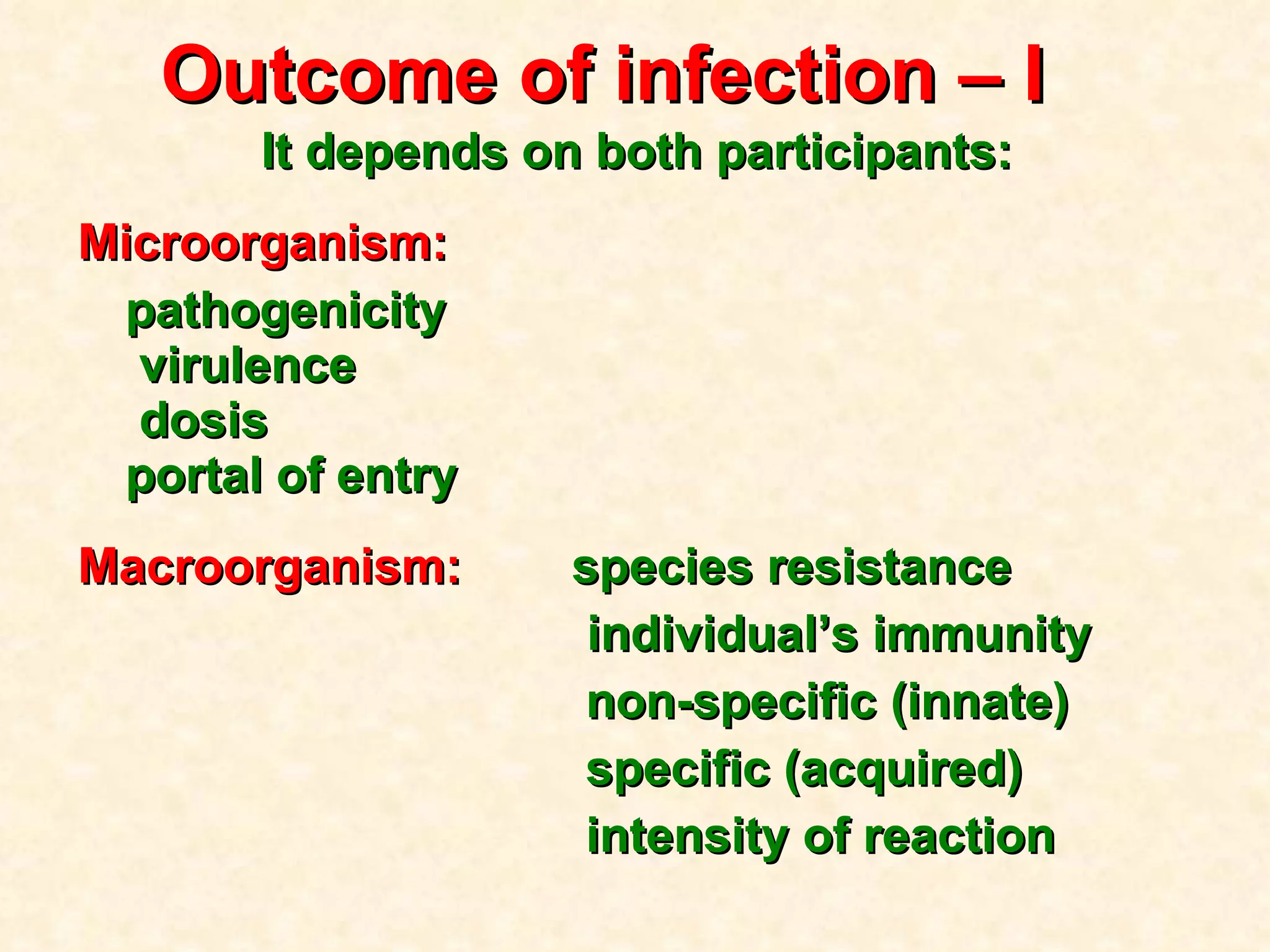
Outcome of infection  – I  It depends on both participants: Microorganism: pathogenicity  virulence  dosis  portal of entry Macroorganism:  species resistance individual’s immunity non-specific (innate) specific (acquired) intensity of reaction
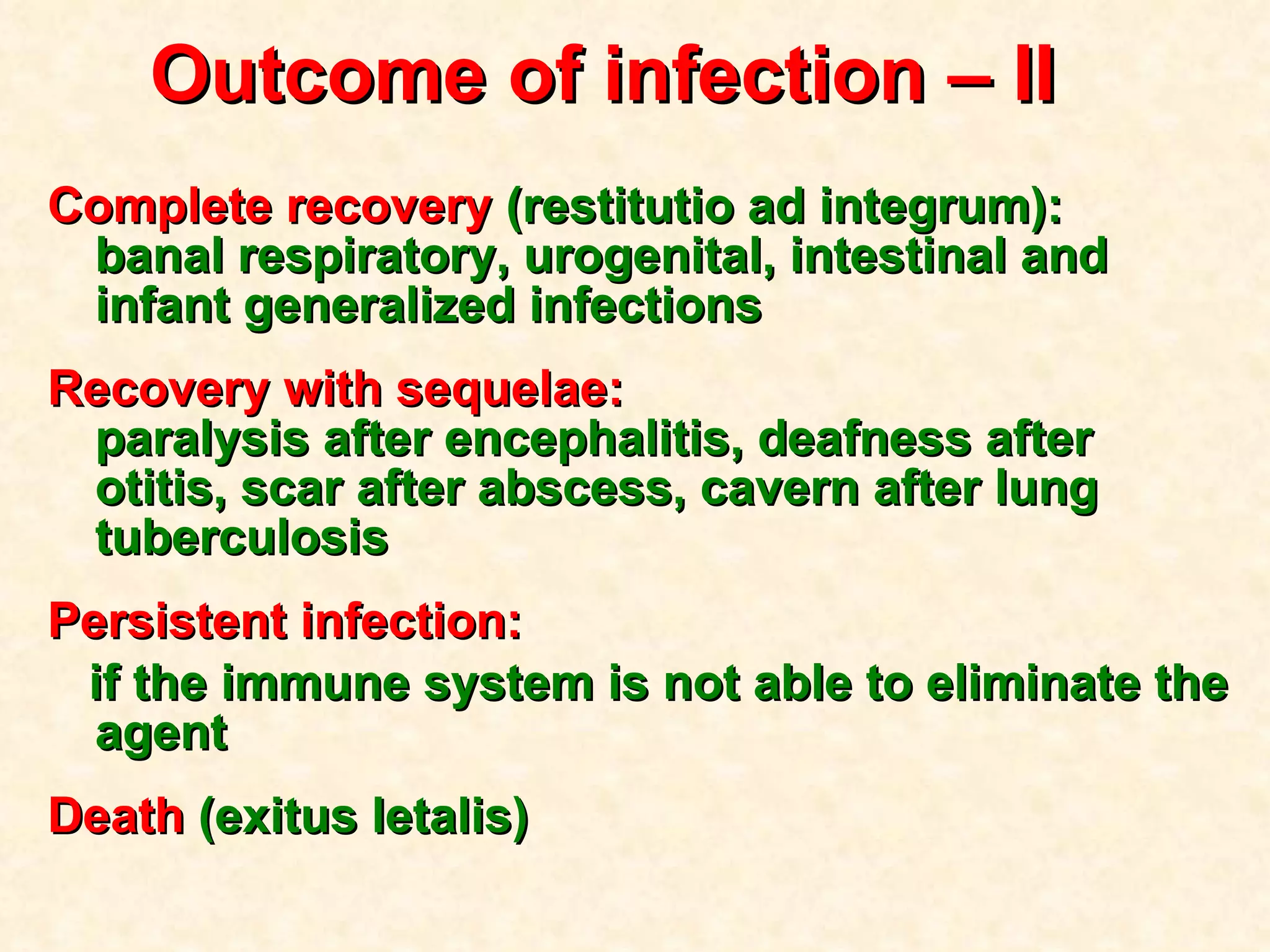
Outcome of infection  – II  Complete recovery  (restitutio ad integrum) :   banal respiratory, urogenital, intestinal and infant generalized infections Recovery with sequelae :   paralysis after encephalitis, deafness after otitis, scar after abscess, cavern after lung tuberculosis Persistent infection :   if the immune system is not able to eliminate the agent Death  (exitus letalis)
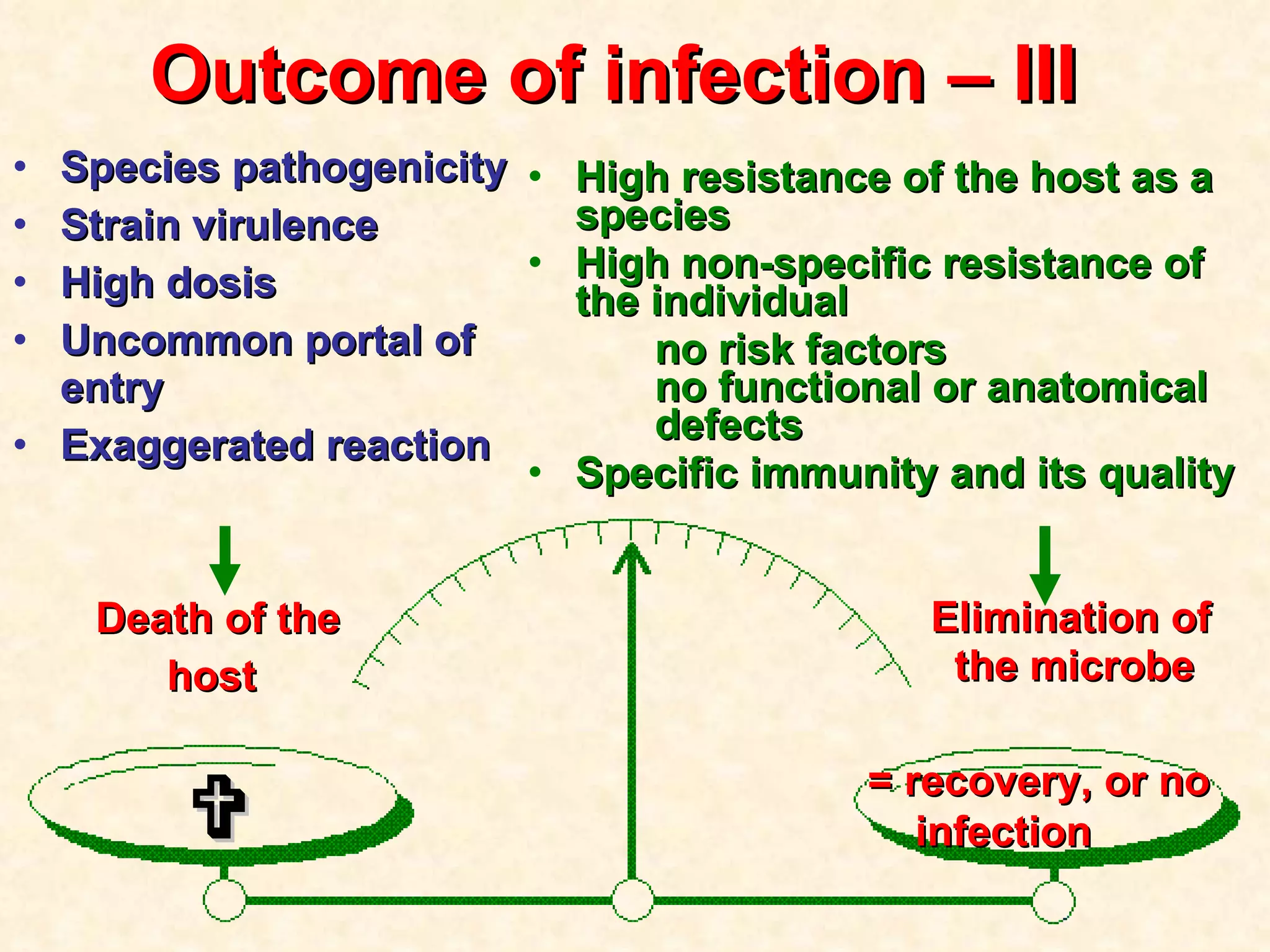
Outcome of infection  – III  Species pathogenicity Strain virulence High dosis Uncommon portal of entry Exaggerated reaction  Death of the  host High resistance of the host  as a species High non-specific resistance of the individual  no risk factors  no functional or anatomical  defects Specific immunity and its quality Elimination of  the microbe  =  recovery, or no infection
Recommended reading material   Paul de Kruif: Microbe Hunters Paul de Kruif: Men against Death Axel Munthe: The Story of San Michele Sinclair Lewis: Arrowsmith André Maurois: La vie de Sir Alexander Fleming Hans Zinsser: Rats, Lice, and History Michael Crichton: Andromeda Strain Albert Camus: Peste Victor Heisser: An American Doctor Odyssey Richard Preston: The Hot Zone David Tyrrell  & Michael Fielder: Cold Wars Mika Waltari: The Egyptian Please mail me other suggestions at: [email_address] Thank you for your attention

12 course and_forms_of_infection_-_i_2_

  • 1.
    Institute for Microbiology,Medical Faculty of Masaryk University and St. Anna Faculty Hospital in Brno Miroslav Votava, Vladana Woznicová COURSE AND FORMS OF INFECTION – I Lecture for 2nd-year students May 18 th , 200 9
  • 2.
    Course of infection – I Incubation time salmonellosis ½–1 day, influenza 1–2 days, tbc 2–8 weeks, hepatitis B 90–100 days Prodroms not always; nonspecific (  T, headache, feeling ill etc.), several hours t o days Typical syndrome of infectious disease as described in textbooks Convalescence from subsiding troubles till normalization of results
  • 3.
    Course of infection – II Relapse the same agent, infection comes on again during the convalescence Recurrence the agent remains in the body, infection comes on again only after recovery (Brill-Zinsser disease = recurrence of epidemic typhus) Reinfection new infection by the same agent from outside Superinfection infection by an other agent before recovery from the first infection
  • 4.
    Forms of infectionInapparent infection (without symptoms) production of antibodies Manifest infection (with symptoms) : subclinical : non - characteristic signs only abortive : some symptoms only or merely little expressed ones clinical : typical signs as in textbook foudroyant, fulminant : very abrupt, with dramatic symptoms
  • 5.
    Duration of infectionAcute: days (common cold, salmonellosis) till weeks (majority of infections) Subacute: months – either as a complication of any infection, or as the rule (some kinds of hepatitis, warts, sepsis lenta) Chronic: years (tbc, lepra, dermatomycoses, parasitic infections) Fulminant, foudroyant: very rapid course – hours (meningococcal sepsis)
  • 6.
  • 7.
    Special types ofchronic infections Inapparent chronic infections can be divided into 1. latent: agent hides in a non-infectious form, or it escapes from the infected cell after an activation of infection only HSV and VZV: nerve ganglia cells, CMV: kidney and salivary glands cells, EBV: lymphocytes 2. persistent: agent can be detected by routine methods, because it is present mostly in an infectious form Both can be activated
  • 8.
    Examples of persistentinfections Bacterial: Rickettsia prowazekii (activation of exanthematic typhus = m. Brill-Zinsser, Salmonella Typhi (carriers), Mycob. tbc (lymphatic nodes) Viral: HBV (hepatocytes), adenoviruses (adenoids), JCV and BKV (kidneys), congenital infections by CMV and rubella virus Parasitary: hypnozoites of Plasmodium ovale and P. vivax (liver), Toxoplasma gondii bradyzoites (nodes, muscles, brain)
  • 9.
    Primary infections primary × secondary infection: before the first (primary) infection is over the secondary infection (superinfection) caused by another microbe supersedes primary × postprimary infection: in tbc only ; in postprimary infection the late hypersensitivity has developed primary × recurrent infection: during latent infections, e.g. HSV : primary infection = gingivostomatitis aphthosa; recurrent one = herpes labialis
  • 10.
    Other types ofinfection – I Opportunist ic infection : infection on a weakened terrain, often secondary one During AIDS : CMV retinitis, CMV or candidal esophagitis, herpes zoster, cryptococcal meningitis, toxoplasmatic encephalitis, cryptosporidial or microsporidial enteritis, colibacillary and other types of sepsis Nosocomial (hospital-acquired) infection : in connection with the stay in a hospital , often opportunist one Iatrogenic infection : caused by a medical intervention
  • 11.
    Other types ofinfection – II Community-acquired infection: infection obtained in common population Pyogenic infection: is manifested by suppuration Specific infection: usually with typical pathology and histology, therefore syphilis or tuberculosis Exogenous infection: agent enters the body from outside Endogenous infection: agent = member of normal microflora (the disease is not contagious, it is not possible to determine the incubation time)
  • 12.
    www.skininfection.com http://imagehost.revealedsingularity.net/mrsa.jpg http://www.bioquell.com
  • 13.
    Other types ofinfection – III Anthroponoses = infections transmisible among human beings only (typhoid fever, shigelloses, exanthematic viroses, venereal infections etc.) Zoonoses = infections transmisible from animals to man and vice versa (salmonelloses, tularemia, lyme borreliosis, tick-borne encephalitis, some types of ringworm etc.) Sapronoses = infections acquired from the environment , in which the agent actively multiplies (tetanus, gas gangraene, legionellosis, histoplasmosis, amoebic meningoencephalitis etc.)
  • 14.
  • 15.
    Outcome of infection – I It depends on both participants: Microorganism: pathogenicity virulence dosis portal of entry Macroorganism: species resistance individual’s immunity non-specific (innate) specific (acquired) intensity of reaction
  • 16.
    Outcome of infection – II Complete recovery (restitutio ad integrum) : banal respiratory, urogenital, intestinal and infant generalized infections Recovery with sequelae : paralysis after encephalitis, deafness after otitis, scar after abscess, cavern after lung tuberculosis Persistent infection : if the immune system is not able to eliminate the agent Death (exitus letalis)
  • 17.
    Outcome of infection – III Species pathogenicity Strain virulence High dosis Uncommon portal of entry Exaggerated reaction Death of the host High resistance of the host as a species High non-specific resistance of the individual no risk factors no functional or anatomical defects Specific immunity and its quality Elimination of the microbe  = recovery, or no infection
  • 18.
    Recommended reading material Paul de Kruif: Microbe Hunters Paul de Kruif: Men against Death Axel Munthe: The Story of San Michele Sinclair Lewis: Arrowsmith André Maurois: La vie de Sir Alexander Fleming Hans Zinsser: Rats, Lice, and History Michael Crichton: Andromeda Strain Albert Camus: Peste Victor Heisser: An American Doctor Odyssey Richard Preston: The Hot Zone David Tyrrell & Michael Fielder: Cold Wars Mika Waltari: The Egyptian Please mail me other suggestions at: [email_address] Thank you for your attention