SILTFLUX
Project Objectives
• Increase knowledge and understanding of suspended silt flux in rivers to help set standards
for suspended solids flux and concentrations for the protection of sensitive catchments in
Ireland.
• Assess the benefits of silt reduction that mitigation measures can achieve.
• Understand the relationship between concentrations/flux of silts and the potential for
deposition and ecological impacts in different types of rivers, and under variable land-use
pressures.
Tasks
• Literature Review
• Database of sediment flux measurements
• Validating measurement methodology
• Measurement of sediment fluxes and ecological status in
selected catchments with a range of typologies and
typical land uses.
• Review of benefits of river impact mitigation methods.
• Dissemination via publications and workshops
River sediment is a natural and dynamic component of the river/catchment system, transported as
bedload and/or suspended load, depending on the relationship between flow conditions, sediment
supply and the structure, density, size and shape of materials. In healthy fluvial systems, suspended
sediments or silts (typically <63 μm, but up to 2 mm in diameter in extreme events) provide the basis
for diverse aquatic ecosystems through nutrient cycling and replenishment as well as forming the
contributing materials from which aquatic habitats are constructed in river beds and especially banks.
Too much silt, however, can lead to the obstruction of channels, the smothering of habitats, ingress
into the bed, and reduction of light levels in the water column and at the bed, potentially leading to
deoxygenation and environmental deterioration. The chemically-active silt fraction (<63 μm) can
also act as an important carrier of potentially hazardous nutrients and contaminants, including P and
N, polychlorinated biphenyls (PCBs), dioxins and heavy metals, meaning that effective pollution
management is critically linked to understanding sediment transport and storage pathways.
Team
• Michael Bruen
• Mary Kelly-Quinn
• John O’Sullivan
• Jonathan Turner
• Damian Lawler
• Anna Rymszewicz
• Elizabeth Conroy
• Martin O’Grady
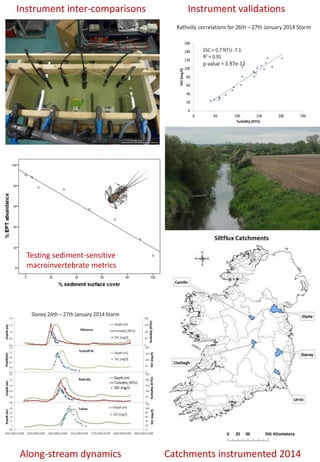
Along-stream dynamics
Instrument validations
Catchments instrumented 2014
Instrument inter-comparisons
Testing sediment-sensitive
macroinvertebrate metrics

Siltflux Leaflet

  • 1.
    SILTFLUX Project Objectives • Increaseknowledge and understanding of suspended silt flux in rivers to help set standards for suspended solids flux and concentrations for the protection of sensitive catchments in Ireland. • Assess the benefits of silt reduction that mitigation measures can achieve. • Understand the relationship between concentrations/flux of silts and the potential for deposition and ecological impacts in different types of rivers, and under variable land-use pressures. Tasks • Literature Review • Database of sediment flux measurements • Validating measurement methodology • Measurement of sediment fluxes and ecological status in selected catchments with a range of typologies and typical land uses. • Review of benefits of river impact mitigation methods. • Dissemination via publications and workshops River sediment is a natural and dynamic component of the river/catchment system, transported as bedload and/or suspended load, depending on the relationship between flow conditions, sediment supply and the structure, density, size and shape of materials. In healthy fluvial systems, suspended sediments or silts (typically <63 μm, but up to 2 mm in diameter in extreme events) provide the basis for diverse aquatic ecosystems through nutrient cycling and replenishment as well as forming the contributing materials from which aquatic habitats are constructed in river beds and especially banks. Too much silt, however, can lead to the obstruction of channels, the smothering of habitats, ingress into the bed, and reduction of light levels in the water column and at the bed, potentially leading to deoxygenation and environmental deterioration. The chemically-active silt fraction (<63 μm) can also act as an important carrier of potentially hazardous nutrients and contaminants, including P and N, polychlorinated biphenyls (PCBs), dioxins and heavy metals, meaning that effective pollution management is critically linked to understanding sediment transport and storage pathways. Team • Michael Bruen • Mary Kelly-Quinn • John O’Sullivan • Jonathan Turner • Damian Lawler • Anna Rymszewicz • Elizabeth Conroy • Martin O’Grady
  • 2.
    Along-stream dynamics Instrument validations Catchmentsinstrumented 2014 Instrument inter-comparisons Testing sediment-sensitive macroinvertebrate metrics