Twentieth CenturyModern Dance“The body says what words cannot.”-Martha Graham
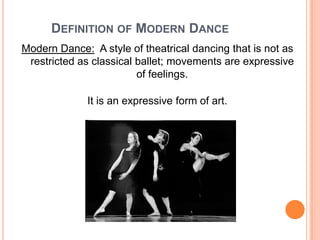
Definition of Modern DanceModern Dance:  A style of theatrical dancing that is not as restricted as classical ballet; movements are expressive  of feelings.It is an expressive form of art.
History & InfluenceOriginated in the United States	In the early 1900’s Started as a rebellion against the strict style of classical balletBased on Utopian idealsFirst seen as extremely radical
Characteristics of Modern DanceInterpretive instead of using sets of steps and dance booksLooks improvisedLoose movement Gravity plays and important roleTells a story though the danceUse motions, props, music, and lights to show emotions Costumes were important to the overall dance
Modern DanceBalletDo a lot of floor work and choreography on the groundC-Shaped spineBarefoot or light shoesHeavy movementsCostumes made to show movementUpright choreography like leaps and turnsErect spinePointe shoes or ballet slippersLight on their feetElegant structured costumes to show beauty
The Physics of Modern DanceGravity: Use laws of gravity for falls, balancing, and elevationImportant to maintain your natural heightCenter of gravityAction & Reaction:For every action there must be an equal and opposite reaction (Newton's third law)Centrifugal & Centripetal ForcesAffect circular motion such as turns; revolve around an axisInertia and Momentum
The PioneersMartha GrahamRuth St. Denis & Ted ShawnIsadora DuncanLoie Fuller
Martha Graham(1894-1991)Mother of modern dance, not graham crackers!American dancer and choreographerLearned to dance at Denishawn Studio in NYCInspiration for the routines came from a “certain string” First to establish moving scenery and speech with dancingBroke social norms on how dance was seen Founded her own dance company, technique, and theatre
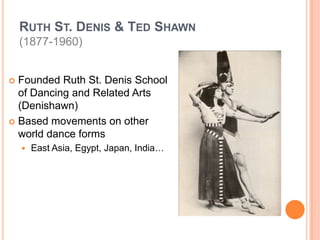
Ruth St. Denis & Ted Shawn(1877-1960)Founded Ruth St. Denis School of Dancing and Related Arts (Denishawn)Based movements on other world dance formsEast Asia, Egypt, Japan, India…
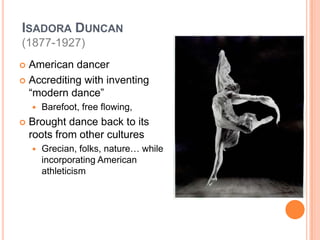
Isadora Duncan(1877-1927)American dancerAccrediting with inventing “modern dance”Barefoot, free flowing, Brought dance back to its roots from other culturesGrecian, folks, nature… while incorporating American athleticism
Loie Fuller(1862-1928)She was the first choreographer to incorporate lighting into her piecesMulticolored lights on silk  First to use incandescent lightsHad a traveling lighting teamResponsible for multiple European toursIsadora Duncan
CritiquesHard to follow the storyline Not widely accepted at the timeAudiences were intrigued by the new style
Influence on TodayModern dance has become more widely accepted and knownInfluenced other stylesEspecially post-modern dance and contemporaryMost popular style of dance in the professional worldFeatured tours and television shows
“I thought I was seeing a revelation. Time stopped for me. I could not believe what I was seeing. Those works are engraved on my brain, my mind, my heart. I’ve never forgotten, never, the atmosphere on stage, the lighting… the use of props, the use of costume… the strongest, simplest, most powerful theater I think I’ve ever seen.” – Glen Tetley (critic)

Twentieth Century Modern Dance

  • 1.
    Twentieth CenturyModern Dance“Thebody says what words cannot.”-Martha Graham
  • 2.
    Definition of ModernDanceModern Dance: A style of theatrical dancing that is not as restricted as classical ballet; movements are expressive of feelings.It is an expressive form of art.
  • 3.
    History & InfluenceOriginatedin the United States In the early 1900’s Started as a rebellion against the strict style of classical balletBased on Utopian idealsFirst seen as extremely radical
  • 4.
    Characteristics of ModernDanceInterpretive instead of using sets of steps and dance booksLooks improvisedLoose movement Gravity plays and important roleTells a story though the danceUse motions, props, music, and lights to show emotions Costumes were important to the overall dance
  • 5.
    Modern DanceBalletDo alot of floor work and choreography on the groundC-Shaped spineBarefoot or light shoesHeavy movementsCostumes made to show movementUpright choreography like leaps and turnsErect spinePointe shoes or ballet slippersLight on their feetElegant structured costumes to show beauty
  • 8.
    The Physics ofModern DanceGravity: Use laws of gravity for falls, balancing, and elevationImportant to maintain your natural heightCenter of gravityAction & Reaction:For every action there must be an equal and opposite reaction (Newton's third law)Centrifugal & Centripetal ForcesAffect circular motion such as turns; revolve around an axisInertia and Momentum
  • 9.
    The PioneersMartha GrahamRuthSt. Denis & Ted ShawnIsadora DuncanLoie Fuller
  • 10.
    Martha Graham(1894-1991)Mother ofmodern dance, not graham crackers!American dancer and choreographerLearned to dance at Denishawn Studio in NYCInspiration for the routines came from a “certain string” First to establish moving scenery and speech with dancingBroke social norms on how dance was seen Founded her own dance company, technique, and theatre
  • 11.
    Ruth St. Denis& Ted Shawn(1877-1960)Founded Ruth St. Denis School of Dancing and Related Arts (Denishawn)Based movements on other world dance formsEast Asia, Egypt, Japan, India…
  • 12.
    Isadora Duncan(1877-1927)American dancerAccreditingwith inventing “modern dance”Barefoot, free flowing, Brought dance back to its roots from other culturesGrecian, folks, nature… while incorporating American athleticism
  • 13.
    Loie Fuller(1862-1928)She wasthe first choreographer to incorporate lighting into her piecesMulticolored lights on silk First to use incandescent lightsHad a traveling lighting teamResponsible for multiple European toursIsadora Duncan
  • 14.
    CritiquesHard to followthe storyline Not widely accepted at the timeAudiences were intrigued by the new style
  • 15.
    Influence on TodayModerndance has become more widely accepted and knownInfluenced other stylesEspecially post-modern dance and contemporaryMost popular style of dance in the professional worldFeatured tours and television shows
  • 16.
    “I thought Iwas seeing a revelation. Time stopped for me. I could not believe what I was seeing. Those works are engraved on my brain, my mind, my heart. I’ve never forgotten, never, the atmosphere on stage, the lighting… the use of props, the use of costume… the strongest, simplest, most powerful theater I think I’ve ever seen.” – Glen Tetley (critic)