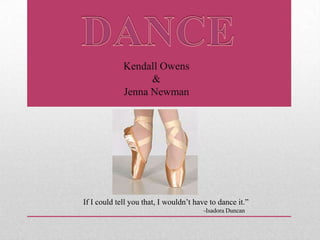
Kendall Owens
&
Jenna Newman
If I could tell you that, I wouldn’t have to dance it.”
-Isadora Duncan
BALLET
Origins
 Started in Italy, France
 Originated in the Renaissance courts to provide entertainment for
the royalty.
Positioning and Movement
 Dancers maintain erect posture and a turned-out position
facing the audience.
 Movements followed the rhythm of the music
 Movements defied gravity and dancers seemed to soar
through the air ignoring the realities of life.
 Every movement had its “place” or was “set in stone
 Very structured and restricting movement.
BALLET
From Ballet  Modern
* Multiple movements in art, literature, and
theatre influenced the changes in dance.
* Major events and conditions of society such
as the Great Depression and World War 1
and 2
* during these times people used dance to
pass the time.
* Dancers wanted more freedom and
independence and caused them to veer away
from the technical aspects of dance.
The rise of modern dance
Origins
‫ﻡ‬ Modern was developed in rejection to ballet
‫ﻡ‬ Flourished in areas that lacked strong ballet
such as Europe (where it originated)
‫ﻡ‬ 1930’s- the U.S was the center for “dance
experimentation”
Goals
‫ﻡ‬ Dancers wished to be:
‫ﻡ‬ more creative
‫ﻡ‬ taken more seriously as an artist
not just a performer
‫ﻡ‬ Make dance more “personal” and
relatable
Add
relationship
to art to the
presentation
and leave
space next
to bullet
Modern dance characteristics
Movements
‫ﻡ‬ Free movement
‫ﻡ‬ Movements used a multidimensional
orientation in space
‫ﻡ‬ Dancers stood sideways or turned their
backs to the audience
‫ﻡ‬ Deliberate falling motions
‫ﻡ‬ Take into account the weight of the body
Artist performance Relationship
‫ﻡ‬ Personal
‫ﻡ‬ Sometimes told stories about real feelings such as
sorrow, rage, happiness, or excitement
‫ﻡ‬ Silence was used as an aesthetical experience
‫ﻡ‬ 1 artist often acted as the choreographer and
performer
Modern dance characteristics
MARTHA GRAHAM
“The Mother of Modern Dance”
 Graham believed in internal movements. She used natural
human movements (walking and breathing) and turned
them into dance movements.
 She was inspired by art, history, literature, and social
commentary.
Techniques
 Focused on the use of contraction and release through
the natural exhaling and inhaling of breathing
 Added abdominal and pelvic contractions and floor
work to dance
 Very grounded movement in contrast to the airborne
movements of ballet
 Introduced moving scenery, the use of props and
sculptures as symbols, and the combination of speech
and dance.
 Used sharp angular movement
 Dressed in long, straight, dark dresses instead of the
traditional light, flowing chiffon costumes
MARTHA GRAHAM
“The Mother of Modern Dance”
MARTHA GRAHAM
Works
“It’s not my job to look
beautiful. It’s my job to look
interesting.”
 Her pieces were very dramatic. Her goal was to portray the more real
feelings of life such as guilt, desire, and rage. She wished to reflect
the true feelings felt in life rather than the gimmick feelings like
always being happy.
MARTHA GRAHAM
Works
 Chronicle (1936): This is one of Martha’s most
defining work. It brought serious issues to the stage
in a dramatic style. Influenced by the Wall Street
Crash, the Great Depression, and the Spanish Civil
War, it focused on the ideas of depression and
isolation reflected through a dark nature of set and
costumes.
 Primitive Canticles influenced by American
Indians.
 Lamentation (1930)
http://www.youtube.com/watch?v=xgf3xgbKYko
(show beginning then jump to dance)
 Frontier (1976)
http://www.youtube.com/watch?v=z2Q6UJN0ef0
(2:25)
ISADORA DUNCAN
 She found inspiration in music, poetry, and nature.
 Used the connection between her own thoughts and feelings with the
movements they can generate to portray a message. She felt that dance
was a spiritual expression from your soul.
ISADORA DUNCAN
Techniques
 Uses Greek sculptures as a source of movement
 Created dances that alternated between resisting and
giving in to gravity
 She introduced the idea that movement comes from
your solar plexus and out from there.
 Dances barefoot
ISADORA DUNCAN
Works
Dances inspired by the Russian Revolution and
her most political works (1912-1925)
 Mother
 Revolutionary
 Marche Salv
Dances in response to World War 1 and dances
of despair, lamentation, and renewal following
the death of her children (1912-1920)
 Military Polonaise
 Marche Heroique
http://www.youtube.com/watch?v=-Ra19kIOFCo
Dances inspired by Greek Antiquity such as
sculptures, vase paintings, and mythology
(1900-1915)
 Dance of the Amazons
 Morning Star
 Tangra
 Orpheus’ Lament
ISADORA DUNCAN
Works
Dances inspired by nature set as
autobiographical dance poems to music (1900-
1910)
 Water Study
 Lullabye
 Butterfly Etude
Dances inspired by passion and romance due to
Isadora’s love life and art led her to create
works that unleashed her torment and
reassuring her womanhood (1908-1915)
 Rose Petals
 The Ave Maria
 Death and the Maiden
MERCE CUNNINGHAM
 Introduced the idea of the relationship between dance and
music may occur in the same time and space, but created
independently of each other.
 Used chance procedures, such as rolling a dice to determine
what part of the body to use
 Partnered with John Cage. Cage’s music was a framework
for Cunningham’s movement to exist.
MERCE CUNNINGHAM
Techniques
 Rigorous movement
 Emphasis on acquiring strength, clarity
and precision
 Fused Graham techniques and
traditional ballet
Techniques
 Uses the idea of the body’s own “line of energy”
to promote easy natural movement.
 Intense movement from the spine, of the torso and
feet
 choreography was an expression of the nature of
change itself
 He wasn’t interested in telling stories, but used the
intensity and energy of the human body to create
movement
MERCE CUNNINGHAM
In his works dancers often danced alone even in duets or
ensembles, and music and design would act as environments
to the dancers and audience.
MERCE CUNNINGHAM
Works
 Borst Park (1972), Inlets (1977), and Inlets 2
(1983)- inspired by wildlife
 Solo (1975)- also inspired by wildlife. He
seemed to transform from one animal to
another.
 Rainforest (1968)- inspired by anthropology
 The Coast zone-
http://www.youtube.com/watch?v=OBcwL8ROB
Ak
 Second Hand-
http://www.youtube.com/watch?NR=1&v=-
FwiMlDQ7rI&feature=endscreen
Reactions to modern dance
The reactions to the shift in dance were mixed.
Against the change:
→Preferred the classical ballet
→Argued that it was not art
→Dance should remain a performance based idea
→Highlighted the body in a less than professional manner
→Rebellious
Reactions to modern dance
For Modern:
→Worthy of being classified as art
→Creative qualities
→Made personal connections
→Includes the audience in the experience
→More for the public view (not just royalty/rich)
Moderns Impact on Dance
‫ﺼ‬ Dance is now considered an art form
‫ﺼ‬ It has led to various styles of dance
(lyrical, contemporary, etc.)
‫ﺼ‬ More emotional and personal/relatable
‫ﺼ‬ Takes into account the realities of life
(gravity, feelings/emotions, natural movements)
‫ﺼ‬ Free/angular movement
‫ﺼ‬ No “classes”
‫ﺼ‬ Dancers start at earlier ages

Kendall Jenna powerpoint

  • 1.
    Kendall Owens & Jenna Newman IfI could tell you that, I wouldn’t have to dance it.” -Isadora Duncan
  • 2.
    BALLET Origins  Started inItaly, France  Originated in the Renaissance courts to provide entertainment for the royalty.
  • 3.
    Positioning and Movement Dancers maintain erect posture and a turned-out position facing the audience.  Movements followed the rhythm of the music  Movements defied gravity and dancers seemed to soar through the air ignoring the realities of life.  Every movement had its “place” or was “set in stone  Very structured and restricting movement. BALLET
  • 4.
    From Ballet Modern * Multiple movements in art, literature, and theatre influenced the changes in dance. * Major events and conditions of society such as the Great Depression and World War 1 and 2 * during these times people used dance to pass the time. * Dancers wanted more freedom and independence and caused them to veer away from the technical aspects of dance.
  • 5.
    The rise ofmodern dance Origins ‫ﻡ‬ Modern was developed in rejection to ballet ‫ﻡ‬ Flourished in areas that lacked strong ballet such as Europe (where it originated) ‫ﻡ‬ 1930’s- the U.S was the center for “dance experimentation” Goals ‫ﻡ‬ Dancers wished to be: ‫ﻡ‬ more creative ‫ﻡ‬ taken more seriously as an artist not just a performer ‫ﻡ‬ Make dance more “personal” and relatable Add relationship to art to the presentation and leave space next to bullet
  • 6.
    Modern dance characteristics Movements ‫ﻡ‬Free movement ‫ﻡ‬ Movements used a multidimensional orientation in space ‫ﻡ‬ Dancers stood sideways or turned their backs to the audience ‫ﻡ‬ Deliberate falling motions ‫ﻡ‬ Take into account the weight of the body
  • 7.
    Artist performance Relationship ‫ﻡ‬Personal ‫ﻡ‬ Sometimes told stories about real feelings such as sorrow, rage, happiness, or excitement ‫ﻡ‬ Silence was used as an aesthetical experience ‫ﻡ‬ 1 artist often acted as the choreographer and performer Modern dance characteristics
  • 8.
    MARTHA GRAHAM “The Motherof Modern Dance”  Graham believed in internal movements. She used natural human movements (walking and breathing) and turned them into dance movements.  She was inspired by art, history, literature, and social commentary.
  • 9.
    Techniques  Focused onthe use of contraction and release through the natural exhaling and inhaling of breathing  Added abdominal and pelvic contractions and floor work to dance  Very grounded movement in contrast to the airborne movements of ballet  Introduced moving scenery, the use of props and sculptures as symbols, and the combination of speech and dance.  Used sharp angular movement  Dressed in long, straight, dark dresses instead of the traditional light, flowing chiffon costumes MARTHA GRAHAM “The Mother of Modern Dance”
  • 10.
    MARTHA GRAHAM Works “It’s notmy job to look beautiful. It’s my job to look interesting.”  Her pieces were very dramatic. Her goal was to portray the more real feelings of life such as guilt, desire, and rage. She wished to reflect the true feelings felt in life rather than the gimmick feelings like always being happy.
  • 11.
    MARTHA GRAHAM Works  Chronicle(1936): This is one of Martha’s most defining work. It brought serious issues to the stage in a dramatic style. Influenced by the Wall Street Crash, the Great Depression, and the Spanish Civil War, it focused on the ideas of depression and isolation reflected through a dark nature of set and costumes.  Primitive Canticles influenced by American Indians.  Lamentation (1930) http://www.youtube.com/watch?v=xgf3xgbKYko (show beginning then jump to dance)  Frontier (1976) http://www.youtube.com/watch?v=z2Q6UJN0ef0 (2:25)
  • 12.
    ISADORA DUNCAN  Shefound inspiration in music, poetry, and nature.  Used the connection between her own thoughts and feelings with the movements they can generate to portray a message. She felt that dance was a spiritual expression from your soul.
  • 13.
    ISADORA DUNCAN Techniques  UsesGreek sculptures as a source of movement  Created dances that alternated between resisting and giving in to gravity  She introduced the idea that movement comes from your solar plexus and out from there.  Dances barefoot
  • 14.
    ISADORA DUNCAN Works Dances inspiredby the Russian Revolution and her most political works (1912-1925)  Mother  Revolutionary  Marche Salv Dances in response to World War 1 and dances of despair, lamentation, and renewal following the death of her children (1912-1920)  Military Polonaise  Marche Heroique http://www.youtube.com/watch?v=-Ra19kIOFCo
  • 15.
    Dances inspired byGreek Antiquity such as sculptures, vase paintings, and mythology (1900-1915)  Dance of the Amazons  Morning Star  Tangra  Orpheus’ Lament ISADORA DUNCAN Works Dances inspired by nature set as autobiographical dance poems to music (1900- 1910)  Water Study  Lullabye  Butterfly Etude Dances inspired by passion and romance due to Isadora’s love life and art led her to create works that unleashed her torment and reassuring her womanhood (1908-1915)  Rose Petals  The Ave Maria  Death and the Maiden
  • 16.
    MERCE CUNNINGHAM  Introducedthe idea of the relationship between dance and music may occur in the same time and space, but created independently of each other.  Used chance procedures, such as rolling a dice to determine what part of the body to use  Partnered with John Cage. Cage’s music was a framework for Cunningham’s movement to exist.
  • 17.
    MERCE CUNNINGHAM Techniques  Rigorousmovement  Emphasis on acquiring strength, clarity and precision  Fused Graham techniques and traditional ballet
  • 18.
    Techniques  Uses theidea of the body’s own “line of energy” to promote easy natural movement.  Intense movement from the spine, of the torso and feet  choreography was an expression of the nature of change itself  He wasn’t interested in telling stories, but used the intensity and energy of the human body to create movement MERCE CUNNINGHAM
  • 19.
    In his worksdancers often danced alone even in duets or ensembles, and music and design would act as environments to the dancers and audience. MERCE CUNNINGHAM Works  Borst Park (1972), Inlets (1977), and Inlets 2 (1983)- inspired by wildlife  Solo (1975)- also inspired by wildlife. He seemed to transform from one animal to another.  Rainforest (1968)- inspired by anthropology  The Coast zone- http://www.youtube.com/watch?v=OBcwL8ROB Ak  Second Hand- http://www.youtube.com/watch?NR=1&v=- FwiMlDQ7rI&feature=endscreen
  • 20.
    Reactions to moderndance The reactions to the shift in dance were mixed. Against the change: →Preferred the classical ballet →Argued that it was not art →Dance should remain a performance based idea →Highlighted the body in a less than professional manner →Rebellious
  • 21.
    Reactions to moderndance For Modern: →Worthy of being classified as art →Creative qualities →Made personal connections →Includes the audience in the experience →More for the public view (not just royalty/rich)
  • 22.
    Moderns Impact onDance ‫ﺼ‬ Dance is now considered an art form ‫ﺼ‬ It has led to various styles of dance (lyrical, contemporary, etc.) ‫ﺼ‬ More emotional and personal/relatable ‫ﺼ‬ Takes into account the realities of life (gravity, feelings/emotions, natural movements) ‫ﺼ‬ Free/angular movement ‫ﺼ‬ No “classes” ‫ﺼ‬ Dancers start at earlier ages