

DANCE
as an art
Today’s
Lesson
1
2
3
Folk Dance
Ballet
Modern Dance
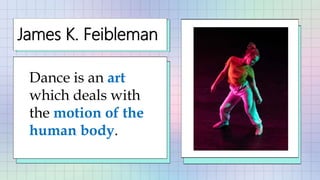
Dance is an art
which deals with
the motion of the
human body.
James K. Feibleman
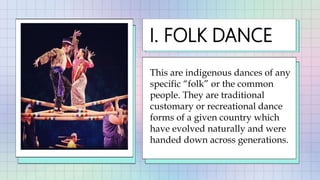
This are indigenous dances of any
specific “folk” or the common
people. They are traditional
customary or recreational dance
forms of a given country which
have evolved naturally and were
handed down across generations.
I. FOLK DANCE
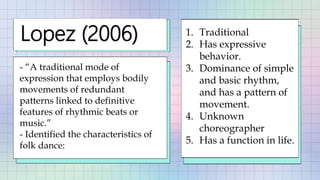
Lopez (2006)
- “A traditional mode of
expression that employs bodily
movements of redundant
patterns linked to definitive
features of rhythmic beats or
music.”
- Identified the characteristics of
folk dance:
1. Traditional
2. Has expressive
behavior.
3. Dominance of simple
and basic rhythm,
and has a pattern of
movement.
4. Unknown
choreographer
5. Has a function in life.
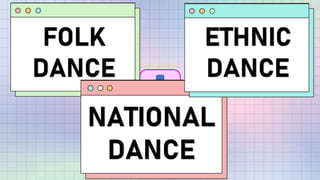
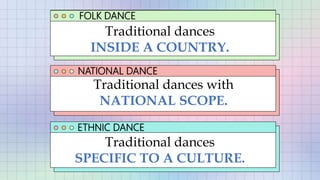
FOLK DANCE
NATIONAL DANCE
ETHNIC DANCE
Traditional dances with
NATIONAL SCOPE.
Traditional dances
INSIDE A COUNTRY.
Traditional dances
SPECIFIC TO A CULTURE.
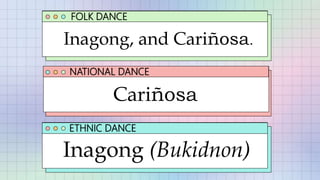
FOLK DANCE
NATIONAL DANCE
ETHNIC DANCE
Cariñosa
Inagong, and Cariñosa.
Inagong (Bukidnon)
ETHNIC DANCES
(Types)
RITUAL DANCES
LIFE-CYCLE DANCES
OCCUPATIONAL DANCES
Relating to the cycle of human life such as
birthing, courtship, wedding, and funeral.
Depict ritual ceremonies.
Exhibit work and occupation of
dancers.
1
2
3
FOLK DANCES
(Regional Classification)
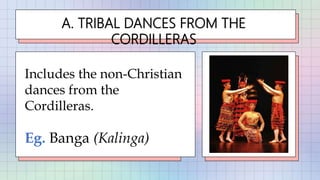
A. TRIBAL DANCES FROM THE
CORDILLERAS
Includes the non-Christian
dances from the
Cordilleras.
Eg. Banga (Kalinga)
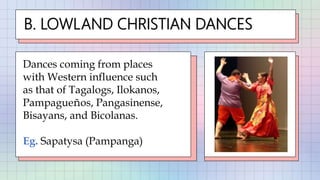
B. LOWLAND CHRISTIAN DANCES
Dances coming from places
with Western influence such
as that of Tagalogs, Ilokanos,
Pampagueños, Pangasinense,
Bisayans, and Bicolanas.
Eg. Sapatysa (Pampanga)
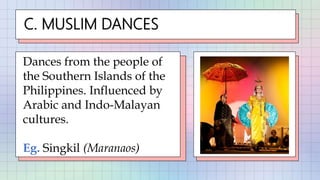
C. MUSLIM DANCES
Dances from the people of
the Southern Islands of the
Philippines. Influenced by
Arabic and Indo-Malayan
cultures.
Eg. Singkil (Maranaos)
FOLK DANCES
(General Classification)
LIFE-CYCLE DANCES
Serves as a ritual as one passes to a different
stage in life.
FESTIVAL DANCES
OCCUPATIONAL DANCES
Celebration of recurring events of special
significance.
Depict the means of livelihood of the Filipino
people.
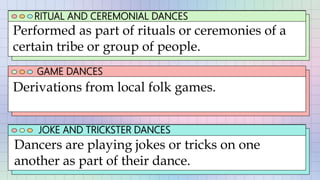
RITUAL AND CEREMONIAL DANCES
GAME DANCES
JOKE AND TRICKSTER DANCES
Performed as part of rituals or ceremonies of a
certain tribe or group of people.
Dancers are playing jokes or tricks on one
another as part of their dance.
Derivations from local folk games.
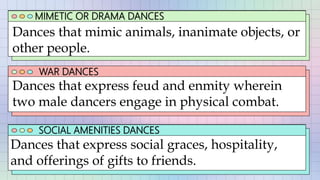
MIMETIC OR DRAMA DANCES
WAR DANCES
SOCIAL AMENITIES DANCES
Dances that mimic animals, inanimate objects, or
other people.
Dances that express feud and enmity wherein
two male dancers engage in physical combat.
Dances that express social graces, hospitality,
and offerings of gifts to friends.
FUNDAMENTAL
STEPS
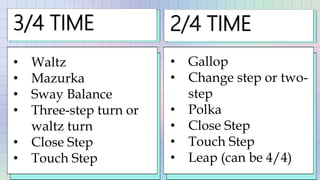
3/4 TIME
• Waltz
• Mazurka
• Sway Balance
• Three-step turn or
waltz turn
• Close Step
• Touch Step
2/4 TIME
• Gallop
• Change step or two-
step
• Polka
• Close Step
• Touch Step
• Leap (can be 4/4)
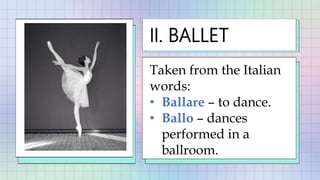
Taken from the Italian
words:
• Ballare – to dance.
• Ballo – dances
performed in a
ballroom.
II. BALLET
Haskell (1965)
Ballet is a
combination of the
arts of dancing,
poetry, music, and
painting.
Burian (1963)
Ballet is an artistic,
programmatic,
scenic dance,
accompanied by
music.
BRIEF HISTORY
DINNER BALLETS IN ITALY
INTRODUCTION OF BALLET TO THE
WORLD
WHY FRENCH IS THE MEDIUM OF
BALLET
Queen Catherine de Medici marked the staging
of ballet. She brought ballet out from Italy to
France.
Ballet started as a performance in the royal court
where MALE SERVANTS would perform during
a court dinner.
Although ballet started in Italy and spread out through
European countries, it was the French people who
widened its popularity.
1
2
3
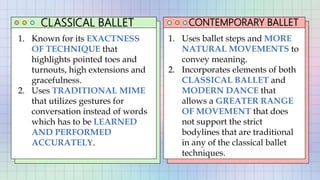
CLASSICAL BALLET CONTEMPORARY BALLET
1. Known for its EXACTNESS
OF TECHNIQUE that
highlights pointed toes and
turnouts, high extensions and
gracefulness.
2. Uses TRADITIONAL MIME
that utilizes gestures for
conversation instead of words
which has to be LEARNED
AND PERFORMED
ACCURATELY.
1. Uses ballet steps and MORE
NATURAL MOVEMENTS to
convey meaning.
2. Incorporates elements of both
CLASSICAL BALLET and
MODERN DANCE that
allows a GREATER RANGE
OF MOVEMENT that does
not support the strict
bodylines that are traditional
in any of the classical ballet
techniques.
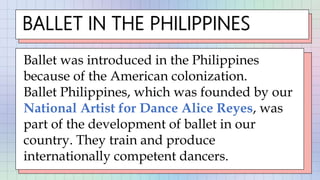
BALLET IN THE PHILIPPINES
Ballet was introduced in the Philippines
because of the American colonization.
Ballet Philippines, which was founded by our
National Artist for Dance Alice Reyes, was
part of the development of ballet in our
country. They train and produce
internationally competent dancers.
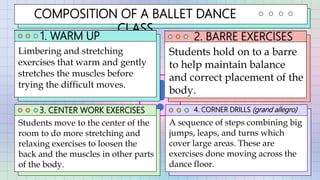
COMPOSITION OF A BALLET DANCE
CLASS
1. WARM UP 2. BARRE EXERCISES
3. CENTER WORK EXERCISES 4. CORNER DRILLS (grand allegro)
Limbering and stretching
exercises that warm and gently
stretches the muscles before
trying the difficult moves.
Students hold on to a barre
to help maintain balance
and correct placement of the
body.
Students move to the center of the
room to do more stretching and
relaxing exercises to loosen the
back and the muscles in other parts
of the body.
A sequence of steps combining big
jumps, leaps, and turns which
cover large areas. These are
exercises done moving across the
dance floor.
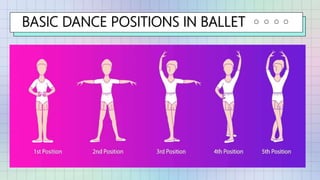
BASIC DANCE POSITIONS IN BALLET
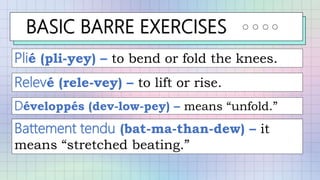
BASIC BARRE EXERCISES
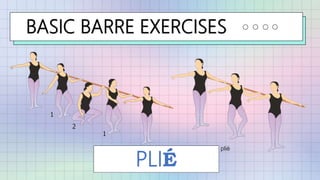
Plié (pli-yey) – to bend or fold the knees.
Relevé (rele-vey) – to lift or rise.
Développés (dev-low-pey) – means “unfold.”
Battement tendu (bat-ma-than-dew) – it
means “stretched beating.”
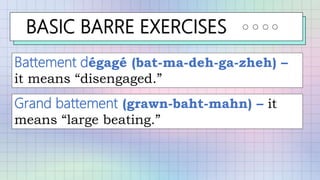
BASIC BARRE EXERCISES
Battement dégagé (bat-ma-deh-ga-zheh) –
it means “disengaged.”
Grand battement (grawn-baht-mahn) – it
means “large beating.”
BASIC BARRE EXERCISES
PLIÉ
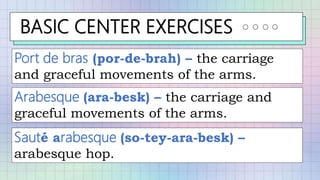
BASIC CENTER EXERCISES
Port de bras (por-de-brah) – the carriage
and graceful movements of the arms.
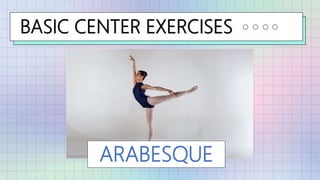
Arabesque (ara-besk) – the carriage and
graceful movements of the arms.
Sauté arabesque (so-tey-ara-besk) –
arabesque hop.
BASIC CENTER EXERCISES
Attitude – the bent leg is raised in front or
behind the body.
Pas de bourrée (pha-de-bo-rey) – means
“stuffed steps.”
Glissade – gliding step.
BASIC CENTER EXERCISES
ARABESQUE
BASIC CORNER EXERCISES
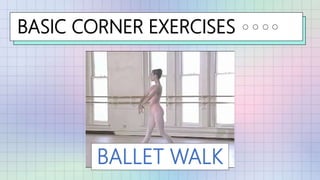
Ballet walks – describes the way a ballet
dancer walks.
Chassé (cha-sey) – means “chasing step.”
Sautés (so-teys) – means “jumps.”
Jeté (je-tey) – it means “thrown.”
BASIC CORNER EXERCISES
Grand jeté – means a big leap.
Assemblé (a-sem-bley) – means “assembled.”
BASIC CORNER EXERCISES
BALLET WALK
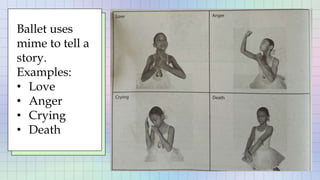
Ballet uses
mime to tell a
story.
Examples:
• Love
• Anger
• Crying
• Death
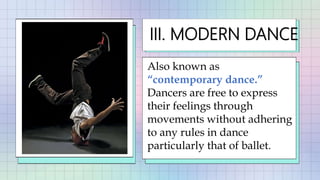
III. MODERN DANCE
Also known as
“contemporary dance.”
Dancers are free to express
their feelings through
movements without adhering
to any rules in dance
particularly that of ballet.
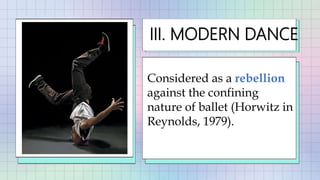
III. MODERN DANCE
Considered as a rebellion
against the confining
nature of ballet (Horwitz in
Reynolds, 1979).
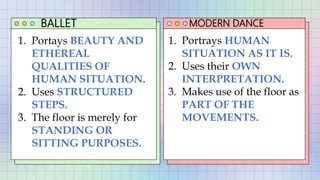
BALLET MODERN DANCE
1. Portays BEAUTY AND
ETHEREAL
QUALITIES OF
HUMAN SITUATION.
2. Uses STRUCTURED
STEPS.
3. The floor is merely for
STANDING OR
SITTING PURPOSES.
1. Portrays HUMAN
SITUATION AS IT IS.
2. Uses their OWN
INTERPRETATION.
3. Makes use of the floor as
PART OF THE
MOVEMENTS.
MODERN DANCES
(Characteristics)
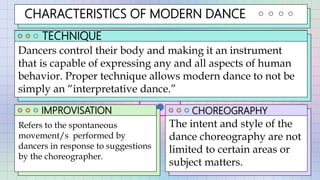
CHARACTERISTICS OF MODERN DANCE
TECHNIQUE
IMPROVISATION CHOREOGRAPHY
Dancers control their body and making it an instrument
that is capable of expressing any and all aspects of human
behavior. Proper technique allows modern dance to not be
simply an “interpretative dance.”
Refers to the spontaneous
movement/s performed by
dancers in response to suggestions
by the choreographer.
The intent and style of the
dance choreography are not
limited to certain areas or
subject matters.
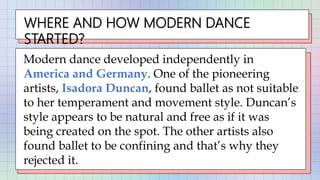
WHERE AND HOW MODERN DANCE
STARTED?
Modern dance developed independently in
America and Germany. One of the pioneering
artists, Isadora Duncan, found ballet as not suitable
to her temperament and movement style. Duncan’s
style appears to be natural and free as if it was
being created on the spot. The other artists also
found ballet to be confining and that’s why they
rejected it.
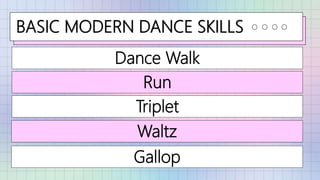
BASIC MODERN DANCE SKILLS
Dance Walk
Triplet
Run
Waltz
Gallop
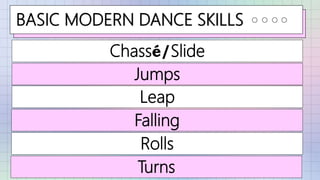
BASIC MODERN DANCE SKILLS
Chassé/Slide
Leap
Jumps
Falling
Rolls
Turns

Dance as an Art

  • 2.
  • 3.
  • 4.
    Dance is anart which deals with the motion of the human body. James K. Feibleman
  • 5.
    This are indigenousdances of any specific “folk” or the common people. They are traditional customary or recreational dance forms of a given country which have evolved naturally and were handed down across generations. I. FOLK DANCE
  • 6.
    Lopez (2006) - “Atraditional mode of expression that employs bodily movements of redundant patterns linked to definitive features of rhythmic beats or music.” - Identified the characteristics of folk dance: 1. Traditional 2. Has expressive behavior. 3. Dominance of simple and basic rhythm, and has a pattern of movement. 4. Unknown choreographer 5. Has a function in life.
  • 8.
    FOLK DANCE NATIONAL DANCE ETHNICDANCE Traditional dances with NATIONAL SCOPE. Traditional dances INSIDE A COUNTRY. Traditional dances SPECIFIC TO A CULTURE.
  • 9.
    FOLK DANCE NATIONAL DANCE ETHNICDANCE Cariñosa Inagong, and Cariñosa. Inagong (Bukidnon)
  • 10.
  • 11.
    RITUAL DANCES LIFE-CYCLE DANCES OCCUPATIONALDANCES Relating to the cycle of human life such as birthing, courtship, wedding, and funeral. Depict ritual ceremonies. Exhibit work and occupation of dancers. 1 2 3
  • 12.
  • 13.
    A. TRIBAL DANCESFROM THE CORDILLERAS Includes the non-Christian dances from the Cordilleras. Eg. Banga (Kalinga)
  • 14.
    B. LOWLAND CHRISTIANDANCES Dances coming from places with Western influence such as that of Tagalogs, Ilokanos, Pampagueños, Pangasinense, Bisayans, and Bicolanas. Eg. Sapatysa (Pampanga)
  • 15.
    C. MUSLIM DANCES Dancesfrom the people of the Southern Islands of the Philippines. Influenced by Arabic and Indo-Malayan cultures. Eg. Singkil (Maranaos)
  • 16.
  • 17.
    LIFE-CYCLE DANCES Serves asa ritual as one passes to a different stage in life. FESTIVAL DANCES OCCUPATIONAL DANCES Celebration of recurring events of special significance. Depict the means of livelihood of the Filipino people.
  • 18.
    RITUAL AND CEREMONIALDANCES GAME DANCES JOKE AND TRICKSTER DANCES Performed as part of rituals or ceremonies of a certain tribe or group of people. Dancers are playing jokes or tricks on one another as part of their dance. Derivations from local folk games.
  • 19.
    MIMETIC OR DRAMADANCES WAR DANCES SOCIAL AMENITIES DANCES Dances that mimic animals, inanimate objects, or other people. Dances that express feud and enmity wherein two male dancers engage in physical combat. Dances that express social graces, hospitality, and offerings of gifts to friends.
  • 20.
  • 21.
    3/4 TIME • Waltz •Mazurka • Sway Balance • Three-step turn or waltz turn • Close Step • Touch Step 2/4 TIME • Gallop • Change step or two- step • Polka • Close Step • Touch Step • Leap (can be 4/4)
  • 22.
    Taken from theItalian words: • Ballare – to dance. • Ballo – dances performed in a ballroom. II. BALLET
  • 23.
    Haskell (1965) Ballet isa combination of the arts of dancing, poetry, music, and painting. Burian (1963) Ballet is an artistic, programmatic, scenic dance, accompanied by music.
  • 24.
  • 25.
    DINNER BALLETS INITALY INTRODUCTION OF BALLET TO THE WORLD WHY FRENCH IS THE MEDIUM OF BALLET Queen Catherine de Medici marked the staging of ballet. She brought ballet out from Italy to France. Ballet started as a performance in the royal court where MALE SERVANTS would perform during a court dinner. Although ballet started in Italy and spread out through European countries, it was the French people who widened its popularity. 1 2 3
  • 27.
    CLASSICAL BALLET CONTEMPORARYBALLET 1. Known for its EXACTNESS OF TECHNIQUE that highlights pointed toes and turnouts, high extensions and gracefulness. 2. Uses TRADITIONAL MIME that utilizes gestures for conversation instead of words which has to be LEARNED AND PERFORMED ACCURATELY. 1. Uses ballet steps and MORE NATURAL MOVEMENTS to convey meaning. 2. Incorporates elements of both CLASSICAL BALLET and MODERN DANCE that allows a GREATER RANGE OF MOVEMENT that does not support the strict bodylines that are traditional in any of the classical ballet techniques.
  • 28.
    BALLET IN THEPHILIPPINES Ballet was introduced in the Philippines because of the American colonization. Ballet Philippines, which was founded by our National Artist for Dance Alice Reyes, was part of the development of ballet in our country. They train and produce internationally competent dancers.
  • 29.
    COMPOSITION OF ABALLET DANCE CLASS 1. WARM UP 2. BARRE EXERCISES 3. CENTER WORK EXERCISES 4. CORNER DRILLS (grand allegro) Limbering and stretching exercises that warm and gently stretches the muscles before trying the difficult moves. Students hold on to a barre to help maintain balance and correct placement of the body. Students move to the center of the room to do more stretching and relaxing exercises to loosen the back and the muscles in other parts of the body. A sequence of steps combining big jumps, leaps, and turns which cover large areas. These are exercises done moving across the dance floor.
  • 30.
  • 31.
    BASIC BARRE EXERCISES Plié(pli-yey) – to bend or fold the knees. Relevé (rele-vey) – to lift or rise. Développés (dev-low-pey) – means “unfold.” Battement tendu (bat-ma-than-dew) – it means “stretched beating.”
  • 32.
    BASIC BARRE EXERCISES Battementdégagé (bat-ma-deh-ga-zheh) – it means “disengaged.” Grand battement (grawn-baht-mahn) – it means “large beating.”
  • 33.
  • 34.
    BASIC CENTER EXERCISES Portde bras (por-de-brah) – the carriage and graceful movements of the arms. Arabesque (ara-besk) – the carriage and graceful movements of the arms. Sauté arabesque (so-tey-ara-besk) – arabesque hop.
  • 35.
    BASIC CENTER EXERCISES Attitude– the bent leg is raised in front or behind the body. Pas de bourrée (pha-de-bo-rey) – means “stuffed steps.” Glissade – gliding step.
  • 36.
  • 37.
    BASIC CORNER EXERCISES Balletwalks – describes the way a ballet dancer walks. Chassé (cha-sey) – means “chasing step.” Sautés (so-teys) – means “jumps.” Jeté (je-tey) – it means “thrown.”
  • 38.
    BASIC CORNER EXERCISES Grandjeté – means a big leap. Assemblé (a-sem-bley) – means “assembled.”
  • 39.
  • 40.
    Ballet uses mime totell a story. Examples: • Love • Anger • Crying • Death
  • 41.
    III. MODERN DANCE Alsoknown as “contemporary dance.” Dancers are free to express their feelings through movements without adhering to any rules in dance particularly that of ballet.
  • 42.
    III. MODERN DANCE Consideredas a rebellion against the confining nature of ballet (Horwitz in Reynolds, 1979).
  • 43.
    BALLET MODERN DANCE 1.Portays BEAUTY AND ETHEREAL QUALITIES OF HUMAN SITUATION. 2. Uses STRUCTURED STEPS. 3. The floor is merely for STANDING OR SITTING PURPOSES. 1. Portrays HUMAN SITUATION AS IT IS. 2. Uses their OWN INTERPRETATION. 3. Makes use of the floor as PART OF THE MOVEMENTS.
  • 44.
  • 45.
    CHARACTERISTICS OF MODERNDANCE TECHNIQUE IMPROVISATION CHOREOGRAPHY Dancers control their body and making it an instrument that is capable of expressing any and all aspects of human behavior. Proper technique allows modern dance to not be simply an “interpretative dance.” Refers to the spontaneous movement/s performed by dancers in response to suggestions by the choreographer. The intent and style of the dance choreography are not limited to certain areas or subject matters.
  • 46.
    WHERE AND HOWMODERN DANCE STARTED? Modern dance developed independently in America and Germany. One of the pioneering artists, Isadora Duncan, found ballet as not suitable to her temperament and movement style. Duncan’s style appears to be natural and free as if it was being created on the spot. The other artists also found ballet to be confining and that’s why they rejected it.
  • 47.
    BASIC MODERN DANCESKILLS Dance Walk Triplet Run Waltz Gallop
  • 48.
    BASIC MODERN DANCESKILLS Chassé/Slide Leap Jumps Falling Rolls Turns