HISTORY OF
ARCHITECTURE
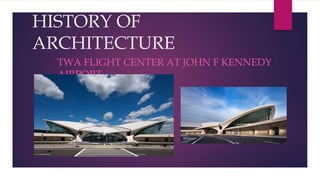
TWA FLIGHT CENTER AT JOHN F KENNEDY
AIRPORT
Eero Saarinen
 Eero Saarinen was born in 1910 in Finland.
 He was an American Architect and Product Designer
of 20th century.
 He was famous for his varying style according to the
demand of the project simple, sweeping, arching
structural curves.
 According to Eero Saarinen “The purpose of
Architecture is to shelter and enhance man’s life on
earth and to fulfill his belief in the nobility of his
existence.
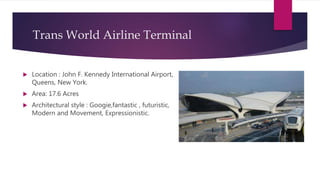
Trans World Airline Terminal
 Location : John F. Kennedy International Airport,
Queens, New York.
 Area: 17.6 Acres
 Architectural style : Googie,fantastic , futuristic,
Modern and Movement, Expressionistic.
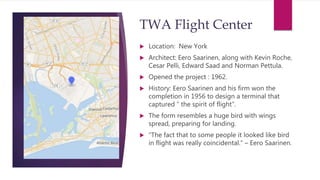
TWA Flight Center
 Location: New York
 Architect: Eero Saarinen, along with Kevin Roche,
Cesar Pelli, Edward Saad and Norman Pettula.
 Opened the project : 1962.
 History: Eero Saarinen and his firm won the
completion in 1956 to design a terminal that
captured “ the spirit of flight”.
 The form resembles a huge bird with wings
spread, preparing for landing.
 “The fact that to some people it looked like bird
in flight was really coincidental.” – Eero Saarinen.
Trans World Airlines at JFK
 Original futuristic design, neo-futurist and fantastic
architectural styles.
 Features thin shell roof, tube – shaped departure/
arrival corridors,expansive windows that highlight
departing and arriving jets, strips of skylights
seperating the four “wings”.
 He developed a special curve edged cermamic tile to
conform to the shell.
 Best challenge for the design was allowing for smooth
passage through the terminal.
Design
• Concept for the form was derived
from the rind of a grapefruit.
• Biggest challenge of the design was
allowing for smooth passage
through the terminal.
• Final solution consisted of creating
4 adjacent shells counterbalancing
each other.
• Final scheme used 3 different sized
configurations of curved, diamond
shaped shells by 4 curvilinear
shaped columns.
Countless study models were made to
determine the most suitable form.
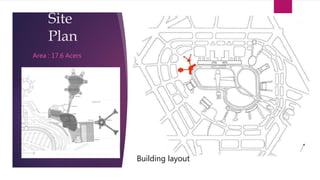
Site
Plan
Area : 17.6 Acers
Building layout
Terminal Level One
Terminal Level Two
Elevation
Elevation
Sections
Structural
Design
Shell Roof
Buttress for support
Glass Skylights
Glass Curtain Wall
Structural
Design
• Reinforced poured in place
concrete shell curve
inspired by grapefruit.
• Four diamond shaped shells
symmetrical on the East –
West axis
• Roof thickness from 7” to
40” at columns.
• Cantilevers are extended to
eighty feet.
• The roof's thin concrete
shell is built to span a space
with a minimum of material.
Roof
Facade
• The main portion of the
head house's facade is
made of large green-tinted
glass walls.
• These glass walls were
coated with a dark-
purple mylar film.
• Single-story wings extend
outward from the main
terminal to the north and
south, and contain several
door openings within the
concave walls.
• Inside these wings are
maintenance areas
Columns
• Four curvilinear y-
shaped columns of
poured in place
reinforced
concrete.
• 51’ Tall.
• 315’ Long.
• 3’ Thick.
Columns
Skylights
• Skylights stretch across
the seams seperating the
shells.
• Each shell meets in the
center to support each
other.
• Emphasizes the line of the
roof and seperation of the
vaults.
• Steel pipe truss curtain wall.
• Outer arc pulls mullions inward
while the mullions hang away
from the structure.
• System relies on the stiffness.
• Structural glass held in the
place by mullionsand hang
outwardly.
• Curtain wall system fills in
'voids‘ between concrete
emphasizing the 'lightness‘ of
the structure.
Curtain Wall
Interiors
• The interiors are dominated
by a combination of cool
white and warm red, a hue.
• Framed with round penny tile
flooring.
• The large windows of the
restaurants provide a view of
planes taking off and landing.
• A concrete balcony on the
upper floor spans the central
staircase from the lower floor
to the intermediate level.
Interior Staircase
 Though the head house is two stories tall, it contains an
intermediate level, joined to the lower level by a central
staircase and to the upper level by four peripheral
staircases.
 Ceramic tiles line the walls and floors.
 A concrete balcony on the upper floor spans the central
staircase from the lower floor to the intermediate level.
 The TWA Flight Center incorporated many innovations
upon its completion, including closed circuit television, a
central public address system, baggage carousels,
electromechanical split-flap display schedule board and
baggage scales, and the satellite clustering of gates away
from the main terminal.
 The intermediate level contains an area facing east, where
passengers could originally see the tarmac.
Staircase
Passageway
s
• The two passageways
leading from the head
house are completely
enclosed and cross a
service roadway.
• These tubes are covered
in concrete, with an
elliptical cross section as
well as indirect lighting.
• To save money, the
passageways did not
have moving walkway.
Thankyou
BY CHAITRA R
3rd SEM B.Arch
RRSA

Twa flight center at jfk

  • 1.
    HISTORY OF ARCHITECTURE TWA FLIGHTCENTER AT JOHN F KENNEDY AIRPORT
  • 2.
    Eero Saarinen  EeroSaarinen was born in 1910 in Finland.  He was an American Architect and Product Designer of 20th century.  He was famous for his varying style according to the demand of the project simple, sweeping, arching structural curves.  According to Eero Saarinen “The purpose of Architecture is to shelter and enhance man’s life on earth and to fulfill his belief in the nobility of his existence.
  • 3.
    Trans World AirlineTerminal  Location : John F. Kennedy International Airport, Queens, New York.  Area: 17.6 Acres  Architectural style : Googie,fantastic , futuristic, Modern and Movement, Expressionistic.
  • 4.
    TWA Flight Center Location: New York  Architect: Eero Saarinen, along with Kevin Roche, Cesar Pelli, Edward Saad and Norman Pettula.  Opened the project : 1962.  History: Eero Saarinen and his firm won the completion in 1956 to design a terminal that captured “ the spirit of flight”.  The form resembles a huge bird with wings spread, preparing for landing.  “The fact that to some people it looked like bird in flight was really coincidental.” – Eero Saarinen.
  • 5.
    Trans World Airlinesat JFK  Original futuristic design, neo-futurist and fantastic architectural styles.  Features thin shell roof, tube – shaped departure/ arrival corridors,expansive windows that highlight departing and arriving jets, strips of skylights seperating the four “wings”.  He developed a special curve edged cermamic tile to conform to the shell.  Best challenge for the design was allowing for smooth passage through the terminal.
  • 6.
    Design • Concept forthe form was derived from the rind of a grapefruit. • Biggest challenge of the design was allowing for smooth passage through the terminal. • Final solution consisted of creating 4 adjacent shells counterbalancing each other. • Final scheme used 3 different sized configurations of curved, diamond shaped shells by 4 curvilinear shaped columns. Countless study models were made to determine the most suitable form.
  • 7.
    Site Plan Area : 17.6Acers Building layout
  • 8.
  • 9.
  • 10.
  • 11.
  • 12.
  • 13.
  • 14.
    Glass Skylights Glass CurtainWall Structural Design
  • 15.
    • Reinforced pouredin place concrete shell curve inspired by grapefruit. • Four diamond shaped shells symmetrical on the East – West axis • Roof thickness from 7” to 40” at columns. • Cantilevers are extended to eighty feet. • The roof's thin concrete shell is built to span a space with a minimum of material. Roof
  • 16.
    Facade • The mainportion of the head house's facade is made of large green-tinted glass walls. • These glass walls were coated with a dark- purple mylar film. • Single-story wings extend outward from the main terminal to the north and south, and contain several door openings within the concave walls. • Inside these wings are maintenance areas
  • 17.
    Columns • Four curvilineary- shaped columns of poured in place reinforced concrete. • 51’ Tall. • 315’ Long. • 3’ Thick. Columns
  • 18.
    Skylights • Skylights stretchacross the seams seperating the shells. • Each shell meets in the center to support each other. • Emphasizes the line of the roof and seperation of the vaults.
  • 19.
    • Steel pipetruss curtain wall. • Outer arc pulls mullions inward while the mullions hang away from the structure. • System relies on the stiffness. • Structural glass held in the place by mullionsand hang outwardly. • Curtain wall system fills in 'voids‘ between concrete emphasizing the 'lightness‘ of the structure. Curtain Wall
  • 20.
    Interiors • The interiorsare dominated by a combination of cool white and warm red, a hue. • Framed with round penny tile flooring. • The large windows of the restaurants provide a view of planes taking off and landing. • A concrete balcony on the upper floor spans the central staircase from the lower floor to the intermediate level.
  • 21.
    Interior Staircase  Thoughthe head house is two stories tall, it contains an intermediate level, joined to the lower level by a central staircase and to the upper level by four peripheral staircases.  Ceramic tiles line the walls and floors.  A concrete balcony on the upper floor spans the central staircase from the lower floor to the intermediate level.  The TWA Flight Center incorporated many innovations upon its completion, including closed circuit television, a central public address system, baggage carousels, electromechanical split-flap display schedule board and baggage scales, and the satellite clustering of gates away from the main terminal.  The intermediate level contains an area facing east, where passengers could originally see the tarmac. Staircase
  • 22.
    Passageway s • The twopassageways leading from the head house are completely enclosed and cross a service roadway. • These tubes are covered in concrete, with an elliptical cross section as well as indirect lighting. • To save money, the passageways did not have moving walkway.
  • 23.