EERO
SAARINEN
Architect and Industrial Designer
GOUTHAM NAIK
CONTENT
INTRODUCTION
 BACKGROUND
 EARLY LIFE
 HIS CAREER
INSPIRATION & INFLUENCE
IDEOLOGY & TYPOLOGY
QUOTES & AWARDS
CONCLUSION
BIBILOGRAPHY
INTRODUCTION
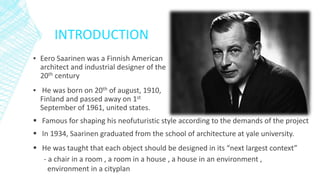
▪ Eero Saarinen was a Finnish American
architect and industrial designer of the
20th century
▪ He was born on 20th of august, 1910,
Finland and passed away on 1st
September of 1961, united states.
 Famous for shaping his neofuturistic style according to the demands of the project
 In 1934, Saarinen graduated from the school of architecture at yale university.
 He was taught that each object should be designed in its “next largest context”
- a chair in a room , a room in a house , a house in an environment ,
environment in a cityplan
BACKGROUND
▪ His father, Eliel Saarinen, was an architect and his mother, Louise
gesellius, a sculptor
▪ In 1923 the sarrinen’s family emigrated to U.S
▪ Eero studied sculpture at the academie de la grande chauiere before
studying architecture at yale university
▪ A yale scholarship enabled eero to travel to Europe again but he
returned to the US in 1936 to work in his father’s architectural practice.
EARLY CAREER
▪ Eero Saarinen also took up a teaching appointment at the crankbrook
academy in which his father eliel Saarinen had been head
▪ When his father died in 1950, he took over his practice , running it as
“SAARINEN & ASSOCIATES” in brimingham
▪ Experimenting with Charles eames he developed new furniture forms
▪ Later Saarinen and eames took part in the “organic design in home
furnishings” competition
▪ Later he developed many good furniture designs like single legged
“tulip chair” which became very popular
CAREER
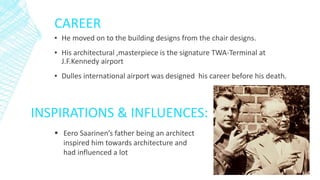
▪ He moved on to the building designs from the chair designs.
▪ His architectural ,masterpiece is the signature TWA-Terminal at
J.F.Kennedy airport
▪ Dulles international airport was designed his career before his death.
INSPIRATIONS & INFLUENCES:
 Eero Saarinen’s father being an architect
inspired him towards architecture and
had influenced a lot
IDEOLOGY
▪ Eero Saarinen believed “Always design a thing by considering it in its
next larger context a chair in a room , a room in a house, a house in an
environment, an environment in a city plan
VIEW ON MODERNISM:
 As an architect, Saarinen became the leader of the 2nd generation of
modernists.
 He built on his predecessors work using new construction technology
to create
 modern architectural forms, but disparaged the simple, abstract
compositions of early modernism
 He refused to develop singular style , preffering to flex the designs to
the needs of the clients
TYPOLOGY
▪ He designs buildings in a irregular manner
▪ Uses concrete as major building material
 “The purpose of architecture is to shelter and enhance man’s life on earth
and to fulfill his belief in the nobility of his existence.”
QUOTES BY EERO SAARINEN:
EERO SAARINEN’S PROJECTS
▪ Crank brook school for boys furnishings , blooms field hills
▪ Saarinen house furnishings , Bloomfield hills
▪ Kingswood school for girls furnishings , Bloomfield hills
▪ Hvittrask studio and home , kirkkonummi , Michigan
▪ Swedish theatre , Helsinki , Finland
▪ Fenton community center , Fenton
▪ J.F spencer house , Grosse pointe Farms
▪ Klein Hans’s music hall, buffalo, New York.
▪ Crow island school, Winnetka , Illinois
EERO SAARINEN’S PROJECTS
▪ Berkshire music center buildings , Lenox , Massachusetts
▪ Eero Saarinen house , Bloomfield hills
▪ General motors technical center , warren , Michigan
▪ University of Michigan , school of music , Ann arbor
▪ IBM manufacturing & training facility, Rochester Minnesota.
▪ TWA terminal , new York city
▪ Hill college house , Philadelphia , Pennsylvania
▪ Dulles international airport , Chantilly
▪ Athens airport, Athens, Greece
CASE STUDIES
▪ Project Information
Location: New York
Architect: Eero Saarinen, along with Kevin Roche,
Cesar Pelli, Edward Saad, & Norman Pettula
Completion: 28 May 1962
Client: Ralph Dawson, Trans World Airlines at JFK International Airport.
TWA TERMINAL
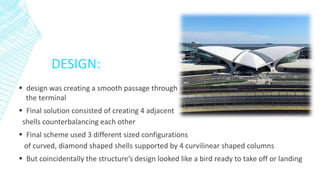
DESIGN:
 design was creating a smooth passage through
the terminal
 Final solution consisted of creating 4 adjacent
shells counterbalancing each other
 Final scheme used 3 different sized configurations
of curved, diamond shaped shells supported by 4 curvilinear shaped columns
 But coincidentally the structure’s design looked like a bird ready to take off or landing
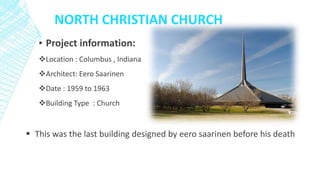
NORTH CHRISTIAN CHURCH
▪ Project information:
Location : Columbus , Indiana
Architect: Eero Saarinen
Date : 1959 to 1963
Building Type : Church
 This was the last building designed by eero saarinen before his death
DESIGN
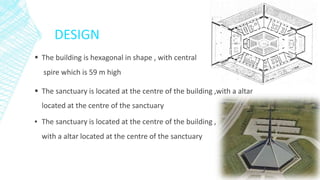
 The building is hexagonal in shape , with central
spire which is 59 m high
 The sanctuary is located at the centre of the building ,with a altar
located at the centre of the sanctuary
▪ The sanctuary is located at the centre of the building ,
with a altar located at the centre of the sanctuary
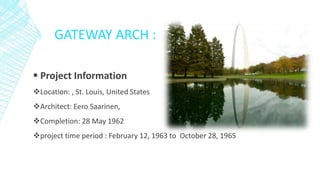
GATEWAY ARCH :
 Project Information
Location: , St. Louis, United States
Architect: Eero Saarinen,
Completion: 28 May 1962
project time period : February 12, 1963 to October 28, 1965
DESIGN
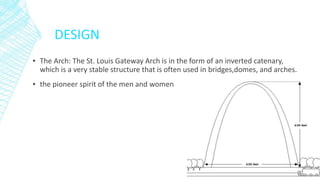
▪ The Arch: The St. Louis Gateway Arch is in the form of an inverted catenary,
which is a very stable structure that is often used in bridges,domes, and arches.
▪ the pioneer spirit of the men and women
BOOKS
 Saarinen and his firm won the competition in 1956 to design a terminal
that captured “the spirit of flight”
AWARDS
 Eero Saarinen on His Work , written by eero Saarinen
 Eero Saarinen , shaping the future
CONCLUSION
▪ Eero builts
▪ There were many critics to eero Saarinen in the beginning but later
people adapted his neo futuristic style of architecture
▪ His legacy continued even after his death
BIBILOGRAPHY
▪ Richard Guy Wilson, (2000). “America's Castles”, Newspaper Moguls, the American
Swedish Institute, Pittock Mansion.
▪ Roman Antonio (2003), “Eero Saarinen”, Princeton Architectural Press, New York.
▪ Serraino Pierluigi (2006). “Saarinen, a Structural Expressionist”, Taschen, Koln.
▪ Merkel Jayne, (2005), “Eero Saarinen”. Phaidon Press, London.
▪ Pelkonen, Eeva-Liisa (2006). “Eero Saarinen”. Yale University Press, New Haven.
▪ Saarinen Aline B, (1968). “Eero Saarinen on his work”. Yale University Press, New Haven
▪ Knight Richard (2008). “Saarinen's Quest, a Memoir”, William Stout Publishers, San
Francisco.
▪ Eero Saarinen (1968),”eero Saarinen on his works”, Yale University press, new haven.
▪ Donald Albrecht (2011),”Eero Saarinen, Shaping the future”, Yale university press, New
haven.

Eero Saarinen

  • 1.
  • 2.
    CONTENT INTRODUCTION  BACKGROUND  EARLYLIFE  HIS CAREER INSPIRATION & INFLUENCE IDEOLOGY & TYPOLOGY QUOTES & AWARDS CONCLUSION BIBILOGRAPHY
  • 3.
    INTRODUCTION ▪ Eero Saarinenwas a Finnish American architect and industrial designer of the 20th century ▪ He was born on 20th of august, 1910, Finland and passed away on 1st September of 1961, united states.  Famous for shaping his neofuturistic style according to the demands of the project  In 1934, Saarinen graduated from the school of architecture at yale university.  He was taught that each object should be designed in its “next largest context” - a chair in a room , a room in a house , a house in an environment , environment in a cityplan
  • 4.
    BACKGROUND ▪ His father,Eliel Saarinen, was an architect and his mother, Louise gesellius, a sculptor ▪ In 1923 the sarrinen’s family emigrated to U.S ▪ Eero studied sculpture at the academie de la grande chauiere before studying architecture at yale university ▪ A yale scholarship enabled eero to travel to Europe again but he returned to the US in 1936 to work in his father’s architectural practice.
  • 5.
    EARLY CAREER ▪ EeroSaarinen also took up a teaching appointment at the crankbrook academy in which his father eliel Saarinen had been head ▪ When his father died in 1950, he took over his practice , running it as “SAARINEN & ASSOCIATES” in brimingham ▪ Experimenting with Charles eames he developed new furniture forms ▪ Later Saarinen and eames took part in the “organic design in home furnishings” competition ▪ Later he developed many good furniture designs like single legged “tulip chair” which became very popular
  • 6.
    CAREER ▪ He movedon to the building designs from the chair designs. ▪ His architectural ,masterpiece is the signature TWA-Terminal at J.F.Kennedy airport ▪ Dulles international airport was designed his career before his death. INSPIRATIONS & INFLUENCES:  Eero Saarinen’s father being an architect inspired him towards architecture and had influenced a lot
  • 7.
    IDEOLOGY ▪ Eero Saarinenbelieved “Always design a thing by considering it in its next larger context a chair in a room , a room in a house, a house in an environment, an environment in a city plan
  • 8.
    VIEW ON MODERNISM: As an architect, Saarinen became the leader of the 2nd generation of modernists.  He built on his predecessors work using new construction technology to create  modern architectural forms, but disparaged the simple, abstract compositions of early modernism  He refused to develop singular style , preffering to flex the designs to the needs of the clients
  • 9.
    TYPOLOGY ▪ He designsbuildings in a irregular manner ▪ Uses concrete as major building material  “The purpose of architecture is to shelter and enhance man’s life on earth and to fulfill his belief in the nobility of his existence.” QUOTES BY EERO SAARINEN:
  • 10.
    EERO SAARINEN’S PROJECTS ▪Crank brook school for boys furnishings , blooms field hills ▪ Saarinen house furnishings , Bloomfield hills ▪ Kingswood school for girls furnishings , Bloomfield hills ▪ Hvittrask studio and home , kirkkonummi , Michigan ▪ Swedish theatre , Helsinki , Finland ▪ Fenton community center , Fenton ▪ J.F spencer house , Grosse pointe Farms ▪ Klein Hans’s music hall, buffalo, New York. ▪ Crow island school, Winnetka , Illinois
  • 11.
    EERO SAARINEN’S PROJECTS ▪Berkshire music center buildings , Lenox , Massachusetts ▪ Eero Saarinen house , Bloomfield hills ▪ General motors technical center , warren , Michigan ▪ University of Michigan , school of music , Ann arbor ▪ IBM manufacturing & training facility, Rochester Minnesota. ▪ TWA terminal , new York city ▪ Hill college house , Philadelphia , Pennsylvania ▪ Dulles international airport , Chantilly ▪ Athens airport, Athens, Greece
  • 12.
    CASE STUDIES ▪ ProjectInformation Location: New York Architect: Eero Saarinen, along with Kevin Roche, Cesar Pelli, Edward Saad, & Norman Pettula Completion: 28 May 1962 Client: Ralph Dawson, Trans World Airlines at JFK International Airport. TWA TERMINAL
  • 13.
    DESIGN:  design wascreating a smooth passage through the terminal  Final solution consisted of creating 4 adjacent shells counterbalancing each other  Final scheme used 3 different sized configurations of curved, diamond shaped shells supported by 4 curvilinear shaped columns  But coincidentally the structure’s design looked like a bird ready to take off or landing
  • 14.
    NORTH CHRISTIAN CHURCH ▪Project information: Location : Columbus , Indiana Architect: Eero Saarinen Date : 1959 to 1963 Building Type : Church  This was the last building designed by eero saarinen before his death
  • 15.
    DESIGN  The buildingis hexagonal in shape , with central spire which is 59 m high  The sanctuary is located at the centre of the building ,with a altar located at the centre of the sanctuary ▪ The sanctuary is located at the centre of the building , with a altar located at the centre of the sanctuary
  • 16.
    GATEWAY ARCH : Project Information Location: , St. Louis, United States Architect: Eero Saarinen, Completion: 28 May 1962 project time period : February 12, 1963 to October 28, 1965
  • 17.
    DESIGN ▪ The Arch:The St. Louis Gateway Arch is in the form of an inverted catenary, which is a very stable structure that is often used in bridges,domes, and arches. ▪ the pioneer spirit of the men and women
  • 18.
    BOOKS  Saarinen andhis firm won the competition in 1956 to design a terminal that captured “the spirit of flight” AWARDS  Eero Saarinen on His Work , written by eero Saarinen  Eero Saarinen , shaping the future
  • 19.
    CONCLUSION ▪ Eero builts ▪There were many critics to eero Saarinen in the beginning but later people adapted his neo futuristic style of architecture ▪ His legacy continued even after his death
  • 20.
    BIBILOGRAPHY ▪ Richard GuyWilson, (2000). “America's Castles”, Newspaper Moguls, the American Swedish Institute, Pittock Mansion. ▪ Roman Antonio (2003), “Eero Saarinen”, Princeton Architectural Press, New York. ▪ Serraino Pierluigi (2006). “Saarinen, a Structural Expressionist”, Taschen, Koln. ▪ Merkel Jayne, (2005), “Eero Saarinen”. Phaidon Press, London. ▪ Pelkonen, Eeva-Liisa (2006). “Eero Saarinen”. Yale University Press, New Haven. ▪ Saarinen Aline B, (1968). “Eero Saarinen on his work”. Yale University Press, New Haven ▪ Knight Richard (2008). “Saarinen's Quest, a Memoir”, William Stout Publishers, San Francisco. ▪ Eero Saarinen (1968),”eero Saarinen on his works”, Yale University press, new haven. ▪ Donald Albrecht (2011),”Eero Saarinen, Shaping the future”, Yale university press, New haven.