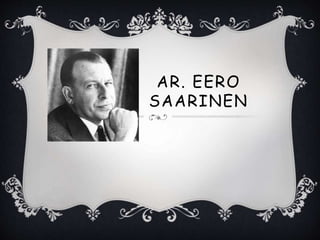
AR. EERO
SAARINEN
LIFE
• Eero was the son of the noted architect Eliel Saarinen
and Loja Gesellius, a sculptor. The Saarinen family of
four, including a sister, Eva-Lisa, moved to the United
States in 1923.
• Eero attended public schools in Michigan. In 1929 he
studied sculpture at the Académie de la Grande
Chaumière in Paris but, as he recounted years later, “it
never occurred to me to do anything but follow in my
father's footsteps.
LIFE
• .” Between 1931 and 1934 he studied architecture at Yale
University, where the curriculum was untouched by
modern theories.
• His father's architecture in Finland had focused on a free
adaptation of medieval Scandinavian forms, and in the
United States he designed various private school
buildings from 1925 to 1941, including Cranbook
Academy of Art in Bloomfield Hills, Mich., following
this loose, romantic style.
PROFESSIONAL PHASE
• Eero Saarinen's professional work in the United States
began in 1936 with research on housing and city
planning with the Flint Institute of Research and
Planning in Flint, Mich.
• He joined his father's practice in Bloomfield Hills in
1938, and one year later their collaborative design—
tranquil yet monumental—for the mall in Washington,
D.C., won first prize in the Smithsonian Institution
Gallery of Art competition. Unfortunately the design
was never executed.
PHILOSOPHIES
• He was taught that each object should be designed
in its "next largest context - a chair in a room, a
room in a house, a house in an environment,
environment in a city plan."
• For him, "The major concern ...was to create a
monument which would have lasting significance
and would be a landmark of our time...
• His opinion was that, "...all parts of an
architectural composition must be parts of the same
form-world."
EERO’S WORKS
• In the 11 years that he survived his father,
Saarinen's own work included a series of
dramatically different designs that displayed a
richer and more diverse vocabulary.
• He introduced sculptural forms that were rich in
architectural character and visual drama unknown
in earlier years. The exciting results were welcomed
by many who were bored by the uniformity of the
International Style of modern architecture
EERO’S WORKS
 Trans World Airlines (TWA) terminal
at John F. Kennedy International
Airport, New York City
 Dulles International Airport
TERMINAL BUILDING,
DULLES
INTERNATIONAL
AIRPORT,
CHANTILLEY,
VIRGINIA,
USA.
(1958-1962)
DULLES INTERNATIONAL
AIRPORT
 This airport was
designed to provide a
modern gateway to the
capital of the nation and
building it for the
federal government.
 The site was a flat plain.
 The main terminus is a single
, compact structure , not
entirely free from formalist
tendencies but one which is
technically exciting.
 The final design concept
arrived at was a suspended
structure, high at the front
,lower in the middle ,slightly
higher at the back , generated
by a rectangular plan.
 The building is thus capable
of lateral extension .
• The 16 pairs of pylons curve
upwards and support the
hammock-like roof in tension.
• Passengers are brought into
the building at 3 levels and
circulation is made to coincide
with the system of mobile
lounges which take people to
air craft on the two-mile-long
runway.
DULLES INTERNATIONAL AIRPORT
• A corner of the building
with the reinforced
concrete pylon carrying
the cable on which the
roof is supported.
• The design included a
landscaped man-made
lake to collect rainwater,
a low-rise hotel, and a
row of office buildings
along the north side of
the main parking lot
SITE PLAN
Plan
U
N
D
E
R
C
O
N
S
T
R
U
C
T
I
O
N
INTERIORS
EXTERIOR
SECTION
SIDE VIEW
TRANS WORLD AIRLINES (TWA)
TERMINAL AT JOHN F.
KENNEDY INTERNATIONAL
AIRPORT, NEW YORK CITY
T.W.A. TERMINAL AT NEW YORK
Building type ----airport terminal
Construction system ---concrete
One of the most self-assured, self-confident— even self-conscious—buildings
to emerge as a result of the interplay of the architectonic and engineer-
inspired buildings was Saarinen's TWA Terminal Buildings at New York.
T.W.A. TERMINAL AT NEW YORK
 It alarmed the remaining purists of modern architecture.
 Its bird-like symbolism, exciting forms and cavernous
interior were not simply a casual reminder of the
changes that had taken place in architectural thinking
in the 1950s, but a demonstration of the architect's role
as an originator .
T.W.A. TERMINAL AT NEW YORK
 This is surely one of the world's most dramatic airline
terminals.
 Few straight lines here: approached head on, its curving
contours uncannily suggest a bird in flight.
 Inside, the main lobby's soaring, swooping walls, its
carefully modeled staircases, seating areas, and many
other features are a blend of graceful sculptural forms
selected 'to suggest the excitement of the trip.'
 Saarinen's terminal for TWA is sculpted as a symbol of
flight - abstract, and not intentionally as a landing
eagle as it has often been described.
T.W.A. TERMINAL AT NEW YORK
 The expressive curves of the design create attractive,
spacious halls and a rare degree of exhilaration for an
airport terminal.
 The period bright orange carpets are gone, and the
atmosphere is a more contemporary cool with the tone
set by the purple-tinted glazing, but the romance of
flight is very much alive.
View of exterior overview approaching
terminal
View of exterior, base of flying roofs
View of interior, sitting area at
mezzanine roof meeting
View of interior detail, ventilator by
entry doors
Location Terminal 5, John F. Kennedy International
Airport, Queens, New York 11430
United States
Area 17.6 acres (7.1 ha)
Architect Eero Saarinen and Associates
Architectural style Neo-futuristic
• According to him, it was '...a building in which the
architecture itself would express the drama and
specialness and excitement of travel... a place of
movement and transition... The shapes were
deliberately chosen in order to emphasize an upward-
soaring quality of line.
T.W.A. TERMINAL AT NEW YORK
Sectional View
KRESGE AUDITORIUM
 Opened: 1955
 Architectural
style: Modern
architecture
 Owner: Massachusetts
Institute of Technology
 Height: 15 m
Kresge Auditorium is an auditorium
building for the Massachusetts Institute of
Technology, located at 48 Massachusetts
Avenue, Cambridge, Massachusetts
 Sitting on a circular red brick platform,
the dome contains a concert hall (with
seating for 1226 people), plus a lower
level that houses a
small theater(seating 204), two
rehearsal rooms, dressing rooms,
offices, bathrooms, and lounges.
 The main stage is paneled with warm-
colored vertical wood elements that
echo the vertical glass panels of the
building's facade.
Plan of Auditorium
 The auditorium is defined by an
elegant thin-shell structure of
reinforced concrete, one-eighth of
a sphere rising to a height of 50 feet,
and sliced away by sheer
glass curtain walls so that it comes to
earth on only three points. Thin-
shelled concrete technology was
innovative for the times.
 The dome weighs only 1200 tons and
is currently clad with copper. It was
originally covered with smooth,
bright, orastone which was then
replaced with lead sheeting attached
with stainless steel wires.
 In 1980, cracks were found in the
supporting structure and the
auditorium was closed immediately
for repairs. Copper replaced the lead
at that time.
 Every seat in the concert hall has an
unobstructed view, since there are no
interior supports for the overarching
dome. Working with renowned
acoustical architects Bolt, Beranek
and Newman, architect Saarinen
employed free-hanging acoustic
"clouds" that absorb and direct
sound, instead of a traditional plaster
ceiling. These clouds also contain
lights, loudspeakers, and ventilation.
 While standing on either side of the
entry lobby, one can distinctly hear
people on the other side speaking in
as low a voice as a whisper. This so-
called whispering gallery effect is
produced by the geometrical shape
and hard surfaces of the space.
THANK YOU

Ar. e3ro saarinen

  • 1.
  • 3.
    LIFE • Eero wasthe son of the noted architect Eliel Saarinen and Loja Gesellius, a sculptor. The Saarinen family of four, including a sister, Eva-Lisa, moved to the United States in 1923. • Eero attended public schools in Michigan. In 1929 he studied sculpture at the Académie de la Grande Chaumière in Paris but, as he recounted years later, “it never occurred to me to do anything but follow in my father's footsteps.
  • 4.
    LIFE • .” Between1931 and 1934 he studied architecture at Yale University, where the curriculum was untouched by modern theories. • His father's architecture in Finland had focused on a free adaptation of medieval Scandinavian forms, and in the United States he designed various private school buildings from 1925 to 1941, including Cranbook Academy of Art in Bloomfield Hills, Mich., following this loose, romantic style.
  • 5.
    PROFESSIONAL PHASE • EeroSaarinen's professional work in the United States began in 1936 with research on housing and city planning with the Flint Institute of Research and Planning in Flint, Mich. • He joined his father's practice in Bloomfield Hills in 1938, and one year later their collaborative design— tranquil yet monumental—for the mall in Washington, D.C., won first prize in the Smithsonian Institution Gallery of Art competition. Unfortunately the design was never executed.
  • 6.
    PHILOSOPHIES • He wastaught that each object should be designed in its "next largest context - a chair in a room, a room in a house, a house in an environment, environment in a city plan." • For him, "The major concern ...was to create a monument which would have lasting significance and would be a landmark of our time... • His opinion was that, "...all parts of an architectural composition must be parts of the same form-world."
  • 7.
    EERO’S WORKS • Inthe 11 years that he survived his father, Saarinen's own work included a series of dramatically different designs that displayed a richer and more diverse vocabulary. • He introduced sculptural forms that were rich in architectural character and visual drama unknown in earlier years. The exciting results were welcomed by many who were bored by the uniformity of the International Style of modern architecture
  • 8.
    EERO’S WORKS  TransWorld Airlines (TWA) terminal at John F. Kennedy International Airport, New York City  Dulles International Airport
  • 9.
  • 10.
    DULLES INTERNATIONAL AIRPORT  Thisairport was designed to provide a modern gateway to the capital of the nation and building it for the federal government.  The site was a flat plain.
  • 11.
     The mainterminus is a single , compact structure , not entirely free from formalist tendencies but one which is technically exciting.  The final design concept arrived at was a suspended structure, high at the front ,lower in the middle ,slightly higher at the back , generated by a rectangular plan.  The building is thus capable of lateral extension .
  • 12.
    • The 16pairs of pylons curve upwards and support the hammock-like roof in tension. • Passengers are brought into the building at 3 levels and circulation is made to coincide with the system of mobile lounges which take people to air craft on the two-mile-long runway. DULLES INTERNATIONAL AIRPORT
  • 13.
    • A cornerof the building with the reinforced concrete pylon carrying the cable on which the roof is supported. • The design included a landscaped man-made lake to collect rainwater, a low-rise hotel, and a row of office buildings along the north side of the main parking lot
  • 14.
  • 15.
  • 16.
  • 17.
  • 18.
  • 19.
  • 20.
    TRANS WORLD AIRLINES(TWA) TERMINAL AT JOHN F. KENNEDY INTERNATIONAL AIRPORT, NEW YORK CITY
  • 21.
    T.W.A. TERMINAL ATNEW YORK Building type ----airport terminal Construction system ---concrete One of the most self-assured, self-confident— even self-conscious—buildings to emerge as a result of the interplay of the architectonic and engineer- inspired buildings was Saarinen's TWA Terminal Buildings at New York.
  • 22.
    T.W.A. TERMINAL ATNEW YORK  It alarmed the remaining purists of modern architecture.  Its bird-like symbolism, exciting forms and cavernous interior were not simply a casual reminder of the changes that had taken place in architectural thinking in the 1950s, but a demonstration of the architect's role as an originator .
  • 23.
    T.W.A. TERMINAL ATNEW YORK  This is surely one of the world's most dramatic airline terminals.  Few straight lines here: approached head on, its curving contours uncannily suggest a bird in flight.  Inside, the main lobby's soaring, swooping walls, its carefully modeled staircases, seating areas, and many other features are a blend of graceful sculptural forms selected 'to suggest the excitement of the trip.'
  • 27.
     Saarinen's terminalfor TWA is sculpted as a symbol of flight - abstract, and not intentionally as a landing eagle as it has often been described.
  • 28.
    T.W.A. TERMINAL ATNEW YORK  The expressive curves of the design create attractive, spacious halls and a rare degree of exhilaration for an airport terminal.  The period bright orange carpets are gone, and the atmosphere is a more contemporary cool with the tone set by the purple-tinted glazing, but the romance of flight is very much alive.
  • 29.
    View of exterioroverview approaching terminal View of exterior, base of flying roofs View of interior, sitting area at mezzanine roof meeting View of interior detail, ventilator by entry doors
  • 30.
    Location Terminal 5,John F. Kennedy International Airport, Queens, New York 11430 United States Area 17.6 acres (7.1 ha) Architect Eero Saarinen and Associates Architectural style Neo-futuristic
  • 31.
    • According tohim, it was '...a building in which the architecture itself would express the drama and specialness and excitement of travel... a place of movement and transition... The shapes were deliberately chosen in order to emphasize an upward- soaring quality of line. T.W.A. TERMINAL AT NEW YORK
  • 32.
  • 33.
  • 34.
     Opened: 1955 Architectural style: Modern architecture  Owner: Massachusetts Institute of Technology  Height: 15 m Kresge Auditorium is an auditorium building for the Massachusetts Institute of Technology, located at 48 Massachusetts Avenue, Cambridge, Massachusetts
  • 37.
     Sitting ona circular red brick platform, the dome contains a concert hall (with seating for 1226 people), plus a lower level that houses a small theater(seating 204), two rehearsal rooms, dressing rooms, offices, bathrooms, and lounges.  The main stage is paneled with warm- colored vertical wood elements that echo the vertical glass panels of the building's facade.
  • 38.
  • 40.
     The auditoriumis defined by an elegant thin-shell structure of reinforced concrete, one-eighth of a sphere rising to a height of 50 feet, and sliced away by sheer glass curtain walls so that it comes to earth on only three points. Thin- shelled concrete technology was innovative for the times.  The dome weighs only 1200 tons and is currently clad with copper. It was originally covered with smooth, bright, orastone which was then replaced with lead sheeting attached with stainless steel wires.  In 1980, cracks were found in the supporting structure and the auditorium was closed immediately for repairs. Copper replaced the lead at that time.
  • 41.
     Every seatin the concert hall has an unobstructed view, since there are no interior supports for the overarching dome. Working with renowned acoustical architects Bolt, Beranek and Newman, architect Saarinen employed free-hanging acoustic "clouds" that absorb and direct sound, instead of a traditional plaster ceiling. These clouds also contain lights, loudspeakers, and ventilation.  While standing on either side of the entry lobby, one can distinctly hear people on the other side speaking in as low a voice as a whisper. This so- called whispering gallery effect is produced by the geometrical shape and hard surfaces of the space.
  • 42.