(206) 450-5235 jennuwine1@gmail.com 4325 W Emerson St, Seattle, WA 98199
PROFESSIONAL EXPERIENCE
	
	 Milepost 31
	 Alaskan Way Viaduct Replacement Program
ACADEMIC EXERCISES
	 Celebration
	 Senior Living Center
	 Innen
	 School of Interior Design
	 The Art Institute of Seattle
	 North Campus Remodel
	 Domayne
	 U.S. Debut Store
	 Design|Savvy
	 Interior Design Firm
	 Rammed Earth House
	 Morris Residence
TECHNICAL SKILLS
	 Presentation Hand Drafting
	 Exterior and Interior Pencil Drawings
| PORTFOLIO
COMMERCIAL DESIGN
Information Center for the Alaskan Way Viaduct Replacement Program
Client: Washington State Department of Transportation
INSPIRATION
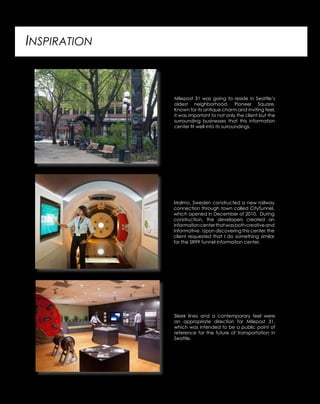
Milepost 31 was going to reside in Seattle’s
oldest neighborhood, Pioneer Square.
Known for its antique charm and inviting feel,
it was important to not only the client but the
surrounding businesses that this information
center fit well into its surroundings.
Malmo, Sweden constructed a new railway
connection through town called CityTunnel,
which opened in December of 2010. During
construction, the developers created an
informationcenterthatwasbothcreativeand
informative. Upon discovering this center, the
client requested that I do something similar
for the SR99 tunnel information center.
Sleek lines and a contemporary feel were
an appropriate direction for Milepost 31,
which was intended to be a public point of
reference for the future of transportation in
Seattle.
CONCEPT
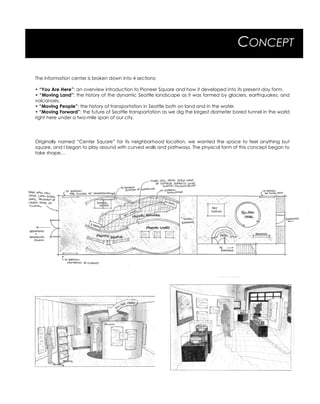
The information center is broken down into 4 sections:
• “You Are Here”: an overview introduction to Pioneer Square and how it developed into its present day form.
• “Moving Land”: the history of the dynamic Seattle landscape as it was formed by glaciers, earthquakes, and
volcanoes.
• “Moving People”: the history of transportation in Seattle both on land and in the water.
• “Moving Forward”: the future of Seattle transportation as we dig the largest diameter bored tunnel in the world
right here under a two-mile span of our city.
Originally named “Center Square” for its neighborhood location, we wanted the space to feel anything but
square, and I began to play around with curved walls and pathways. The physical form of this concept began to
take shape…
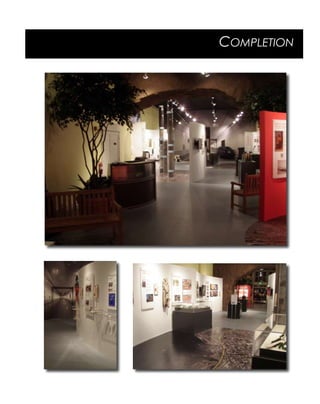
VISITOR EXPERIENCE
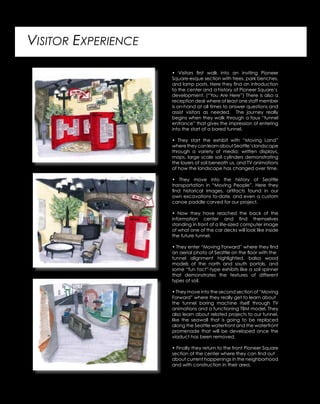
• Visitors first walk into an inviting Pioneer
Square-esque section with trees, park benches,
and lamp posts. Here they find an introduction
to the center and a history of Pioneer Square’s
development. (“You Are Here”) There is also a
reception desk where at least one staff member
is on-hand at all times to answer questions and
assist visitors as needed. The journey really
begins when they walk through a faux “tunnel
entrance” that gives the impression of entering
into the start of a bored tunnel.
• They start the exhibit with “Moving Land”
wheretheycanlearnaboutSeattle’slandscape
through a variety of media: written displays,
maps, large scale soil cylinders demonstrating
the layers of soil beneath us, and TV animations
of how the landscape has changed over time.
• They move into the history of Seattle
transportation in “Moving People”. Here they
find historical images, artifacts found in our
own excavations to-date, and even a custom
canoe paddle carved for our project.
• Now they have reached the back of the
information center and find themselves
standing in front of a life-sized computer image
of what one of the car decks will look like inside
the future tunnel.
• They enter “Moving Forward” where they find
an aerial photo of Seattle on the floor with the
tunnel alignment highlighted, balsa wood
models of the north and south portals, and
some “fun fact”-type exhibits like a soil spinner
that demonstrates the textures of different
types of soil.
• They move into the second section of “Moving
Forward” where they really get to learn about
the tunnel boring machine itself through TV
animations and a functioning TBM model. They
also learn about related projects to our tunnel,
like the seawall that is going to be replaced
along the Seattle waterfront and the waterfront
promenade that will be developed once the
viaduct has been removed.
• Finally they return to the front Pioneer Square
section of the center where they can find out
about current happenings in the neighborhood
and with construction in their area.
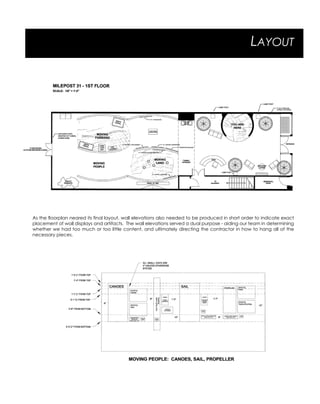
LAYOUT
As the floorplan neared its final layout, wall elevations also needed to be produced in short order to indicate exact
placement of wall displays and artifacts. The wall elevations served a dual purpose - aiding our team in determining
whether we had too much or too little content, and ultimately directing the contractor in how to hang all of the
necessary pieces.
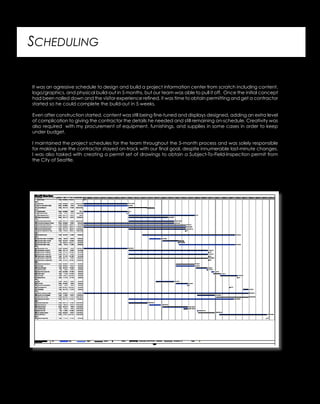
SCHEDULING
It was an agressive schedule to design and build a project information center from scratch including content,
logo/graphics, and physical build-out in 5 months, but our team was able to pull it off. Once the initial concept
had been nailed down and the visitor experience refined, it was time to obtain permitting and get a contractor
started so he could complete the build-out in 5 weeks.
Even after construction started, content was still being fine-tuned and displays designed, adding an extra level
of complication to giving the contractor the details he needed and still remaining on-schedule. Creativity was
also required with my procurement of equipment, furnishings, and supplies in some cases in order to keep
under budget.
I maintained the project schedules for the team throughout the 5-month process and was solely responsible
for making sure the contractor stayed on-track with our final goal, despite innumerable last-minute changes.
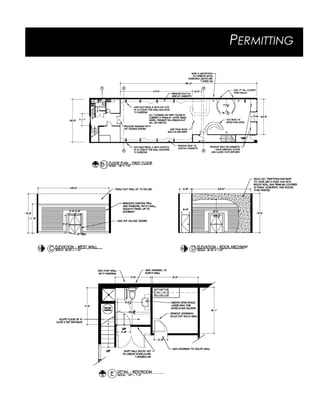
I was also tasked with creating a permit set of drawings to obtain a Subject-To-Field-Inspection permit from
the City of Seattle.
PERMITTING
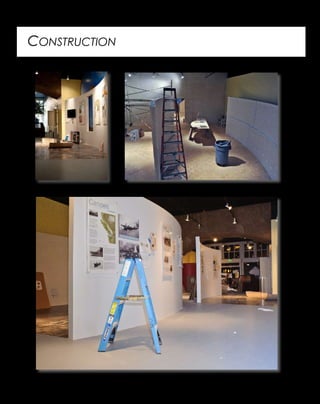
CONSTRUCTION
COMPLETION
INSTITUTIONAL DESIGN
Senior Living Facility
Celebration
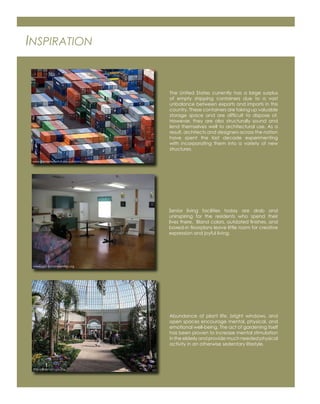
INSPIRATION
The United States currently has a large surplus
of empty shipping containers due to a vast
unbalance between exports and imports in this
country. These containers are taking up valuable
storage space and are difficult to dispose of.
However, they are also structurally sound and
lend themselves well to architectural use. As a
result, architects and designers across the nation
have spent the last decade experimenting
with incorporating them into a variety of new
structures.
Senior living facilities today are drab and
uninspiring for the residents who spend their
lives there. Bland colors, outdated finishes, and
boxed-in floorplans leave little room for creative
expression and joyful living.
Abundance of plant life, bright windows, and
open spaces encourage mental, physical, and
emotional well-being. The act of gardening itself
has been proven to increase mental stimulation
in the elderly and provide much needed physical
activity in an otherwise sedentary lifestyle.
www.thenextwayefutures.wordpress.com
http://flickr.com/photos
www.countryhomeestates.org
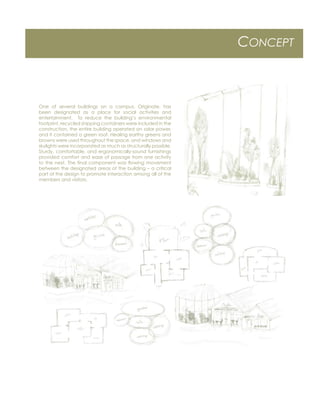
CONCEPT
One of several buildings on a campus, Originate, has
been designated as a place for social activities and
entertainment. To reduce the building’s environmental
footprint, recycled shipping containers were included in the
construction, the entire building operated on solar power,
and it contained a green roof. Healing earthy greens and
browns were used throughout the space, and windows and
skylights were incorporated as much as structurally possible.
Sturdy, comfortable, and ergonomically-sound furnishings
provided comfort and ease of passage from one activity
to the next. The final component was flowing movement
between the designated areas of the building – a critical
part of the design to promote interaction among all of the
members and visitors.
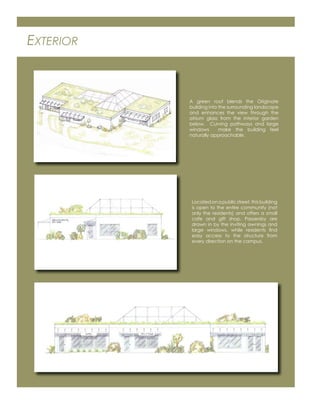
EXTERIOR
A green roof blends the Originate
building into the surrounding landscape
and enhances the view through the
atrium glass from the interior garden
below. Curving pathways and large
windows make the building feel
naturally approachable.
Locatedonapublicstreet,thisbuilding
is open to the entire community (not
only the residents) and offers a small
cafe and gift shop. Passersby are
drawn in by the inviting awnings and
large windows, while residents find
easy access to the structure from
every direction on the campus.
FINISHES
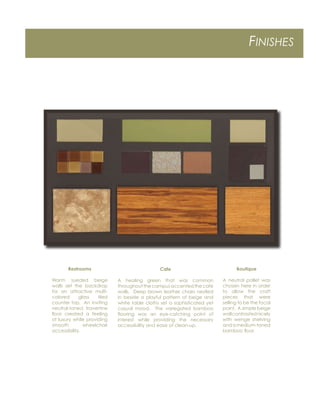
Restrooms
Warm sueded beige
walls set the backdrop
for an attractive multi-
colored glass tiled
counter top. An inviting
neutral-toned travertine
floor created a feeling
of luxury while providing
smooth wheelchair
accessibility.
Cafe
A healing green that was common
throughoutthecampusaccentedthecafe
walls. Deep brown leather chairs nestled
in beside a playful pattern of beige and
white table cloths set a sophisticated yet
casual mood. The variegated bamboo
flooring was an eye-catching point of
interest while providing the necessary
accessibility and ease of clean-up.
Boutique
A neutral pallet was
chosen here in order
to allow the craft
pieces that were
selling to be the focal
point. A simple beige
wallcontrastednicely
with wenge shelving
andamedium-toned
bamboo floor.
INTERIOR
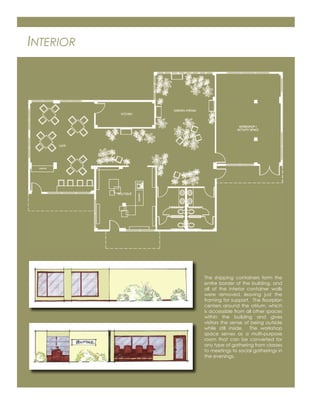
The shipping containers form the
entire border of the building, and
all of the interior container walls
were removed, leaving just the
framing for support. The floorplan
centers around the atrium, which
is accessible from all other spaces
within the building and gives
visitors the sense of being outside
while still inside. The workshop
space serves as a multi-purpose
room that can be converted for
any type of gathering from classes
to meetings to social gatherings in
the evenings.
INTERIOR
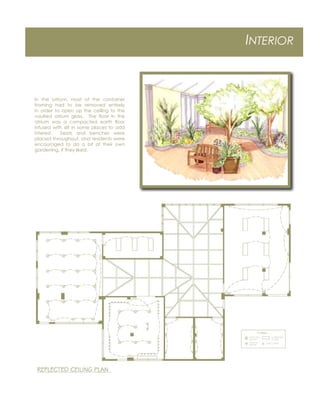
In the atrium, most of the container
framing had to be removed entirely
in order to open up the ceiling to the
vaulted atrium glass. The floor in the
atrium was a compacted earth floor
infused with silt in some places to add
interest. Seats and benches were
placed throughout, and residents were
encouraged to do a bit of their own
gardening, if they liked.
INSTITUTIONAL DESIGN
School of Interior Design
Innen
INSPIRATION
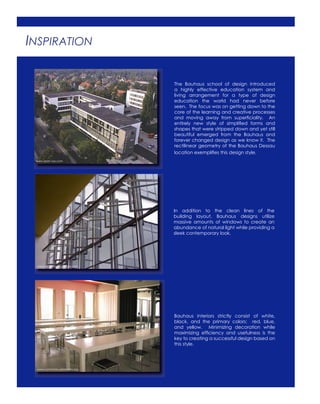
The Bauhaus school of design introduced
a highly effective education system and
living arrangement for a type of design
education the world had never before
seen. The focus was on getting down to the
core of the learning and creative processes
and moving away from superficiality. An
entirely new style of simplified forms and
shapes that were stripped down and yet still
beautiful emerged from the Bauhaus and
forever changed design as we know it. The
rectilinear geometry of the Bauhaus Dessau
location exemplifies this design style.
In addition to the clean lines of the
building layout, Bauhaus designs utilize
massive amounts of windows to create an
abundance of natural light while providing a
sleek contemporary look.
Bauhaus interiors strictly consist of white,
black, and the primary colors: red, blue,
and yellow. Minimizing decoration while
maximizing efficiency and usefulness is the
key to creating a successful design based on
this style.
www.span.vox.com
www.commons.wikimedia.org
www.picasaweb.google.com
CONCEPT
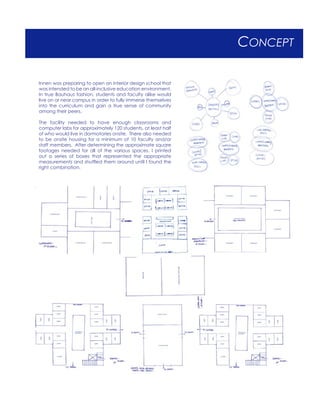
Innen was preparing to open an interior design school that
was intended to be an all-inclusive education environment.
In true Bauhaus fashion, students and faculty alike would
live on or near campus in order to fully immerse themselves
into the curriculum and gain a true sense of community
among their peers.
The facility needed to have enough classrooms and
computer labs for approximately 120 students, at least half
of who would live in dormotories onsite. There also needed
to be onsite housing for a minimum of 10 faculty and/or
staff members. After determining the approximate square
footages needed for all of the various spaces, I printed
out a series of boxes that represented the appropriate
measurements and shuffled them around until I found the
right combination.
EXTERIOR
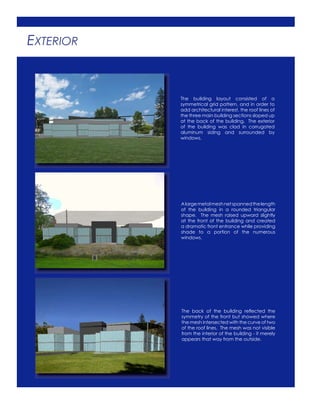
The building layout consisted of a
symmetrical grid pattern, and in order to
add architectural interest, the roof lines of
the three main building sections sloped up
at the back of the building. The exterior
of the building was clad in corrugated
aluminum siding and surrounded by
windows.
Alargemetalmeshnetspannedthelength
of the building in a rounded triangular
shape. The mesh raised upward slightly
at the front of the building and created
a dramatic front entrance while providing
shade to a portion of the numerous
windows.
The back of the building reflected the
symmetry of the front but showed where
the mesh intersected with the curve of two
of the roof lines. The mesh was not visible
from the interior of the building - it merely
appears that way from the outside.
FINISHES
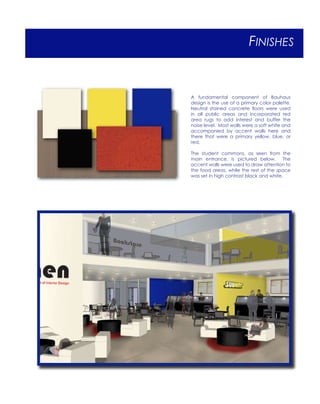
A fundamental component of Bauhaus
design is the use of a primary color palette.
Neutral stained concrete floors were used
in all public areas and incorporated red
area rugs to add interest and buffer the
noise level. Most walls were a soft white and
accompanied by accent walls here and
there that were a primary yellow, blue, or
red.
The student commons, as seen from the
main entrance, is pictured below. The
accent walls were used to draw attention to
the food areas, while the rest of the space
was set in high contrast black and white.
INTERIOR
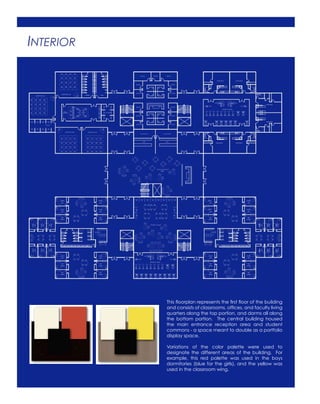
This floorplan represents the first floor of the building
and consists of classrooms, offices, and faculty living
quarters along the top portion, and dorms all along
the bottom portion. The central building housed
the main entrance reception area and student
commons - a space meant to double as a portfolio
display space.
Variations of the color palette were used to
designate the different areas of the building. For
example, this red palette was used in the boys
dormitories (blue for the girls), and the yellow was
used in the classroom wing.
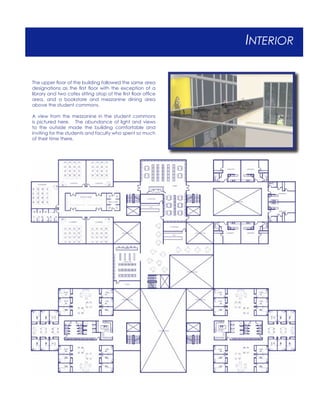
INTERIOR
The upper floor of the building followed the same area
designations as the first floor with the exception of a
library and two cafes sitting atop of the first floor office
area, and a bookstore and mezzanine dining area
above the student commons.
A view from the mezzanine in the student commons
is pictured here. The abundance of light and views
to the outside made the building comfortable and
inviting for the students and faculty who spent so much
of their time there.
INSTITUTIONAL DESIGN
North Campus First Floor
INSPIRATION
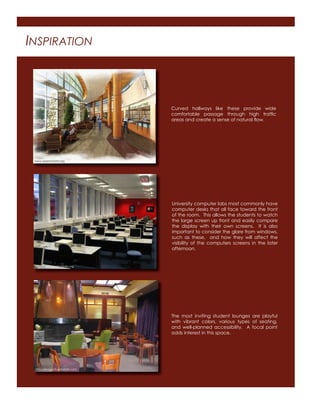
Curved hallways like these provide wide
comfortable passage through high traffic
areas and create a sense of natural flow.
University computer labs most commonly have
computer desks that all face toward the front
of the room. This allows the students to watch
the large screen up front and easily compare
the display with their own screens. It is also
important to consider the glare from windows,
such as these, and how they will affect the
visibility of the computers screens in the later
afternoon.
The most inviting student lounges are playful
with vibrant colors, various types of seating,
and well-planned accessibility. A focal point
adds interest in this space.
www.aspenhosital.org
http://image10.webshots.com
http://upload.wikimedia.org
CONCEPT
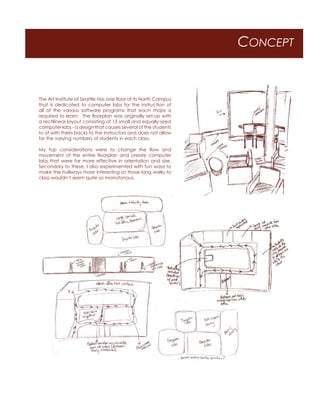
The Art Institute of Seattle has one floor of its North Campus
that is dedicated to computer labs for the instruction of
all of the various software programs that each major is
required to learn. The floorplan was originally set-up with
a rectilinear layout consisting of 13 small and equally-sized
computer labs - a design that causes several of the students
to sit with theirs backs to the instructors and does not allow
for the varying numbers of students in each class.
My top considerations were to change the flow and
movement of the entire floorplan and create computer
labs that were far more effective in orientation and size.
Secondary to these, I also experimented with fun ways to
make the hallways more interesting so those long walks to
class wouldn’t seem quite so monotonous.
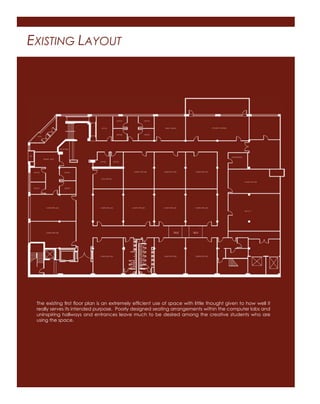
EXISTING LAYOUT
The existing first floor plan is an extremely efficient use of space with little thought given to how well it
really serves its intended purpose. Poorly designed seating arrangements within the computer labs and
uninspiring hallways and entrances leave much to be desired among the creative students who are
using the space.
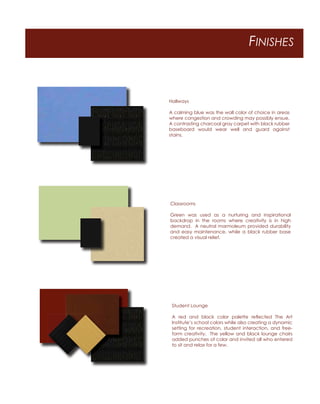
FINISHES
Hallways
A calming blue was the wall color of choice in areas
where congestion and crowding may possibly ensue.
A contrasting charcoal gray carpet with black rubber
baseboard would wear well and guard against
stains.
Classrooms
Green was used as a nurturing and inspirational
backdrop in the rooms where creativity is in high
demand. A neutral marmoleum provided durability
and easy maintenance, while a black rubber base
created a visual relief.
Student Lounge
A red and black color palette reflected The Art
Institute’s school colors while also creating a dynamic
setting for recreation, student interaction, and free-
form creativity. The yellow and black lounge chairs
added punches of color and invited all who entered
to sit and relax for a few.
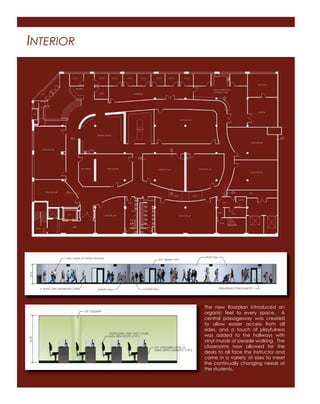
INTERIOR
The new floorplan introduced an
organic feel to every space. A
central passageway was created
to allow easier access from all
sides, and a touch of playfulness
was added to the hallways with
vinyl murals of people walking. The
classrooms now allowed for the
desks to all face the instructor and
came in a variety of sizes to meet
the continually changing needs of
the students.
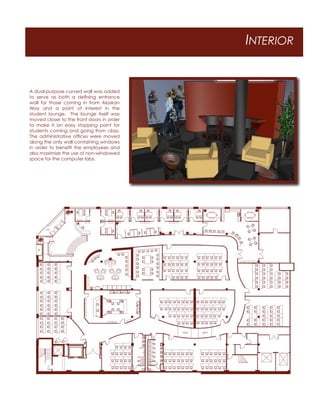
INTERIOR
A dual-purpose curved wall was added
to serve as both a defining entrance
wall for those coming in from Alaskan
Way and a point of interest in the
student lounge. The lounge itself was
moved closer to the front doors in order
to make it an easy stopping point for
students coming and going from class.
The administrative offices were moved
along the only wall containing windows
in order to benefit the employees and
also maximize the use of non-windowed
space for the computer labs.
COMMERCIAL DESIGN
DOMAYNEU.S. Debut Store
INSPIRATION
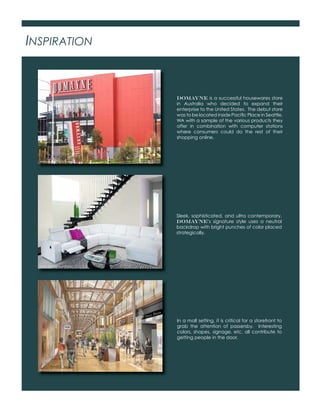
DOMAYNE is a successful housewares store
in Australia who decided to expand their
enterprise to the United States. The debut store
was to be located inside Pacific Place in Seattle,
WA with a sample of the various products they
offer in combination with computer stations
where consumers could do the rest of their
shopping online.
Sleek, sophisticated, and ultra contemporary,
DOMAYNE’s signature style uses a neutral
backdrop with bright punches of color placed
strategically.
In a mall setting, it is critical for a storefront to
grab the attention of passersby. Interesting
colors, shapes, signage, etc. all contribute to
getting people in the door.
www.domayne.com.au
www.cityofsanrafael.org
www.domayne.com.au
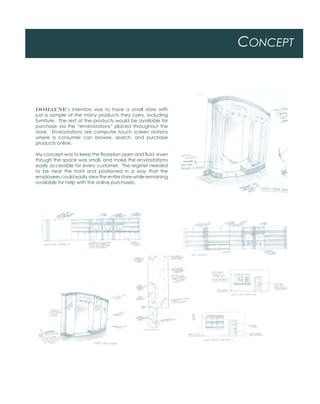
CONCEPT
DOMAYNE’s intention was to have a small store with
just a sample of the many products they carry, including
furniture. The rest of the products would be available for
purchase via the “envirostations” placed throughout the
store. Envirostations are computer touch screen stations
where a consumer can browse, search, and purchase
products online.
My concept was to keep the floorplan open and fluid, even
though the space was small, and make the envirostations
easily accessible for every customer. The register needed
to be near the front and positioned in a way that the
employees could easily view the entire store while remaining
available for help with the online purchases.
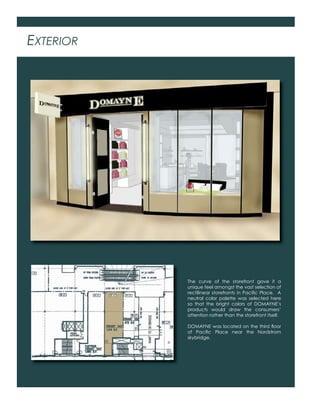
EXTERIOR
The curve of the storefront gave it a
unique feel amongst the vast selection of
rectilinear storefronts in Pacific Place. A
neutral color palette was selected here
so that the bright colors of DOMAYNE’s
products would draw the consumers’
attention rather than the storefront itself.
DOMAYNE was located on the third floor
of Pacific Place near the Nordstrom
skybridge.
FINISHES
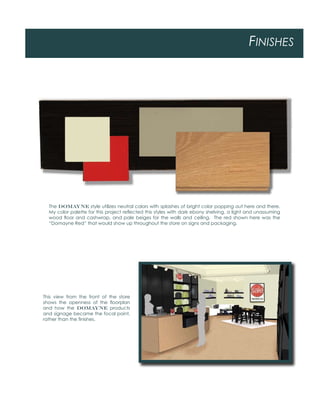
The DOMAYNE style utilizes neutral colors with splashes of bright color popping out here and there.
My color palette for this project reflected this styles with dark ebony shelving, a light and unassuming
wood floor and cashwrap, and pale beiges for the walls and ceiling. The red shown here was the
“Domayne Red” that would show up throughout the store on signs and packaging.
This view from the front of the store
shows the openness of the floorplan
and how the DOMAYNE products
and signage became the focal point,
rather than the finishes.
INTERIOR
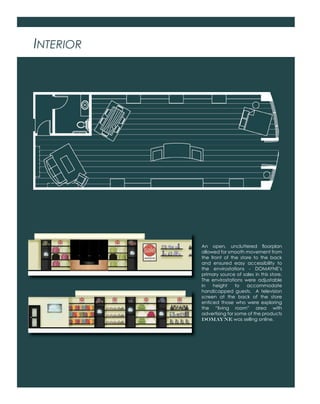
An open, uncluttered floorplan
allowed for smooth movement from
the front of the store to the back
and ensured easy accessibility to
the envirostations - DOMAYNE’s
primary source of sales in this store.
The envirostations were adjustable
in height to accommodate
handicapped guests. A television
screen at the back of the store
enticed those who were exploring
the “living room” area with
advertising for some of the products
DOMAYNE was selling online.
INTERIOR
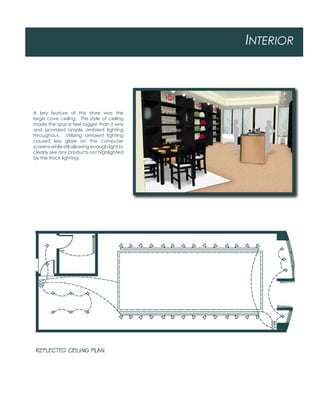
A key feature of this store was the
large cove ceiling. This style of ceiling
made the space feel bigger than it was
and provided ample ambient lighting
throughout. Utilizing ambient lighting
caused less glare on the computer
screens while still allowing enough light to
clearly see any products not highlighted
by the track lighting.
COMMERCIAL DESIGN
DESIGN|SAVVY
Interior Design Firm
INSPIRATION
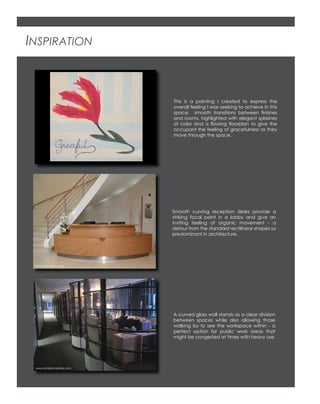
This is a painting I created to express the
overall feeling I was seeking to achieve in this
space: smooth transitions between finishes
and rooms, highlighted with elegant splashes
of color and a flowing floorplan to give the
occupant the feeling of gracefulness as they
move through the space.
Smooth curving reception desks provide a
striking focal point in a lobby and give an
inviting feeling of organic movement - a
detour from the standard rectilinear shapes so
predominant in architecture.
A curved glass wall stands as a clear division
between spaces while also allowing those
walking by to see the workspace within - a
perfect option for public work areas that
might be congested at times with heavy use.
www.ambiencedore.com
www.pwlimited.co.uk
CONCEPT
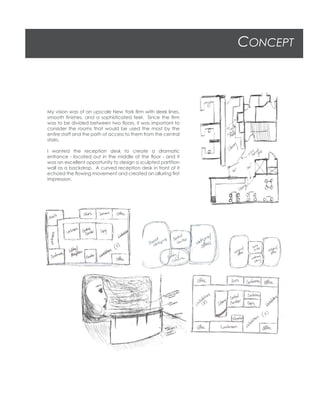
My vision was of an upscale New York firm with sleek lines,
smooth finishes, and a sophisticated feel. Since the firm
was to be divided between two floors, it was important to
consider the rooms that would be used the most by the
entire staff and the path of access to them from the central
stairs.
I wanted the reception desk to create a dramatic
entrance - located out in the middle of the floor - and it
was an excellent opportunity to design a sculpted partition
wall as a backdrop. A curved reception desk in front of it
echoed the flowing movement and created an alluring first
impression.
EXTERIOR
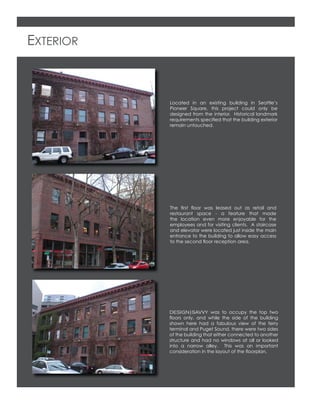
Located in an existing building in Seattle’s
Pioneer Square, this project could only be
designed from the interior. Historical landmark
requirements specified that the building exterior
remain untouched.
DESIGN|SAVVY was to occupy the top two
floors only, and while the side of the building
shown here had a fabulous view of the ferry
terminal and Puget Sound, there were two sides
of the building that either connected to another
structure and had no windows at all or looked
into a narrow alley. This was an important
consideration in the layout of the floorplan.
The first floor was leased out as retail and
restaurant space - a feature that made
the location even more enjoyable for the
employees and for visiting clients. A staircase
and elevator were located just inside the main
entrance to the building to allow easy access
to the second floor reception area.
FINISHES
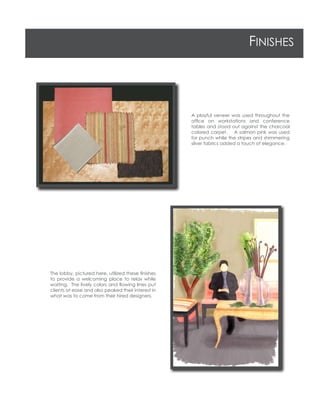
A playful veneer was used throughout the
office on workstations and conference
tables and stood out against the charcoal
colored carpet. A salmon pink was used
for punch while the stripes and shimmering
silver fabrics added a touch of elegance.
The lobby, pictured here, utilized these finishes
to provide a welcoming place to relax while
waiting. The lively colors and flowing lines put
clients at ease and also peaked their interest in
what was to come from their hired designers.
INTERIOR - FIRST FLOOR
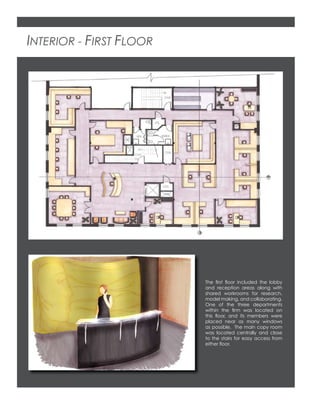
The first floor included the lobby
and reception areas along with
shared workrooms for research,
model making, and collaborating.
One of the three departments
within the firm was located on
this floor, and its members were
placed near as many windows
as possible. The main copy room
was located centrally and close
to the stairs for easy access from
either floor.
INTERIOR - SECOND FLOOR
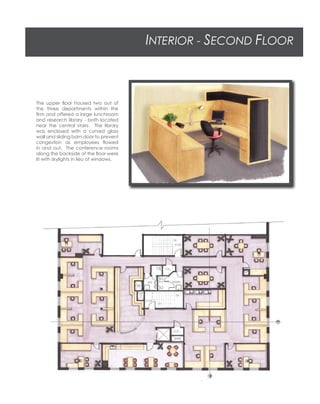
The upper floor housed two out of
the three departments within the
firm and offered a large lunchroom
and research library - both located
near the central stairs. The library
was enclosed with a curved glass
wall and sliding barn door to prevent
congestion as employees flowed
in and out. The conference rooms
along the backside of the floor were
lit with skylights in lieu of windows.
RESIDENTIAL DESIGN
Morris Residence
Rammed Earth House
INSPIRATION
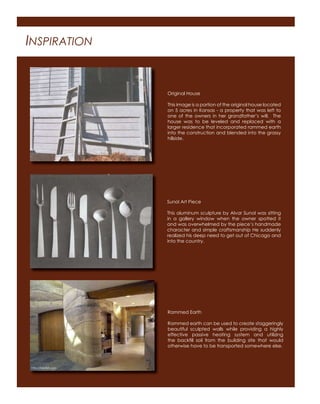
Original House
This image is a portion of the original house located
on 5 acres in Kansas - a property that was left to
one of the owners in her grandfather’s will. The
house was to be leveled and replaced with a
larger residence that incorporated rammed earth
into the construction and blended into the grassy
hillside.
Sunol Art Piece
This aluminum sculpture by Alvar Sunol was sitting
in a gallery window when the owner spotted it
and was overwhelmed by the piece’s handmade
character and simple craftsmanship He suddenly
realized his deep need to get out of Chicago and
into the country.
Rammed Earth
Rammed earth can be used to create staggeringly
beautiful sculpted walls while providing a highly
effective passive heating system and utilizing
the backfill soil from the building site that would
otherwise have to be transported somewhere else.
http://heatkit.com
CONCEPT
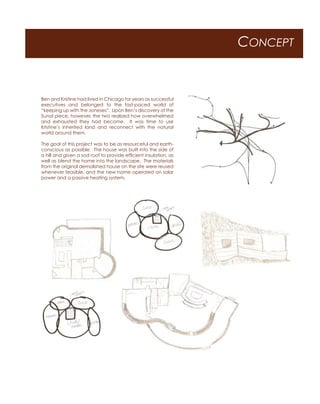
Ben and Kristine had lived in Chicago for years as successful
executives and belonged to the fast-paced world of
“keeping up with the Joneses”. Upon Ben’s discovery of the
Sunol piece, however, the two realized how overwhelmed
and exhausted they had become. It was time to use
Kristine’s inherited land and reconnect with the natural
world around them.
The goal of this project was to be as resourceful and earth-
conscious as possible. The house was built into the side of
a hill and given a sod roof to provide efficient insulation, as
well as blend the home into the landscape. The materials
from the original demolished house on the site were reused
whenever feasible, and the new home operated on solar
power and a passive heating system.
EXTERIOR
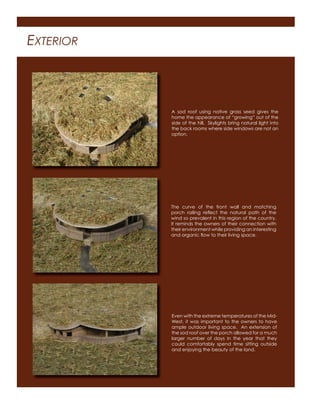
A sod roof using native grass seed gives the
home the appearance of “growing” out of the
side of the hill. Skylights bring natural light into
the back rooms where side windows are not an
option.
The curve of the front wall and matching
porch railing reflect the natural path of the
wind so prevalent in this region of the country.
It reminds the owners of their connection with
their environment while providing an interesting
and organic flow to their living space.
Even with the extreme temperatures of the Mid-
West, it was important to the owners to have
ample outdoor living space. An extension of
the sod roof over the porch allowed for a much
larger number of days in the year that they
could comfortably spend time sitting outside
and enjoying the beauty of the land.
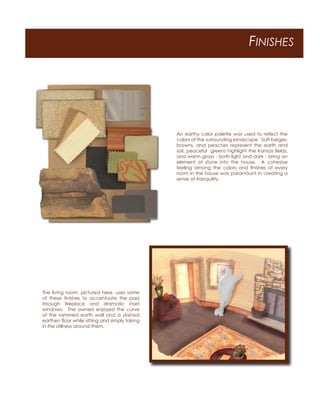
FINISHES
An earthy color palette was used to reflect the
colors of the surrounding landscape. Soft beiges,
browns, and peaches represent the earth and
soil, peaceful greens highlight the Kansas fields,
and warm grays - both light and dark - bring an
element of stone into the house. A cohesive
feeling among the colors and finishes of every
room in the house was paramount in creating a
sense of tranquility.
The living room, pictured here, uses some
of these finishes to accentuate the pass
through fireplace and dramatic inset
windows. The owners enjoyed the curve
of the rammed earth wall and a stained
earthen floor while sitting and simply taking
in the stillness around them.
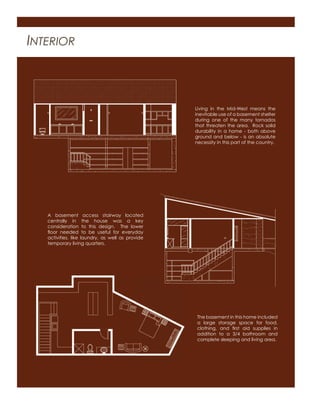
INTERIOR
Living in the Mid-West means the
inevitable use of a basement shelter
during one of the many tornados
that threaten the area. Rock solid
durability in a home - both above
ground and below - is an absolute
necessity in this part of the country.
A basement access stairway located
centrally in the house was a key
consideration to this design. The lower
floor needed to be useful for everyday
activities, like laundry, as well as provide
temporary living quarters.
The basement in this home included
a large storage space for food,
clothing, and first aid supplies in
addition to a 3/4 bathroom and
complete sleeping and living area.
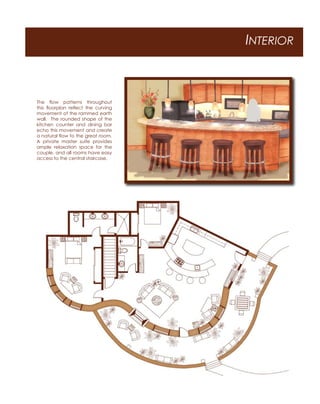
INTERIOR
The flow patterns throughout
this floorplan reflect the curving
movement of the rammed earth
wall. The rounded shape of the
kitchen counter and dining bar
echo this movement and create
a natural flow to the great room.
A private master suite provides
ample relaxation space for the
couple, and all rooms have easy
access to the central staircase.
TECHNICAL SKILLS
Presentation Hand Drafting
Exterior and Interior Pencil Drafts
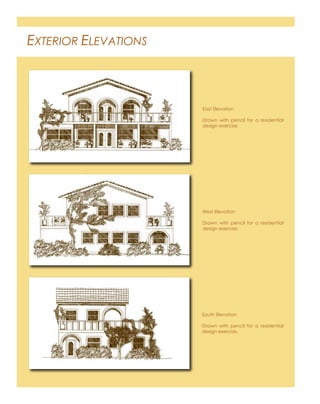
EXTERIOR ELEVATIONS
East Elevation
Drawn with pencil for a residential
design exercise.
West Elevation
Drawn with pencil for a residential
design exercise.
South Elevation
Drawn with pencil for a residential
design exercise.
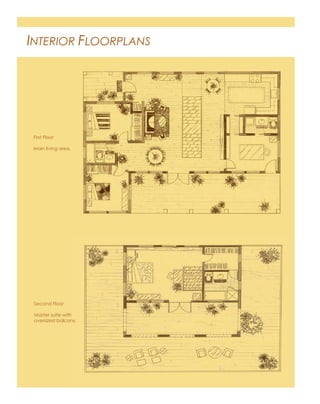
INTERIOR FLOORPLANS
First Floor
Main living area.
Second Floor
Master suite with
oversized balcony.

Jennifer Carlson Portfolio

  • 1.
    (206) 450-5235 jennuwine1@gmail.com4325 W Emerson St, Seattle, WA 98199 PROFESSIONAL EXPERIENCE Milepost 31 Alaskan Way Viaduct Replacement Program ACADEMIC EXERCISES Celebration Senior Living Center Innen School of Interior Design The Art Institute of Seattle North Campus Remodel Domayne U.S. Debut Store Design|Savvy Interior Design Firm Rammed Earth House Morris Residence TECHNICAL SKILLS Presentation Hand Drafting Exterior and Interior Pencil Drawings | PORTFOLIO
  • 2.
    COMMERCIAL DESIGN Information Centerfor the Alaskan Way Viaduct Replacement Program Client: Washington State Department of Transportation
  • 3.
    INSPIRATION Milepost 31 wasgoing to reside in Seattle’s oldest neighborhood, Pioneer Square. Known for its antique charm and inviting feel, it was important to not only the client but the surrounding businesses that this information center fit well into its surroundings. Malmo, Sweden constructed a new railway connection through town called CityTunnel, which opened in December of 2010. During construction, the developers created an informationcenterthatwasbothcreativeand informative. Upon discovering this center, the client requested that I do something similar for the SR99 tunnel information center. Sleek lines and a contemporary feel were an appropriate direction for Milepost 31, which was intended to be a public point of reference for the future of transportation in Seattle.
  • 4.
    CONCEPT The information centeris broken down into 4 sections: • “You Are Here”: an overview introduction to Pioneer Square and how it developed into its present day form. • “Moving Land”: the history of the dynamic Seattle landscape as it was formed by glaciers, earthquakes, and volcanoes. • “Moving People”: the history of transportation in Seattle both on land and in the water. • “Moving Forward”: the future of Seattle transportation as we dig the largest diameter bored tunnel in the world right here under a two-mile span of our city. Originally named “Center Square” for its neighborhood location, we wanted the space to feel anything but square, and I began to play around with curved walls and pathways. The physical form of this concept began to take shape…
  • 5.
    VISITOR EXPERIENCE • Visitorsfirst walk into an inviting Pioneer Square-esque section with trees, park benches, and lamp posts. Here they find an introduction to the center and a history of Pioneer Square’s development. (“You Are Here”) There is also a reception desk where at least one staff member is on-hand at all times to answer questions and assist visitors as needed. The journey really begins when they walk through a faux “tunnel entrance” that gives the impression of entering into the start of a bored tunnel. • They start the exhibit with “Moving Land” wheretheycanlearnaboutSeattle’slandscape through a variety of media: written displays, maps, large scale soil cylinders demonstrating the layers of soil beneath us, and TV animations of how the landscape has changed over time. • They move into the history of Seattle transportation in “Moving People”. Here they find historical images, artifacts found in our own excavations to-date, and even a custom canoe paddle carved for our project. • Now they have reached the back of the information center and find themselves standing in front of a life-sized computer image of what one of the car decks will look like inside the future tunnel. • They enter “Moving Forward” where they find an aerial photo of Seattle on the floor with the tunnel alignment highlighted, balsa wood models of the north and south portals, and some “fun fact”-type exhibits like a soil spinner that demonstrates the textures of different types of soil. • They move into the second section of “Moving Forward” where they really get to learn about the tunnel boring machine itself through TV animations and a functioning TBM model. They also learn about related projects to our tunnel, like the seawall that is going to be replaced along the Seattle waterfront and the waterfront promenade that will be developed once the viaduct has been removed. • Finally they return to the front Pioneer Square section of the center where they can find out about current happenings in the neighborhood and with construction in their area.
  • 6.
    LAYOUT As the floorplanneared its final layout, wall elevations also needed to be produced in short order to indicate exact placement of wall displays and artifacts. The wall elevations served a dual purpose - aiding our team in determining whether we had too much or too little content, and ultimately directing the contractor in how to hang all of the necessary pieces.
  • 7.
    SCHEDULING It was anagressive schedule to design and build a project information center from scratch including content, logo/graphics, and physical build-out in 5 months, but our team was able to pull it off. Once the initial concept had been nailed down and the visitor experience refined, it was time to obtain permitting and get a contractor started so he could complete the build-out in 5 weeks. Even after construction started, content was still being fine-tuned and displays designed, adding an extra level of complication to giving the contractor the details he needed and still remaining on-schedule. Creativity was also required with my procurement of equipment, furnishings, and supplies in some cases in order to keep under budget. I maintained the project schedules for the team throughout the 5-month process and was solely responsible for making sure the contractor stayed on-track with our final goal, despite innumerable last-minute changes. I was also tasked with creating a permit set of drawings to obtain a Subject-To-Field-Inspection permit from the City of Seattle.
  • 8.
  • 9.
  • 10.
  • 11.
  • 12.
    INSPIRATION The United Statescurrently has a large surplus of empty shipping containers due to a vast unbalance between exports and imports in this country. These containers are taking up valuable storage space and are difficult to dispose of. However, they are also structurally sound and lend themselves well to architectural use. As a result, architects and designers across the nation have spent the last decade experimenting with incorporating them into a variety of new structures. Senior living facilities today are drab and uninspiring for the residents who spend their lives there. Bland colors, outdated finishes, and boxed-in floorplans leave little room for creative expression and joyful living. Abundance of plant life, bright windows, and open spaces encourage mental, physical, and emotional well-being. The act of gardening itself has been proven to increase mental stimulation in the elderly and provide much needed physical activity in an otherwise sedentary lifestyle. www.thenextwayefutures.wordpress.com http://flickr.com/photos www.countryhomeestates.org
  • 13.
    CONCEPT One of severalbuildings on a campus, Originate, has been designated as a place for social activities and entertainment. To reduce the building’s environmental footprint, recycled shipping containers were included in the construction, the entire building operated on solar power, and it contained a green roof. Healing earthy greens and browns were used throughout the space, and windows and skylights were incorporated as much as structurally possible. Sturdy, comfortable, and ergonomically-sound furnishings provided comfort and ease of passage from one activity to the next. The final component was flowing movement between the designated areas of the building – a critical part of the design to promote interaction among all of the members and visitors.
  • 14.
    EXTERIOR A green roofblends the Originate building into the surrounding landscape and enhances the view through the atrium glass from the interior garden below. Curving pathways and large windows make the building feel naturally approachable. Locatedonapublicstreet,thisbuilding is open to the entire community (not only the residents) and offers a small cafe and gift shop. Passersby are drawn in by the inviting awnings and large windows, while residents find easy access to the structure from every direction on the campus.
  • 15.
    FINISHES Restrooms Warm sueded beige wallsset the backdrop for an attractive multi- colored glass tiled counter top. An inviting neutral-toned travertine floor created a feeling of luxury while providing smooth wheelchair accessibility. Cafe A healing green that was common throughoutthecampusaccentedthecafe walls. Deep brown leather chairs nestled in beside a playful pattern of beige and white table cloths set a sophisticated yet casual mood. The variegated bamboo flooring was an eye-catching point of interest while providing the necessary accessibility and ease of clean-up. Boutique A neutral pallet was chosen here in order to allow the craft pieces that were selling to be the focal point. A simple beige wallcontrastednicely with wenge shelving andamedium-toned bamboo floor.
  • 16.
    INTERIOR The shipping containersform the entire border of the building, and all of the interior container walls were removed, leaving just the framing for support. The floorplan centers around the atrium, which is accessible from all other spaces within the building and gives visitors the sense of being outside while still inside. The workshop space serves as a multi-purpose room that can be converted for any type of gathering from classes to meetings to social gatherings in the evenings.
  • 17.
    INTERIOR In the atrium,most of the container framing had to be removed entirely in order to open up the ceiling to the vaulted atrium glass. The floor in the atrium was a compacted earth floor infused with silt in some places to add interest. Seats and benches were placed throughout, and residents were encouraged to do a bit of their own gardening, if they liked.
  • 18.
    INSTITUTIONAL DESIGN School ofInterior Design Innen
  • 19.
    INSPIRATION The Bauhaus schoolof design introduced a highly effective education system and living arrangement for a type of design education the world had never before seen. The focus was on getting down to the core of the learning and creative processes and moving away from superficiality. An entirely new style of simplified forms and shapes that were stripped down and yet still beautiful emerged from the Bauhaus and forever changed design as we know it. The rectilinear geometry of the Bauhaus Dessau location exemplifies this design style. In addition to the clean lines of the building layout, Bauhaus designs utilize massive amounts of windows to create an abundance of natural light while providing a sleek contemporary look. Bauhaus interiors strictly consist of white, black, and the primary colors: red, blue, and yellow. Minimizing decoration while maximizing efficiency and usefulness is the key to creating a successful design based on this style. www.span.vox.com www.commons.wikimedia.org www.picasaweb.google.com
  • 20.
    CONCEPT Innen was preparingto open an interior design school that was intended to be an all-inclusive education environment. In true Bauhaus fashion, students and faculty alike would live on or near campus in order to fully immerse themselves into the curriculum and gain a true sense of community among their peers. The facility needed to have enough classrooms and computer labs for approximately 120 students, at least half of who would live in dormotories onsite. There also needed to be onsite housing for a minimum of 10 faculty and/or staff members. After determining the approximate square footages needed for all of the various spaces, I printed out a series of boxes that represented the appropriate measurements and shuffled them around until I found the right combination.
  • 21.
    EXTERIOR The building layoutconsisted of a symmetrical grid pattern, and in order to add architectural interest, the roof lines of the three main building sections sloped up at the back of the building. The exterior of the building was clad in corrugated aluminum siding and surrounded by windows. Alargemetalmeshnetspannedthelength of the building in a rounded triangular shape. The mesh raised upward slightly at the front of the building and created a dramatic front entrance while providing shade to a portion of the numerous windows. The back of the building reflected the symmetry of the front but showed where the mesh intersected with the curve of two of the roof lines. The mesh was not visible from the interior of the building - it merely appears that way from the outside.
  • 22.
    FINISHES A fundamental componentof Bauhaus design is the use of a primary color palette. Neutral stained concrete floors were used in all public areas and incorporated red area rugs to add interest and buffer the noise level. Most walls were a soft white and accompanied by accent walls here and there that were a primary yellow, blue, or red. The student commons, as seen from the main entrance, is pictured below. The accent walls were used to draw attention to the food areas, while the rest of the space was set in high contrast black and white.
  • 23.
    INTERIOR This floorplan representsthe first floor of the building and consists of classrooms, offices, and faculty living quarters along the top portion, and dorms all along the bottom portion. The central building housed the main entrance reception area and student commons - a space meant to double as a portfolio display space. Variations of the color palette were used to designate the different areas of the building. For example, this red palette was used in the boys dormitories (blue for the girls), and the yellow was used in the classroom wing.
  • 24.
    INTERIOR The upper floorof the building followed the same area designations as the first floor with the exception of a library and two cafes sitting atop of the first floor office area, and a bookstore and mezzanine dining area above the student commons. A view from the mezzanine in the student commons is pictured here. The abundance of light and views to the outside made the building comfortable and inviting for the students and faculty who spent so much of their time there.
  • 25.
  • 26.
    INSPIRATION Curved hallways likethese provide wide comfortable passage through high traffic areas and create a sense of natural flow. University computer labs most commonly have computer desks that all face toward the front of the room. This allows the students to watch the large screen up front and easily compare the display with their own screens. It is also important to consider the glare from windows, such as these, and how they will affect the visibility of the computers screens in the later afternoon. The most inviting student lounges are playful with vibrant colors, various types of seating, and well-planned accessibility. A focal point adds interest in this space. www.aspenhosital.org http://image10.webshots.com http://upload.wikimedia.org
  • 27.
    CONCEPT The Art Instituteof Seattle has one floor of its North Campus that is dedicated to computer labs for the instruction of all of the various software programs that each major is required to learn. The floorplan was originally set-up with a rectilinear layout consisting of 13 small and equally-sized computer labs - a design that causes several of the students to sit with theirs backs to the instructors and does not allow for the varying numbers of students in each class. My top considerations were to change the flow and movement of the entire floorplan and create computer labs that were far more effective in orientation and size. Secondary to these, I also experimented with fun ways to make the hallways more interesting so those long walks to class wouldn’t seem quite so monotonous.
  • 28.
    EXISTING LAYOUT The existingfirst floor plan is an extremely efficient use of space with little thought given to how well it really serves its intended purpose. Poorly designed seating arrangements within the computer labs and uninspiring hallways and entrances leave much to be desired among the creative students who are using the space.
  • 29.
    FINISHES Hallways A calming bluewas the wall color of choice in areas where congestion and crowding may possibly ensue. A contrasting charcoal gray carpet with black rubber baseboard would wear well and guard against stains. Classrooms Green was used as a nurturing and inspirational backdrop in the rooms where creativity is in high demand. A neutral marmoleum provided durability and easy maintenance, while a black rubber base created a visual relief. Student Lounge A red and black color palette reflected The Art Institute’s school colors while also creating a dynamic setting for recreation, student interaction, and free- form creativity. The yellow and black lounge chairs added punches of color and invited all who entered to sit and relax for a few.
  • 30.
    INTERIOR The new floorplanintroduced an organic feel to every space. A central passageway was created to allow easier access from all sides, and a touch of playfulness was added to the hallways with vinyl murals of people walking. The classrooms now allowed for the desks to all face the instructor and came in a variety of sizes to meet the continually changing needs of the students.
  • 31.
    INTERIOR A dual-purpose curvedwall was added to serve as both a defining entrance wall for those coming in from Alaskan Way and a point of interest in the student lounge. The lounge itself was moved closer to the front doors in order to make it an easy stopping point for students coming and going from class. The administrative offices were moved along the only wall containing windows in order to benefit the employees and also maximize the use of non-windowed space for the computer labs.
  • 32.
  • 33.
    INSPIRATION DOMAYNE is asuccessful housewares store in Australia who decided to expand their enterprise to the United States. The debut store was to be located inside Pacific Place in Seattle, WA with a sample of the various products they offer in combination with computer stations where consumers could do the rest of their shopping online. Sleek, sophisticated, and ultra contemporary, DOMAYNE’s signature style uses a neutral backdrop with bright punches of color placed strategically. In a mall setting, it is critical for a storefront to grab the attention of passersby. Interesting colors, shapes, signage, etc. all contribute to getting people in the door. www.domayne.com.au www.cityofsanrafael.org www.domayne.com.au
  • 34.
    CONCEPT DOMAYNE’s intention wasto have a small store with just a sample of the many products they carry, including furniture. The rest of the products would be available for purchase via the “envirostations” placed throughout the store. Envirostations are computer touch screen stations where a consumer can browse, search, and purchase products online. My concept was to keep the floorplan open and fluid, even though the space was small, and make the envirostations easily accessible for every customer. The register needed to be near the front and positioned in a way that the employees could easily view the entire store while remaining available for help with the online purchases.
  • 35.
    EXTERIOR The curve ofthe storefront gave it a unique feel amongst the vast selection of rectilinear storefronts in Pacific Place. A neutral color palette was selected here so that the bright colors of DOMAYNE’s products would draw the consumers’ attention rather than the storefront itself. DOMAYNE was located on the third floor of Pacific Place near the Nordstrom skybridge.
  • 36.
    FINISHES The DOMAYNE styleutilizes neutral colors with splashes of bright color popping out here and there. My color palette for this project reflected this styles with dark ebony shelving, a light and unassuming wood floor and cashwrap, and pale beiges for the walls and ceiling. The red shown here was the “Domayne Red” that would show up throughout the store on signs and packaging. This view from the front of the store shows the openness of the floorplan and how the DOMAYNE products and signage became the focal point, rather than the finishes.
  • 37.
    INTERIOR An open, unclutteredfloorplan allowed for smooth movement from the front of the store to the back and ensured easy accessibility to the envirostations - DOMAYNE’s primary source of sales in this store. The envirostations were adjustable in height to accommodate handicapped guests. A television screen at the back of the store enticed those who were exploring the “living room” area with advertising for some of the products DOMAYNE was selling online.
  • 38.
    INTERIOR A key featureof this store was the large cove ceiling. This style of ceiling made the space feel bigger than it was and provided ample ambient lighting throughout. Utilizing ambient lighting caused less glare on the computer screens while still allowing enough light to clearly see any products not highlighted by the track lighting.
  • 39.
  • 40.
    INSPIRATION This is apainting I created to express the overall feeling I was seeking to achieve in this space: smooth transitions between finishes and rooms, highlighted with elegant splashes of color and a flowing floorplan to give the occupant the feeling of gracefulness as they move through the space. Smooth curving reception desks provide a striking focal point in a lobby and give an inviting feeling of organic movement - a detour from the standard rectilinear shapes so predominant in architecture. A curved glass wall stands as a clear division between spaces while also allowing those walking by to see the workspace within - a perfect option for public work areas that might be congested at times with heavy use. www.ambiencedore.com www.pwlimited.co.uk
  • 41.
    CONCEPT My vision wasof an upscale New York firm with sleek lines, smooth finishes, and a sophisticated feel. Since the firm was to be divided between two floors, it was important to consider the rooms that would be used the most by the entire staff and the path of access to them from the central stairs. I wanted the reception desk to create a dramatic entrance - located out in the middle of the floor - and it was an excellent opportunity to design a sculpted partition wall as a backdrop. A curved reception desk in front of it echoed the flowing movement and created an alluring first impression.
  • 42.
    EXTERIOR Located in anexisting building in Seattle’s Pioneer Square, this project could only be designed from the interior. Historical landmark requirements specified that the building exterior remain untouched. DESIGN|SAVVY was to occupy the top two floors only, and while the side of the building shown here had a fabulous view of the ferry terminal and Puget Sound, there were two sides of the building that either connected to another structure and had no windows at all or looked into a narrow alley. This was an important consideration in the layout of the floorplan. The first floor was leased out as retail and restaurant space - a feature that made the location even more enjoyable for the employees and for visiting clients. A staircase and elevator were located just inside the main entrance to the building to allow easy access to the second floor reception area.
  • 43.
    FINISHES A playful veneerwas used throughout the office on workstations and conference tables and stood out against the charcoal colored carpet. A salmon pink was used for punch while the stripes and shimmering silver fabrics added a touch of elegance. The lobby, pictured here, utilized these finishes to provide a welcoming place to relax while waiting. The lively colors and flowing lines put clients at ease and also peaked their interest in what was to come from their hired designers.
  • 44.
    INTERIOR - FIRSTFLOOR The first floor included the lobby and reception areas along with shared workrooms for research, model making, and collaborating. One of the three departments within the firm was located on this floor, and its members were placed near as many windows as possible. The main copy room was located centrally and close to the stairs for easy access from either floor.
  • 45.
    INTERIOR - SECONDFLOOR The upper floor housed two out of the three departments within the firm and offered a large lunchroom and research library - both located near the central stairs. The library was enclosed with a curved glass wall and sliding barn door to prevent congestion as employees flowed in and out. The conference rooms along the backside of the floor were lit with skylights in lieu of windows.
  • 46.
  • 47.
    INSPIRATION Original House This imageis a portion of the original house located on 5 acres in Kansas - a property that was left to one of the owners in her grandfather’s will. The house was to be leveled and replaced with a larger residence that incorporated rammed earth into the construction and blended into the grassy hillside. Sunol Art Piece This aluminum sculpture by Alvar Sunol was sitting in a gallery window when the owner spotted it and was overwhelmed by the piece’s handmade character and simple craftsmanship He suddenly realized his deep need to get out of Chicago and into the country. Rammed Earth Rammed earth can be used to create staggeringly beautiful sculpted walls while providing a highly effective passive heating system and utilizing the backfill soil from the building site that would otherwise have to be transported somewhere else. http://heatkit.com
  • 48.
    CONCEPT Ben and Kristinehad lived in Chicago for years as successful executives and belonged to the fast-paced world of “keeping up with the Joneses”. Upon Ben’s discovery of the Sunol piece, however, the two realized how overwhelmed and exhausted they had become. It was time to use Kristine’s inherited land and reconnect with the natural world around them. The goal of this project was to be as resourceful and earth- conscious as possible. The house was built into the side of a hill and given a sod roof to provide efficient insulation, as well as blend the home into the landscape. The materials from the original demolished house on the site were reused whenever feasible, and the new home operated on solar power and a passive heating system.
  • 49.
    EXTERIOR A sod roofusing native grass seed gives the home the appearance of “growing” out of the side of the hill. Skylights bring natural light into the back rooms where side windows are not an option. The curve of the front wall and matching porch railing reflect the natural path of the wind so prevalent in this region of the country. It reminds the owners of their connection with their environment while providing an interesting and organic flow to their living space. Even with the extreme temperatures of the Mid- West, it was important to the owners to have ample outdoor living space. An extension of the sod roof over the porch allowed for a much larger number of days in the year that they could comfortably spend time sitting outside and enjoying the beauty of the land.
  • 50.
    FINISHES An earthy colorpalette was used to reflect the colors of the surrounding landscape. Soft beiges, browns, and peaches represent the earth and soil, peaceful greens highlight the Kansas fields, and warm grays - both light and dark - bring an element of stone into the house. A cohesive feeling among the colors and finishes of every room in the house was paramount in creating a sense of tranquility. The living room, pictured here, uses some of these finishes to accentuate the pass through fireplace and dramatic inset windows. The owners enjoyed the curve of the rammed earth wall and a stained earthen floor while sitting and simply taking in the stillness around them.
  • 51.
    INTERIOR Living in theMid-West means the inevitable use of a basement shelter during one of the many tornados that threaten the area. Rock solid durability in a home - both above ground and below - is an absolute necessity in this part of the country. A basement access stairway located centrally in the house was a key consideration to this design. The lower floor needed to be useful for everyday activities, like laundry, as well as provide temporary living quarters. The basement in this home included a large storage space for food, clothing, and first aid supplies in addition to a 3/4 bathroom and complete sleeping and living area.
  • 52.
    INTERIOR The flow patternsthroughout this floorplan reflect the curving movement of the rammed earth wall. The rounded shape of the kitchen counter and dining bar echo this movement and create a natural flow to the great room. A private master suite provides ample relaxation space for the couple, and all rooms have easy access to the central staircase.
  • 53.
    TECHNICAL SKILLS Presentation HandDrafting Exterior and Interior Pencil Drafts
  • 54.
    EXTERIOR ELEVATIONS East Elevation Drawnwith pencil for a residential design exercise. West Elevation Drawn with pencil for a residential design exercise. South Elevation Drawn with pencil for a residential design exercise.
  • 55.
    INTERIOR FLOORPLANS First Floor Mainliving area. Second Floor Master suite with oversized balcony.