TOPIC:
Closing the Digital Divide In The Gambia
Course: Advanced Spectrum Management For Mobile Telecommunication (GSMA)
Participant Name: Mr. Serign Modou Bah
Date: 19th October, 2017
Contents of Discussion
Introduction
Investment in the ICT sector of The Gambia
Mobile Broadband Infrastructure of The Gambia
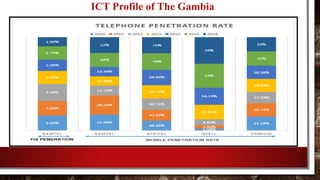
ICT Profile of The Gambia
ICT Policy,Programme,Legal & Regulatory Framework
Conclusion
1
2
3
4
5
6
Frequency and Spectrum Management in The Gambia
6
Introduction
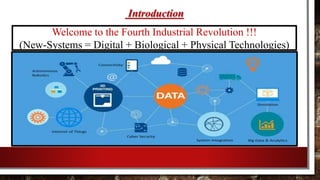
Welcome to the Fourth Industrial Revolution !!!
(New-Systems = Digital + Biological + Physical Technologies)
Introduction
Introduction
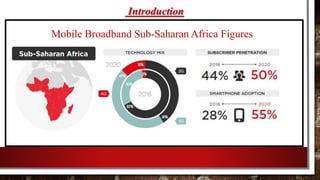
Mobile Broadband Sub-Saharan Africa Figures
Introduction
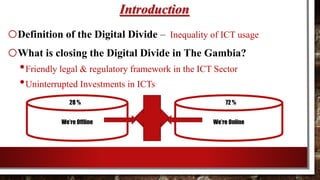
oDefinition of the Digital Divide – Inequality of ICT usage
oWhat is closing the Digital Divide in The Gambia?
•Friendly legal & regulatory framework in the ICT Sector
•Uninterrupted Investments in ICTs
We’re Offline We’re Online
28 % 72 %
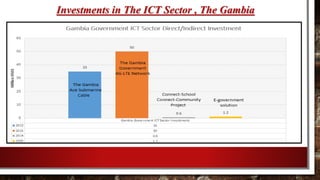
Investments in The ICT Sector , The Gambia
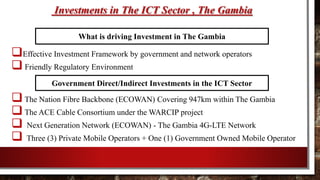
Effective Investment Framework by government and network operators
 Friendly Regulatory Environment
The Nation Fibre Backbone (ECOWAN) Covering 947km within The Gambia
The ACE Cable Consortium under the WARCIP project
 Next Generation Network (ECOWAN) - The Gambia 4G-LTE Network
 Three (3) Private Mobile Operators + One (1) Government Owned Mobile Operator
What is driving Investment in The Gambia
Government Direct/Indirect Investments in the ICT Sector
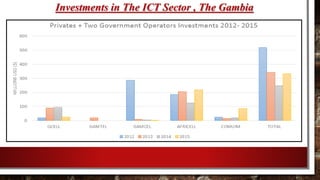
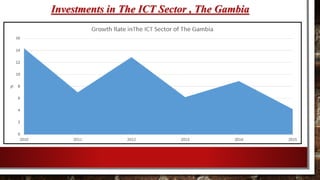
Investments in The ICT Sector , The Gambia
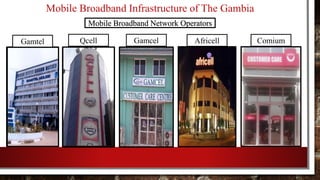
Mobile Broadband Infrastructure of The Gambia
Mobile Broadband Network Operators
Gamtel Qcell Gamcel Africell Comium
Mobile Broadband Infrastructure of The Gambia
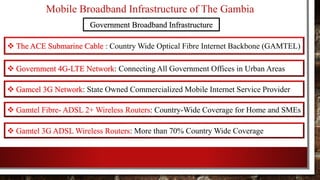
Government Broadband Infrastructure
 The ACE Submarine Cable : Country Wide Optical Fibre Internet Backbone (GAMTEL)
 Government 4G-LTE Network: Connecting All Government Offices in Urban Areas
 Gamcel 3G Network: State Owned Commercialized Mobile Internet Service Provider
 Gamtel Fibre- ADSL 2+ Wireless Routers: Country-Wide Coverage for Home and SMEs
 Gamtel 3G ADSL Wireless Routers: More than 70% Country Wide Coverage
Mobile Broadband Infrastructure of The Gambia
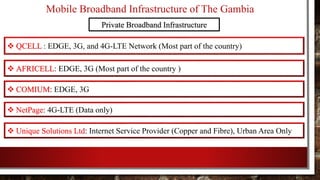
Private Broadband Infrastructure
 QCELL : EDGE, 3G, and 4G-LTE Network (Most part of the country)
 AFRICELL: EDGE, 3G (Most part of the country )
 COMIUM: EDGE, 3G
 NetPage: 4G-LTE (Data only)
 Unique Solutions Ltd: Internet Service Provider (Copper and Fibre), Urban Area Only
Mobile Broadband Infrastructure of The Gambia
Mobile Cellular Services
Frequency and Spectrum Management in The Gambia
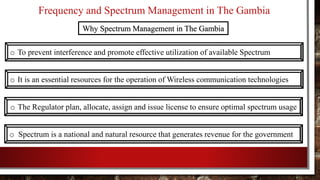
o To prevent interference and promote effective utilization of available Spectrum
o It is an essential resources for the operation of Wireless communication technologies
o The Regulator plan, allocate, assign and issue license to ensure optimal spectrum usage
o Spectrum is a national and natural resource that generates revenue for the government
Why Spectrum Management in The Gambia
Frequency and Spectrum Management in The Gambia
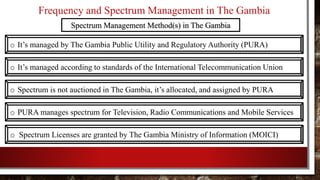
o It’s managed according to standards of the International Telecommunication Union
o Spectrum is not auctioned in The Gambia, it’s allocated, and assigned by PURA
o PURA manages spectrum for Television, Radio Communications and Mobile Services
o Spectrum Licenses are granted by The Gambia Ministry of Information (MOICI)
Spectrum Management Method(s) in The Gambia
o It’s managed by The Gambia Public Utility and Regulatory Authority (PURA)
Frequency and Spectrum Management in The Gambia
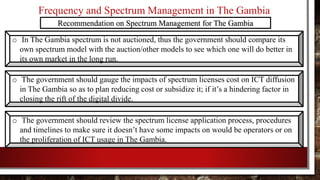
Recommendation on Spectrum Management for The Gambia
o In The Gambia spectrum is not auctioned, thus the government should compare its
own spectrum model with the auction/other models to see which one will do better in
its own market in the long run.
o The government should gauge the impacts of spectrum licenses cost on ICT diffusion
in The Gambia so as to plan reducing cost or subsidize it; if it’s a hindering factor in
closing the rift of the digital divide.
o The government should review the spectrum license application process, procedures
and timelines to make sure it doesn’t have some impacts on would be operators or on
the proliferation of ICT usage in The Gambia.
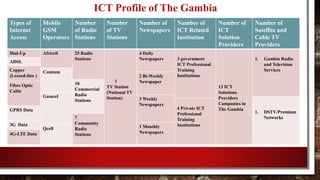
ICT Profile of The Gambia
Types of
Internet
Access
Mobile
GSM
Operators
Number
of Radio
Stations
Number
of TV
Stations
Number of
Newspapers
Number of
ICT Related
Institution
Number of
ICT
Solution
Providers
Number of
Satellite and
Cable TV
Providers
Dial-Up Africell 25 Radio
Stations
1
TV Station
(National TV
Station)
4 Daily
Newspapers 3 government
ICT Professional
Training
Institutions
13 ICT
Solutions
Providers
Companies in
The Gambia
1. Gambia Radio
and Television
Services
ADSL
Copper
(Leased-line )
Comium
2 Bi-Weekly
Newspaper18
Commercial
Radio
Stations
Fibre Optic
Cable
Gamcel
3 Weekly
Newspapers
1. DSTV/Premium
Networks
4 Private ICT
Professional
Training
Institutions
GPRS Data
7
Community
Radio
Stations
3G Data 1 Monthly
Newspapers
Qcell
4G-LTE Data
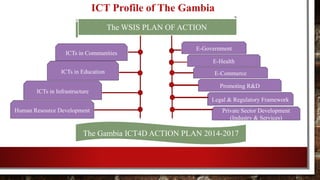
ICT Profile of The Gambia
The WSIS PLAN OF ACTION
ICTs in Education
ICTs in Communities
ICTs in Infrastructure
Human Resource Development
E-Government
E-Health
E-Commerce
Promoting R&D
Legal & Regulatory Framework
Private Sector Development
(Industry & Services)
The Gambia ICT4D ACTION PLAN 2014-2017
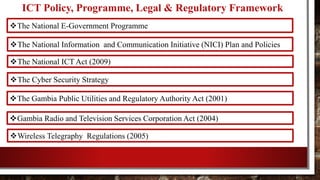
ICT Policy, Programme, Legal & Regulatory Framework
The National E-Government Programme
The National Information and Communication Initiative (NICI) Plan and Policies
The National ICT Act (2009)
The Cyber Security Strategy
The Gambia Public Utilities and Regulatory Authority Act (2001)
Gambia Radio and Television Services Corporation Act (2004)
Wireless Telegraphy Regulations (2005)
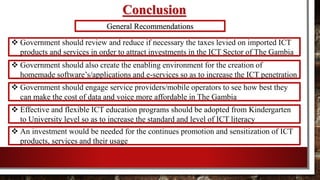
Conclusion
 Government should review and reduce if necessary the taxes levied on imported ICT
products and services in order to attract investments in the ICT Sector of The Gambia
General Recommendations
 Government should also create the enabling environment for the creation of
homemade software’s/applications and e-services so as to increase the ICT penetration
 Government should engage service providers/mobile operators to see how best they
can make the cost of data and voice more affordable in The Gambia
 Effective and flexible ICT education programs should be adopted from Kindergarten
to University level so as to increase the standard and level of ICT literacy
 An investment would be needed for the continues promotion and sensitization of ICT
products, services and their usage
Conclusion
We highlighted the Fourth Industrial Revolution and its areas of focus
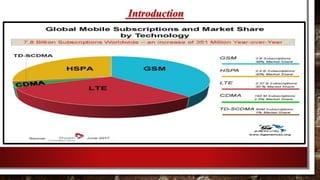
We manifested the Global as well as Regional Mobile Broadband Subscription Rate from 2016 – 2020
We stated and conceptualized the definition of digital divide
We stated and conceptualized the definition of what is the digital divide
We also highlighted investments in the ICT sector and the key drivers of investment into the ICT sector
We also have a light dive on the Broadband Infrastructure of The Gambia and Its key players
Yes of course, besides spectrum management, we also discussed about the general ICT profile of The Gambia
Finally, we have also discussed about the policy, programme, legal and regulatory aspect of the ICT sector
References
1. “Information About The Fourth Industrial Revolution https://themanufacturertln.com/additive-manufacturing/where-
does-additive-manufacturing-lie-within-the-fourth-industrial-revolution/”
2. 5G-America “http://www.5gamericas.org/en/resources/statistics/statistics-global/”
3. “Internet World Stats-Usage and Population Statistics: http://www.internetworldstats.com/africa.htm”
4. "Advanced Spectrum Management for Mobile Telecommunications - GSMA Capacity Building eLearning course,
Session 3 and 4".
5. "Advanced Spectrum Management for Mobile Telecommunications - GSMA Capacity Building eLearning course,
The Mobile Economy 2017 Document".
6. “The Gambia Public Utility and Regulatory Authority (PURA) Annual Report and Financial Statement 2015 –
www.pura.gm”
7. “The Gambia Ministry of Information and Communication Infrastructure policies, plans, programs and other
documents: http://www.moici.gov.gm/index.php?option=com_content&view=article&id=40&Itemid=150”
8. “Gambia Profile ((Latest Data Available- 2016)-ITU : https://www.itu.int/net4/itu-
d/icteye/CountryProfileReport.aspx?countryID=92”
End
Thank you so much for giving me the
greatest gift: Your Attention

Final project on Advanced Spectrum Management for Mobile Telecommunications

  • 1.
    TOPIC: Closing the DigitalDivide In The Gambia Course: Advanced Spectrum Management For Mobile Telecommunication (GSMA) Participant Name: Mr. Serign Modou Bah Date: 19th October, 2017
  • 2.
    Contents of Discussion Introduction Investmentin the ICT sector of The Gambia Mobile Broadband Infrastructure of The Gambia ICT Profile of The Gambia ICT Policy,Programme,Legal & Regulatory Framework Conclusion 1 2 3 4 5 6 Frequency and Spectrum Management in The Gambia 6
  • 3.
    Introduction Welcome to theFourth Industrial Revolution !!! (New-Systems = Digital + Biological + Physical Technologies)
  • 4.
  • 5.
  • 6.
    Introduction oDefinition of theDigital Divide – Inequality of ICT usage oWhat is closing the Digital Divide in The Gambia? •Friendly legal & regulatory framework in the ICT Sector •Uninterrupted Investments in ICTs We’re Offline We’re Online 28 % 72 %
  • 7.
    Investments in TheICT Sector , The Gambia Effective Investment Framework by government and network operators  Friendly Regulatory Environment The Nation Fibre Backbone (ECOWAN) Covering 947km within The Gambia The ACE Cable Consortium under the WARCIP project  Next Generation Network (ECOWAN) - The Gambia 4G-LTE Network  Three (3) Private Mobile Operators + One (1) Government Owned Mobile Operator What is driving Investment in The Gambia Government Direct/Indirect Investments in the ICT Sector
  • 8.
    Investments in TheICT Sector , The Gambia
  • 9.
    Investments in TheICT Sector , The Gambia
  • 10.
    Investments in TheICT Sector , The Gambia
  • 11.
    Mobile Broadband Infrastructureof The Gambia Mobile Broadband Network Operators Gamtel Qcell Gamcel Africell Comium
  • 12.
    Mobile Broadband Infrastructureof The Gambia Government Broadband Infrastructure  The ACE Submarine Cable : Country Wide Optical Fibre Internet Backbone (GAMTEL)  Government 4G-LTE Network: Connecting All Government Offices in Urban Areas  Gamcel 3G Network: State Owned Commercialized Mobile Internet Service Provider  Gamtel Fibre- ADSL 2+ Wireless Routers: Country-Wide Coverage for Home and SMEs  Gamtel 3G ADSL Wireless Routers: More than 70% Country Wide Coverage
  • 13.
    Mobile Broadband Infrastructureof The Gambia Private Broadband Infrastructure  QCELL : EDGE, 3G, and 4G-LTE Network (Most part of the country)  AFRICELL: EDGE, 3G (Most part of the country )  COMIUM: EDGE, 3G  NetPage: 4G-LTE (Data only)  Unique Solutions Ltd: Internet Service Provider (Copper and Fibre), Urban Area Only
  • 14.
  • 15.
    Mobile Broadband Infrastructureof The Gambia Mobile Cellular Services
  • 16.
    Frequency and SpectrumManagement in The Gambia o To prevent interference and promote effective utilization of available Spectrum o It is an essential resources for the operation of Wireless communication technologies o The Regulator plan, allocate, assign and issue license to ensure optimal spectrum usage o Spectrum is a national and natural resource that generates revenue for the government Why Spectrum Management in The Gambia
  • 17.
    Frequency and SpectrumManagement in The Gambia o It’s managed according to standards of the International Telecommunication Union o Spectrum is not auctioned in The Gambia, it’s allocated, and assigned by PURA o PURA manages spectrum for Television, Radio Communications and Mobile Services o Spectrum Licenses are granted by The Gambia Ministry of Information (MOICI) Spectrum Management Method(s) in The Gambia o It’s managed by The Gambia Public Utility and Regulatory Authority (PURA)
  • 18.
    Frequency and SpectrumManagement in The Gambia Recommendation on Spectrum Management for The Gambia o In The Gambia spectrum is not auctioned, thus the government should compare its own spectrum model with the auction/other models to see which one will do better in its own market in the long run. o The government should gauge the impacts of spectrum licenses cost on ICT diffusion in The Gambia so as to plan reducing cost or subsidize it; if it’s a hindering factor in closing the rift of the digital divide. o The government should review the spectrum license application process, procedures and timelines to make sure it doesn’t have some impacts on would be operators or on the proliferation of ICT usage in The Gambia.
  • 19.
    ICT Profile ofThe Gambia Types of Internet Access Mobile GSM Operators Number of Radio Stations Number of TV Stations Number of Newspapers Number of ICT Related Institution Number of ICT Solution Providers Number of Satellite and Cable TV Providers Dial-Up Africell 25 Radio Stations 1 TV Station (National TV Station) 4 Daily Newspapers 3 government ICT Professional Training Institutions 13 ICT Solutions Providers Companies in The Gambia 1. Gambia Radio and Television Services ADSL Copper (Leased-line ) Comium 2 Bi-Weekly Newspaper18 Commercial Radio Stations Fibre Optic Cable Gamcel 3 Weekly Newspapers 1. DSTV/Premium Networks 4 Private ICT Professional Training Institutions GPRS Data 7 Community Radio Stations 3G Data 1 Monthly Newspapers Qcell 4G-LTE Data
  • 20.
    ICT Profile ofThe Gambia
  • 21.
    ICT Profile ofThe Gambia The WSIS PLAN OF ACTION ICTs in Education ICTs in Communities ICTs in Infrastructure Human Resource Development E-Government E-Health E-Commerce Promoting R&D Legal & Regulatory Framework Private Sector Development (Industry & Services) The Gambia ICT4D ACTION PLAN 2014-2017
  • 22.
    ICT Policy, Programme,Legal & Regulatory Framework The National E-Government Programme The National Information and Communication Initiative (NICI) Plan and Policies The National ICT Act (2009) The Cyber Security Strategy The Gambia Public Utilities and Regulatory Authority Act (2001) Gambia Radio and Television Services Corporation Act (2004) Wireless Telegraphy Regulations (2005)
  • 23.
    Conclusion  Government shouldreview and reduce if necessary the taxes levied on imported ICT products and services in order to attract investments in the ICT Sector of The Gambia General Recommendations  Government should also create the enabling environment for the creation of homemade software’s/applications and e-services so as to increase the ICT penetration  Government should engage service providers/mobile operators to see how best they can make the cost of data and voice more affordable in The Gambia  Effective and flexible ICT education programs should be adopted from Kindergarten to University level so as to increase the standard and level of ICT literacy  An investment would be needed for the continues promotion and sensitization of ICT products, services and their usage
  • 24.
    Conclusion We highlighted theFourth Industrial Revolution and its areas of focus We manifested the Global as well as Regional Mobile Broadband Subscription Rate from 2016 – 2020 We stated and conceptualized the definition of digital divide We stated and conceptualized the definition of what is the digital divide We also highlighted investments in the ICT sector and the key drivers of investment into the ICT sector We also have a light dive on the Broadband Infrastructure of The Gambia and Its key players Yes of course, besides spectrum management, we also discussed about the general ICT profile of The Gambia Finally, we have also discussed about the policy, programme, legal and regulatory aspect of the ICT sector
  • 25.
    References 1. “Information AboutThe Fourth Industrial Revolution https://themanufacturertln.com/additive-manufacturing/where- does-additive-manufacturing-lie-within-the-fourth-industrial-revolution/” 2. 5G-America “http://www.5gamericas.org/en/resources/statistics/statistics-global/” 3. “Internet World Stats-Usage and Population Statistics: http://www.internetworldstats.com/africa.htm” 4. "Advanced Spectrum Management for Mobile Telecommunications - GSMA Capacity Building eLearning course, Session 3 and 4". 5. "Advanced Spectrum Management for Mobile Telecommunications - GSMA Capacity Building eLearning course, The Mobile Economy 2017 Document". 6. “The Gambia Public Utility and Regulatory Authority (PURA) Annual Report and Financial Statement 2015 – www.pura.gm” 7. “The Gambia Ministry of Information and Communication Infrastructure policies, plans, programs and other documents: http://www.moici.gov.gm/index.php?option=com_content&view=article&id=40&Itemid=150” 8. “Gambia Profile ((Latest Data Available- 2016)-ITU : https://www.itu.int/net4/itu- d/icteye/CountryProfileReport.aspx?countryID=92”
  • 26.
    End Thank you somuch for giving me the greatest gift: Your Attention

Editor's Notes

  • #4 https://themanufacturertln.com/additive-manufacturing/where-does-additive-manufacturing-lie-within-the-fourth-industrial-revolution/
  • #5 http://www.5gamericas.org/en/resources/statistics/statistics-global/