Kinnar Majithia (P1026)
       2nd Year PGDBM
LG Electronics
                      LG Electronics
•   LG = Lucky + GoldStar Co. Ltd
    – Lucky: sold household products
    – GoldStar: sold electronic products

• Subsidiary of LG Corp. founded by Koo In-Hwoi

• Koo In-Hwoi founded Lak-Hui (Lucky) in 1947 which became first
  Korean company to become public in 1952

• As company expanded plastic business, it established GoldStar Co.
  Ltd. in 1958.

• 1995 – GoldStar was renamed as LG as Lucky and GoldStar merged
LG Electronics
                     LG Electronics
• Headquarters: Seoul, South Korea

• Head: Koo Bon-joon (Vice-Chairman, CEO)

• Highlights:
    World’s 2nd largest manufacturer of TV sets
    By 2005 LG was a Top 100 global brand

• Revenue: US$ 48.2 billion(2010)

• Net Income: US$ 1.1 billion(2010)

• Employee count: 80,000+
LG Electronics
                         LG Electronics
• Slogan: Life’s Good, it’s a backronym
    – Expresses Brand’s Value, Promises, Benefits, Personality


• LG Symbol
    – Symbolizes world, future, youth, humanity, technology
    – Two parts: LG logo in grey, stylized image of human face in unique LG red color
    – Red color represents friendliness and gives strong impression of LG’s
      commitment to deliver the best
    – Circle symbolizes ‘Globe’, smiling face conveys ‘Friendliness, Approachability’
    – Eye represents ‘Goal-oriented, focused, confident’

• Product Categories: Mobiles, Digital appliances, Digital display, Digital media
LG Electronics
               LG Electronics
• Logo Changes
  – LG formed from 2 different companies named
    Lucky(chemical cosmetic company, 1947) and
    Goldstar(radio manufacturing plant, 1958) owned
    by same person


  – In 1995, Lucky Goldstar was renamed to LG
    Electronics
LG Electronics
• LG India
   – Wholly-owned subsidiary of LG Electronics est. in 1997

   – Set up state-of-art manufacturing unit in Noida, 1998

   – LG Electronics India Ltd. (LGEIL) is consumer durables market leader
     with 27% market share

   – LG Soft India: Innovation wing of LG Electronics India in Bangalore

   – LG came up with TV offering Hindi and regional language menus

   – Introduced ‘Cineplus’ and ‘Sampoorna’ TVs for rural markets
SONY
• Headquarters: Sony
  Corporation, Minato, Tokyo, Japan moved
  from Shinagawa, Tokyo in 2006

• World’s 5th largest media conglomerate with
  US$ 86.64 billion(FY2011)

• Current CEO, Chairman and President:
  Howard Stringer
SONY
• Sony Group Organizational Details Summary
   – Consumer Products and Services Group
        •   Sony Computer Entertainment
        •   Sony Network Entertainment
        •   VAIO and mobile business Group
        •   Personal Imaging and Sound Business Group
        •   Home Entertainment Business Group
   – Professional & Device Solutions Group
        • Device Solutions Business Group
        • Semiconductor Business Group
        • Professional Solutions Group
   –   Sony Pictures Entertainment
   –   Sony Music Entertainment
   –   Sony Financial Holdings Group
   –   Sony Ericsson Mobile Communications
   –   Sony DADC
SONY
• Founders:
   – Akio Morita and Masaru Ibuka derived Sony from
     Sonus, Latin word for sound, and also from English slang
     word Sonny, since they considered themselves as sonny
     boys, a loan-word into Japanese which in early 1950s
     connoted smart and presentable young men

• History:
   – 1945, after WWII, Masaru Ibuka started radio-repair shop Masaru Ibuka
     in bomb-damaged department store building in
     Nihonbashi of Tokyo

   – Next year, Akio Morita joined him to find a company called
     Tokyo Tsushin Kogyo K.K.
SONY
• History
   – 1950s: Ibuka traveled to US to Bell Labs after hearing about invention
     of transistor and convinced Bell to license transistor technology to his
     company

   – 1955: Tokyo Tsushin Kogyo release Sony TR-55, Japan’s first
     commercially produced transistor radio

   – 1955: Decision made to use Sony logo on Totsuko products

   – 1956: Release of TR-6, for this Sony contracted ‘Atchan’, now known as
     Sony Boy, cartoon created by Fuyuhiko Okabe

   – 1958: Company name changed to Sony Corp., Sony listed on TSE

   – 1960: World’s first direct-view portable TV, TV8-301 launched
SONY
• History
   – 1965: Launch of 19-inch color TV 19C-70

   – 1968: Trintron brand name for its lines of aperture grilled CRT televisions, KV-
     1310

   – 1979: Launch of TPS-L2 first stereo cassette player ‘Walkman’

   – 1982: Launch of world’s first CD player, CDP-101

   – 1990: Launch of HD-equipped 16:9 wide aspect ratio, 36” TV, KW 3600HD

   – 1997: Launch of home-use PC VAIO series

   – 2001: Sony Ericsson Mobile Communications established
SONY
• History
  – 2005: Sony launches BRAVIA brand HDTV-
    compatible flat-screen TVs

  – 2007: World’s first OLED TV launched

  – 2009: Sony unveils new brand message
    ‘make.believe’
SONY
• Company Names Considered:
  – For a Romanized name , strongly considered
    TTK, rejected as railway company Tokyo Kyuko was
    called TKK
  – Totsuko was used in Japan but then Americans had
    problems in pronouncing it
  – Tokyo Teletech was considered but rejected as
    Teletech was being used by an American company
  – Sony: combination of sonus(root of sonic and
    sound, Latin) and sonny(American term in 1950s to
    call a boy)
  – Sony name adopted in January 1958
SONY
• Logo Changes
   First logo, 1950s      2nd Logo, 1957-58


  First Sony Logo, 1955   Sony Corp appears
SONY
• Logo Changes

                   Sony added sticker with
                   campaign ‘It’s a SONY’
SAMSUNG ELECTRONICS
• Samsung name comes from the word ‘three
  stars’ that shine brightly
• The hanja character ‘sam’ has double
  meaning of three and strong while ‘sung’
  connotes ‘star’ and ‘bright’
• The corporate name has auspicious meaning
  in it, meaning that it foretells success
SAMSUNG ELECTRONICS
• HIGHLIGHTS
  – Founded in 1969
  – Headquarters: Samsung Town, Seoul, South Korea
  – CEO: Choi Gee-Sung
  – Chairman: Lee Kun-hee
  – Parent: Samsung Group
  – Revenues: US$ 133.78 billion (2010)
  – Net Income: US$ 13.78 billion (2010)
SAMSUNG ELECTRONICS
• HIGHLIGHTS
  – Assembly Plants and Sales Network: 65 countries
  – Employee count: Around 200,000
  – In 2009, overtook HP to become world’s biggest IT
    maker
  – Largest sales revenues in LCD, LED
    Displays, Computer chips
  – Since 2006, Samsung is no.1 in no. of TV units sold
SAMSUNG ELECTRONICS
• HISTORY
  – 1938: Lee Byung-chull came to Daegu city and
    founded Samsung Sanghoe, dealt in groceries and
    made noodles
  – 1947: Head office moved to Seoul. When Korean war
    broke out he left Seoul starting Sugar refinery in Busan
  – 1954: lee founded Cheil Mojik – largest woolen mill
    ever in the country
  – 1960s: Samsung grouped entered Electronics industry
  – 1969: Samsung-Sanyo Electronics
SAMSUNG ELECTRONICS
• Logo
  – 1993: In honor of 55th anniversary Samsung’s
    corporate logo was redefined
  – Name written in English expanding its global presence
    throughout the world
  – Elliptical shape symbolizes world moving through
    space, conveying a distinctive image of innovation and
    change
  – The first letter, "S", and the last letter, "G," partially
    break out of the oval to connect the interior with the
    exterior, showing SAMSUNG's desire to be one with
    the world and to serve society as a whole
SAMSUNG ELECTRONICS
• Logo
  – The English rendering is a visual expression of its
    core corporate vision, excellence in customer
    service through technology
  – The blue colour symbolizes stability and
    reliability, which are precisely what the company
    wishes to accomplish with its customers. It also
    stands for social responsibility as a corporate
    citizen, a company official explained
SAMSUNG ELECTRONICS
• Categories
  – TV/Audio/Video
  – Mobile Phone
  – Camera/Camcorder
  – Home Appliances
  – PC/Peripherals/Printers
  – Memory Cards
Panasonic
• Founded: March 13,1918 at Osaka, Japan

• Founder: Konosuke Matsushita

• Headquarters: Kadoma, Osaka, Japan

• Key People
   – Kunio Nakamura(Chairman)
   – Fumio Ohtsubo(President)

• Revenues: US$ 104.88 billion (2011)

• Employee count: 365,000+ (2011)
Panasonic
                        ,
• Product Profile
  – Televisions
  – Digital Cameras
  – Recorders
  – Home Appliances
  – Personal and Health Care
  – Communications and Security Products
  – Personal Computers and Office Products
Panasonic
• History
  – Founded in 1918 by Konosuke Matsushita first
    selling duplex lamp sockets
  – 1927: Produced bicycle lamp, first product
    manufactured under the name National
  – Matsusihita’s brother-in-law, Toshio lue, founded
    Sanyo as a subcontractor for components after
    WWII and became a competitor for Panasonic. But
    in Dec. 2009 it became a subsidiary of Panasonic
Panasonic
• History
  – 1952: Made its first Black and White TV

  – 1960: Made its first Color TV
                                     Color TV   B/W TV

  – 1996: Made Plasma TV

  – 1998: Made Digital TV

                             Plasma TV          Digital TV
Panasonic
• Logo Changes
Panasonic
• Logo Changes
Panasonic
                     ,
• Logo Changes
Panasonic
                     ,
• Logo Changes
• Koninklijke Philips Electronics N.V. (Royal Philips
  Electronics), commonly known as Philips
• Founded: 1891, Eindhoven, Netherlands
• Headquarters: Amsterdam, Netherlands
• Products:
   –   Consumer Electronics
   –   Domestic Appliances
   –   Lighting
   –   Medical Systems
   –   Medical Technology
• Key People:
  – Frans van Houten (CEO)
  – Jeroen van der Veer (Chairman)
• Revenue: 25.42 Euros (2010)
• Employee count: 119,000 (2010)
• Founded in 1891 by Gerard Philips as light
  bulb company
• 1920: Healthcare – Entry into Medical Systems
  with purchase of C.H.F. Muller
• 1927: Radio broadcast from Netherlands
• 1928: TV demonstration to the public
• 1950: Philishave, inspired by bicycle lamp
• 1960: Audio Tape Cassette
• 1972: First home VCR
• 1980: Compact Disc Introduction
• 1990: Let’s make things better – Revolutionary
  Advertising
• 2000 onwards: DVD Recorder, Plasma TV, LCD
  TV, LED TV
• Philips Logos
• Past and present CEOs
   –   1891–1922: Gerard Philips
   –   1922–1939: Anton Philips
   –   1939–1961: Frans Otten
   –   1961–1971: Frits Philips
   –   1971–1977: Henk van Riemsdijk
   –   1977–1981: Nico Rodenburg
   –   1982–1986: Wisse Dekker
   –   1986–1990: Cornelis Van der Klugt
   –   1990–1996: Jan Timmer
   –   1996–2001: Cor Boonstra
   –   2001–2011: Gerard Kleisterlee
   –   2011–now: Frans van Houten
• 2004: Let’s make things better  Sense and simplicity

• Philips India
   – Operations started in Kolkata in 1930 under name Philips Electrical Co.
     (India) Pvt Ltd
   – 1938: Philips India set up its first Indian lamp-manufacturing factory in
     Kolkata
   – 1948: Philips started manufacturing radios in Kolkata
   – 1959: 2nd Radio factory set up near Pune
   – 1957: Public Limited Company – Philips India Ltd.
   – 1970: Consumer Electronics factory in Pimpri, Pune(shut down in
     2006)
   – 1982: Philips brought Colour TV to India
   – 1996: Philips software center in Bangalore
•   Founded: 1910, Japan
•   Founder: Namihei Odaira
•   Headquarters: Chiyoda, Tokyo, Japan
•   President: Hiroaki Nakanishi
•   Revenue: US$ 112.4 billion (2011)
•   Employee Count: 361,745
•   Hitachi Ltd. is parent of Hitachi Group as part
    of larger DKB group of companies
• Timeline
  – 1910: Company formed. Completed five-
    horsepower induction motor
  – 1924: Completed the first large-scale DC
    electric locomotive to be manufactured in Japan
  – 1932: Completed Hitachi's first electric
    refrigerator
  – 1970: Developed computer-aided traffic control
    system for the Shinkansen (Bullet Train)
• Timeline
  – 1974: Commercial operation began at
    Japan‘s first 470,000-kW nuclear power station
  – 1985: Developed CAD/CAE system with ultra-high
    resolution colour display
  – 1995: Developed Super TFT LCD
    module featuring ultra-wide viewing angles
  – 2007: Developed EMIEW 2, a small and
    lightweight interactive robot
• Hitachi Wordmark


  – The preferred presentation of the Hitachi Wordmark is
    in Hitachi Red
• Difficult Times
  – In March 1999, Hitachi, Ltd., was confronting a grave
    crisis with severe financial deficits. To confront these
    difficult business conditions, management sought to
    move forward by uniting the Hitachi Group into a
    single-minded company, and strived to create a
    competitive edge by seeking how to differentiate
    Hitachi from other companies
  – One important policy related to these efforts was the
    formation of a brand creation project, resulting in the
    establishment of a message, the " Hitachi Brand
    Platform", that could be consistently communicated
    by all Hitachi Group employees
• Hitachi Slogan: Inspire the Next
  – Hitachi seeks to breathe new life into the coming
    era
• Origin of Hitachi Mark and Meaning


   – The Founder of Hitachi, Ltd., Namihei Odaira, designed the Hitachi
     Mark even before the establishment of the company in 1910.
   – It was his belief that a mark was necessary to win the trust and
     confidence of the people as a symbol of quality products.
   – Namihei Odaira used the two Chinese characters hi, meaning "sun"
     and tachi, meaning "rise" to form the mark by superimposing one
     character on the other and enclosing them in a circle.
   – The four barbs protruding at the four points of the compass signify the
     sun's rays.
   – The mark was designed to capture Odaira's vision of a man standing
     before the rising sun, planning a better future for all.
• Founded: 1981
• Incorporated: 1985, as TCL Telecommunication
  Equipment Co. Ltd.
• Began manufacturing for Chinese markets in
  1980s and selling overseas in 2000s
• Headquarters: Huizhou, Guangdong, China
• Revenue: US$6.49 billion (2009)
• Employee Count: approx. 50,000
• Chairman: Li Dongsheng
• In 2010, it was 25th largest consumer electronics producer
  and sixth-largest television producer
  (after Samsung, LG, Sony, Panasonic and Sharp)

• TCL comprises of 3 listed companies:
   – TCL Corporation
   – TCL Multimedia Technology Holdings Ltd.
   – TCL Communications Technology Holdings Ltd.

• TCL primarily sells its products under the TCL brand name in
  Africa, Asia, Australasia, South America and Russia, under
  the Alcatel brand in Europe (ex. Russia), and under the RCA
  brand in North America
• Timeline
  – 1953: The RCA brand marketed the first colour
    television
  – 1992: TCL started manufacturing widescreens
  – 2001: the company became the number 1 in colour
    TVs in China
  – 2002: In November, TCL signed an agreement with
    Motorola for the production of mobile telephones. In
    April, the company signed a memorandum of intent
    with the Japanese conglomerate, Matsushita Electric
    Industrial Co. Ltd.
• Timeline
  – 2003: TCL Mobile was ranked among the 5 most dynamic
    technology companies in Asia Pacific by Deloitte Touche
    Tohmatsu
  – 2004: In September, the T&A joint venture between TCL
    Communication and Alcatel was formalised. Shares in TCL
    were made available on the Hong Kong Stock Exchange.
    During the same period, the company became the largest
    television manufacturer by merging with Thomson's TV
    Division, the owner of the RCA and Thomson brands
  – 2005: In December, TCL announced that it would be
    collaborating with Walt Disney. In March, TCL International
    became TCL Multimedia
• Timeline
  – 2006: In October, TCL announced a European
    reorganisation plan and a new business model
  – 2007: In May, European reorganisation was
    completed
  – 2008: In December, TCL signed a cooperation
    agreement with Intel to develop the new
    generation of television by Internet. In September,
    the company introduced the first LCD interactive
    television with the X9 series
•   TCL Multimedia, an international electronics group TCL Multimedia, an
    international electronics group, is active in Europe with the Thomson (1) and TCL
    brands, in North America with RCA (1) and TCL and in Asia under the TCL and Rowa
    brands

•   July 2003: TCL chairman Li Dongsheng formally announced a 'Dragon and Tiger
    Plan' to establish two competitive TCL businesses in global markets ("Dragons")
    and three leading businesses inside China ("Tigers")

•   Nov 2003: TCL(67%) and Thomson SA of France announced the creation of a joint
    venture to produce televisions and DVD players worldwide

•   April 2004: In April 2004, TCL and Alcatel announced the creation of a mobile
    phone manufacturing joint venture

•   TCL sold a total of 4.18 million LCD TV sets in 2008, more than triple the number
    during 2007
• TCL is organised into four business divisions:
  – Multimedia
  – Communications
  – Home Appliances
  – Techne Electronics
• In addition it has two affiliated business areas:
  – Real Estate & Investment
  – Logistics & Services
• Founded: 1981, as MERC Electronics
• Headquarters: Mumbai, India
• Revenue: US$340.85 million
• Employee count: 1500+
• Founders: G.L. Mirchandani and Vijay
  Mansukhani
• 1982: Started assembling TV sets at Andheri
  factory
• Onida brand has following range of products.
   –   LCD TVs
   –   Plasma TVs
   –   Televisions
   –   DVD and Home Theater Systems
   –   Air Conditioners
   –   Washing machines
   –   Microwave Ovens
   –   Presentation Products
   –   Inverters
   –   Mobile phones
   –   LED TV
• ONIDA came out with the famous caption
  'Neighbour's envy, Owner's Pride', another
  popular theme of the ads was a devil complete
  with horns and tail in the 1980s


• Tagline: ‘Neighbour’s Envy, Our Pride’
  Changed to ‘Nothing but the truth’ in 2004
• Devil replaced by Siddharth and Ritu in 2009
  and the tagline changed to ‘Tumko Dekha to
  yeh Design aaya’ or ‘Designed with you in
  mind’


                                Onida Devil
• Management
   – Mr. Gulu Mirchandani (Chairman and MD)
   – Mr. Vijay Mansukhani (MD)
   – Mr. G. Sundar (CEO)

• Milestones
   –   1981 : MIRC Electronics Pvt. Ltd. was established
   –   1982 : CTV production started at Nand Bhavan, Mumbai
   –   1983 : Technical collaboration with JVC, Japan for CTV
   –   1985 : Established in-house R&D wing
   –   1986 : Production expanded and moved to a new factory at Kalina
   –   1987 : Moved to our own factory building "ONIDA HOUSE"
              Iwai, Speaker plant commences its operation
• Milestones
   – 1992 : Crossed 1 million CTV sales
   – 1995 : ISO 9001 certification obtained from BVQI
   – 1998 : Award for excellence in electronics by ministry of IT
   – 1999 : First in India to develop Internet enabled CTV
   – 2003 : Launched world's first LCD remote 'i-Control'
            : Launched Air-conditioners
            : Launched Rear Projection TV, Plasma TV & DVD Players
            : Launched Fully Automatic front loading Washing Machines
            : Operations started in Russia
   2005 : Launch of 'POISON' range of CTV's
   2009 : Onida’s Brand relaunch
   2010 : Launched LED TVs with I-Care Technology
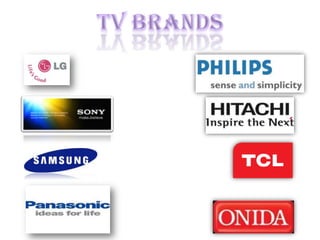
Tv brands

Tv brands

  • 1.
  • 3.
    LG Electronics LG Electronics • LG = Lucky + GoldStar Co. Ltd – Lucky: sold household products – GoldStar: sold electronic products • Subsidiary of LG Corp. founded by Koo In-Hwoi • Koo In-Hwoi founded Lak-Hui (Lucky) in 1947 which became first Korean company to become public in 1952 • As company expanded plastic business, it established GoldStar Co. Ltd. in 1958. • 1995 – GoldStar was renamed as LG as Lucky and GoldStar merged
  • 4.
    LG Electronics LG Electronics • Headquarters: Seoul, South Korea • Head: Koo Bon-joon (Vice-Chairman, CEO) • Highlights:  World’s 2nd largest manufacturer of TV sets  By 2005 LG was a Top 100 global brand • Revenue: US$ 48.2 billion(2010) • Net Income: US$ 1.1 billion(2010) • Employee count: 80,000+
  • 5.
    LG Electronics LG Electronics • Slogan: Life’s Good, it’s a backronym – Expresses Brand’s Value, Promises, Benefits, Personality • LG Symbol – Symbolizes world, future, youth, humanity, technology – Two parts: LG logo in grey, stylized image of human face in unique LG red color – Red color represents friendliness and gives strong impression of LG’s commitment to deliver the best – Circle symbolizes ‘Globe’, smiling face conveys ‘Friendliness, Approachability’ – Eye represents ‘Goal-oriented, focused, confident’ • Product Categories: Mobiles, Digital appliances, Digital display, Digital media
  • 6.
    LG Electronics LG Electronics • Logo Changes – LG formed from 2 different companies named Lucky(chemical cosmetic company, 1947) and Goldstar(radio manufacturing plant, 1958) owned by same person – In 1995, Lucky Goldstar was renamed to LG Electronics
  • 7.
    LG Electronics • LGIndia – Wholly-owned subsidiary of LG Electronics est. in 1997 – Set up state-of-art manufacturing unit in Noida, 1998 – LG Electronics India Ltd. (LGEIL) is consumer durables market leader with 27% market share – LG Soft India: Innovation wing of LG Electronics India in Bangalore – LG came up with TV offering Hindi and regional language menus – Introduced ‘Cineplus’ and ‘Sampoorna’ TVs for rural markets
  • 8.
    SONY • Headquarters: Sony Corporation, Minato, Tokyo, Japan moved from Shinagawa, Tokyo in 2006 • World’s 5th largest media conglomerate with US$ 86.64 billion(FY2011) • Current CEO, Chairman and President: Howard Stringer
  • 9.
    SONY • Sony GroupOrganizational Details Summary – Consumer Products and Services Group • Sony Computer Entertainment • Sony Network Entertainment • VAIO and mobile business Group • Personal Imaging and Sound Business Group • Home Entertainment Business Group – Professional & Device Solutions Group • Device Solutions Business Group • Semiconductor Business Group • Professional Solutions Group – Sony Pictures Entertainment – Sony Music Entertainment – Sony Financial Holdings Group – Sony Ericsson Mobile Communications – Sony DADC
  • 10.
    SONY • Founders: – Akio Morita and Masaru Ibuka derived Sony from Sonus, Latin word for sound, and also from English slang word Sonny, since they considered themselves as sonny boys, a loan-word into Japanese which in early 1950s connoted smart and presentable young men • History: – 1945, after WWII, Masaru Ibuka started radio-repair shop Masaru Ibuka in bomb-damaged department store building in Nihonbashi of Tokyo – Next year, Akio Morita joined him to find a company called Tokyo Tsushin Kogyo K.K.
  • 11.
    SONY • History – 1950s: Ibuka traveled to US to Bell Labs after hearing about invention of transistor and convinced Bell to license transistor technology to his company – 1955: Tokyo Tsushin Kogyo release Sony TR-55, Japan’s first commercially produced transistor radio – 1955: Decision made to use Sony logo on Totsuko products – 1956: Release of TR-6, for this Sony contracted ‘Atchan’, now known as Sony Boy, cartoon created by Fuyuhiko Okabe – 1958: Company name changed to Sony Corp., Sony listed on TSE – 1960: World’s first direct-view portable TV, TV8-301 launched
  • 12.
    SONY • History – 1965: Launch of 19-inch color TV 19C-70 – 1968: Trintron brand name for its lines of aperture grilled CRT televisions, KV- 1310 – 1979: Launch of TPS-L2 first stereo cassette player ‘Walkman’ – 1982: Launch of world’s first CD player, CDP-101 – 1990: Launch of HD-equipped 16:9 wide aspect ratio, 36” TV, KW 3600HD – 1997: Launch of home-use PC VAIO series – 2001: Sony Ericsson Mobile Communications established
  • 13.
    SONY • History – 2005: Sony launches BRAVIA brand HDTV- compatible flat-screen TVs – 2007: World’s first OLED TV launched – 2009: Sony unveils new brand message ‘make.believe’
  • 14.
    SONY • Company NamesConsidered: – For a Romanized name , strongly considered TTK, rejected as railway company Tokyo Kyuko was called TKK – Totsuko was used in Japan but then Americans had problems in pronouncing it – Tokyo Teletech was considered but rejected as Teletech was being used by an American company – Sony: combination of sonus(root of sonic and sound, Latin) and sonny(American term in 1950s to call a boy) – Sony name adopted in January 1958
  • 15.
    SONY • Logo Changes First logo, 1950s 2nd Logo, 1957-58 First Sony Logo, 1955 Sony Corp appears
  • 16.
    SONY • Logo Changes Sony added sticker with campaign ‘It’s a SONY’
  • 17.
    SAMSUNG ELECTRONICS • Samsungname comes from the word ‘three stars’ that shine brightly • The hanja character ‘sam’ has double meaning of three and strong while ‘sung’ connotes ‘star’ and ‘bright’ • The corporate name has auspicious meaning in it, meaning that it foretells success
  • 18.
    SAMSUNG ELECTRONICS • HIGHLIGHTS – Founded in 1969 – Headquarters: Samsung Town, Seoul, South Korea – CEO: Choi Gee-Sung – Chairman: Lee Kun-hee – Parent: Samsung Group – Revenues: US$ 133.78 billion (2010) – Net Income: US$ 13.78 billion (2010)
  • 19.
    SAMSUNG ELECTRONICS • HIGHLIGHTS – Assembly Plants and Sales Network: 65 countries – Employee count: Around 200,000 – In 2009, overtook HP to become world’s biggest IT maker – Largest sales revenues in LCD, LED Displays, Computer chips – Since 2006, Samsung is no.1 in no. of TV units sold
  • 20.
    SAMSUNG ELECTRONICS • HISTORY – 1938: Lee Byung-chull came to Daegu city and founded Samsung Sanghoe, dealt in groceries and made noodles – 1947: Head office moved to Seoul. When Korean war broke out he left Seoul starting Sugar refinery in Busan – 1954: lee founded Cheil Mojik – largest woolen mill ever in the country – 1960s: Samsung grouped entered Electronics industry – 1969: Samsung-Sanyo Electronics
  • 21.
    SAMSUNG ELECTRONICS • Logo – 1993: In honor of 55th anniversary Samsung’s corporate logo was redefined – Name written in English expanding its global presence throughout the world – Elliptical shape symbolizes world moving through space, conveying a distinctive image of innovation and change – The first letter, "S", and the last letter, "G," partially break out of the oval to connect the interior with the exterior, showing SAMSUNG's desire to be one with the world and to serve society as a whole
  • 22.
    SAMSUNG ELECTRONICS • Logo – The English rendering is a visual expression of its core corporate vision, excellence in customer service through technology – The blue colour symbolizes stability and reliability, which are precisely what the company wishes to accomplish with its customers. It also stands for social responsibility as a corporate citizen, a company official explained
  • 23.
    SAMSUNG ELECTRONICS • Categories – TV/Audio/Video – Mobile Phone – Camera/Camcorder – Home Appliances – PC/Peripherals/Printers – Memory Cards
  • 24.
    Panasonic • Founded: March13,1918 at Osaka, Japan • Founder: Konosuke Matsushita • Headquarters: Kadoma, Osaka, Japan • Key People – Kunio Nakamura(Chairman) – Fumio Ohtsubo(President) • Revenues: US$ 104.88 billion (2011) • Employee count: 365,000+ (2011)
  • 25.
    Panasonic , • Product Profile – Televisions – Digital Cameras – Recorders – Home Appliances – Personal and Health Care – Communications and Security Products – Personal Computers and Office Products
  • 26.
    Panasonic • History – Founded in 1918 by Konosuke Matsushita first selling duplex lamp sockets – 1927: Produced bicycle lamp, first product manufactured under the name National – Matsusihita’s brother-in-law, Toshio lue, founded Sanyo as a subcontractor for components after WWII and became a competitor for Panasonic. But in Dec. 2009 it became a subsidiary of Panasonic
  • 27.
    Panasonic • History – 1952: Made its first Black and White TV – 1960: Made its first Color TV Color TV B/W TV – 1996: Made Plasma TV – 1998: Made Digital TV Plasma TV Digital TV
  • 28.
  • 29.
  • 30.
    Panasonic , • Logo Changes
  • 31.
    Panasonic , • Logo Changes
  • 32.
    • Koninklijke PhilipsElectronics N.V. (Royal Philips Electronics), commonly known as Philips • Founded: 1891, Eindhoven, Netherlands • Headquarters: Amsterdam, Netherlands • Products: – Consumer Electronics – Domestic Appliances – Lighting – Medical Systems – Medical Technology
  • 33.
    • Key People: – Frans van Houten (CEO) – Jeroen van der Veer (Chairman) • Revenue: 25.42 Euros (2010) • Employee count: 119,000 (2010) • Founded in 1891 by Gerard Philips as light bulb company • 1920: Healthcare – Entry into Medical Systems with purchase of C.H.F. Muller
  • 34.
    • 1927: Radiobroadcast from Netherlands • 1928: TV demonstration to the public • 1950: Philishave, inspired by bicycle lamp • 1960: Audio Tape Cassette • 1972: First home VCR • 1980: Compact Disc Introduction • 1990: Let’s make things better – Revolutionary Advertising • 2000 onwards: DVD Recorder, Plasma TV, LCD TV, LED TV
  • 35.
  • 36.
    • Past andpresent CEOs – 1891–1922: Gerard Philips – 1922–1939: Anton Philips – 1939–1961: Frans Otten – 1961–1971: Frits Philips – 1971–1977: Henk van Riemsdijk – 1977–1981: Nico Rodenburg – 1982–1986: Wisse Dekker – 1986–1990: Cornelis Van der Klugt – 1990–1996: Jan Timmer – 1996–2001: Cor Boonstra – 2001–2011: Gerard Kleisterlee – 2011–now: Frans van Houten
  • 37.
    • 2004: Let’smake things better  Sense and simplicity • Philips India – Operations started in Kolkata in 1930 under name Philips Electrical Co. (India) Pvt Ltd – 1938: Philips India set up its first Indian lamp-manufacturing factory in Kolkata – 1948: Philips started manufacturing radios in Kolkata – 1959: 2nd Radio factory set up near Pune – 1957: Public Limited Company – Philips India Ltd. – 1970: Consumer Electronics factory in Pimpri, Pune(shut down in 2006) – 1982: Philips brought Colour TV to India – 1996: Philips software center in Bangalore
  • 38.
    Founded: 1910, Japan • Founder: Namihei Odaira • Headquarters: Chiyoda, Tokyo, Japan • President: Hiroaki Nakanishi • Revenue: US$ 112.4 billion (2011) • Employee Count: 361,745 • Hitachi Ltd. is parent of Hitachi Group as part of larger DKB group of companies
  • 39.
    • Timeline – 1910: Company formed. Completed five- horsepower induction motor – 1924: Completed the first large-scale DC electric locomotive to be manufactured in Japan – 1932: Completed Hitachi's first electric refrigerator – 1970: Developed computer-aided traffic control system for the Shinkansen (Bullet Train)
  • 40.
    • Timeline – 1974: Commercial operation began at Japan‘s first 470,000-kW nuclear power station – 1985: Developed CAD/CAE system with ultra-high resolution colour display – 1995: Developed Super TFT LCD module featuring ultra-wide viewing angles – 2007: Developed EMIEW 2, a small and lightweight interactive robot
  • 41.
    • Hitachi Wordmark – The preferred presentation of the Hitachi Wordmark is in Hitachi Red
  • 42.
    • Difficult Times – In March 1999, Hitachi, Ltd., was confronting a grave crisis with severe financial deficits. To confront these difficult business conditions, management sought to move forward by uniting the Hitachi Group into a single-minded company, and strived to create a competitive edge by seeking how to differentiate Hitachi from other companies – One important policy related to these efforts was the formation of a brand creation project, resulting in the establishment of a message, the " Hitachi Brand Platform", that could be consistently communicated by all Hitachi Group employees
  • 43.
    • Hitachi Slogan:Inspire the Next – Hitachi seeks to breathe new life into the coming era
  • 44.
    • Origin ofHitachi Mark and Meaning – The Founder of Hitachi, Ltd., Namihei Odaira, designed the Hitachi Mark even before the establishment of the company in 1910. – It was his belief that a mark was necessary to win the trust and confidence of the people as a symbol of quality products. – Namihei Odaira used the two Chinese characters hi, meaning "sun" and tachi, meaning "rise" to form the mark by superimposing one character on the other and enclosing them in a circle. – The four barbs protruding at the four points of the compass signify the sun's rays. – The mark was designed to capture Odaira's vision of a man standing before the rising sun, planning a better future for all.
  • 45.
    • Founded: 1981 •Incorporated: 1985, as TCL Telecommunication Equipment Co. Ltd. • Began manufacturing for Chinese markets in 1980s and selling overseas in 2000s • Headquarters: Huizhou, Guangdong, China • Revenue: US$6.49 billion (2009) • Employee Count: approx. 50,000 • Chairman: Li Dongsheng
  • 46.
    • In 2010,it was 25th largest consumer electronics producer and sixth-largest television producer (after Samsung, LG, Sony, Panasonic and Sharp) • TCL comprises of 3 listed companies: – TCL Corporation – TCL Multimedia Technology Holdings Ltd. – TCL Communications Technology Holdings Ltd. • TCL primarily sells its products under the TCL brand name in Africa, Asia, Australasia, South America and Russia, under the Alcatel brand in Europe (ex. Russia), and under the RCA brand in North America
  • 47.
    • Timeline – 1953: The RCA brand marketed the first colour television – 1992: TCL started manufacturing widescreens – 2001: the company became the number 1 in colour TVs in China – 2002: In November, TCL signed an agreement with Motorola for the production of mobile telephones. In April, the company signed a memorandum of intent with the Japanese conglomerate, Matsushita Electric Industrial Co. Ltd.
  • 48.
    • Timeline – 2003: TCL Mobile was ranked among the 5 most dynamic technology companies in Asia Pacific by Deloitte Touche Tohmatsu – 2004: In September, the T&A joint venture between TCL Communication and Alcatel was formalised. Shares in TCL were made available on the Hong Kong Stock Exchange. During the same period, the company became the largest television manufacturer by merging with Thomson's TV Division, the owner of the RCA and Thomson brands – 2005: In December, TCL announced that it would be collaborating with Walt Disney. In March, TCL International became TCL Multimedia
  • 49.
    • Timeline – 2006: In October, TCL announced a European reorganisation plan and a new business model – 2007: In May, European reorganisation was completed – 2008: In December, TCL signed a cooperation agreement with Intel to develop the new generation of television by Internet. In September, the company introduced the first LCD interactive television with the X9 series
  • 50.
    TCL Multimedia, an international electronics group TCL Multimedia, an international electronics group, is active in Europe with the Thomson (1) and TCL brands, in North America with RCA (1) and TCL and in Asia under the TCL and Rowa brands • July 2003: TCL chairman Li Dongsheng formally announced a 'Dragon and Tiger Plan' to establish two competitive TCL businesses in global markets ("Dragons") and three leading businesses inside China ("Tigers") • Nov 2003: TCL(67%) and Thomson SA of France announced the creation of a joint venture to produce televisions and DVD players worldwide • April 2004: In April 2004, TCL and Alcatel announced the creation of a mobile phone manufacturing joint venture • TCL sold a total of 4.18 million LCD TV sets in 2008, more than triple the number during 2007
  • 51.
    • TCL isorganised into four business divisions: – Multimedia – Communications – Home Appliances – Techne Electronics • In addition it has two affiliated business areas: – Real Estate & Investment – Logistics & Services
  • 52.
    • Founded: 1981,as MERC Electronics • Headquarters: Mumbai, India • Revenue: US$340.85 million • Employee count: 1500+ • Founders: G.L. Mirchandani and Vijay Mansukhani • 1982: Started assembling TV sets at Andheri factory
  • 53.
    • Onida brandhas following range of products. – LCD TVs – Plasma TVs – Televisions – DVD and Home Theater Systems – Air Conditioners – Washing machines – Microwave Ovens – Presentation Products – Inverters – Mobile phones – LED TV
  • 54.
    • ONIDA cameout with the famous caption 'Neighbour's envy, Owner's Pride', another popular theme of the ads was a devil complete with horns and tail in the 1980s • Tagline: ‘Neighbour’s Envy, Our Pride’ Changed to ‘Nothing but the truth’ in 2004
  • 55.
    • Devil replacedby Siddharth and Ritu in 2009 and the tagline changed to ‘Tumko Dekha to yeh Design aaya’ or ‘Designed with you in mind’ Onida Devil
  • 56.
    • Management – Mr. Gulu Mirchandani (Chairman and MD) – Mr. Vijay Mansukhani (MD) – Mr. G. Sundar (CEO) • Milestones – 1981 : MIRC Electronics Pvt. Ltd. was established – 1982 : CTV production started at Nand Bhavan, Mumbai – 1983 : Technical collaboration with JVC, Japan for CTV – 1985 : Established in-house R&D wing – 1986 : Production expanded and moved to a new factory at Kalina – 1987 : Moved to our own factory building "ONIDA HOUSE" Iwai, Speaker plant commences its operation
  • 57.
    • Milestones – 1992 : Crossed 1 million CTV sales – 1995 : ISO 9001 certification obtained from BVQI – 1998 : Award for excellence in electronics by ministry of IT – 1999 : First in India to develop Internet enabled CTV – 2003 : Launched world's first LCD remote 'i-Control' : Launched Air-conditioners : Launched Rear Projection TV, Plasma TV & DVD Players : Launched Fully Automatic front loading Washing Machines : Operations started in Russia 2005 : Launch of 'POISON' range of CTV's 2009 : Onida’s Brand relaunch 2010 : Launched LED TVs with I-Care Technology