
Government Intervention –
Subsidies
Government
Intervention in Markets
Subsidies
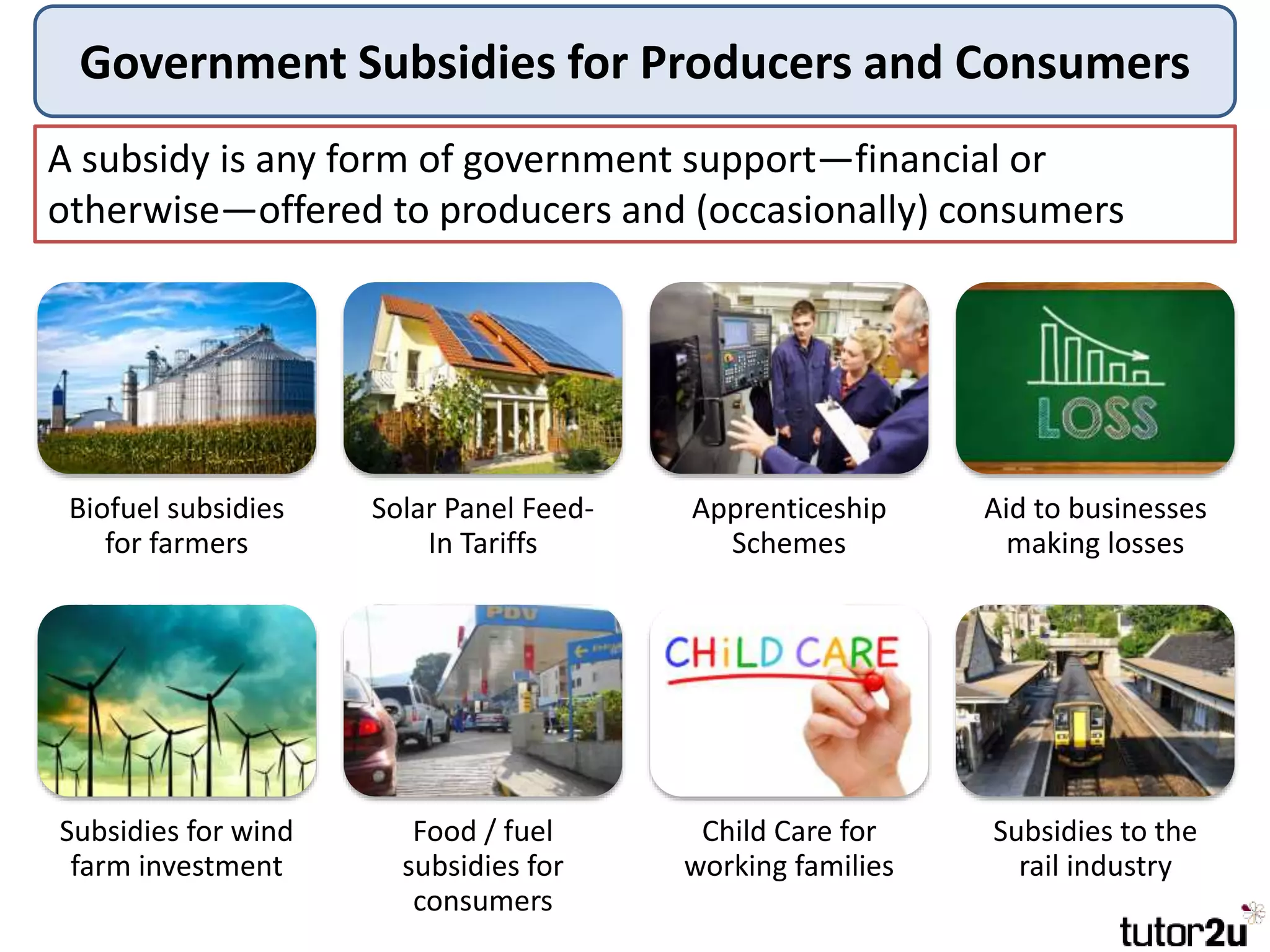
Government Subsidies for Producers and Consumers
A subsidy is any form of government support—financial or
otherwise—offered to producers and (occasionally) consumers
Biofuel subsidies
for farmers
Solar Panel Feed-
In Tariffs
Apprenticeship
Schemes
Aid to businesses
making losses
Subsidies for wind
farm investment
Food / fuel
subsidies for
consumers
Child Care for
working families
Subsidies to the
rail industry
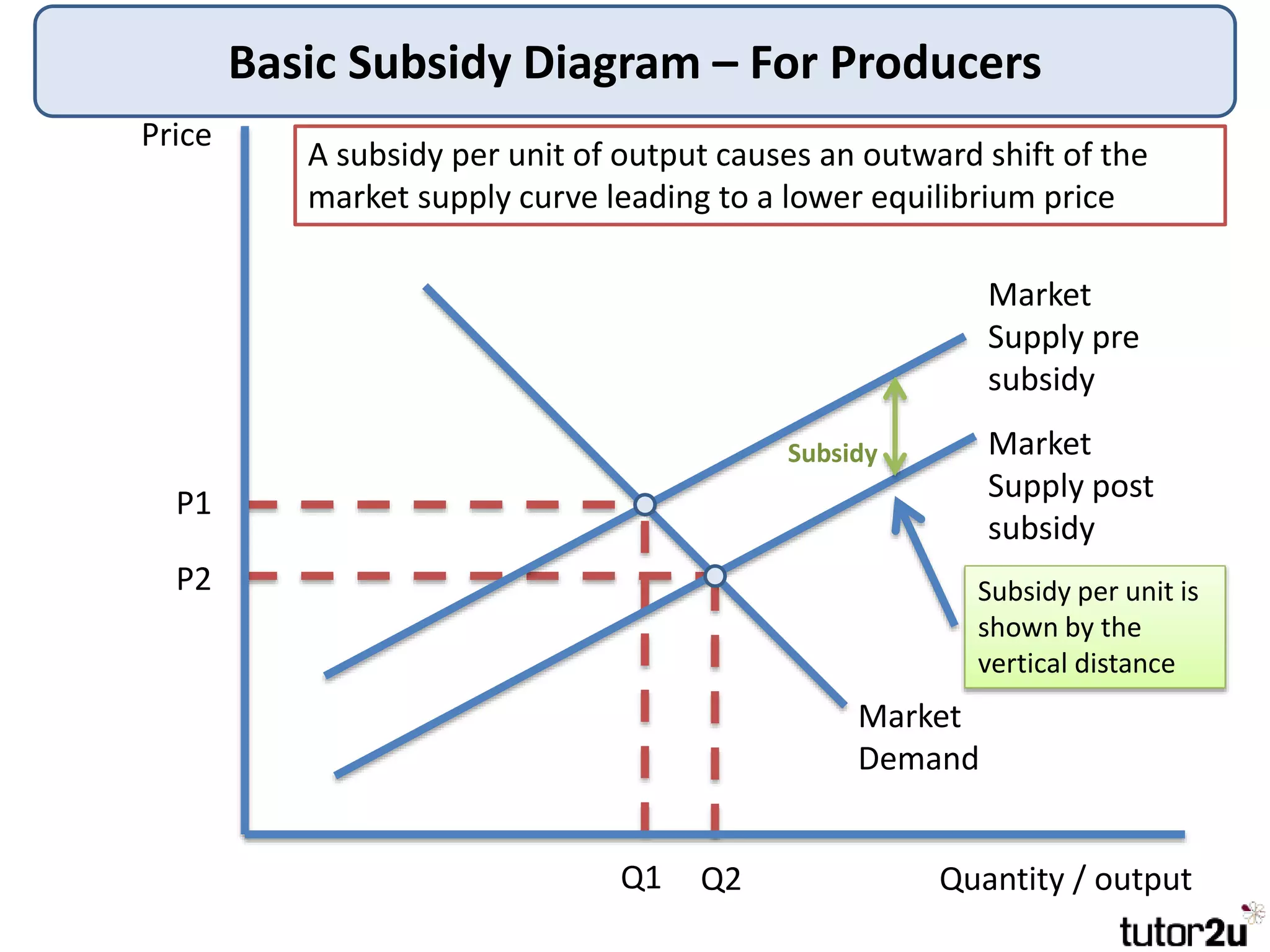
Basic Subsidy Diagram – For Producers
Price
Quantity / output
Market
Supply pre
subsidy
P1
Q1
A subsidy per unit of output causes an outward shift of the
market supply curve leading to a lower equilibrium price
Market
Demand
Market
Supply post
subsidy
P2
Q2
Subsidy
Subsidy per unit is
shown by the
vertical distance
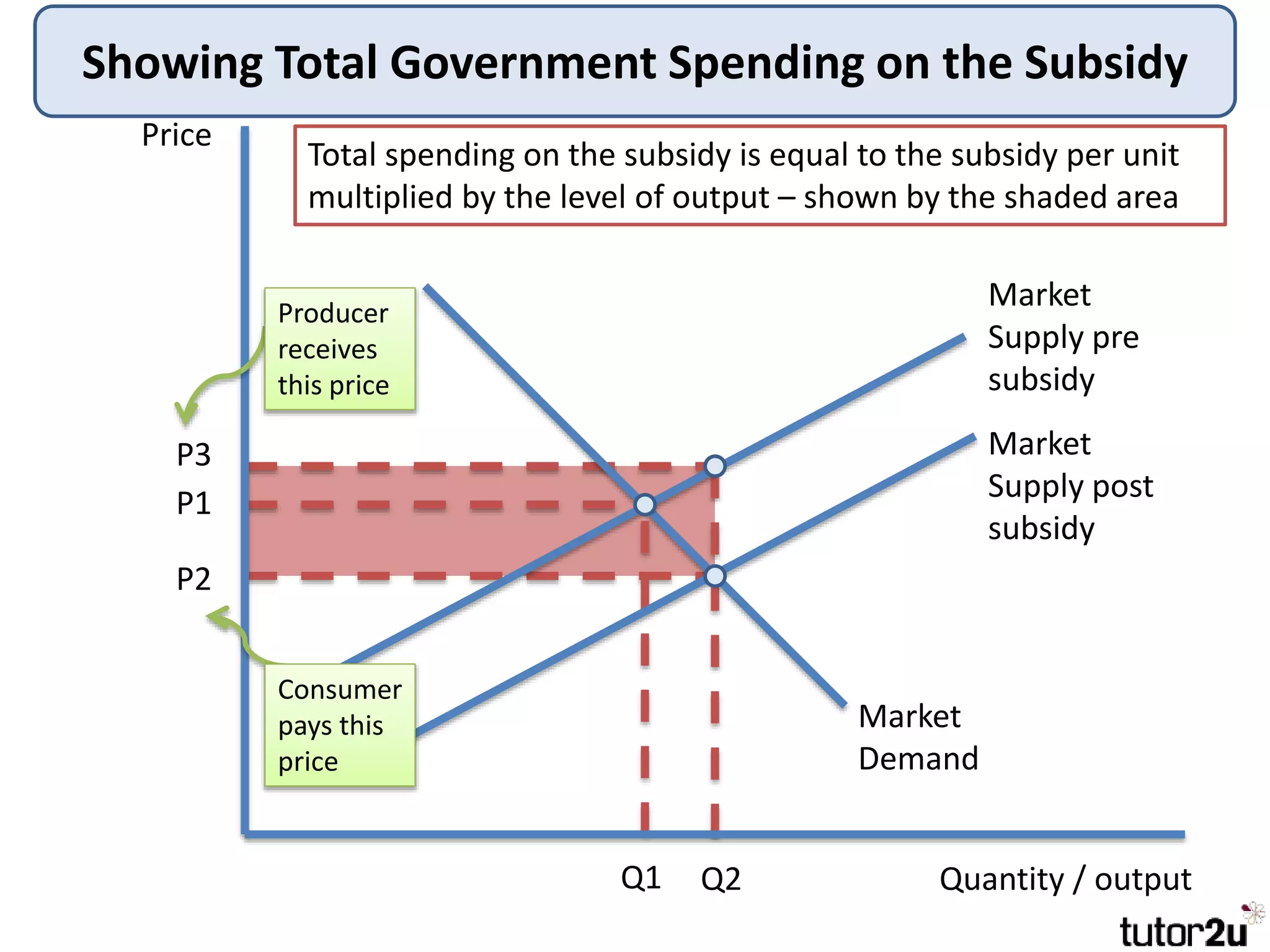
Showing Total Government Spending on the Subsidy
Price
Quantity / output
Market
Supply pre
subsidy
P1
Q1
Total spending on the subsidy is equal to the subsidy per unit
multiplied by the level of output – shown by the shaded area
Market
Demand
Market
Supply post
subsidy
P2
Q2
P3
Producer
receives
this price
Consumer
pays this
price
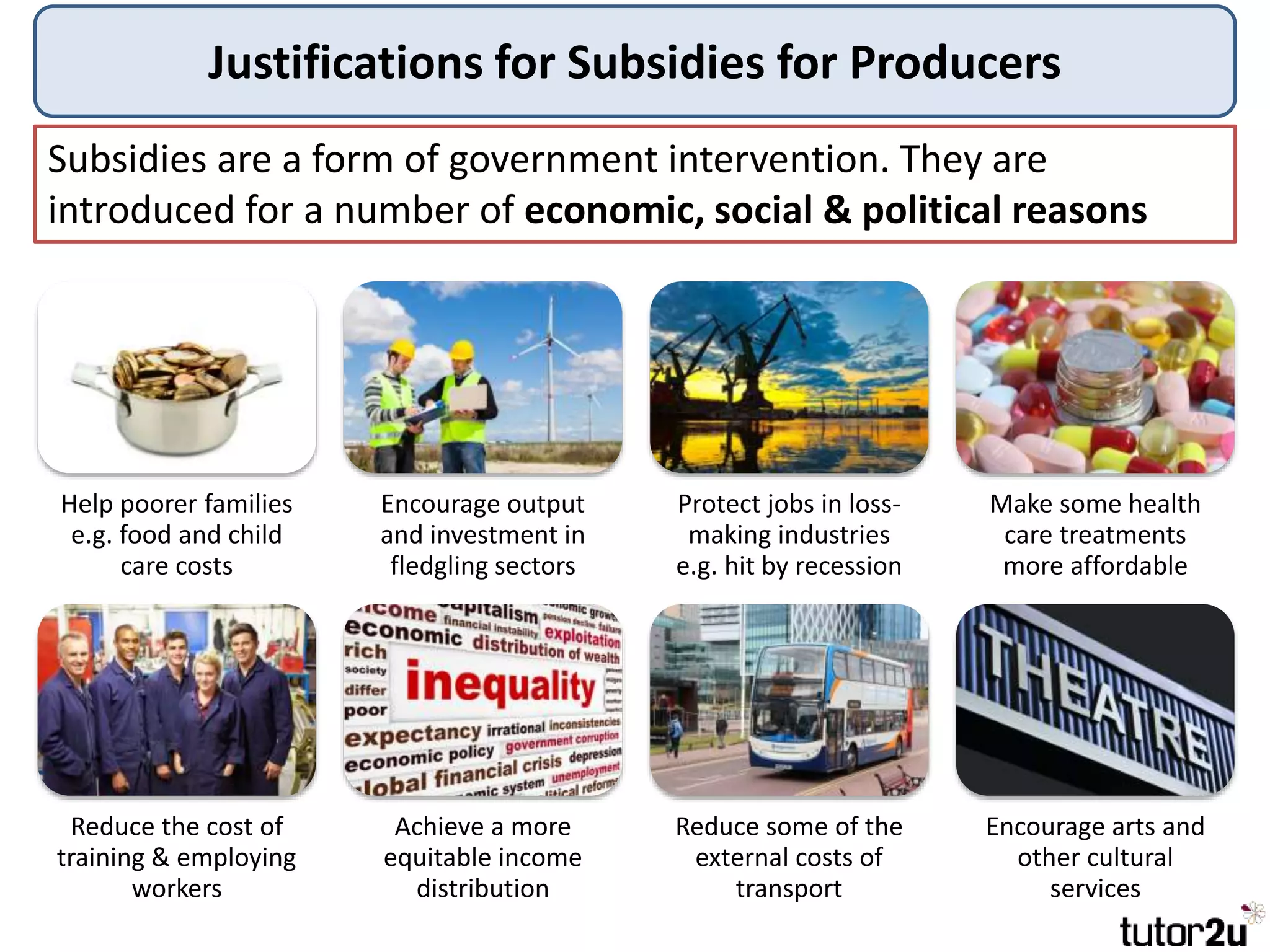
Justifications for Subsidies for Producers
Subsidies are a form of government intervention. They are
introduced for a number of economic, social & political reasons
Help poorer families
e.g. food and child
care costs
Encourage output
and investment in
fledgling sectors
Protect jobs in loss-
making industries
e.g. hit by recession
Make some health
care treatments
more affordable
Reduce the cost of
training & employing
workers
Achieve a more
equitable income
distribution
Reduce some of the
external costs of
transport
Encourage arts and
other cultural
services
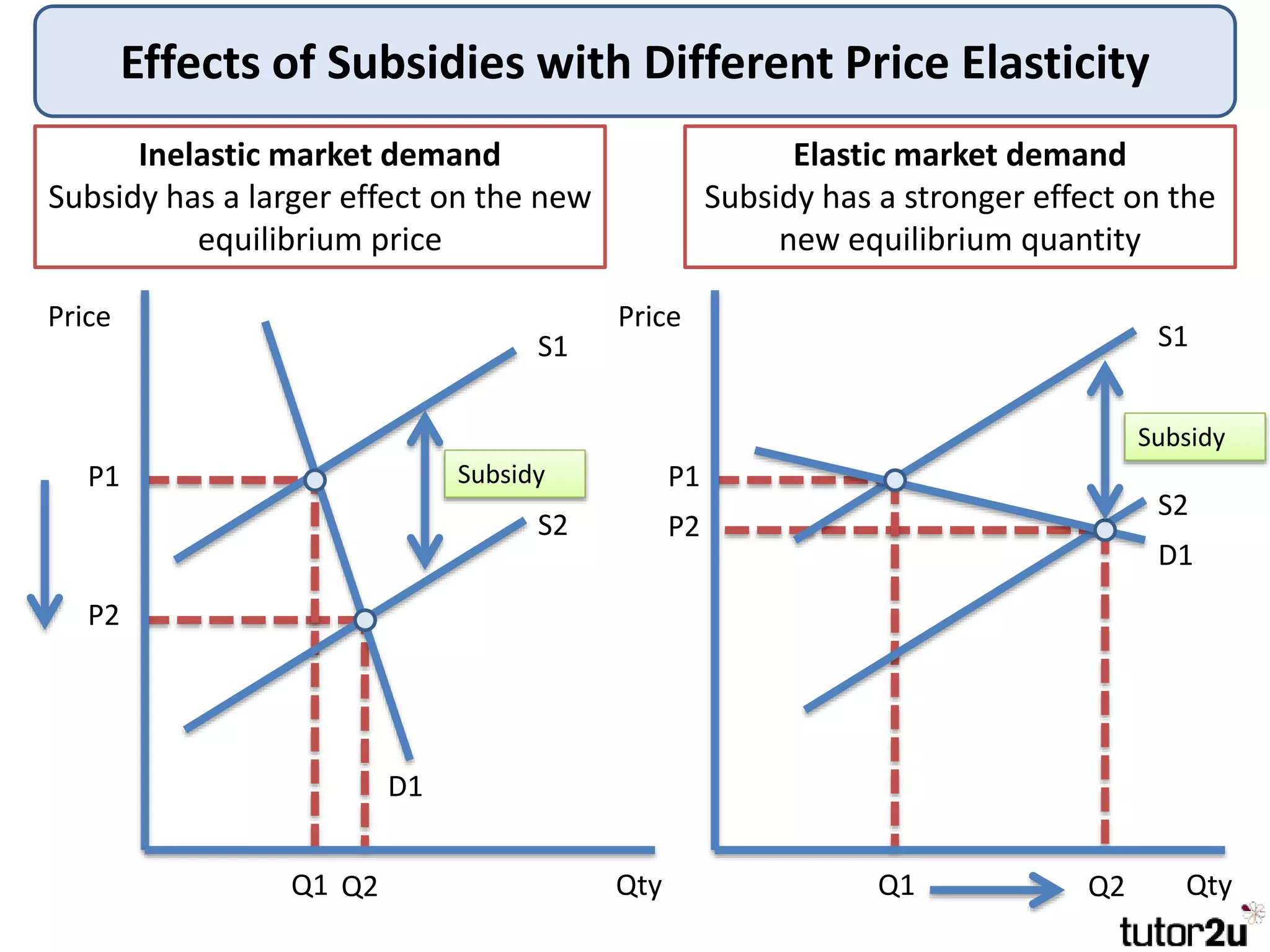
Effects of Subsidies with Different Price Elasticity
Inelastic market demand
Subsidy has a larger effect on the new
equilibrium price
Price
Qty
Price
Qty
P1
Q1
Elastic market demand
Subsidy has a stronger effect on the
new equilibrium quantity
D1
P2
Q2
S1
S2
S1
S2
D1
Q1 Q2
P1
P2
Subsidy
Subsidy
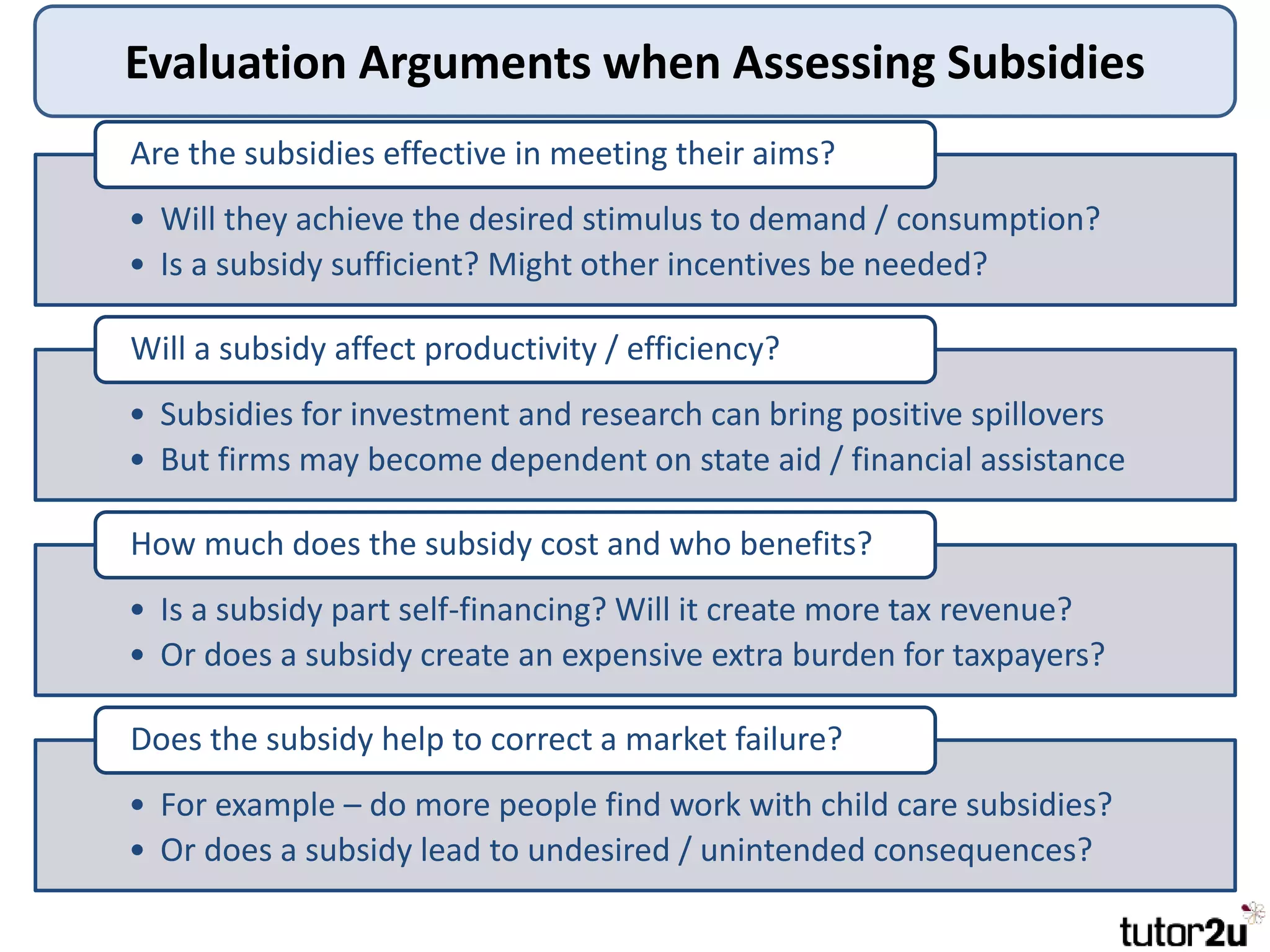
Evaluation Arguments when Assessing Subsidies
• Will they achieve the desired stimulus to demand / consumption?
• Is a subsidy sufficient? Might other incentives be needed?
Are the subsidies effective in meeting their aims?
• Subsidies for investment and research can bring positive spillovers
• But firms may become dependent on state aid / financial assistance
Will a subsidy affect productivity / efficiency?
• Is a subsidy part self-financing? Will it create more tax revenue?
• Or does a subsidy create an expensive extra burden for taxpayers?
How much does the subsidy cost and who benefits?
• For example – do more people find work with child care subsidies?
• Or does a subsidy lead to undesired / unintended consequences?
Does the subsidy help to correct a market failure?
Get help from fellow
students, teachers and
tutor2u on Twitter:
@tutor2u_econ
Tutor2u
Keep up-to-date with economics,
resources, quizzes and
worksheets for your economics
course.

Tutor2u - Government Intervention – Subsidies

  • 1.
  • 2.
  • 3.
    Government Subsidies forProducers and Consumers A subsidy is any form of government support—financial or otherwise—offered to producers and (occasionally) consumers Biofuel subsidies for farmers Solar Panel Feed- In Tariffs Apprenticeship Schemes Aid to businesses making losses Subsidies for wind farm investment Food / fuel subsidies for consumers Child Care for working families Subsidies to the rail industry
  • 4.
    Basic Subsidy Diagram– For Producers Price Quantity / output Market Supply pre subsidy P1 Q1 A subsidy per unit of output causes an outward shift of the market supply curve leading to a lower equilibrium price Market Demand Market Supply post subsidy P2 Q2 Subsidy Subsidy per unit is shown by the vertical distance
  • 5.
    Showing Total GovernmentSpending on the Subsidy Price Quantity / output Market Supply pre subsidy P1 Q1 Total spending on the subsidy is equal to the subsidy per unit multiplied by the level of output – shown by the shaded area Market Demand Market Supply post subsidy P2 Q2 P3 Producer receives this price Consumer pays this price
  • 6.
    Justifications for Subsidiesfor Producers Subsidies are a form of government intervention. They are introduced for a number of economic, social & political reasons Help poorer families e.g. food and child care costs Encourage output and investment in fledgling sectors Protect jobs in loss- making industries e.g. hit by recession Make some health care treatments more affordable Reduce the cost of training & employing workers Achieve a more equitable income distribution Reduce some of the external costs of transport Encourage arts and other cultural services
  • 7.
    Effects of Subsidieswith Different Price Elasticity Inelastic market demand Subsidy has a larger effect on the new equilibrium price Price Qty Price Qty P1 Q1 Elastic market demand Subsidy has a stronger effect on the new equilibrium quantity D1 P2 Q2 S1 S2 S1 S2 D1 Q1 Q2 P1 P2 Subsidy Subsidy
  • 8.
    Evaluation Arguments whenAssessing Subsidies • Will they achieve the desired stimulus to demand / consumption? • Is a subsidy sufficient? Might other incentives be needed? Are the subsidies effective in meeting their aims? • Subsidies for investment and research can bring positive spillovers • But firms may become dependent on state aid / financial assistance Will a subsidy affect productivity / efficiency? • Is a subsidy part self-financing? Will it create more tax revenue? • Or does a subsidy create an expensive extra burden for taxpayers? How much does the subsidy cost and who benefits? • For example – do more people find work with child care subsidies? • Or does a subsidy lead to undesired / unintended consequences? Does the subsidy help to correct a market failure?
  • 9.
    Get help fromfellow students, teachers and tutor2u on Twitter: @tutor2u_econ
  • 10.
    Tutor2u Keep up-to-date witheconomics, resources, quizzes and worksheets for your economics course.

Editor's Notes

  • #3 Exam questions involving drawing subsidy diagrams are typically found demanding by many students so please remember to revise this area of the course properly and get in lots of practise for this type of government intervention. If your analysis is accurate, you will frequently be given plenty of scope to critically evaluate the role of subsidies particularly when it comes to addressing different types of market failure. Strong evaluation understands the importance of elasticity in assessing the impact and also considers alternatives to subsidies by the government.