FLAG SHIELD
LOCATION
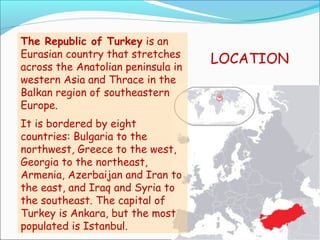
The Republic of Turkey is an
Eurasian country that stretches
across the Anatolian peninsula in
western Asia and Thrace in the
Balkan region of southeastern
Europe.
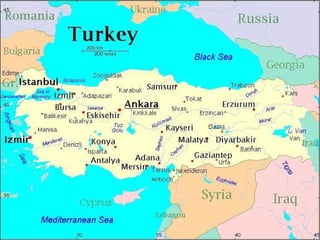
It is bordered by eight
countries: Bulgaria to the
northwest, Greece to the west,
Georgia to the northeast,
Armenia, Azerbaijan and Iran to
the east, and Iraq and Syria to
the southeast. The capital of
Turkey is Ankara, but the most
populated is Istanbul.
HISTORY
Antiquity
The Anatolian peninsula (also called
Minor Asia), comprising most of
modern Turkey, is one of the
oldest continually inhabited regions
in the world due to its location at
the intersection of Asia and
Europe.
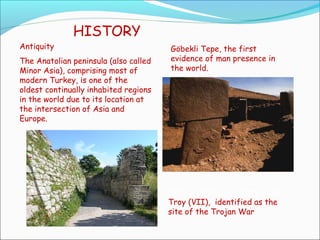
Göbekli Tepe, the first
evidence of man presence in
the world.
Portion of the legendary walls
Troy (VII), identified as the
site of the Trojan War
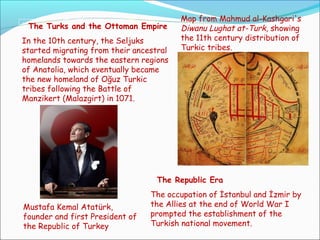
The Turks and the Ottoman Empire
In the 10th century, the Seljuks
started migrating from their ancestral
homelands towards the eastern regions
of Anatolia, which eventually became
the new homeland of Oğuz Turkic
tribes following the Battle of
Manzikert (Malazgirt) in 1071.
Map from Mahmud al-Kashgari's
Diwanu Lughat at-Turk, showing
the 11th century distribution of
Turkic tribes.
The Republic Era
The occupation of İstanbul and İzmir by
the Allies at the end of World War I
prompted the establishment of the
Turkish national movement.
Mustafa Kemal Atatürk,
founder and first President of
the Republic of Turkey
LANGUAGE
Turkish is the sole official language throughout Turkey.
 RELIGION
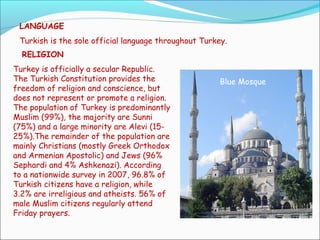
Turkey is officially a secular Republic.
The Turkish Constitution provides the
freedom of religion and conscience, but
does not represent or promote a religion.
The population of Turkey is predominantly
Muslim (99%), the majority are Sunni
(75%) and a large minority are Alevi (15-
25%).The remainder of the population are
mainly Christians (mostly Greek Orthodox
and Armenian Apostolic) and Jews (96%
Sephardi and 4% Ashkenazi). According
to a nationwide survey in 2007, 96.8% of
Turkish citizens have a religion, while
3.2% are irreligious and atheists. 56% of
male Muslim citizens regularly attend
Friday prayers.
Blue Mosque
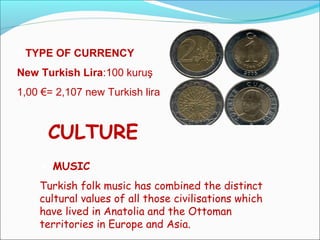
TYPE OF CURRENCY
New Turkish Lira:100 kuruş
1,00 €= 2,107 new Turkish lira
CULTURE
 MUSIC
Turkish folk music has combined the distinct
cultural values of all those civilisations which
have lived in Anatolia and the Ottoman
territories in Europe and Asia.
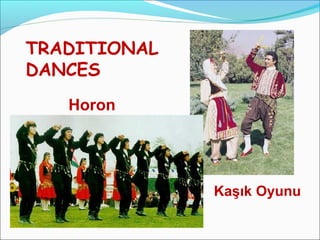
TRADITIONAL
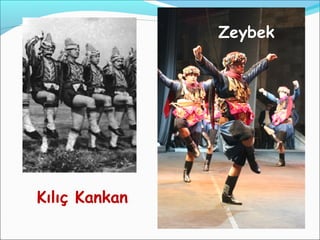
DANCES
Horon
Kaşık Oyunu
Kılıç Kankan
Zeybek
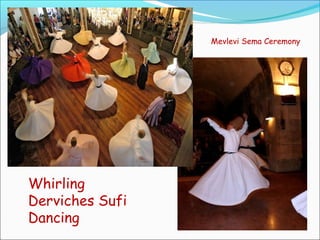
Whirling
Derviches Sufi
Dancing
Mevlevi Sema Ceremony
Popular figures
Nasrettin Hoca
He is a medieval legendary
satirical Sufi figure.]
Nasreddin
was a populist philosopher and
wise man, remembered for his
funny stories and anecdotes.
Much of Nasreddin's actions
can be described as illogical yet
logical, rational yet irrational,
bizarre yet normal, foolish yet
sharp, and simple yet profound.
What adds even further to his
uniqueness is the way he gets
across his messages in
unconventional yet very
effective methods in a profound
simplicity.
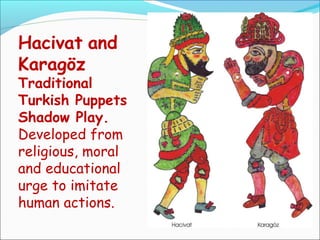
Hacivat and
Karagöz
Traditional
Turkish Puppets
Shadow Play.
Developed from
religious, moral
and educational
urge to imitate
human actions.
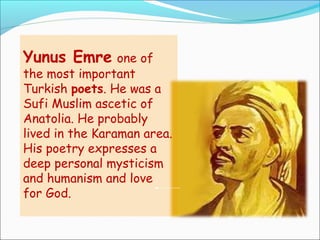
Yunus Emre one of
the most important
Turkish poets. He was a
Sufi Muslim ascetic of
Anatolia. He probably
lived in the Karaman area.
His poetry expresses a
deep personal mysticism
and humanism and love
for God.
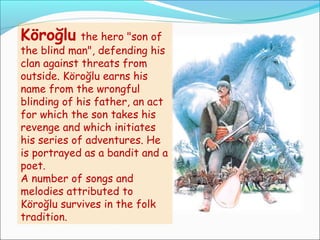
Köroğlu the hero "son of
the blind man", defending his
clan against threats from
outside. Köroğlu earns his
name from the wrongful
blinding of his father, an act
for which the son takes his
revenge and which initiates
his series of adventures. He
is portrayed as a bandit and a
poet.
A number of songs and
melodies attributed to
Köroğlu survives in the folk
tradition.
Important Monuments
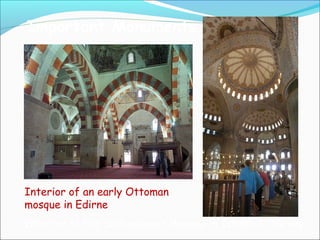
Interior of an early Ottoman
mosque in Edirne
Interior of the Sultanahmet Mosque in Istanbul, Turkey
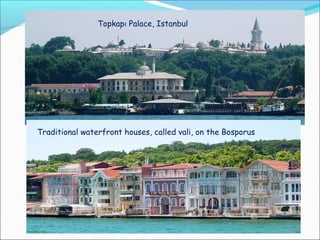
Topkapı Palace, Istanbul
Traditional waterfront houses, called vali, on the Bosporus
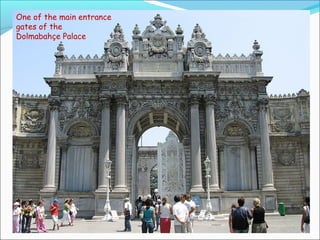
One of the main entrance
gates of the
Dolmabahçe Palace
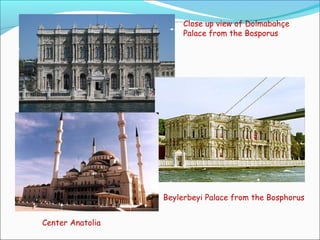
Close up view of Dolmabahçe
Palace from the Bosporus
Beylerbeyi Palace from the Bosphorus
Center Anatolia
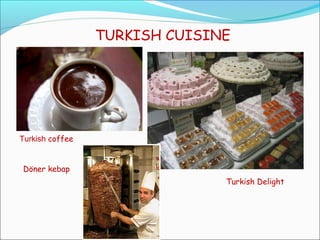
TURKISH CUISINE
Turkish coffee
Turkish Delight
Döner kebap
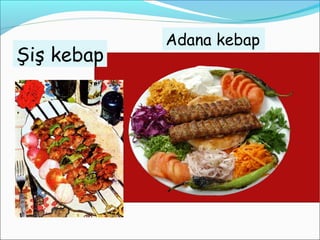
Şiş kebap
Adana kebap
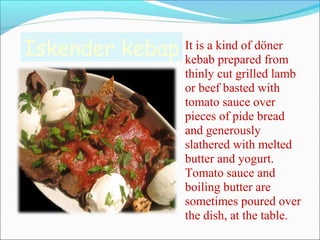
İskender kebap It is a kind of döner
kebab prepared from
thinly cut grilled lamb
or beef basted with
tomato sauce over
pieces of pide bread
and generously
slathered with melted
butter and yogurt.
Tomato sauce and
boiling butter are
sometimes poured over
the dish, at the table.
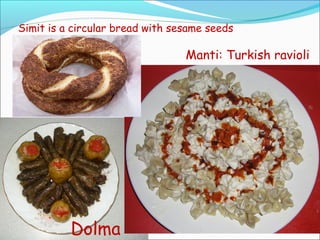
Manti: Turkish ravioli
Dolma
Simit is a circular bread with sesame seeds
SPORT
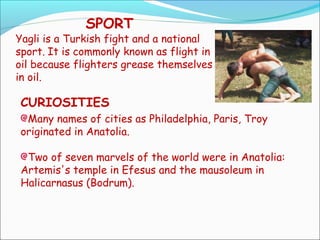
Yagli is a Turkish fight and a national
sport. It is commonly known as flight in
oil because flighters grease themselves
in oil.
CURIOSITIES
Many names of cities as Philadelphia, Paris, Troy
originated in Anatolia.
Two of seven marvels of the world were in Anatolia:
Artemis's temple in Efesus and the mausoleum in
Halicarnasus (Bodrum).
CURIOSITIES
Anatolia was the main site for Christianity.
Abraham was born in Sanliurfa, the city we are
working on our European project.
Seven churches of the Apocalypsis are placed in
Anatolia: Efesus, Ismirna, Pergamundo, Tiatira, Sardis,
Philadelphia and Laodicea.
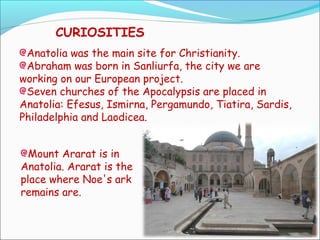
Mount Ararat is in
Anatolia. Ararat is the
place where Noe's ark
remains are.
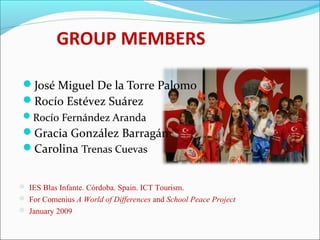
GROUP MEMBERS
José Miguel De la Torre Palomo
Rocío Estévez Suárez
Rocío Fernández Aranda
Gracia González Barragán
Carolina Trenas Cuevas
 IES Blas Infante. Córdoba. Spain. ICT Tourism.
 For Comenius A World of Differences and School Peace Project
 January 2009

Turkey presentation

  • 1.
  • 2.
    LOCATION The Republic ofTurkey is an Eurasian country that stretches across the Anatolian peninsula in western Asia and Thrace in the Balkan region of southeastern Europe. It is bordered by eight countries: Bulgaria to the northwest, Greece to the west, Georgia to the northeast, Armenia, Azerbaijan and Iran to the east, and Iraq and Syria to the southeast. The capital of Turkey is Ankara, but the most populated is Istanbul.
  • 4.
    HISTORY Antiquity The Anatolian peninsula(also called Minor Asia), comprising most of modern Turkey, is one of the oldest continually inhabited regions in the world due to its location at the intersection of Asia and Europe. Göbekli Tepe, the first evidence of man presence in the world. Portion of the legendary walls Troy (VII), identified as the site of the Trojan War
  • 5.
    The Turks andthe Ottoman Empire In the 10th century, the Seljuks started migrating from their ancestral homelands towards the eastern regions of Anatolia, which eventually became the new homeland of Oğuz Turkic tribes following the Battle of Manzikert (Malazgirt) in 1071. Map from Mahmud al-Kashgari's Diwanu Lughat at-Turk, showing the 11th century distribution of Turkic tribes. The Republic Era The occupation of İstanbul and İzmir by the Allies at the end of World War I prompted the establishment of the Turkish national movement. Mustafa Kemal Atatürk, founder and first President of the Republic of Turkey
  • 6.
    LANGUAGE Turkish is thesole official language throughout Turkey.  RELIGION Turkey is officially a secular Republic. The Turkish Constitution provides the freedom of religion and conscience, but does not represent or promote a religion. The population of Turkey is predominantly Muslim (99%), the majority are Sunni (75%) and a large minority are Alevi (15- 25%).The remainder of the population are mainly Christians (mostly Greek Orthodox and Armenian Apostolic) and Jews (96% Sephardi and 4% Ashkenazi). According to a nationwide survey in 2007, 96.8% of Turkish citizens have a religion, while 3.2% are irreligious and atheists. 56% of male Muslim citizens regularly attend Friday prayers. Blue Mosque
  • 7.
    TYPE OF CURRENCY NewTurkish Lira:100 kuruş 1,00 €= 2,107 new Turkish lira CULTURE  MUSIC Turkish folk music has combined the distinct cultural values of all those civilisations which have lived in Anatolia and the Ottoman territories in Europe and Asia.
  • 8.
  • 9.
  • 10.
  • 11.
    Popular figures Nasrettin Hoca Heis a medieval legendary satirical Sufi figure.] Nasreddin was a populist philosopher and wise man, remembered for his funny stories and anecdotes. Much of Nasreddin's actions can be described as illogical yet logical, rational yet irrational, bizarre yet normal, foolish yet sharp, and simple yet profound. What adds even further to his uniqueness is the way he gets across his messages in unconventional yet very effective methods in a profound simplicity.
  • 12.
    Hacivat and Karagöz Traditional Turkish Puppets ShadowPlay. Developed from religious, moral and educational urge to imitate human actions.
  • 13.
    Yunus Emre oneof the most important Turkish poets. He was a Sufi Muslim ascetic of Anatolia. He probably lived in the Karaman area. His poetry expresses a deep personal mysticism and humanism and love for God.
  • 14.
    Köroğlu the hero"son of the blind man", defending his clan against threats from outside. Köroğlu earns his name from the wrongful blinding of his father, an act for which the son takes his revenge and which initiates his series of adventures. He is portrayed as a bandit and a poet. A number of songs and melodies attributed to Köroğlu survives in the folk tradition.
  • 15.
    Important Monuments Interior ofan early Ottoman mosque in Edirne Interior of the Sultanahmet Mosque in Istanbul, Turkey
  • 16.
    Topkapı Palace, Istanbul Traditionalwaterfront houses, called vali, on the Bosporus
  • 17.
    One of themain entrance gates of the Dolmabahçe Palace
  • 18.
    Close up viewof Dolmabahçe Palace from the Bosporus Beylerbeyi Palace from the Bosphorus Center Anatolia
  • 19.
  • 20.
  • 21.
    İskender kebap Itis a kind of döner kebab prepared from thinly cut grilled lamb or beef basted with tomato sauce over pieces of pide bread and generously slathered with melted butter and yogurt. Tomato sauce and boiling butter are sometimes poured over the dish, at the table.
  • 22.
    Manti: Turkish ravioli Dolma Simitis a circular bread with sesame seeds
  • 23.
    SPORT Yagli is aTurkish fight and a national sport. It is commonly known as flight in oil because flighters grease themselves in oil. CURIOSITIES Many names of cities as Philadelphia, Paris, Troy originated in Anatolia. Two of seven marvels of the world were in Anatolia: Artemis's temple in Efesus and the mausoleum in Halicarnasus (Bodrum).
  • 24.
    CURIOSITIES Anatolia was themain site for Christianity. Abraham was born in Sanliurfa, the city we are working on our European project. Seven churches of the Apocalypsis are placed in Anatolia: Efesus, Ismirna, Pergamundo, Tiatira, Sardis, Philadelphia and Laodicea. Mount Ararat is in Anatolia. Ararat is the place where Noe's ark remains are.
  • 25.
    GROUP MEMBERS José MiguelDe la Torre Palomo Rocío Estévez Suárez Rocío Fernández Aranda Gracia González Barragán Carolina Trenas Cuevas  IES Blas Infante. Córdoba. Spain. ICT Tourism.  For Comenius A World of Differences and School Peace Project  January 2009