HORTICULTURE
WATER GARDEN
BY
DEVADHARSHINI .T
II M.Sc BOTANY
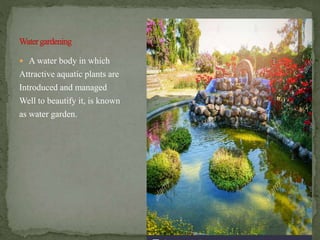
 A water body in which
Attractive aquatic plants are
Introduced and managed
Well to beautify it, is known
as water garden.
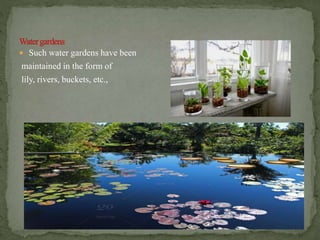
 Such water gardens have been
maintained in the form of
lily, rivers, buckets, etc.,
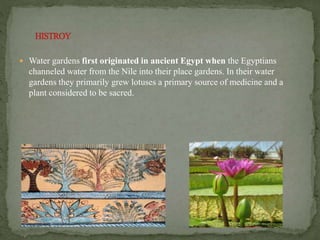
 Water gardens first originated in ancient Egypt when the Egyptians
channeled water from the Nile into their place gardens. In their water
gardens they primarily grew lotuses a primary source of medicine and a
plant considered to be sacred.
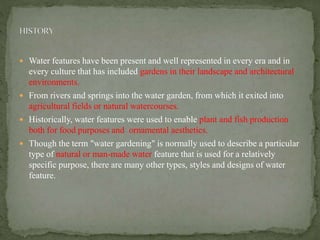
 Water features have been present and well represented in every era and in
every culture that has included gardens in their landscape and architectural
environments.
 From rivers and springs into the water garden, from which it exited into
agricultural fields or natural watercourses.
 Historically, water features were used to enable plant and fish production
both for food purposes and ornamental aesthetics.
 Though the term "water gardening" is normally used to describe a particular
type of natural or man-made water feature that is used for a relatively
specific purpose, there are many other types, styles and designs of water
feature.
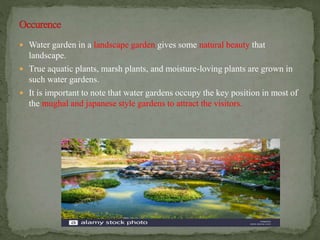
 Water garden in a landscape garden gives some natural beauty that
landscape.
 True aquatic plants, marsh plants, and moisture-loving plants are grown in
such water gardens.
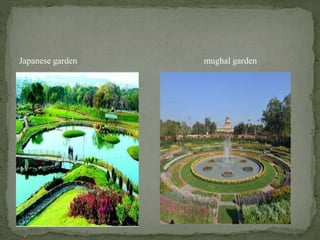
 It is important to note that water gardens occupy the key position in most of
the mughal and japanese style gardens to attract the visitors.
Japanese garden mughal garden
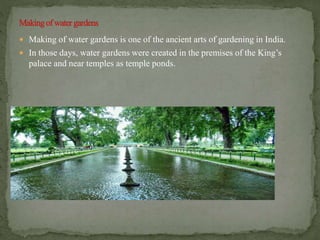
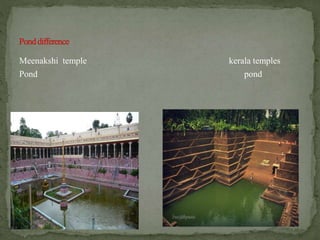
 Making of water gardens is one of the ancient arts of gardening in India.
 In those days, water gardens were created in the premises of the King’s
palace and near temples as temple ponds.
Meenakshi temple kerala temples
Pond pond
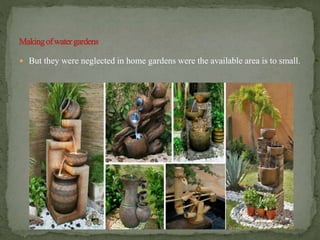
 But they were neglected in home gardens were the available area is to small.
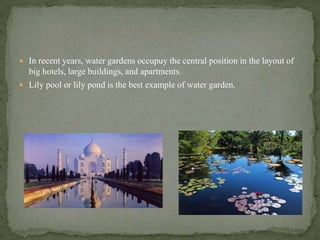
 In recent years, water gardens occupuy the central position in the layout of
big hotels, large buildings, and apartments.
 Lily pool or lily pond is the best example of water garden.
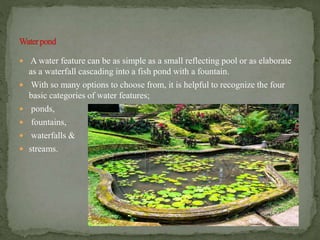
 A water feature can be as simple as a small reflecting pool or as elaborate
as a waterfall cascading into a fish pond with a fountain.
 With so many options to choose from, it is helpful to recognize the four
basic categories of water features;
 ponds,
 fountains,
 waterfalls &
 streams.
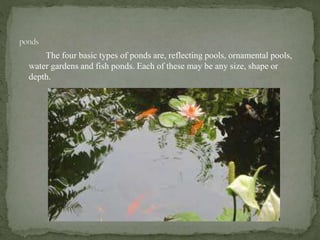
The four basic types of ponds are, reflecting pools, ornamental pools,
water gardens and fish ponds. Each of these may be any size, shape or
depth.
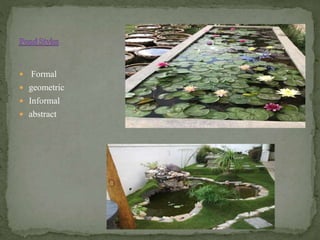
 Formal
 geometric
 Informal
 abstract
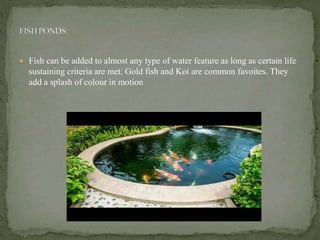
 Fish can be added to almost any type of water feature as long as certain life
sustaining criteria are met. Gold fish and Koi are common favoites. They
add a splash of colour in motion
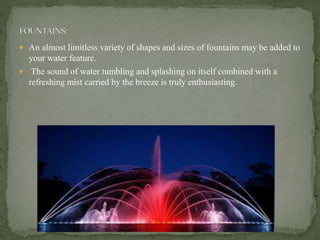
 An almost limitless variety of shapes and sizes of fountains may be added to
your water feature.
 The sound of water tumbling and splashing on itself combined with a
refreshing mist carried by the breeze is truly enthusiasting.
 Like fountains, waterfall
add sound, motion and vitality
to your water feature.
 Often created with natural
stone slabs or boulders, waterfalls
bring vertical dimension.
 Waterfalls capture your interest
from a distance as they dance
and flow.
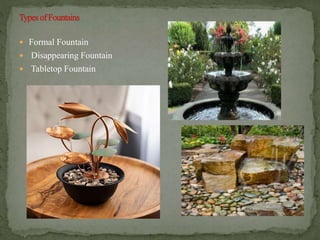
 Formal Fountain
 Disappearing Fountain
 Tabletop Fountain
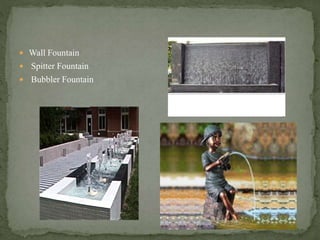
 Wall Fountain
 Spitter Fountain
 Bubbler Fountain
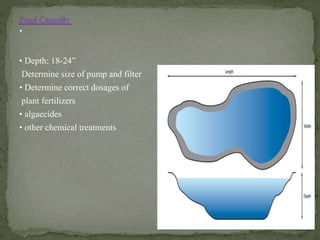
• Depth: 18-24”
Determine size of pump and filter
• Determine correct dosages of
plant fertilizers
• algaecides
• other chemical treatments
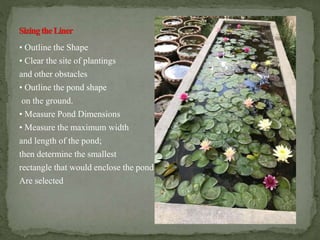
• Outline the Shape
• Clear the site of plantings
and other obstacles
• Outline the pond shape
on the ground.
• Measure Pond Dimensions
• Measure the maximum width
and length of the pond;
then determine the smallest
rectangle that would enclose the pond
Are selected
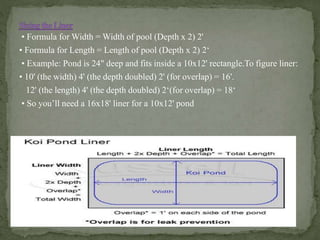
• Formula for Width = Width of pool (Depth x 2) 2'
• Formula for Length = Length of pool (Depth x 2) 2‘
• Example: Pond is 24" deep and fits inside a 10x12' rectangle.To figure liner:
• 10' (the width) 4' (the depth doubled) 2' (for overlap) = 16'.
12' (the length) 4' (the depth doubled) 2‘(for overlap) = 18‘
• So you’ll need a 16x18' liner for a 10x12' pond
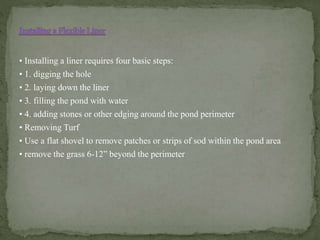
• Installing a liner requires four basic steps:
• 1. digging the hole
• 2. laying down the liner
• 3. filling the pond with water
• 4. adding stones or other edging around the pond perimeter
• Removing Turf
• Use a flat shovel to remove patches or strips of sod within the pond area
• remove the grass 6-12” beyond the perimeter
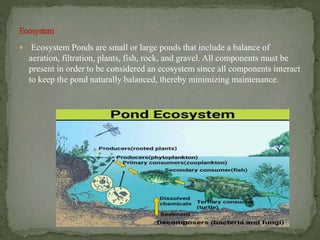
 Ecosystem Ponds are small or large ponds that include a balance of
aeration, filtration, plants, fish, rock, and gravel. All components must be
present in order to be considered an ecosystem since all components interact
to keep the pond naturally balanced, thereby minimizing maintenance.
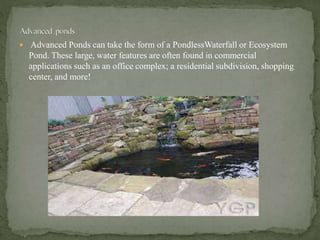
 Advanced Ponds can take the form of a PondlessWaterfall or Ecosystem
Pond. These large, water features are often found in commercial
applications such as an office complex; a residential subdivision, shopping
center, and more!
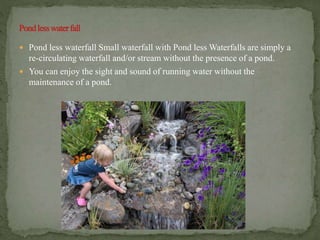
 Pond less waterfall Small waterfall with Pond less Waterfalls are simply a
re-circulating waterfall and/or stream without the presence of a pond.
 You can enjoy the sight and sound of running water without the
maintenance of a pond.
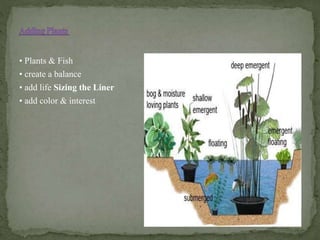
• Plants & Fish
• create a balance
• add life Sizing the Liner
• add color & interest
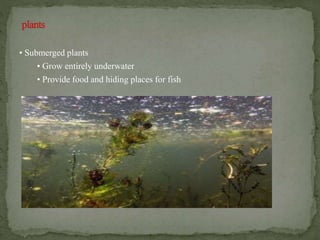
• Submerged plants
• Grow entirely underwater
• Provide food and hiding places for fish
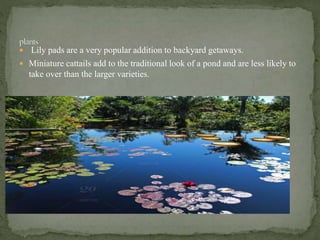
 Lily pads are a very popular addition to backyard getaways.
 Miniature cattails add to the traditional look of a pond and are less likely to
take over than the larger varieties.
• Use to cover pond surface keep water cool
• Limits algae growth
• Require no soil
• Water lilies: Hardy & Tropical
Examples of these are: –
Mosquito ferns (Azolla spp.)
Water-spangle (Salvinia spp.)
Water-clover (Marsilea vestita)
Water Lettuce (Pistia stratiotes)
Water Hyacinth (Eichhornia crassipes)
• Fish
• Control mosquitoes and algae
• Red Comet, Calico Fantail, Japanese koi
• Before adding fish acclimate fish to pool by adding pool water to bag four
times every 15mins
• Don’t feed for first 3-4 day then feed them daily amounts of only what they
can eat in 10-15 mins.
• Snails
• Contribute eat algae
 • Fish are a great addition to any pond. They help control insects and are
soothing to watch.
• Snails
• Place eight small snails in the pond per square yard
• Fish
• Each fish should have six square inches to one square foot of water
• 2" fish: 1 square foot
• 4" fish: 2 square feet
• 6" fish: 3 square feet
• 8" fish: 4 square feet
• 12" fish: 6 square feet
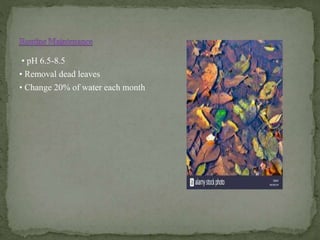
• pH 6.5-8.5
• Removal dead leaves
• Change 20% of water each month
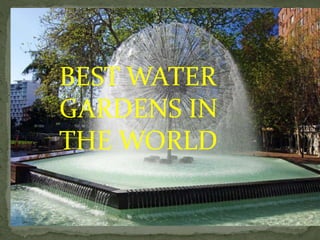
BEST WATER
GARDENS IN
THE WORLD
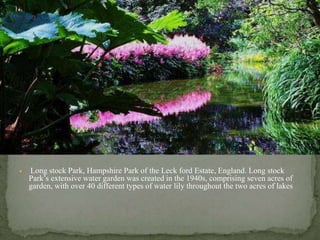
 Long stock Park, Hampshire Park of the Leck ford Estate, England. Long stock
Park’s extensive water garden was created in the 1940s, comprising seven acres of
garden, with over 40 different types of water lily throughout the two acres of lakes
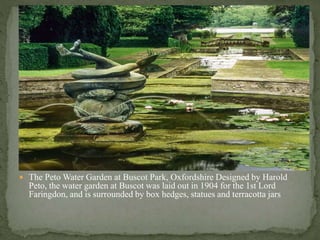
 The Peto Water Garden at Buscot Park, Oxfordshire Designed by Harold
Peto, the water garden at Buscot was laid out in 1904 for the 1st Lord
Faringdon, and is surrounded by box hedges, statues and terracotta jars
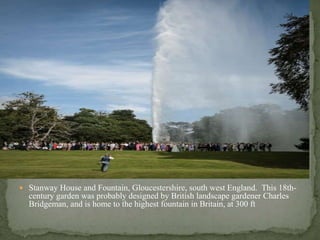
 Stanway House and Fountain, Gloucestershire, south west England. This 18th-
century garden was probably designed by British landscape gardener Charles
Bridgeman, and is home to the highest fountain in Britain, at 300 ft
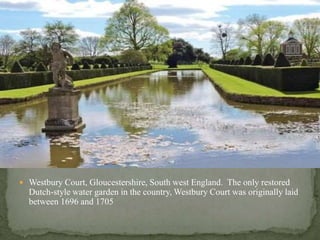
 Westbury Court, Gloucestershire, South west England. The only restored
Dutch-style water garden in the country, Westbury Court was originally laid
between 1696 and 1705
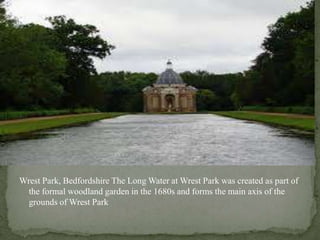
Wrest Park, Bedfordshire The Long Water at Wrest Park was created as part of
the formal woodland garden in the 1680s and forms the main axis of the
grounds of Wrest Park

HORTICULTURE Water garden.pptx

  • 1.
  • 2.
     A waterbody in which Attractive aquatic plants are Introduced and managed Well to beautify it, is known as water garden.
  • 3.
     Such watergardens have been maintained in the form of lily, rivers, buckets, etc.,
  • 4.
     Water gardensfirst originated in ancient Egypt when the Egyptians channeled water from the Nile into their place gardens. In their water gardens they primarily grew lotuses a primary source of medicine and a plant considered to be sacred.
  • 5.
     Water featureshave been present and well represented in every era and in every culture that has included gardens in their landscape and architectural environments.  From rivers and springs into the water garden, from which it exited into agricultural fields or natural watercourses.  Historically, water features were used to enable plant and fish production both for food purposes and ornamental aesthetics.  Though the term "water gardening" is normally used to describe a particular type of natural or man-made water feature that is used for a relatively specific purpose, there are many other types, styles and designs of water feature.
  • 6.
     Water gardenin a landscape garden gives some natural beauty that landscape.  True aquatic plants, marsh plants, and moisture-loving plants are grown in such water gardens.  It is important to note that water gardens occupy the key position in most of the mughal and japanese style gardens to attract the visitors.
  • 7.
  • 8.
     Making ofwater gardens is one of the ancient arts of gardening in India.  In those days, water gardens were created in the premises of the King’s palace and near temples as temple ponds.
  • 9.
    Meenakshi temple keralatemples Pond pond
  • 10.
     But theywere neglected in home gardens were the available area is to small.
  • 11.
     In recentyears, water gardens occupuy the central position in the layout of big hotels, large buildings, and apartments.  Lily pool or lily pond is the best example of water garden.
  • 12.
     A waterfeature can be as simple as a small reflecting pool or as elaborate as a waterfall cascading into a fish pond with a fountain.  With so many options to choose from, it is helpful to recognize the four basic categories of water features;  ponds,  fountains,  waterfalls &  streams.
  • 13.
    The four basictypes of ponds are, reflecting pools, ornamental pools, water gardens and fish ponds. Each of these may be any size, shape or depth.
  • 14.
     Formal  geometric Informal  abstract
  • 15.
     Fish canbe added to almost any type of water feature as long as certain life sustaining criteria are met. Gold fish and Koi are common favoites. They add a splash of colour in motion
  • 16.
     An almostlimitless variety of shapes and sizes of fountains may be added to your water feature.  The sound of water tumbling and splashing on itself combined with a refreshing mist carried by the breeze is truly enthusiasting.
  • 17.
     Like fountains,waterfall add sound, motion and vitality to your water feature.  Often created with natural stone slabs or boulders, waterfalls bring vertical dimension.  Waterfalls capture your interest from a distance as they dance and flow.
  • 18.
     Formal Fountain Disappearing Fountain  Tabletop Fountain
  • 19.
     Wall Fountain Spitter Fountain  Bubbler Fountain
  • 20.
    • Depth: 18-24” Determinesize of pump and filter • Determine correct dosages of plant fertilizers • algaecides • other chemical treatments
  • 21.
    • Outline theShape • Clear the site of plantings and other obstacles • Outline the pond shape on the ground. • Measure Pond Dimensions • Measure the maximum width and length of the pond; then determine the smallest rectangle that would enclose the pond Are selected
  • 22.
    • Formula forWidth = Width of pool (Depth x 2) 2' • Formula for Length = Length of pool (Depth x 2) 2‘ • Example: Pond is 24" deep and fits inside a 10x12' rectangle.To figure liner: • 10' (the width) 4' (the depth doubled) 2' (for overlap) = 16'. 12' (the length) 4' (the depth doubled) 2‘(for overlap) = 18‘ • So you’ll need a 16x18' liner for a 10x12' pond
  • 23.
    • Installing aliner requires four basic steps: • 1. digging the hole • 2. laying down the liner • 3. filling the pond with water • 4. adding stones or other edging around the pond perimeter • Removing Turf • Use a flat shovel to remove patches or strips of sod within the pond area • remove the grass 6-12” beyond the perimeter
  • 24.
     Ecosystem Pondsare small or large ponds that include a balance of aeration, filtration, plants, fish, rock, and gravel. All components must be present in order to be considered an ecosystem since all components interact to keep the pond naturally balanced, thereby minimizing maintenance.
  • 25.
     Advanced Pondscan take the form of a PondlessWaterfall or Ecosystem Pond. These large, water features are often found in commercial applications such as an office complex; a residential subdivision, shopping center, and more!
  • 26.
     Pond lesswaterfall Small waterfall with Pond less Waterfalls are simply a re-circulating waterfall and/or stream without the presence of a pond.  You can enjoy the sight and sound of running water without the maintenance of a pond.
  • 27.
    • Plants &Fish • create a balance • add life Sizing the Liner • add color & interest
  • 28.
    • Submerged plants •Grow entirely underwater • Provide food and hiding places for fish
  • 29.
     Lily padsare a very popular addition to backyard getaways.  Miniature cattails add to the traditional look of a pond and are less likely to take over than the larger varieties.
  • 30.
    • Use tocover pond surface keep water cool • Limits algae growth • Require no soil • Water lilies: Hardy & Tropical Examples of these are: – Mosquito ferns (Azolla spp.) Water-spangle (Salvinia spp.) Water-clover (Marsilea vestita) Water Lettuce (Pistia stratiotes) Water Hyacinth (Eichhornia crassipes)
  • 31.
    • Fish • Controlmosquitoes and algae • Red Comet, Calico Fantail, Japanese koi • Before adding fish acclimate fish to pool by adding pool water to bag four times every 15mins • Don’t feed for first 3-4 day then feed them daily amounts of only what they can eat in 10-15 mins. • Snails • Contribute eat algae
  • 32.
     • Fishare a great addition to any pond. They help control insects and are soothing to watch.
  • 33.
    • Snails • Placeeight small snails in the pond per square yard • Fish • Each fish should have six square inches to one square foot of water • 2" fish: 1 square foot • 4" fish: 2 square feet • 6" fish: 3 square feet • 8" fish: 4 square feet • 12" fish: 6 square feet
  • 34.
    • pH 6.5-8.5 •Removal dead leaves • Change 20% of water each month
  • 35.
  • 36.
     Long stockPark, Hampshire Park of the Leck ford Estate, England. Long stock Park’s extensive water garden was created in the 1940s, comprising seven acres of garden, with over 40 different types of water lily throughout the two acres of lakes
  • 37.
     The PetoWater Garden at Buscot Park, Oxfordshire Designed by Harold Peto, the water garden at Buscot was laid out in 1904 for the 1st Lord Faringdon, and is surrounded by box hedges, statues and terracotta jars
  • 38.
     Stanway Houseand Fountain, Gloucestershire, south west England. This 18th- century garden was probably designed by British landscape gardener Charles Bridgeman, and is home to the highest fountain in Britain, at 300 ft
  • 39.
     Westbury Court,Gloucestershire, South west England. The only restored Dutch-style water garden in the country, Westbury Court was originally laid between 1696 and 1705
  • 40.
    Wrest Park, BedfordshireThe Long Water at Wrest Park was created as part of the formal woodland garden in the 1680s and forms the main axis of the grounds of Wrest Park