TUNED LIQUID
DAMPERS
LATERAL LOAD RESISTANCE
 structural modifications
 aerodynamic modifications
 base isolation techniques
 damping sources
STRUCTURAL
MODIFICATIONS
Outrigger system Belt bandage system
AERODYNAMIC
MODIFICATIONS
Fins Chamfered corners
BASE ISOLATION
Elastomeric bearings Sliding bearings
DAMPING SOURCES
 structural
 aerodynamic
 soil
 auxiliary
WHY AUXILIARY SOURCES?
 very less contribution of other sources
 difficulty in estimation
 adverse effects
 predictable & reliable
AUXILIARY SOURCES
 active
 passive
tuned liquid dampers
 semi active
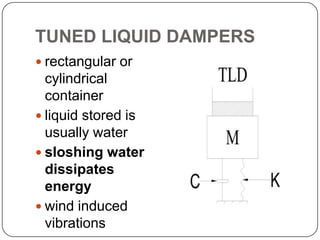
TUNED LIQUID DAMPERS
 rectangular or
cylindrical
container
 liquid stored is
usually water
 sloshing water
dissipates
energy
 wind induced
vibrations
TUNING
 tuned to the natural frequency of the
structure
 achieved by adjusting the dimensions
 frequency equation
EFFICIENCY
 amplitude dependent
 placing on top floor
 floater beads
 torsion springs
 screens and baffles
ADVANTAGES
 low installation cost
 no moving parts
 low operation and maintenance cost
 frequency can be controlled by adjusting
height
 resistance against wind & earthquake
 temporary use
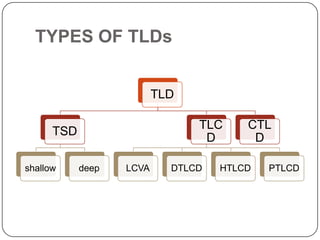
TYPES OF TLDs
TLD
TSD
shallow deep
TLC
D
LCVA DTLCD HTLCD PTLCD
CTL
D
TUNED SLOSHING DAMPERS
 single or a group of liquid stored
containers
 shallow and deep
 based on the ratio of depth of water to
that of the length in direction of vibration
 diameter in case of circular tanks
 < 0.15 shallow
 > 0.15 deep
TSDs (contd:)
 shallow TSDs has larger amplitude of
sloshing
 better damping at smaller vibrations
 non linear behavior at large scale
vibrations
 deep TSDs linear behavior even under
larger excitations
 water can be used for fire fighting and
emergency supply
APPLICATION
TSD unit Shin Yokohama Prince Hotel
TUNED LIQUID COLUMN
DAMPERS
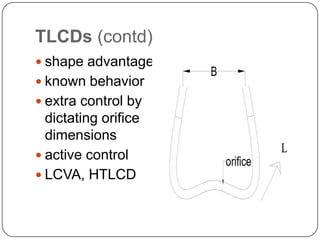
 liquid stored in interconnected tubes
 an orifice provided in between
 motion of liquid mass in the tube
 pressure drop due to orifice
 unidirectional nature
 double TLCD
TLCDs (contd)
 shape advantage
 known behavior
 extra control by
dictating orifice
dimensions
 active control
 LCVA, HTLCD
APPLICATION
Cross section One Wall Center
CONTROLLABLE TLDs
CONCLUSIONS
 Effective against both wind and
earthquake
 TSDs suited for small scale excitations
 TLCDs are much more advantageous
 Control can be exercised for further
efficiency, but costly.

Tuned Liquid Dampers