Comprehensive Geriatric
Assessment: Physiotherapy
perspective
Shyam Krishnan K
Assistant Professor Sr. Scale
Dept. Physiotherapy
KMC Mangaluru
Background
 By the year 2050:
20% of the population will be older than 65 years
850,000 people will be centenarians
 In the 4,500 years from the Bronze Age to the year 1900, life
expectancy increased 27 years
 In the next 90 years, from 1900-1990, life expectancy also
increased 27 years
 Of all human who have EVER lived to be 65 or older, half are
currently alive
The necessity
 Advancement at all levels of health care delivery → increased life
expectancy → adding of years to life not necessarily life to years
 Self reported epidemiological data of older people show, over half of the
advanced years of life is lived with some disability
↓
Often associated with identified medical condition
 Many individual diseases produce similar outcomes in terms of functional
limitations and QOL
 Many elderly anyways lose functional abilities without there being a clear
cut single diagnosis to explain it
Causations
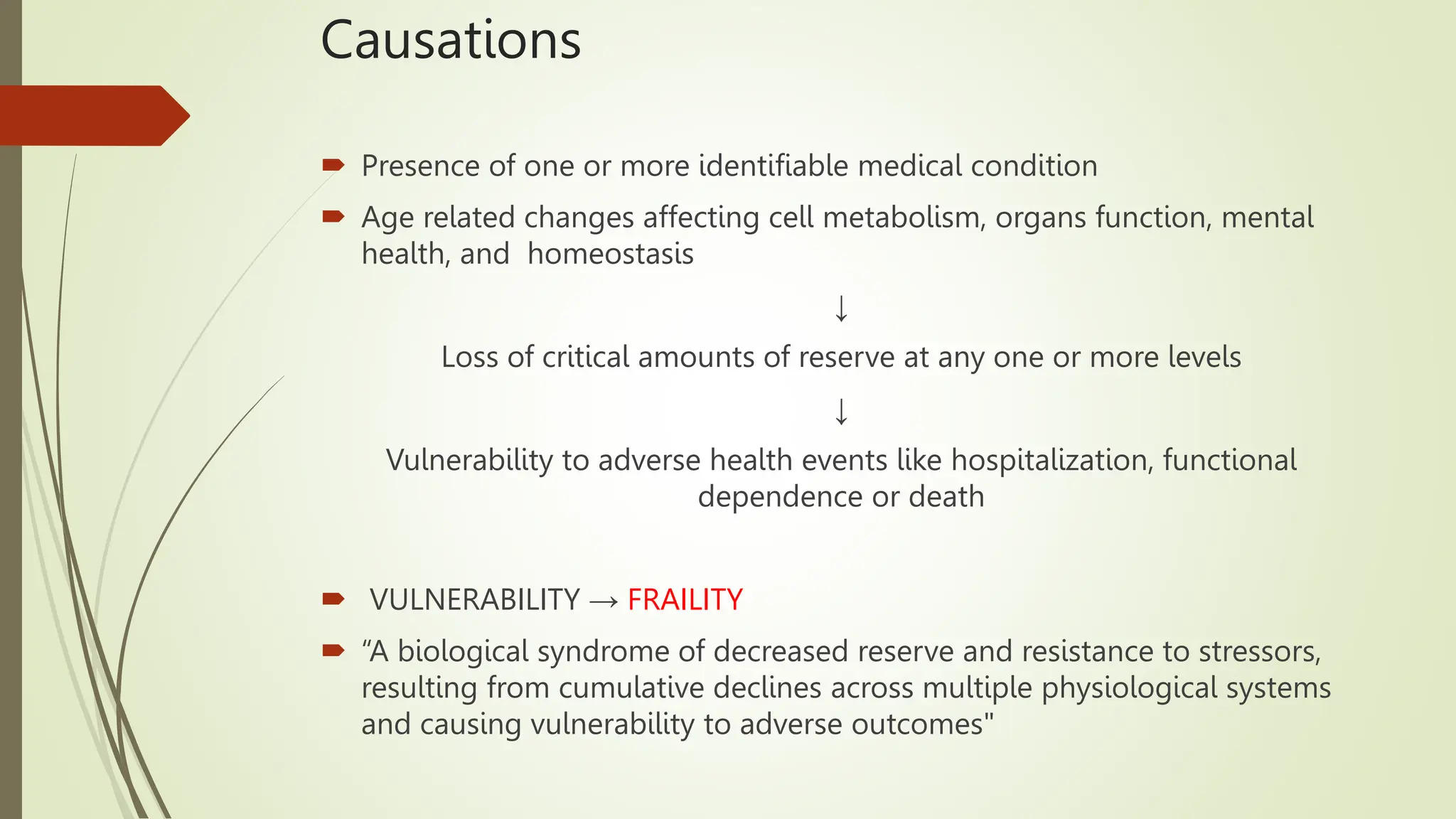
 Presence of one or more identifiable medical condition
 Age related changes affecting cell metabolism, organs function, mental
health, and homeostasis
↓
Loss of critical amounts of reserve at any one or more levels
↓
Vulnerability to adverse health events like hospitalization, functional
dependence or death
 VULNERABILITY → FRAILITY
 “A biological syndrome of decreased reserve and resistance to stressors,
resulting from cumulative declines across multiple physiological systems
and causing vulnerability to adverse outcomes"
How to identify?
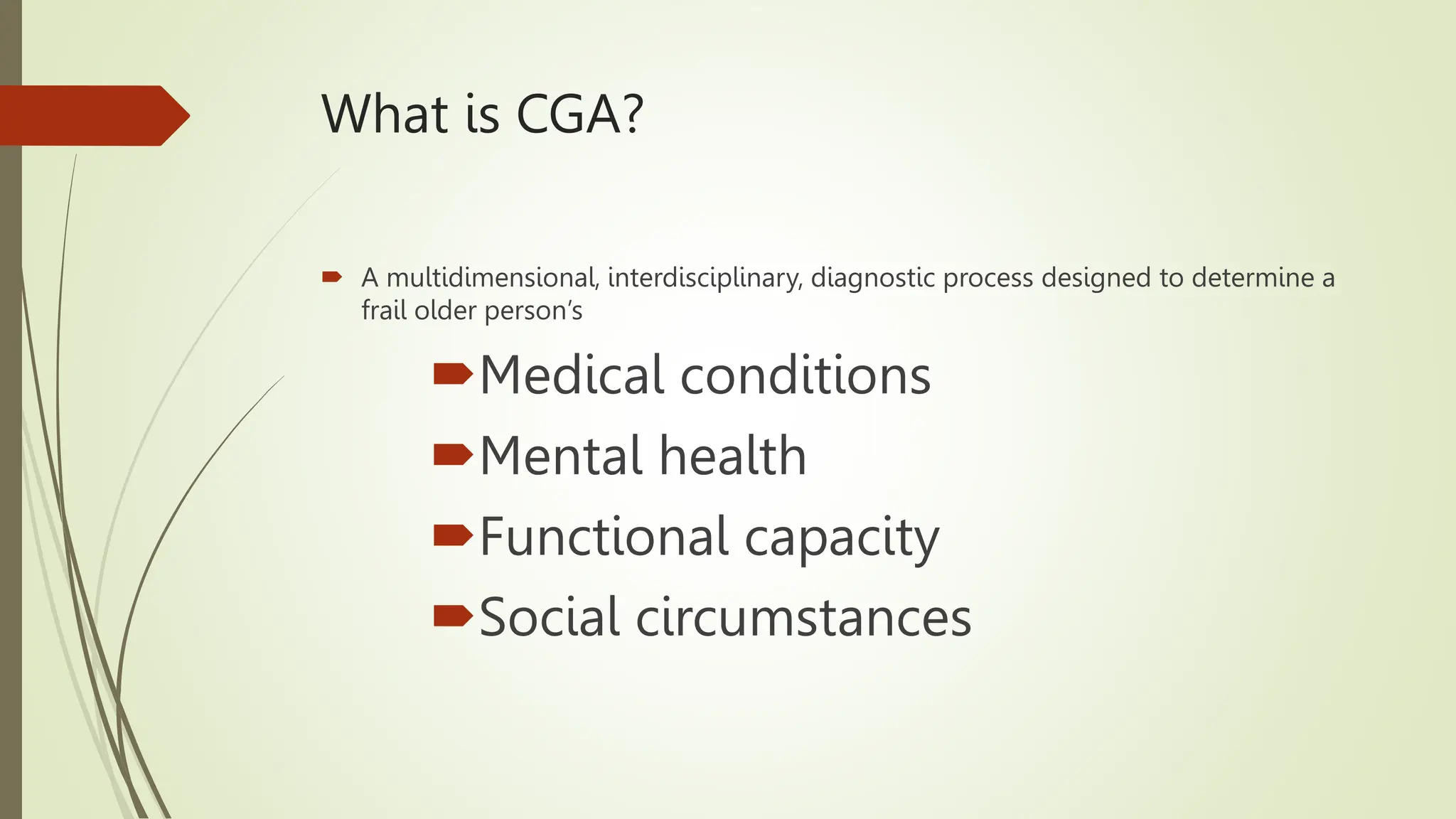
What is CGA?
 A multidimensional, interdisciplinary, diagnostic process designed to determine a
frail older person’s
Medical conditions
Mental health
Functional capacity
Social circumstances
Purpose
Planning and carrying out a holistic treatment
plan
Rehabilitation
Support
Long-term follow up
Core principles
Older person is central to the process
Their capacity to participate voluntarily must be
assessed, and if lacking, their needs be addressed in
an ethical fashion
Good link between social and healthcare , for CGA to
be delivered in an efficient and timely manner
Assessment should be standardized and carried out
to a reliable standard
Circumstances
Acute illness → functional limitation
Transfer for care → rehab/re-enablement
A frail patient prior to surgery, or experiencing two or
more “geriatric syndromes” of falls, delirium,
incontinence or immobility
The team
Dimensions of CGA
Elements
Purpose
Highest priority:
• Prevention of decline in the independent performance of
ADLs
• Drives the diagnostic process and clinical decision making
Screen for preventable diseases
Screen for functional impairments that may
result in physical disability and amenable to
intervention
Relevance of PT
 The extensive knowledge of causation and outcomes of
movement dysfunctions and frailty
 Tools for evaluating , planning, and executing corrective
interventions for disabling conditions
 Role in prevention
 Cost effectiveness when actively involved in health care
delivery.
The domains
Physiotherapy perspective
 Who needs??
Functional
assessment
Way of determining health
needs now and in the
future
Assessments of patients
with frailty should occur
after every illness or injury
to establish the effect the
episode had on the
patient’s functional ability
Functional
assessments should
be done on every
patient over 75 years
old
Elements
• ADL/IADL
• Gait
• Balance
• Physical activity/exercise
status
Functional
assessment
 Subjective
Usual scheme
Additional data regarding
Any thing changed recently (vision,
hearing, mobility, medications etc.)
Fall risk assessment tool questions (FRAT)
Dietary intake/ changes
Dependence/Independence in ADL/IADL
Functional assessment
 Objective
Observation
Posture
Appearance/body shape
Skin Changes
specifics
Relevant
palpation
Functional
assessment
 Gait
SPEED: Assessed using a
standardized test like 10 m walk
test/TUG
ENDURANCE: 6 min walk test
ANLAYSIS: Spatial-Temporal
parameters
A gait speed less
than 0.8 m/s
indicates frailty
Functional assessment
 Balance
 75% of People over 70 have balance issue
 Standardized assessment tools like Berg Balance Scale and the Tinneti Balance
and Gait Assessment
 Shorter/less time consuming, TUG, Single leg stance, FRT
Falls
An environmental evaluation as well is necessary for the multifactorial
intervention for fall prevention
Functional
assessment
Barthel index for
ADL
KATZ index for ADL
Lawton-Brody IADL
scale
Functional assessment
 Other routine objective evaluations
Muscle strength → Grip strength
ROM
Miscellaneous like Reaction time
Functional
assessment
Outcome Measures (OM) Description of OM Psychometric properties
Frail elderly functional
assessment
Examines functional
ability in the frail
Nineteen point
questionnaire
• Valid
• Reliable
• Sensitive to change
10 Metre Walk Test 10 Metre Walk Test  Excellent test-retest
reliability and high
concurrent validity
when compared to
the shorter 4 metre
walk test
The Barthel Index The Barthel Index
It measures the patient's
ability to look after
themselves by asking 10
questions and answers
that are graded on the
amount of assistance
required
 The interrater
reliability of this
outcome is fair to
good depending on
which activity is being
assessed
Functional
assessment
Outcome measure Description Psychometric properties
The Edmonton Frail Scale 12 questions related to cognition,
general health status, mobility,
social status, medication use,
nutrition, mood, continence and
functional performance. It has a
total score of 17 which depicts
severe frailty. It is a very brief way
of assessing for frailty and can be
used to see whether a CGA
should take place
 Good inter-rater reliability
 Takes less than 5 mins to
complete
 Good construct validity
 Acceptable internal
consistency
PRISMA7 A questionnaire devised of
seven yes or no questions that
can be used when the patient
is unable to carry out a Stand
Up and Go or a 10 Metre Walk
Test. It was developed with a
service in Canadian
healthcare, to integrate frailty
assessment and management
and allow for increase patient-
centred care
 Using this approach can
reduce hospitalization and
is an encouraged
approach across systems
 Recommended by the
BGS and can indicate
frailty
Functional
assessment
Outcome measures Description Psychometric properties
Tinetti Balance and Gait
Assessment
The Tinetti is a 17 item
OM used to assess gait
and balance
 70% sensitivity score
(good predictor of
falls risk)
 Excellent test-retest
and intrarater
reliability
Elderly Mobility Scale Assesses mobility in the
frail by completing 20
components
 Good concurrent
validity
 Good discriminant
validity
 Good inter-rater
reliability
General relevant
evaluation/assessment
(medical domain)
 Subjective and Objective
assessment of Musculo-skeletal,
Neurological, Cardiopulmonary
systems
 Medication review
 Identifying polypharmacy
 Screening for Adverse Drug
Reactions
 Relating symptoms/clinical findings
to polypharmacy
 Screening for pressure ulcer
 Screening for incontinence
General relevant
evaluation/assessment
(medical domain)
Poly pharmacy screening
General relevant
evaluation/assessment
(medical domain)
Pressure ulcer risk
General relevant
evaluation/assessment
(medical domain
 Incontinence
 Frequency volume chart
 Urogenital Distress inventory
(UDI)
General relevant evaluation/assessment
(medical domain)
Incontinence Impact Questionnaire- Short form (IIQ-7)
General relevant
evaluation/assessment
(medical domain)
Nutrition screening
Mental
Health
Cognitive screening
Folstein MMSE
The Short Portable Mini Mental
Status Questionnaire (SPMMSQ)
The Clock Drawing test
Mental Health
Cognitive
Mental health
Cognitive
Mental health
Clock Drawing test
Mental health
Clock
drawing
test
Mental health
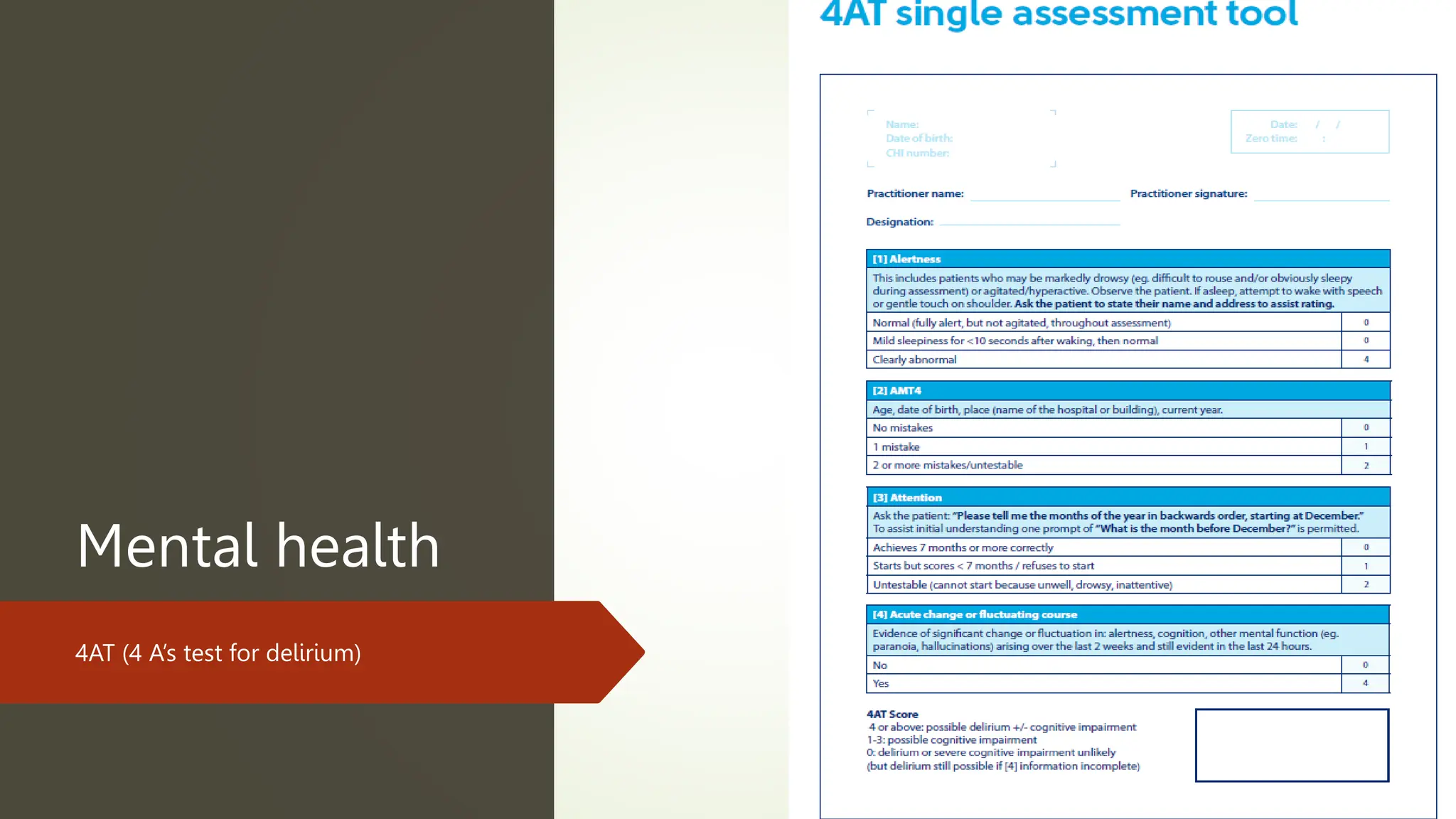
4AT (4 A’s test for delirium)
Mental Health
4AT
Mental health
Depression screening
Social and
environmental
domains
Social
Social support
questionnaire
27 items designed
to measure
perceptions of
social support
Interpersonal
Support Evaluation
List (ISEL)
40 items scale with
four subscales
Tangible support
Belonging support
Self esteem support
Appraisal support
Social and
environmental
domains
Social history
Having the patient describe typical day
Frequency and nature of social contacts
Driving and availability of transportation
facilities
Caregivers and support systems
Ability of family members to help the
patient
Environmental
evaluation
Environmental evaluation
 HSSAT (Home Safety Self Assessment
Tool)
Environmental
evaluation
 Home Hazard checklist
THANK YOU

Comprehensive Geriatric Assessment (1).pptx

  • 1.
    Comprehensive Geriatric Assessment: Physiotherapy perspective ShyamKrishnan K Assistant Professor Sr. Scale Dept. Physiotherapy KMC Mangaluru
  • 2.
    Background  By theyear 2050: 20% of the population will be older than 65 years 850,000 people will be centenarians  In the 4,500 years from the Bronze Age to the year 1900, life expectancy increased 27 years  In the next 90 years, from 1900-1990, life expectancy also increased 27 years  Of all human who have EVER lived to be 65 or older, half are currently alive
  • 3.
    The necessity  Advancementat all levels of health care delivery → increased life expectancy → adding of years to life not necessarily life to years  Self reported epidemiological data of older people show, over half of the advanced years of life is lived with some disability ↓ Often associated with identified medical condition  Many individual diseases produce similar outcomes in terms of functional limitations and QOL  Many elderly anyways lose functional abilities without there being a clear cut single diagnosis to explain it
  • 4.
    Causations  Presence ofone or more identifiable medical condition  Age related changes affecting cell metabolism, organs function, mental health, and homeostasis ↓ Loss of critical amounts of reserve at any one or more levels ↓ Vulnerability to adverse health events like hospitalization, functional dependence or death  VULNERABILITY → FRAILITY  “A biological syndrome of decreased reserve and resistance to stressors, resulting from cumulative declines across multiple physiological systems and causing vulnerability to adverse outcomes"
  • 6.
  • 7.
    What is CGA? A multidimensional, interdisciplinary, diagnostic process designed to determine a frail older person’s Medical conditions Mental health Functional capacity Social circumstances
  • 8.
    Purpose Planning and carryingout a holistic treatment plan Rehabilitation Support Long-term follow up
  • 9.
    Core principles Older personis central to the process Their capacity to participate voluntarily must be assessed, and if lacking, their needs be addressed in an ethical fashion Good link between social and healthcare , for CGA to be delivered in an efficient and timely manner Assessment should be standardized and carried out to a reliable standard
  • 10.
    Circumstances Acute illness →functional limitation Transfer for care → rehab/re-enablement A frail patient prior to surgery, or experiencing two or more “geriatric syndromes” of falls, delirium, incontinence or immobility
  • 11.
  • 12.
  • 13.
  • 14.
    Purpose Highest priority: • Preventionof decline in the independent performance of ADLs • Drives the diagnostic process and clinical decision making Screen for preventable diseases Screen for functional impairments that may result in physical disability and amenable to intervention
  • 15.
    Relevance of PT The extensive knowledge of causation and outcomes of movement dysfunctions and frailty  Tools for evaluating , planning, and executing corrective interventions for disabling conditions  Role in prevention  Cost effectiveness when actively involved in health care delivery.
  • 16.
  • 17.
  • 18.
    Functional assessment Way of determininghealth needs now and in the future Assessments of patients with frailty should occur after every illness or injury to establish the effect the episode had on the patient’s functional ability Functional assessments should be done on every patient over 75 years old Elements • ADL/IADL • Gait • Balance • Physical activity/exercise status
  • 19.
    Functional assessment  Subjective Usual scheme Additionaldata regarding Any thing changed recently (vision, hearing, mobility, medications etc.) Fall risk assessment tool questions (FRAT) Dietary intake/ changes Dependence/Independence in ADL/IADL
  • 20.
    Functional assessment  Objective Observation Posture Appearance/bodyshape Skin Changes specifics Relevant palpation
  • 21.
    Functional assessment  Gait SPEED: Assessedusing a standardized test like 10 m walk test/TUG ENDURANCE: 6 min walk test ANLAYSIS: Spatial-Temporal parameters A gait speed less than 0.8 m/s indicates frailty
  • 22.
    Functional assessment  Balance 75% of People over 70 have balance issue  Standardized assessment tools like Berg Balance Scale and the Tinneti Balance and Gait Assessment  Shorter/less time consuming, TUG, Single leg stance, FRT Falls An environmental evaluation as well is necessary for the multifactorial intervention for fall prevention
  • 23.
    Functional assessment Barthel index for ADL KATZindex for ADL Lawton-Brody IADL scale
  • 24.
    Functional assessment  Otherroutine objective evaluations Muscle strength → Grip strength ROM Miscellaneous like Reaction time
  • 25.
    Functional assessment Outcome Measures (OM)Description of OM Psychometric properties Frail elderly functional assessment Examines functional ability in the frail Nineteen point questionnaire • Valid • Reliable • Sensitive to change 10 Metre Walk Test 10 Metre Walk Test  Excellent test-retest reliability and high concurrent validity when compared to the shorter 4 metre walk test The Barthel Index The Barthel Index It measures the patient's ability to look after themselves by asking 10 questions and answers that are graded on the amount of assistance required  The interrater reliability of this outcome is fair to good depending on which activity is being assessed
  • 26.
    Functional assessment Outcome measure DescriptionPsychometric properties The Edmonton Frail Scale 12 questions related to cognition, general health status, mobility, social status, medication use, nutrition, mood, continence and functional performance. It has a total score of 17 which depicts severe frailty. It is a very brief way of assessing for frailty and can be used to see whether a CGA should take place  Good inter-rater reliability  Takes less than 5 mins to complete  Good construct validity  Acceptable internal consistency PRISMA7 A questionnaire devised of seven yes or no questions that can be used when the patient is unable to carry out a Stand Up and Go or a 10 Metre Walk Test. It was developed with a service in Canadian healthcare, to integrate frailty assessment and management and allow for increase patient- centred care  Using this approach can reduce hospitalization and is an encouraged approach across systems  Recommended by the BGS and can indicate frailty
  • 27.
    Functional assessment Outcome measures DescriptionPsychometric properties Tinetti Balance and Gait Assessment The Tinetti is a 17 item OM used to assess gait and balance  70% sensitivity score (good predictor of falls risk)  Excellent test-retest and intrarater reliability Elderly Mobility Scale Assesses mobility in the frail by completing 20 components  Good concurrent validity  Good discriminant validity  Good inter-rater reliability
  • 28.
    General relevant evaluation/assessment (medical domain) Subjective and Objective assessment of Musculo-skeletal, Neurological, Cardiopulmonary systems  Medication review  Identifying polypharmacy  Screening for Adverse Drug Reactions  Relating symptoms/clinical findings to polypharmacy  Screening for pressure ulcer  Screening for incontinence
  • 29.
  • 30.
  • 31.
    General relevant evaluation/assessment (medical domain Incontinence  Frequency volume chart  Urogenital Distress inventory (UDI)
  • 32.
    General relevant evaluation/assessment (medicaldomain) Incontinence Impact Questionnaire- Short form (IIQ-7)
  • 33.
  • 34.
    Mental Health Cognitive screening Folstein MMSE TheShort Portable Mini Mental Status Questionnaire (SPMMSQ) The Clock Drawing test
  • 35.
  • 36.
  • 37.
  • 38.
  • 39.
    Mental health 4AT (4A’s test for delirium)
  • 40.
  • 41.
  • 42.
    Social and environmental domains Social Social support questionnaire 27items designed to measure perceptions of social support Interpersonal Support Evaluation List (ISEL) 40 items scale with four subscales Tangible support Belonging support Self esteem support Appraisal support
  • 43.
    Social and environmental domains Social history Havingthe patient describe typical day Frequency and nature of social contacts Driving and availability of transportation facilities Caregivers and support systems Ability of family members to help the patient
  • 44.
  • 45.
    Environmental evaluation  HSSAT(Home Safety Self Assessment Tool)
  • 46.
  • 48.