Cultural Leadership
& Predictors of CSR
Waldman et. Al 2006
Introduction
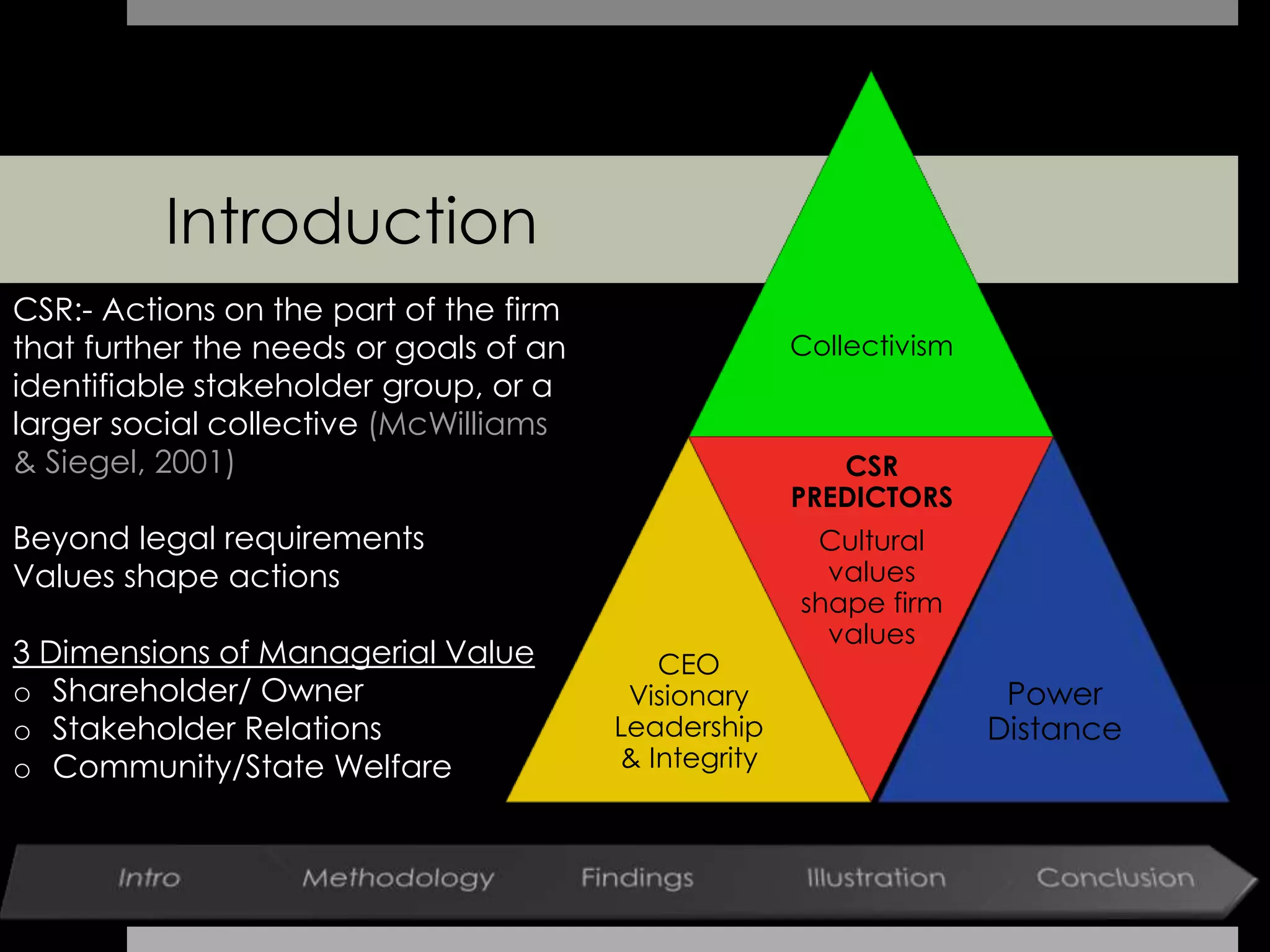
Collectivism
CEO
Visionary
Leadership
& Integrity
CSR
PREDICTORS
Cultural
values
shape firm
values
Power
Distance
CSR:- Actions on the part of the firm
that further the needs or goals of an
identifiable stakeholder group, or a
larger social collective (McWilliams
& Siegel, 2001)
Beyond legal requirements
Values shape actions
3 Dimensions of Managerial Value
o Shareholder/ Owner
o Stakeholder Relations
o Community/State Welfare
Methodology
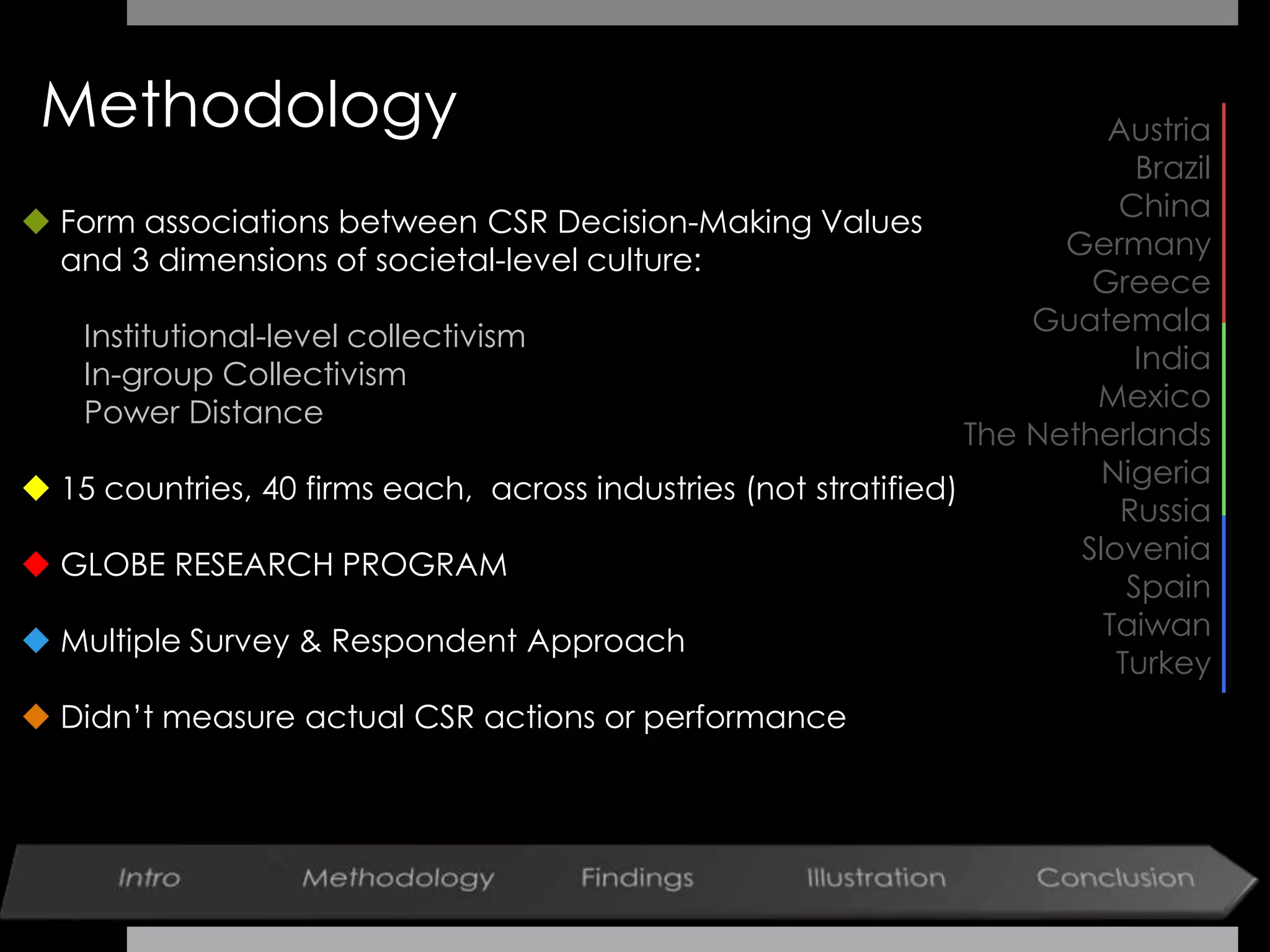
 Form associations between CSR Decision-Making Values
and 3 dimensions of societal-level culture:
Institutional-level collectivism
In-group Collectivism
Power Distance
 15 countries, 40 firms each, across industries (not stratified)
 GLOBE RESEARCH PROGRAM
 Multiple Survey & Respondent Approach
 Didn’t measure actual CSR actions or performance
Austria
Brazil
China
Germany
Greece
Guatemala
India
Mexico
The Netherlands
Nigeria
Russia
Slovenia
Spain
Taiwan
Turkey
Findings
2. CSR IS A MULTI-DIMENSIONAL CONSTRUCT
Consisting of concern for:
shareholders, stakeholders & community.
Each predicted differently by variables.
Previously there was a lack of clarity about dimensionality & depth
Findings
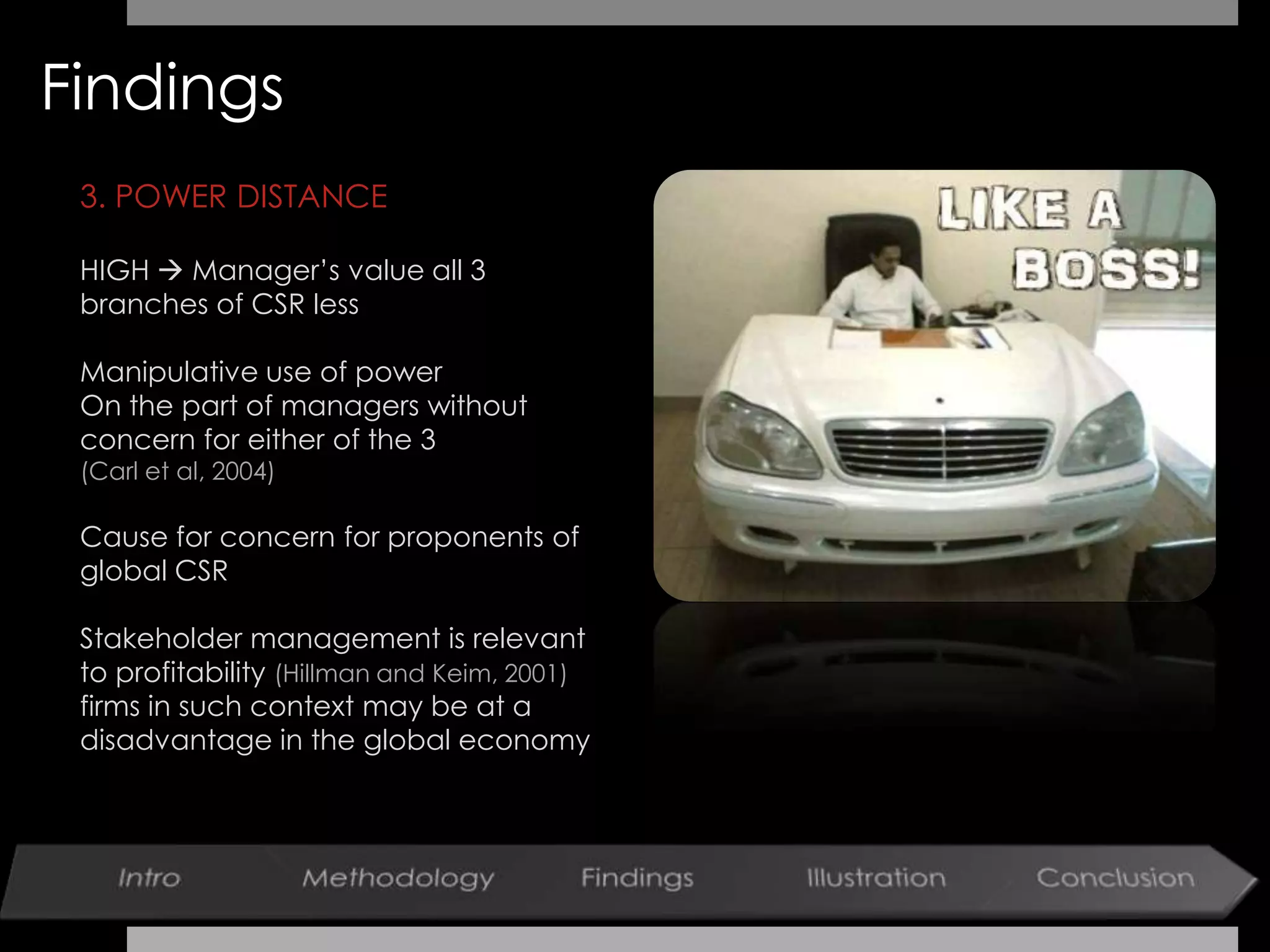
3. POWER DISTANCE
HIGH  Manager’s value all 3
branches of CSR less
Manipulative use of power
On the part of managers without
concern for either of the 3
(Carl et al, 2004)
Cause for concern for proponents of
global CSR
Stakeholder management is relevant
to profitability (Hillman and Keim, 2001)
firms in such context may be at a
disadvantage in the global economy
Findings
5. ORGANISATIONAL LEVEL
VARIABLES
VISIONARY LEADERSHIP & INTEGRITY
Can account for variables in managerial
values with regard to CSR
May be a driver of how subordinate
managers view CSR
More related to Shareholder and
Stakeholder CSR
CONCLUSION
Demographic, Cultural and Leadership factors are critical determinants of
the CSR values of managers. International firms should assess such
variables for managers in different countries.
Leadership can help align decision making across borders, despite culture
4. COLLECTIVISM
COLLECTIVIST CULTURE
managers value more aspects of CSR
Such cultures encourage delaying immediate
needs or gratification for future concerns.
INSTITUTIONAL COLLECTIVISM
Significant relationships with all 3 dimensions
IN-GROUP COLLECTIVISM
No significant relationships with any dimension
Waldmanintoday’ssociety
CONCLUSION 1: GDP INFLUENCES CSR
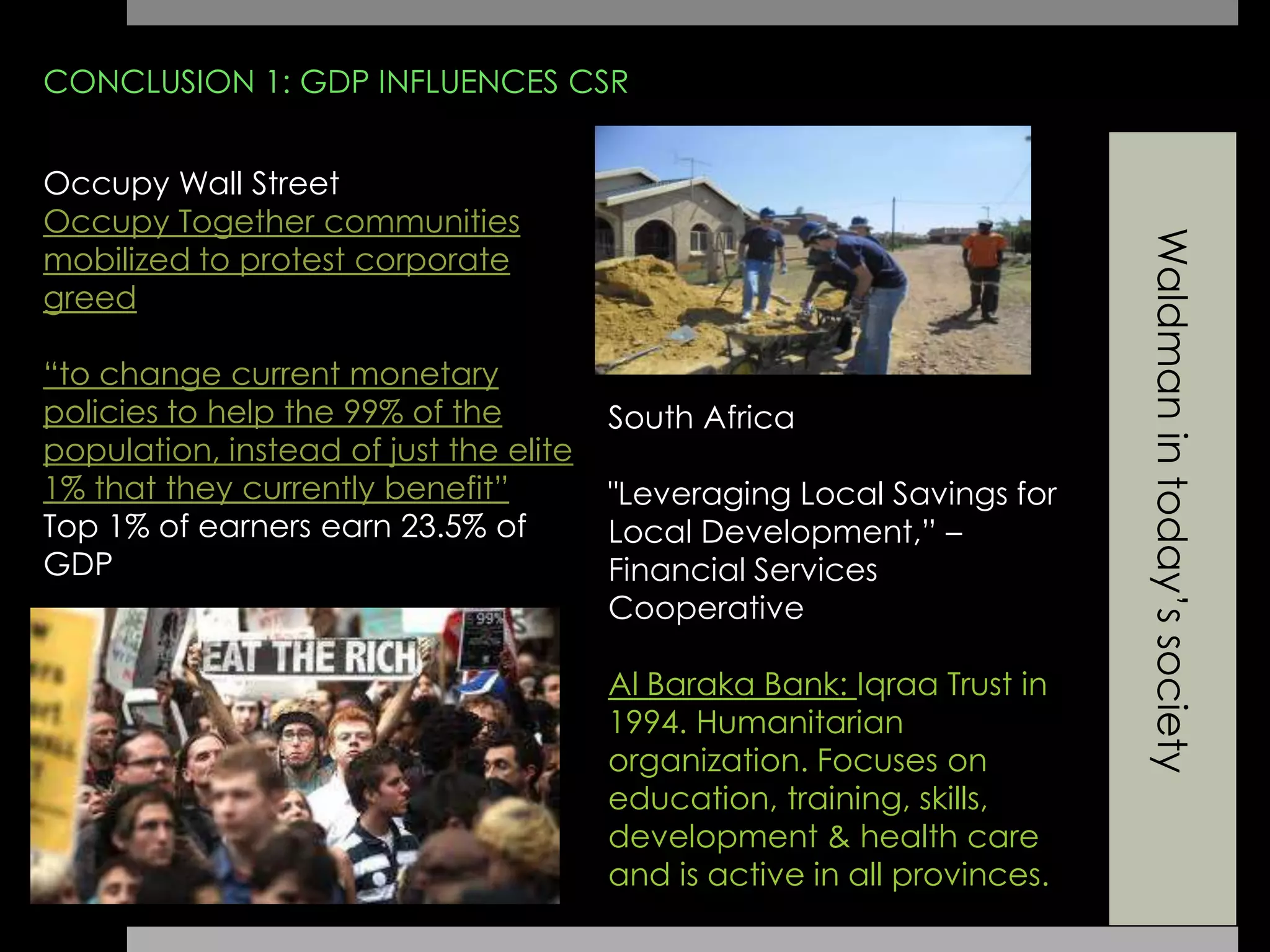
Occupy Wall Street
Occupy Together communities
mobilized to protest corporate
greed
“to change current monetary
policies to help the 99% of the
population, instead of just the elite
1% that they currently benefit”
Top 1% of earners earn 23.5% of
GDP
South Africa
"Leveraging Local Savings for
Local Development,” –
Financial Services
Cooperative
Al Baraka Bank: Iqraa Trust in
1994. Humanitarian
organization. Focuses on
education, training, skills,
development & health care
and is active in all provinces.
Waldmanintoday’ssociety
POWER DISTANCE IMPACT ON CSR
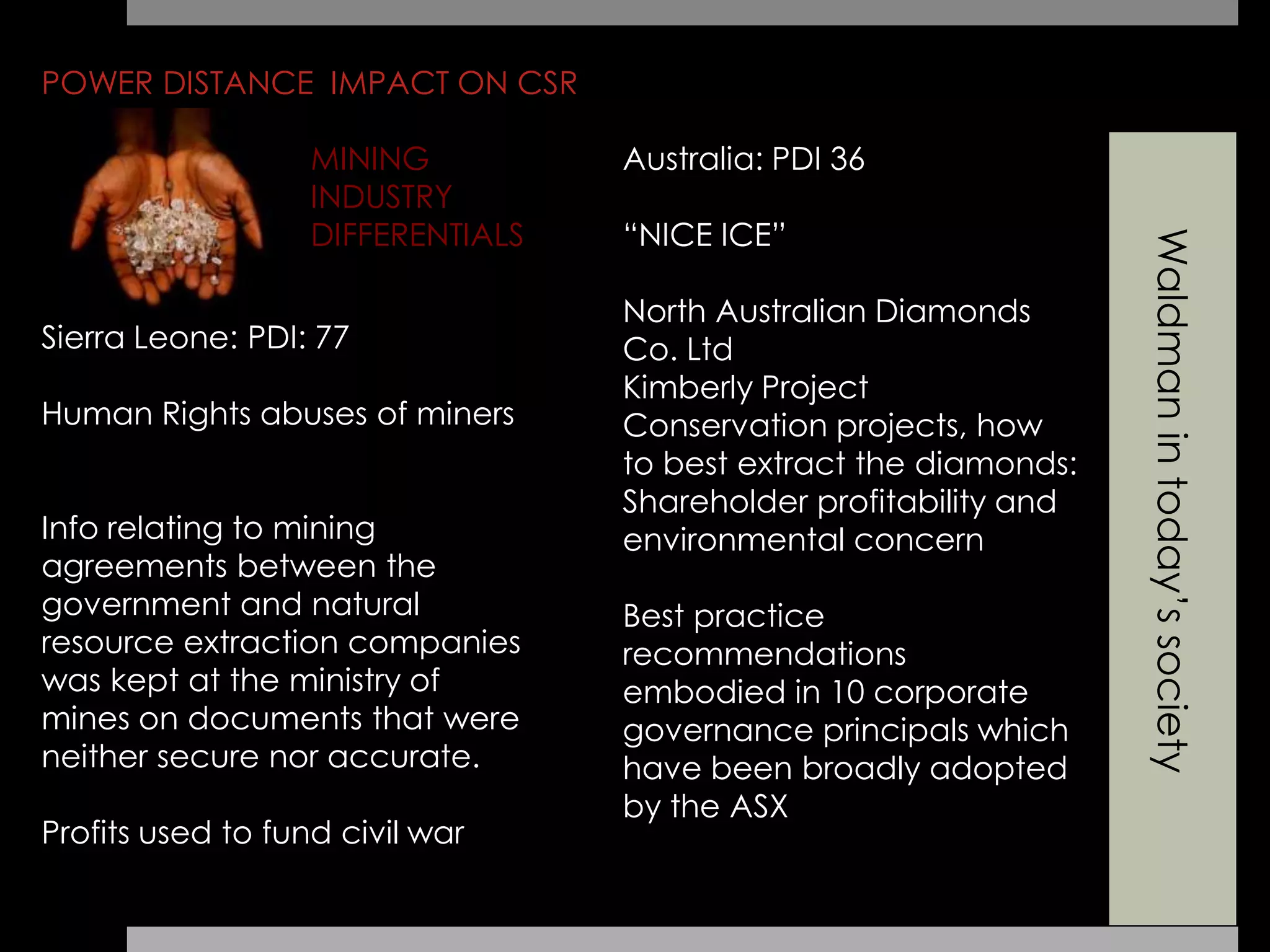
Sierra Leone: PDI: 77
Human Rights abuses of miners
Info relating to mining
agreements between the
government and natural
resource extraction companies
was kept at the ministry of
mines on documents that were
neither secure nor accurate.
Profits used to fund civil war
Australia: PDI 36
“NICE ICE”
North Australian Diamonds
Co. Ltd
Kimberly Project
Conservation projects, how
to best extract the diamonds:
Shareholder profitability and
environmental concern
Best practice
recommendations
embodied in 10 corporate
governance principals which
have been broadly adopted
by the ASX
MINING
INDUSTRY
DIFFERENTIALS
Waldmanintoday’ssociety
CONCLUSION 5: ORGANISATIONAL LEVEL VARIABLES
(VISIONARY LEADERSHIP
& INTEGRITY AMONGST CEOs)
Domiciled in the USA- largest GDP
in the world
Top management tendency to
disregard Societal Level CSR in
decision making
Yet the visionary leadership of
Howard Schultz has the company
involved in many Societal Level
CSR activities
Opportunity Finance Network
Ethical Sourcing
Environmental Stewardship
Community involvement
Personal Takeaways

Tuesday22

  • 1.
    Cultural Leadership & Predictorsof CSR Waldman et. Al 2006
  • 2.
    Introduction Collectivism CEO Visionary Leadership & Integrity CSR PREDICTORS Cultural values shape firm values Power Distance CSR:-Actions on the part of the firm that further the needs or goals of an identifiable stakeholder group, or a larger social collective (McWilliams & Siegel, 2001) Beyond legal requirements Values shape actions 3 Dimensions of Managerial Value o Shareholder/ Owner o Stakeholder Relations o Community/State Welfare
  • 3.
    Methodology  Form associationsbetween CSR Decision-Making Values and 3 dimensions of societal-level culture: Institutional-level collectivism In-group Collectivism Power Distance  15 countries, 40 firms each, across industries (not stratified)  GLOBE RESEARCH PROGRAM  Multiple Survey & Respondent Approach  Didn’t measure actual CSR actions or performance Austria Brazil China Germany Greece Guatemala India Mexico The Netherlands Nigeria Russia Slovenia Spain Taiwan Turkey
  • 4.
    Findings 2. CSR ISA MULTI-DIMENSIONAL CONSTRUCT Consisting of concern for: shareholders, stakeholders & community. Each predicted differently by variables. Previously there was a lack of clarity about dimensionality & depth
  • 5.
    Findings 3. POWER DISTANCE HIGH Manager’s value all 3 branches of CSR less Manipulative use of power On the part of managers without concern for either of the 3 (Carl et al, 2004) Cause for concern for proponents of global CSR Stakeholder management is relevant to profitability (Hillman and Keim, 2001) firms in such context may be at a disadvantage in the global economy
  • 6.
    Findings 5. ORGANISATIONAL LEVEL VARIABLES VISIONARYLEADERSHIP & INTEGRITY Can account for variables in managerial values with regard to CSR May be a driver of how subordinate managers view CSR More related to Shareholder and Stakeholder CSR CONCLUSION Demographic, Cultural and Leadership factors are critical determinants of the CSR values of managers. International firms should assess such variables for managers in different countries. Leadership can help align decision making across borders, despite culture 4. COLLECTIVISM COLLECTIVIST CULTURE managers value more aspects of CSR Such cultures encourage delaying immediate needs or gratification for future concerns. INSTITUTIONAL COLLECTIVISM Significant relationships with all 3 dimensions IN-GROUP COLLECTIVISM No significant relationships with any dimension
  • 7.
    Waldmanintoday’ssociety CONCLUSION 1: GDPINFLUENCES CSR Occupy Wall Street Occupy Together communities mobilized to protest corporate greed “to change current monetary policies to help the 99% of the population, instead of just the elite 1% that they currently benefit” Top 1% of earners earn 23.5% of GDP South Africa "Leveraging Local Savings for Local Development,” – Financial Services Cooperative Al Baraka Bank: Iqraa Trust in 1994. Humanitarian organization. Focuses on education, training, skills, development & health care and is active in all provinces.
  • 8.
    Waldmanintoday’ssociety POWER DISTANCE IMPACTON CSR Sierra Leone: PDI: 77 Human Rights abuses of miners Info relating to mining agreements between the government and natural resource extraction companies was kept at the ministry of mines on documents that were neither secure nor accurate. Profits used to fund civil war Australia: PDI 36 “NICE ICE” North Australian Diamonds Co. Ltd Kimberly Project Conservation projects, how to best extract the diamonds: Shareholder profitability and environmental concern Best practice recommendations embodied in 10 corporate governance principals which have been broadly adopted by the ASX MINING INDUSTRY DIFFERENTIALS
  • 9.
    Waldmanintoday’ssociety CONCLUSION 5: ORGANISATIONALLEVEL VARIABLES (VISIONARY LEADERSHIP & INTEGRITY AMONGST CEOs) Domiciled in the USA- largest GDP in the world Top management tendency to disregard Societal Level CSR in decision making Yet the visionary leadership of Howard Schultz has the company involved in many Societal Level CSR activities Opportunity Finance Network Ethical Sourcing Environmental Stewardship Community involvement
  • 10.