Business Ethics Journal Review
by Chris MacDonald & Alexei Marcoux
Bringing Values Back into
CSR
Group Members
NAME Reg No
 Nikhil Singh 112070
 Rushikesh Kardile 112085
 S Navneeth 112086
 Sameer Ahmed 112090
 Shobhit Mathur 112097
 Siddharth Rohilla 112102
 Thomas Tom 112109
 Vipasha Taneja 112115
INTRODUCTION
 CHRISTIAN R. THAUER is the latest in a string of authors
seeking to explain what drives corporations to pursue
corporate social responsibility (CSR).
 The topic is increasing timely given the growing role of
corporations in global governance and the stagnation of
inter-state attempts to confront pressing issues like climate
change and poor labour conditions in the developing
world.
Thauer’s Thinking
 Thauer takes a novel approach by focusing on the intra-
organizational determinants of CSR.
 Despite more than two decades of optimism about the
potential of CSR to revolutionize global business, take-up
remains erratic both within and across industrial sectors.
 Thauer correctly recognizes that focusing on the external
determinants of CSR can only take us so far. He seeks to
move beyond theories that look outside the firm by
holding external conditions constant while examining the
inner workings of eleven South African firms in the textiles
and automotive sectors.
The Pursuit of CSR as per Thauer
• Thauer defines CSR as, “firms voluntarily reintegrating
negative externalities of production or contributing to the
common good by adhering to environmental, health, or
social standards.”
• In short, his argument is that firms pursue CSR to resolve
internal managerial dilemas.
• He takes a novel approach by focusing on the intra-
organizational determinants of CSR but leaves out the
importance of managerial values.
CONTINUE…..
• He associates CSR to dilemmas faced by corporates in certain
fields, such as:
 Labour-related CSR as a response to the human resources
dilemma -
 He says that a firm that invests in labour related CSR is
better positioned to reduce turnover and mitigate social problems
that could affect productivity.
 Environmental CSR as a response to the technological
specialization dilemma-
 by implementing an environmental management system, can better
control production process standards and introduce strict
monitoring and sanctioning mechanisms to ensure production goals are
met.
• These dilemmas are associated to the investments made by the
firm in job-specific training or highly specialized equipment.
Shortcomings of Thauer’s Work
 Thauer’s proposal would result in problems at the
managerial level as the leveraging power reduces because
of the non-transferable investments made by the firm.
 van der Ven offers the following critiques:
1. The theory offered in Thauer’s paper has limited generalizability.
2. The hypothesized causal relationships presented are
indeterminate.
3. The assumptions underlying his analytic model do not pass an
empirical correspondence test.
• The lack of acknowledgement of the managerial roles is
lacking in the theory.
• Moreover, the value system of managers and how these
values affect the decision-making of the managers should
have been highlighted
• According to the author, the above two points form the key
to what motivates CSR.
Continue….
 Thauer’s theory says little about some of the greatest
advances in labour-related CSR in the developing world.
 van der Ven refers to the burgeoning movement towards
Fair trade certification.
 Most of the industries involved in this movement, namely
the coffee, cotton and cocoa industries, principally employ
unskilled labour. Asset specificity theory cannot explain
why firms would invest in CSR that benefits unskilled
labourers.
Thauer and Environmental CSR
 According to Thauer, firms opt for environmental CSR as a
result of technological specialization dilemma.
 The dilemma arises when the firm invests asset specific
resources and focuses in a single production unit.
 This leaves the management vulnerable to informa=on as
the expertise and machinery specialization has been
focused on a single sub unit.
 As a result, once the production-specifc assets have been
created, the management suggests Environmental CSR as a
solution to distribute the benefits to other sub units,
in contrast to solely focusing on a single sub unit.
 These include standards with strict monitoring and
sanctioning mechanisms such as ISO 14001 & VDA 6.1
The Underlying Anomaly
 The fact why firms would choose environmental CSR over a
range of other options is unclear.
 Thauer’s approach leads to two solutions in order to
prevent opportunism by the incentivized sub-unit:
 Implementing a quality management system check. Eg:
ISO & VDA standards.
 Monitoring the production unit under a strict supervision.
 Since there appears to be no link in the actual
 Environmental impact and the measures adopted as stated
above, there appears to be no environmentalism in
Thauer’s theory of environmental CSR.
Companies with the best CSR
Programmes
 1. Tata Steel: The company uses Human Development
Index to keep track of CSR in villages.
 2. Tata Chemicals: The company spends Rs 12 cr on CSR
every year & wildlife conservation tops priority.
 3. Mahindra Group: CSR is a mix of strategic
philanthropy, shared values & sustainability.
 4. Maruti Suzuki: Community development and road
safety propel Maruti's CSR in the fast lane.
 5. Tata Motors: The company drives CSR through
healthcare and education.
 6. Siemens
CSR programming span SCENARIOS
 SCENARIO 1: programmes focus on philanthropy, support for
local civic organizations, and engagement with
community initiatives.
SCENARIO 2: programmes deliver social or environmental
benefits in ways that support a company's operations
across the business value chain .
SCENARIO 3: programmes create new forms of business to
address social or environmental challenges with
expectation of business results in the long run
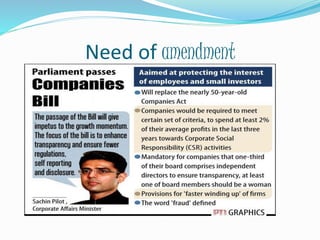
Need of amendment
Company act 2013
 The Companies Act, 2013 has introduced the idea of
CSR to the forefront and through its disclose-or-
explain mandate, is promoting greater transparency
and disclosure.
 CSR needs to go beyond communities and beyond the
concept of philanthropy.
 CSR in India tends to focus on what is done with
profits after they are made.
Cont…
 Require companies to set-up a CSR committee
consisting of their board members, including at least
one independent director
 spend at least 2% of their average net profit in the
previous three years on CSR activities.
 net profit as the profit before tax as per the books of
accounts, excluding profits arising from branches
outside India.
 set of activities eligible under CSR. set of activities
eligible under CSR. .
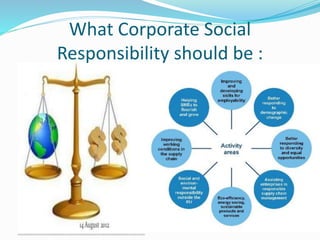
What Corporate Social
Responsibility should be :
And what is it turning to be…
The ground reality:
 Nike's numerous CSR hurdles - sweat-shops, not paying their workers
properly etc. Yet with every industry survey, the company tops the best
CSR lists.
 companies like Coca-Cola and Pepsico - if one of the four prongs of
CSR is responsibility towards the market place, it can be argued that
consumption of their products leads to health problems.
 Wal-Mart: widely acknowledged as one of the most unsustainable
businesses, it is now setting the standards for sustainable business and
also forcing its supply chain to become more sustainable.
What to do now
 Proper counselling and thereby better understanding of CSR activities
for top level management of the company
 Efficient monitoring of Corporate Social Responsibility activities to
bring out the ironical behaviour in Multi National Corporation.
 Ensuring the interest and motive of the Multi National Corporations
and those of NGO’s are the same.
 Promotion of companies with unbiased CSR activities by honouring
them in public for their achievements
 Input and ideas of subordinates and co-members of the team should
be included while planning CSR activities
 Companys should use social media to make their CSR activity more
user friendly at the same time promoting their work.
CONCLUSION
 WHAT IS CSR???
 CSR is a management concept whereby company achieves a
balance of economic, environmental and social
imperatives(“Tripple-Bottom-Line approach), while at the
same time addressing the expectations of shareholders and
stakeholders.
 Key CSR issues: Environmental management, eco-
efficiency, responsible sourcing, stakeholder engagement,
labour standards and working conditions, empoyee and
community relations, social equity, gender balance, human
rights, good governance and anti-corruption measures.
CONTINUED……
 A properly implemented CSR concept can bring along
a variety of competitive advantages, such as enhanced
access to capital and markets, increased sales and
profits, operational cost savings, improved
productivity and quality, efficient human resouce base,
improved brand image and reputation enhanced
customer loyalty, better decision making, and risk
management processes.
 CSR is basically based on the Question of “Good
Business” for a “Good Society” – today and tomorrow.
 Now, THAUER’S Approach for CSR:-
 He adopted a Novel Approach and focused on the intra-
organizational determinants of CSR by holding External
conditions, like climate change and poor labour conditions,
constant.
 And While Hamish Van(the reviwer) agrees with the
author’s approach but the lacking thing is the Role of
managerial values that drives CSR and how these Values
affect CSR.
 He contradict with the argument of Thauer and said that
“There are reasonable grounds to Question the
assumptions underlying the bargaining game.”
 Basically, Thauer’s article represents a good step towards
explaining variation in levels of CSR within similar socio-
economic concepts.
 But the lacking part was that he has not focused on value
systems of management which will help in shaping the
direction of CSR initiatives.
 So, we would like to conclude: CSR will only provide with
corporate values and corporate citizenship but when it
is combined alongwith the shared value, It will help in
designing new products and services that meet social
and environmental needs while simultaneously
delivering a financial return(profits).
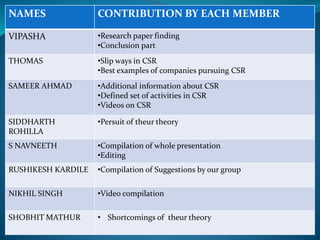
NAMES CONTRIBUTION BY EACH MEMBER
VIPASHA •Research paper finding
•Conclusion part
THOMAS •Slip ways in CSR
•Best examples of companies pursuing CSR
SAMEER AHMAD •Additional information about CSR
•Defined set of activities in CSR
•Videos on CSR
SIDDHARTH
ROHILLA
•Persuit of theur theory
S NAVNEETH •Compilation of whole presentation
•Editing
RUSHIKESH KARDILE •Compilation of Suggestions by our group
NIKHIL SINGH •Video compilation
SHOBHIT MATHUR • Shortcomings of theur theory
Bringing Values back to CSR

Bringing Values back to CSR

  • 1.
    Business Ethics JournalReview by Chris MacDonald & Alexei Marcoux Bringing Values Back into CSR
  • 2.
    Group Members NAME RegNo  Nikhil Singh 112070  Rushikesh Kardile 112085  S Navneeth 112086  Sameer Ahmed 112090  Shobhit Mathur 112097  Siddharth Rohilla 112102  Thomas Tom 112109  Vipasha Taneja 112115
  • 3.
    INTRODUCTION  CHRISTIAN R.THAUER is the latest in a string of authors seeking to explain what drives corporations to pursue corporate social responsibility (CSR).  The topic is increasing timely given the growing role of corporations in global governance and the stagnation of inter-state attempts to confront pressing issues like climate change and poor labour conditions in the developing world.
  • 4.
    Thauer’s Thinking  Thauertakes a novel approach by focusing on the intra- organizational determinants of CSR.  Despite more than two decades of optimism about the potential of CSR to revolutionize global business, take-up remains erratic both within and across industrial sectors.  Thauer correctly recognizes that focusing on the external determinants of CSR can only take us so far. He seeks to move beyond theories that look outside the firm by holding external conditions constant while examining the inner workings of eleven South African firms in the textiles and automotive sectors.
  • 5.
    The Pursuit ofCSR as per Thauer
  • 6.
    • Thauer definesCSR as, “firms voluntarily reintegrating negative externalities of production or contributing to the common good by adhering to environmental, health, or social standards.” • In short, his argument is that firms pursue CSR to resolve internal managerial dilemas. • He takes a novel approach by focusing on the intra- organizational determinants of CSR but leaves out the importance of managerial values.
  • 7.
    CONTINUE….. • He associatesCSR to dilemmas faced by corporates in certain fields, such as:  Labour-related CSR as a response to the human resources dilemma -  He says that a firm that invests in labour related CSR is better positioned to reduce turnover and mitigate social problems that could affect productivity.  Environmental CSR as a response to the technological specialization dilemma-  by implementing an environmental management system, can better control production process standards and introduce strict monitoring and sanctioning mechanisms to ensure production goals are met. • These dilemmas are associated to the investments made by the firm in job-specific training or highly specialized equipment.
  • 8.
  • 9.
     Thauer’s proposalwould result in problems at the managerial level as the leveraging power reduces because of the non-transferable investments made by the firm.  van der Ven offers the following critiques: 1. The theory offered in Thauer’s paper has limited generalizability. 2. The hypothesized causal relationships presented are indeterminate. 3. The assumptions underlying his analytic model do not pass an empirical correspondence test. • The lack of acknowledgement of the managerial roles is lacking in the theory. • Moreover, the value system of managers and how these values affect the decision-making of the managers should have been highlighted • According to the author, the above two points form the key to what motivates CSR.
  • 10.
    Continue….  Thauer’s theorysays little about some of the greatest advances in labour-related CSR in the developing world.  van der Ven refers to the burgeoning movement towards Fair trade certification.  Most of the industries involved in this movement, namely the coffee, cotton and cocoa industries, principally employ unskilled labour. Asset specificity theory cannot explain why firms would invest in CSR that benefits unskilled labourers.
  • 11.
    Thauer and EnvironmentalCSR  According to Thauer, firms opt for environmental CSR as a result of technological specialization dilemma.  The dilemma arises when the firm invests asset specific resources and focuses in a single production unit.  This leaves the management vulnerable to informa=on as the expertise and machinery specialization has been focused on a single sub unit.  As a result, once the production-specifc assets have been created, the management suggests Environmental CSR as a solution to distribute the benefits to other sub units, in contrast to solely focusing on a single sub unit.  These include standards with strict monitoring and sanctioning mechanisms such as ISO 14001 & VDA 6.1
  • 12.
    The Underlying Anomaly The fact why firms would choose environmental CSR over a range of other options is unclear.  Thauer’s approach leads to two solutions in order to prevent opportunism by the incentivized sub-unit:  Implementing a quality management system check. Eg: ISO & VDA standards.  Monitoring the production unit under a strict supervision.  Since there appears to be no link in the actual  Environmental impact and the measures adopted as stated above, there appears to be no environmentalism in Thauer’s theory of environmental CSR.
  • 13.
    Companies with thebest CSR Programmes  1. Tata Steel: The company uses Human Development Index to keep track of CSR in villages.  2. Tata Chemicals: The company spends Rs 12 cr on CSR every year & wildlife conservation tops priority.  3. Mahindra Group: CSR is a mix of strategic philanthropy, shared values & sustainability.  4. Maruti Suzuki: Community development and road safety propel Maruti's CSR in the fast lane.  5. Tata Motors: The company drives CSR through healthcare and education.  6. Siemens
  • 14.
    CSR programming spanSCENARIOS  SCENARIO 1: programmes focus on philanthropy, support for local civic organizations, and engagement with community initiatives. SCENARIO 2: programmes deliver social or environmental benefits in ways that support a company's operations across the business value chain . SCENARIO 3: programmes create new forms of business to address social or environmental challenges with expectation of business results in the long run
  • 15.
  • 16.
    Company act 2013 The Companies Act, 2013 has introduced the idea of CSR to the forefront and through its disclose-or- explain mandate, is promoting greater transparency and disclosure.  CSR needs to go beyond communities and beyond the concept of philanthropy.  CSR in India tends to focus on what is done with profits after they are made.
  • 17.
    Cont…  Require companiesto set-up a CSR committee consisting of their board members, including at least one independent director  spend at least 2% of their average net profit in the previous three years on CSR activities.  net profit as the profit before tax as per the books of accounts, excluding profits arising from branches outside India.  set of activities eligible under CSR. set of activities eligible under CSR. .
  • 19.
  • 20.
    And what isit turning to be…
  • 21.
    The ground reality: Nike's numerous CSR hurdles - sweat-shops, not paying their workers properly etc. Yet with every industry survey, the company tops the best CSR lists.  companies like Coca-Cola and Pepsico - if one of the four prongs of CSR is responsibility towards the market place, it can be argued that consumption of their products leads to health problems.  Wal-Mart: widely acknowledged as one of the most unsustainable businesses, it is now setting the standards for sustainable business and also forcing its supply chain to become more sustainable.
  • 22.
    What to donow  Proper counselling and thereby better understanding of CSR activities for top level management of the company  Efficient monitoring of Corporate Social Responsibility activities to bring out the ironical behaviour in Multi National Corporation.  Ensuring the interest and motive of the Multi National Corporations and those of NGO’s are the same.  Promotion of companies with unbiased CSR activities by honouring them in public for their achievements  Input and ideas of subordinates and co-members of the team should be included while planning CSR activities  Companys should use social media to make their CSR activity more user friendly at the same time promoting their work.
  • 23.
    CONCLUSION  WHAT ISCSR???  CSR is a management concept whereby company achieves a balance of economic, environmental and social imperatives(“Tripple-Bottom-Line approach), while at the same time addressing the expectations of shareholders and stakeholders.  Key CSR issues: Environmental management, eco- efficiency, responsible sourcing, stakeholder engagement, labour standards and working conditions, empoyee and community relations, social equity, gender balance, human rights, good governance and anti-corruption measures.
  • 24.
    CONTINUED……  A properlyimplemented CSR concept can bring along a variety of competitive advantages, such as enhanced access to capital and markets, increased sales and profits, operational cost savings, improved productivity and quality, efficient human resouce base, improved brand image and reputation enhanced customer loyalty, better decision making, and risk management processes.  CSR is basically based on the Question of “Good Business” for a “Good Society” – today and tomorrow.
  • 25.
     Now, THAUER’SApproach for CSR:-  He adopted a Novel Approach and focused on the intra- organizational determinants of CSR by holding External conditions, like climate change and poor labour conditions, constant.  And While Hamish Van(the reviwer) agrees with the author’s approach but the lacking thing is the Role of managerial values that drives CSR and how these Values affect CSR.  He contradict with the argument of Thauer and said that “There are reasonable grounds to Question the assumptions underlying the bargaining game.”
  • 26.
     Basically, Thauer’sarticle represents a good step towards explaining variation in levels of CSR within similar socio- economic concepts.  But the lacking part was that he has not focused on value systems of management which will help in shaping the direction of CSR initiatives.  So, we would like to conclude: CSR will only provide with corporate values and corporate citizenship but when it is combined alongwith the shared value, It will help in designing new products and services that meet social and environmental needs while simultaneously delivering a financial return(profits).
  • 27.
    NAMES CONTRIBUTION BYEACH MEMBER VIPASHA •Research paper finding •Conclusion part THOMAS •Slip ways in CSR •Best examples of companies pursuing CSR SAMEER AHMAD •Additional information about CSR •Defined set of activities in CSR •Videos on CSR SIDDHARTH ROHILLA •Persuit of theur theory S NAVNEETH •Compilation of whole presentation •Editing RUSHIKESH KARDILE •Compilation of Suggestions by our group NIKHIL SINGH •Video compilation SHOBHIT MATHUR • Shortcomings of theur theory