Principles of
Language Assessment
Here starts
the lesson!
By Hilda Sarco
Assessment And Evaluation
MSc GONZALEZ DIAZ AMILCAR OSWALDO
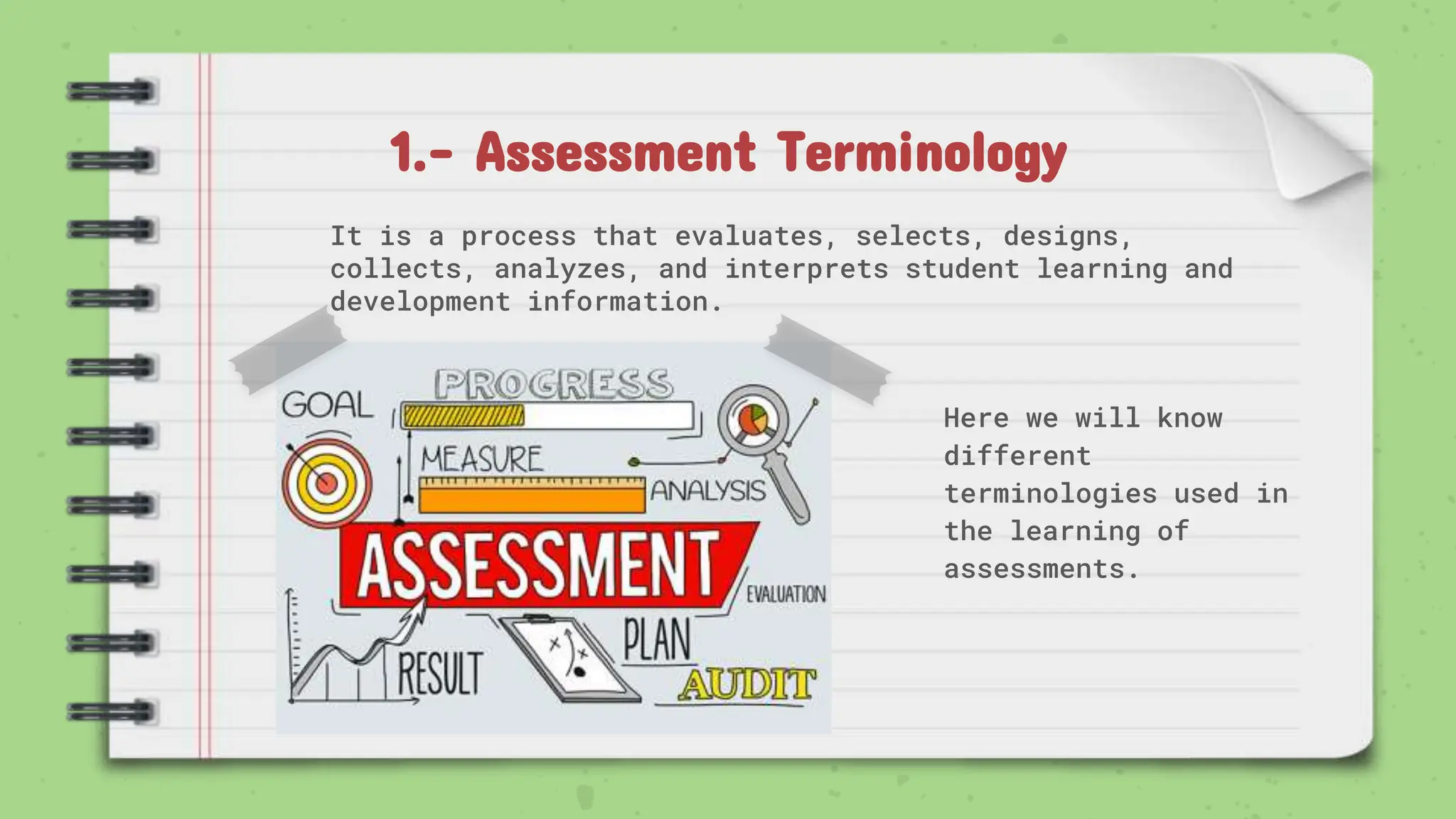
1.- Assessment Terminology
It is a process that evaluates, selects, designs,
collects, analyzes, and interprets student learning and
development information.
Here we will know
different
terminologies used in
the learning of
assessments.
Assessment Terminology
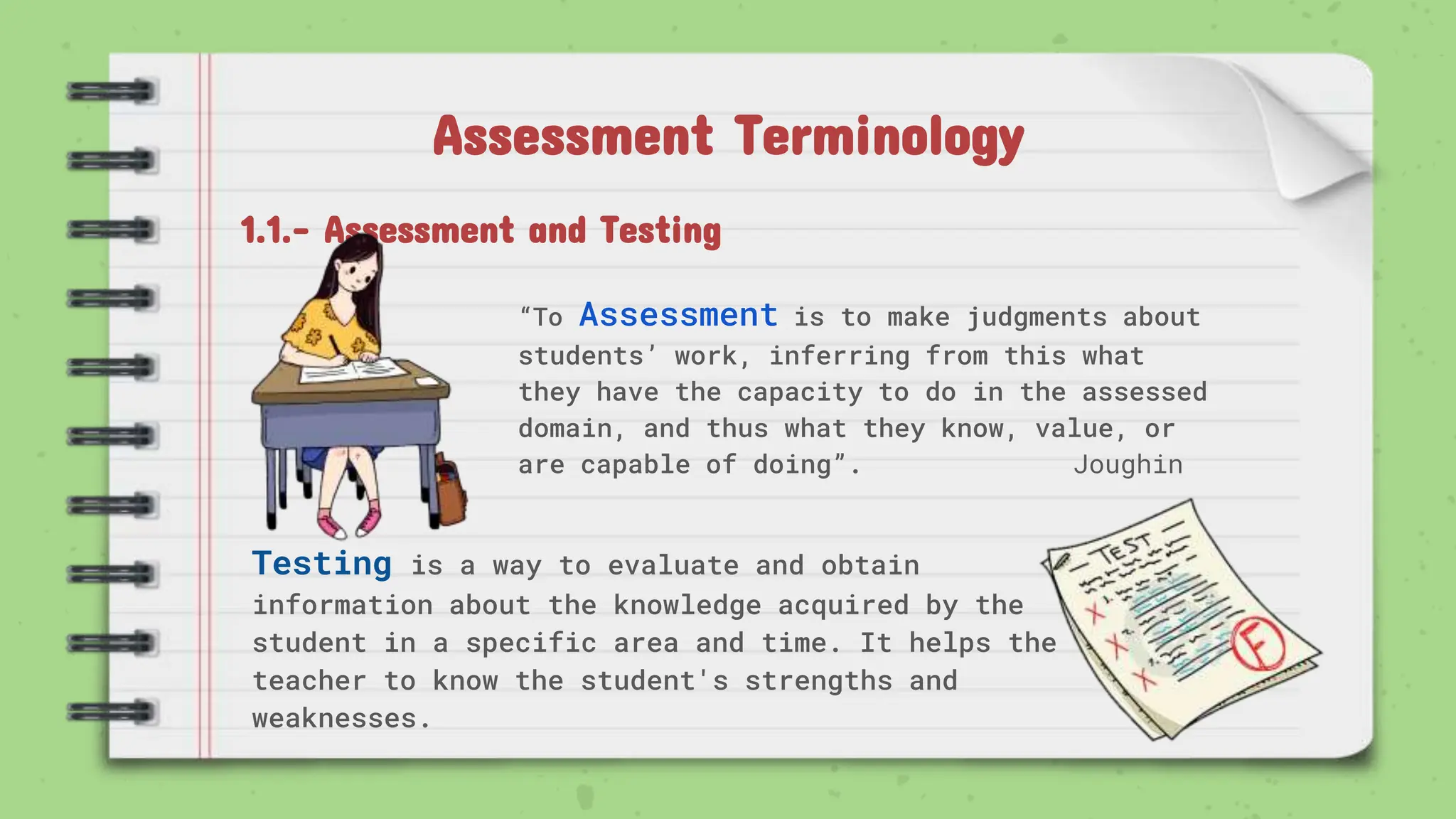
“To Assessment is to make judgments about
students’ work, inferring from this what
they have the capacity to do in the assessed
domain, and thus what they know, value, or
are capable of doing”. Joughin
1.1.- Assessment and Testing
Testing is a way to evaluate and obtain
information about the knowledge acquired by the
student in a specific area and time. It helps the
teacher to know the student's strengths and
weaknesses.
Assessment Terminology
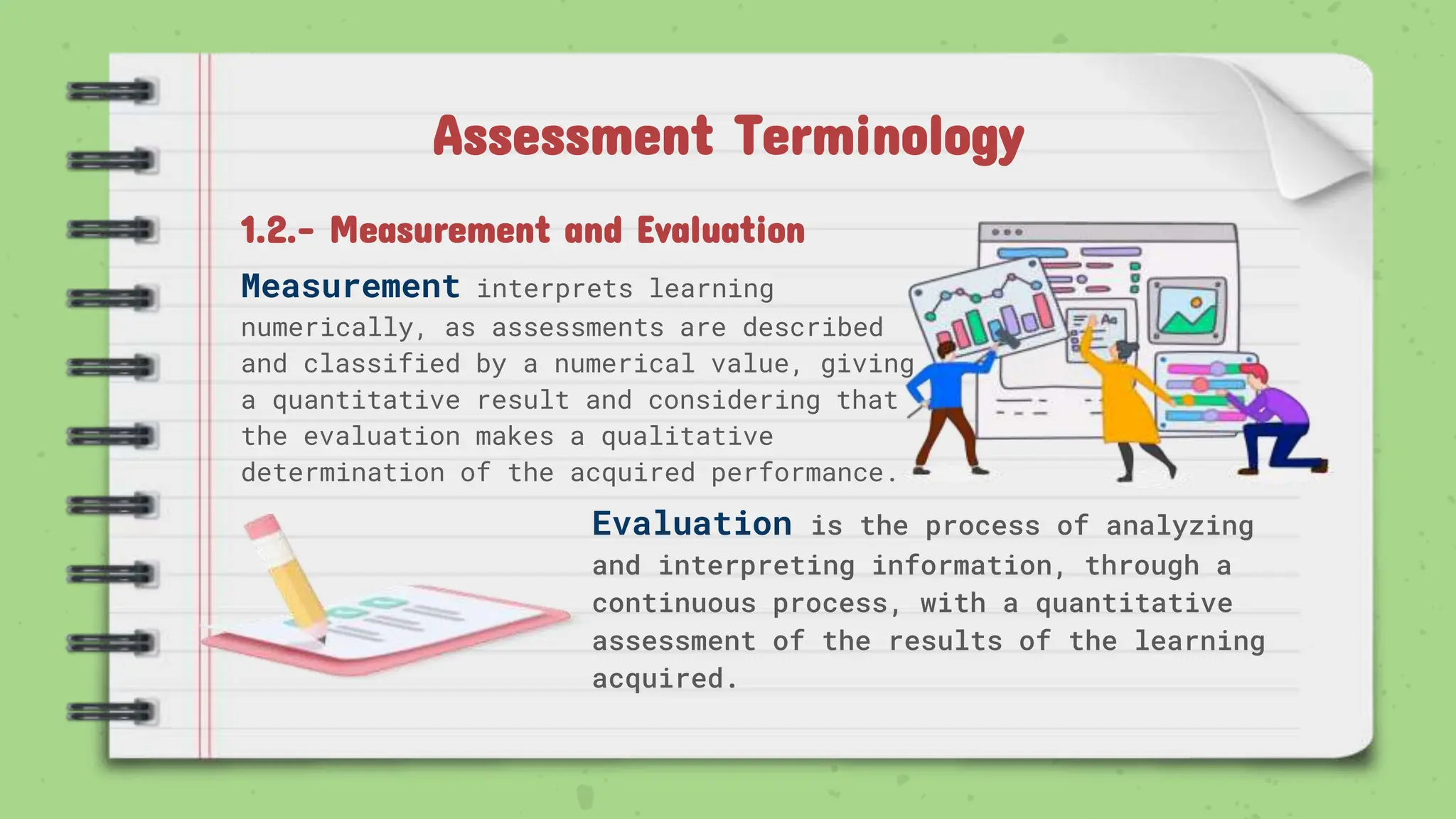
Measurement interprets learning
numerically, as assessments are described
and classified by a numerical value, giving
a quantitative result and considering that
the evaluation makes a qualitative
determination of the acquired performance.
1.2.- Measurement and Evaluation
Evaluation is the process of analyzing
and interpreting information, through a
continuous process, with a quantitative
assessment of the results of the learning
acquired.
Assessment Terminology
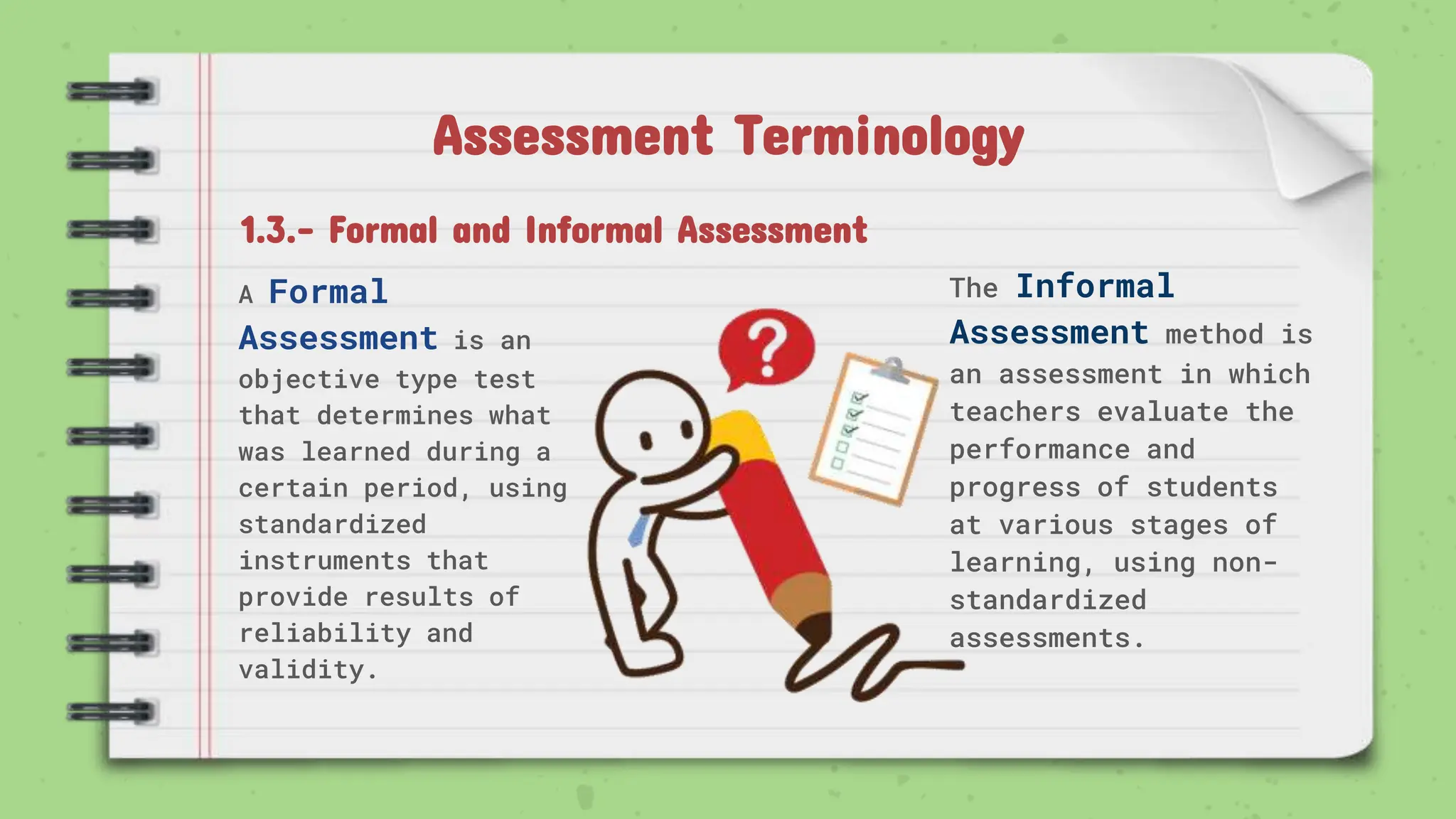
A Formal
Assessment is an
objective type test
that determines what
was learned during a
certain period, using
standardized
instruments that
provide results of
reliability and
validity.
1.3.- Formal and Informal Assessment
The Informal
Assessment method is
an assessment in which
teachers evaluate the
performance and
progress of students
at various stages of
learning, using non-
standardized
assessments.
Assessment Terminology
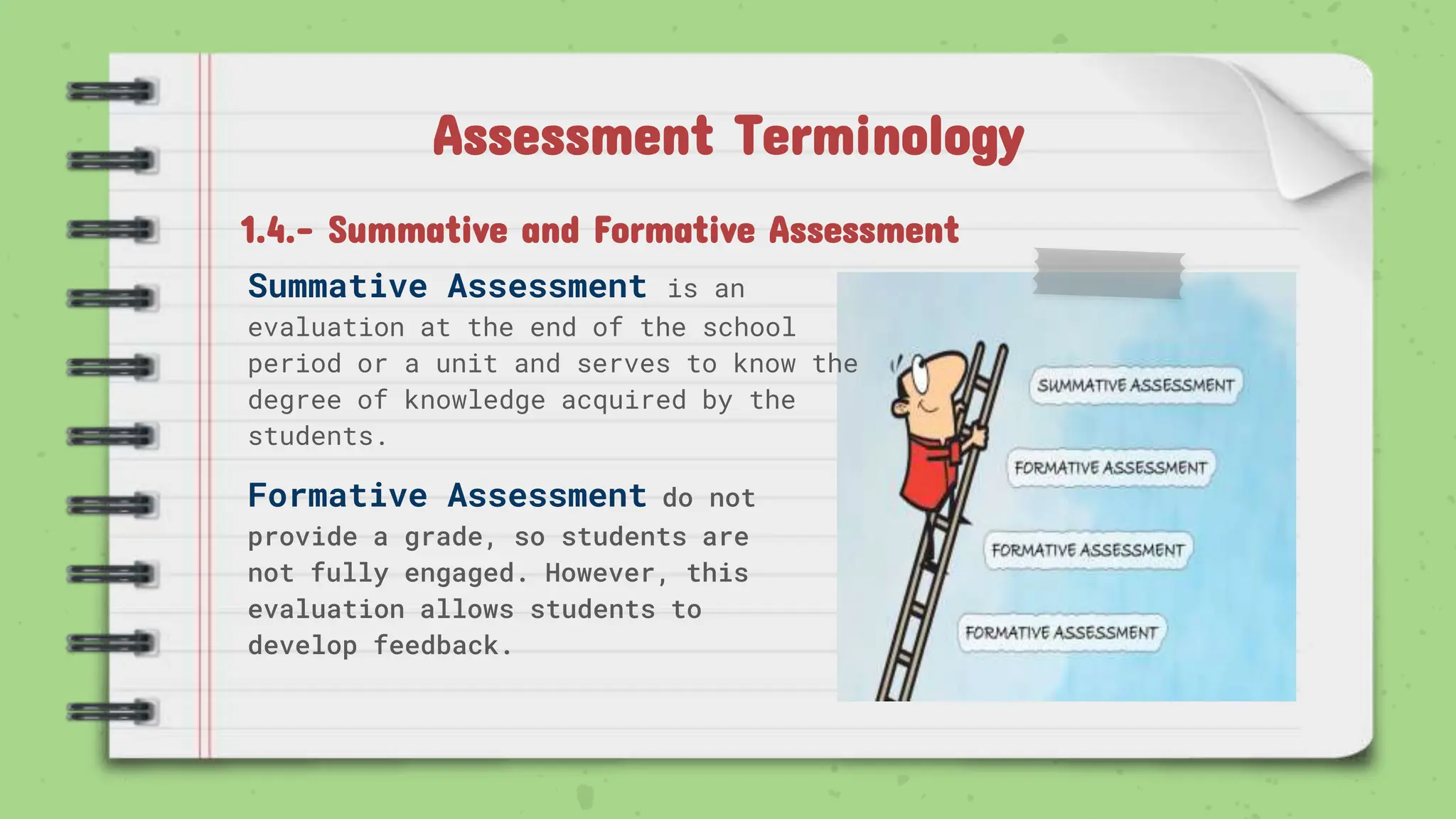
1.4.- Summative and Formative Assessment
Summative Assessment is an
evaluation at the end of the school
period or a unit and serves to know the
degree of knowledge acquired by the
students.
Formative Assessment do not
provide a grade, so students are
not fully engaged. However, this
evaluation allows students to
develop feedback.
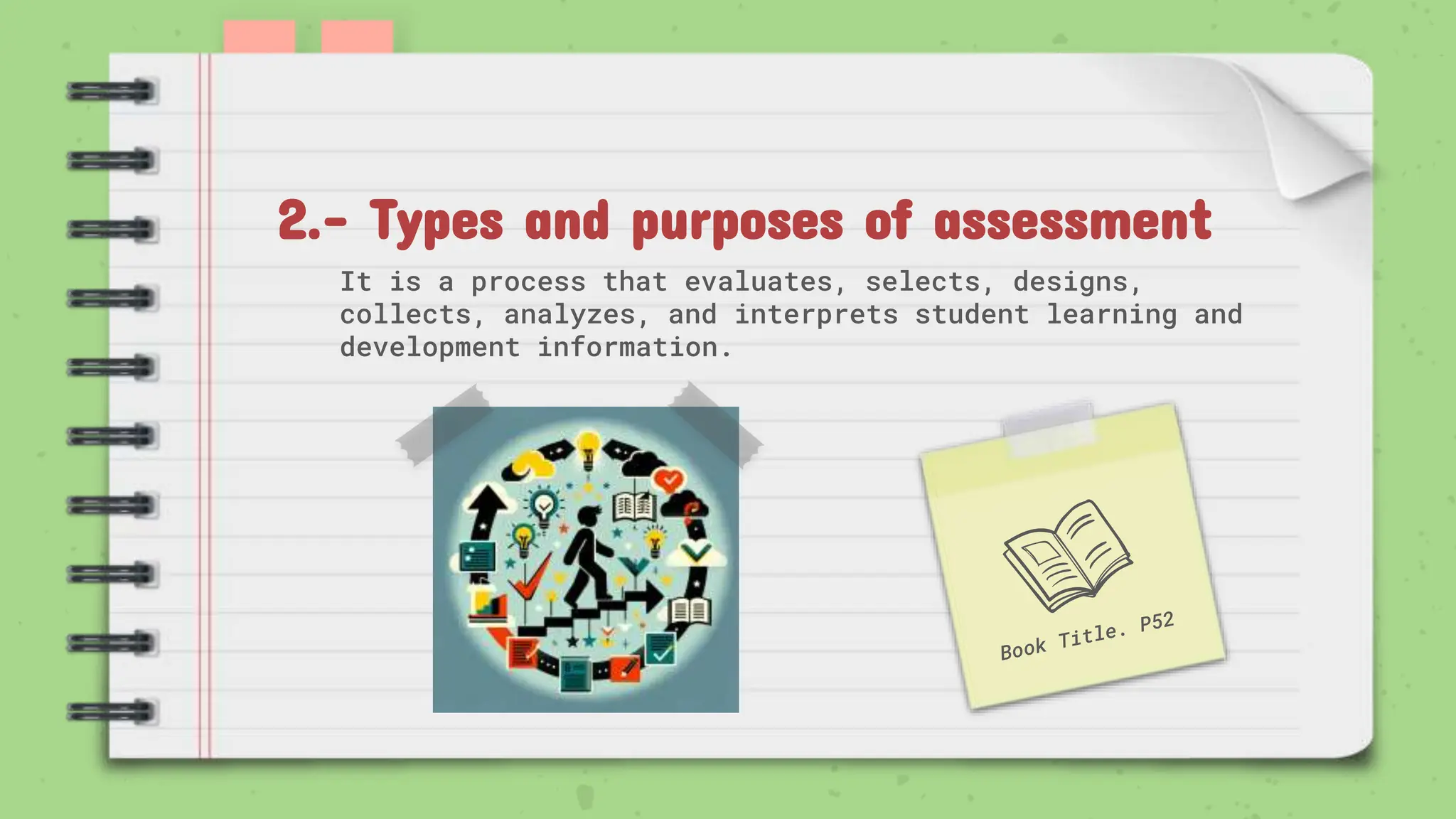
2.- Types and purposes of assessment
It is a process that evaluates, selects, designs,
collects, analyzes, and interprets student learning and
development information.
2.1.- Achievement tests
It is a tool that helps measure knowledge
of a specific topic in a standardized way
that helps us understand the student's
academic progress.
2.2.- Diagnostic tests
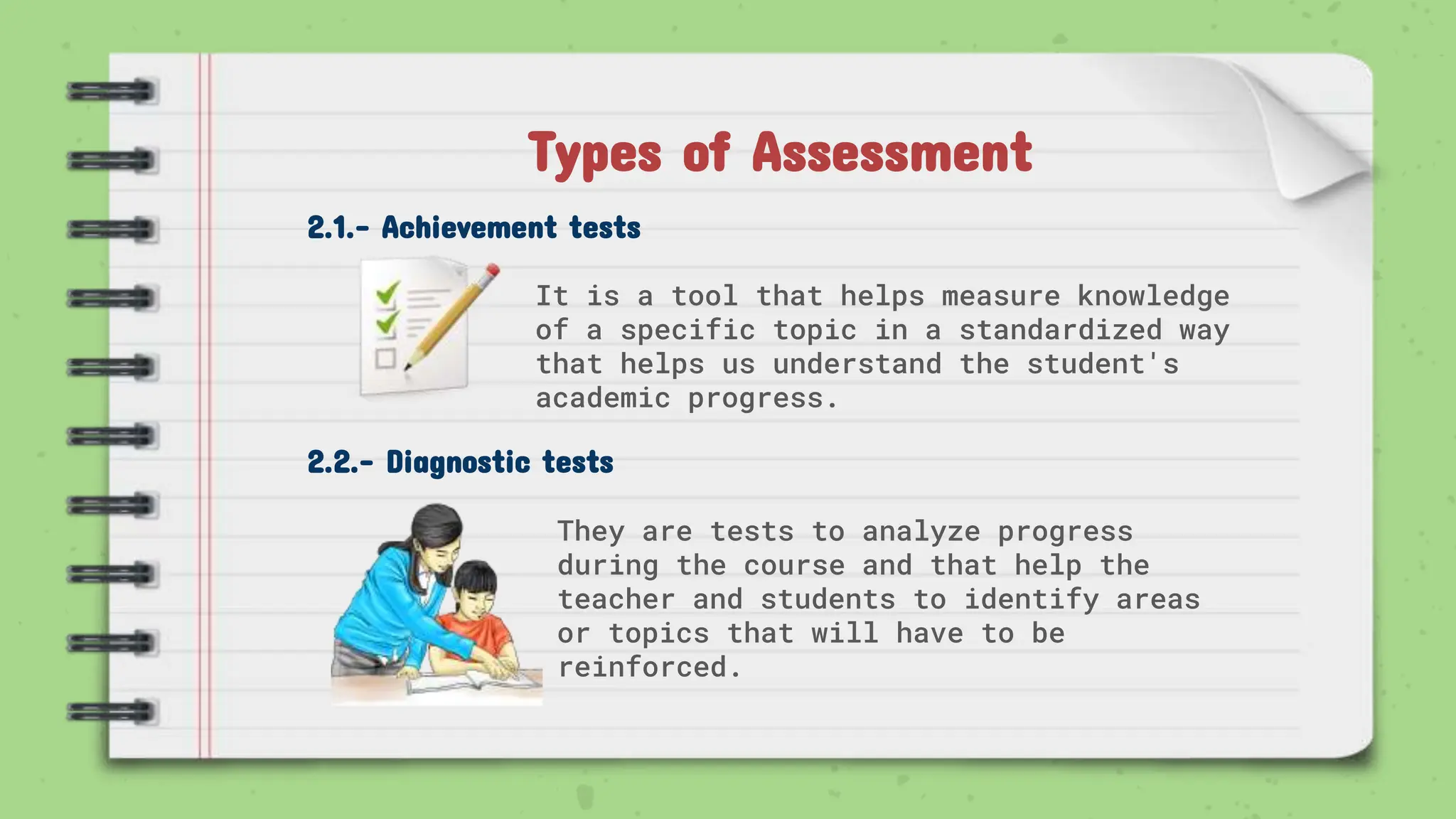
They are tests to analyze progress
during the course and that help the
teacher and students to identify areas
or topics that will have to be
reinforced.
Types of Assessment
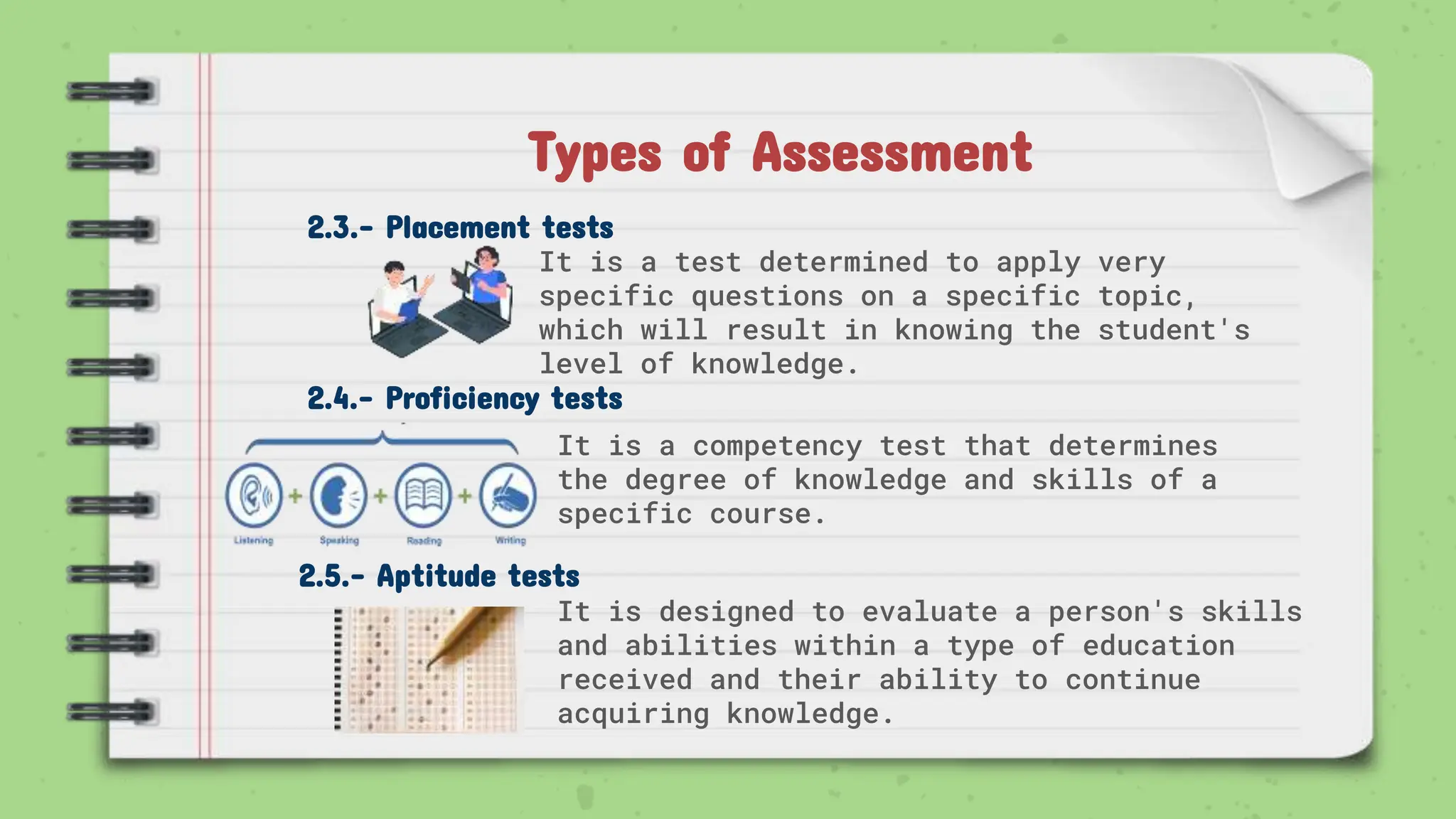
2.3.- Placement tests
It is a test determined to apply very
specific questions on a specific topic,
which will result in knowing the student's
level of knowledge.
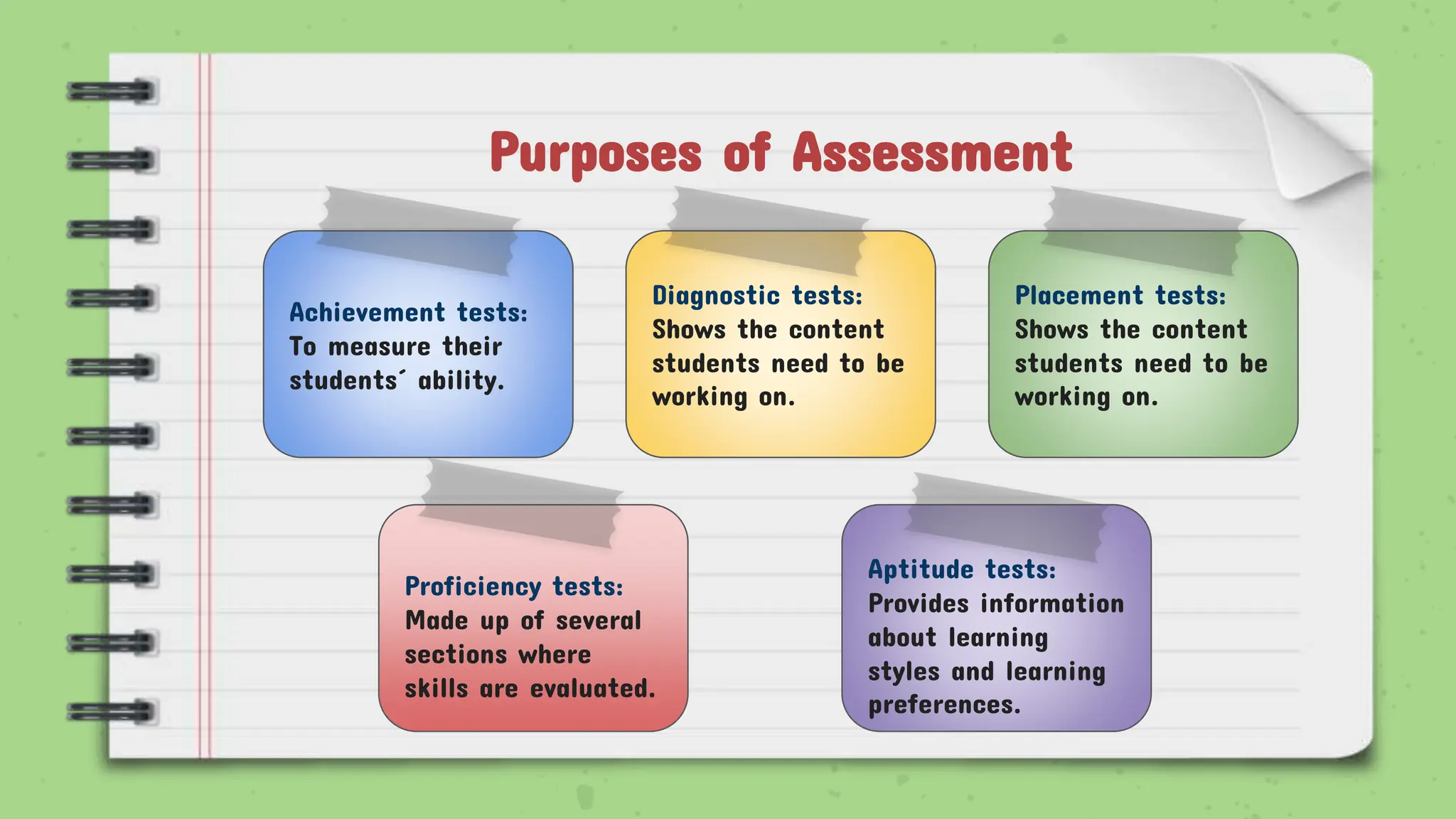
2.4.- Proficiency tests
It is a competency test that determines
the degree of knowledge and skills of a
specific course.
Types of Assessment
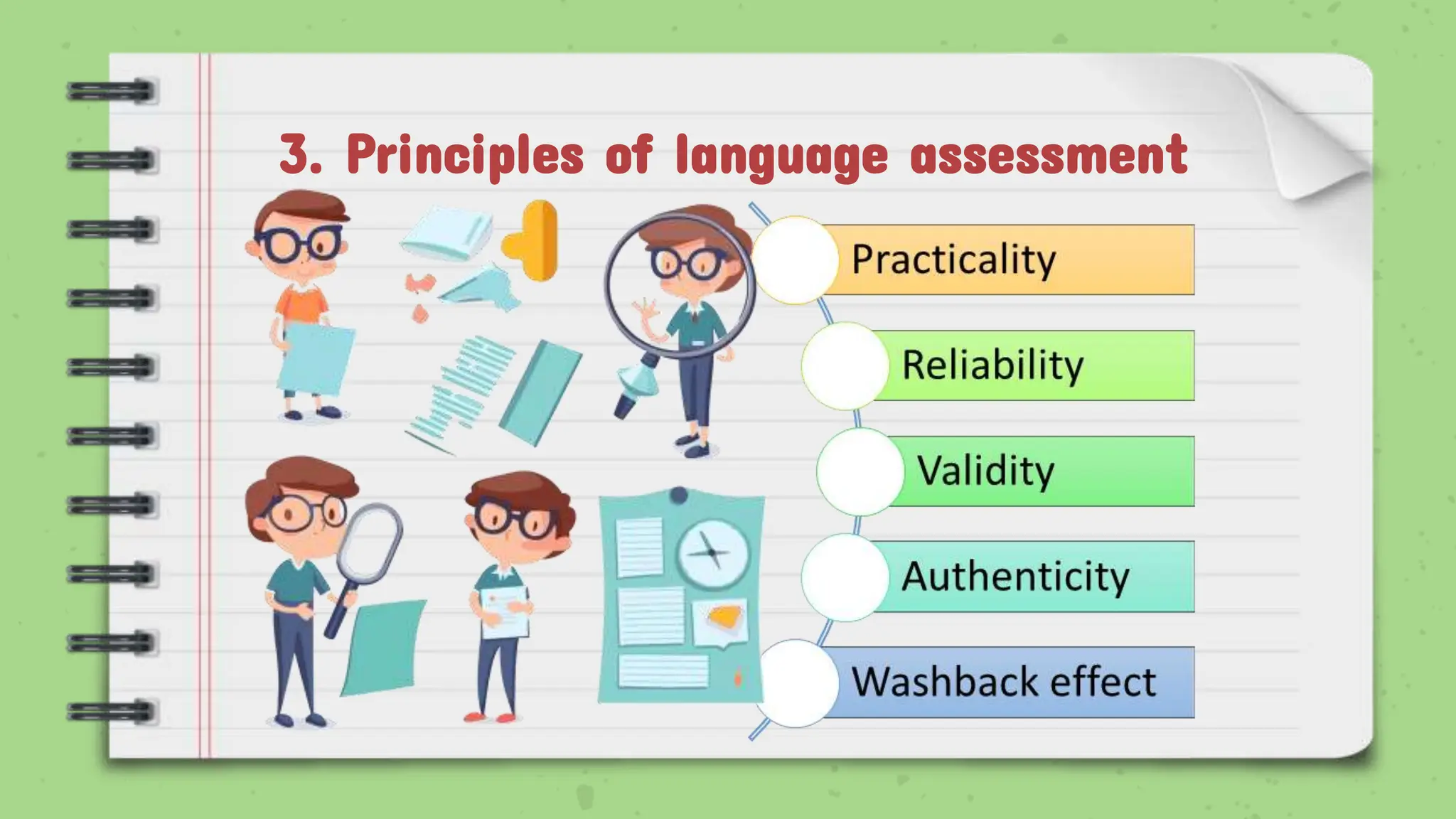
2.5.- Aptitude tests
It is designed to evaluate a person's skills
and abilities within a type of education
received and their ability to continue
acquiring knowledge.
Achievement tests:
To measure their
students´ ability.
Purposes of Assessment
Diagnostic tests:
Shows the content
students need to be
working on.
Placement tests:
Shows the content
students need to be
working on.
Proficiency tests:
Made up of several
sections where
skills are evaluated.
Aptitude tests:
Provides information
about learning
styles and learning
preferences.
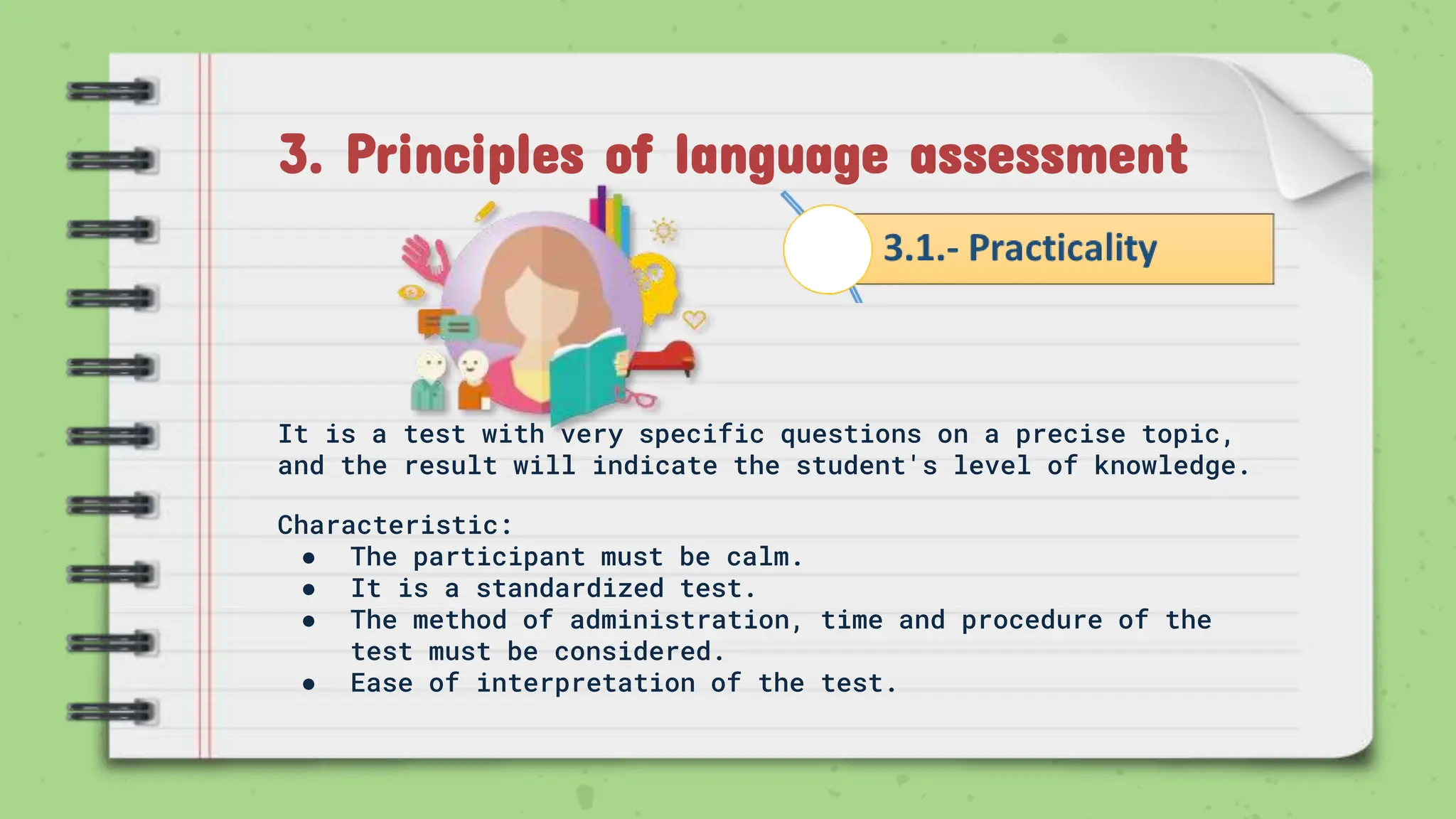
3. Principles of language assessment
It is a test with very specific questions on a precise topic,
and the result will indicate the student's level of knowledge.
Characteristic:
● The participant must be calm.
● It is a standardized test.
● The method of administration, time and procedure of the
test must be considered.
● Ease of interpretation of the test.
3. Principles of language assessment
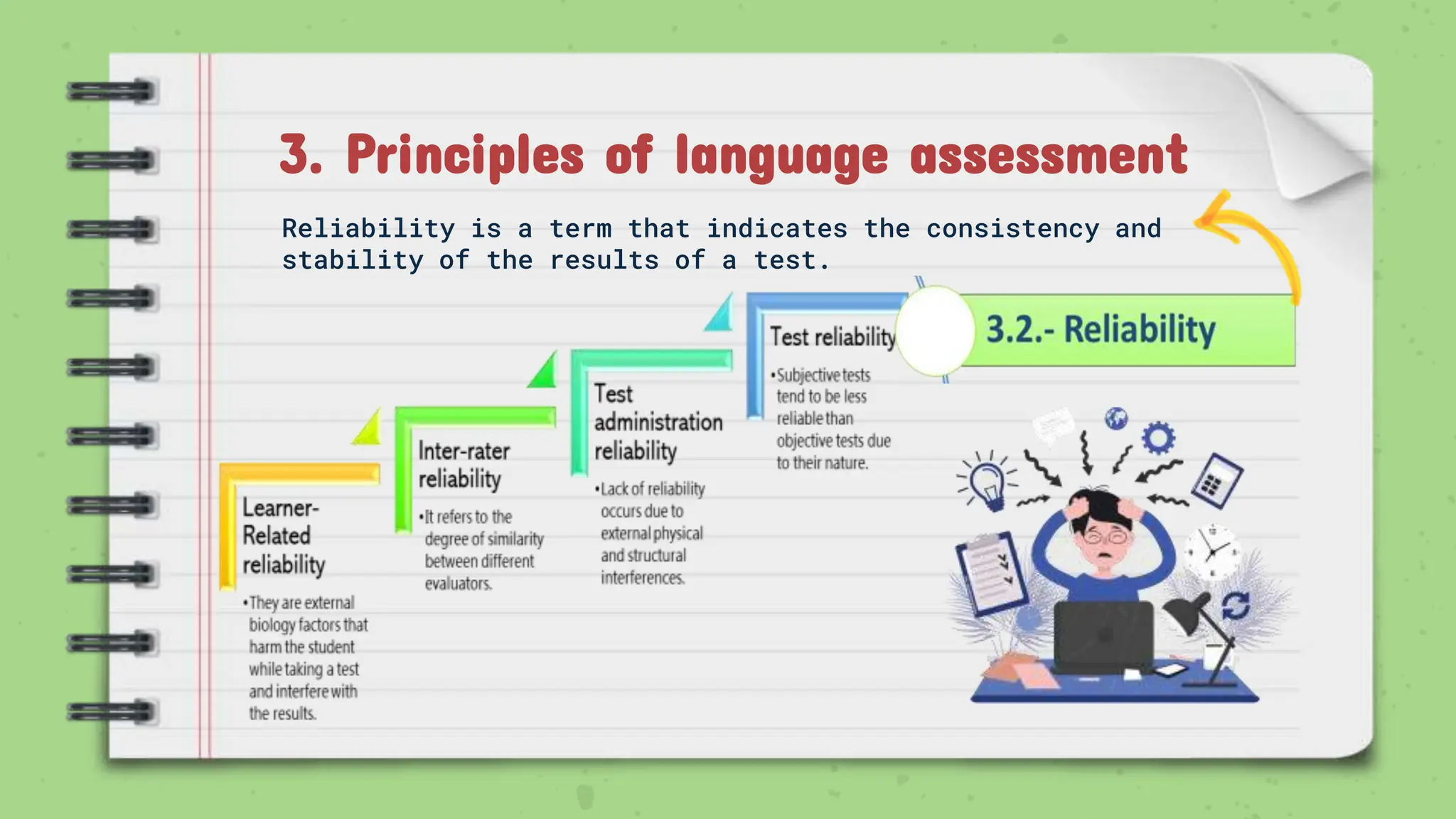
Reliability is a term that indicates the consistency and
stability of the results of a test.
3. Principles of language assessment
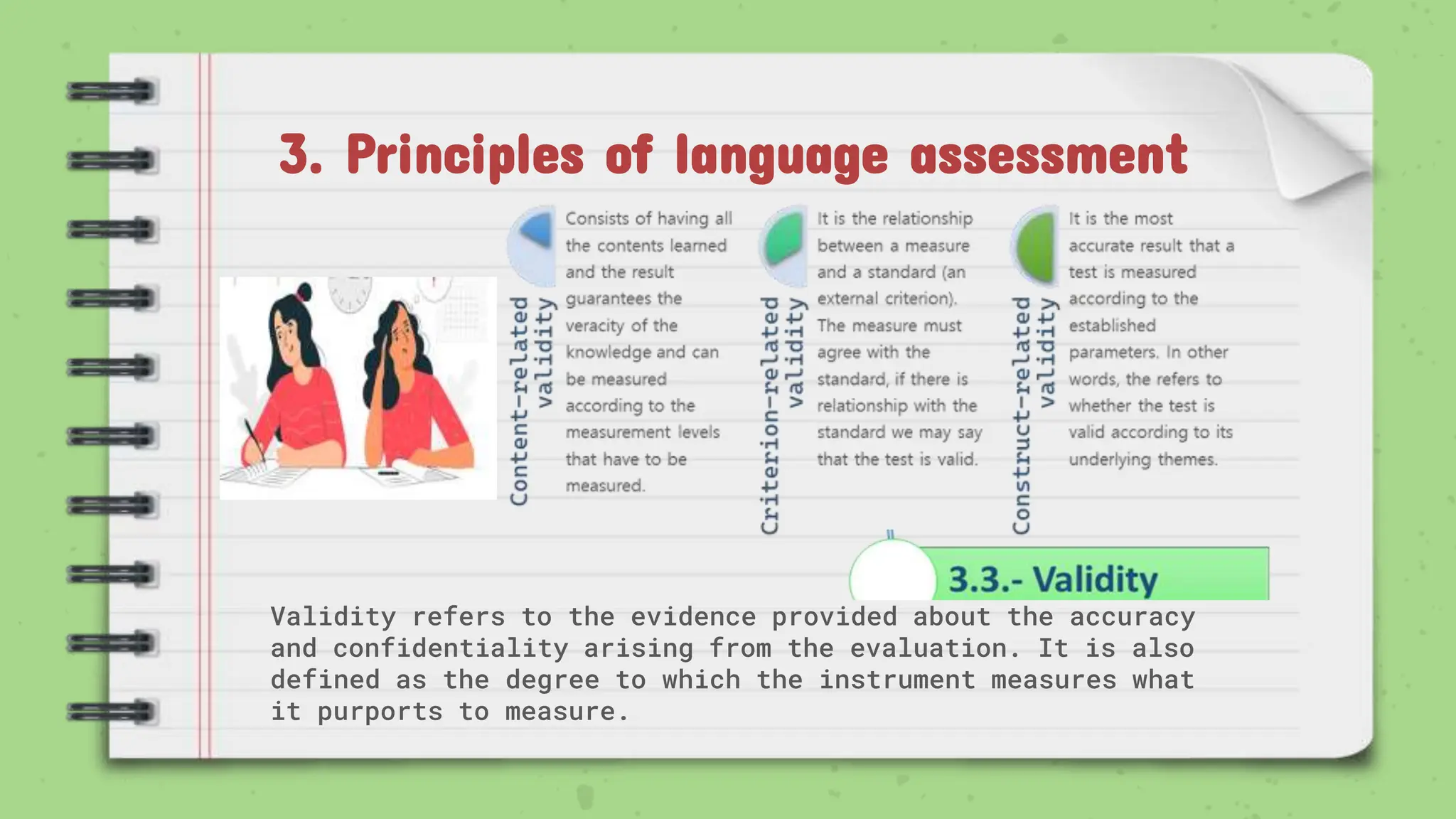
Validity refers to the evidence provided about the accuracy
and confidentiality arising from the evaluation. It is also
defined as the degree to which the instrument measures what
it purports to measure.
3. Principles of language assessment
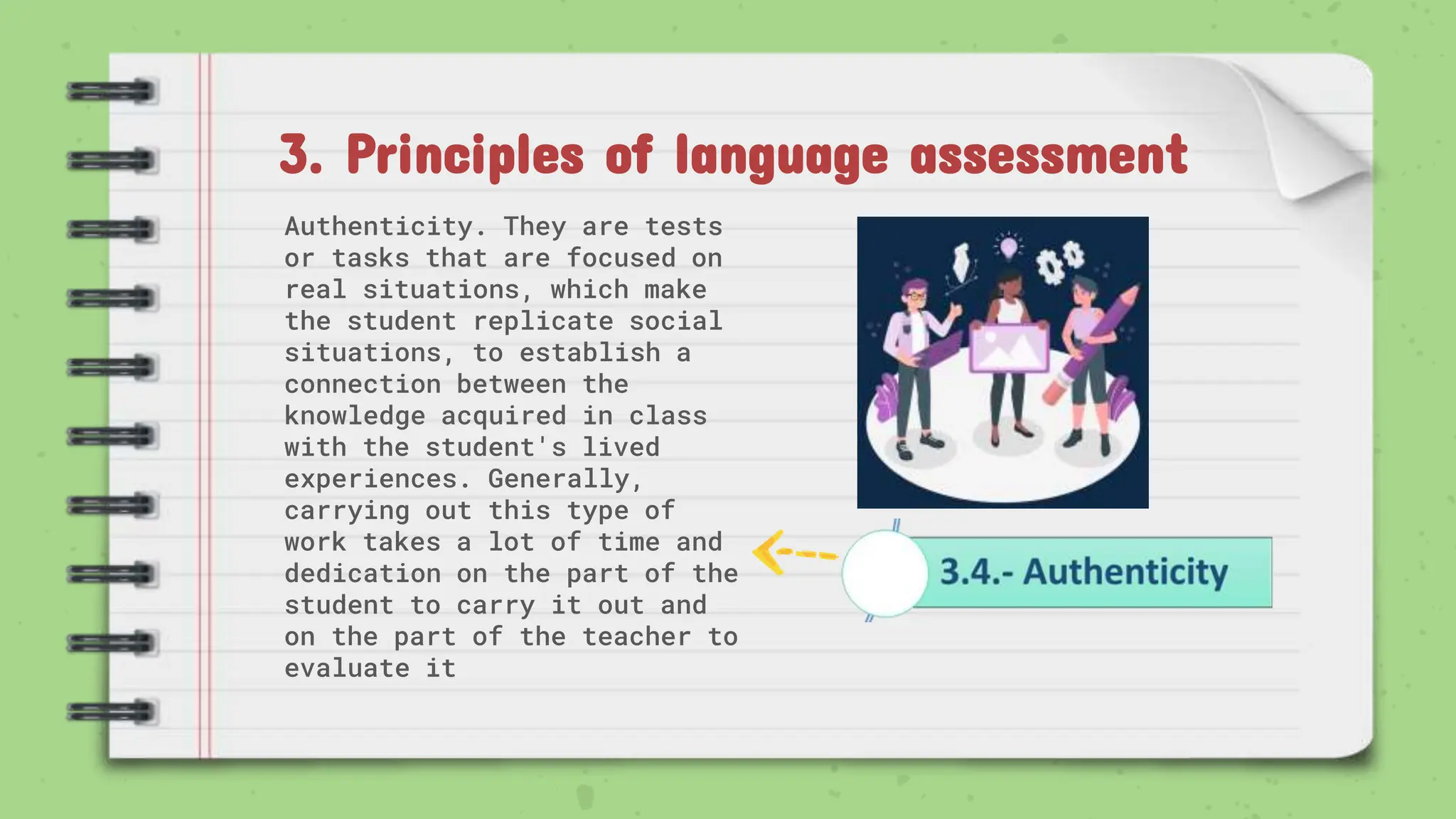
Authenticity. They are tests
or tasks that are focused on
real situations, which make
the student replicate social
situations, to establish a
connection between the
knowledge acquired in class
with the student's lived
experiences. Generally,
carrying out this type of
work takes a lot of time and
dedication on the part of the
student to carry it out and
on the part of the teacher to
evaluate it
3. Principles of language assessment
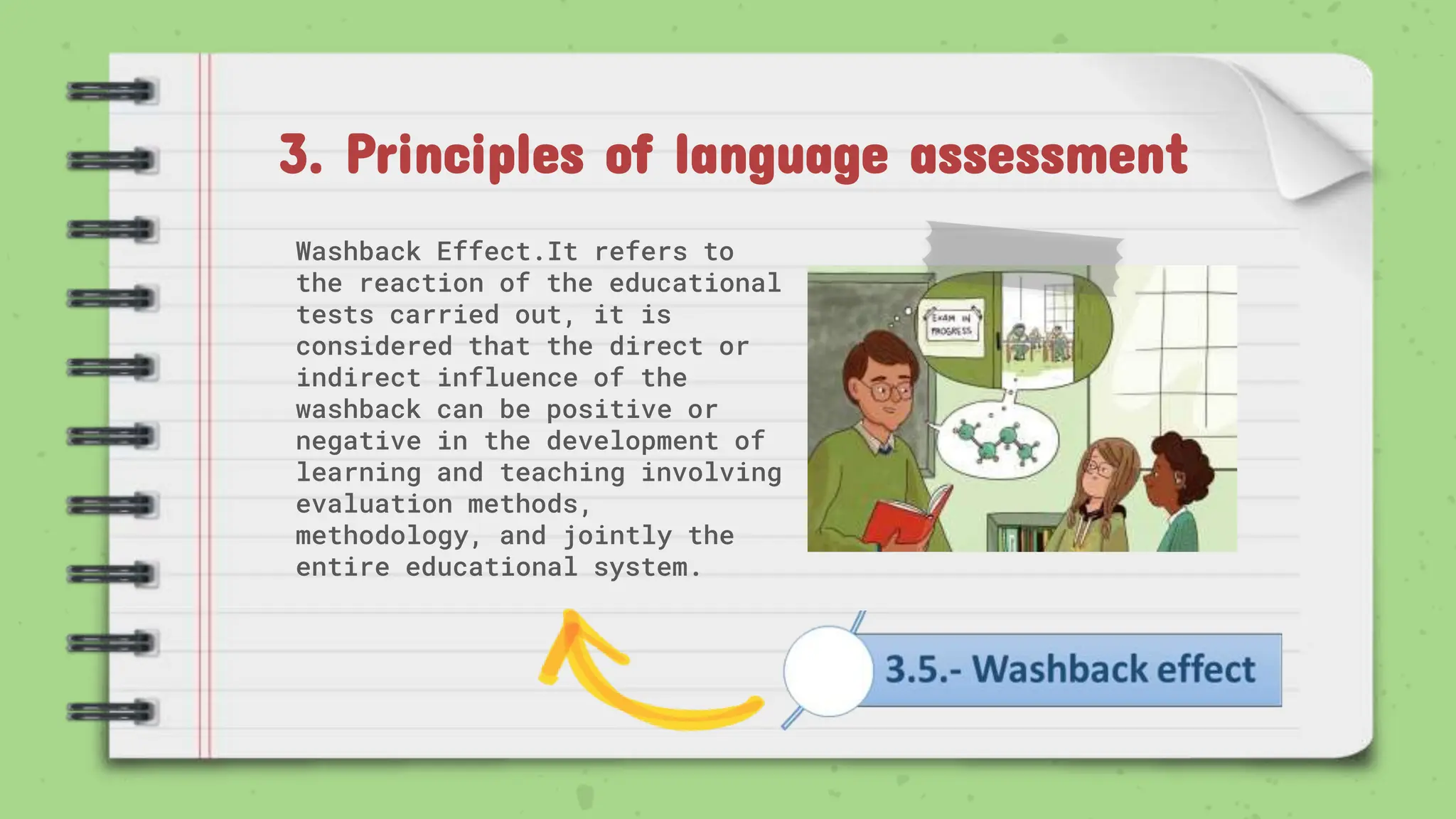
Washback Effect.It refers to
the reaction of the educational
tests carried out, it is
considered that the direct or
indirect influence of the
washback can be positive or
negative in the development of
learning and teaching involving
evaluation methods,
methodology, and jointly the
entire educational system.
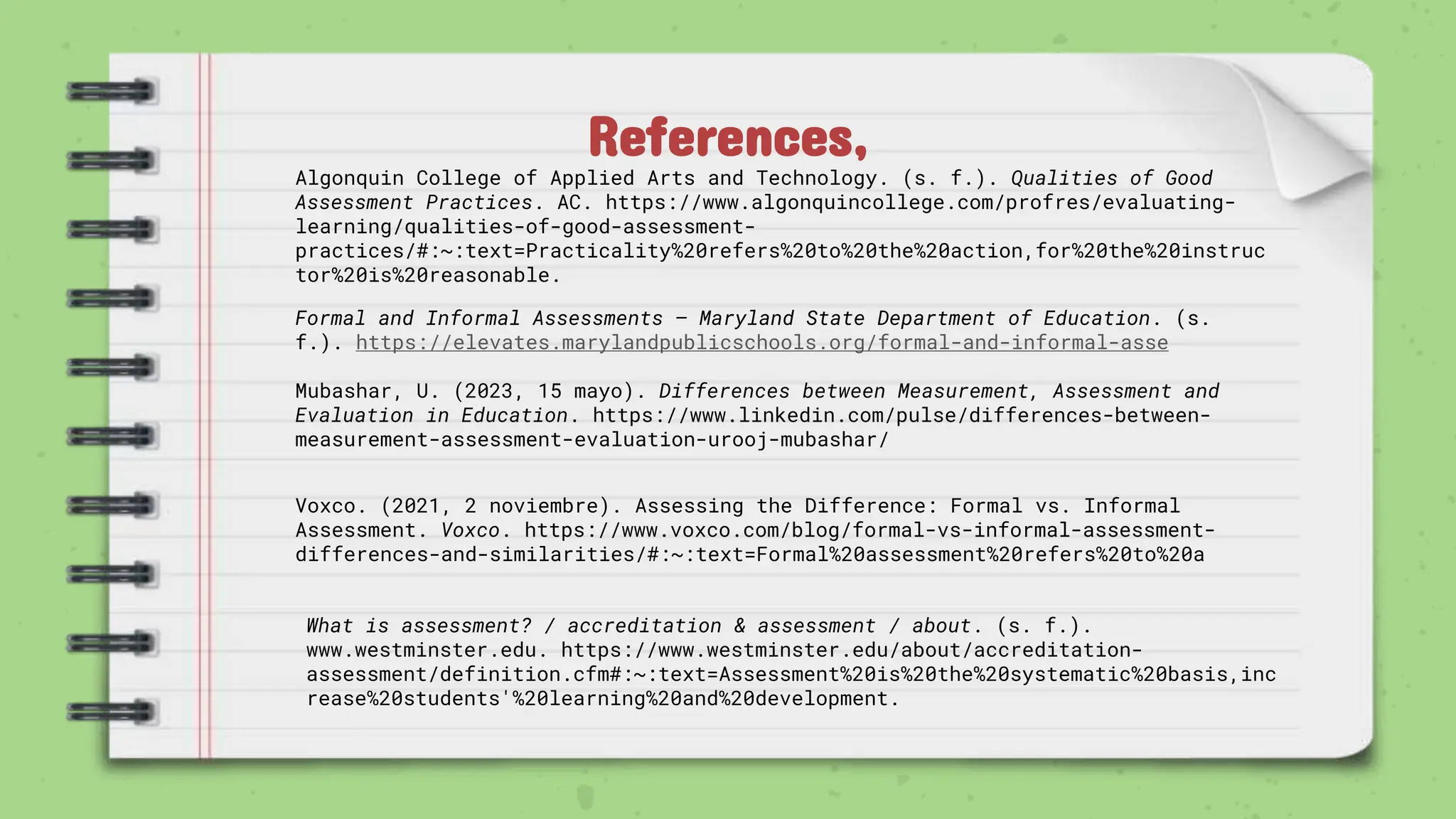
References,
Algonquin College of Applied Arts and Technology. (s. f.). Qualities of Good
Assessment Practices. AC. https://www.algonquincollege.com/profres/evaluating-
learning/qualities-of-good-assessment-
practices/#:~:text=Practicality%20refers%20to%20the%20action,for%20the%20instruc
tor%20is%20reasonable.
Formal and Informal Assessments – Maryland State Department of Education. (s.
f.). https://elevates.marylandpublicschools.org/formal-and-informal-asse
Mubashar, U. (2023, 15 mayo). Differences between Measurement, Assessment and
Evaluation in Education. https://www.linkedin.com/pulse/differences-between-
measurement-assessment-evaluation-urooj-mubashar/
Voxco. (2021, 2 noviembre). Assessing the Difference: Formal vs. Informal
Assessment. Voxco. https://www.voxco.com/blog/formal-vs-informal-assessment-
differences-and-similarities/#:~:text=Formal%20assessment%20refers%20to%20a
What is assessment? / accreditation & assessment / about. (s. f.).
www.westminster.edu. https://www.westminster.edu/about/accreditation-
assessment/definition.cfm#:~:text=Assessment%20is%20the%20systematic%20basis,inc
rease%20students'%20learning%20and%20development.
For your attention

Principles of Language Assessment.Activity 1.

  • 1.
    Principles of Language Assessment Herestarts the lesson! By Hilda Sarco Assessment And Evaluation MSc GONZALEZ DIAZ AMILCAR OSWALDO
  • 2.
    1.- Assessment Terminology Itis a process that evaluates, selects, designs, collects, analyzes, and interprets student learning and development information. Here we will know different terminologies used in the learning of assessments.
  • 3.
    Assessment Terminology “To Assessmentis to make judgments about students’ work, inferring from this what they have the capacity to do in the assessed domain, and thus what they know, value, or are capable of doing”. Joughin 1.1.- Assessment and Testing Testing is a way to evaluate and obtain information about the knowledge acquired by the student in a specific area and time. It helps the teacher to know the student's strengths and weaknesses.
  • 4.
    Assessment Terminology Measurement interpretslearning numerically, as assessments are described and classified by a numerical value, giving a quantitative result and considering that the evaluation makes a qualitative determination of the acquired performance. 1.2.- Measurement and Evaluation Evaluation is the process of analyzing and interpreting information, through a continuous process, with a quantitative assessment of the results of the learning acquired.
  • 5.
    Assessment Terminology A Formal Assessmentis an objective type test that determines what was learned during a certain period, using standardized instruments that provide results of reliability and validity. 1.3.- Formal and Informal Assessment The Informal Assessment method is an assessment in which teachers evaluate the performance and progress of students at various stages of learning, using non- standardized assessments.
  • 6.
    Assessment Terminology 1.4.- Summativeand Formative Assessment Summative Assessment is an evaluation at the end of the school period or a unit and serves to know the degree of knowledge acquired by the students. Formative Assessment do not provide a grade, so students are not fully engaged. However, this evaluation allows students to develop feedback.
  • 7.
    2.- Types andpurposes of assessment It is a process that evaluates, selects, designs, collects, analyzes, and interprets student learning and development information.
  • 8.
    2.1.- Achievement tests Itis a tool that helps measure knowledge of a specific topic in a standardized way that helps us understand the student's academic progress. 2.2.- Diagnostic tests They are tests to analyze progress during the course and that help the teacher and students to identify areas or topics that will have to be reinforced. Types of Assessment
  • 9.
    2.3.- Placement tests Itis a test determined to apply very specific questions on a specific topic, which will result in knowing the student's level of knowledge. 2.4.- Proficiency tests It is a competency test that determines the degree of knowledge and skills of a specific course. Types of Assessment 2.5.- Aptitude tests It is designed to evaluate a person's skills and abilities within a type of education received and their ability to continue acquiring knowledge.
  • 10.
    Achievement tests: To measuretheir students´ ability. Purposes of Assessment Diagnostic tests: Shows the content students need to be working on. Placement tests: Shows the content students need to be working on. Proficiency tests: Made up of several sections where skills are evaluated. Aptitude tests: Provides information about learning styles and learning preferences.
  • 11.
    3. Principles oflanguage assessment
  • 12.
    3. Principles oflanguage assessment It is a test with very specific questions on a precise topic, and the result will indicate the student's level of knowledge. Characteristic: ● The participant must be calm. ● It is a standardized test. ● The method of administration, time and procedure of the test must be considered. ● Ease of interpretation of the test.
  • 13.
    3. Principles oflanguage assessment Reliability is a term that indicates the consistency and stability of the results of a test.
  • 14.
    3. Principles oflanguage assessment Validity refers to the evidence provided about the accuracy and confidentiality arising from the evaluation. It is also defined as the degree to which the instrument measures what it purports to measure.
  • 15.
    3. Principles oflanguage assessment Authenticity. They are tests or tasks that are focused on real situations, which make the student replicate social situations, to establish a connection between the knowledge acquired in class with the student's lived experiences. Generally, carrying out this type of work takes a lot of time and dedication on the part of the student to carry it out and on the part of the teacher to evaluate it
  • 16.
    3. Principles oflanguage assessment Washback Effect.It refers to the reaction of the educational tests carried out, it is considered that the direct or indirect influence of the washback can be positive or negative in the development of learning and teaching involving evaluation methods, methodology, and jointly the entire educational system.
  • 17.
    References, Algonquin College ofApplied Arts and Technology. (s. f.). Qualities of Good Assessment Practices. AC. https://www.algonquincollege.com/profres/evaluating- learning/qualities-of-good-assessment- practices/#:~:text=Practicality%20refers%20to%20the%20action,for%20the%20instruc tor%20is%20reasonable. Formal and Informal Assessments – Maryland State Department of Education. (s. f.). https://elevates.marylandpublicschools.org/formal-and-informal-asse Mubashar, U. (2023, 15 mayo). Differences between Measurement, Assessment and Evaluation in Education. https://www.linkedin.com/pulse/differences-between- measurement-assessment-evaluation-urooj-mubashar/ Voxco. (2021, 2 noviembre). Assessing the Difference: Formal vs. Informal Assessment. Voxco. https://www.voxco.com/blog/formal-vs-informal-assessment- differences-and-similarities/#:~:text=Formal%20assessment%20refers%20to%20a What is assessment? / accreditation & assessment / about. (s. f.). www.westminster.edu. https://www.westminster.edu/about/accreditation- assessment/definition.cfm#:~:text=Assessment%20is%20the%20systematic%20basis,inc rease%20students'%20learning%20and%20development.
  • 18.