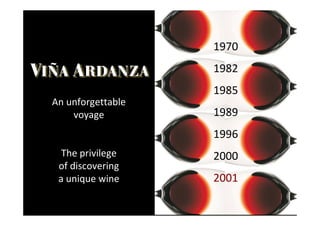
1981

                   1970
                   1982
                          1989
                   1985
An unforgettable
    voyage         1989
                   1996
                          1996
  The privilege    2000
 of discovering
 a unique wine     2001
                          2001
INITIAL CONSIDERATIONS

Unforgettable voyage through seven
SINGULARE vintages of Viña Ardanza,
an EMBLEMATIC wine

The ‘official’ qualification does not coincide
with the result obtained in the winery

All the vintages contain a high percentage of
GARNACHA (20-25%)


We monitor the EVOLUTION of each vintage
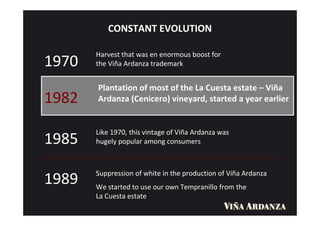
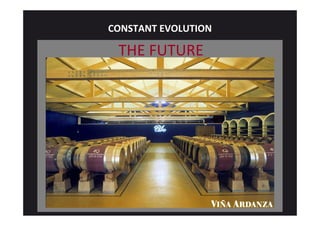
CONSTANT EVOLUTION

       Harvest that was en enormous boost for
1970   the Viña Ardanza trademark

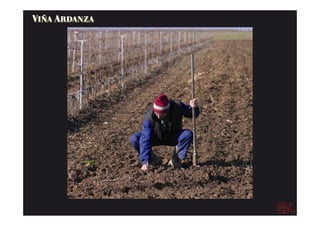
       Plantation of most of the La Cuesta estate – Viña Ardanza
1982   (Cenicero) vineyard, started a year earlier


       Like 1970, this vintage of Viña Ardanza was
1985   hugely popular among consumers


       Suppression of white in the production of Viña Ardanza
1989   We started to use our own Tempranillo from the
       La Cuesta estate
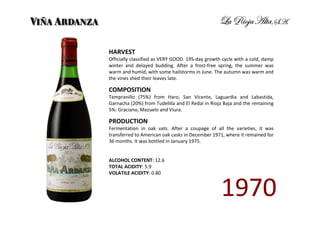
HARVEST
Officially classified as VERY GOOD. 195-day growth cycle with a cold, damp
winter and delayed budding. After a frost-free spring, the summer was
warm and humid, with some hailstorms in June. The autumn was warm and
the vines shed their leaves late.

COMPOSITION
Tempranillo (75%) from Haro, San Vicente, Laguardia and Labastida,
Garnacha (20%) from Tudelilla and El Redal in Rioja Baja and the remaining
5%: Graciano, Mazuelo and Viura.

PRODUCTION
Fermentation in oak vats. After a coupage of all the varieties, it was
transferred to American oak casks in December 1971, where it remained for
36 months. It was bottled in January 1975.


ALCOHOL CONTENT: 12.6
TOTAL ACIDITY: 5.9
VOLATILE ACIDITY: 0.80


                                                  1970
CONSTANT EVOLUTION

       Harvest that was en enormous boost for
1970   the Viña Ardanza trademark


       Plantation of most of the La Cuesta estate – Viña
1982   Ardanza (Cenicero) vineyard, started a year earlier


       Like 1970, this vintage of Viña Ardanza was
1985   hugely popular among consumers


       Suppression of white in the production of Viña Ardanza
1989   We started to use our own Tempranillo from the
       La Cuesta estate
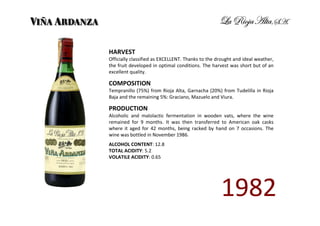
HARVEST
Officially classified as EXCELLENT. Thanks to the drought and ideal weather,
the fruit developed in optimal conditions. The harvest was short but of an
excellent quality.

COMPOSITION
Tempranillo (75%) from Rioja Alta, Garnacha (20%) from Tudelilla in Rioja
Baja and the remaining 5%: Graciano, Mazuelo and Viura.

PRODUCTION
Alcoholic and malolactic fermentation in wooden vats, where the wine
remained for 9 months. It was then transferred to American oak casks
where it aged for 42 months, being racked by hand on 7 occasions. The
wine was bottled in November 1986.
ALCOHOL CONTENT: 12.8
TOTAL ACIDITY: 5.2
VOLATILE ACIDITY: 0.65


                                                   1982
CONSTANT EVOLUTION

       Harvest that was en enormous boost for
1970   the Viña Ardanza trademark


       Plantation of most of the La Cuesta estate – Viña Ardanza
1982   (Cenicero) vineyard, started a year earlier


       Like 1970, this vintage of Viña Ardanza was
1985   hugely popular among consumers

       Suppression of white in the production of Viña Ardanza
1989   We started to use our own Tempranillo from the
       La Cuesta estate
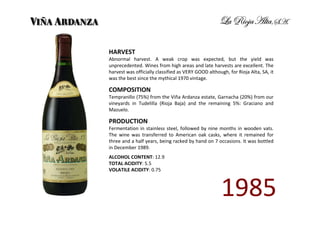
HARVEST
Abnormal harvest. A weak crop was expected, but the yield was
unprecedented. Wines from high areas and late harvests are excellent. The
harvest was officially classified as VERY GOOD although, for Rioja Alta, SA, it
was the best since the mythical 1970 vintage.

COMPOSITION
Tempranillo (75%) from the Viña Ardanza estate, Garnacha (20%) from our
vineyards in Tudelilla (Rioja Baja) and the remaining 5%: Graciano and
Mazuelo.

PRODUCTION
Fermentation in stainless steel, followed by nine months in wooden vats.
The wine was transferred to American oak casks, where it remained for
three and a half years, being racked by hand on 7 occasions. It was bottled
in December 1989.
ALCOHOL CONTENT: 12.9
TOTAL ACIDITY: 5.5
VOLATILE ACIDITY: 0.75


                                                     1985
CONSTANT EVOLUTION

       Harvest that was en enormous boost for
1970   the Viña Ardanza trademark


       Plantation of most of the La Cuesta estate – Viña Ardanza
1982   (Cenicero) vineyard, started a year earlier


       Like 1970, this vintage of Viña Ardanza was
1985   hugely popular among consumers

       Suppression of white in the production of Viña
       Ardanza
1989   We started to use our own Tempranillo from the
       La Cuesta estate
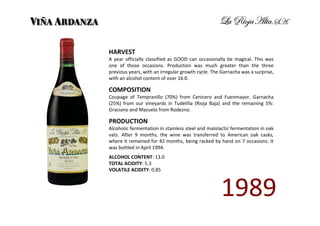
HARVEST
A year officially classified as GOOD can occasionally be magical. This was
one of those occasions. Production was much greater than the three
previous years, with an irregular growth cycle. The Garnacha was a surprise,
with an alcohol content of over 16.0.

COMPOSITION
Coupage of Tempranillo (70%) from Cenicero and Fuenmayor, Garnacha
(25%) from our vineyards in Tudelilla (Rioja Baja) and the remaining 5%:
Graciano and Mazuelo from Rodezno.

PRODUCTION
Alcoholic fermentation in stainless steel and malolactic fermentation in oak
vats. After 9 months, the wine was transferred to American oak casks,
where it remained for 42 months, being racked by hand on 7 occasions. It
was bottled in April 1994.
ALCOHOL CONTENT: 13.0
TOTAL ACIDITY: 5.3
VOLATILE ACIDITY: 0.85


                                                   1989
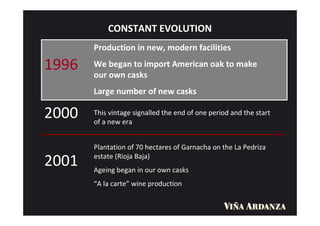
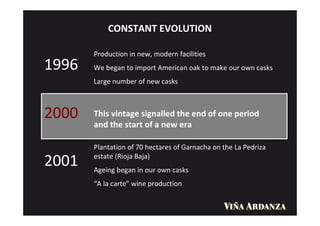
CONSTANT EVOLUTION
       Production in new, modern facilities

1996   We began to import American oak to make
       our own casks
       Large number of new casks

2000   This vintage signalled the end of one period and the start
       of a new era


       Plantation of 70 hectares of Garnacha on the La Pedriza
       estate (Rioja Baja)
2001   Ageing began in our own casks
       “A la carte” wine production
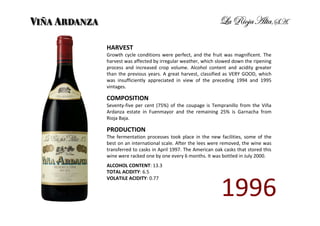
HARVEST
Growth cycle conditions were perfect, and the fruit was magnificent. The
harvest was affected by irregular weather, which slowed down the ripening
process and increased crop volume. Alcohol content and acidity greater
than the previous years. A great harvest, classified as VERY GOOD, which
was insufficiently appreciated in view of the preceding 1994 and 1995
vintages.

COMPOSITION
Seventy-five per cent (75%) of the coupage is Tempranillo from the Viña
Ardanza estate in Fuenmayor and the remaining 25% is Garnacha from
Rioja Baja.

PRODUCTION
The fermentation processes took place in the new facilities, some of the
best on an international scale. After the lees were removed, the wine was
transferred to casks in April 1997. The American oak casks that stored this
wine were racked one by one every 6 months. It was bottled in July 2000.
ALCOHOL CONTENT: 13.3
TOTAL ACIDITY: 6.5
VOLATILE ACIDITY: 0.77


                                                    1996
CONSTANT EVOLUTION

       Production in new, modern facilities
1996   We began to import American oak to make our own casks
       Large number of new casks


2000   This vintage signalled the end of one period
       and the start of a new era

       Plantation of 70 hectares of Garnacha on the La Pedriza
       estate (Rioja Baja)
2001   Ageing began in our own casks
       “A la carte” wine production
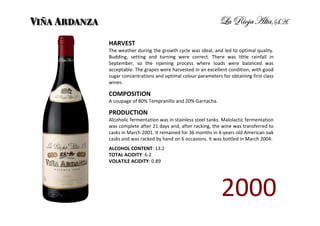
HARVEST
The weather during the growth cycle was ideal, and led to optimal quality.
Budding, setting and turning were correct. There was little rainfall in
September, so the ripening process where loads were balanced was
acceptable. The grapes were harvested in an excellent condition, with good
sugar concentrations and optimal colour parameters for obtaining first class
wines.

COMPOSITION
A coupage of 80% Tempranillo and 20% Garnacha.

PRODUCTION
Alcoholic fermentation was in stainless steel tanks. Malolactic fermentation
was complete after 21 days and, after racking, the wine was transferred to
casks in March 2001. It remained for 36 months in 4-years old American oak
casks and was racked by hand on 6 occasions. It was bottled in March 2004.
ALCOHOL CONTENT: 13.2
TOTAL ACIDITY: 6.2
VOLATILE ACIDITY: 0.89


                                                   2000
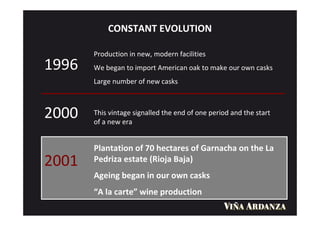
CONSTANT EVOLUTION

       Production in new, modern facilities
1996   We began to import American oak to make our own casks
       Large number of new casks


2000   This vintage signalled the end of one period and the start
       of a new era


       Plantation of 70 hectares of Garnacha on the La
2001   Pedriza estate (Rioja Baja)
       Ageing began in our own casks
       “A la carte” wine production
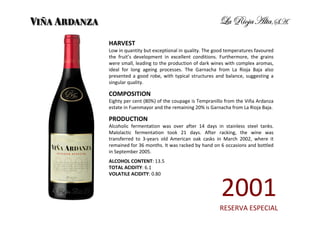
2001
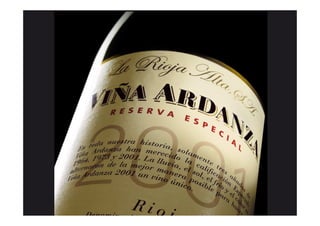
RESERVA ESPECIAL
“Only three vintages of
  Viña Ardanza have ever
 deserved the designation
     ‘Reserva Especial’:
   1964, 1973 and 2001.
 Rain, sunshine, cold and
heat alternated in the best
possible way to make Viña
  Ardanza 2001 a unique
           wine”.
HARVEST
Low in quantity but exceptional in quality. The good temperatures favoured
the fruit’s development in excellent conditions. Furthermore, the grains
were small, leading to the production of dark wines with complex aromas,
ideal for long ageing processes. The Garnacha from La Rioja Baja also
presented a good robe, with typical structures and balance, suggesting a
singular quality.

COMPOSITION
Eighty per cent (80%) of the coupage is Tempranillo from the Viña Ardanza
estate in Fuenmayor and the remaining 20% is Garnacha from La Rioja Baja.

PRODUCTION
Alcoholic fermentation was over after 14 days in stainless steel tanks.
Malolactic fermentation took 21 days. After racking, the wine was
transferred to 3-years old American oak casks in March 2002, where it
remained for 36 months. It was racked by hand on 6 occasions and bottled
in September 2005.
ALCOHOL CONTENT: 13.5
TOTAL ACIDITY: 6.1
VOLATILE ACIDITY: 0.80


                                                  2001
                                                 RESERVA ESPECIAL
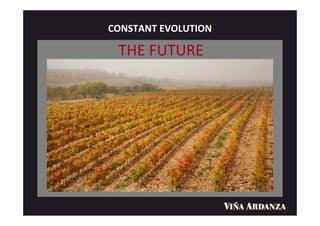
CONSTANT EVOLUTION

 THE FUTURE
CONSTANT EVOLUTION

 THE FUTURE
CONSTANT EVOLUTION

 THE FUTURE
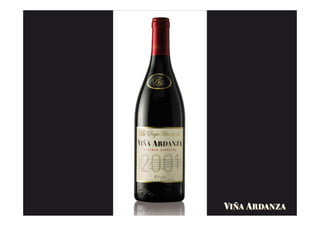
Viña Ardanza 2001 Reserva Especial

Viña Ardanza 2001 Reserva Especial

  • 1.
    1981 1970 1982 1989 1985 An unforgettable voyage 1989 1996 1996 The privilege 2000 of discovering a unique wine 2001 2001
  • 2.
    INITIAL CONSIDERATIONS Unforgettable voyagethrough seven SINGULARE vintages of Viña Ardanza, an EMBLEMATIC wine The ‘official’ qualification does not coincide with the result obtained in the winery All the vintages contain a high percentage of GARNACHA (20-25%) We monitor the EVOLUTION of each vintage
  • 3.
    CONSTANT EVOLUTION Harvest that was en enormous boost for 1970 the Viña Ardanza trademark Plantation of most of the La Cuesta estate – Viña Ardanza 1982 (Cenicero) vineyard, started a year earlier Like 1970, this vintage of Viña Ardanza was 1985 hugely popular among consumers Suppression of white in the production of Viña Ardanza 1989 We started to use our own Tempranillo from the La Cuesta estate
  • 4.
    HARVEST Officially classified asVERY GOOD. 195-day growth cycle with a cold, damp winter and delayed budding. After a frost-free spring, the summer was warm and humid, with some hailstorms in June. The autumn was warm and the vines shed their leaves late. COMPOSITION Tempranillo (75%) from Haro, San Vicente, Laguardia and Labastida, Garnacha (20%) from Tudelilla and El Redal in Rioja Baja and the remaining 5%: Graciano, Mazuelo and Viura. PRODUCTION Fermentation in oak vats. After a coupage of all the varieties, it was transferred to American oak casks in December 1971, where it remained for 36 months. It was bottled in January 1975. ALCOHOL CONTENT: 12.6 TOTAL ACIDITY: 5.9 VOLATILE ACIDITY: 0.80 1970
  • 5.
    CONSTANT EVOLUTION Harvest that was en enormous boost for 1970 the Viña Ardanza trademark Plantation of most of the La Cuesta estate – Viña 1982 Ardanza (Cenicero) vineyard, started a year earlier Like 1970, this vintage of Viña Ardanza was 1985 hugely popular among consumers Suppression of white in the production of Viña Ardanza 1989 We started to use our own Tempranillo from the La Cuesta estate
  • 7.
    HARVEST Officially classified asEXCELLENT. Thanks to the drought and ideal weather, the fruit developed in optimal conditions. The harvest was short but of an excellent quality. COMPOSITION Tempranillo (75%) from Rioja Alta, Garnacha (20%) from Tudelilla in Rioja Baja and the remaining 5%: Graciano, Mazuelo and Viura. PRODUCTION Alcoholic and malolactic fermentation in wooden vats, where the wine remained for 9 months. It was then transferred to American oak casks where it aged for 42 months, being racked by hand on 7 occasions. The wine was bottled in November 1986. ALCOHOL CONTENT: 12.8 TOTAL ACIDITY: 5.2 VOLATILE ACIDITY: 0.65 1982
  • 8.
    CONSTANT EVOLUTION Harvest that was en enormous boost for 1970 the Viña Ardanza trademark Plantation of most of the La Cuesta estate – Viña Ardanza 1982 (Cenicero) vineyard, started a year earlier Like 1970, this vintage of Viña Ardanza was 1985 hugely popular among consumers Suppression of white in the production of Viña Ardanza 1989 We started to use our own Tempranillo from the La Cuesta estate
  • 9.
    HARVEST Abnormal harvest. Aweak crop was expected, but the yield was unprecedented. Wines from high areas and late harvests are excellent. The harvest was officially classified as VERY GOOD although, for Rioja Alta, SA, it was the best since the mythical 1970 vintage. COMPOSITION Tempranillo (75%) from the Viña Ardanza estate, Garnacha (20%) from our vineyards in Tudelilla (Rioja Baja) and the remaining 5%: Graciano and Mazuelo. PRODUCTION Fermentation in stainless steel, followed by nine months in wooden vats. The wine was transferred to American oak casks, where it remained for three and a half years, being racked by hand on 7 occasions. It was bottled in December 1989. ALCOHOL CONTENT: 12.9 TOTAL ACIDITY: 5.5 VOLATILE ACIDITY: 0.75 1985
  • 10.
    CONSTANT EVOLUTION Harvest that was en enormous boost for 1970 the Viña Ardanza trademark Plantation of most of the La Cuesta estate – Viña Ardanza 1982 (Cenicero) vineyard, started a year earlier Like 1970, this vintage of Viña Ardanza was 1985 hugely popular among consumers Suppression of white in the production of Viña Ardanza 1989 We started to use our own Tempranillo from the La Cuesta estate
  • 14.
    HARVEST A year officiallyclassified as GOOD can occasionally be magical. This was one of those occasions. Production was much greater than the three previous years, with an irregular growth cycle. The Garnacha was a surprise, with an alcohol content of over 16.0. COMPOSITION Coupage of Tempranillo (70%) from Cenicero and Fuenmayor, Garnacha (25%) from our vineyards in Tudelilla (Rioja Baja) and the remaining 5%: Graciano and Mazuelo from Rodezno. PRODUCTION Alcoholic fermentation in stainless steel and malolactic fermentation in oak vats. After 9 months, the wine was transferred to American oak casks, where it remained for 42 months, being racked by hand on 7 occasions. It was bottled in April 1994. ALCOHOL CONTENT: 13.0 TOTAL ACIDITY: 5.3 VOLATILE ACIDITY: 0.85 1989
  • 15.
    CONSTANT EVOLUTION Production in new, modern facilities 1996 We began to import American oak to make our own casks Large number of new casks 2000 This vintage signalled the end of one period and the start of a new era Plantation of 70 hectares of Garnacha on the La Pedriza estate (Rioja Baja) 2001 Ageing began in our own casks “A la carte” wine production
  • 20.
    HARVEST Growth cycle conditionswere perfect, and the fruit was magnificent. The harvest was affected by irregular weather, which slowed down the ripening process and increased crop volume. Alcohol content and acidity greater than the previous years. A great harvest, classified as VERY GOOD, which was insufficiently appreciated in view of the preceding 1994 and 1995 vintages. COMPOSITION Seventy-five per cent (75%) of the coupage is Tempranillo from the Viña Ardanza estate in Fuenmayor and the remaining 25% is Garnacha from Rioja Baja. PRODUCTION The fermentation processes took place in the new facilities, some of the best on an international scale. After the lees were removed, the wine was transferred to casks in April 1997. The American oak casks that stored this wine were racked one by one every 6 months. It was bottled in July 2000. ALCOHOL CONTENT: 13.3 TOTAL ACIDITY: 6.5 VOLATILE ACIDITY: 0.77 1996
  • 21.
    CONSTANT EVOLUTION Production in new, modern facilities 1996 We began to import American oak to make our own casks Large number of new casks 2000 This vintage signalled the end of one period and the start of a new era Plantation of 70 hectares of Garnacha on the La Pedriza estate (Rioja Baja) 2001 Ageing began in our own casks “A la carte” wine production
  • 22.
    HARVEST The weather duringthe growth cycle was ideal, and led to optimal quality. Budding, setting and turning were correct. There was little rainfall in September, so the ripening process where loads were balanced was acceptable. The grapes were harvested in an excellent condition, with good sugar concentrations and optimal colour parameters for obtaining first class wines. COMPOSITION A coupage of 80% Tempranillo and 20% Garnacha. PRODUCTION Alcoholic fermentation was in stainless steel tanks. Malolactic fermentation was complete after 21 days and, after racking, the wine was transferred to casks in March 2001. It remained for 36 months in 4-years old American oak casks and was racked by hand on 6 occasions. It was bottled in March 2004. ALCOHOL CONTENT: 13.2 TOTAL ACIDITY: 6.2 VOLATILE ACIDITY: 0.89 2000
  • 23.
    CONSTANT EVOLUTION Production in new, modern facilities 1996 We began to import American oak to make our own casks Large number of new casks 2000 This vintage signalled the end of one period and the start of a new era Plantation of 70 hectares of Garnacha on the La 2001 Pedriza estate (Rioja Baja) Ageing began in our own casks “A la carte” wine production
  • 24.
  • 28.
    “Only three vintagesof Viña Ardanza have ever deserved the designation ‘Reserva Especial’: 1964, 1973 and 2001. Rain, sunshine, cold and heat alternated in the best possible way to make Viña Ardanza 2001 a unique wine”.
  • 30.
    HARVEST Low in quantitybut exceptional in quality. The good temperatures favoured the fruit’s development in excellent conditions. Furthermore, the grains were small, leading to the production of dark wines with complex aromas, ideal for long ageing processes. The Garnacha from La Rioja Baja also presented a good robe, with typical structures and balance, suggesting a singular quality. COMPOSITION Eighty per cent (80%) of the coupage is Tempranillo from the Viña Ardanza estate in Fuenmayor and the remaining 20% is Garnacha from La Rioja Baja. PRODUCTION Alcoholic fermentation was over after 14 days in stainless steel tanks. Malolactic fermentation took 21 days. After racking, the wine was transferred to 3-years old American oak casks in March 2002, where it remained for 36 months. It was racked by hand on 6 occasions and bottled in September 2005. ALCOHOL CONTENT: 13.5 TOTAL ACIDITY: 6.1 VOLATILE ACIDITY: 0.80 2001 RESERVA ESPECIAL
  • 31.
  • 32.
  • 33.